


Many customers making enameled aluminum wire for the first time ask: Can’t I just put it directly on the enameling machine after drawing? Why is annealing necessary in between?
The answer is no. Enameled aluminum wire has even stricter requirements for “softness” than bare aluminum wire. Copper wire has a certain elongation margin after drawing, but aluminum wire doesn’t—the elongation of drawn aluminum wire is only 2–4%. The cyclic tension and winding bending on the enameling machine cause it to break immediately. The annealing process is precisely the prerequisite for continuous production of enameled aluminum wire.
We’ve been in the electrical wire industry for 30 years, and we’ve encountered many pitfalls in the enameled aluminum wire sector. Today, we’ll break down the annealing process, focusing on its connection with the enameling process.
What exactly does annealing do?
In short: It heats the aluminum wire, which has become hard and brittle after cold drawing, to above the recrystallization temperature but below the melting point, holds it at that temperature for a period of time, and then cools it.
Why do we do this?
During the drawing process of aluminum wire, the grains are elongated and the dislocation density skyrockets—a process technically called “work hardening.” The result is increased hardness, but a drastically reduced elongation. Enameling machines use a continuous winding and unwinding process, making tension fluctuations inevitable; a wire that is too stiff cannot withstand this.
Annealing allows the grains to re-nucleate and grow, releasing the internal stress left by cold deformation. The resulting aluminum wire is both soft and tough, able to bend 180 degrees without cracking.
It sounds impressive, but it boils down to three words: softening back to its original state.
For enameled aluminum wire, annealing has an additional task: ensuring a clean surface with appropriate reactivity—it must be free of residual oil (which affects enamel coating adhesion) and excessive oxidation (which would form an alumina powder film, preventing enamel coating from adhering).
Annealing Temperature Window for Enameled Aluminum Wire
| Process State | Temperature Range | Application in Enameled Wire |
|---|---|---|
| Intermediate Annealing (Stress Relief) | 150–250°C | Restores plasticity between multiple drawing passes |
| Full Annealing (O State) | 300–410°C | Most commonly used finished annealing for enameled aluminum wire |
| Overheat Warning Line | >460°C | Coarse grains, enamel coating will not “hold” |
| Aluminum Melting Point | 660°C | Absolutely must not be touched |
The most discussed temperature window in the industry is 300–410°C.
If it’s too low, the grains haven’t grown properly, and the wire is still “half-hard and not soft”—our experienced workers call this “half-cooked rice.” If it’s too high, the grains grow too large, the strength decreases, and “flattening” and “edge-forming” are likely to occur during enameled wire winding.
For example, pure aluminum 1350 alloy used for O-state soft wire (the most common grade of enameled aluminum wire) typically involves a 340–380°C holding time for 1–3 hours. Enameled wire manufacturers are particularly wary of this range when ordering in bulk—over-annealed wire will peel off after a sharp bend at 1× diameter.
Three Most Common Annealing Processes for Enameled Aluminum Wire
1. Continuous Annealing (Online Annealing) — Mainstream for Enameled Aluminum Wire
The most common method for mainstream enameled aluminum wire and fine round aluminum wire (0.1–2.6 mm in diameter).
The aluminum wire exits the wire feeding rack and passes through a long, strip-shaped electric or gas-fired heating furnace, with a constant temperature section typically 3–6 meters long. The wire feeding speed directly determines the holding time—generally controlled between 30 seconds and 3 minutes.
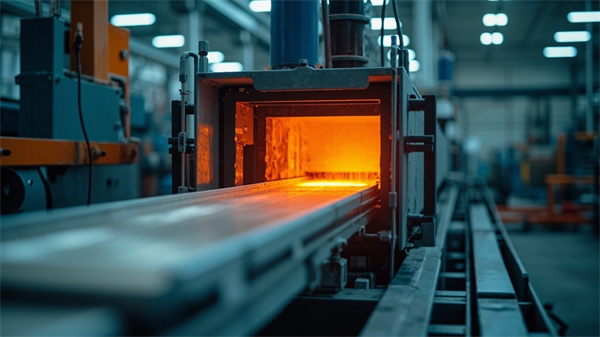
Advantages: High production capacity, good wire diameter consistency, and small footprint.
Pitfalls: Furnace temperature fluctuations exceeding ±10°C can result in inconsistent wire hardness even within the same coil. Therefore, temperature control accuracy is a core KPI for continuous annealing.
For enameled wire, continuous annealing also offers a hidden advantage: the wire goes directly from the annealing furnace into the enameling machine, eliminating the need for secondary wire feeding and avoiding secondary damage. Our factory uses this line for all fine enameled aluminum wire, with a daily capacity of 8 tons per shift.
2. Bell-type / Well-type Furnace Batch Annealing — Large Enameled Aluminum Rods & Alloy Wires
Large aluminum rods (diameter 2.6 mm and above) and aluminum alloy wires (5056, 6061, etc.) undergo this process.
The coiled aluminum wire/rod is suspended into a bell-shaped furnace, evacuated or filled with nitrogen for protection (to prevent oxidation), and heated according to a preset curve—for example, 120°C for 20 minutes → 185°C → 340°C for 2 hours (this is the measured curve of patented process CN103668015A for aluminum alloy cable conductors). It is then cooled in the furnace to below 50°C before being removed.
Advantages: Precise temperature curve, suitable for large specifications, suitable for alloy wires.
Disadvantages: Each furnace takes 8–12 hours; production capacity is limited by the number of furnaces; energy consumption is significantly higher than continuous annealing.
For enameled wire, the aluminum wire from the bell-shaped furnace needs to undergo a final unwinding and surface inspection—good nitrogen protection results in a bright wire surface; inadequate protection results in a “gray wire,” which must be chemically polished or mechanically scraped off before enameling; otherwise, the enameled coating adhesion will be completely ruined.
3. Resistance Annealing (Contact Heating) — Ultra-fine Enameled Aluminum Wire
Ultra-fine enameled aluminum wire utilizes the conductivity of the aluminum wire itself. A large current is passed through the aluminum wire to generate Joule heat, thus completing the annealing process.
This method is commonly used for ultra-fine enameled aluminum wire with a diameter of 0.05–0.5 mm. The current density is controlled at 80–150 A/mm², and the aluminum wire can reach 400°C within a fraction of a second.
Advantages: Extremely fast speed, low energy consumption.
Drawbacks: Requires strict uniformity of wire diameter; a 5% fluctuation in diameter will result in one section being over-burned and another under-burned.
For enameled aluminum wire, the biggest advantage of resistance annealing is short thermal history and no excessive oxidation. However, the cooling section must be protected with nitrogen or argon gas; otherwise, a thick oxide film will have formed on the surface of the aluminum wire by the time it is wound up.
Key Control Points for Enameled Aluminum Wire Annealing
Surface oxidation is the number one enemy of enameled wire annealing. Aluminum begins to oxidize above 300°C. Although the alumina film on the surface is not thick, it reduces the adhesion of the enamel coating. During the production of enameled aluminum wire, the annealing furnace is usually protected with nitrogen, and the oxygen content is controlled below 50 ppm. Our workshop’s actual tests show that when the oxygen content exceeds 200 ppm, the pass rate for the enamel coating winding test drops from 98% to below 70%.
Surface oil stains must be cleaned before annealing. If the lubricant used for drawing is not cleaned before annealing, it will carbonize and seep into the aluminum matrix, forming black spots on the surface. If this is discovered during the enameling process, the entire batch must be reworked. Our factory’s process involves adding an ultrasonic alkaline wash + hot water rinsing + drying after the final drawing stage and before annealing to ensure that the residual oil content on the wire surface is ≤ 5 mg/m².
Take-up tension. The take-up tension of enameled aluminum wire after annealing is 30–50% lower than that of copper wire—aluminum wire is soft, and it deforms under high tension. The winding tension on a continuous annealing line is generally controlled at 5–15 N (corresponding to a wire diameter of 0.3–1.0 mm).
Post-furnace dwell time. If annealed aluminum wire is exposed to air for a long time (more than 30 minutes), the oxide film will thicken to 5–8 nm, making it prone to “pinholes” during enameling. The best practice is to directly feed it into the enameling machine after annealing—this is why enameled wire factories place the annealing furnace and enameling machine in a straight line.
How to Judge Whether the Annealing of Enameled Aluminum Wire Is Done Well
Quick judgment method (workshop): Take a section of aluminum wire and wind it around a 5 mm diameter rod 10 times. If there are no cracks, no burrs, and the loops are close together, it is qualified. Then scratch the wire surface. If you can’t leave a white mark with your fingernail, it is qualified (a white mark indicates that the oxide film is too thick).
Laboratory judgment method: Measure elongation (≥ 20% for O-state enameled aluminum wire rods), conductivity (≥ 63% IACS), and yield strength (typically 30–50 MPa for O-state).
Enameling verification method: Apply 1–2 layers of primer (polyester or polyurethane) directly on the enameling machine, and perform enamel coating winding test, rapid pull test, and softening breakdown test according to GB/T 6109 or IEC 60317 standards. If it passes on the first try, the annealing process is successful.
Microscopic judgment: Metallographic observation shows that O-state enameled aluminum wire rods should have uniform equiaxed grains with a grain size of ASTM 5–7. If fibrous grains elongated along the drawing direction appear, it indicates insufficient temperature or too short a holding time.
International Standards Related to Enameled Aluminum Wire
– IEC 60317 Series — General standards for enameled round aluminum wire. Requirements exist for the elongation, resistance, and enamel coating adhesion of annealed aluminum wire.
– ASTM B609 — Annealed round wire for electrical applications of 1350-O aluminum alloy. Specifies full annealing in the O state, with a minimum conductivity of 63% IACS and a minimum elongation of 20%.
– ASTM B856 — Specification for stranded conductors of annealed aluminum alloy. Requires that the individual filaments be fully annealed before stranding, and the elongation of the entire conductor after stranding should also be ≥ 20%.
– GB/T 6109 — Chinese standard for enameled wire, with specific requirements for aluminum cores.
If your product needs UL certification or wants to enter the North American power market, ASTM B609 and B856 are indispensable; for enameled aluminum wire used in motor windings, IEC 60317 is a basic requirement.
How We Do It
Zhengzhou LP Industry’s enameled aluminum wire annealing is done on two lines:
– Fine enameled aluminum wire (0.1–2.6 mm): Continuous annealing furnace, nitrogen protection (oxygen content ≤ 30 ppm), temperature control accuracy ±5°C, daily capacity 8 tons per shift. Directly connected to the enameling machine after annealing, without intermediate stops or secondary unwinding.
– Large enameled aluminum rods (2.6–7.0 mm) and alloy enameled wire: Bell-type nitrogen protection furnace, 6 tons per furnace, furnace temperature uniformity ±8°C. Loaded onto the enameling machine within 24 hours of furnace exit.
Each batch of finished products undergoes four tests: elongation, conductivity, surface oxidation color difference, and enamel coating adhesion (rapid pull test after primer coating). Test data is provided to the customer along with the batch shipment report.
For specific grades (1350, 5056, 6061, 6101), parameters for continuous annealing furnaces specifically for enameled aluminum wire, or to find out which annealing line your enameled aluminum wire products should use, please contact our technical team directly: