


Inductors are indispensable core components in power electronic circuits, widely used in power supplies, new energy, photovoltaic inverters, charging stations, communication equipment, and other fields. As the core conductive material of inductors, the performance of the winding wire directly affects the inductor’s efficiency, temperature rise, size, and cost.
With the continued high cost of copper and the ever-increasing demand for lightweight materials, the application of aluminum wire in inductors is rapidly expanding. This article provides a systematic technical guide for inductor design engineers and purchasing decision-makers from six dimensions: technical feasibility, design considerations, manufacturing processes, application scenarios, quality control, and selection guidelines.
I. Technical Feasibility of Aluminum Wire in Inductors
1.1 Conductivity
Aluminum has a conductivity of approximately 61% IACS, meaning that for the same cross-sectional area, the resistance of an aluminum conductor is about 60% higher than that of a copper conductor. To achieve the same resistance value as copper wire, the cross-sectional area of aluminum wire needs to be increased by about 1.6 times (the wire diameter increases by about 1.26 times).
In inductor design, by appropriately increasing the cross-sectional area of the aluminum wire, it is entirely possible to achieve the same electrical performance as copper wire. This design compensation is perfectly feasible in most power inductors and filter inductors.
1.2 Thermal Performance
Aluminum has a thermal conductivity of 237 W/(m·K), lower than copper’s 401 W/(m·K). However, in inductors, heat is primarily conducted through the insulation (enamel coating), the core material, and the heat dissipation structure. The thermal conductivity of the conductor itself has a limited impact on overall heat dissipation.
Through reasonable heat dissipation design (such as increasing the heat dissipation area and optimizing the core structure), the temperature rise of aluminum wire inductors can be kept within acceptable limits.
1.3 Lightweight Advantages
Aluminum has a density of only 2.70 g/cm³, approximately 30% of that of copper (8.96 g/cm³). Inductors wound with aluminum wire can be 50-70% lighter than those wound with copper wire. This advantage is particularly important in the following scenarios:
- New Energy Vehicles: Reducing overall vehicle weight
- Aerospace: Strict weight restrictions
- Portable Devices: Reducing transportation and installation costs
- Large Power Inductors: Significantly reducing overall device weight
1.4 Cost Advantage
The raw material cost of aluminum wire is much lower than that of copper wire. For cost-sensitive high-power inductor applications, aluminum wire can significantly reduce manufacturing costs and improve product market competitiveness.
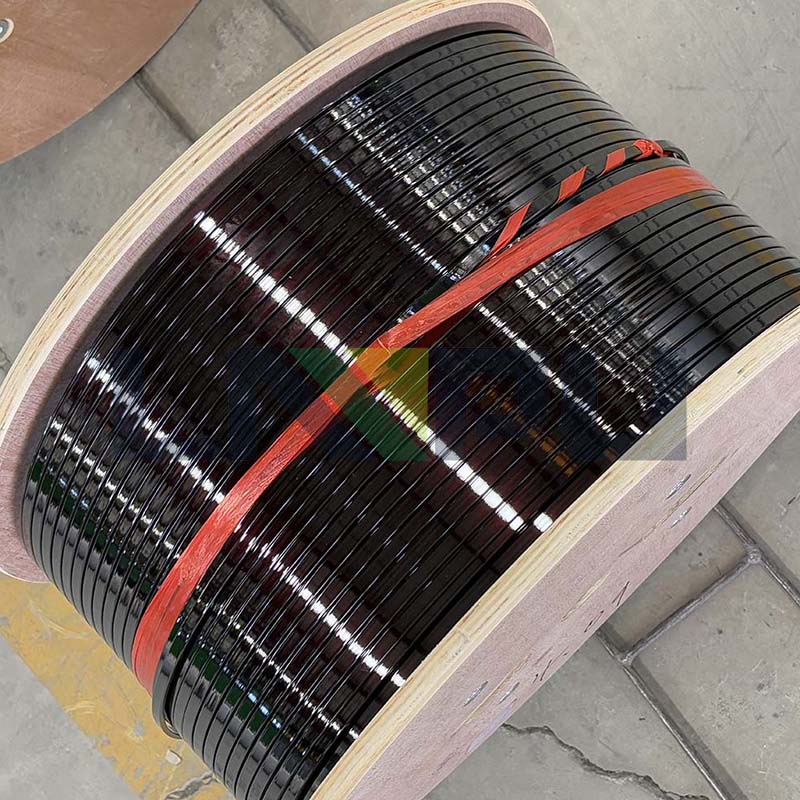
II. Key Points of Inductor Design
2.1 Cross-Sectional Area Compensation
The primary principle of aluminum wire inductor design is cross-sectional area compensation. To achieve the same resistance value as copper wire, the cross-sectional area of aluminum wire needs to be increased by approximately 1.6 times. This means:
- Wire diameter increases by approximately 26%
- Winding volume increases, requiring a larger window area
- Core size may need to be adjusted accordingly
2.2 Insulation Design
The insulation design of aluminum wire inductors is basically the same as that of copper wire inductors, but the following points should be noted:
Insulation Class Selection: Select the appropriate insulation class (Class F/H) according to the inductor’s operating temperature.
Interlayer Insulation: Insulating paper, Nomex paper, or insulating varnish can be used between layers of aluminum wire windings.
End Insulation: The winding ends are weak points in insulation and require reinforced insulation treatment.
2.3 Temperature Rise Control
Temperature rise control is key to aluminum wire inductor design:
Heat Dissipation Design: Improve heat dissipation by increasing the heat dissipation area, optimizing the core structure, and using forced air cooling.
Current Density Control: Set the aluminum wire current density reasonably to avoid long-term overload operation.
Hot Spot Temperature: Monitor the winding hot spot temperature to ensure it does not exceed the heat resistance limit of the insulation material.
2.4 Connection Design
The connection between the aluminum wire and the external copper terminals or copper busbar is a key aspect of aluminum wire inductor design:
Copper-Aluminum Transition Terminals: Use dedicated copper-aluminum transition terminals to avoid electrochemical corrosion caused by direct contact between aluminum and copper.
Ultrasonic Welding: Aluminum wire leads can be connected to copper terminals using ultrasonic welding.
Mechanical Crimping: Large cross-section aluminum wires can be connected using mechanical crimping.
III. Manufacturing Process Key Points
3.1 Winding Process
The winding process for aluminum wire is basically the same as for copper wire, but the following points should be noted:
Tension Control: The tensile strength of aluminum wire is lower than that of copper wire; the winding tension should be controlled within 15-25% of the breaking strength of the aluminum wire.
Bending Radius: The bending radius of the aluminum wire should be appropriately increased to avoid damage to the enamel coating during winding.
Interlayer Insulation: Ensure that the interlayer insulation material is placed correctly during winding, without misalignment or damage.
3.2 Impregnation Process
The impregnation process for aluminum wire inductors is the same as that for copper wire inductors:
Vacuum Pressure Impregnation (VPI): Applicable to power inductors, ensuring the insulating varnish fully penetrates the winding.
Impregnation Time: Determined based on winding size and insulating varnish type.
Curing Temperature: A temperature profile is set based on the curing characteristics of the insulating varnish.
3.3 Assembly Process
Special attention must be paid to contact treatment during the assembly of aluminum wire inductors:
Copper-Aluminum Transition: Use dedicated copper-aluminum transition terminals to avoid electrochemical corrosion.
Fastening Measures: The winding must be fully fastened to prevent displacement due to electromagnetic forces during operation.
Insulation Treatment: Overall insulation treatment is required after assembly to ensure insulation performance.
IV. Application Scenarios
4.1 Power Inductors
Power inductors are the main application areas for aluminum wire:
- Switching Power Supplies: Energy storage inductors in DC-DC converters
- Photovoltaic Inverters: Filter inductors, boost inductors
- Charging Stations: Power factor correction inductors
- Frequency Inverters: DC bus inductors
4.2 Filter Inductors
- EMI Filtering: Common-mode inductors, differential-mode inductors
- Power Supply Filtering: Smoothing DC output
- Harmonic Filtering: Eliminating grid harmonics
4.3 Current Transformers
The application of aluminum wire in current transformers is gradually increasing:
- Advantages: Lightweight, low cost
- Technical Requirements: High accuracy requirements, need to ensure stable winding resistance
4.4 Special Inductors
- Welding Equipment Inductors: High current, high heat dissipation requirements
- Medical Equipment Inductors: High reliability requirements
- Rail Transit Inductors: High vibration environment
V. Quality Control
5.1 Raw Material Inspection
Aluminum Wire Inspection:
- Conductivity: ≥61% IACS
- Wire Diameter Tolerance: ±0.002mm
- Enamel Coating Quality: Breakdown voltage, flexibility, continuity
Insulation Material Inspection:
- Insulating Paper/Nomex Paper: Thickness, breakdown strength
- Insulating Varnish: Viscosity, solid content, curing characteristics
5.2 Production Process Inspection
Winding Inspection:
- Winding Dimensions: Meets design requirements
- Interlayer Insulation: No misalignment or damage
- Contact Quality: Firm welding or crimping
Impregnation Inspection:
- Impregnation Quality: Full penetration of varnish
- Curing Quality: Full curing of enamel coating
5.3 Factory Testing
Aluminum wire inductors must undergo the following tests before leaving the factory:
| Test Item | Requirements |
|---|---|
| Inductance Value Test | Meets design value, deviation ≤±5% |
| DC Resistance Test | Meets design value, deviation ≤±2% |
| Insulation Resistance Test | ≥1000MΩ |
| Withstand Voltage Test | Performed according to standards |
| Temperature Rise Test | Winding temperature rise ≤ insulation class allowable value |
VI. Selection Guide
6.1 Application Scenario Judgment
Scenarios where aluminum wire inductors are preferred:
- Cost-sensitive power supply projects
- Weight-sensitive new energy and aerospace applications
- Conventional applications with moderate current density
- Large-size, high-power inductors
Scenarios where copper wire inductors are preferred:
- Precision applications requiring high efficiency
- Space-constrained applications where winding volume cannot be increased
- High-frequency applications (significant skin effect)
- Harsh environments (high humidity, high corrosion)
6.2 Specifications Confirmation
- Rated current
- Inductance value
- Insulation class: Class F/H
- Connection method: Copper-aluminum transition terminals
6.3 Certification Requirements
Ensure the product meets relevant certification requirements such as UL, IEC, and CE.
Conclusion
The application of aluminum wire in inductors is a mature and economical technical solution. Through reasonable cross-sectional area compensation, insulation design, and heat dissipation optimization, aluminum wire inductors can achieve performance levels comparable to copper wire inductors, while significantly reducing costs and weight.
Aluminum wire inductors are finding increasingly widespread applications in power inductors, filter inductors, and special inductors. Inductor design engineers and purchasing decision-makers should scientifically and rationally select winding materials based on specific application needs, cost budgets, and performance requirements to achieve maximum economic benefits while ensuring product quality.