


In the electrical and motor industries, copper wire has long been the “default option.” However, with fluctuating raw material prices, increasing cost pressures, and the growing demand for lightweighting, aluminum wire is regaining attention. Many people struggle with the choice: How much difference is there between aluminum and copper wire? Is the conductivity really that different? Will using aluminum wire cause problems? Frankly, this isn’t a simple “which is better” question. The answer depends on your specific application scenario, budget constraints, and technical requirements. Today, based on years of industry experience, I’ll systematically discuss the differences in conductivity between aluminum and copper wire, and how to choose in practical applications.
What Exactly Are Conductivity and Resistivity?
Before comparing aluminum and copper wire, we need to clarify a few key concepts.
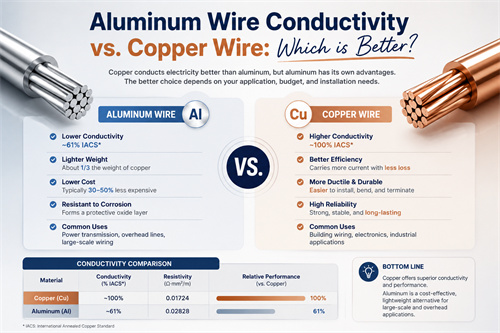
Resistivity: This is an inherent property of the material itself, representing the material’s ability to impede the flow of current. The lower the resistivity, the better the conductivity.
- Copper resistivity: 1.68 × 10⁻⁸ Ω·m (20°C)
- Aluminum resistivity: 2.82 × 10⁻⁸ Ω·m (20°C)
That is, under the same conditions, aluminum’s resistivity is approximately 1.68 times that of copper.
Conductivity: This concept is the reciprocal of resistivity. Copper’s conductivity is approximately 61% that of aluminum—in other words, copper conducts about 61% more electricity than aluminum.
Temperature Rise Effect: Here’s an important detail—temperature affects resistivity. As temperature increases, resistivity also increases. The temperature coefficient of resistivity for most conductors is approximately 0.4%/°C. This means that for every 1°C increase in temperature, resistance increases by about 0.4%.
In actual operation, motors and transformer windings generate heat. Copper and aluminum have slightly different temperature characteristics, but within the temperature range we are concerned with (room temperature to 200°C), their trends are consistent.
How Much Difference Is There Between Aluminum Wire and Copper Wire?
To provide a clearer understanding, I have compiled a detailed data comparison table:
| Parameters | Copper (Cu) | Aluminum (Al) | Differences |
|---|---|---|---|
| Resistivity (Ω·m) | 1.68×10⁻⁸ | 2.82×10⁻⁸ | Aluminum is 1.68 times more resistive than copper |
| Density (g/cm³) | 8.89 | 2.70 | Aluminum is about 70% lighter |
| Melting Point (°C) | 1085 | 660 | Copper is higher |
| Coefficient of Thermal Expansion | 17×10⁻⁶ | 23×10⁻⁶ | Aluminum expands more |
| Tensile Strength (MPa) | 220-470 | 90-190 | Copper is stronger |
| Relative Conductivity (IACS) | 100% | 61% | Aluminum is 61% of copper |
| Price (International Market) | Benchmark | Approximately 1/3 the price of copper | Aluminum is cheaper |
A key point of comparison: To achieve the same resistance value between aluminum and copper wires, the cross-sectional area of the aluminum wire needs to be increased by approximately 64%. Even so, because aluminum’s density is only 30% of copper’s, even with a 64% increase in cross-sectional area, the weight of the aluminum wire is still only about half that of the copper wire.
This is the core advantage of aluminum wire—significantly reducing weight while maintaining similar electrical performance.
Why Is Copper Wire More Conductive?
From an atomic structure perspective, copper’s conductivity is superior to aluminum, mainly for the following reasons:
Higher density of free electrons:
Copper atoms have only one electron in their outer shell, but the bond between this electron and the nucleus is just right—neither too tight, making free movement difficult, nor too loose, allowing for easy scattering. In contrast, although aluminum atoms have three electrons in their outer shell, two of them are tightly bound to the nucleus, leaving only the third electron to participate in conduction relatively freely.
More Stable Crystal Lattice Structure:
Copper’s face-centered cubic crystal lattice structure is more stable under temperature changes. This results in less performance degradation in copper during thermal cycling.
Oxidation Issues:
Aluminum readily forms an aluminum oxide (Al₂O₃) film in air. This oxide film has high resistivity and, if not handled properly, can significantly increase contact resistance. Copper also oxidizes to form copper oxide (Cu₂O), but copper oxide has much better conductivity than aluminum oxide, and the copper oxide film does not continuously thicken like aluminum.
What Are the Real Advantages of Aluminum Wire?
After discussing so many advantages of copper, do you think aluminum wire is useless? Of course not. Aluminum wire has its own unique advantages:
1. Weight Advantage – Approximately 69% Lighter
This is aluminum’s biggest selling point. The value of aluminum wire is evident in applications requiring weight reduction. For example:
- Transformers – Large transformers use tons of copper per unit. Using aluminum wire can reduce weight by 30%-50%.
- Aerospace equipment – Every gram of weight reduction is valuable.
- New energy vehicles – Batteries are already heavy enough; other components should be as lightweight as possible.
2. Cost Advantage – Approximately 1/3 the Cost of Copper
Copper prices fluctuate greatly, putting significant cost pressure on motor and transformer manufacturers. Choosing aluminum wire can significantly reduce costs during periods of high copper prices.
However, it’s important to note that while enameled aluminum wire is cheaper, it may require a larger cross-sectional area to compensate for the difference in conductivity; the overall cost advantage needs careful calculation.
3. Resource Reserve Advantage
Aluminum accounts for approximately 7.5% of the Earth’s crust, while copper accounts for only 0.005%. In the long run, aluminum resource supply is more stable, and price fluctuations are relatively smaller.
Shortcomings of Aluminum Wire: Which Scenarios Should Be Used with Caution?
Aluminum wire is not a panacea; the following scenarios require careful consideration:
1. High-Power Motors
The higher the power of the motor, the higher the operating current. Aluminum wire requires a larger cross-sectional area to compensate for conductivity, which leads to:
- Increased slot fill factor, potentially affecting the overall size of the motor
- Increased end dimensions, requiring a redesign of the motor structure
For industrial motors above 100kW, copper wire remains the mainstream choice.
2. High-Temperature Operating Environments
Aluminum’s melting point is only 660°C, much lower than copper. In extreme high-temperature environments, the mechanical properties of aluminum wire will significantly decrease.
If the operating temperature frequently approaches or exceeds 200°C, copper wire or special high-temperature aluminum wire is recommended.
3. High-Frequency Vibration Scenarios
Aluminum has lower tensile strength and fatigue limit than copper. In equipment with high-frequency start-stop or vibration (such as compressors, vibrating screens, etc.), the service life of aluminum wire may be shorter than that of copper wire.
4. Extremely Compact Designs
If your motor design is accurate to the millimeter, the fact that aluminum wire requires a larger cross-sectional area can cause design difficulties.
How to Choose for Different Scenarios?
Based on years of experience, I have summarized a simple selection comparison table:
| Application Scenarios | Recommended Conductor | Reasons |
|---|---|---|
| Large Power Transformers | Aluminum Wire | Significant weight reduction, controllable cost |
| Small Power Distribution Transformers | Aluminum or Copper Wire | Depends on budget and design |
| General Industrial Motors (>100kW) | Copper Wire | Stable conductivity, high reliability |
| Household Appliance Motors (<10kW) | Aluminum or Copper Wire | Cost sensitive, aluminum wire is feasible |
| Power Tool Motors | Copper Wire or CCA | Frequent start-stop, high reliability requirements |
| New Energy Vehicle Drive Motors | Copper Wire | Strict performance requirements |
| Charging Station Components | Aluminum Wire | Cost optimization is the primary consideration |
| Reactors/Inductors | Aluminum Wire | Size and weight are important considerations |
About Copper-Clad Aluminum Wire (CCA): A Compromise Solution
When discussing aluminum and copper wires, copper-clad aluminum wire (CCA) must be mentioned.
What is copper-clad aluminum wire?
Copper-clad aluminum wire is a composite conductor with an aluminum core and an outer copper cladding. A typical structure has a copper layer that accounts for 5%-10% of the total thickness but covers the entire surface area of the conductor.
Advantages of Copper-Clad Aluminum Wire:
- Retains the lightweight advantage of aluminum
- Copper surface, welding performance is the same as pure copper wire
- Cost is 20%-30% lower than pure copper wire
Limitations of Copper-Clad Aluminum Wire:
- Skin effect – Under high-frequency current, the current mainly flows in the copper layer, and the conductivity contribution of the aluminum core is limited
- Not suitable for high-current applications
- Long-term reliability data is not as comprehensive as pure copper wire
Typical Application Scenarios:
- Audio equipment (high-frequency signal transmission)
- Coaxial cable
- Transformer winding (specific specifications)
Special Treatment Requirements of Aluminum Wire
The connection process is crucial to the quality of aluminum wire. This is where I’ve seen the most people stumble.
Main Challenges in Aluminum Wire Connection:
Aluminum surfaces easily form a high-resistivity aluminum oxide film. This film can cause at the connection point:
- Increased contact resistance
- Localized heating
- Even burnout of the connection point
Correct Handling Method:
Method 1: Mechanical Connection (Recommended)
Use specialized aluminum terminals or cold pressing technology. The key points are:
- The contact surface must be large enough
- The crimping torque must meet the specifications
- Regularly check the connection status
Method 2: Welding (Requires Special Process)
If welding is necessary:
- Use inert gas protection (nitrogen or argon)
- Use dedicated aluminum welding wire
- Strictly control the welding temperature to avoid overheating
Method 3: Use Pre-Tinned Aluminum Wire
Many manufacturers now offer pre-tinned aluminum wire. This type of wire:
- Has a solder coating on the surface
- Can be processed using ordinary soldering processes
- Greatly simplifies the production process
Our factory provides this type of solderable aluminum wire, and customer feedback has been very good.
A word of advice from someone with experience: Aluminum wire is indeed more “delicate” than copper wire when it comes to connections. But as long as the process is correct, reliability is not an issue at all. The worst thing is to directly apply the connection process of copper wire to aluminum wire, resulting in hidden dangers.
How to Calculate Costs? Don’t Just Focus on Material Prices
Many people choose aluminum wire because it’s cheap. But I suggest doing a complete cost calculation before selecting a model.
Cost Factors to Consider:
- Raw Material Costs: Aluminum costs about 1/3 of copper, but the cross-sectional area is 64% larger.
- Processing Costs: Aluminum wire is softer, and cutting and stripping may require different equipment.
- Connection Costs: Aluminum wire connection processes are more demanding, potentially increasing labor time.
- Design Costs: May require adjustments to the overall design of the motor or transformer.
- Transportation Costs: Aluminum wire is lighter, potentially reducing transportation costs.
- Long-Term Maintenance Costs: Considering lifespan and maintenance cycles.
In summary, the overall cost advantage of aluminum wire is approximately 15%-30%, depending on the application and product specifications.