

Should you choose aluminum or copper magnet wire? This is an unavoidable engineering decision in the design of motors, transformers, and induction coils.
Both materials conduct electricity in windings—but their electrical conductivity efficiency, mechanical strength, weight, and cost differ significantly. Selecting the wrong material may result in reduced overall system efficiency at best—or, at worst, budget overruns and mandatory rework.
Below, we compare aluminum magnet wire and copper magnet wire side-by-side, breaking down each key parameter in detail.
I. Fundamental Differences Between Aluminum Magnet Wire and Copper Magnet Wire: A Comparative Analysis of Material Properties
The core of magnet wire is the metallic conductor. Although both copper and aluminum conduct electricity, they exhibit significant differences across five key properties.
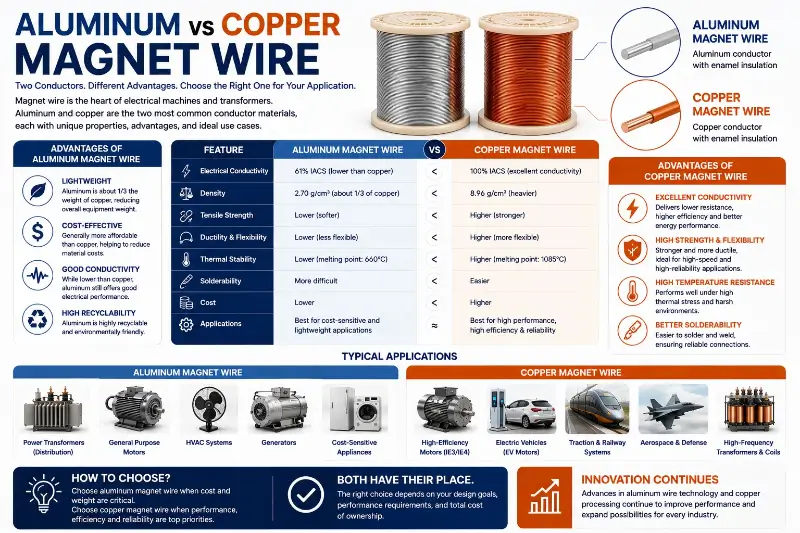
Density: The Key Determinant of Coil Weight
Copper density: 8.96 g/cm³; aluminum density: 2.70 g/cm³ — a difference of 3.3×.
This means that, under identical resistance and identical length conditions, aluminum magnet wire weighs only ~49% of equivalent copper magnet wire. Expressed another way, aluminum wire is 51% lighter than copper wire.
For weight-sensitive applications—such as transformers, wind turbine generators, and traction motors for new-energy vehicles—this advantage is highly tangible.
Electrical Conductivity: The Key Determinant of Coil Resistance
Copper’s volumetric conductivity is 100% IACS (International Annealed Copper Standard); aluminum’s is only 61% IACS. That is, at identical cross-sectional area and length, copper’s resistance is just 61% of aluminum’s.
To achieve equivalent current-carrying capacity, aluminum wire’s cross-sectional area must be increased by 64% relative to copper wire. While this may appear disadvantageous for aluminum, its significantly lower density ensures aluminum retains a decisive weight advantage overall.
Resistivity: The Foundational Principle for Temperature Rise Design
At 20°C, copper resistivity = 1.724 μΩ·cm; aluminum resistivity = 2.654 μΩ·cm. Both increase with temperature, but their temperature coefficients differ: copper = 0.00393/°C; aluminum = 0.0043/°C. Aluminum exhibits a slightly steeper resistivity rise with temperature.
This implies that, in high-temperature environments, aluminum magnet wire experiences faster resistance growth—imposing stricter requirements for temperature rise control.
Tensile Strength: The Determinant of Winding Process Difficulty
Copper magnet wire (annealed/soft temper): tensile strength = 220 MPa; aluminum magnet wire (annealed/soft temper): tensile strength = 90 MPa. Aluminum’s mechanical strength is less than half that of copper.
In practical winding operations, aluminum wire is more prone to surface damage and breakage—especially during high-speed automated winding or under high-tension conditions. Production efficiency is typically 10–20% lower compared to copper wire.
Thermal Conductivity and Coefficient of Thermal Expansion
Copper thermal conductivity = 397 W/(m·K); aluminum thermal conductivity = 237 W/(m·K). Copper dissipates heat more rapidly. In high-power windings, copper magnet wire’s superior thermal conductivity can directly reduce temperature rise by 5–10°C.
Copper coefficient of thermal expansion = 17×10⁻⁶/°C; aluminum coefficient of thermal expansion = 23×10⁻⁶/°C. Aluminum expands more noticeably upon heating—posing higher demands on dimensional stability of windings and slot-fill ratio design.
II. Electrical Performance Comparison: Conductivity, Skin Effect, and Eddy Current Losses
Electrical performance is the primary criterion for magnet wire selection.
DC Resistance and Volumetric Efficiency
DC resistance is primarily determined by conductor cross-sectional area and length. Copper exhibits high conductivity; thus, for the same outer diameter, copper magnet wire has lower DC resistance. For example, the DC resistance of 1.0 mm OD copper enameled wire is approximately 22.4 Ω/km, whereas that of 1.0 mm OD aluminum enameled wire is approximately 36.7 Ω/km—a difference of 64%.
However, aluminum magnet wire can be designed with an enlarged cross-sectional area. For instance, increasing the aluminum wire’s outer diameter from 1.0 mm to 1.27 mm enables its resistance to fall below that of the 1.0 mm OD copper wire. This approach is termed “equivalent-resistance design”—aluminum magnet wire compensates for its lower conductivity by increasing physical dimensions.
Skin Effect and High-Frequency Applications
As current frequency increases, current tends to flow near the conductor surface. At power frequency (50 Hz), the skin depth for copper is ~9.3 mm and for aluminum ~11.7 mm—having negligible impact on conventional AWG 18–32 enameled wires.
However, at frequencies above 20 kHz (e.g., switch-mode power supplies [SMPS], LLC resonant converters, induction heating), the skin depth reduces to ~0.46 mm for copper and ~0.58 mm for aluminum. At these frequencies, utilization of the conductor’s cross-sectional area declines for both materials—the skin-effect advantage of copper diminishes, rendering aluminum viable.
If frequency rises further—to above 100 kHz (e.g., wireless charging, SMPS)—the disparity narrows even more. Nevertheless, copper’s overall eddy current loss remains ~30%–40% lower than that of aluminum.
Eddy Current Losses and Core Loss Interaction
Winding eddy current losses are inversely proportional to resistivity. Due to its lower resistivity, copper incurs lower eddy current losses. In high-frequency motors (e.g., new-energy vehicle traction motors operating at 10–20 kHz PWM), the total core loss + copper loss of copper magnet wire is 15%–25% lower than that of aluminum magnet wire.
This is why virtually all new-energy vehicle traction motors employ copper enameled wire—the efficiency advantage directly translates into extended driving range.
III. Mechanical and Thermal Properties: Winding Process, Temperature Rise, and Reliability
Winding is the critical step transforming magnet wire from raw material into electrical components. Mechanical and thermal properties directly determine yield.
Tensile Strength and Elongation
Copper magnet wire typically exhibits elongation ≥ 25%, whereas aluminum magnet wire ranges from 8% to 15%. Copper wire is less prone to fracture during sharp bending, flattening, or coiling.
Aluminum magnet wire frequently suffers “necking” on high-speed automatic winding machines—e.g., diameter reduction from 1.0 mm to 0.97 mm—resulting in elevated resistance. This necessitates winding tension control at less than half that used for copper wire.
Bendability and Springback
Copper enameled wire permits bending radii as small as 1×D (where D is wire diameter); aluminum enameled wire generally requires ≥ 2×D. Copper wire exhibits low springback, facilitating coil shaping; aluminum wire shows high springback, causing significant variation in stator slot fill factor.
In actual production, aluminum magnet wire windings are more susceptible to defects such as “bulging” and “edge collapse”. Repair costs are high.
Heat Resistance and Temperature Rise
Copper melting point: 1085°C; aluminum melting point: 660°C. Copper’s inherent thermal resistance far exceeds that of aluminum. However, the temperature rating of magnet wire (e.g., Class 130/155/180/200/220/240) is determined primarily by the insulation enamel—not by the conductor itself.
What truly governs temperature rise is heat dissipation—copper’s higher thermal conductivity yields a temperature rise 8–12°C lower than aluminum’s. This difference is a decisive lifetime factor in insulation systems rated H-class (180°C) and above.
Thermal Expansion and Dimensional Stability
Copper coefficient of thermal expansion: 17×10⁻⁶/°C; aluminum: 23×10⁻⁶/°C. Copper offers superior dimensional stability.
In precision motors (e.g., servo motors, stepper motors), thermal expansion of aluminum windings can cause air-gap variations of 0.05–0.1 mm, compromising accuracy. This is one primary reason why servo motors almost never employ aluminum magnet wire.
IV. Weight, Cost, and Economic Comparison
All engineering problems ultimately come down to economics.
Weight Comparison: Practical Differences at Equal DC Resistance
Calculated for identical DC resistance and identical length:
- Copper wire: cross-sectional area A_cu, weight W_cu
- Aluminum wire: cross-sectional area 1.61 × A_cu (due to 64% higher resistivity), but density only 1/3.3 that of copper
Net result: aluminum wire weight ≈ 0.49 × W_cu — i.e., 51% lighter.
For transformer windings (where copper accounts for 30%–40% of total weight), substituting aluminum reduces overall weight by 15%–20%.
Cost Comparison: Unit Price vs. Total Cost of Ownership
2026 spot average prices:
- Copper magnet wire: ~9.5 USD/kg
- Aluminum magnet wire: ~2.5 USD/kg
Aluminum unit price is 74% lower. However, due to its lower density, aluminum weighs less per unit length — resulting in aluminum costing approximately 50% less *per unit of equal resistance*.
But there is a caveat: aluminum magnet wire termination processes are more complex, requiring specialized Cu–Al transition connectors, oxidation-inhibiting coatings, and torque-controlled crimping — increasing termination cost per end by 0.3–0.8 USD versus copper. With 50 terminations per winding, this adds 15–40 USD in termination cost.
Long-Term Reliability and Maintenance
Aluminum magnet wire is more prone to the following under vibration, high temperature, and humid conditions:
- Increased contact resistance (due to insulating Al₂O₃ layer)
- Loose connections
- Terminal corrosion
Consequently, maintenance intervals for aluminum-wound equipment are shortened by 30%–50% compared to copper-wound equivalents. In high-power, long-life applications (e.g., wind turbine transformers, rail traction motors), failure rates of aluminum windings are 2–3× those of copper windings.
V. Advantages of Aluminum Magnet Wire
Lightweight: Core Requirement for Transformers and Large Motors
For power transformers rated above 1 MVA, copper windings can weigh 500–2000 kg. Replacing copper with aluminum reduces weight by 250–1000 kg—directly lowering transportation and lifting costs.
Low Cost: Preferred Choice for High-Volume, Low-Power Applications
In household appliance motors, air-conditioning compressors, and small transformers, aluminum magnet wire costs more than 50% less than copper. Even with marginally lower efficiency, its total lifecycle cost remains advantageous.
Resource Security: Immunity to Copper Price Volatility
Copper prices have historically exhibited high volatility (USD 5.5–11/kg from 2018–2024). In contrast, aluminum prices remain relatively stable (USD 2.0–3.0/kg). For high-volume products sensitive to supply-chain fluctuations, aluminum magnet wire offers greater predictability.
Processability: Easier to Flatten, Emboss, and Strand
Aluminum exhibits superior ductility compared to copper (aluminum elongation: 8%–15%; copper ≥25% in annealed condition). However, aluminum is more commonly used for “embossing” (increasing conductor surface area for high-frequency Litz wire applications).
VI. Disadvantages of Aluminum Magnet Wire
Lower Electrical Conductivity: Larger Cross-Sectional Area Required
Aluminum exhibits 64% higher electrical resistance than copper at the same dimensions. This necessitates increased aluminum wire usage and larger coil volumes.
Lower Mechanical Strength: Challenges for Winding Yield
Aluminum’s tensile strength is only 40% that of copper. High-speed winding easily causes wire thinning or breakage, demanding stringent tension control.
Surface Oxidation: A Hidden Trap in Termination Processes
Aluminum forms an insulating Al₂O₃ layer within seconds of air exposure. Prior to soldering, this oxide layer must be mechanically removed (e.g., by scraping) or chemically disrupted using flux; otherwise, high contact resistance and cold solder joints result.
Higher Thermal Expansion: Incompatible with Precision Coils
Aluminum’s coefficient of thermal expansion is 35% higher than that of copper, adversely affecting dimensional stability in precision coils (e.g., servo motors, precision transformers).
Complex Termination: Higher Joint Cost
Copper–aluminum transition joints (e.g., copper–aluminum welding, ultrasonic welding, torque-controlled bolted joints) cost 3–5× more than pure-copper joints. If process specifications are not strictly followed, joint overheating is a common failure mode.
VII. Advantages of Copper Magnet Wire
Highest Electrical Conductivity: Best Volumetric Efficiency
Copper conductivity is 100% IACS—1.64× that of aluminum. For the same resistance, copper requires less volume, enabling more compact coils and higher equipment power density.
High Mechanical Strength: Preferred for High-Speed Winding
Copper tensile strength is 220 MPa—2.4× that of aluminum. It withstands automated high-speed winding at speeds exceeding 20 m/s, with yield rates >99%.
Rapid Heat Dissipation: Easier Temperature Rise Control
Copper thermal conductivity is 397 W/(m·K), 67% higher than aluminum. In high-power windings, temperature rise can be reduced by 8–12°C, extending insulation service life.
Easy Soldering: Mature Termination Processes
Copper can be directly soldered, crimped, or welded. Its surface does not form an insulating oxide layer. Standard termination processes are well established, minimizing operator training costs.
Long-Term Reliability: Longest Service Life
Copper windings exhibit high reliability under design conditions of 180°C and a 30-year service life. Aluminum windings under identical conditions typically exhibit 30%–50% shorter lifespans.
VIII. Disadvantages of Copper Magnet Wire
High Weight: Not User-Friendly for Mobile Devices
Copper density is 3.3× that of aluminum. In traction motors for new-energy vehicles, portable devices, and drone windings using copper, weight remains an unavoidable burden.
High Cost: Significant Raw Material Price Volatility
Copper price: USD 9–11/kg—3–4× that of aluminum. In volume production projects, raw material cost accounts for 50%–70% of total BOM cost; copper price fluctuations directly impact overall gross margin.
Resource Scarcity: Supply Chain Risk
Copper ore reserves and production are highly concentrated (Chile and Peru account for ~50% of global output). Geopolitical events, labor strikes, and transportation accidents can directly affect pricing.
High-Frequency Eddy Current Losses: Limitations Persist in Ultra-High-Frequency Applications
Skin effect in copper becomes pronounced above 100 kHz. At such frequencies, specialized constructions—e.g., **Litz Wire**, copper foil—are required.
IX. Selection Decision Guide: Application Scenarios vs. Material Mapping
High-Frequency, High-Power-Density, Precision Equipment — Choose Copper
Servo motors, stepper motors, new-energy vehicle traction motors, high-frequency transformers, induction heating coils, and medical MRI magnets. These applications impose stringent requirements on efficiency, precision, temperature rise, and service life—making copper magnet wire the top choice.
Large-Scale Transformers, Low-Cost Household Appliances, Lightweight Applications — Choose Aluminum
Distribution transformers (>500 kVA), wind turbine stator windings, air-conditioner compressors, refrigerator compressors, and washing-machine motors. These applications are highly sensitive to cost and weight—where aluminum magnet wire delivers clear overall advantages.
Hybrid Solutions: Copper–Aluminum Transition & CCA Substitution
Some manufacturers use copper–aluminum transition joints to connect copper terminals to aluminum windings; next-generation copper-clad aluminum (CCA) wire combines copper’s solderability with aluminum’s lightweight advantage. CCA wire has a slightly larger diameter than equivalent copper wire but costs 30%–40% less.
Standards and Certifications
Always verify compliance with the following standards during selection:
- IEC 60317 series (enamel insulation)
- NEMA MW 1000-C (North America)
- ASTM B233 (aluminum conductors)
- ASTM B286 (copper conductors)
- UL 1446 (insulation systems)
Decision Checklist
- Is the application high-frequency (>10 kHz)? Yes → Prioritize copper
- Is it high-power-density? Yes → Copper
- Is weight sensitivity critical? Yes → Aluminum or CCA
- Is budget sensitivity critical (low-power scenarios)? Yes → Aluminum
- Is long service life required (>15 years)? Yes → Copper
- Is the termination process mature? No → Exercise caution with aluminum
- Does the material comply with IEC 60317 / NEMA standards? No → Reject
Ultimately, the copper–aluminum debate has no absolute answer. During design, rigorously balance weight, cost, efficiency, and temperature rise; during selection, consider process maturity, supplier reliability, and long-term maintenance cost. The optimal material depends entirely on how project priorities are ranked.