


Aluminum foil for pouch batteries is not a single product category, but rather a collective term for two types of materials: cathode current collector aluminum foil (inside the cell, carrying the active material) and aluminum laminate film outer packaging (outside the cell, providing barrier and sealing functions). The thickness, purity, and surface treatment of these two types of aluminum foil are entirely different and must not be mixed. Below, we will clarify the selection logic based on the latest market data and application scenarios from 2024 to 2026.
I. Boundaries Between the Two Types of Aluminum Foil
In brief:
- **Current Collector Aluminum Foil** — Thickness of 12–20 μm, purity ≥ 99.45% (1xxx series, such as 1070/1060/1235/1100), located inside the cell, with the cathode active material coated on it.
- **Aluminum Laminate Film** — CPP/AL/PET three-layer composite structure, with the aluminum layer thickness of 30–80 μm, located outside the cell, responsible for oxygen and moisture barrier (moisture vapor transmission rate ≤ 0.05 g/m²·day) and mechanical protection.
Confusing these two categories is a common procurement mistake. For instance, when someone asks “what thickness of aluminum foil is used for pouch batteries”, the answer is “15 μm internally, 40–60 μm aluminum layer externally” — these two belong to entirely different thickness grades.
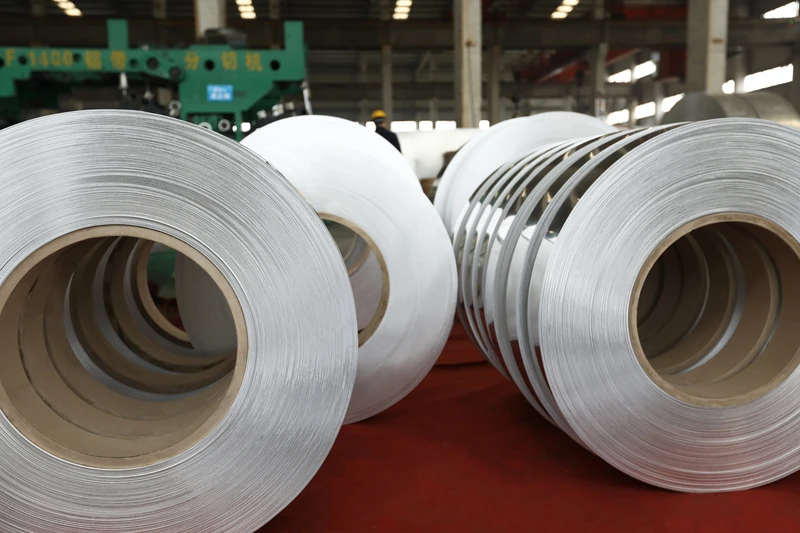
II. Key Specifications and Typical Values
| Category | Thickness (μm) | Alloy/Purity | Tensile Strength (MPa) | Elongation (%) | Surface Treatment |
|---|---|---|---|---|---|
| Current Collector (3C Digital) | 12–15 | 1070 (≥ 99.7%) | ≥ 130 | ≥ 1.5 | Passivation |
| Current Collector (Energy Storage) | 18–20 | 1100 / 1235 | ≥ 170 | ≥ 3 | Double-Sided Carbon Coating |
| Laminate Film Outer Layer (Aluminum Foil) | 30 / 35 / 40 | 8079 / 8021 (≥ 99.0%) | ≥ 80 | ≥ 4 | Passivation + Lamination |
| Laminate Film Aluminum Layer (High-End) | 50 / 60 / 80 | 8079 | ≥ 100 | ≥ 6 | Double-Sided Passivation |
Three figures from the table deserve attention: 15 μm is the current mainstream specification for power battery current collectors (top suppliers such as LandT and MTI all deliver according to this specification); 40 μm is the most common specification for laminate film outer layers; 50–80 μm is mainly used in military and aerospace pouch cells, where the unit price is 2–3 times that of standard specifications.
III. Market Size and Growth
There is significant variation across different estimates. Here we compare five independent data sources together:
| Data Source | 2024 Size (USD Billion) | Forecast Year | Target Size (USD Billion) | CAGR |
|---|---|---|---|---|
| Wise Guy Reports | 22.8 | 2031 | 98.3 | 23.8% |
| Market Growth Reports | 25.4 | 2033 | 163.7 | 23.0% |
| 24chemicalresearch | 30.9 | 2032 | 161.4 | 23.0% |
| SkyQuest | 11.3 (2025) | 2034 | 23.1 | 9.35% |
The discrepancies in estimates primarily stem from whether aluminum laminate film outer packaging is included and whether all segments (3C, power, and energy storage) are covered. Taken together, the 2024 market size ranges from USD 1.2–3.1 billion, and by 2030–2034 it is expected to reach USD 10–16 billion, with a CAGR of 9–24%. Regardless of which estimate is used, aluminum foil for pouch batteries is a fast-growing track, driven by the combined demand from EV power batteries, energy storage stations, and 3C high-energy-density pouch cells.
IV. Application Fields and Selection Logic
- **EV Power Batteries** — Leading pouch solutions from CATL, BYD, and CALB mainly use 15 μm current collectors combined with 40 μm laminate film outer layers. The trend is that 800V high-voltage platforms are migrating toward thinner specifications (12 μm), which demands higher aluminum foil strength.
- **Energy Storage Stations** — Energy storage cells from Sungrow and Hyperstrong prefer 18–20 μm current collectors, emphasizing cycle life of ≥ 6000 cycles, while the laminate film requires greater thickness (50–60 μm) to enhance safety.
- **3C Digital** — Smartphones, tablets, and TWS earbuds have limited battery thickness, so 12 μm current collectors and 30 μm laminate films are mainstream, requiring flexibility superior to that of power batteries.
- **Drones / Power Tools** — For high-rate discharge scenarios, double-sided carbon-coated current collectors are needed (improving conductivity by 30%–50%), with laminate films of 35–40 μm balancing weight and safety.
V. Procurement Notes
1. **Identify the alloy grade clearly** — Use 1xxx series (1070/1060/1235/1100) for current collectors, and 8xxx series (8079/8021) for laminate film outer layers. Mixing them will lead to insufficient ductility or poor welding performance.
2. **Pay attention to surface treatment processes** — Carbon coating thickness (typically 1–3 μm), etching uniformity, and passivation film thickness (≥ 50 nm) directly affect battery cycle life.
3. **Inspection items** — Thickness tolerance, surface roughness Ra, tensile strength, elongation, electrical conductivity (≥ 61% IACS), and appearance (free of pinholes or wrinkles).
4. **Certifications and compliance** — For automotive power batteries, refer to IATF 16949; for energy storage, refer to UL 1973 / IEC 62619; for 3C products, refer to RoHS / REACH.
Final Thoughts
When selecting aluminum foil for pouch batteries, the key is to first determine whether it is the internal current collector or external aluminum laminate film — the two differ in thickness by 3–5 times. For current collectors, focus on alloy purity and surface coating; for laminate films, focus on aluminum layer thickness and barrier performance. In 2024 the market was valued at USD 1.2–3.1 billion, and by 2033 it may exceed USD 16 billion — the track is still expanding rapidly.
If you are evaluating pouch battery aluminum foil suppliers (current collectors or laminate film outer layers), please contact Zhengzhou LP Industry Co., Ltd. Email: office@cnlpzz.com, WhatsApp: 0086-19337889070. We offer direct factory supply with 30 years of metal processing experience and support customized specifications and OEM processing.