


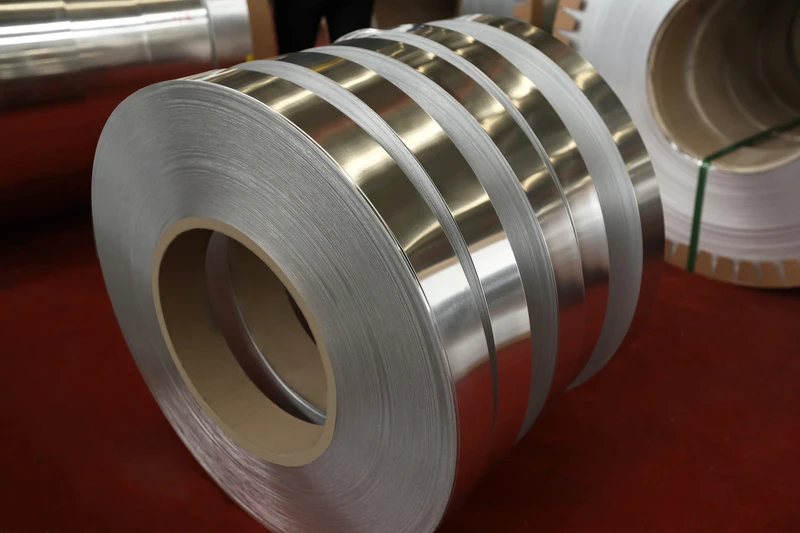
Aluminum foil for DC filter reactors is a key conductive material in DC filter reactor windings. DC filter reactors are important passive filtering components in power electronics systems, primarily used to filter ripple currents and voltages in DC power supplies or DC buses, providing smoother and cleaner DC output.
I. Working Characteristics and Principles of DC Filter Reactors
1.1 Working Principle
Characteristics of the filtering principle DC filter reactors operate on the filtering principle of the inductance. When the component parts of a ripple current is applied to the D.C. supply to produce ripple the ripple current passes through the Reactors winding being resisted by the inductive reactance. The greater the resistive and the higher the ripple frequency the greater number of the inductive reactance. DC filter reactors are generally employed with filter capacitors to comprise LC filter circuits, in which the reactor blocks the ripple current of high frequency and the capacitor opens the ripple current of high frequency with a low impedance.
1.2 Types of DC Filter Reactors
Iron-core DC reactors use iron cores as magnetic paths, offering high inductance and compact size, but with DC bias issues.
Air-core DC reactors have no iron core with air as the magnetic path, offering good linearity and no saturation problems.
Common-mode filter reactors are specifically designed to filter common-mode interference using bi-directional symmetrical winding structures.
1.3 Operating Characteristics
- Wide ripple frequency range: From hundreds of Hz to tens of kHz
- Wide operating current range: From several amperes to hundreds or thousands of amperes
- Prominent temperature rise: Copper losses generate heat, affecting filtering performance
- Strict reliability requirements: Power electronics systems require long-term continuous operation
II. Special Requirements for Aluminum Foil Materials
2.1 Excellent Electrical Conductivity
Pure aluminum 1060: conductivity IACS 59-61%. Pure aluminum 1070: conductivity can reach IACS 61% or higher. Temperature coefficient of resistivity is approximately +0.4% per degree C.
2.2 Excellent Mechanical Properties
Tensile strength: Resists breaking during winding. Elongation: Ensures no brittle fracture during bending. Hardness: O-state is soft, H14 offers balanced processability, H18 is hardest.
2.3 Precise Dimensional Accuracy
Thickness accuracy directly affects inductance values. Width accuracy affects winding fill factor. Thickness uniformity ensures product consistency.
2.4 Excellent Thermal Properties
High-temperature strength: winding temperature can exceed 100 degrees C at full load. Thermal expansion coefficient is approximately 23 x 10 to the power of -6 per degree C.
2.5 Good Corrosion Resistance
Aluminum forms a protective aluminum oxide film in air. Additional anti-corrosion treatment may be needed in humid, saline, or chemically corrosive environments.
III. Specifications
3.1 Aluminum Foil Substrate
- 1060: Al content 99.60% or higher, conductivity IACS 59-61%
- 1070: Al content 99.70% or higher, conductivity IACS 61% or higher
- 3003: Manganese added for higher strength, conductivity IACS 42-50%
3.2 Thickness Selection
- Small power (below 10A): 0.05-0.15mm
- Medium power (10-100A): 0.1-0.3mm
- Large power (100-500A): 0.2-0.8mm
- Extra-large power (above 500A): 0.5-3.0mm
3.3 Mechanical Properties
- O-state (annealed): Tensile strength 55-95MPa, elongation 25% or higher
- H14-state (semi-hard): Tensile strength 95-125MPa, elongation 10% or higher
- H18-state (hard): Tensile strength 125MPa or higher, elongation 2% or higher
3.4 Width Specifications
Common widths: 10mm, 15mm, 20mm, 25mm, 30mm, 40mm, 50mm, 60mm, 80mm, 100mm, with custom widths available.
IV. Selection Guide
4.1 By Power Level
- Small power (below 1kW): Thickness 0.05-0.15mm, material 1060-O/H14 state
- Medium power (1-10kW): Thickness 0.1-0.3mm, material 1060-H14/H18 state
- Large power (10-50kW): Thickness 0.2-0.8mm, material 1060-H18 state
- Extra-large power (above 50kW): Thickness 0.5-3.0mm, material 1060-H18 state
4.2 By Ripple Frequency
- Low frequency ripple (below 1kHz): Thickness 0.1-0.5mm
- Medium frequency ripple (1-20kHz): Thickness 0.05-0.3mm
- High frequency ripple (above 20kHz): Thickness 0.05-0.15mm, multi-strand winding may be required
V. Dimensional Tolerance Requirements
Thickness tolerance: Standard +/-0.02mm to ultra-high precision +/-0.005mm
Width tolerance: Standard +/-0.3mm to ultra-high precision +/-0.05mm
Thickness uniformity: Standard within +/-3% to precision within +/-1%
VI. Production Process (Expanded)
6.1 Production Process Flow
Raw material preparation: High-purity electrolytic aluminum ingots with aluminum content of 99.70% or higher serve as the foundation for quality aluminum foil production.
Smelting and casting: Solid aluminum ingots are melted at high temperatures and then solidified into cast ingots. Precise control of casting temperature, speed, and cooling rate ensures uniform and dense internal structure free from pores and inclusions. Cast ingots require homogenization treatment to eliminate composition segregation.
Hot rolling: Ingots are heated and rolled at temperatures typically between 400-500 degrees C where aluminum has good plasticity and low deformation resistance. Hot rolling reduces ingots to intermediate thickness of 6-10mm while improving internal structure.
Cold rolling: The key process determining thickness precision and surface quality. Multi-pass rolling with 15-30% reduction per pass achieves good plate quality and thickness uniformity. Modern production lines use high-precision AGC (Automatic Gauge Control) systems for real-time thickness monitoring and adjustment.
Annealing: Heat treatment according to product requirements. Full annealing produces O-state foil with best softness; incomplete annealing produces H14 semi-hard state; H18 hard state is achieved through greater cold work hardening.
Slitting: Wide aluminum foil coils are cut to customer-required widths using circular shears or flying shears. Edge quality control is critical to ensure clean, burr-free edges.
6.2 Key Process Control Points
Chemical composition control: Aluminum content must meet standards; impurity elements must be within allowable limits. Large manufacturers use spectrometers to test each heat’s chemical composition.
Thickness uniformity control: The most critical control point. Longitudinal uniformity should be within +/-3%; transverse uniformity within +/-1%. High-precision AGC systems and precise tension control are essential.
Surface quality control: Surface defects like scratches, indentations, oil stains, and oxidation spots affect appearance and performance. Production requires clean rolls, proper lubrication, and clean workshop conditions.
Edge quality control: Burrs and edge chips cause stress concentration leading to breakage. Slitting equipment requires sharp blades, precise clearance, and stable tension control.
6.3 Production and Testing Equipment
Modern aluminum foil production lines include: high-precision cold rolling mills with AGC and AFC systems; batch annealing furnaces or continuous annealing lines; high-precision slitting machines; and various online inspection equipment.
Testing equipment includes: spectrometers for chemical composition; universal testing machines for mechanical properties; eddy current conductivity meters; high-precision thickness gauges; and appearance inspection equipment.
VII. Quality Inspection Methods (Expanded)
7.1 Chemical Composition Inspection
Spectroscopic analysis determines aluminum content and alloying elements including iron, silicon, copper, and manganese. For 1060 aluminum: Al 99.60% or higher, Fe 0.35% or less, Si 0.25% or less, Cu 0.05% or less, Mn 0.03% or less. For 1070 aluminum: Al 99.70% or higher, Fe 0.25% or less, Si 0.20% or less, Cu 0.03% or less.
7.2 Mechanical Property Inspection
Tensile strength and elongation are tested using universal testing machines with strip specimens. O-state: tensile strength 55-95MPa, elongation 25% or higher; H14: 95-125MPa, elongation 10% or higher; H18: 125MPa or higher, elongation 2% or higher. Hardness testing uses Brinell or Rockwell hardness testers.
7.3 Electrical Property Inspection
Eddy current conductivity meters measure conductivity based on electromagnetic induction principles. 1060 aluminum requires IACS 59% or higher; 1070 requires IACS 61% or higher. Resistivity is measured using four-probe method or micro-ohmmeter. Aluminum resistivity at 20 degrees C is approximately 0.0282 ohm per square millimeter per meter.
7.4 Dimensional Inspection
Thickness measurement uses high-precision thickness gauges with 0.001mm accuracy at multiple positions. Width measurement uses steel rulers, vernier calipers, or projectors. Length measurement uses length counters or steel tapes.
7.5 Appearance Inspection
Surface quality inspection checks for scratches, indentations, oxidation spots, oil stains, creases, and delamination. Edge quality inspection checks for burrs, chipped edges, wavy edges, and fin edges. Serious defects should be scrapped; minor defects may be downgraded for less demanding applications.
VIII. Supplier Selection (Expanded)
8.1 Key Evaluation Points
Material quality: Chemical composition should meet standards with stable properties. Suppliers should have complete raw material inspection and process control systems.
Specification range: Excellent suppliers offer various thickness (0.05-3.0mm) and width (10-200mm) specifications with custom capabilities.
Thickness control precision: Ability to achieve +/-0.01mm or tighter tolerances with high-precision AGC systems.
Mechanical property control: Ability to provide various tempers (O, H14, H18) with stable mechanical properties.
Testing capability: Complete inspection equipment including spectrometers, universal testing machines, eddy current meters, and high-precision thickness gauges. Provide complete test reports for each batch.
Production scale: Large-scale production typically offers more stable process control, stricter quality management, and more competitive pricing.
Technical support: Professional selection guidance and technical support for reactor design questions.
Price competitiveness: Competitive pricing while maintaining quality, though price should not be the sole consideration.
Delivery and fulfillment: Standard lead times and ability to handle urgent orders, with good track records.
8.2 Sample Testing Process
Step 1: Dimensional inspection – Measure thickness, width, coil diameter, and coil weight using precision instruments. Check tolerances.
Step 2: Appearance inspection – Visual inspection under adequate lighting for surface and edge defects. Document defect locations, types, and severity.
Step 3: Performance testing – Chemical composition by spectroscopy, mechanical properties by tensile testing, electrical conductivity by eddy current meter.
Step 4: Process testing – Actual or simulated winding tests to check for folding, cracking, or breaking. Bending tests for formed applications. Welding tests for termination quality.
Step 5: Finished product testing – Wind sample inductors and test inductance, DC resistance, and quality factor. Conduct aging or reliability tests if needed.
8.3 Supplier Evaluation and Continuous Monitoring
Supplier evaluation record is built, recording the basicinformation, production capability, testing capability, quality level and service performance. Have routine performance evaluation according to delivery on time, quality passing percentage, and service responding speed. Audits of suppliers (on-site) should be carried out periodically to ensure the continued conformance of procedures of approved suppliers with specified requirements, -such as audits of status of production equipment, testing equipment calibration, process control records and staff qualification. Major suppliers should be audited a minimum of once per year. Set up the quality problem feedback system. Report the problem quickly. Know the reason and demand corrective and preventive actions. Follow up action implementation. Keep the good contact with suppliers for production plan, technical improvement and NPD.
IX. Conclusion
With 30 years of experience exporting electrical wire and metal foil, our company has accumulated extensive expertise in aluminum foil for DC filter reactors. We supply high-quality aluminum foil products for various DC filter reactors to meet different power levels and performance requirements.
Core advantages:
- Multiple aluminum alloy options (1060, 1070, 3003)
- Thickness range 0.05-3.0mm
- Multiple tempers available (O, H14, H18 states)
- Ultra-high thickness precision up to +/-0.005mm
- Excellent thickness uniformity within +/-3%
- Complete test reports for each batch
- Customized specifications and selection support
- Professional technical team support
Contact:
Email: office@cnlpzz.com
WhatsApp: 0086-19337889070