

Imagine a scenario: on the electric drive production line of an automotive parts factory, a drive motor on the test bench has run continuously for 400 hours and the winding thermometer reads 195°C. The workshop foreman holds up the temperature curve and asks us — “At this temperature, how much longer can the Class 150 enameled wire last?”
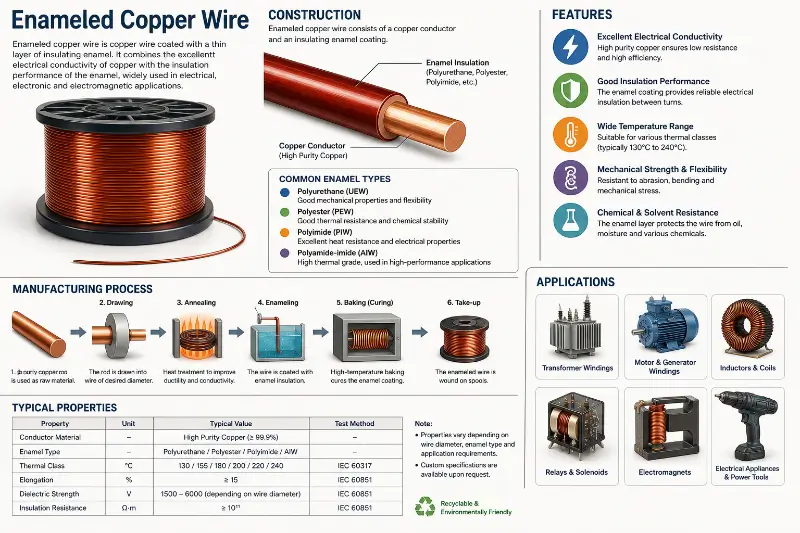
That is where the real value of high temperature enameled copper wire lies. It is not a more expensive substitute; it is a tool that changes the entire logic of winding design. Before going further, one core definition needs to be clear: high temperature enameled copper wire means round copper wire coated with heat-resistant enamel systems such as polyesterimide (EIW), polyamide-imide (PAIW), and polyimide (PI), at thermal class 180°C and above. In essence, it lifts the allowable working temperature limit of the winding up from the conventional 130/155°C, and that is where design freedom comes from. The advantages below are stated in engineering terms so they can be evaluated against your own design envelope.
What Exactly “Thermal Class” Means: Three Temperature Concepts You Should Not Confuse
When many customers first ask about “high temperature enameled copper wire,” what they really want to know is not the material name, but how hot their own winding is allowed to run. Three temperature concepts have to be kept apart here.
The first is the temperature index. This is the material’s nominal life temperature — the temperature at which the enamel can hold its insulation properties over the long term under standard-specified test conditions. In the NEMA MW 1000 system, for example, MW 15-C polyvinyl acetal enameled wire is classified as Thermal Class 105, and MW 53-C polyester with fiberglass covering is classified as Thermal Class 180.
The second is the thermal shock temperature. This is the short-duration transient capability. Our technical documentation for 200-grade polyesterimide-over-polyamide-imide round wire states it plainly: Class 200 requires a minimum temperature index of 200 and a thermal shock temperature of at least 220°C. These two numbers are not the same thing — thermal shock covers conditions such as motor starting, stall, and overload.
The third is the design temperature, and this is the number you actually calculate. Its composition is straightforward:
Design Temperature = Maximum Ambient Temperature + Equipment Temperature Rise + Safety Margin (typically 15–20°C)
The design temperature must sit below the rated temperature of the selected magnet wire, with enough margin left for load swings and extreme conditions.
There is a common trap here: the temperature index is not the recommended operating temperature. Class 180 does not mean you may run the winding at 180°C — that is the temperature index, the baseline for life extrapolation, not a long-term operating temperature. The actual insulation class correspondence is:
| Insulation Class | Temperature Class | Common Coating System |
|---|---|---|
| E | 120°C | Polyvinyl acetal (PEVA) |
| B | 130°C | Polyester (PEW), polyurethane (UEW) |
| F | 155°C | Polyester (PEW), UEW with nylon overcoat |
| H | 180°C | Polyesterimide (EIW) |
| C | 200°C | EIW with PAIW, PAI |
| C+ | 220°C | PAIW, PAI with PI overcoat |
| — | 240°C | Polyimide (PI) |
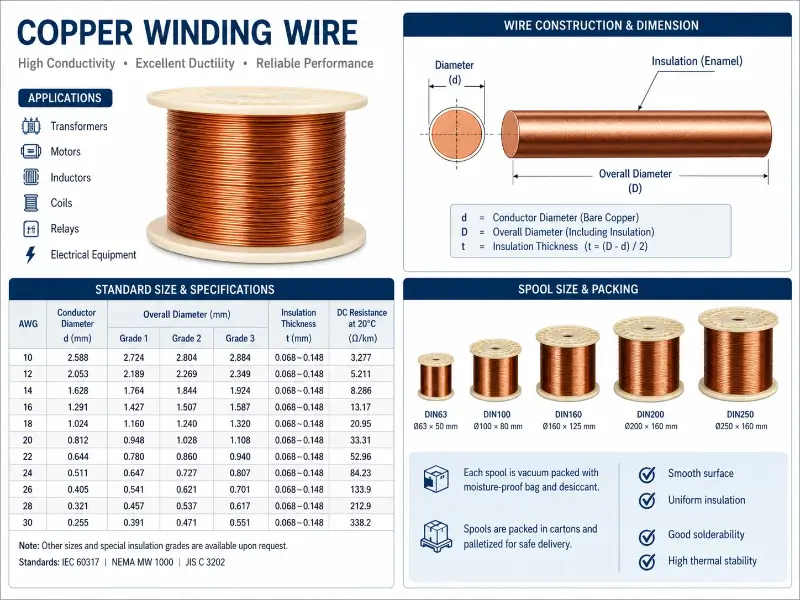
One more confusion worth clearing up: many customers mix up “thermal class” with “enamel grade” (Grade 1/2/3, meaning single, double, and triple coating). These are orthogonal concepts — thermal class describes temperature resistance, while enamel grade describes insulation thickness and dielectric strength. The same enamel can be applied as Grade 1 or Grade 3. Do not treat them as interchangeable.
Advantage 1: Raising the Ceiling on Winding Design Temperature
The most direct benefit of high temperature enameled copper wire is not the vague notion of “more durable,” but a quantifiable degree of design freedom. Every design decision that follows from a higher thermal class starts here.
Motor design runs into one unavoidable equation: temperature rise → losses → efficiency → power density. Copper loss I²R directly determines heat generation, and heat generation in turn limits allowable current. With a standard 155-grade enameled wire, once the winding temperature approaches its ceiling, the engineer has only two options — increase the conductor cross-section (more copper, so the machine gets heavier and more expensive), or add a cooling structure (air cooling becomes water cooling, adding cost and bulk).
Raising thermal class from 155 to 180 lifts the permitted winding temperature by 25°C, which widens the usable current-density range. The same motor can then carry thinner conductors with more turns, achieving a higher slot fill factor and spreading resistance losses over a smaller conductor mass.
Look at the wider chain: thermal class improvement → higher allowable winding temperature → higher current density → smaller conductor cross-section for the same output torque → reduced copper loss and temperature rise → smaller and lighter motor, with efficiency and power density improving together. This is the fundamental reason high temperature enameled copper wire dominates new-energy drive motors — not because manufacturers like chasing new things, but because it lets the motor shrink. That single effect, lower copper loss in a smaller stator, is where most of the commercial value of high temperature enameled copper wire actually lives.
Advantage 2: Efficiency and Power Density Gains from Lower I²R Losses
Putting that chain into concrete numbers makes it far more tangible, and this is where high temperature enameled copper wire changes the bill of materials.
Where slot fill factor is the binding constraint, flat-wire windings can reach over 90% slot fill, while round-wire windings typically land between 70% and 80%. That means for the same stator slot, flat wire accepts a noticeably larger conductor cross-sectional area, and DC resistance drops accordingly.
At the same time, higher-thermal-class enamels have greater mechanical strength, which allows a thinner coating while still meeting the required insulation thickness. A thinner enamel means more conductor fits into the same slot. Combine the two and you get lower winding DC resistance, lower I²R loss, and higher efficiency.
On our own production lines, 180-grade (EIW) enameled wire is the most widely used configuration for new-energy drive motors, while 200-grade (EIW with PAIW) appears more often in high-performance electric drives and compressor motors. The difference is not about which one is “better” — it is about how hot that motor has to run, whether oil cooling is fitted, and what slot fill target the design calls for.
One number is worth remembering: the resistivity of copper is 1.7 μΩ·cm, while aluminium is 2.8 μΩ·cm. That gap is the fundamental reason copper is the preferred conductor in most applications — higher conductivity means a more compact winding and lower resistive loss. High temperature enameled copper wire preserves that conductive advantage under harsher thermal conditions, which is precisely why it is specified wherever copper loss and thermal margin both sit on the critical path.
Advantage 3: Mechanical Durability and Thermal Cycling Resistance
This point is routinely underestimated, yet it is where the most real production-line failures occur — and where high temperature enameled copper wire shows a durability margin that ordinary wire simply cannot match.
Enameled wire goes through a complete sequence of abuse during production: payoff, conductor straightening, winding, in-slot shaping, annealing, insertion, and end-winding shaping. Every one of those steps bends, stretches, and abrades the enamel. Once the enamel cracks, bare conductor is exposed — and you have an inter-turn short.
The advantage of high-temperature enamel systems here comes from the material itself. Our documentation describes polyamide-imide (AIW) as having an extremely hard, smooth surface, with abrasion resistance and tensile adhesion far exceeding ordinary polyester (PEW) and polyesterimide (EIW). That matters a great deal in flat-wire forming and insertion — flat wire must be pre-bent, and the enamel has to survive that repeated bending without cracking.
Thermal cycling resistance is a separate dimension. Data show that, within the same temperature fluctuation range, the thermal fatigue resistance of Class 180 materials is roughly 2–3 times that of Class 130.
This matters most for equipment with frequent start-stop cycles — elevator motors, crane motors, injection moulding machine motors. Their problem is usually not that steady-state temperature is too high, but that repeated hot-cold switching fatigues the enamel until it fails. High temperature enameled copper wire is the usual answer for these cyclic-duty machines.
Advantage 4: Longer Expected Service Life
Expected service life data for high temperature enameled copper wire at rated temperature, taken from published technical literature and stated as expected rather than guaranteed values. For any procurement team weighing a long service interval, this is the number that justifies the specification.
| Thermal Class | Rated Temperature | Expected Life |
|---|---|---|
| Class 200 | 200°C | 30,000–50,000 hours; some premium products exceed 60,000 hours |
| Grade 220 and above | 220–240°C | 50,000–100,000 hours or more, roughly 2–5 times ordinary-grade materials |
Why the spread is so wide? Because the decomposition temperature of polyimide (PI) exceeds 500°C, so during long-term operation at rated temperature the material itself barely degrades chemically.
From a plant maintenance standpoint there is a very practical calculation here. In many factories a substantial share of industrial motors and generators actually run with winding temperatures above 180°C, where traditional insulation systems cannot cope and repairs — sometimes complete machine replacement — become routine. Moving to a PAI/PI system largely removes the winding-life problem from the equation, and for most operators that is where the business case for high temperature enameled copper wire is easiest to justify.
Several influencing factors must be stated clearly, though, because temperature numbers alone are misleading.
Temperature fluctuations often damage life more than steady-state heat. Cold and hot cycling driven by load swings and changing cooling conditions accelerates the initiation and spread of enamel cracks.
Chemical media accelerate ageing. Hydrolytic ageing in humid environments hits highly hygroscopic polyester materials particularly hard, and polyester in transformer oil can swell and deteriorate.
The design temperature must keep its margin. This is the formula stated earlier — design temperature below rated temperature, with 15–20°C of margin. Shorten that margin and the life extrapolation degrades.
Advantage 5: Typical Applications by Thermal Class
A higher thermal class is not automatically better. Each class has its own territory, and the mature engineering correspondences look like this. Choosing high temperature enameled copper wire means picking the lowest class that meets the duty, not the highest class available.
130–155 class (B/F class) — household appliances, power tools, general industrial motors, conventional transformers. Ambient conditions here are mild and loads are stable, so cost dominates the decision.
180 class (H class) — medium-sized industrial motors, wind turbine generators, machine-tool spindle motors, and the mainstream choice for new-energy drive motors. Class 180 is the most widely used thermal class in industry today and represents the cost-performance inflection point.
200 class (C class) — refrigerator compressors, air-conditioning compressors, new-energy vehicle drive motors, and oil-cooled motors. 200-grade EIW with PAIW is the standout composite coating product in the automotive and refrigeration industries: the EIW underlayer delivers high dielectric strength and economy, while the PAIW top layer delivers top-tier mechanical scratch resistance and refrigerant resistance. Structurally, the EIW underlayer typically accounts for roughly 70–80% of the enamel thickness, with the PAIW top layer making up the remaining 20–30%.
220 class (C+ class) — high-performance electric drives, 800V high-voltage platform motors, high-temperature industrial furnace fans, servo motors, and special-purpose industrial motors.
240 class — motors for extreme temperature environments and special operating conditions.
One point deserves emphasis: application and thermal class are not tied one-to-one. For the same electric drive motor, winding temperature can differ by more than 30°C between oil-cooled and naturally cooled configurations, which changes the thermal class requirement completely. Calculate the winding temperature first, then determine the thermal class — that order cannot be reversed.
The Costs: High Temperature Enameled Copper Wire Is Not Cheap
An article that lists only benefits is not credible. Here are the costs that have to be weighed alongside them. Specifying high temperature enameled copper wire without pricing these trade-offs is how projects run over budget.
Cost is the most direct of them. Products at grade 220 and above typically cost 3–5 times those at grade 155. The raw material cost of PAIW and PI already sits far above PEW, and a double coating of EIW with PAIW means two painting passes and two curing stages, adding line takt time and energy consumption.
Mechanical flexibility drops. The harder the enamel, the better the abrasion resistance — and the worse the bending performance. High-grade enamels are more prone to cracking during winding and shaping, a direct trade-off between wear resistance and flexibility. High-temperature wire therefore demands tighter winding process control and better equipment.
Moisture sensitivity rises. PAI enameled wire has a relatively high moisture absorption rate, up to 5%. PI coatings handle moisture better but have weaker adhesion and frequently need a topcoat. Humid applications need their own evaluation.
Solderability is usually sacrificed. The thermal class ceiling of conventional solderable polyurethane (UEW) wire is comparatively low. A 180-grade solderable system depends on a composite of a heat-resistant inner layer and a decomposable outer layer, which makes both the structure and the cost more complicated. If your process relies on in-line tinning, say so at the selection stage.
Rework becomes harder. Low-grade enamels strip fairly readily in a stripping oven, while high-temperature coatings tend to come off by thermal ablation or mechanical means, adding rework labour and material loss.
So the correct posture is not “pick the highest class available.” It is to establish the real upper winding temperature, allow adequate margin, and then select the lowest class that genuinely covers the requirement. Applied properly, high temperature enameled copper wire is an engineering decision with a measurable return — not a specification upgrade.
A Five-Step Selection Path for High Temperature Enameled Copper Wire
Building on the principles above, here is a selection process you can actually run. Every step below exists to make sure high temperature enameled copper wire is specified on evidence rather than on reputation.
Step one: establish the real working temperature. Do not back-calculate it from the nameplate rating. Measure it, or calculate from the worst case: maximum ambient temperature + full-load temperature rise + overload transient peak.
Step two: add the margin to obtain the design temperature. The safety margin is normally 15–20°C, and the design temperature must stay strictly below the rated temperature.
Step three: match the enamel system. For 180°C requirements choose EIW; for 200°C choose EIW with PAIW, which is usually the best cost-performance compromise; above 220°C choose PAI or PAI with PI. Evaluate the specialised requirements at the same time — refrigerant resistance for compressors, oil resistance for transformer applications, chemical resistance, and adhesion.
Step four: check standards and test requirements. The IEC 60317 series and ANSI/NEMA MW 1000 are the principal standard systems. Review the key clauses: no cracks in the enamel after heat shock, thermoplastic flow temperature, springback, breakdown voltage at rated temperature (commonly required at no less than 75% of the room-temperature value), and extractable substance content (≤ 0.5% for Class 200). Select enamel grade, Grade 1/2/3, according to the dielectric strength needed.
Step five: assess supplier capability. This is the step most often skipped, and the one most likely to go wrong. A supplier that cannot document how it coats high temperature enameled copper wire will not be able to tell you what your winding temperature margin really is. Ask whether they hold UL certification, RoHS and REACH compliance reports, and batch traceability; whether their production line covers the enamel system you need, since not every supplier runs an EIW/PAIW composite line; whether they can provide a first-article verification report; and what their lead time and export capability look like.
About LP Industry
Zhengzhou LP Industry Co.,Ltd. has been producing and exporting enameled wire for 30 years, and we are a source manufacturer supplying factories directly. We operate a 60-acre modern production base, hold ISO 9001, ISO 14001, and ISO 45001 certification audited by SGS, and our products meet UL, REACH, and RoHS requirements while conforming to IEC, GB, JIS, and NEMA international standards.
Our products have been exported to more than 50 countries. Specification coverage includes round wire from 0.016 to 7.0 mm and flat wire from 0.8 to 10 mm thick and 2 to 25 mm wide. Main grades and thermal classes are UEW(QA) solderable polyurethane at class 155, PEW(QZ) polyester at class 155, EIW(QZXY) polyesterimide at class 180, and EI/AIW(QZY) polyesterimide over polyamide-imide at class 200, plus the high-temperature series covering classes 200, 220, and 240 in PAIW, PAI, and PI composite systems.
Typical applications span new-energy vehicle drive motors and charging piles, inverter and inverter transformer windings, photovoltaic and energy storage systems, wind turbine generators, air-conditioning and refrigerator compressor motors, servo and stepper motors, high-frequency transformers and inductors, and industrial heating equipment.
Unsure which class to specify? Send us your winding temperature, wire diameter, and coating requirements, and our technical team will come back with a specific thermal class recommendation and a sample plan.
Contact: office@cnlpzz.com | WhatsApp: 0086-19337889070
Final selection should follow the current standard versions and the mutually confirmed technical agreement. Parameters given here are typical values; actual specifications are subject to the product documentation.