

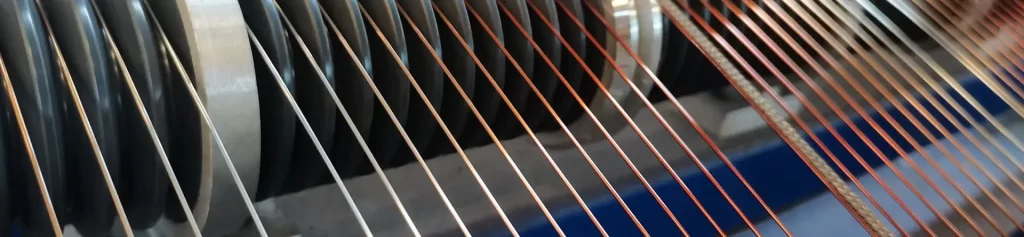
Aluminum magnet wire is one of the important alternative materials to enameled copper wire in the modern electrical industry. With the acceleration of global electrification, the intensification of copper price fluctuations, and the increasing demand for lightweight, aluminum magnet wire has gained more and more extensive attention and application in multiple application fields due to its unique advantages. Aluminum magnet wire refers to a winding wire with electrical aluminum rod as the conductor and insulating enamel film as the insulation layer, which can be used for the winding manufacturing of transformers, inductors, motors, household appliances, and other electrical equipment. Compared with enameled copper wire, aluminum magnet wire has significant advantages in weight, cost, heat dissipation, processability, etc., but also has technical challenges such as lower conductivity, complex connection process, and poor oxidation resistance. This article systematically describes the core technical advantages, performance characteristics, application fields, technical challenges, and selection decision framework of aluminum magnet wire, providing comprehensive technical reference for electrical engineers, procurement personnel, and designers.
Comparison Between Aluminum Magnet Wire and Enameled Copper Wire
Comparison of Basic Physical Properties
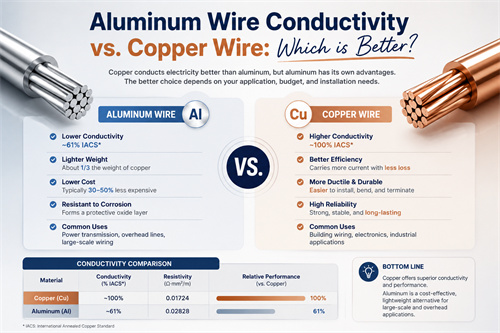
Density: Copper density: 8.96 g/cm³. Aluminum density: 2.70 g/cm³. The density of aluminum is about 30.2% of that of copper, and the weight of aluminum magnet wire at the same volume is about 30% of that of enameled copper wire. Resistivity (20 degrees C): Copper: 0.01724 Ω·mm²/m. Aluminum: 0.02826 Ω·mm²/m. The resistivity of aluminum is about 1.64 times that of copper, which means that at the same resistance, the cross-sectional area of aluminum magnet wire needs to be about 1.64 times that of enameled copper wire. Thermal Conductivity: Copper: about 400 W/(m·K). Aluminum: about 237 W/(m·K). Although the thermal conductivity of aluminum is lower than that of copper, it is still relatively high, which is beneficial to winding heat dissipation. Specific Heat Capacity: Copper: 0.385 J/(g·K). Aluminum: 0.900 J/(g·K). The specific heat capacity of aluminum is about 2.3 times that of copper, meaning that at the same mass, aluminum can absorb more heat, and the temperature rise is slower. Thermal Expansion Coefficient: Copper: 16.5×10^-6 /K. Aluminum: 23.1×10^-6 /K. The thermal expansion coefficient of aluminum is about 1.4 times that of copper, and the expansion difference needs to be considered when the temperature changes.
Comparison of Economics
Raw Material Cost: The price of copper is usually 3 to 5 times that of aluminum, and the price of copper fluctuates greatly. Aluminum reserves are abundant in the earth’s crust, and the price is relatively stable. The use of aluminum magnet wire can significantly reduce the cost of raw materials. Processing Cost: The drawing, annealing, and enamel coating processes of aluminum magnet wire are similar to those of enameled copper wire, and the processing cost difference is not large. The density of aluminum magnet wire is low, and the transportation and storage costs are lower. The processing difficulty of large specification aluminum magnet wire is lower than that of enameled copper wire of the same specification. Full Life Cycle Cost: Aluminum magnet wire has significant advantages in the full life cycle cost of transformers. For weight-sensitive applications (such as new energy vehicles, rail transit), the energy-saving benefits brought by the lightweight of aluminum magnet wire are considerable.
Core Advantages of Aluminum Magnet Wire
Weight Advantage
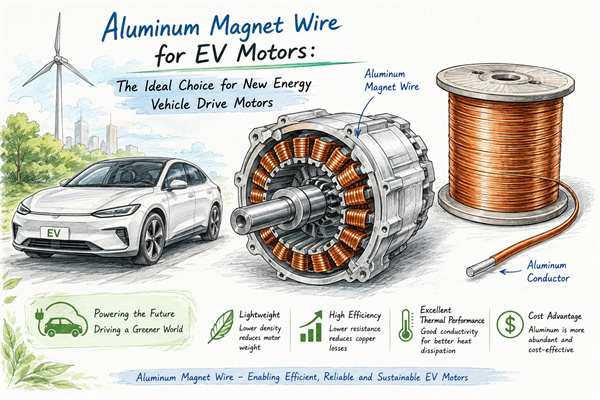
The most significant advantage of aluminum magnet wire is its light weight. Under the same electrical performance, the weight of aluminum magnet wire is about 45 to 55% of that of enameled copper wire (considering the need to increase the cross-sectional area due to the difference in resistivity). This advantage is particularly important in the following applications: New Energy Vehicle Drive Motor: The weight of the motor directly affects the energy consumption and driving range of the vehicle. The use of aluminum magnet wire can significantly reduce the weight of the motor and improve energy efficiency. The application of aluminum magnet wire in the drive motor of new energy vehicles is increasingly popular. Rail Transit Traction Motor: The lightweight of the traction motor has an important impact on the energy efficiency and load capacity of the train. Aluminum magnet wire has application space in the traction motors of subways, light rails, and other rail transits. Aerospace Motor: The aerospace field has extremely stringent requirements for weight. Aluminum magnet wire has application prospects in aircraft motors and auxiliary power systems. Transformer: The number of distribution transformers is huge, and the reduction of the weight of a single unit has significant significance for installation and transportation. Aluminum magnet wire has been widely used in distribution transformers.
Cost Advantage
Material Cost: The price of aluminum is only 1/5 to 1/3 of that of copper. The large-scale use of aluminum magnet wire can significantly reduce the material cost of transformers and motors. The cost advantage of aluminum magnet wire is more prominent when the price of copper is high. Inventory Cost: The inventory cost of aluminum magnet wire is much lower than that of enameled copper wire. Reduce the capital occupied by inventory and improve the efficiency of capital turnover. Transportation Cost: Aluminum magnet wire is light in weight, and the transportation cost is relatively low. For long-distance transportation, the advantage is more obvious.
Heat Dissipation Advantage
High Specific Heat Capacity: The specific heat capacity of aluminum is about 2.3 times that of copper. At the same mass, the aluminum magnet wire winding can absorb more heat. In the case of short-term overload, the temperature rise of the aluminum magnet wire winding is slow. Good Thermal Conductivity: The thermal conductivity of aluminum is 237 W/(m·K), which is lower than that of copper but still at a relatively high level. The heat dissipation performance of the aluminum magnet wire winding is good, which is beneficial to reducing the temperature rise. Heat Dissipation Area Advantage: Due to the higher resistivity, aluminum magnet wire needs a larger cross-sectional area. A larger cross-sectional area means a larger heat dissipation surface, which is beneficial to natural heat dissipation.
Resource and Environmental Protection Advantages
Resource Reserves: The reserves of aluminum in the earth’s crust are about 8.1%, which is the most abundant metal element in the earth’s crust. The reserves of copper are relatively small and unevenly distributed. The resource sustainability of aluminum magnet wire is better than that of enameled copper wire. Environmental Protection Advantages: The recycling rate of aluminum is high, up to more than 95%. The energy consumption of aluminum recycling is only 5% of that of primary aluminum. The application of aluminum magnet wire is in line with the requirements of circular economy and sustainable development. Stable Supply Chain: The global supply chain of aluminum is relatively stable, and the price fluctuation is relatively small. The application of aluminum magnet wire helps to reduce the dependence of the electrical manufacturing industry on the supply of copper.
Technical Challenges of Aluminum Magnet Wire
Electrical Performance Challenges
Lower Conductivity: The conductivity of aluminum is about 61% of that of copper (IACS International Annealed Copper Standard). At the same cross-sectional area, the resistance of aluminum magnet wire is 1.64 times that of enameled copper wire. To achieve the same resistance, the cross-sectional area of aluminum magnet wire needs to be increased to 1.64 times. Countermeasures: Increase the Conductor Cross-Sectional Area: Compensate by increasing the wire diameter or using rectangular wire. Optimize Winding Design: Consider the high-resistance characteristics of aluminum wire in the design. Use Copper Clad Aluminum Wire (CCA): Cover the copper layer on the aluminum core to take into account both cost and connectivity.
Connection Process Challenges
Connection Reliability: The surface of aluminum is easy to form an oxide film (Al₂O₃), which affects the reliability of the electrical connection. The thermal expansion coefficient difference between aluminum and copper is large, and the connection may become loose under the temperature cycle. Welding Difficulty: The welding process of aluminum is more complicated than that of copper. Special flux and special welding equipment are required. Conventional tin soldering is difficult to directly weld aluminum wire. Countermeasures: Use Copper Clad Aluminum Wire (CCA): The external copper layer is easy to weld. Use Aluminum-Specific Connection Terminals: Use aluminum alloy or tin-plated terminals. Use Mechanical Crimping: Crimped connections can avoid welding problems. Use Cold Pressure Welding Technology: Through pressure, aluminum produces plastic deformation and destroys the oxide film.
Mechanical Performance Challenges
Tensile Strength: The tensile strength of pure aluminum is low (soft state about 70 to 100 MPa). The tensile strength can be increased by alloying (such as aluminum-magnesium-silicon alloy). The mechanical properties of aluminum magnet wire are usually lower than those of enameled copper wire. Flexibility: Aluminum has good flexibility and a small bending radius. Aluminum magnet wire is not easy to crack during the winding process. Creep Performance: Aluminum is prone to creep at high temperature, resulting in loose connection. The creep characteristics of aluminum should be considered in the design.
Oxidation Resistance Challenges
Oxidation Problem: Aluminum is chemically active and easy to form an oxide film when exposed to air. The oxide film has poor conductivity and affects the connection performance. Oxidation accelerates at high temperature. Countermeasures: Enamel Film Protection: The insulating enamel film effectively isolates the air and prevents aluminum from being oxidized. Copper Clad Aluminum Wire: The external copper layer prevents aluminum from being oxidized. Plating Treatment: Plate tin or silver on the surface of aluminum to improve oxidation resistance.
Main Application Fields of Aluminum Magnet Wire
Distribution Transformer
Application Status: Aluminum magnet wire is one of the most widely used winding materials in distribution transformers. In small and medium-sized distribution transformers, aluminum magnet wire windings have become dominant. Large power transformers have also partially adopted aluminum magnet wire. Advantage Embodiment: Significantly reduce transformer cost. Reduce the weight of the transformer, and it is convenient for transportation and installation. Meet the economic requirements of the distribution network for transformers. Technical Specifications: The round wire specification of aluminum magnet wire is usually between 0.5 and 5.0 mm. Rectangular aluminum magnet wire is also used in large-capacity transformers. The temperature class of aluminum magnet wire is usually Class 130, Class 155, Class 180.
Motor Winding
Application Fields: Small and medium-sized asynchronous motors. Household appliance motors (air conditioners, washing machines, refrigerators, etc.). New energy vehicle drive motors. Industrial motors. Advantage Embodiment: Reduce motor weight. Reduce motor cost. Meet the dual requirements of household appliances for cost and weight. Typical Application Cases: Household Appliance Motor: A large number of aluminum magnet wires are used, which is the main winding material for household appliance motors. Industrial Motor: Some small and medium-sized industrial motors have begun to adopt aluminum magnet wire. New Energy Vehicle Drive Motor: The application of flat wire aluminum magnet wire is gradually increasing.
Inductors and Reactors
Application Status: Aluminum magnet wire is widely used in small and medium-sized inductors. It is also used in power reactors and filters. Advantage Embodiment: Reduce inductor cost. Good heat dissipation performance is beneficial to the stable operation of the inductor.
New Energy Applications
Wind Generator: Wind generators are sensitive to weight. Aluminum magnet wire is used in the stator winding of wind generators. New Energy Vehicle: New energy vehicle drive motor. The application of aluminum magnet wire in new energy vehicles is growing rapidly. Flat wire aluminum magnet wire technology has become an industry hotspot. Solar Inverter: Inductors and transformers in solar inverters. Aluminum magnet wire has advantages in cost-sensitive applications.
Household Appliances
Air Conditioner Motor: Air conditioner compressor motor, outdoor fan motor, etc. Aluminum magnet wire is the main winding material for air conditioner motors. Washing Machine Motor: Washing machine drive motor. Aluminum magnet wire is widely used in washing machine motors. Refrigerator Motor: Refrigerator compressor motor. The application of aluminum magnet wire in refrigerator motors. Microwave Oven and Induction Cooker: High-frequency transformer and coil. Aluminum magnet wire has certain applications in these applications.
Product Types of Aluminum Magnet Wire
Classification by Shape
Enameled Aluminum Round Wire: The most common aluminum magnet wire product. The specification range is wide, from thin wire to large specification. Suitable for various winding applications. Enameled Aluminum Flat Wire/Rectangular Wire: Suitable for large transformers and motors. High slot fill rate and good heat dissipation performance. It is increasingly widely used in new energy vehicle drive motors.
Classification by Enamel Film
Polyester Enameled Aluminum Wire (PEW): Class 130 or Class 155. Widely used, moderate cost. Polyurethane Enameled Aluminum Wire (UEW): Class 130. Can be directly welded, and it is convenient for processing. Polyester Imide Enameled Aluminum Wire (EIW): Class 180. Excellent heat resistance. Polyamide Imide Enameled Aluminum Wire (AIW): Class 200. Outstanding heat resistance, suitable for high temperature applications. Composite Enamel Film Enameled Aluminum Wire: Polyester imide base layer + polyamide imide surface layer. Excellent comprehensive performance.
Special Aluminum Magnet Wire
Copper Clad Aluminum Enameled Wire (CCA): Copper layer is covered outside the aluminum core. It has both the cost advantage of aluminum and the convenience of copper connection. It is suitable for occasions with high welding requirements. Self-Bonding Enameled Aluminum Wire: Self-bonding enamel is coated outside the conventional enamel layer. After heating and curing, an integral coil is formed. Suitable for special shape windings. Corona-Resistant Enameled Aluminum Wire: Suitable for high voltage motors and transformers. Excellent corona resistance.
Selection Decision of Aluminum Magnet Wire
Selection Principle
Application Scenario Analysis: Clarify the type, capacity, and use of electrical equipment. Analyze the priority of the application for weight, cost, and performance. Electrical Performance Requirements: Clarify the voltage level, current capacity, and temperature rise limit. Calculate the required conductor cross-sectional area. Mechanical Performance Requirements: Consider the requirements of the winding process for flexibility and tensile strength. Consider the influence of the use environment on mechanical properties. Environmental Conditions: Temperature, humidity, chemical media, and other environmental factors. Requirements for the heat resistance and chemical resistance of the enamel film. Economic Evaluation: Comparison of raw material costs. Comparison of processing costs. Full life cycle cost analysis.
Enameled Copper Wire vs Aluminum Magnet Wire Selection Matrix
Scenarios for Prioritizing Enameled Copper Wire: Extremely compact space design. Equipment with extremely high efficiency requirements. Applications with extremely high reliability. High-frequency and high power density equipment. Scenarios for Prioritizing Aluminum Magnet Wire: Weight-sensitive applications (new energy vehicles, rail transit, aerospace). Cost-sensitive applications (household appliances, distribution transformers). Large cross-sectional area windings. Considerations of resource constraints and stable supply chain.
Aluminum Magnet Wire Specification Selection
Determination of Cross-Sectional Area: Calculate the required cross-sectional area according to the current capacity and voltage level. Considering the resistivity difference, the cross-sectional area of aluminum wire is about 1.64 times that of copper wire. Consider heat dissipation and temperature rise limits. Selection of Enamel Film Class: Select the enamel film temperature class according to the working temperature. Reserve a temperature rise margin of 15 to 20 degrees C. Shape Selection: Round Wire: Strong universality, suitable for various windings. Rectangular Wire: High slot fill rate, suitable for large transformers and high power density motors.
Supplier Evaluation
Production Capacity: The production process of aluminum magnet wire is different from that of enameled copper wire. Suppliers should have stable production capacity of aluminum magnet wire. Special enamel coating processes for aluminum should be equipped. Quality Management System: ISO 9001 and other quality management system certifications. Perfect process quality control. Application Experience: Suppliers should have application experience of aluminum magnet wire in related industries. Can provide professional technical support. R&D Capability: Enamel formula R&D capability. Process optimization capability.
Application Development Trend of Aluminum Magnet Wire
New Energy Vehicle Drive
Application Driver: The comprehensive requirements of new energy vehicles for motor power density, energy efficiency, and cost. Flat wire aluminum magnet wire technology has become a popular technology for new energy vehicle drive motors. Technical Progress: The enamel coating process of flat wire aluminum magnet wire is continuously optimized. The production technology of large specification rectangular aluminum magnet wire is constantly improving. The control level of the uniformity of enamel film thickness is improved.
Large Capacity Transformer
Application Driver: Large capacity transformers are sensitive to cost. The application proportion of aluminum magnet wire in large capacity transformers will continue to increase. Technical Challenges: Production of large specification rectangular aluminum magnet wire. Insulation reliability under high voltage. Long-term operation reliability.
High Efficiency Motor
Application Driver: Energy-saving policies promote the popularization of high efficiency motors. Aluminum magnet wire helps to reduce the cost of high efficiency motors. Technical Direction: Improve the electrical conductivity of aluminum magnet wire. Optimize the heat resistance of the enamel film. Improve the connection process.
Intelligent Manufacturing
Technical Application: Intelligent control of the production process of aluminum magnet wire. Online quality monitoring and quality traceability. Digital production process optimization.
Conclusion
As an important alternative material to enameled copper wire, aluminum magnet wire has significant advantages in weight, cost, heat dissipation, resources, and environmental protection. Its weight is only about 30% of that of enameled copper wire of the same specification, the material cost is only 1/5 to 1/3 of that of enameled copper wire, and it has good heat dissipation performance and high resource sustainability. The main technical challenges of aluminum magnet wire include low conductivity, complex connection process, and poor oxidation resistance. By increasing the cross-sectional area, copper-clad aluminum composite structure, special connection process, and other technical means, these challenges can be effectively addressed. The main application fields of aluminum magnet wire include distribution transformers, motor windings, inductors, household appliances, new energy vehicles, etc. In weight-sensitive and cost-sensitive applications, aluminum magnet wire has obvious competitive advantages. The selection decision should be based on the specific application scenario, electrical performance, mechanical performance, environmental conditions, and economic requirements, and comprehensively evaluate the advantages and disadvantages of aluminum magnet wire and enameled copper wire. In the fields of new energy vehicle drive motors, distribution transformers, and household appliance motors, the application proportion of aluminum magnet wire will continue to increase. With the continuous progress of enamel coating process, connection technology, and composite material technology, the performance of aluminum magnet wire will be further improved, and the application field will be further expanded. Aluminum magnet wire manufacturers should keep up with the development trend of the electrical industry, continuously optimize product performance and application solutions, and provide strong support for the lightweight, low-cost, and sustainable development of the electrical industry.