

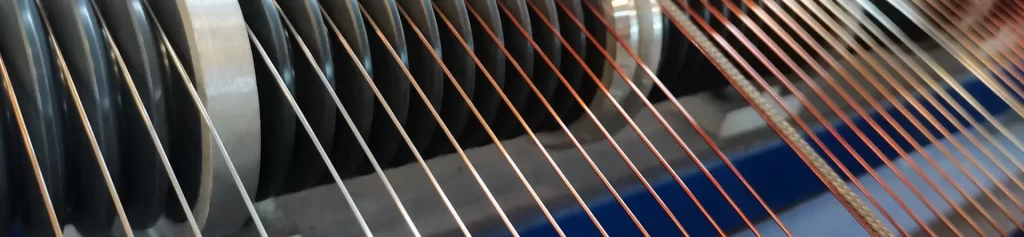
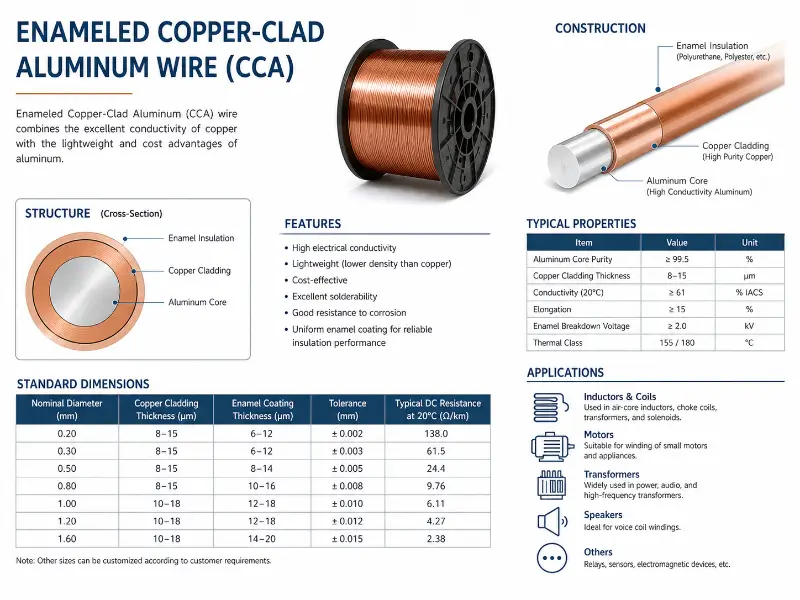
If you have ever handled a piece of enameled copper clad aluminum wire and carefully peeled back the outer coating, you will have seen this structure: a silvery-white aluminum core on the inside, a uniform copper layer in the middle, and the colored or brown enamel film on the outside.
Three layers. It looks simple. But turning an aluminum rod into a machine-ready coil of enameled copper clad aluminum wire involves more process steps than most people imagine.
This article walks through the route in order. No sales pitch, just what each step does, why it is done that way, and what goes wrong when the whole batch has to be scrapped.
What Enameled Copper Clad Aluminum Wire Actually Is
Let us settle the structural definition first, because every subsequent process depends on it.
Enameled copper clad aluminum wire is built on a copper clad aluminum core (CCA): a conductor-grade aluminum core with a continuous outer copper layer. Copper and aluminum are bonded at the atomic level into a single body whose interface can carry mechanical load and electrical current at the same time.
This is a different product from copper-plated aluminum, and the difference matters:
- Cladding: Pressure and heat cause solid-state diffusion between the two metals, so copper and aluminum atoms interdiffuse across the interface and form a metallurgical bond. When the wire is broken, the interface does not separate.
- Plating: Relying on electrochemical deposition, copper atoms grow layer by layer on the aluminum surface, and the bonding depends on adhesion rather than diffusion.
The test is direct: bend the wire repeatedly in opposite directions until it breaks and look at the interface. Delamination means plating. No delamination means cladding.
Every process decision that follows in this production process of enameled copper clad aluminum wire is, in the end, a decision about that one interface.
Why Anyone Would Use Copper Clad Aluminum Instead of Pure Aluminum or Pure Copper
These performance numbers determine where the material makes economic sense.
Conductivity: The overall conductivity of enameled copper clad aluminum wire is approximately 61% or more of a pure copper conductor of the same cross-sectional area. That sounds like a weakness, but flip the comparison around: it is far better than pure aluminum. Pure aluminum itself is only about 61% as conductive as pure copper.
Strength: The copper layer supplies the mechanical strength, which is much better than pure aluminum. The elastic modulus of aluminum is only about 55% of copper and its tensile strength about 40%, so pure aluminum wire tends to stretch plastically during winding, lead insertion and terminal crimping.
Connection reliability: This is the fundamental reason copper clad aluminum is used in huge volumes for speaker cable, signal cable and automotive harnesses. The aluminum oxide film melts at roughly 2050°C, ordinary flux cannot touch it, and pure aluminum is close to hopeless for terminals. The copper layer can be soldered and crimped directly, and terminal reliability is essentially the same as with copper wire.
Cost and weight: Enameled copper clad aluminum wire is cheaper than pure copper, and about 56% of the weight of pure copper at a 20% copper volume fraction.
In short, copper clad aluminum balances the gap between cheaper-than-copper and more-usable-than-aluminum. It is not a universal replacement. But where cost sensitivity, soldering reliability and less-than-full-load conductivity are the requirements, it is a very reasonable choice.
Composite Billet Manufacturing: Seven Technical Routes
This is the heart of the production process, and it decides whether the copper-aluminum interface of the finished enameled copper clad aluminum wire will truly bond.
Industry uses seven main composite methods, each with a different interface bonding mechanism, cost profile and applicable wire diameter range. Whichever route is chosen, the output of this stage of the production process is the same thing: a composite billet whose copper-aluminum interface is already strong enough to survive the drawing that follows.
Electroplating for Enameled Copper Clad Aluminum Wire
The copper layer is formed by electrochemical deposition onto the aluminum substrate.
The critical control points are plating adhesion and thickness uniformity. Aluminum carries a natural oxide film, so plating directly onto it gives poor adhesion, which is why the surface must be activated beforehand. The advantages are precise control of copper thickness and manageable cost. The disadvantage is that adhesion is weaker than a metallurgical bond, so the bond degrades under prolonged thermal cycling.
Suited to medium and fine diameters where extreme bonding strength is not required. Electroplated enameled copper clad aluminum wire is common in signal and audio cable, where cost matters more than thermal cycling durability.
Cold Pressure Welding Cladding
At room temperature, high mechanical pressure makes the copper strip and aluminum core deform plastically and bond together.
The mechanism is the cold-welding effect under pressure: the contact surfaces are forced to within atomic spacing and simply adhere. No heating is involved and the copper-aluminum ratio is precisely controlled. The drawback is the tonnage required by the equipment, which limits the achievable diameter.
Hot Roll Cladding of Copper Clad Aluminum
The copper-aluminum interface is joined by diffusion bonding through rolling at elevated temperature.
Temperature has to be controlled tightly. Too high and both copper and aluminum oxidize, which destroys the bond; too low and diffusion stays incomplete, leaving the interface effectively hollow.
Clad Extrusion for Copper Clad Aluminum Wire
The copper tube is formed around the aluminum core and the assembly is then extruded together, with the die forcing the interface into intimate contact.
This is one of the mainstream industrial routes. The advantages are continuous production, high throughput and a large bonded interface area.
Hydrostatic Extrusion for Copper Clad Aluminum Wire
High-pressure fluid assists the simultaneous deformation and bonding of copper and aluminum.
This suits high-precision composite wire and produces the highest quality composite interface of the available methods. The process window is narrow and the capital investment is heavy, but the interface quality is the best of the seven.
Roll Press-Cladding Method for Copper Clad Aluminum
The copper strip and aluminum core wire are paid off simultaneously, heated, and then pressed by rolls so that the copper strip wraps and crimps onto the core; the seam flash is cut off to form the billet.
Copper layer thickness uniformity is good and the method suits larger diameters.
Core-Filled Continuous Casting of Copper Clad Aluminum
A continuous casting process in which molten aluminum is fed into the shrinking copper tube shell, with the composite achieved by diffusion.
It reduces the number of process steps and lowers cost, and represents a relatively new industrialization direction.
How to choose? For fine diameters requiring interface bonding strength and stable output, hydrostatic extrusion or clad extrusion are the natural choices. Where cost dominates and the specification mix is wide, roll press-cladding and core-filled casting have the advantage. For high-volume medium and fine diameters, electroplating remains a pragmatic solution.
Pre-Weld Treatment: The Step Most Often Overlooked
Before cladding, the copper strip and aluminum core must be cleaned.
What gets removed is specifically oil and grease plus the oxide layer. The oxide film on aluminum is only a few microns thick, but its effect on bonding strength is fatal: it prevents copper and aluminum atoms from making direct contact, so diffusion cannot take place.
If this step is done badly, no amount of annealing at 400°C afterwards will rescue the wire. This is the single most common root cause of delamination failures reported on enameled copper clad aluminum wire.
We have received customer samples where the copper layer peeled away in one piece and left the interface completely bare of aluminum. When we trace such a failure back, it almost always points to insufficient pre-weld cleaning or an oxide layer that was not controlled.
Cladding and Welding: Argon Arc Welding Is the Detail That Counts
The copper strip is wrapped concentrically around the aluminum rod core and joined by argon arc welding so that the longitudinal seam is fully filled.
“Fully filled” is a hard requirement. If the seam has a depression or an unfused region, that section becomes the weak point of the entire composite wire. The defect is amplified through every subsequent drawing pass, and the result is a broken wire.
Argon arc welding uses an inert gas to shield the molten pool, keeping copper and aluminum from reacting with air to form oxides at high temperature. Seam surface quality and width consistency directly determine whether the wire survives drawing. A weak seam is the classic initiation point for a split that only shows up much later, at the winding machine, as a broken enameled copper clad aluminum wire.
Drawing: Conservation of Copper Volume Ratio Is the Core Constraint
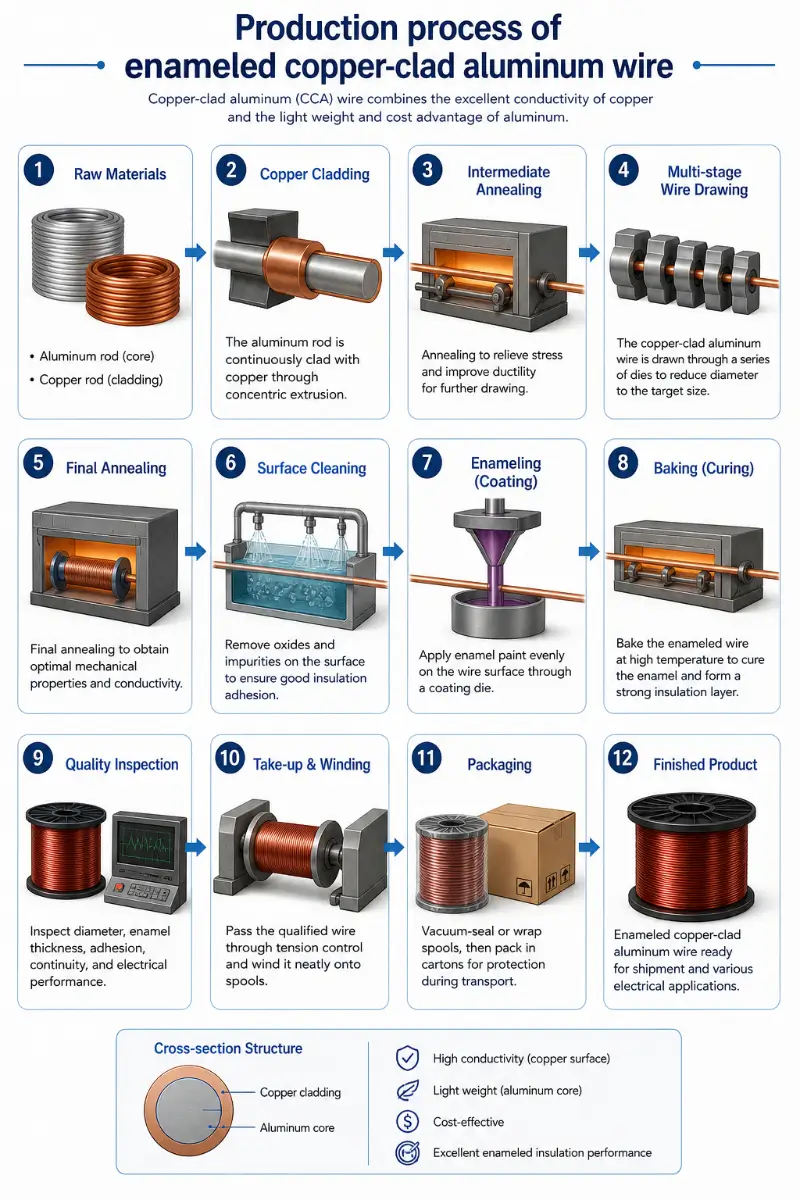
The composite billet goes through multiple drawing passes to reach the target diameter of the finished enameled copper clad aluminum wire.
During drawing, copper and aluminum reduce proportionally, with the copper volume ratio held constant throughout. This is the key to understanding the whole process: the copper layer does not lose a fixed “thickness” as the wire thins. It shrinks in proportion with the aluminum core.
That physical fact produces a direct engineering constraint on the production process: copper layer thickness is a hard ceiling on achievable wire diameter for enameled copper clad aluminum wire.
Once the copper layer becomes too thin, it opens up into cracks under the repeated tensile strain of drawing. As soon as the copper cracks and the aluminum core is exposed, the conductivity and corrosion resistance of the wire collapse.
ASTM B566 specifies that the copper layer of Class 10 must be at least 3.5% of the wire radius, and Class 15 at least 5%. That is why CCA has a minimum diameter limit. It is not that the equipment cannot do it; physics does not allow it.
This line runs diameters from 0.2 mm to 20 mm consistently.
Cleaning and Annealing: Two Separate Temperature Windows
Cleaning: the wire is washed with clean water at 50–70°C to remove surface oil.
This step is often folded into the annealing operation, but pulling it out separately is justified. Drawing lubricant that remains on the wire carbonizes at annealing temperature and forms carbides at the copper-aluminum interface, and carbides permanently kill the bond. Lubricant residue is the second most common root cause of delamination in enameled copper clad aluminum wire.
Annealing: the cleaned wire is heat treated in an annealing furnace.
The temperature is approximately 400°C, with sufficient soaking time. The purpose is twofold: remove the work hardening generated by drawing, and allow copper and aluminum atoms to diffuse fully so that a firm atomic-level metallurgical bond forms.
That 400°C figure is not arbitrary. Too low and diffusion stays incomplete, leaving the interface bonded only by mechanical interlocking. The annealing furnace is where enameled copper clad aluminum wire either gains its metallurgical bond or never gets one. Too high and the aluminum grain grows, ductility drops, and the wire becomes prone to brittle breakage in the next drawing pass. The melting point of aluminum is only 660°C, so the process window is narrow by nature.
Annealing also has a side effect that is frequently overlooked: the aluminum oxide film regenerates during the cycle. The elapsed time between annealing and enameling therefore has to be controlled, and the wire should not stand in air for long.
Pre-Enameling Surface Treatment: The Aluminum Oxide Film Is Unavoidable
This step determines whether enamel adhesion can pass.
The oxide film that aluminum forms naturally in air is hard, dense and firmly attached. If it is not removed before coating, the enamel film peels away from the aluminum during winding, abrasion or immersion, and pinholes and peel-strength failures are fundamentally failures of this operation.
The usual approach is an alkaline wash to strip the oxide, followed by surface activation. The interval between treatment and coating has to be controlled, and ambient humidity matters as well.
This is the extra burden that CCA carries compared with ordinary copper magnet wire. Copper needs no oxide treatment. Aluminum does. Skip it and the enamel will peel off the enameled copper clad aluminum wire in the customer’s winding machine, which is the most expensive way to find out.
Enameling: Where the Name “Enameled Wire” Comes From
In the coating stage of the production process, the treated wire is introduced into the coating zone of the curing oven at 500–700 m/min, where the insulation varnish is applied through a felt or a die.
Curing and cooling: the wire is cured at high temperature inside the oven so that the varnish forms a tough insulating film, then cooled.
Take-up: the finished enameled copper clad aluminum wire is wound at 3–5 meters per minute, completing the production process.
Notice the gap between those speed figures. The enameling line runs at 500–700 m/min while take-up runs at only 3–5 m/min. The enameling stage is where a technically sound composite billet can still be turned into an unusable enameled copper clad aluminum wire. The wire in between is held in tension balance through tens and sometimes over a hundred meters of oven. This is exactly why enameling is the most failure-prone operation on the line: a single wire spends more than a minute inside, and any tension fluctuation, uneven die pickup or oven temperature drift ultimately shows up as uneven enamel on the reel.
Die or felt? Felt application suits round wire, with film thickness governed by felt varnish loading and line speed. Die application, also called template or mandrel coating, controls film thickness through the varnish die diameter, is far more precise, and is used for high thermal class products with tight film tolerances.
How is the thermal class chosen? The common systems are:
- Polyester (PEW / QA)
- Solderable polyurethane (UEW / QZ)
- Polyester-imide (EIW / QZXY)
- Polyimide (AIW / QZY)
- Polyester-imide / polyamide-imide composite (EI/AIW / QZY)
Thermal classes cover 130, 155, 180, 200 and 220. Each of these enamels can be applied to a copper clad aluminum core, and the choice determines what the finished enameled copper clad aluminum wire can withstand.
One concept has to be kept straight here: Class N refers to thermal class, while Grade 1/2/3 refers to enamel thickness grade. These two are orthogonal. When a customer says “Class 180”, they are asking about temperature rating. When they say “Grade 2”, they are asking about film thickness. Neither statement can be misread.
Finished Wire Inspection: Six Sets of Acceptance Criteria
Producing the wire does not mean it is usable. Inspection of enameled copper clad aluminum wire has to cover dimensions, electrical properties, mechanical properties, interface integrity, enamel and appearance at the same time.
Copper Layer Thickness and Copper Volume Ratio
Three measurement methods, each with its own purpose:
Metallographic microscopy — the specimen is mounted, ground, polished and etched, then observed and measured directly under a metallurgical microscope for local and average copper layer thickness. This is the reference method for arbitration measurement. It is the most accurate, but it is slow, destructive and cannot run on the production line.
Eddy current thickness measurement — based on electromagnetic induction, where the probe generates a high-frequency field that induces eddy currents in the specimen surface, and the current strength correlates with the thickness of the surface copper layer. It is fast, non-destructive and suitable for in-line production use. One detail matters here: eddy current measures the surface locally, so it is sensitive to copper eccentricity. If the copper layer is thicker on one side than the other, the reading jumps.
Chemical dissolution and weighing — a specific reagent such as nitric acid dissolves the copper layer from a specimen of known length and weight, and the average thickness and weight percentage of the copper layer are calculated from the mass difference before and after dissolution. This is the most direct way to answer the question “how much copper is actually in there”.
Acceptance criteria:
– ASTM B566: Class 10 copper layer ≥ 3.5% of wire radius, Class 15 ≥ 5%
– Copper volume ratio: 10A/10H at 8%–12%, 15A/15H at 13%–17%
Copper layer thickness and copper volume ratio are the two numbers that most often differ between a good enameled copper clad aluminum wire and a bad one, and they are the two numbers that most often differ between two suppliers quoting the same class.
DC Resistivity
A double-arm bridge or high-precision low-resistance meter measures the DC resistance of a defined length of specimen at a standard temperature (20°C), from which volume resistivity or conductivity is calculated.
Criteria (ASTM B566):
| Class | Copper volume ratio | Condition | Max resistivity Ω·mm²/m | Density g/cm³ |
|---|---|---|---|---|
| Class 10A | 8–12% | Annealed | 0.02743 | 3.32 |
| Class 15A | 13–17% | Annealed | 0.02676 | 3.63 |
| Class 10H | 8–12% | Hard drawn | 0.02743 | 3.32 |
| Class 15H | 13–17% | Hard drawn | 0.02676 | 3.63 |
Conductivity criterion: overall conductivity not less than 61% of a pure copper conductor of the same cross-sectional area.
Tensile Strength and Elongation
Values are read from the standard tables against the nominal diameter. The rule for intermediate diameters is explicit: elongation requirements apply the next smaller size, while tensile strength requirements apply the next larger size.
For large hard-drawn conductors the typical minimum tensile strength is 16 ksi (about 110 MPa), while the maximum for annealed conductors is held at 20 ksi (about 138 MPa). Over a 10-inch gauge length, elongation is at least 1% for hard-drawn and at least 15% for annealed.
Adhesion and Bond Strength
Repeated reverse bending to fracture, with no separation of the copper and aluminum layers.
This test is brutal, but it works. It simulates the actual stress state of wire that is repeatedly bent, crimped into terminals and wound at the coil end. For enameled copper clad aluminum wire, adhesion is not a secondary characteristic; it is the characteristic that decides whether the wire survives service.
Torsion and Continuity
Torsion test: no visible cracks or dents are permitted on the copper layer surface.
Continuity inspection: no seams or delamination under 10× magnification, and a high-voltage spark tester is used to pass the conductor through a high-voltage electrode at a defined speed to detect pinholes, cracks and other defects in the copper layer that expose the aluminum core.
This one is the safety floor. Once the copper layer is breached, the aluminum core meets electrolyte or moisture and corrosion spreads outward from the break.
Dimensional Accuracy
A high-precision digital micrometer or laser diameter gauge measures outer diameter, ellipticity and uniformity at multiple points along the specimen length.
Chemical Composition
A spark direct-reading spectrometer or inductively coupled plasma atomic emission spectrometer provides quantitative analysis to confirm the aluminum core alloy grade and the copper layer purity — copper layer purity is typically required to be no less than 99.9%.
Two Standard Differences That Must Be Set Straight
This is where procurement of enameled copper clad aluminum wire goes wrong most often.
ASTM B566 has only four classes: Class 10A, 15A, 10H and 15H. The copper volume ratio tops out at 17%. Every enameled copper clad aluminum wire claimed to ASTM B566 falls into one of these four.
Chinese national standard GB/T 29197-2012 “Copper-clad Aluminum Wire” adds one grade: 20A and 20H, with a copper layer volume ratio of 18%–22% and a maximum resistivity of 0.02594 Ω·mm²/m.
So CCA products on the market labeled “20%, 30% or 40% copper content” have to be read carefully:
- 20% falls inside the 20A/20H classes of GB/T 29197 and is covered by the national standard.
- 30% and 40% fall into ranges defined by neither ASTM B566 nor GB/T 29197, and must be specified separately in the technical agreement — including the copper volume ratio measurement method, the interface bonding strength grade and the acceptance criteria.
Do not expect to accept a 40% copper product with ASTM B566 alone. That is not a lenient standard; it is that the standard does not cover these grades.
Five items are worth writing into the procurement technical agreement: conductor class, diameter tolerance, packaging method (reel or spool), special inspection requirements, and the measurement method for copper volume ratio. That last one matters, because two suppliers using metallography and chemical dissolution respectively can report results several percentage points apart.
Interface Quality: Why Microscopic Inspection Cannot Be Replaced
Fast inspection on the production floor relies on eddy current and peel testing. Both can screen out obviously non-conforming batches, but establishing batch-wide consistency needs the microscopy report. If the supplier of enameled copper clad aluminum wire cannot show you a metallographic section, that tells you something important about their production process.
Industry data show that specimens tracked by microscopic inspection survive thermal cycling before cladding failure for close to three times as long as specimens that are not.
The logic is not complicated. Eddy current tells you that something is wrong at a point, but where in the batch, how much of it there is, and what the distribution looks like can only come from a metallographic section. Under thermal cycling, it is always the weakest interface that fails first.
One more number is worth remembering: for every 0.1% drop in copper volume fraction, resistivity rises by 3% to 5%. That means a slight copper shortfall does not immediately make the product “non-conforming”. It quietly pushes the resistance up, and by the time the terminal runs hot the cost has already been made.
Where Enameled Copper Clad Aluminum Wire Fits
Enameled copper clad aluminum wire is not a universal solution. Knowing what this production process delivers, and where it suits, is more useful than knowing how good the wire is.
Enameled copper clad aluminum wire is suitable for:
– Automotive harnesses, speaker cable and signal cable — where solder reliability and cost both matter
– High-frequency applications — under skin effect the current concentrates in the surface copper layer, so high-frequency performance is better than pure aluminum
– Large cross-section power and distribution work — the 20%–40% copper range gives the best balance of cost and conductivity
– Hearing aids, sensors and extreme temperature environments — where weight matters
It is not suitable for:
– Applications requiring full rated ampacity — 61% conductivity means the cross-section has to be increased
– Constrained slot windings — once the cross-section grows, slot fill becomes a serious problem
– Cases where conductivity is mandated by code — some electrical codes place explicit limits or conditions on the use of CCA
The difference between low frequency and high frequency in enameled copper clad aluminum wire deserves a separate mention. At low frequency the aluminum core carries most of the current and the copper layer exists mainly for terminal soldering and contact reliability. At high frequency the current concentrates in the copper layer through skin effect, and at that point copper layer thickness directly determines the high-frequency performance.
How to Judge Whether a Batch Is Reliable
The most useful moves for a buyer:
Ask for metallographic sections first. A supplier that can provide sections from different batches of enameled copper clad aluminum wire is running real quality control, not just an eddy current pass.
Ask how the copper volume ratio is measured. Metallography and chemical dissolution give noticeably different results, so the method has to be agreed first.
Look at the interface after the peel test. Not whether the copper peels off — copper clad aluminum is supposed to peel — but whether any copper remains on the aluminum surface. Copper remaining means metallurgical bonding. Bare aluminum means plating.
Run a thermal cycle. It is the closest thing to real validation and says more about true interface bonding than any single-point test.
Cross-check resistivity against the declared class. A wire marked 15A with resistivity at 0.028 either has too little copper or is mislabeled.
About Us
We are Zhengzhou LP Industry Co., Ltd., a magnet wire source manufacturer with 30 years of export experience, a 60-acre self-built factory and ISO 9001, ISO 14001 and ISO 45001 systems audited by SGS.
Both copper and aluminum conductors are available. Round wire from 0.016 to 7.0 mm; flat wire from 0.8 to 10 mm in thickness and 2 to 25 mm in width. Thermal classes cover 155, 180, 200, 220 and 240.
We work to IEC, GB, JIS and NEMA standards or to your own specification. For enameled copper clad aluminum wire, we run the entire route ourselves, from composite billet through enameling and curing, so interface bonding and copper layer uniformity are controlled at the source rather than inspected in at the end. That is the difference between owning a production process and renting one.
Our products have shipped to more than 50 countries.
If you have specific gauge requirements for enameled copper clad aluminum wire, or want to compare products made by different process routes, send us the parameters and our engineering team will give you targeted advice.
Contact: office@cnlpzz.com | WhatsApp: 0086-19337889070