

Copper clad aluminum wire (CCA) has been one of the fastest-growing composite conductors in the materials field over the past decade. However, engineers who actually utilize this material are often not convinced by “copper’s conductivity,” but rather driven by two more practical factors: weight budget and material cost. A typical scenario is consumer audio products. A customer needs to drive a 4-inch full-range driver with a fixed voice coil frame space and a thermal budget of only 40°C. Using traditional copper wire directly reduces the driver’s sensitivity by one notch. Switching to pure aluminum presents another problem—the aluminum oxidation film makes terminal soldering extremely unreliable, with a return rate that once reached 8%.
Finally, they adopted copper clad aluminum coil wire. The copper layer accounts for 15% of the cross-sectional volume, reducing the weight by about 63% compared to pure copper. The first-pass yield of solder joints returned to over 99%, and the sensitivity index also met the requirements. This is the core value of enameled copper clad aluminum wire (often referred to in the industry as ECCA/ECCAW): using metallurgical bonding to attach the solderability and surface conductivity of copper to a lightweight aluminum skeleton. This article breaks down this solution in the order of actual engineering decisions: where are the physical boundaries of the conductor, what are the options for the enamel coating system, to what extent can the custom dimension be covered, and how to match it for different application scenarios.
Basic Structure and Physical Properties of the Copper-Clad Aluminum Conductor
Enameled copper clad aluminum wire starts with a copper clad aluminum conductor, which is a bimetallic composite conductor. The center is a conductive aluminum core, and the outer layer is a continuous oxygen-free copper layer, which is permanently bonded to the aluminum core through electroplating or metallurgical bonding processes. Several key points in this structure deserve special mention. Metallurgical bonding, not a sleeve. The copper layer and aluminum core form a continuous metallurgical bond, not a simple physical sleeve. This determines almost all subsequent performance characteristics—the copper layer will not crack or peel during winding, and the current path will not create additional contact resistance at the interface.
The volume percentage of copper is a graded parameter, not a free variable. ASTM B566 covers four classes of copper clad aluminum wire, each pairing a nominal copper content with a mechanical condition. The same table below shows the copper content bands and the minimum cladding thickness for each class:
| Category | Copper layer volume percentage | Minimum copper layer thickness |
|---|---|---|
| Class 10A / 10H | 8% ~ 12% | ≥ 1.75% radius |
| Class 15A / 15H | 13% ~ 17% | ≥ 2.50% radius |
It is worth noting that ASTM B566 defines only the 10% and 15% copper classes. Higher copper contents, such as 20% to 40%, appear in the market and in some supplier data sheets, but they sit outside the four classes of the standard and must be agreed in the technical agreement.
The letter suffix indicates the mechanical condition: A is annealed (soft drawn), suitable for applications requiring good ductility and repeated winding, such as voice coils and transformer coils; H is hard-drawn, with higher tensile strength, suitable for applications requiring high-tension wiring, spring forming, or high-speed drawing by automatic winding machines. The specifications section also lists both SJ/T 11223-2000 and ASTM B566-93 standards.
This detail is crucial for export-oriented supply chains—domestic customers refer to the national standard, while European and American customers refer to ASTM; both standards must be compatible. There’s a counterintuitive aspect to AC performance. It’s common knowledge that the DC resistance of enameled copper clad aluminum wire is higher than that of pure copper wire. However, above 5 MHz, the AC conductivity of copper clad aluminum is comparable to that of solid copper.
This is due to the skin effect: high-frequency current flows only through the outermost layer of the conductor, and the outermost layer of copper clad aluminum is precisely copper. This characteristic directly determines the position of copper clad aluminum in high-frequency applications—high-frequency transformers, RF coaxial cables, induction heating, and wireless charging coils—copper clad aluminum performs excellently in these areas, while being significantly lighter than pure copper. The density advantage can be quantified.
For the same weight and diameter, 1 ton of pure copper wire can yield 2.6 to 3.2 tons of enameled copper clad aluminum wire. This means that in projects sensitive to logistics costs or with specific weight reduction targets, both material and transportation costs will decrease simultaneously. Mechanically, copper clad aluminum is better than pure aluminum but softer than pure copper. Its modulus of elasticity is lower than copper, making winding smoother and more suitable for the tension of automated equipment; however, its strength is lower than pure copper, making it unsuitable for structural loads. This is often overlooked during selection—winding wire does not bear mechanical functions, a point that holds true for most applications.
Enamel Coating Systems: The Triangle of Solderability, Thermal Class, and Mechanical Strength
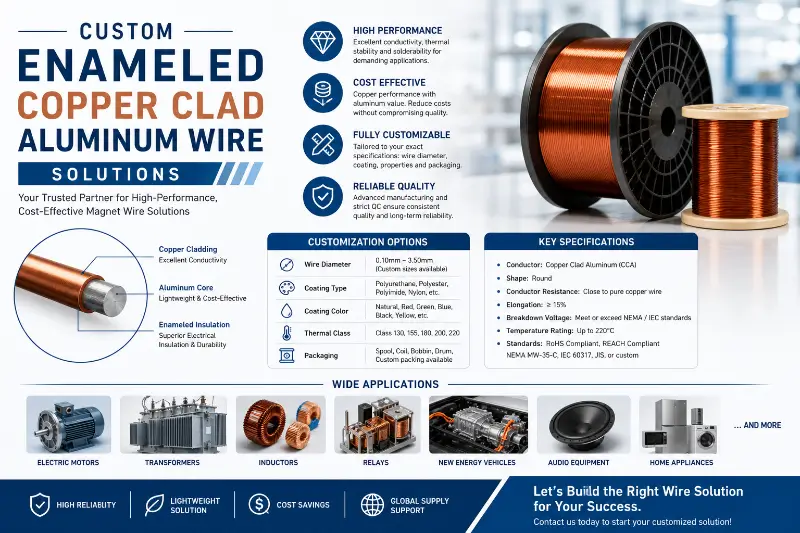
The insulation layer of enameled copper clad aluminum wire shares the same enamel coating technology system as copper wire. The only difference is that the substrate is changed from copper to copper clad aluminum, resulting in higher sensitivity to pinhole control and interlayer bonding. The reason is clear. The minimum thickness of the copper layer is only 1.75% of the radius for Class 10A, which is roughly 4.4 micrometers on a 0.5 mm wire diameter and still less than 10 micrometers on a 1.0 mm wire. At this thickness, any through-hole will directly expose the aluminum core—once the aluminum core absorbs moisture and oxidizes, an inter-turn short circuit is almost inevitable. Therefore, the ECCA pinhole test must be strictly performed; it is not optional. Based on the combination of insulating varnishes, the available systems can be roughly divided into four categories:
Polyester (PEW / QZ)
Base coat: Single-layer polyester, most common for Class 130 and 155. Excellent adhesion and elasticity—the polyester resin has extremely strong molecular bonding with the metal matrix, and the enamel coating can extend synchronously with the wire, making it less prone to cracking and peeling when winding coils with very small radii. This is the mainstream choice for Class 130/155 motor windings.
Modified Polyester
The primary solution for Grade 155. Compared to ordinary polyester, it offers a more balanced range of heat resistance and mechanical properties, making it highly acceptable in motor manufacturing plants. Combined with a polyamide-imide top coat, it can achieve Grade 180.
Polyester-Imide plus Polyamide-Imide Dual Layer (EIW / AIW)
The basic structure for Grade 200 and 220. The polyester imide base coat provides heat resistance, while the polyamide-imide top coat provides mechanical protection. Significant thermal shock resistance: Grade 200 requires thermal shock resistance up to 220°C, and Grade 220 requires 240°C.
Solderable Polyurethane (UEW)
This is one of the most valuable options for enameled copper clad aluminum wire and a core reason why many customers choose CCA over pure aluminum. The fatal weakness of pure aluminum is its oxidation film—it prevents reliable metallurgical bonding at weld joints. Copper clad aluminum wire, on the other hand, has a copper outer layer, naturally possessing excellent solderability; when combined with a solderable polyurethane/enamel coating, the enamel coating melts and peels off directly during welding, eliminating the need for mechanical scraping or chemical removal. Solderable polyurethane coatings of grades 130 and 155 are available (NEMA MW 75-C, MW 79-C, MW 80-C corresponding to IEC 60317-20/21/35). Solderable polyester coatings of grade 180 (MW 77-C, IEC 60317-23) are also possible. When selecting a model, consider your actual assembly process: If downstream processes involve manual soldering or automatic soldering machines, a solderable system is recommended; if downstream processes involve cold pressing of terminals or direct encapsulation after winding, then the mechanical strength of polyester or polyester imide is more important. Insulation classes (Grade 1 / Grade 2 / Grade 3) correspond to different enamel coating thicknesses and breakdown voltages, following IEC 60317-0-1. Larger wire diameters and higher winding voltages require higher insulation classes.
Customization Dimensions: Wire Diameter, Thermal Class, and Specification Combinations
| Thermal class | Enamel coating models | Base coat / top coat | Typical standard correspondences |
|---|---|---|---|
| 130 | PEW/130, UEW/130 | Polyester / solderable polyurethane | IEC 60317-8/11, NEMA MW 75-C |
| 155 | PEW/155, UEW/155 | Modified polyester / solderable polyurethane | IEC 60317-20/23, NEMA MW 79-C / MW 77-C |
| 180 | EIW/180, UEW/180 | Polyester-imide / polyamide-imide | IEC 60317-13/51, NEMA MW 36-C / MW 82-C |
| 200 | EIW/AIW/200 | Polyester-imide / polyamide-imide | IEC 60317-13, NEMA MW 36-A |
| 220 | EIW(EI/AIW)/220 | Polyester-imide / polyamide-imide | IEC 60317-13, NEMA MW 38-C / MW 36-C |
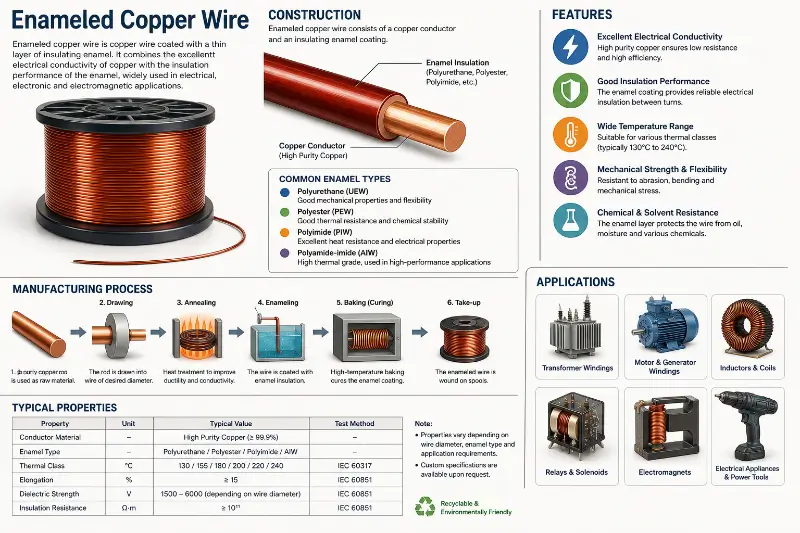
The true “custom” of enameled copper clad aluminum wire lies in the combination of wire diameter, thermal class, and specifications, not just in abstract terms. Wire diameter range. Round wires from 0.19 mm to 4.0 mm are the standard supply range; for ultra-fine wires or thicker wire diameters, an extended range from 0.08 mm to 8.00 mm is also available. The minimum specification for export products is 0.19 mm, corresponding to approximately AWG 26 to 28. Thermal class combination. The complete optional matrix is: Packaging and Delivery. Plywood spools weighing 30 kg to 150 kg are standard configurations, available in 250×500 and 250×600 sizes. This range covers everything from manual loading in small electronics factories to continuous production lines in large motor factories. Customers often specify a maximum weight per spool for their own payoff racks. Electrical specifications confirmation method. ASTM B566 specifies several tests: tensile strength and elongation, resistance and IACS at 20°C, conductivity, and density-calculated mass per unit length. Simultaneously, the wire must be seamless, without delamination, and the finished product must not have joints or splices. One easily overlooked but crucial point is: the finished product must not have joints or splices. Once a winding wire has joints, the winding turn distribution and inter-turn insulation consistency will be problematic, which is why many buyers include “seamless joints” in their technical agreements.
Application Matching: Which Projects Should Use ECCA and Which Should Avoid It
Audio and Loudspeaker Voice Coils
This is the most mature application area for enameled copper clad aluminum wire, almost the default choice. Voice coils are extremely sensitive to weight (directly determining the transient response and sensitivity of the unit), and the terminals must be reliably soldered. A 10% or 15% copper layer CCA does not have significant drawbacks here. It’s important to note the thermal budget: With voice coils operating at full power for extended periods, the temperature rise can exceed 180°C. In this case, the choice of enamel coating system becomes more critical than the conductor material—the thermal stability of the enamel coating on the aluminum core/interface at high temperatures requires specialized verification. Similar applications include guitar cables, custom power payoffs, subwoofers, speaker crossover networks, and voice coils for dynamic and in-ear headphones.
Automotive and New Energy
The core advantages of copper clad aluminum here are weight and cost, while the terminal crimping and welding performance is guaranteed by the copper layer. In the new energy sector, copper clad aluminum is being evaluated for use in drive motors and charging modules. One important point to note: automotive applications have much higher requirements for thermal shock and cold thermal cycling than general electronic applications. For enamel coating systems, it’s recommended to go directly for Class 200 or 220, and avoid cost-cutting at Class 155.
Power Supplies and High-Frequency Magnetics
Here, the high-frequency characteristics of copper clad aluminum truly come into play. Above 5 MHz, AC conductivity is equivalent to solid copper, which is especially valuable for switching power supplies and wireless charging.
RF and Communications
CATV coaxial cable conductors, semi-rigid cables, flexible coaxial RF cables, microwave connectors, data cables, antenna feeders. CATV is the largest traditional market for copper clad aluminum, and the technology is most thoroughly validated in this area.
Aerospace and Specialized Environments
Aerospace, military, extreme temperature sensors, noise control, underwater sensors, space propulsion systems, retractable fuel lines (Boeing lines), special resistors and capacitors, wireless charging systems, atomic research equipment, nuclear power and medical equipment. The criteria for high reliability applications are straightforward: if the customer requires 100% copper conductor, copper clad aluminum should not be included in the solution; if the customer accepts composite materials, then focus on reviewing the copper layer bonding strength and pinhole test reports—these are the safety baselines.
Consumer Electronics and Home Applications
Hearing aids, button battery powered devices, outdoor control panels and sensors, printers, special resistors and capacitors, DIY and audiophile-grade cables.
Custom Solutions and Supplier Capability Assessment
If you are evaluating a supplier, not just buying a roll of cable, there are a few questions worth asking directly. First, is the conductor drawn in-house or purchased externally? The core barriers to entry for copper clad aluminum lie in the coating bonding process and the consistency of wire drawing. If the supplier’s CCA (copper clad aluminum) conductor is purchased as bare wire, and they only do the enamel coating themselves, then the ceiling for quality control is limited. Second, can they provide enameled copper clad aluminum wire, copper conductor, and aluminum conductor simultaneously? This is something many solution-oriented suppliers cannot do. A project might require both high-reliability pure copper coils and lightweight copper-clad aluminum coils. Covering both substrates means that material combinations can be done within the same project, rather than sourcing from two separate suppliers and then aligning the processes. Third, is the standard coverage complete? IEC 60317, NEMA MW 1000, GB 6108, JIS C3202, ASTM B566—having the testing capabilities for these standards is essential to meet the certification requirements of different export markets. Fourth, where are the custom boundaries? Clarify the lower limit for wire diameter, the upper limit for thermal class, the optional range for copper layer ratio, the upper limit for single-shaft weight, insulation class combinations, shaft diameter, and labeling method. If these parameters are clearly stated in the custom order, it will save a lot of disputes later.
Taking Zhengzhou LP Industry Co., Ltd. as an example, as a source manufacturer with 30 years of experience in exporting magnetic wire, the company completes the entire process from conductor to enamel coating within its 60-acre production base. It holds ISO 9001/ISO 14001/ISO 45001 system certifications (audited by SGS), and its products comply with UL/REACH/RoHS requirements. Conductor substrates are available in pure copper, pure aluminum, and copper clad aluminum, with thermal classes covering 155/180/200/220/240. Round wire diameters range from 0.016 to 7.0 mm, and flat wire thicknesses from 0.8 to 10 mm and widths from 2 to 25 mm. Models include UEW (QA), PEW (QZ), EIW (QZXY), and EI/AIW (QZY).
Summary
Select by temperature. When specifying enameled copper clad aluminum wire for winding and working temperatures below 130°C, choose Class 130; for 130 to 155°C, choose Class 155 polyester or modified polyester; for 155 to 180°C, choose Class 180 EIW; for 180 to 200°C, choose Class 200 EI/AIW; for above 200°C, choose Class 220 EI/AIW. Leave a 10 to 20°C margin for thermal class; do not select directly at the upper limit. Select by frequency. For power frequency and low frequency motors, the DC resistance disadvantage of copper clad aluminum needs to be compensated for by increasing the diameter of the heavy-duty wire or increasing the number of windings. In high-frequency applications above 1 MHz, copper clad aluminum can almost replace pure copper without additional calculations. Select according to assembly process.
Choose a solderable polyurethane system for areas requiring welded connections; choose a polyester imide + polyamide-imide double-layer system for areas requiring high mechanical strength and wear resistance; use solderable polyester nylon (MW 78-C / MW 80-C) when both are required. Select according to conductor type. Choose Class A annealed conductors for repeated winding and shaping; choose Class H hard-drawn conductors for high-speed automatic winding machines and applications requiring tensile strength. Final practical advice. The electrical performance of copper clad aluminum is highly dependent on the continuity of the copper layer. When commencing production for the first time or changing suppliers, it is essential to request a pinhole test report, coating adhesion test records, and measured resistance data. Do not rely solely on the nominal values in the specifications book. These three data points are crucial indicators for judging the actual quality level. This document is for engineering selection reference. Specific parameters should be based on the actual technical agreement and the latest standard version.