

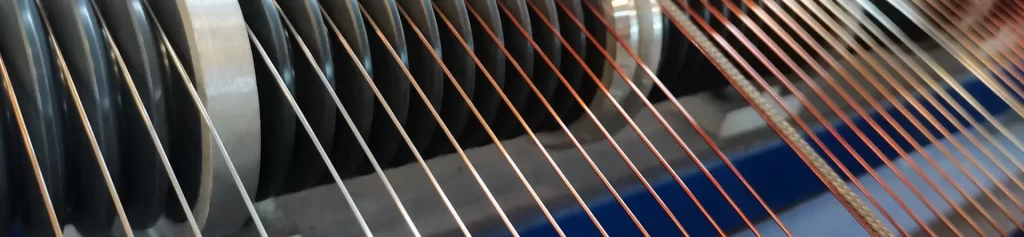
In the design of motors, transformers, compressors, and traction converters, temperature is one of the first constraints raised, and the choice of high-temperature resistant enameled copper wire is usually among the first engineering decisions. When customers require “long-term operation above 200℃,” engineers are not truly facing a single number, but a whole set of mutually constraining engineering indicators: the temperature index must be high, the softening temperature cannot collapse; thermal shock must be withstood, the enamel coating cannot become brittle; electrical performance must be stable, and mechanical margins cannot be sacrificed; finally, cost, supply chain, and process feasibility must also be considered.
This article systematically breaks down the actual performance boundaries of high-temperature resistant enameled copper wire according to performance dimensions, covering four main grades: 180 / 200 / 220 / 240℃. It focuses on explaining what each indicator means, under what operating conditions it becomes a bottleneck, and how to make trade-offs in engineering.
High-Temperature Performance Requirements and Selection Basis
The Essence of Thermal Class and the Meaning of Temperature Index
IEC 60317 and NEMA MW 1000 use the “Temperature Index (TI)” to define the long-term heat resistance of the enamel coating on high-temperature resistant enameled copper wire. The temperature index is not a limit value of “how many degrees it can withstand,” but rather a nominal long-term operating temperature extrapolated through accelerated aging tests. In practical engineering, when the winding temperature is below TI, the aging process of the enamel coating is very slow; once it exceeds TI, the aging rate rises sharply, and the lifespan is no longer linear.
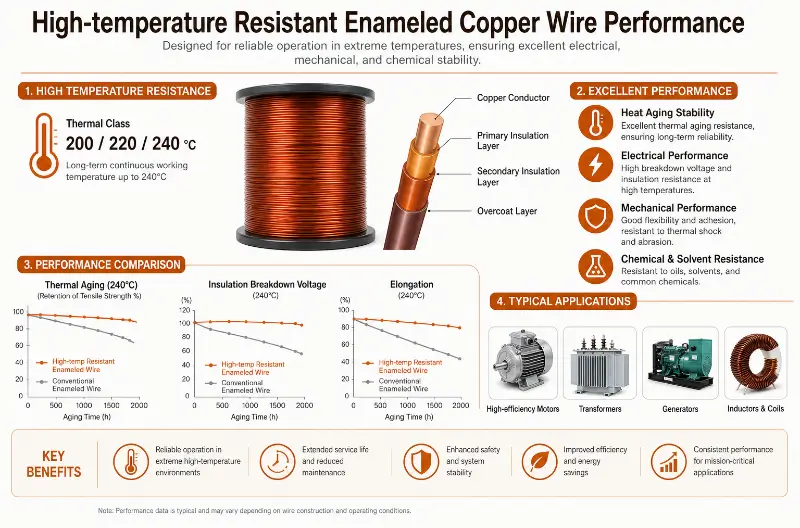
For high-temperature resistant enameled copper wire, the mainstream thermal classes are as follows: Class E is 120°C, Class B is 130°C, Class F is 155°C, Class H is 180°C, Class C is 200°C, Class C+ is 220°C, and higher classes include 240°C and 250°C. It is important to note that the thermal class of the enameled copper wire itself is not equal to the temperature rating of the entire winding system. The winding system also includes slot insulation, turn-to-turn insulation, adhesives, padding paper, leads, end binding materials, and potting varnish. If the temperature resistance of any material is lower than that of the enamel coating, the upper limit of the entire winding system is lowered. When designing a 200°C rated motor, the actual lifespan is often determined not by the enameled wire, but by the impregnation varnish or slot insulation.
The Role of Copper Conductor and Enamel Coating at High Temperatures
The core reason why high-temperature resistant enameled copper wire uses copper instead of aluminum is copper’s stability under high-temperature conditions. Copper has a conductivity of 100% IACS, a resistance of approximately 0.0175 Ω·mm²/m, a thermal conductivity of 397–401 W/m·K, and a melting point of 1083°C; in contrast, aluminum has a conductivity of only 61% IACS, a resistance of 0.0282 Ω·mm²/m, a thermal conductivity of 226–237 W/m·K, and a melting point of 660°C. This difference is amplified at high temperatures, resulting in three specific consequences. First, approximately 1.6 times the conductor cross-sectional area is required for the same resistance, affecting both slot fill factor and overall machine size.
Second, copper’s thermal conductivity is approximately 1.7 times that of aluminum, allowing heat to be dissipated from the winding more quickly, directly determining the magnitude of the internal temperature gradient. Third, copper has a current-carrying capacity of approximately 8–10 A/mm², while aluminum has approximately 5–6 A/mm². Combined with the difference in melting points, the overload margin in high-temperature applications is completely different.
Typical Applications Above 200°C
Different levels of applications have clearly defined roles in their corresponding working scenarios. For high-temperature resistant enameled copper wire, Class 180 polyesterimide enameled wire is widely used in high-efficiency industrial motors, new energy vehicle drive motors, and various household appliance motors, relying on its wear resistance and chemical resistance. 200°C composite enameled wire (polyesterimide primer with a polyamide-imide topcoat) is mainly aimed at high-vibration, high-temperature conditions in harsh environments, typically in new energy vehicle drive motors, servo motors, refrigeration compressors, and wind turbine generators.
Class 220 polyamide-imide enameled wire and Class 240 polyimide enameled wire enter more extreme fields: aerospace motors and actuators, satellite coils, rocket engine coils, nuclear industry equipment, military communication equipment, high-speed train traction motors, and winding under extreme temperature cycling conditions (-65°C to 220°C).
Enamel Coating System and Temperature Performance
Technological Evolution of Three Generations of Enamel Coating Systems
The performance differences between high-temperature resistant enameled copper wire grades stem from the enamel coating chemical system, not just the grade number. Currently, there are three main systems used in industry today. Polyesterimide (PEI/EIW) is the mainstay for the 180°C thermal class. It introduces an imide structure into polyester, and its heat resistance, wear resistance, and chemical resistance are significantly better than ordinary polyester.
The cost is relatively controllable, making it the most economical upgrade path for industrial motors. Polyamide-imide (PAI / AIW) corresponds to a 220°C thermal class. It is currently the most well-balanced in terms of overall performance among mass-produced enamel coatings. It’s worth noting an easily overlooked performance margin: while the official rating for PAI is typically 220°C, its breakdown temperature can often reach 330–350°C. This means that under short-term overload or localized hotspot conditions, PAI enamel coating failure often doesn’t begin with softening, but rather with cracks introduced by mechanical stress, pinholes, or thermal shock. Understanding this is valuable for failure analysis. Polyimide (PI / PIW) corresponds to the 240°C thermal class and is the highest temperature resistant among mass-produced enamel coating systems.
Polyimide is made by polycondensation and imidization of trimellitic anhydride (PMDA) and aromatic diamines (such as ODA). Its thermal decomposition temperature is above 500°C, and it remains flexible and non-brittle across a full temperature range of -65°C to 220°C. It is resistant to gamma rays, electron beams, and neutron radiation, and exhibits extremely strong resistance to chemical media.
Why Have Composite Coatings Become Mainstream?
For high-temperature resistant enameled copper wire, a single enamel coating can hardly meet all engineering requirements simultaneously, hence the emergence of dual-coat structures: the primer is responsible for mechanical properties and adhesion, while the topcoat is responsible for thermal properties and chemical protection. This design is almost the default choice for Class 200 and above. There are three common combinations. PEI/PAI Composite: The PEI primer has a temperature resistance of 180°C, good mechanical properties, and moderate cost.
The PAI topcoat has a temperature resistance of 200°C and outstanding wear and chemical resistance. Overall temperature resistance is dominated by PAI, while mechanical properties are contributed by PEI. The overall cost falls between pure PEI and pure PAI. It is widely used in new energy vehicle drive motors, servo motors, refrigeration compressors, and wind power transformers. PEI/PI Composite: The primer has good adhesion, and the PI topcoat has a temperature resistance of 220°C and outstanding chemical and radiation resistance. It is used in aerospace, military, and high-speed rail traction motors. PE/PAI Composite: The primer has low cost and good flexibility, and the PAI topcoat is wear- and chemical-resistant. It is used for upgraded versions of industrial motors and home appliances. IEC 60317-13 specifies PEI/PAI composites (polyester or polyamide-imide) corresponding to Class 200; IEC 60317-15 specifies self-lubricating PEI/PAI composites with an adhesive layer.
Three Real Shortcomings of Polyimide
Polyimide is the material of choice for high-temperature resistant enameled copper wire, but it’s not perfect, and three shortcomings must be addressed in engineering. Brittleness is the primary issue. PI enamel coating has lower flexibility and elongation than PAI enamel coating. Direct use can cause stress cracking during mechanical processes such as winding, shaping, and slot insertion, usually requiring plasticizing or composite modification to improve this.
Adhesion is the second issue. PI enamel coating has poor adhesion to the substrate, requiring a primer (such as PEI primer) to enhance bonding. Pure PI enamel coating is rarely used alone in actual products. Cost is the third issue. Polyimide is the most expensive component in the enamel coating system, which is an unavoidable variable in project cost accounting. This is also why Class 240 solutions often only appear in key sub-components rather than covering the entire machine. Therefore, in the ECCA (copper clad aluminum) wire field, PEI/PI composite coatings or PI self-lubricating modified systems are more common than pure PI wires.
Engineering Interpretation of Key Performance Indicators
Difference between Temperature Index and Thermal Shock Temperature
For high-temperature resistant enameled copper wire, Temperature Index (TI) and Thermal Shock Temperature are two different concepts, yet they are often used interchangeably. TI describes the ability to operate stably over a long period, while thermal shock temperature describes the resistance to cracking under short-term temperature changes. Taking IEC 60317-58 / NEMA MW 84-C for 220°C polyamide-imide flat wire as an example, the specifications clearly require: a temperature index of 220°C, and the enamel coating does not crack under thermal shock testing at 240°C (wound on a mandrel 6 times the wire thickness, then inspected at 4 times the wire thickness).
Converting this to 240°C polyimide wire, the thermal shock requirement increases to 260°C. Meanwhile, the thermal shock temperature requirement for Class 200 composite enameled wire is at least 220°C. This difference has a clear engineering implication: the thermal shock margin is typically 20–40°C above the TI (Temperature Index). In other words, if a motor’s actual operating temperature is 220°C, but it’s equipped with Class 200 enameled wire, then there’s almost no margin for thermal shock testing.
Dielectric Strength and Breakdown Voltage
Breakdown voltage is one of the most critical performance indicators of high-temperature resistant enameled copper wire, and also one of the most easily misunderstood. It is not determined by enamel coating thickness alone, but by the combined effects of enamel coating thickness, enamel coating type, conductor diameter, and pinhole density. The following specifications for Class 240 polyimide enameled copper wire (Grade 2 heavy coating) can be used as a reference:
| Nominal Diameter (mm) | Maximum Outer Diameter (mm) | Minimum Breakdown Voltage (V) | Resistance at 20°C (Ω/m) |
|---|---|---|---|
| 0.300 | 0.352 | 4100 | 0.2336 – 0.2507 |
| 0.500 | 0.566 | 4600 | 0.08462 – 0.08959 |
| 0.800 | 0.884 | 4900 | 0.03305 – 0.03500 |
| 1.120 | 1.217 | 5000 | 0.01688 – 0.01786 |
Two patterns can be observed from this data.
First, the breakdown voltage increases with increasing diameter, but the increase is limited—from 0.300mm to 1.120mm, the diameter increases by approximately 3.7 times, but the breakdown voltage only increases by about 22%. This indicates that the dominant factor in breakdown voltage is the enamel coating thickness, rather than the conductor cross-sectional area. Second, the breakdown voltage is lower in thinner segments (only 4100V at 0.300mm). This segment also has the highest density of pinhole defects and is most prone to early failure; therefore, the winding tension and the shaping force within the slot need to be carefully controlled. The official specifications for Class 220 polyamide-imide flat wire state: dielectric strength (ball pressure method) not less than 2.0 kV, with a typical actual value not less than 3 kV; high-voltage discontinuity test at 2.5 kV not exceeding 7 points per 100m; conductivity 58–59 MS/m, with a practical value not less than 58.5 MS/m.
Elongation, Excess Length Ratio, and Mechanical Allowance
High-temperature resistant enameled copper wire generally involves a trade-off in its mechanical properties: the higher the temperature resistance, the harder and more brittle the enameled wire, and the lower the elongation and excess length ratio. Elongation reflects the ductility of the enameled wire; a higher value means it is less likely to break during processing. The excess length ratio reflects the ability of the enameled wire to remain intact after being wound from a straight line into a spiral during winding.
Taking 220°C polyamide-imide flat wire specifications as an example: the elongation at break of this enameled copper wire is not less than 32%, and can reach 32-38% in the crack-free state; the bending test requires the mandrel diameter to be 4 times or 3 times the width, and the thickness direction to be 4 times or 3 times the thickness; the pencil hardness reaches 4H-5H. In comparison, the requirements for the Grade 2 coating of Class 240 polyimide wire in the range of 0.300-1.120mm are: elongation not less than 32% (with cracks) and not less than 38% (without cracks), pencil hardness 4H-5H, and it must maintain a minimum H hardness after immersion in a standard solvent for 0.5 hours/60°C, and also maintain a minimum H hardness after immersion in alcohol for 0.5 hours/60°C. These two sets of data show that the hardness and elongation requirements of high-grade enamel coating are not much more lenient than those of Class 220.
High-temperature performance is not free—it is primarily achieved through mechanical allowance and processing tolerance.
Cut-through and Abrasion Resistance
High-temperature resistant enameled copper wire in service often faces vibration, mechanical shock, and localized wear caused by stator-rotor friction; therefore, cut-through and abrasion resistance are crucial in high-temperature rating selection. Class 240 polyimide enameled copper wire can withstand a cut-through test at 500°C for 2 minutes without breakdown.
For high-temperature resistant enameled copper wire in the 220–240°C range, abrasion resistance mainly relies on the hardness of the polyamide-imide and the polyimide topcoat; this is the engineering origin of the “abrasion-resistant topcoat, flexibility-retaining primer” division of labor in PEI/PAI composite coatings.
Chemical and Radiation Resistance
High-temperature resistant enameled copper wire is often used in environments accompanied by chemical media. Class 220 PAI enameled copper wire exhibits good resistance to the following media: commercial impregnating varnishes, commercial refrigerants, commercial dry transformer oils, and commercial hydraulic oils. In chemical resistance tests, after solvent immersion for 0.5 hours at 60°C the pencil hardness must retain a minimum H rating, and after alcohol immersion under the same conditions it must likewise retain a minimum H rating.
Class 240 high-temperature resistant enameled copper wire further possesses resistance to gamma rays, electron beams, and neutron radiation, and its chemical inertness is close to that of a fully encapsulating medium, making it the default choice for aerospace and nuclear industry equipment.
Thermal Aging Resistance and Lifespan Extrapolation
Life assessment of high-temperature resistant enameled copper wire relies on the Arrhenius accelerated aging model. This typically involves applying constant temperatures at two or more points (e.g., 200°C, 220°C, 240°C), periodically measuring the decreasing trend of insulation resistance, and then extrapolating to the allowable life at the target operating temperature.
The thermal life of PI 220 polyimide enamel coating on high-temperature resistant enameled copper wire at a long-term operating temperature of 220°C is no less than 20,000 hours. It is important to note the applicable boundaries of this figure: it corresponds to the enamel coating itself, not the entire winding system, and is derived under specified test conditions and standard sample conditions.
Standard System and Product Model Comparison
Correspondence between IEC 60317 and NEMA MW 1000
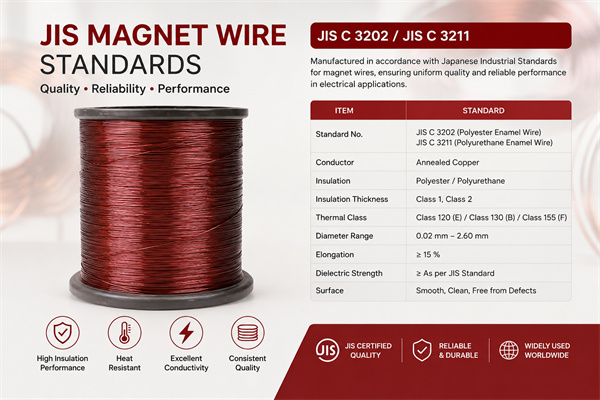
Engineering selection of high-temperature resistant enameled copper wire is inseparable from standard comparison tables. Commonly used standards include: IEC 60317 series (International Electrotechnical Commission wire standards, divided into 0-X general requirements and X specific product requirements), NEMA MW 1000 (American Institute of Electrical Manufacturers magnetic wire standards, including multiple MW1000-CXX volumes), GB/T 6109 (Chinese national standard, equivalent to IEC 60317), JIS C 3202 (Japanese Industrial Standard), and ASTM D1676 (American Society for Testing and Materials test methods for magnetic wire coating). The core comparisons between various enamel coating systems and standard models are as follows:
| Thermal Class | Coating System | IEC 60317 Part | NEMA MW 1000 |
|---|---|---|---|
| 155°C | Polyester (PEW) | 60317-3 | MW 5-C |
| 155°C | Polyurethane (solderable / UEW) | 60317-20 | MW 79-C |
| 180°C | Polyesterimide (PEI / EIW) | 60317-8 | MW 30-C |
| 180°C | Polyurethane (solderable / UEW) | 60317-51 | MW 82-C |
| 200°C | Polyesterimide over Polyamide-Imide (PEI/PAI) | 60317-13 | MW 35-C · MW 73-C |
| 220°C | Polyamide-Imide (PAI / AIW) | 60317-57 | MW 37-C |
| 220°C | Polyamide-Imide (flat wire) | 60317-58 | MW 84-C |
| 240°C | Polyimide (PI / PIW) | 60317-46 | MW 16-C |
In plain terms, the thermal class correspondence runs as follows: Class 180 is polyesterimide; Class 200 is a polyesterimide/polyamide-imide composite or a polyamide-imide single coating; Class 220 is polyamide-imide; Class 240 is polyimide.
Nominal Conductor Diameter and Dimensional Tolerances
The nominal conductor diameter of high-temperature resistant enameled copper wire conforms to IEC 60317-0-3:2008 and Clause 4 of IEC 60317-0-3:2008/AMD1:2013. Taking Class 240 polyimide round wire as an example, the production diameter range is 0.250–1.500 mm, and the published size tables cover 0.300–1.120 mm.
Other sizes can be determined by review according to specifications. Insulation film thickness is divided into three grades: Grade 1 (single coat), Grade 2 (heavy coat), and Grade 3 (triple coat). It should be noted that the enamel coating grade and thermal class (thermal class / Class) are two orthogonal dimensions. The thermal class addresses the thermal aging issue of high-temperature resistant enameled copper wire. Grades 1/2/3 primarily affect enamel coating thickness, mechanical fit space, and breakdown voltage. Confusing these two concepts during selection is a common mistake.
Supplier Qualification and Traceability Requirements
The acceptance standards for high-temperature resistant enameled copper wire differ from those for ordinary magnet wire used at 155°C. It is recommended to specify the following requirements in the contract and technical agreement: Suppliers should provide products that comply with IEC, NEMA, UL, and JIS standards, and be able to provide material testing reports and conformity certificates to ensure quality traceability.
Regarding certifications, UL Recognized certification, ISO 9001 quality management system, IATF 16949 automotive industry quality management system, and RoHS and REACH substance compliance reports are common entry barriers. For high-temperature resistant enameled copper wire, mass-produced wires require batch-by-batch inspection, and key parameters (thermal shock, breakdown voltage, excess length ratio, pinholes) should be documented for each batch. For UL certification documents, the document number in the UL Recognized Components list is crucial for verification. For example, the UL document number for a certain Class 240 polyimide enameled wire is E174580.
Selection Decision-Making Method for High-Temperature Operating Conditions
Deriving the Thermal Class from Continuous Operating Temperature
The first step in selecting a product class for high-temperature resistant enameled copper wire by working backward from the continuous operating temperature is always to return to the operating condition itself, not to search backward from the product catalog. What needs to be determined is: the continuous operating temperature (winding), the permissible short-term overload temperature and duration, and the range of ambient temperature fluctuations.
The continuous operating temperature determines the minimum thermal class, and hence the minimum TI (Temperature Index) rating, for the high-temperature resistant enameled copper wire; a margin of 10–20°C should be allowed above the TI. Short-term overload determines whether the thermal shock test can be passed. Empirically, when the winding temperature fluctuation exceeds 20°C, thermal shock often becomes the failure mode earlier than long-term aging.
Application Scenarios and Thermal Class Mapping
Based on the above operating parameters, common applications can be mapped to recommended levels:
| Application Scenario | Continuous Operating Temperature | Recommended Class | Recommended Coating System |
|---|---|---|---|
| High-efficiency industrial motors, appliance motors | 130–155°C | Class 155 | Polyester (PEW) or polyurethane |
| EV drive motors, servo motors | 155–180°C | Class 180 | Polyesterimide (PEI / EIW) |
| Refrigeration compressors, wind power transformers | 180–200°C | Class 200 | PEI/PAI composite |
| Aerospace motors, nuclear industry equipment | 200–220°C | Class 220 | Polyamide-Imide (PAI / AIW) |
| Satellite coils, rocket engine coils | 220–240°C | Class 240 | Polyimide (PI / PIW) |
Five-Step Selection Process
Step 1, Determine continuous operating temperature and thermal shock conditions for the high-temperature resistant enameled copper wire, providing dual constraints of TI and thermal shock. Step 2, Select the enamel coating system. If solderability (direct terminal soldering) is required, note that enamel coating systems above Class 220 generally lack direct soldering capability, requiring a separate paint removal process or the use of a solderable Class 180 solution. Step 3, Determine the enamel coating grade and diameter specifications. Balance slot fill factor, mechanical strength, and breakdown voltage; be aware of pinhole risk for thin wire segments. Step 4, Check the overall temperature resistance of the winding system. Verify each item: slot insulation, turn-to-turn insulation, adhesive, impregnation varnish, leads, and end binding materials. Any item below the enamel coating grade will become a system weakness. Step 5, Verification and traceability. Check reports on thermal shock, breakdown voltage, pinholes, and excess length ratio by batch, and request UL file numbers and system certifications.
Common Failure Modes and Attributions
There are four typical failure modes for high-temperature resistant enameled copper wire, each with different attribution logic. Enameled coating thermal aging cracking, manifested as a continuous decrease in insulation resistance, is usually caused by long-term operating temperatures exceeding the TI rating, or insufficient heat dissipation design within the winding leading to actual temperatures higher than the design value. Thermal shock cracking often occurs during sudden temperature changes or start-up/shutdown conditions, and cracks often originate from stress concentration points on the conductor surface.
Pinhole and breakdown failures are concentrated in thin wire segments and high slot fill factor designs, caused by mechanical damage to the wire during embedding and shaping processes combined with defects in the enameled coating itself. Chemical incompatibility between the enameled coating and the slot insulation or impregnation varnish, manifested as coating swelling and loss of adhesion, requires prior verification through material matching tests, especially in composite coating systems above grade 200.
Overall Performance and Cost Trade-offs of High-Temperature Enameled Copper Wire
From a performance perspective, the advantages of high-temperature resistant enameled copper wire are clear. Class 240 polyimide wire maintains stable dielectric properties at temperatures of 220°C or even higher, withstands thermal shock up to 260°C, withstands a cut-through test at 500°C for 2 minutes, and offers near-complete protection against chemical media and radiation. Its conductor conductivity remains above 58.5 MS/m. These products directly support the winding needs of aerospace motors, satellite coils, and nuclear industry equipment. However, the costs are equally clear and spread across multiple dimensions.
Mechanical performance is the most direct loss: the elongation and excess length ratio requirements for Class 240 high-temperature resistant enameled copper wire are not less stringent than those for Class 220. Furthermore, PI enameled copper wire itself is brittle and requires plasticizing or composite modification, significantly narrowing the window for winding and shaping processes. Cost is the second factor; polyimide is the most expensive component in the enameled copper wire system, and Class 240 solutions are typically used only for critical sub-components rather than for comprehensive system coverage. The third trade-off is manufacturing complexity. Composite coatings, primer matching, and additional curing baking all lengthen the process chain and increase the risk of batch inconsistency. It is precisely these trade-offs that make PEI/PAI composite enamel coatings (200°C rating) the most cost-effective high-temperature solution in the current industry: trading roughly 180°C-class mechanical tolerance for 200°C-class thermal performance, at a cost only a fraction of that of pure PAI. When operating conditions truly require temperatures above 220°C, then stepping up to PAI or PI is a reasonable engineering sequence.
Selection based on operating temperature: Temperature is the only non-negotiable input. For standard industrial and household appliance motors operating at 130–155°C, polyester or polyurethane is sufficient; pursuing additional margins is meaningless. For the 155–180°C range, polyesterimide is chosen, as wear resistance and chemical resistance are the main value sources for this grade. For the 180–200°C range, PEI/PAI composite enamel coating offers the best cost-performance ratio; avoid single-layer PAI if possible. Selection based on overload and thermal shock capabilities: When winding temperature fluctuations exceed 20°C, or when frequent start-stop cycles, stalling, or short-term severe overloads occur, thermal shock will precede long-term aging as the failure mode. In this case, thermal shock temperature requirements should be considered a primary indicator, and note that the 220°C thermal shock requirement for Class 200 enameled wire has almost no margin near full load; if necessary, increase the requirement by one grade. Selection based on mechanical and cost constraints:: High-temperature ratings are not free; decreased elongation, increased embrittlement of the enamel coating, narrowing of the process window, and increased unit price are inevitable consequences. When a project involves unfamiliarity with the winding process, large batch sizes, or is cost-sensitive, the robustness of a Class 200 composite enamel coating is superior to that of a Class 220 single-layer PAI. However, when structural reliability, temperature rise margin, or military/aerospace qualifications are stringent requirements, it is worthwhile to bear the cost and process trade-offs of the Class 220 and Class 240 options.