

Whether the enamel coating on magnet wire cracks at low temperatures depends on the glass transition temperature of the coating polymer, the quality of conductor annealing, and the testing method itself. To understand the testing criteria for low-temperature brittleness, it is first necessary to clarify the actual boundaries of the clauses in the standard system.
Definition and Failure Mechanisms of Low-Temperature Brittleness
Low-temperature brittleness refers to the phenomenon where the enamel coating of enameled copper wire cracks, peels off, or even exposes metal when subjected to mechanical stresses such as bending, tension, or rapid pulling at low temperatures. It is physically the opposite of thermal shock cracking at high temperatures, but it also threatens the insulation integrity.
Glass Transition Temperature and the Low-Temperature State of the Enamel
At room temperature, the polymer in the enamel coating is in a highly elastic state, where molecular chain segments can disperse external forces through conformational changes. When the ambient temperature drops below the glass transition temperature (Tg), the chain segment movement is frozen, the material enters the glassy state, the modulus increases sharply, and the elongation decreases sharply. At this point, even slight bending stress may exceed the strain tolerance of the enamel coating.
The Tg positions of different resin systems vary greatly, which is the first layer of differentiation in low-temperature tolerance. Polyurethane (UEW) offers relatively good low-temperature performance due to its good molecular chain flexibility; polyester (PEW) and polyester-imide (EIW) occupy the middle range; polyamide-imide (AIW) and polyimide (PI) have a higher crosslink density and their glass transition regions are further to the right, resulting in narrower strain tolerances under extremely low temperature conditions.
It is important to note that the actual low-temperature behavior of magnet wire enamel also depends on the coating thickness, degree of curing, and interfacial state between multiple layers, rather than a single resin parameter. The thicker the coating, the greater the tensile strain on the outer surface during bending, and the more prone it is to cracking first in the outer layer.
Conductor Annealing Quality as a Hidden Variable
Copper does not undergo a ductile-brittle transition at extremely low temperatures; instead, its ductility is maintained or even enhanced due to the restricted movement of impurities. Therefore, the conductor-side risk of low-temperature cracking in magnet wire does not originate from the low temperature itself, but rather from the residual stress and microcracks left by insufficient annealing.
When insufficiently annealed hard copper wire is bent, cracks preferentially initiate at defects and propagate towards the enamel coating, eventually manifesting as surface cracking or metal exposure. Industry data shows that continuous annealing in a nitrogen-hydrogen atmosphere can achieve an elongation of over 30% in copper wire, keeping the risk of cracking in low-temperature winter environments within acceptable limits. This data indicates that low-temperature testing also indirectly verifies the annealing quality of the conductor.
Three Typical Failure Modes
The first type is enamel coating surface cracking, characterized by fine and dense cracks appearing on the outer surface of the coating, often caused by excessive modulus and excessive tensile strain in the outer layer. The second type is enamel coating peeling off from the conductor interface, where the coating peels off in large sheets or even falls off, fundamentally caused by poor adhesion, oxidation pitting, or residual oil on the copper surface. The third type is through-hole expansion, where existing tiny pinholes expand into visible defects after low-temperature stretching, representing a magnification of continuous coating defects by mechanical action.
The third type is the easiest to overlook because the surface of the enamel coating may appear intact, but the internal insulation continuity has decreased. It can usually only be detected through pinhole testing or insulation continuity testing, which is why magnet wire manufacturers treat low-temperature brittleness as a screening indicator for coating continuity rather than a cosmetic check.
Classification of Three Low-Temperature Tests
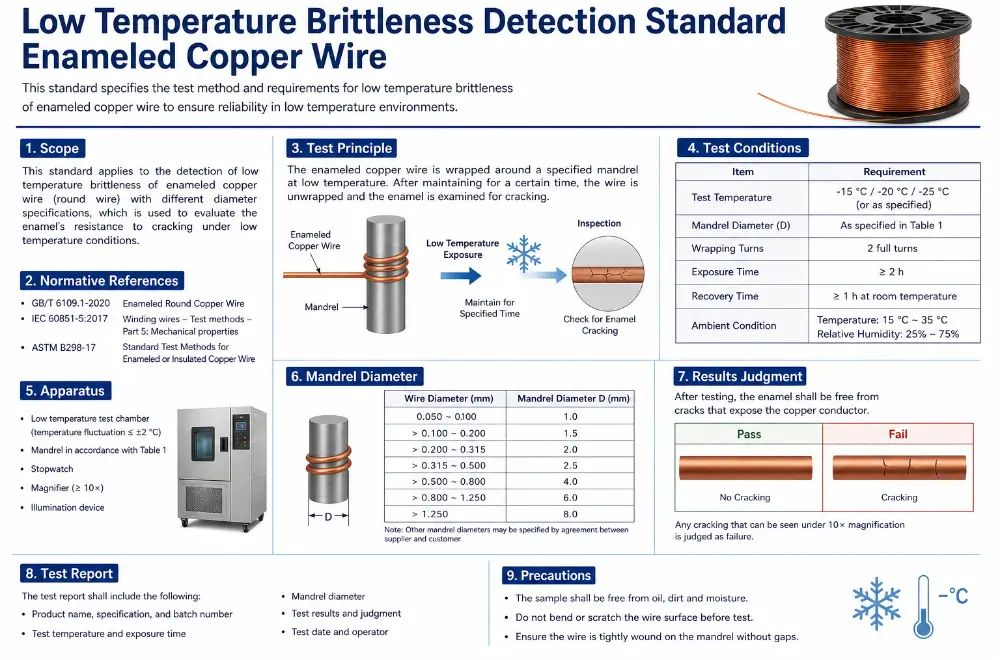
In the industry, “low-temperature brittleness testing” is not a single test, but a collective term for three different types of tests with different purposes and conditions, and the distinction matters whenever a customer writes “magnet wire low temperature brittleness test” into a purchase specification. They each have different applicable standards, sample conditions, temperature conditions, and criteria, and the data cannot be used interchangeably.
| Test type | Main standards | Temperature and conditioning time | Mechanical operation | Acceptance criterion | Typical application |
|---|---|---|---|---|---|
| Refrigerant resistance test | IEC 60317 parts / GB/T 6109 | -40°C, 4 hours conditioning | Bending after conditioning | No cracks in the enamel | Refrigeration compressor, sealed motor |
| Cold bend test | UL 2556 Section 7.5 / UL 2556.2 | Cooled to -25°C (typical) | Wound around a mandrel 4-8 times the wire diameter | No cracks | General cables and winding wires for low-temperature installation |
| Brittle temperature determination | GB/T 5470 / ASTM D746 / ISO 812 | Stepwise cooling with conditioning at each step | Bending attempted at each step | Record the temperature at which cracking begins | Material selection and formula development |
Refrigerant Resistance as a Product Standard Requirement
The refrigerant resistance requirement is a direct requirement for the enamel coating system in product standards. Item 13 of GB/T 6109.1-2008 gives typical conditions: after being placed in an environment of -40°C for 4 hours, a bending test is performed, and the criterion is that the enamel coating does not crack.
However, this requirement does not cover all enamel coating systems. GB/T 6109.9-2008, corresponding to IEC 60317-19:2000 for Class 130 polyurethane composite direct-solderable round wire, explicitly states in item 16 that refrigerant resistance is not applicable. This indicates that low-temperature requirements are determined on a product-by-product basis according to the resin system and intended use, and it cannot be generally assumed that “all enameled wires must withstand temperatures below -40°C”.
Mandrel Diameter Logic in the Cold Bend Test
Cold bend tests are more mature in the cable industry. Their core logic is to use a uniform mandrel ratio to simulate the minimum bending constraint during actual installation. The method specified in UL 2556 Section 7.5 is to cool the cable to a specified temperature (typically -25°C), then bend it around a mandrel with a diameter of 4 to 8 times the wire diameter and check for cracking.
The choice of mandrel magnification directly determines the rigor of the test. A smaller magnification means a smaller bending radius, greater outer layer strain, and a more stringent test. Procurement specifications often specify the mandrel magnification without specifying the angle, essentially handing the decision-making power over the magnification.
From the perspective of cable product temperature rating systems, minimum cold bending temperature, minimum installation temperature, and minimum continuous flexural temperature are three different concepts. The minimum installation temperature is typically 10 to 20°C higher than the laboratory cold bending temperature to compensate for the higher mechanical forces during on-site installation. The minimum continuous flexural temperature, on the other hand, is for applications involving repeated flexing thousands to millions of times at low temperatures, such as automated conveyor systems in environments as low as -30°C. Its evaluation criteria are far more stringent than those for a single bend.
Brittle Temperature Determination for Screening Rather Than Acceptance
GB/T 5470, ASTM D746 and ISO 812 are methods for determining the brittle temperature at the material level. They use a stepped cooling method to find the critical temperature point for cracking and output a temperature range rather than a binary conclusion of whether it is qualified or not.
This type of method is widely used in the rubber and plastics industry. Typical industry requirements include: EPDM for automotive sealing strips -50°C; PVC for wires and cables -25°C for standard types and -40°C for cold-resistant types; TPE for cold storage door seals -60°C; and aerospace silicone rubber -70°C. For enameled wire, this method is mainly used to determine the low-temperature window for new resin formulations, rather than as a routine acceptance item for finished wires.
Low-Temperature Requirements in the IEC 60317 System
The General Requirements section of IEC 60317 (IEC 60317-0-1:2013 and A1:2019 revisions) specifies the general test items for magnet wire in the form of enamelled round copper wire, covering dimensions, resistance, elongation, resilience, flexibility and adhesion, thermal shock, abrasion resistance, solvent resistance, breakdown voltage, insulation continuity, temperature index, resistance to refrigerants, solderability, thermal or solvent adhesion, dielectric loss, transformer oil resistance, weight loss, and pinhole test.
There is no separate item titled “low-temperature brittleness” in this list. This is a crucial prerequisite for understanding the entire low-temperature testing system.
Where Low-Temperature Requirements Actually Come From
Low-temperature performance requirements are distributed across various specific volumes. For example, IEC 60317-4 corresponds to grade 105 polyester enameled copper round wire, IEC 60317-13 corresponds to grade 180 polyester or polyimide enameled copper round wire, and IEC 60317-20 corresponds to grade 220 polyimide enameled copper round wire. The requirements for low-temperature related items vary significantly across different volumes; some specify particular temperatures and times, while others indicate that the requirements are not applicable.
The publicly available catalog of IEC 60317-0-7 (zero-defect fully insulated enameled copper round wire) clearly shows this structure: Clause 8 specifies flexibility and adhesion, 8.1 is the mandrel wrapping test, and 8.2 is the pull test; Clause 9 is thermal shock; and Clause 16 is refrigerant resistance. It is important to note that refrigerant resistance refers to the chemical extraction effect of the refrigerant (such as R22), which is completely different in purpose from low-temperature bending, and the two should not be confused.
Method Sources and Precedence Rules
The mechanical performance test methods in all volumes of IEC 60317 uniformly reference the IEC 60851 series. An important precedent rule in the standard is that when there are discrepancies between the IEC 60851 test method publications and the descriptions in the IEC 60317 volumes, the IEC 60317 volume shall prevail.
Another general rule is environmental conditions: unless otherwise specified, all tests should be conducted at temperatures between 15°C and 35°C and relative humidity between 45% and 75%, and the samples should be conditioned to a stable state in this environment before measurement. This rule applies to the baseline conditions for routine tests, and low-temperature tests are clearly an exception to the “unless otherwise specified” rule.
The NEMA MW 1000 System and ASTM Methods
NEMA MW 1000 (current version is NEMA MW 1000-2023) is the American general specification for magnet wire and the primary reference framework for North American magnet wire procurement. It adopts a three-part structure of Part 1 (terminology), Part 2 (product classification and specifications), and Part 3 (test methods), and continues to align with the IEC system.
The Part 3 Method Framework
Part 3 describes the complete testing process from routine inspection to periodic validation testing. Routine inspection includes dimensions and adhesion; periodic validation testing includes thermoplastic flow temperature and scratch strength. Key equipment includes a spring rebound tester (to measure the elastic memory of the copper conductor), a high voltage tester (to measure dielectric breakdown), a reciprocating scratch tester (to assess mechanical abrasion resistance), and a thermoplastic flow tester (to determine the insulation softening temperature).
In publicly available standard summaries, no separate low-temperature brittleness clause number is listed for any magnet wire designation, which leaves the low-temperature burden for magnet wire procurement largely to the customer. Low-temperature brittleness performance is scattered throughout the specific requirements of various MW models or comes from customer-defined specifications. This fact is consistent with the structural judgment of the IEC system.
Correspondence Between MW Designations and IEC Parts
There is a clear correspondence between NEMA models and IEC specifications: MW 16-C is a 240°C polyimide type, MW 30-C is a 180°C polyester or polyimide type, MW 35-C is a 200°C general-purpose high-performance type with a polyester base coat and a polyamide-imide top coat, and MW 85-C is a zero-defect, fully insulated, solderable type.
MW 35-C’s dual-coating structure provides excellent heat and chemical resistance, making it widely used in electric motors, transformers, and automotive starters. Annex H of the standard incorporates technical content from IEC 60317-56 for global harmonization, and MW 85-C directly adopts the dimensions and test methods from the IEC charts. This convergence means that the same material can simultaneously meet the requirements of both US standards and IEC.
The Applicable Boundaries of ASTM D2307
NEMA’s thermal class rating is based on ASTM D2307, which uses the 20,000-hour extrapolation method. It provides a temperature index, reflecting long-term thermal aging performance, not a low-temperature performance indicator.
This distinction must be strictly made in engineering practice. Temperature index answers “how long this wire can be used in a hot environment,” while low-temperature testing answers “whether this wire will crack in a cold environment.” These represent two opposing performance windows for the enamel coating polymer; they cannot be derived from each other, nor can low-temperature capability be inferred from thermal class values.
The following table consolidates where low-temperature provisions actually sit across the five standards most often referenced for enameled magnet wire, together with the conditions each specifies and whether the requirement is mandatory.
| Standard system | Location of low-temperature provisions | Typical conditions | Mandatory |
|---|---|---|---|
| IEC 60317-0-1 | No low-temperature clause in general requirements | Not applicable | No |
| IEC 60317 product parts | Varies by part, some declared not applicable | Part specific | Part specific |
| GB/T 6109.1-2008 | Clause 13, refrigerant resistance | -40°C, 4 hours, bending after conditioning | Part specific |
| GB/T 6109.9-2008 | Clause 16, declared not applicable | Not applicable | No |
| NEMA MW 1000-2023 | No dedicated clause number, scattered across MW types | Customer specification | No |
| UL 2556 / UL 2556.2 | Section 7.5, cold bend | Cooled to -25°C, wound around mandrel 4-8 times wire diameter | Cable industry practice |
Low-Temperature Provisions in the GB/T 6109 Series
The Chinese standard for magnet wire in the form of enamelled round copper wire, the GB/T 6109 series, corresponds to the IEC 60317 series, with the general requirements section being GB/T 6109.1-2008. There are two main items related to low temperature: one is resistance to refrigerants, and the other is the specific declarations in each volume.
General Requirements for Refrigerant Resistance
GB/T 6109.1-2008, item 13, specifies the following condition: after being placed in an environment of -40°C for 4 hours, a bending test is performed, and it is determined that the enamel coating should not crack.
This 4-hour period differs from the 16-hour period commonly used in low-temperature cable testing. The cable industry requires 16 hours to ensure complete temperature stability of the sample core. However, given the small diameter and low heat capacity of the wire, 4 hours is usually sufficient for the wire diameter to reach equilibrium. When citing data, it is crucial to specify which standard and clause it refers to; inconsistent usage is unacceptable.
Not-Applicable Declarations Across Product Parts
The requirements for low-temperature performance are detailed in each product section. Taking GB/T 6109.9-2008 (corresponding to IEC 60317-19:2000) as an example, item 16, resistance to refrigerants, is marked as inapplicable. Similarly, items 18, heat adhesion, 20, resistance to transformer oil, and 21, weight loss, are also marked as inapplicable. This demonstrates that the standard system assesses each performance characteristic individually based on the system’s specific features.
GB/T 6109.21-2008 (200 grade polyester-amide-imine) is a CNAS accredited project, and its testing scope typically includes suitability assessment for low-temperature resistance-related items. When purchasing and testing, it is essential to consult the original text of the specific section, rather than simply applying the general guidelines.
The Separation of Method Standards and Product Standards
The GB/T 4074 series are test method standards for enameled wires. For example, GB/T 4074.21-1987 is for thermal endurance testing (thermal aging test). This layered structure corresponds completely to IEC 60317 (product) / 60851 (method).
Understanding the concept of “delamination” helps in quickly locating the issue when disputes arise: Discuss “what the product must meet” by referring to GB/T 6109, and discuss “how to test” by referring to GB/T 4074. These two questions are most often confused in customer communication, leading to a mismatch between the test report and actual needs.
Test Equipment and Specimen Preparation
The reliability of low-temperature test results is highly dependent on the details of sample preparation. When the same batch of material yields different conclusions in different laboratories, it is usually not a material issue, but rather due to inconsistent condition control.
Conditioning Time and Thermal Equilibrium
The key parameter is the holding time, and magnet wire buyers should specify it explicitly. GB/T 6109.1 requires the refrigerant to be placed at -40°C for 4 hours; engineering practice for low-temperature cable testing requires holding at -40°C for at least 16 hours to ensure uniform cooling. Furthermore, there are more stringent laboratory requirements, where temperature fluctuations during testing should be controlled within ±2°C.
Insufficient insulation will cause the core temperature of the sample to exceed the set value, making the test too lenient and causing qualified samples to be mistakenly judged as passing. Excessive insulation does not increase the validity of the test, but only increases the cost and testing cycle.
Specimen Transfer and Test Timing
The timing of the operation after removing the sample is crucial. If the sample is left at room temperature for too long before testing, the temperature rise will distort the results. Therefore, engineering practice requires that the sample bend or tensile test be performed quickly after being removed from the cryogenic chamber.
To ensure proper timing, the cryogenic chamber and mechanical testing machine should be located in the same room, or an insulated transfer box should be used to maintain the sample temperature. This detail is often overlooked in third-party testing and is a common reason for inconsistent conclusions from different institutions for the same product.
Mandrel Diameter and Test Environment
The mandrel diameter for cold bending tests is typically specified to be 4 to 8 times the wire diameter, with the actual value determined by standards or customer specifications. The mandrel material and surface condition also affect the results; insufficient smoothness can cause additional friction and mechanical damage.
The temperature and humidity of the testing environment also need to be controlled. The IEC 60317 series specifies that routine tests should be conducted at 15°C to 35°C and 45% to 75% relative humidity, and the samples must be conditioned to stability. Conditioning before low-temperature testing and the low-temperature test itself are two separate processes; baseline conditioning cannot be skipped simply because a low-temperature test has been performed.
Low-Temperature Sensitivity of Different Enamel Systems
Across magnet wire enamel systems, the order of low-temperature sensitivity can be judged comprehensively from several dimensions, including adhesion, elongation, scratch resistance, flexural crack resistance, thermal shock, hydrolysis resistance, and direct weldability.
| Enamel system | Low-temperature crack resistance | Main limiting factor | Typical improvement direction |
|---|---|---|---|
| Polyurethane UEW | Relatively good | Flexible molecular chains but comparatively low adhesion | Increase crosslink density, add a topcoat |
| Polyester PEW | Moderate | Low cost but insufficient crosslink density | Imide modification |
| Polyester-imide EIW | Good | Thicker builds produce greater strain in the outer layer | Reduce coating build |
| Polyamide-imide AIW | Good | Excellent at high temperature, narrow strain tolerance at low temperature | Toughening modification |
| Polyimide PI | Good but costly | Dark colour, demanding winding process | Compound modification |
This table reflects an engineering trade-off: No single system is absolutely superior at low temperatures; coating thickness and curing quality often have a greater impact on low-temperature crack resistance than the resin type itself.
The Inverse Relationship Between Coating Build and Toughness
A thicker enamel coating results in higher breakdown voltage and thermal stability, but poorer bending toughness. This is because the tensile strain on the outer layer increases significantly with decreasing radius during bending, and stress concentration occurs earlier in thicker coatings, making it easier to exceed the strain tolerance.
This principle has a clear corresponding application in engineering: transformers and motors requiring high voltage often use a thicker Grade 2 coating; while small inductors, relays, and tightly wound coils requiring high toughness tend to use a thinner Grade 1 coating. The GB/T 6109, IEC 60317, and JIS standards all adhere to this rule, with a higher coating grade number indicating a thicker coating.
Curing as the Most Overlooked Variable
The curing temperature profile, oven air velocity, and paint viscosity collectively determine the crosslinking density and internal stress of the enamel coating. Insufficient curing leads to low crosslinking density, high internal stress, and susceptibility to cracking; over-curing, on the other hand, makes the enamel coating itself brittle and reduces its elongation.
Therefore, when investigating low-temperature cracking issues, if the enamel coating system and thickness meet the requirements, the focus should be on checking the curing process records, rather than directly suspecting the resin supplier. Acceptance criteria and process control are two sides of the same coin here.
Procurement Acceptance and Engineering Judgement Criteria
Low-temperature performance is a typical customer specification priority item when procuring magnet wire. When there are no mandatory low-temperature clauses in the standard, the final judgment comes from the contract technical specifications, drawing annotations, or specific industry standards.
Four Points to Confirm in the Specification
Four things need to be confirmed during the inquiry and technical agreement phase. First, the test type: clearly specify whether it’s a refrigerant resistance test, cold bending test, or brittle temperature determination; these three are not interchangeable. Second, the temperature and holding time: for example, -40°C/4 hours or -25°C cold bending. Third, the mechanical operating parameters: mandrel ratio, bending angle, and whether tension is required. Fourth, the criterion: is it visual inspection for no cracks and no peeling of the enamel coating, or is an electrical withstand voltage test or pinhole test required?
Point 4 is particularly important. The detection capabilities of visual criteria and electrical criteria are completely different. A wire with an intact enamel coating surface may have had its pinholes expanded after low-temperature stretching.
Required Elements of a Complete Test Report
A usable low-temperature test report should include at least the following: referenced standard number and year, product models and wire diameter, enamel coating system and grade, number of samples, test temperature and measured holding time, transfer method, mandrel diameter and magnification, criterion description, results for each sample and description of non-conforming locations.
Reports lacking descriptions of the transfer method are unreliable for their -40°C results, as it is impossible to determine whether the test was conducted after the temperature had risen.
Common Causes of Nonconformity and Corrective Actions
The most common cause is insufficient conductor annealing. The corrective action is to increase the annealing temperature or extend the holding time to ensure the elongation meets the lower limit of the standard (≥15% for 0.630-1.250mm wire diameter, ≥20% for 1.250-2.800mm, and ≥30% for 2.800-5.000mm). The second cause is excessive coating thickness. The corrective action is to reduce the coating increment or use a thinner coating grade. The third cause is abnormal curing process. The corrective action is to calibrate the oven temperature field and recheck the paint viscosity. The fourth cause is poor copper surface condition. The corrective action is to strengthen cleaning after wire drawing and surface inspection before annealing.
It’s important to distinguish that all four of the above can be corrected through process control. If the Tg of the resin system itself does not meet the requirements, then it’s a material selection issue, which can only be resolved by changing the system.
Regarding temperature conditions, purchasers often specify “-40°C test,” but this statement is incomplete—it doesn’t specify the method used, the duration of insulation, or the bending ratio. A more prudent approach in engineering is to directly cite the standard clause number, clearly stating the test type, temperature, duration, bending ratio, and criteria in one go, to prevent suppliers from interpreting it in the most lenient way.
When reviewing reports, it is essential to verify the actual measured insulation time and temperature fluctuation range, rather than simply looking at the standard number printed on the report. Similarly, a report specifying a particular test type cannot be used to prove that a product meets another type of low-temperature requirement, because the temperature conditions, sample conditions, and judgment logic are all different.
During the material selection and design phases, low-temperature performance should be evaluated in conjunction with the operating environment. If the equipment is statically installed in a low-temperature environment without bending, the stress level is extremely low, and standard general requirements are often sufficient. However, if there is assembly, vibration, or frequent deflection at low temperatures, the low-temperature bending index must be written into the technical agreement, and the compatibility between the enamel coating system and the coating grade must be evaluated simultaneously, rather than relying solely on the thermal class parameter.