

Overview: Class 130’s Position in the Enameled Wire System
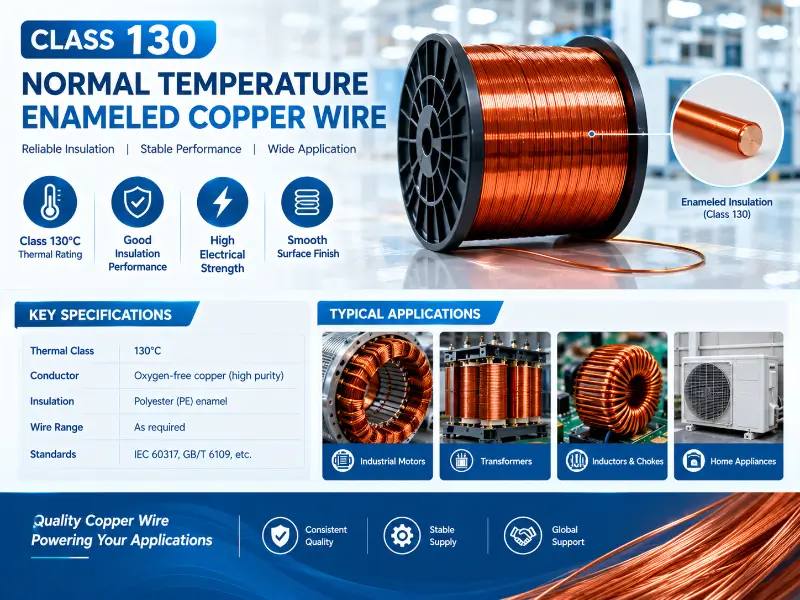
Class 130 (also known as Class B) is the closest to “normal temperature operation” in the enameled wire thermal class system. With a temperature index of 130°C and a thermal shock temperature of at least 155°C, these parameters make it suitable for use in household appliances, small motors, relays, and instrument coils where temperature rise is low. We recently spoke with several purchasing managers, and they often immediately asked, “Is Class 130 130°C or 155°C?” The answer is: 130°C is the temperature index (the highest reference temperature for long-term reliable operation), and 155°C is the thermal shock temperature (the limit for short-term overload without paint cracking). The numbering of this class differs across the four major standard systems: IEC, NEMA, GB/T, and JIS. We will clarify these differences below. According to the NEMA MW 1000-2018 catalog, Class 130 round wire has only one specification: MW 75-C (polyurethane enameled copper wire, solderable). The IEC standard corresponds to 60317-4, the GB/T standard to 6109.4, and the JIS standard to C 3202.6. In other words, if you want to buy Class 130 round wire, you can only choose the polyurethane enameled coating system—this is a hard constraint of Class 130 in international standards.
In-depth analysis of the Class 130 enameled coating system
Chemical basis and solderable characteristics of polyurethane (UEW)
The only enameled coating system corresponding to Class 130 is polyurethane (UEW). Its core resin is polyurethane, which can be modified but must retain the original resin’s chemical properties—a strict requirement specified in IEC 60317-4:2015. The biggest feature of polyurethane is its direct solderability. What does this mean? Conventional enameled wire requires stripping (mechanical scraping or chemical etching) before soldering, while polyurethane enameled coating can be dissolved and peeled off by molten solder flux after immersing in a 360°C solder bath for 3-6 seconds, saving a step. This may seem insignificant, but in applications like relays and miniature inductors that require extensive manual or automated soldering, the savings go far beyond just time—poor consistency in the stripping process is often the root cause of early failures.
Physical and Electrical Performance Characteristics
The dielectric dissipation factor of polyurethane enameled coating performs well at high frequencies. This is crucial for switching power supplies, high-frequency transformers, and RF inductors—low losses mean low temperature rise, which in turn protects the enamel coating, creating a positive cycle. The enamel coating itself is soluble in specific dyes, so different colors can be used to distinguish wire diameters from the same batch (red, yellow, blue, and green are common colors), facilitating phase sequence identification in high-density windings. Polyurethane has moderate mechanical strength and moderate chemical resistance—these are its weaknesses. If your application involves strong acid or alkali environments (electroplating workshops, chemical plants), or requires high-strength mechanical bending (frequently vibrating vehicle motors), careful evaluation is necessary. Polyurethane enamel coatings are sensitive to polar solvents (ketones, esters); cleaning the coating surface with solvents other than alcohol before winding may damage the integrity of the enamel coating.
Comparison of Class 130 (enamel coating) and its adjacent grades
Class 120 (Grade E, corresponding to polyvinyl alcohol formal varnish PVF, NEMA MW 15-C / IEC 60317-1) is the lower neighbor of Class 130. Class 120 is not directly weldable, has a harder enamel coating, and higher mechanical strength—but its heat resistance is 10°C lower. Class 155 (Grade F, corresponding to polyurethane modified varnish, NEMA MW 79-C / IEC 60317-20) is the upper neighbor of Class 130, and it is also directly weldable, with a temperature index 25°C higher, and is also significantly more expensive. An interesting phenomenon is that many buyers only focus on the temperature index when selecting a product, ignoring the “direct weldable” process characteristic. If your production line uses manual soldering or selective wave soldering, Class 130 UEW is the most cost-effective solution. If it uses automated winding + potting (where the encapsulating enamel completely covers the enameled wire, eliminating the need for soldering), then Class 120 PVF is cheaper and more robust.
International Standard Comparison for Class 130 Enameled Copper Wire
Core Requirements of NEMA MW 75-C Standard
NEMA MW 75-C is the specification on page 52 of ANSI/NEMA MW 1000-2018 Part 2, officially named “Polyurethane for Solderable Applications (Single and Heavy)”. It defines two enamel coating grades for Class 130 round wire: single (Grade 1) and heavy (Grade 2). Note: There is no Grade 3 (extra-thick enamel) within the MW 75-C system. If a customer requires Grade 3, a special agreement is needed; it is not directly covered in the standard. The general specification accompanying NEMA MW 1000-2018 is MW 1000 Part 1, which specifies the test methods for all common indicators of enameled wire, such as conductor diameter tolerance, elongation, resistivity, breakdown voltage, and scratch resistance. MW 75-C is a “specification for a specific type” and must be used in conjunction with Part 1.
Scope and Key Changes of IEC 60317-4:2015 ED4
IEC 60317-4:2015 is the current IEC standard for Class 130 round wire (enameled wire), and its title is straightforward: “Solderable polyurethane enameled round copper wire, class 130”. It was superseded by a new version at the end of 2021 (95.99 Withdrawal status), but most manufacturers in the market are still referring to the 2015 version. The new standard has made several key technical changes: 3.2.2 adds general descriptions of the winding wires (previously written in the scope); 3.2.3 adds appearance requirements; Clause 19 revises the dielectric loss factor; and Clause 23 adds a pin hole test. IEC 60317-4 specifies the conductor diameter range as follows: Grade 1: 0.018 mm – 2.000 mm; Grade 2: 0.020 mm – 2.000 mm. This range covers the entire spectrum from the finest AWG 46 (approximately 0.040 mm) to the thickest AWG 13 (approximately 1.800 mm). However, it should be noted that 0.018 mm is the lower limit of the standard; actual production is limited by wire drawing processes, and the minimum production specifications of mainstream manufacturers are generally between 0.025 and 0.040 mm.
Country Correspondence between GB/T 6109.4 and JIS C 3202
GB/T 6109.4 is the Chinese national standard’s corresponding specification for Class 130 round wire (enameled wire), and the title also specifies “Class 130 direct-welding polyurethane enameled copper round wire”. The GB/T 6109 series is an equivalent conversion of the IEC 60317 series (IDT or MOD relationship), so the technical specifications are highly consistent with IEC 60317-4, and the purchaser does not need to re-evaluate when switching between domestic and export manufacturers. JIS C 3202.6 is the corresponding specification for the Japanese Industrial Standard. Japanese manufacturers (such as Jintian, Sumitomo, and Essex Furukawa) commonly use JIS standards to export to the Asian market, and the performance indicators are equivalent to the NEMA/IEC system. JIS standards are more detailed and have stricter inspection standards for the appearance of enamel coatings than IEC standards—a characteristic of Japanese manufacturing.
Key Terminology Explanation: IACS 100% and Resistivity
The upper limit of conductor resistivity for Class 130 enameled copper wire (any enameled copper wire) is 0.017241 Ω·mm²/m—this is the equivalent value of 100% IACS (International Annealed Copper Standard). Annealed copper (soft state, O state) has the highest conductivity; conductivity decreases by 1-2% after hard drawing. The “100% IACS” stated in the product specification is actually a process target value; the actual measured resistivity is usually slightly lower than 0.017241 (conductivity slightly higher than 100% IACS). If you see a manufacturer’s label “101% IACS” or “102% IACS,” that’s a characteristic of high-quality oxygen-free copper (OFHC)—and it’s also more expensive.
Key Performance Indicators of Class 130 Enameled Copper Wire
Conductor Specifications
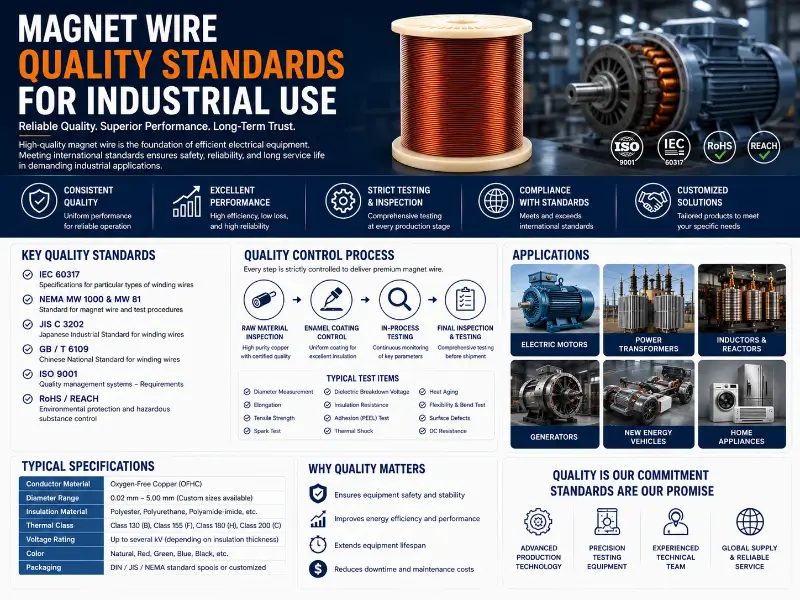
Conductor Material: Copper (C11000 Oxygen-Free Copper / C12200 Phosphorus-Containing Deoxidized Copper, see details below for performance differences) Conductor Diameter Range: 0.018 mm – 2.000 mm (IEC 60317-4 range) AWG Compatibility: 13# – 46# (covering most ultra-fine wire applications) Conductor Resistivity: ≤ 0.017241 Ω·mm²/m (20°C, 100% IACS) Elongation: ≥ Specified value (graded according to conductor diameter, AWG 13 approximately ≥ 25%, AWG 46 approximately ≥ 7%)
Enamel Coating Grade (Grade 1 / Grade 2 / Grade 3)
The enamel coating grade affects three key parameters: outer diameter, breakdown voltage, and duty cycle.
| Enamel Coating Grade | Code | Enamel Coating Increment (Reference) | Typical Application |
|---|---|---|---|
| Grade 1 | Single | Minimum | High-frequency coils, transformers (low dielectric loss preferred) |
| Grade 2 | Heavy | Standard | General motors, relays (electrical strength preferred) |
| Grade 3 | Triple (manufacturer’s agreement) | Maximum | Extreme environments, high-voltage insulation |
The NEMA MW 75-C system only covers Grade 1 and Grade 2. Grade 3 is not directly defined in the standard and requires a special agreement between the manufacturer and the customer. If you see Grade 3 listed in a manufacturer’s product manual, please request a test report to confirm that the enamel coating increment and breakdown voltage meet your requirements.
Breakdown Voltage
The breakdown voltage test for Class 130 enameled wire is conducted under two conditions: room temperature and rated temperature 130°C. At room temperature, the breakdown voltage must be ≥ the standard specified value; at rated temperature, the breakdown voltage is allowed to decrease to 75% of the room temperature specified value. The breakdown voltage increases with increasing conductor diameter (absolute value), but the dielectric strength per unit thickness increases with decreasing diameter (fineer wires withstand a higher voltage gradient per micrometer of enameled coating). For example, for AWG 24 (approximately 0.510 mm conductor diameter) Grade 1, the typical room temperature breakdown voltage is approximately 2.5-3.5 kV; for AWG 30 (approximately 0.254 mm conductor diameter) Grade 1, it is approximately 1.5-2.0 kV. Specific values are subject to the manufacturer’s factory test report—the standard specifies the minimum value, and actual production often exceeds the minimum.
Thermal Properties
| Specifications | Class 130 Requirements |
|---|---|
| Temperature Index | 130°C |
| Thermal Shock Temperature | ≥ 155°C (enamel coating will not crack) |
| Softening Breakdown Temperature | ≥ 200°C (enamel coating will not fail due to pressure at high temperatures) |
| Soldering Temperature (UEW direct soldering) | 360°C ±10°C, 3-6 seconds |
| Temperature Index 130°C does not equate to a recommended operating temperature of 130°C. The temperature index is a “long-term reliable operating reference temperature” extrapolated from the Arrhenius aging model. The actual operating temperature is determined by the equipment’s temperature rise, load cycling, and ambient temperature. When Class 130 enameled wire is installed in a household motor with a temperature rise of 60-70°C, the winding hotspot temperature may reach 110-120°C, and the enameled coating life can exceed 20 years. If installed in a sealed transformer where the hotspot reaches 140°C, the enameled coating life will be shortened to 5-7 years. Thermal Shock Temperature 155°C refers to short-term overload protection. If the enameled wire is instantly immersed from room temperature into a 155°C oven, the enameled coating should not crack or blister. Class 130 enameled wire is stable at 155°C, but there is a risk of failure above 175°C. Softening Breakdown Temperature (200°C) measures the enamel coating’s ability to withstand mechanical stress at high temperatures. The enamel coating is subjected to pressure during winding, shaping, and binding; it is also subjected to pressure during transformer impregnation and drying. If the enamel coating softens and fails below 200°C, the winding may short-circuit during manufacturing. |
Mechanical and Technological Properties
Elongation: Measures the plasticity of the copper conductor. Insufficient elongation means the wire is stiff and prone to breakage during winding. Under the IEC 60317 system, the typical elongation requirement for AWG 24 is ≥ 25% (soft state), and for AWG 36 it is approximately ≥ 12%. Scraping Force: Measures the adhesion between the enamel coating and the copper conductor. Insufficient scraping force means the enamel coating is easily scraped off during winding, resulting in pinholes. The scraping force of Class 130 enamel coating is generally lower than that of Class 180 polyester enamel coating (polyurethane enamel coating itself is softer). This is a characteristic of its manufacturing process, not a defect. Spring back angle: Measures the angle at which the enameled wire springs back after winding. The spring back angle of Class 130 enamel coating is larger than that of Class 120 PVF—the polyurethane enamel coating is softer, and the copper conductor’s elastic recovery is more pronounced. This characteristic needs to be considered when winding precision inductors. Soldering time: The solder bath time window for UEW direct soldering. At a 360°C solder bath, 3 seconds is the lower limit (to ensure the enamel coating fully dissolves), and 6 seconds is the upper limit (to avoid prolonged high-temperature damage to the copper conductor). If your production line’s solder bath temperature is too low (340-350°C), you need to extend it to 8-10 seconds; if it’s too high (370-380°C), shorten it to 2-3 seconds.
Typical Application Scenarios of Class 130 Enameled Copper Wire
General Motors and Household Appliance Motors
Class 130 (washing machines, range hoods, electric fans, air conditioner indoor units) extensively use Class 130 enameled round wire.
The operating temperature of the motor stator winding is typically 100-120°C (Class B temperature rise), and the heat resistance margin of Class 130 UEW (enamel coating) is sufficient. After the winding is wound, it usually needs to be impregnated with insulating varnish for reinforcement. After impregnation, the entire winding forms a single unit. Class 130 exhibits stability under the impregnation process—the enamel coating will not be excessively swollen by the impregnation solvent (mainly toluene and xylene).
Relays and Solenoid Valves
Communication relays, automotive relays, and industrial control relays commonly use Class 130 UEW enameled wire for two reasons: First, it allows for direct soldering; relay coil pins are automatically soldered (automatic winding + automatic soldering), and the stripping process would slow down the cycle time. Second, it offers good high-frequency performance; some communication relays operate in the kHz band, and the low dielectric loss of the polyurethane enameled coating reduces coil heating. Solenoid valves operate at even lower temperatures (mostly in ambient environments), and the heat tolerance of Class 130 is more than sufficient.
Low-Voltage Transformers and Electronic Ballasts
Small power supplies (mobile phone chargers, small appliance power adapters) and fluorescent lamp electronic ballasts are traditional application areas for Class 130. Transformers operate at frequencies of 50 Hz – 500 Hz, and the dielectric loss of the enameled coating has little impact; however, the interlayer insulation of the windings and the filling of end gaps depend on the integrity of the enameled coating. Class 130 UEW Grade 1 enamel coating is sufficient to cover the interlayer insulation requirements of 220V/110V low-voltage transformers.
Instrument Coils and Precision Inductors
Precision inductors, current transformers, voltage transformers and precision inductance measuring instruments (multimeters, oscilloscopes, signal generators) often use Class 130 UEW enameled wire. The reason: the polyurethane enamel coating can be dyed, and multi-colored wire windings make phase sequence identification easier during commissioning and maintenance. Miniature inductors (chip inductors, surface mount inductors) use even finer Class 130 enameled wire (AWG 38-46), which has high requirements for enamel coating integrity—the pinhole test must be passed.
Micro and Small Motors
Class 130 UEW is widely used in power tool motors (drills, angle grinders, lawnmowers), office equipment motors (printers, copiers), and medical device motors (infusion pumps, ventilator drives). These applications have comprehensive performance requirements for enameled wire: heat resistance (motor temperature rise), solderability (lead wire connections), mechanical strength (high-speed centrifugal force), and chemical resistance (lubricants, cleaning agents). Class 130 UEW enameled coating offers balanced overall performance and is a “universal solution” for micro motors.
Selection and Acceptance Considerations for Class 130 Enameled Copper Wire
Selection Decision Process
Step 1: Confirm Temperature Index Requirements. Check the equipment temperature rise curve—what is the hot spot temperature of the motor/transformer? Class 130 (130°C temperature index) is suitable for applications with hot spots ≤ 130°C. If the hotspot temperature is 130-155°C, choose Class 155; if it’s 155-180°C, choose Class 180. Step 2: Confirm if direct soldering is required. If the production line uses automated winding and soldering, choose UEW (UEW systems are available for Class 130/155/180); if it’s manual winding and enamel encapsulation, PVF (Class 120) or PEW (Class 155/180) are cheaper. Step 3: Confirm the enamel coating grade. Choose Grade 1 for low-voltage windings (≤ 220V); Grade 2 for medium-voltage windings (220V – 660V); Grade 3 for high-voltage windings (≥ 660V) or special environments (humid heat, corrosion) (requires specific manufacturer agreement). Step 4: Confirm conductor diameter. Working backwards from the current density (typically 4-8 A/mm²), considering the skin effect (high-frequency applications) and duty cycle (window fill rate), we finally arrive at the standard AWG specifications. Step 5: Confirm Manufacturer Certifications. Customers requiring UL, RoHS, REACH, etc. certifications must request copies of the certificates from the manufacturer. Customers exporting to Europe and America must have RoHS + REACH; customers exporting to North America also require UL.
Acceptance Testing Points
Visual Inspection: The enamel coating should be continuous, uniform, free of bubbles, impurities, and scratches. Observe with a 10x magnifying glass; the enamel coating should be smooth and have a consistent color. Dimensional Measurement: Conductor diameter is measured using a micrometer (accuracy ±0.001 mm) or a laser diameter gauge; outer diameter is measured using the same method but with an added enamel coating increment. The enamel coating increment is accepted according to three grades: Grade 1 / Grade 2 / Grade 3. Breakdown Voltage Test: Apply voltage to the enameled wire at room temperature using a high-voltage tester until breakdown occurs. The sampling quantity for each batch shall be in accordance with GB/T 6109 or IEC 60851 standards (usually 5-10 samples). Temperature Shock Test: Place the enameled wire in a 155°C oven for 30 minutes, then immediately immerse it in room temperature water for rapid cooling. The enamel coating should not crack, blister, or peel. Soldering Test (Applicable to UEW): Immerse the enameled wire in a 360°C solder bath for 3-6 seconds. The enamel coating should be dissolved and peeled off by flux, and the copper conductor surface should be covered with a solder layer. Elongation Test: Stretch the enameled wire using a tensile testing machine until it breaks, and record the percentage elongation at break.
Common Quality Issues and Handling
| Problem Phenomenon | Possible Causes | Handling Measures |
|---|---|---|
| Breakdown voltage below standard | Uneven enamel coating, pinholes, impurities | Return or exchange, request the manufacturer to provide the batch’s test report |
| Poor soldering | Over-modified enamel coating, flux mismatch | Adjust solder bath temperature (360±10°C), change flux |
| Brittle enamel coating | Excessively humid storage environment, expired storage period | Improve storage (≤ 25°C, ≤ 60% RH), FIFO |
| High conductor resistance | Conductor not 100% IACS (e.g., CCA replacement) | Request the manufacturer to provide material certification (material report) |
| Insufficient elongation | Hard conductor (unannealed), excessive wire drawing | Request soft (O-state) conductor, confirm annealing process |
Engineering Trade-offs between Class 130 and Adjacent Classes
Class 130 vs Class 120
Class 120 (E grade) enamel coating is primarily polyvinyl alcohol formaldehyde (PVF, NEMA MW 15-C). Class 120 enamel coating is harder, has higher mechanical strength, but is not resistant to direct welding (requires paint stripping or mechanical scraping). If your application is in a vibrating environment (vehicle motors, power tools), Class 120 enamel coating is more robust; for automated welding lines, Class 130 UEW is more economical. Class 120 is 10-20% cheaper than Class 130—if heat resistance is sufficient and direct welding is not required, Class 120 is the better solution.
Class 130 vs Class 155
Class 155 (F grade) enamel coating is modified polyurethane (NEMA MW 79-C / IEC 60317-20). Class 155 can also be directly soldered, with a temperature index 25°C higher. Class 155 is 15-30% more expensive than Class 130—but it provides an extra 25°C of heat resistance. If your equipment’s hot spot temperature is on the edge of 120-130°C, Class 155 is a safer choice; if the hot spot is clearly ≤ 110°C, Class 130 is sufficient.
Class 130 vs Class 180
Class 180 (H grade) enamel coating is primarily based on polyester imide (Polyesterimide, EIW, NEMA MW 30-C / IEC 60317-8). Class 180 enamel coating has high hardness and strong heat resistance, but is not resistant to strong alkalis—but it cannot be directly soldered. Class 180 is widely used in industrial motors, wind turbines, and traction motors. If your application requires industrial-grade heat resistance, Class 180 is the preferred choice; if your application’s primary process requirement is direct solderability, Class 130/155 still holds the advantage.
Material Selection Decision Tree
Temperature Priority → Hot spot temperature determines the grade (Class 120 / 130 / 155 / 180 / 200 / 220 / 240) Process Priority → Direct soldering determines the enamel coating system (UEW direct soldering / PEW non-direct soldering / EIW non-direct soldering / PVF non-direct soldering) Environment Priority → Strong alkaline environments exclude EIW, strong acid environments exclude PVF, outdoor environments require UV resistance Certification Priority → UL certification typically requires above 130°C, North American automotive standards typically require above 155°C
Summary: Engineering Value and Applicable Boundaries of Class 130
Class 130 enameled copper wire is a “just right” grade in the enameled wire system—its temperature index is sufficient to cover the operating conditions of most household appliances, small motors, and low-voltage transformers. The enamel coating system (polyurethane) UEW offers the convenience of direct soldering, while striking a balance between Class 120 and Class 155 pricing.
If your application involves strong acid or alkali environments, high-intensity mechanical vibration, or sustained high temperatures exceeding 130°C, Class 130 is not the optimal solution—consider Class 155/180/200. However, if your application is typical of scenarios such as household appliances, relays, instrument coils, precision inductors, or micro motors, Class 130 UEW is a mature solution proven by decades of engineering. We recommend that engineers do three things when selecting a Class 130 UEW: measure the hot spot temperature of the equipment (confirm that 130°C is sufficient), evaluate the production line process (confirm that direct soldering is required), and verify international standards (confirm which NEMA MW 75-C / IEC 60317-4 / GB/T 6109.4 / JIS C 3202.6 apply to the customer’s procurement contract). After completing these three steps, selecting a Class 130 UEW will generally be a safe bet. Class 130 is not the cheapest, nor is it the most heat-resistant—but it is the “just right” one.