

Why Motors Need a Dedicated Insulation System
During operation, motors are subjected to four superimposed stresses: electromagnetic stress (inter-turn voltage, phase voltage, transient surges), thermal stress (temperature rise due to copper losses + iron losses + windage losses), mechanical stress (electromagnetic vibration + starting impact + centrifugal force from rotational speed), and environmental stress (humidity, dust, oil mist, refrigerant, corrosive gases). The insulation system must simultaneously withstand the combined effects of these four types of stresses for a design life of over 20 years. International standards IEC 60034-1 and GB 755 define the insulation class as the maximum permissible operating temperature of the winding insulation material, while IEC 60085 and GB/T 11021 provide the thermal aging classification of the insulation material itself.
Motor Insulation Thermal Class System
The core of insulation class is the sum of “extreme heat resistance temperature + temperature rise limit + hot spot margin”. The reference ambient temperature is 40℃. Adding the standard temperature rise and hot spot margin to this value yields the maximum allowable operating temperature for that class. The classifications given by the three major standard systems, IEC 60085, NEMA MG-1, and UL 1446, are as follows: – Class Y 90℃: Unimpregnated cotton, silk, paper, thermoplastics. This is now largely obsolete and used only in very low-cost low-voltage equipment. – Class A 105℃: Impregnated cotton, silk, paper, natural rubber. Standard temperature rise 60K (1.0 SF), hot spot margin 5K. – Class E 120℃: Polyurethane resin, epoxy resin, polyethylene terephthalate. Standard temperature rise 75K, hot spot margin 5K. Commonly found in early IEC designs for small household appliance motors. – Class B 130℃: Mica, glass fiber, asbestos + high-temperature adhesive, standard temperature rise 80K (1.0 SF), hot spot margin 10K, formerly the traditional mainstream grade for general industrial motors. – Class F 155℃: Modified epoxy resin, polyimide resin impregnated mica tape, glass fiber reinforced polyimide film, standard temperature rise 105K, hot spot margin 10K, currently the de facto standard for industrial motors. – Class H 180℃: Silicone rubber, polyimide resin impregnated mica tape, polyimide film-mica composite insulation, standard temperature rise 125K, hot spot margin 15K, suitable for harsh scenarios such as high temperature, high pressure, variable frequency speed control, traction, and new energy drives. – Class N 200℃: Aramid paper + high-end mica products, used in special high-temperature equipment. – Class R 220℃: Polyimide film + special adhesive mica, corresponding to the highest conventional grade newly added in the IEC 60085 revision. – Class C ≥220℃: Inorganic insulation materials such as ceramics, glass, quartz, and PTFE have no fixed upper temperature limit and are determined by material properties and product design verification. They are mainly used in aerospace, deep well drilling, and special metallurgy. The widely used 10K rule states that “for every 10℃ exceeding the rated temperature, the insulation life is approximately halved.” Class F insulation, used with Class B temperature rise (80K), can obtain a heat margin of approximately 25K, extending the insulation life by about 5 times. This is the common engineering practice of “Class F design, Class B temperature rise.”
Comparison of Four Major Insulation Material Families
Motor winding insulation can be classified into four main categories according to the form of the main insulation: enameled wire (enamel coating insulation), glass fiber-insulated wire (fiber + enamel coating), paper-insulated wire (insulating paper + enamel coating), and mica tape and film composite (high voltage main insulation).
Enameled Wire
Each of these four types of materials has its own emphasis in terms of thermal class, dielectric strength, mechanical toughness, chemical resistance, and cost. Enameled wire is the most widely used winding conductor in small and medium-sized motors. It consists of copper or aluminum conductor coated with a 0.02-0.1mm thick layer of polymer insulating varnish, which is cured into a film through multiple cycles of coating and baking. Common enamel coating types include polyester varnish (130℃), polyurethane varnish (120-130℃, suitable for direct welding), polyester-imide varnish (180℃), polyamide-imide varnish (200℃, chemically resistant), polyimide varnish (220-240℃, radiation resistant, resistant to extreme temperature differences), and modified polyester varnish (155℃, general-purpose and economical). The IEC 60317 series specifies independent standard numbers for each enamel coating: 60317-3 modified polyester, 60317-8 polyester-imide, 60317-13/20 polyurethane, 60317-25/26 polyester-imide, 60317-29 polyamide-imide, and 60317-40/44 polyimide. The advantages of enameled wire are high space utilization, uniform enamel coating, typical dielectric strength of 5-10 kV/mm, and good mechanical flexibility, making it suitable for automatic winding and high-speed winding processes.
Glass-Insulated Wire (Fiberglass Covered Wire)
The disadvantage is that a single-layer enamel coating has relatively weak resistance to high-frequency pulses, partial discharges, and mechanical scraping, requiring the use of slot insulation, slot wedges, and phase-to-phase insulation to form a complete insulation system. Glass fiber insulated wire is made by spirally wrapping enameled wire or bare copper wire with alkali-free E-glass fiber yarn, then impregnating it with silicone, polyester, or epoxy resin and baking to cure. According to the NEMA MW 1000 system classification, commonly used models include MW 41-C (single-layer glass filament + polyester, 155℃, grade F), MW 43-C (single-layer glass filament + silicone resin, 180℃, grade H), MW 44-C (single-layer glass filament + polyester + silicone, 180℃, grade H), MW 47-C (double-layer glass filament + polyester + silicone, 180℃, grade H, extremely high mechanical strength), MW 48-C (double-layer glass filament + silicone resin, 180℃, grade H, for flat wire), MW 50-C (single-layer high-temperature organic paint, 180℃, grade H, high humidity), and MW 45-C/MW 46-C (double-layer polyester + glass filament, 155℃, grade F). The advantages of glass fiber-insulated wire are its extremely high mechanical strength (glass fiber tensile strength 1000-3000 MPa), resistance to thermal shock (no damage from short-term overload at 300℃), moisture resistance, and breakdown voltage of 20-40 kV/mm. Typical applications include traction motors, rail transportation, nuclear power, wind power generation, mining, and oil-immersed transformers. Disadvantages include a thick insulation layer (0.10-0.20 mm per side for round wires and 0.10-0.25 mm per side for flat wires), lower slot fill factor, and susceptibility to glass fiber cracking during bending.
Paper-Insulated Wire
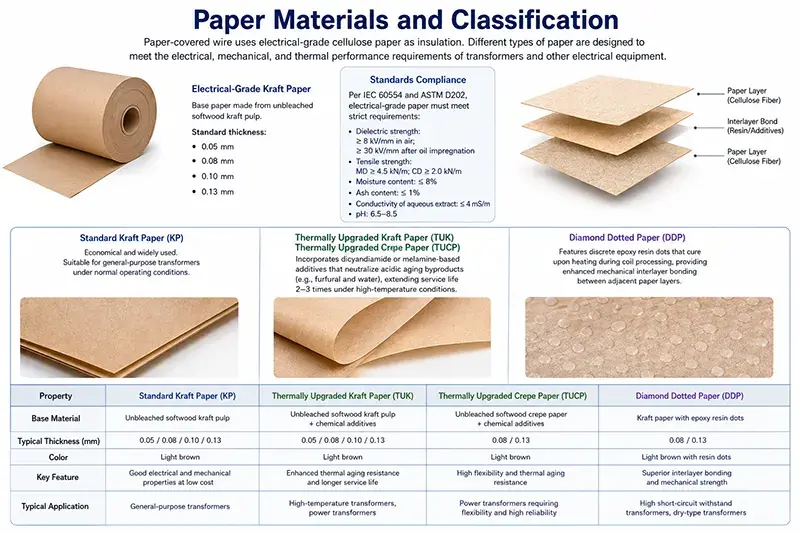
Strict control of wrapping tension (1.0-3.0 N) and overlap rate (50-80%) is required. Paper-insulated wire is made by spirally wrapping insulating paper (kraft paper, crepe paper, aramid paper (Nomex® 410/414), mica paper) around the conductor. It is mainly used in oil-immersed transformers and a few large motors. Common types of insulating paper include kraft paper (0.05-0.15mm, 105℃, Grade A), crepe paper (0.10-0.25mm, good flexibility), Nomex® 410 aramid paper (0.05-0.76mm, 220℃, Grade C), Nomex® 414 aramid paper (0.10-0.76mm, 220℃, Grade C, tear resistant), and mica paper (0.05-0.20mm, 500-1000℃, Grade C+). Paper-insulated wires offer advantages such as excellent corona resistant performance (uniformly distributed electric field in the fiber structure, resulting in a 30-50% higher partial discharge initiation voltage compared to enameled wires of the same thickness), good heat dissipation (porous structure enhances air convection), and mechanical buffering (local damage does not immediately lead to overall failure), making them suitable for high-frequency, high-voltage, mining, and rail transportation applications. The disadvantages are low space utilization (insulation layer 0.2-0.5mm, slot fill factor only 0.3-0.5%), easy moisture absorption (insulation resistance decreases 10 times at 60% humidity), and the need for additional impregnation treatment.
Mica Tape and Film Composite Insulation
Mica tape is the core material of the main insulation of high-voltage motors. It is composed of mica paper + glass cloth or aramid cloth + adhesive. It can withstand a dielectric strength of 15-25 kV/mm and a temperature resistance of 500-1000℃, making it the insulation form with the best high temperature resistance and corona resistance performance. Polyimide film (Kapton®) is heat-resistant up to 400℃, aramid paper (Nomex®) is heat-resistant up to 220-240℃, and polyester film (PET/Mylar®) is heat-resistant up to 150℃. When used in conjunction with mica tape, they can form high-voltage main insulation structures such as mica + polyester film composites, mica + aramid paper composites, and mica + polyimide film composites. These are mainly used in 3kV to 15kV high-voltage motor stator windings, high-voltage transformers, induction heating equipment, nuclear power main pumps, and fire-resistant cables. The advantage of composite insulation is its superior overall performance: top-tier temperature resistance, voltage resistance, corona resistance, mechanical strength, and lifespan. The disadvantages are complex processes, high cost, and the need for specialized equipment for winding and impregnation.
Key Selection Parameters for Motor Windings
The selection of insulation materials is not determined by a single parameter, but by the coordinated matching of five major parameters: – Thermal class: It must cover the hottest temperature during motor operation + 25-30K margin. Class F design and Class B temperature rise are the most cost-effective common practices for industrial motors. – Dielectric strength and partial discharge resistance: including breakdown voltage (kV or kV/mm), PDIV (partial discharge initiation voltage), PDEV (partial discharge extinction voltage), and tanδ (dielectric loss tangent). Low-voltage motors focus on breakdown voltage; medium and high voltage motors (≥3kV) must control PDIV ≥ 1.5 × peak operating voltage and tanδ ≤ 0.02-0.04. – Mechanical strength: tensile strength, elongation, scratch strength, and springback angle. Automated winding requires elongation ≥ 30%, scratch strength ≥ 5N, and springback angle ≤ 5°. – Chemical and environmental resistance: oil resistance, refrigerant resistance, hydrolysis resistance, damp heat aging resistance, and salt spray resistance. – Process and cost: Automated winding, VPI impregnation compatible, compatible with existing tooling, cost per kilogram.
Differentiated Selection for Six Major Motor Families
The insulation requirements vary greatly across different application scenarios, necessitating the reverse matching of material systems according to the specific scenario.
General-Purpose Industrial Motors (IE3/IE4, 0.55–315 kW)
The mainstream solution is Class F insulated wire (polyester imide PEI IEC 60317-25/26) + polyester film trench insulation + Class F impregnated resin. This achieves Class F design, Class B temperature rise, and a lifespan of over 20 years. NEMA Premium/IE3 high-efficiency motors have stringent requirements for insulation loss and temperature rise, making Class F material systems the most cost-effective option.
New Energy Vehicle Drive Motors (NEV, 800 V SiC Inverter, 60–250 kW)
NEV represents the most demanding motor scenario in terms of insulation requirements. An 800V DC bus + SiC inverter generates surge voltage peaks of 1600-2400V with a rise rate of 20-50 kV/μs, and the inter-turn insulation is subjected to high-frequency partial discharge erosion. The mainstream solution is H-class or N-class enameled wire (polyester imide + polyamide imide PEI + PAI composite IEC 60317-27/29 or pure PAI IEC 60317-29) + PDIV reinforced coating + epoxy powder coated ends + mica tape main insulation. It must meet IEC 60034-18-41 Type I or Type II insulation testing. For round wire motors, the enamel coating thickness is Grade 2/3 (0.030-0.080mm), and for flat wire hairpin motors, it uses a double-layer structure of PAI/PI topcoat + PEI basecoat.
Wind Power Generators (DFIG/PMSG-DD, 1.5–18 MW)
The core challenges of wind turbines are high-altitude environmental temperature differences (-40℃ to +55℃), salt spray corrosion, and a 20-year maintenance-free lifespan. The mainstream solution is H-grade or C-grade glass fiber wrapped wire (MW 47-C/MW 48-C) + silicone resin or polyimide impregnation + VPI vacuum pressure impregnation. It must pass the IEC 60068-2-52 96-hour salt spray test, the IEC 60068-2-60 flowing mixed gas corrosion test, and the IEEE 1776 / IEC 60034-18-41 PDIV verification.
Rail Transit Traction Motors (IEC 61373 Cat 1 Class B, 30-Year Life)
Rail transit motors are subjected to severe vibration, impact, a wide temperature range (-50℃ to +50℃), frequent starts and stops, and regenerative braking. The mainstream solution is H-grade double-layer glass fiber wrapped wire (MW 47-C round wire / MW 48-C flat wire) + silicone resin or polyimide impregnation. It must meet EN 45545-2 HL3 fire resistance, TB/T 3230 insulation system life, and IEC 60034-27 PDIV ≥ 1.5 × operating voltage.
Industrial Compressors / Pumps / Fans (10–500 kW)
The mainstream solution is F-class enameled wire + polyester film + F-class impregnated resin. Refrigerant compressors especially require refrigerant and refrigeration oil compatibility: R22 is compatible with enameled wire, R410A requires PEI+PAI composite insulation, R32 requires PAI topcoat, R290 (propane, GWP=3) requires reinforced end insulation for explosion protection, R134a industrial chillers can use F-class enameled wire, and R744 (CO₂) transcritical systems require PAI/PI high-temperature insulation.
Household Appliance Motors (Air Conditioner / Refrigerator / Washing Machine / Vacuum Cleaner, 0.05–2 kW)
The mainstream solution is Class B or Class F enameled wire (polyester PE or polyurethane PU, IEC 60317-3 / 60317-13) + polyester film groove insulation + Class B or Class F impregnation resin. Variable frequency air conditioner BLDC motors with 20-80 kHz PWM switching frequencies require the enameled coating to have a certain degree of corona resistance. IE5 energy efficiency rating requires a loss reduction of more than 20%, driving the gradual replacement of Class B with Class F enameled wire.
International Standards and Compliance Requirements
The standard system for motor insulation is divided into four categories according to level: – Material Standards: IEC 60317 series (enameled wire by type), IEC 60851 series (enameled wire test methods), NEMA MW 1000 (North American unified standard for enameled wire, glass fiber, and paper-insulated wire), GB/T 6109 (Chinese enameled wire), GB/T 7672 (Chinese glass fiber insulated wire), JIS C 3202 (Japanese enameled wire), ASTM B49/B193 (copper conductor), ASTM D149/D1676/D2307 (insulation material testing). – Insulation System Standards: UL 1446 (EIS certification for insulation systems, 5 aging cycle definitions for A/E/B/F/H levels), IEC 60172 / IEEE 1 (Temperature Index TI 20,000-hour extrapolation), ASTM D2307 (Arrhenius assessment of thermal life). – Motor System Standards: IEC 60034-1 (Ratings and performance of rotating electrical machines), GB 755 (China equivalent), UL 1004-1/3/7 (North American safety standards for motor systems), CSA C22.2 No.100/No.77 (Canadian motor standards), EN 60034 (European standards). – Application Standards: IEC 60034-18-41 (Insulation systems for variable frequency motors, Type I/II classification), IEC 60034-18-42 (PD verification for variable frequency motors), IEEE 841 (Chemical process IE3 harsh conditions motors), IEC 60079 (Explosion-proof motors ATEX/IECEx), EN 45545-2 (Railway fire protection), ISO 26262 (Automotive functional safety), IATF 16949 (Automotive quality), AEC-Q200 (Automotive passive components). Compliance is a stringent requirement in the international market. Motors exported to North America must pass UL 1446 EIS certification, with labels clearly indicating “Insulation System: Class F @ 155℃”; frequency converters (drive motors) exported to Europe must meet IEC 60034-18-41 Type I or Type II testing; motors exported to the automotive industry must pass IATF 16949 quality system certification and AEC-Q200 component certification.
5-Step Selection Decision Framework
Motor insulation selection is a systematic project, and it is recommended to proceed in the following 5 steps: 1. Scenario Definition and Operating Condition List: Determine the motor type (induction/synchronous/brushless DC/resistive/claw pole), rated power, rated voltage, speed, load curve (S1-S9), ambient temperature, altitude, humidity, IP protection level, expected life, and special operating conditions (variable frequency drive/explosion-proof/rail transit/aviation). 2. thermal class Matching: Calculate the required insulation class by using “hotspot temperature + 25-30K margin”. For example, ambient temperature 40℃, temperature rise 80K, hotspot margin 10K → select Class B (130℃); under the same conditions, temperature rise 105K → select Class F (155℃); ambient temperature 60℃, temperature rise 105K, hotspot margin 10K → select Class H (180℃). 3. Material System and Structure Selection: Select enameled wire/glass-insulated wire/paper-insulated wire/composite insulation based on the application scenario. For low-voltage general-purpose motors, select Class F PEI enameled wire (IEC 60317-25); for high-voltage variable frequency motors, select Class H PEI+PAI composite enameled wire (IEC 60317-27/29); for traction/nuclear power/wind power, select Class H or Class C glass-insulated wire (MW 47-C/MW 48-C); for oil-immersed transformers, select paper-insulated wire + mineral oil. 4. Dielectric Strength and Partial Discharge Withstand Verification: Define the target values for breakdown voltage, PDIV, PDEV, and tanδ. Low-voltage motors (≤ 690V) require a breakdown voltage ≥ 5 kV; medium-voltage motors (3-6 kV) require a PDIV ≥ 1.5 × peak operating voltage and tanδ ≤ 0.02; high-voltage motors (≥ 10 kV) require a PDIV ≥ 2 × peak operating voltage and tanδ ≤ 0.015. 5. Compliance and Quality Verification: Confirm the UL / CSA / VDE / TÜV / CE / CCC certification requirements of the target market; sample according to ISO 2859-1 AQL 1.0 Level II; perform 4-dimensional quality verification (material consistency, dimensional tolerances, breakdown voltage, and thermal aging).
4-Dimensional Quality Verification System
Quality verification of motor insulation needs to cover four dimensions: materials, electrical, mechanical, and thermal: – Material Consistency: Conductor resistivity, chemical composition of enamel coating/glass fiber/paper, viscosity/solid content of impregnating resin. Sampling inspection for each batch is recommended, ISO 2859-1 AQL 1.0 Level II. – Dimensional Tolerances: Conductor diameter ± tolerance, enamel coating thickness Grade 1/2/3, overall outer diameter increment, ellipticity ≤ 50% tolerance. – Electrical Performance: Breakdown voltage (IEC 60851-5 stranded wire method or metal rod method), insulation resistance (≥ 0.5 MΩ/kV), PDIV (medium and high voltage), tanδ (medium and high voltage). – Thermal Aging: Thermal shock (Class 105-220 temperature range, no cracking when wound with a mandrel of 4 times the diameter), softening breakdown (≥ 170-300℃ range), thermal life Arrhenius assessment (≥ 20,000 hours TI).
Conclusion: Four-Dimensional Match of Operating Conditions, Temperature, Materials, and Cost
There is no absolute “best” for motor insulation, only the “most suitable”. Class F enameled wire is the king of cost-effectiveness for general industrial motors; Class H PEI+PAI composite enameled wire is currently the first choice for new energy vehicle drive motors; Class H/C glass fiber wrapped wire is a reliable choice for demanding scenarios such as traction, wind power, and nuclear power; mica tape composite insulation is an irreplaceable solution for high-voltage motors. The essence of selection decisions is a four-dimensional matching of operating conditions, temperature, materials, and cost. Under the standard systems such as IEC 60034-1, IEC 60085, UL 1446, NEMA MG-1, and GB/T 11021, proceeding through a 5-step process of “scenario definition → thermal class → material system → dielectric verification → compliance” is the most robust path to avoid selection errors and ensure a 20-year lifespan for the motor.