


I. Overview of Copper Foil for Power Lithium Batteries
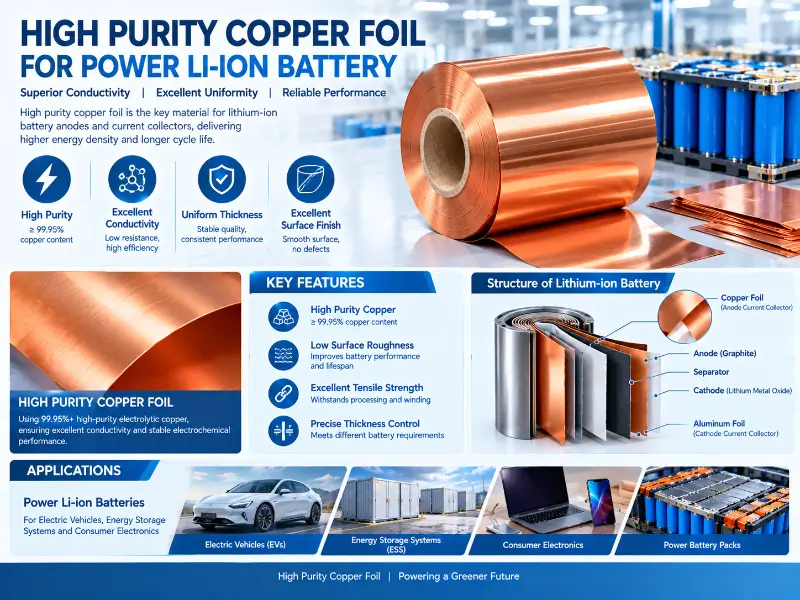
Power lithium-ion batteries, as core energy storage components in high-power applications such as electric vehicles, energy storage systems, and power tools, require a crucial material inside their cells—copper foil—that simultaneously possesses high conductivity, high flexibility, oxidation resistance, and good adhesion to the negative electrode active material. In the lithium-ion battery structure, copper foil primarily functions as the anode current collector, serving the dual purpose of carrying the active material (graphite or silicon-carbon particles) and acting as an electron conduction channel.
Under the design requirements of high energy density (>250 Wh/kg), high rate capability (>3C), and long cycle life (>2000 cycles) for power batteries, the engineering parameters of copper foil have evolved from a simple “conductive layer” used in ordinary electronic circuits to a sophisticated, multi-dimensional, integrated material system. The copper foil of a typical power battery needs to simultaneously meet the following engineering constraints:
| Dimensions | Typical Requirements |
|---|---|
| Purity | Cu ≥ 99.9%, Fe < 0.0010%, Bi < 0.00020%, Pb < 0.0005% |
| Thickness Tolerance | ±1 g/m² (based on IPC-4562A equivalent areal density tolerance) |
| Tensile Strength | RT ≥ 294 MPa, 180°C ≥ 196 MPa |
| Elongation | RT ≥ 5%, 180°C ≥ 3% |
| Surface Roughness | Shiny Ra 0.1-0.4 μm; Matte Rz 0.8-2.0 μm |
| Antioxidant | No oxidation after 90 days at room temperature / 15 minutes at 160°C |
| Pinhole | None (IPC-TM-650 2.1.2) |
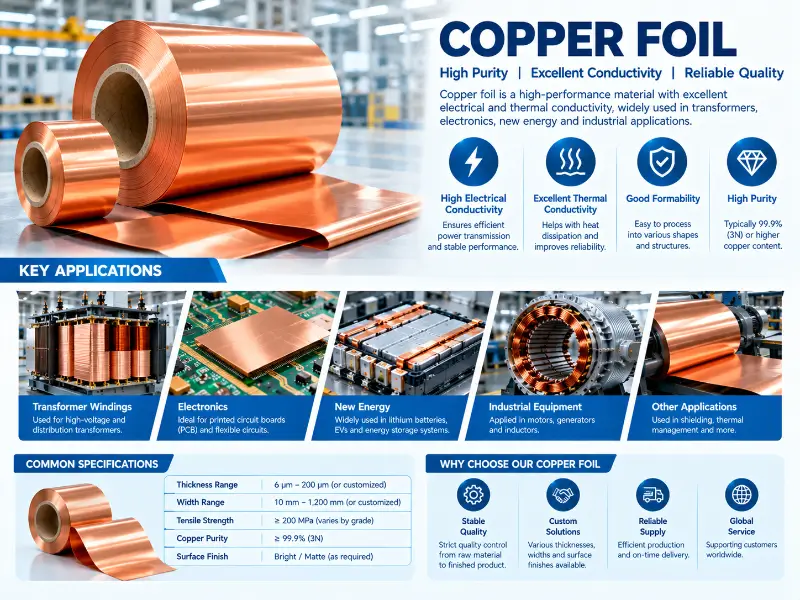
| Width | 200-1295 mm (customizable) |
The engineering design of ordinary 1 oz PCB copper foil (35 μm) cannot be directly transferred to the 6-12 μm battery foil system. This article systematically reviews the “selection decision of high-purity copper foil in power lithium batteries” that is of concern to engineers and purchasers, covering six dimensions: material characteristics, manufacturing process, standard system, application scenarios, cost and decision-making process.
II. Material Structure and Manufacturing Process
2.1 Purity Grade and IACS Conductivity
The “high purity” of copper foil used in lithium batteries is usually defined as 4N grade (Cu content ≥ 99.99%) to 4N5 grade (≥ 99.995%), with 99.9% (3N) being the minimum threshold for actual industrial products. Impurities such as Fe, Bi, and Pb have a significant impact on battery performance: Fe can cause an increase in self-discharge, while Bi and Pb may precipitate under high voltage, causing internal short circuits. Therefore, there are strict regulations on impurity limits for battery-grade copper foil.
| Purity Grade | Cu Content | Fe Limit | Bi Limit | Pb Limit | Typical Applications |
|---|---|---|---|---|---|
| 3N (Battery-Grade Base) | ≥ 99.9% | < 0.0010% | < 0.00020% | < 0.0005% | Consumer Electronics Batteries |
| 4N (Power Grade) | ≥ 99.99% | < 0.0005% | < 0.00010% | < 0.0003% | Power Battery Negative Terminal |
| 4N5 (High-end/Aerospace) | ≥ 99.995% | < 0.0003% | < 0.00005% | < 0.0002% | Aviation batteries, special energy storage |
Regarding conductivity, pure copper at 20°C has an IACS (International Annealed Copper Standard) of 100%, corresponding to 5.80 × 10⁷ S/m. Ordinary electrolytic copper foil, due to crystal defects, has a conductivity of approximately 99-101% IACS; while rolled and annealed (RA) copper foil can recover to 100-101.5% IACS through annealing. HTA (High Tensile Alloy) high-strength alloy copper foil, due to the addition of alloying elements, has a conductivity that decreases to 40-86% IACS.
2.2 Classification of Manufacturing Processes
The mainstream manufacturing processes for copper foil in power lithium batteries can be divided into four categories:
Copper foil is produced by continuously depositing a copper layer on a titanium roller cathode using a copper sulfate electrolyte, followed by peeling, roughening, and anti-oxidation treatment. The ED (Electrode Coating) process is currently the mainstream technology for power battery copper foil, with over 90% of battery copper foil worldwide using this route. Its advantages include: – Thickness can be controlled within the range of 4-105 μm, enabling the production of 6 μm ultra-thin copper foil – Single roll length can reach 5000-15000 meters, suitable for continuous coating – Surface roughness can be flexibly adjusted through electrolyte formulation and current density – High single-line capacity (leading Chinese companies can reach 15,000 tons/year/line).
Typical specifications for ED copper foil, according to the IPC-4562A standard, cover eight thicknesses: 6/7/8/9/10/12/15/20 μm.
Oxygen-free copper rods are continuously rolled to a thickness of 6-50 μm, followed by annealing and softening. The advantages of RA copper foil are: – A double-sided symmetrical bright structure with a metal density close to the theoretical value – Excellent ductility (elongation up to 15-25%) – Extremely high thickness uniformity (±2%) – Suitable for silicon-carbon anodes (Si-C composite anodes require highly ductile copper foil to withstand volume expansion).
RA technology is widely used in 3C batteries and silicon-based anode batteries, but its cost is 30-50% higher than ED technology.
With the accelerated penetration of silicon-carbon anodes (Si-C content > 15%) in power batteries, the tensile strength of traditional pure copper foil (300-400 MPa) is no longer sufficient to withstand the 300% volume expansion of silicon during charging and discharging. HTA copper foil, by adding alloying elements such as Ag, Sn, and Zr to the copper matrix, increases the tensile strength to 500-750 MPa (50-100% higher than pure copper), while maintaining thermal stability at 500°C.
| Performance | Standard ED Copper Foil | HTA Alloy Copper Foil |
|---|---|---|
| Tensile Strength (RT) | 300-400 MPa | 500-750 MPa |
| Tensile strength at 180°C | 150-200 MPa | 200-300 MPa |
| Conductivity (IACS) | 100% | 40-86% |
| Softening temperature | 200°C | 500°C |
| Suitable for negative electrodes | Graphite (Si < 5%) | Silicon-carbon (Si 10-30%) |
These include three main categories: aluminum-clad copper (Al-Cu), tin-clad copper (Sn-Cu), and silver-clad copper (Ag-Cu). Al-Cu composite foil utilizes the low density of aluminum (2.7 g/cm³ vs. copper 8.96 g/cm³) to achieve lightweighting and is primarily used for busbar connectors in EV battery modules. Sn-Cu composite foil improves solderability through a surface tin layer and is used for tab soldering. Ag-Cu composite foil can reduce skin effect losses in high-frequency applications.
2.3 Surface Treatment Process
The surface treatment of copper foil determines its adhesion to the negative electrode paste, and it is mainly divided into four categories:
| Surface Type | Process Characteristics | Surface Roughness (Ra) | Main Applications |
|---|---|---|---|
| Single-Side Frosted | Single-sided roughening + anti-oxidation treatment | 0.25 μm (Shiny) / 2.6 μm Rz (Matte) | Standard power battery |
| Double-Side Shiny | Symmetrical brightness on both sides | 0.25 μm Ra | 3C batteries, silicon-carbon anodes |
| Single-Side Carbon Coating | 1 μm Conductive Carbon Layer Coated on One Side | – | High-Rate Battery |
| Double-Side Carbon Coating | 1 μm carbon layer on each side | – | High Energy Density Battery |
Carbon-coated copper foil, by coating the copper foil surface with a 1 μm thick layer of conductive carbon paste (carbon black + PVDF or CMC binder), can significantly reduce the contact resistance between the negative electrode current collector and the active material, thereby improving the battery rate performance; at the same time, the carbon layer, as a buffer layer, can absorb the volume expansion stress of the silicon-carbon negative electrode and extend the cycle life.
III. Performance Parameter Comparison
3.1 Comparison of Thickness and Areal Density
IPC-4562A is a standard for “Metallic Foil for Printed Circuit Boards” published by the International Electronics Industry Connectivity Council (IPC). Table 3.5.1 of this standard clearly specifies the thickness-area density relationship for battery-grade ED copper foil.
| Nominal Thickness (μm) | Areal Density (g/m²) | Areal Density Tolerance (g/m²) | Typical Applications |
|---|---|---|---|
| 6 | 54 | ±1 | High energy density square battery |
| 7 | 63 | ±1.25 | High energy density square battery |
| 8 | 72 | ±1.5 | Mainstream power batteries |
| 9 | 89 | ±1.8 | Cylindrical 18650/21700 |
| 10 | 89 | ±1.8 | Cylinder 21700/4680 |
| 12 | 107 | ±2.2 | Large cylindrical, energy storage battery |
| 15 | 133 | ±2.8 | PHEV, Energy Storage |
| 20 | 178 | ±3.6 | Commercial vehicles, energy storage |
Areal density tolerance directly affects the consistency of battery capacity. The areal density requirement for copper foil in power battery production lines is usually IPC-4562A “Standard 2”: ±1-2 g/m²; high-end batteries require Standard 1: ±0.5 g/m².
3.2 Mechanical Properties
Tensile strength and elongation are the two core mechanical parameters of copper foil for power batteries. During the charging and discharging process, the volume of the negative electrode changes (approximately 10% for graphite and >100% for silicon-carbon). The copper foil needs to have sufficient tensile strength to prevent breakage, while also requiring high elongation to adapt to bending coating and rolling processes.
| Performance | 25°C (room temperature) | 180°C (high temperature) | Testing Standards |
|---|---|---|---|
| Tensile Strength | ≥ 280-400 MPa | ≥ 150-200 MPa | IPC-TM-650 2.3.18 / 2.4.18 |
| Elongation | ≥ 3.5-6.66% | ≥ 2-3% | IPC-TM-650 2.3.18 / 2.4.18 |
| Oxidation at 180°C for 1 hour | – | No discoloration, no breakage | IPC-TM-650 2.3.15 |
| Tensile strength at 180°C for 1 hour | ≥ 150 MPa | – | Industry standard |
3.3 Surface Quality
The surface quality of the copper foil directly determines the battery’s internal resistance, cycle life, and safety. Key parameters include:
- Roughness: Shiny surface (contacting the back of the negative electrode current collector): Ra 0.1-0.4 μm; Matte surface (contacting the negative electrode slurry): Rz 0.8-2.0 μm. Higher roughness results in stronger adhesion but also higher internal resistance. – Pinholes: Must be zero. Any pinholes will cause slurry leakage during coating, potentially leading to internal short circuits in the battery. – Anti-oxidation: No oxidation or discoloration after 90 days at room temperature / 15 minutes at 160°C. – Surface Tension: ≥ 38 dyne/cm (smooth surface); ≥ 56 dyne/cm after carbon coating. – Wettability: The contact angle of the negative electrode slurry on the copper foil surface should be < 30°.
3.4 Electrical Performance
The volume resistivity of copper foil is 1.724 × 10⁻⁸ Ω·m at 20°C (corresponding to 100% IACS). In battery applications, the sheet resistance of copper foil is more critical than the bulk resistance because it directly determines the internal resistance of the battery.
- 6 μm copper foil surface density: 54 g/m², corresponding to a theoretical volume resistivity of 1.724 × 10⁻⁸ Ω·m at a thickness of 6 μm. – 8 μm copper foil surface density: 72 g/m², theoretical surface resistivity: 2.15 mΩ/□. – 10 μm copper foil surface density: 89 g/m², theoretical surface resistivity: 1.94 mΩ/□.
3.5 Physical and Chemical Properties
The thermal conductivity (401 W/m·K) and coefficient of thermal expansion (16.5 ppm/°C) of copper foil directly affect the thermal management and dimensional stability of the battery. Regarding chemical stability, the copper foil must remain inert in the battery electrolyte (LiPF₆ + EC/DMC) to avoid reacting with the electrolyte and generating gas.
IV. Comparison of Standard Systems
4.1 GB/T 5230 (Chinese National Standard)
GB/T 5230-2000, “Electrolytic Copper Foil,” is China’s national standard for electrolytic copper foil, specifying the models, specifications, and technical requirements for electrolytic copper foil used in printed circuit boards. An updated version, GB/T 5230-2019, was released in 2019, clearly defining parameters such as purity (≥ 99.9%), areal density, and tensile strength (RT ≥ 280 MPa) for battery-grade copper foil.
The models system of GB/T 5230 is similar to that of IPC-4562A, classifying copper foil into eight grades ranging from 6 to 105 μm based on thickness. GB/T 5230-2019 added an appendix on copper foil for batteries, which specifies the impurity limits, oxidation resistance, roughness, and other indicators for copper foil used in LiB.
4.2 IPC-4562A (International Standard)
IPC-4562A is a standard for “metal foil for printed circuit boards” published by the International Electronics Industry Connectivity Council (IPC), and it is widely used by the global battery industry as the de facto standard for battery-grade copper foil. IPC-4562A covers all types of copper foil, including ED copper foil, RA copper foil, and rolled copper foil, and classifies them according to parameters such as thickness, areal density, roughness, tensile strength, and elongation.
IPC-4562A Table 3.5.1 specifies in detail the areal density and tolerances for eight thicknesses: 6/7/8/9/10/12/15/20 μm. Table 3.5.2 specifies three grades of areal density tolerances: Grade 1, Grade 2, and Grade 3 (Grade 1 being the most stringent and Grade 3 the most lenient). Table 3.5.3 specifies the minimum values for tensile strength and elongation.
4.3 JIS C1100 (Japanese Standard)
JIS C1100 is the “General Purpose Copper Strip” standard in Japanese industrial standards. Although it is not a battery-specific standard, major Japanese copper foil suppliers (such as JX Nippon and Mitsui Mining & Smelting) manage their oxygen-free copper raw materials using the JIS C1100 system. JIS C1100 specifies a Cu content of ≥ 99.9%, which is equivalent to GB/T 5230.
4.4 Other Industry Standards
- IEC 61287-1: Standard for power converters for rail transit vehicles, involving copper busbars but not specifically for copper foil. UL 1642 / UL 1973: Lithium-ion battery safety standards (North America), indirectly affecting copper foil selection. UN 38.3: Lithium-ion battery transportation standards. GB/T 36276-2018: Safety requirements for power batteries for electric vehicles. IATF 16949: Quality management systems for the automotive industry (copper foil supplier access requirements).
4.5 Comparison Table of Standard Systems
| Standard | Scope | Key Parameters | Corresponds to IPC-4562A |
|---|---|---|---|
| GB/T 5230-2019 | Chinese Electrolytic Copper Foil | Thickness 6-105 μm, Purity ≥ 99.9% | Compatible |
| IPC-4562A | Global Printed Circuit Board + Battery Foil | 8 Thickness Grades, 3 Tolerance Grades | – |
| JIS C1100 | Japanese Oxygen-Free Copper Raw Material | Cu ≥ 99.9% | Indirect Correspondence |
| IATF 16949 | Automotive Supply Chain | System Certification | Non-Product Standards |
| UL 1642 / 1973 | North American Battery Safety | System Certification | Not a Product Standard |
V. Comparison of Application Scenarios
5.1 Power Battery (EV)
Power batteries are currently the largest application area for high-purity copper foil. Typical specifications: – Square batteries (e.g., CATL CTP, BYD blade batteries): 8-10 μm ED copper foil, width 500-800 mm – Large cylindrical batteries (Tesla 4680, CATL 46105): 10-12 μm ED copper foil, width 400-600 mm – **Soft-pack batteries: 6-8 μm ED or RA copper foil, width 200-400 mm
Key engineering requirements for copper foil in power batteries: – Tensile strength ≥ 350 MPa (withstands rolling tension) – Elongation ≥ 6% (accommodates coating machine bending) – Areal density tolerance ±1 g/m² (ensures capacity consistency) – Antioxidant resistance for 90 days (meets long-chain production and inventory requirements) – Surface carbon coating (improves 3C rate performance)
5.2 Energy Storage Battery (ESS)
The requirements for copper foil in energy storage systems differ from those in power batteries: – Preferred thickness 10-15 μm (prioritizing cost over energy density) – Tensile strength ≥ 280 MPa (no rate capability requirement) – Lifespan > 5000 cycles (higher than 2000 cycles for power batteries) – Single roll length > 10000 m (reducing roll change frequency) – Emphasis on copper foil fatigue after long-term cycling
5.3 3C Consumer Electronics
Requirements for copper foil in 3C batteries (smartphones, laptops, tablets): – 6-8 μm RA or double-sided bright ED copper foil – Elongation > 15% (required for winding process) – High surface uniformity (to avoid inconsistent battery thickness) – Cost sensitive (low profit margins in consumer electronics)
5.4 Power Tools and Electric Two-Wheeled Vehicles
Power tool batteries (power tools, garden tools, electric two-wheelers) requirements: – 8-10 μm ED copper foil – Tensile strength ≥ 300 MPa – High rate capability (5-10C discharge) – Special attention to strength retention under 30-80°C high-temperature cycling
5.5 Aviation and Special Applications
Special applications such as aviation batteries, satellite batteries, and deep-sea batteries require copper foil with the following specifications: – 4N5 purity (≥ 99.995%) – High reliability verification (certified by DO-160, ESCC, etc.) – Resistance to radiation and vacuum outgassing – Weight sensitivity (preferably 6-8 μm ultrathin foil)
5.6 charging station Busbar and battery connection piece
{Charging station}, the busbar connectors of battery modules often use Al-Cu composite foil instead of pure copper strip: – Al-Cu composite foil 0.1-0.3 mm thickness – Single-sided Al (for soldering battery tabs) + single-sided Cu (for soldering PCB) – 30-50% lighter than pure copper – 20-40% lower cost
VI. Cost and Procurement Comparison
6.1 Raw Material Costs
The cost of copper foil mainly consists of four parts: – Copper price (60-70%): based on LME copper price (USD/lb or CNY/t) – Processing fee (15-25%): including electrolysis, rolling, surface treatment, carbon coating, etc. – Energy cost (5-10%): electricity is the largest energy consumption in the ED process – Packaging and transportation (5-10%): vacuum packaging, temperature-controlled transportation
Global Battery Copper Foil Market Outlook for 2025: – Global production capacity > 1.2 million tons/year (China accounts for 55%) – Major Chinese manufacturers: Nord Copper, Jiayuan Technology, Jiujiang Defu, Huwei Copper Foil, Tongguan Copper Foil – Major overseas manufacturers: SK Nexilis (South Korea), LS M&T (South Korea), JX Nippon (Japan) – High-end HTA copper foil premium 50-100% – Standard ED copper foil USD 15-20/kg (2025 spot price)
6.2 Processing Costs
Differences in processing costs between different technologies:
| Process | Processing Fee Ratio | Unit Cost (CNY/m²) | Applicable Thickness |
|---|---|---|---|
| ED Standard | 15-20% | 0.5-1.0 | 6-20 μm |
| ED carbon coating | 25-35% | 1.5-2.5 | 6-12 μm |
| RA Calendering | 35-50% | 2.0-3.5 | 6-50 μm |
| HTA Alloy | 50-80% | 3.5-6.0 | 4-15 μm |
| Composite foil | 40-60% | 2.5-4.0 | 0.1-0.3 mm |
6.3 Procurement Cycle and Supply Chain
Characteristics of the copper foil supply chain for power batteries: – Long construction cycle: Copper foil plants require 18-24 months from planning to production. – Long overseas certification cycle: SK Nexilis requires 12-18 months to validate its entry into Tesla’s supply chain. – High price volatility: Copper prices are expected to fluctuate between USD 8500-10500/t in 2024-2025. – Inventory sensitivity: Battery manufacturers have high requirements for copper foil inventory management (90-day usage).
6.4 Long-term maintenance costs
Maintenance considerations for copper foil throughout the battery’s lifecycle: – Taper welding quality: Copper foil surface oxidation reduces laser welding yield. – Coating process stability: Decreased surface tension of the copper foil reduces slurry adhesion. – Electrolyte compatibility: Compatibility differences between copper foil and specific electrolytes (e.g., LiFSI). – Storage conditions: Below 25°C / 65% RH, sensitive to relative humidity.
VII. Selection Decision Process
7.1 Step 1: Define the specifications of the battery cell
The first step in battery selection is to define the key parameters of the battery cells: – Battery type (prismatic/cylindrical/pouch) – Target energy density (>250 Wh/kg?) – Rate capability requirement (>3C continuous? >5C peak?) – Cycle life requirement (>2000 cycles?) – Operating temperature range (-30 ~ 60°C?)
7.2 Step 2: Determine the basic parameters of the copper foil
Based on the cell specifications, the basic parameters of the copper foil are determined as follows: – Thickness: 6-12 μm – Areal density tolerance: Grade 1 (±0.5 g/m²) / Grade 2 (±1 g/m²) – Tensile strength: 300-500 MPa – Elongation: 5-15%
7.3 Step 3: Evaluate the matching of negative electrode materials
Select copper foil based on the type of negative electrode active material: – Pure graphite: ED standard copper foil, 8-10 μm – Silicon-carbon composite (Si 5-15%): ED high elongation or RA, 8-10 μm – Silicon-carbon composite (Si 15-30%): HTA alloy foil, 6-10 μm – Lithium metal negative electrode: Ultra-thin copper foil (<6 μm) + carbon coating
7.4 Step 4: Verify Supplier Qualifications
Supplier Evaluation Checklist: – IATF 16949 Certification – IPC-4562A Third-Party Testing Report – Battery Manufacturer Supply History (at least one from CATL/BYD/LG/Panasonic/SK) – Production Capacity and Stability (>10,000 tons/year) – R&D Capacity (whether there are patents for HTA foil or carbon coating)
7.5 Step 5: Sample Testing and Pilot Production
New suppliers must undergo: – Small-scale testing (starting from 50 kg) – Pilot-scale testing (500 kg) – Mass production line testing (10 tons) – At least 3 months of process integration – Complete battery performance verification (capacity, internal resistance, cycle life, high and low temperatures)
7.6 Step 6: Cost Negotiation and Strategic Cooperation
- Locked-in copper prices (floating pricing linked to the LME) – Long-term contracts (2-3 years) – Capacity reservations (order priority) – Joint technology development (joint development of new anode materials)
VIII. Summary
High-purity copper foil is a crucial basic material for the negative electrode current collector in power lithium batteries, and its selection is a multi-dimensional engineering trade-off process. From 4N high-purity grades to HTA alloy copper foil, from standard ED to double-sided carbon coating, each technical route corresponds to different battery performance requirements and cost structures. Engineers need to systematically evaluate multiple dimensions such as cell specifications, negative electrode materials, rate requirements, cycle life, and safety when selecting a material, and make a comprehensive decision based on supply chain factors such as supplier qualifications, production capacity stability, and long-term cooperation potential. With the accelerated penetration of silicon-carbon negative electrodes in power batteries and the increasing demand for ultra-thin copper foil from solid-state batteries, HTA alloy copper foil and composite foil will become the main technological directions for the next generation of high-purity copper foil.