

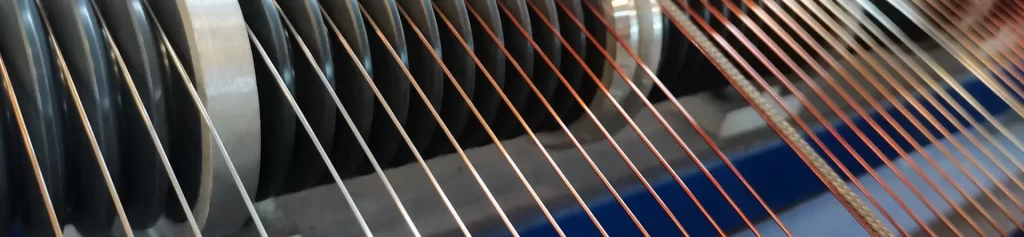
Paper-covered wire is a critical conductor insulation material in transformer manufacturing, playing an irreplaceable role in oil-immersed and dry-type power transformers, traction transformers, HVDC converter transformers, and specialty transformers. This paper presents a comprehensive review of paper-covered wire in the transformer manufacturing industry from the perspective of the manufacturing value chain. The work covers four key dimensions: (i) the global market landscape and the strategic position of paper-covered wire within the transformer industry chain, (ii) international and regional standards governing paper-covered wire, including IEC 60851, IEC 60317, NEMA MW 1000, GB/T 4074, and JIS C 3202, (iii) the three-layer structure of paper-insulated wire, including conductor materials, enamel coating systems, and insulating paper types, with emphasis on the Kraft paper / Nomex 410 / Crepe paper / Mica paper system, and (iv) manufacturing processes, application-specific selection criteria for oil-immersed versus dry-type transformers, quality control indicators, and supplier management. Twelve structured tables summarize conductor categories, standards comparison, enamel and paper types, wrapping methods, voltage-class selection matrices, quality control parameters, sampling plans, cost structure, and global and Chinese supplier landscapes. The findings provide engineering reference data and a five-step selection framework for transformer manufacturers in specifying paper-insulated wire.
Keywords: paper-covered wire; transformer manufacturing; IEC 60851; IEC 60317; NEMA MW 1000; Kraft paper; Nomex 410; enamel coating; oil-immersed transformer; dry-type transformer; voltage class; insulation system.
Industry Overview and the Strategic Position of Paper-Sheathed Wire
Global Landscape of the Transformer Manufacturing Industry
Transformers are one of the most core static electrical devices in power systems, performing five major functions: voltage transformation, current transformation, impedance transformation, phase transformation, and electrical isolation. They are irreplaceable hub equipment across the entire power generation, transmission, distribution, and consumption chain. The global transformer market size was approximately US$750-820 billion in 2025, and is projected to grow at a CAGR of 4.2-5.5% from 2025 to 2030, exceeding US$950 billion by 2030. China holds a 35-40% market share (approximately US$280-310 billion), making it the world’s largest transformer manufacturer and consumer, followed by North America at 18-22%, Europe at 16-20%, India at 6-8%, and Southeast Asia at 4-6%. Growth Drivers: – Aging Power Grid Upgrades: Over 60% of transformers in North America are over 25 years old, and 45% of equipment in the EU is over 30 years old, with a large-scale replacement cycle expected between 2025 and 2035. – Explosive Growth in New Energy Installations: Global new installations of photovoltaics, wind power, and energy storage are projected to reach 750 GW+ by 2025, with each GW of new energy requiring 1.5–2.0 main transformers + 8–12 prefabricated substations. – Electric Vehicle Charging Infrastructure: 800V high-voltage platform fast charging piles require 1.6–3.0 MVA dry/oil-immersed transformers. – Data Center Expansion: AI computing centers consume 200–500 MW of power per campus, requiring 2–4 110–500 kV main transformers. – Rail Transit and UHV: China’s “14th Five-Year Plan” and “15th Five-Year Plan” for UHV transmission include 30+ lines, each requiring 14–28 1000 kV transformers. The irreplaceable role of paper-insulated wire in transformer windings: In the field of transformer winding manufacturing, conductor insulation material is a core element that determines product lifespan, efficiency, and safety. The conductors used in the transformer manufacturing industry are mainly divided into four categories: | Category | Typical Materials | Main Applications | Market Share | Paper-coated Wire | Kraft Paper / Nomex 410 / Crepe Paper / Mica Paper + Copper/Aluminum Conductor | Oil-immersed transformers, dry transformers, high-voltage motor windings | 40–50% | | Enameled Wire | PEW / PEI / PAI / PI Copper/Aluminum with Enamel Coating | Dry transformers, low-voltage side, small motors | 30–35% | | Glass Fiber Coated Wire | Glass Fiber + Enamel Coating | Dry transformers, high-speed rail traction motors | 8–12% | | Copper Foil/Aluminum Foil | Copper/Aluminum Foil + Insulation Layer | High Current Transformer, Rectifier Transformer | 5–10% | Core Advantages of Paper-Insulated Wire (vs. enameled wire/glass-insulated wire): – Highest Thermal Class: Nomex 410/414 paper + PAI/PI enamel coating achieves a long-term operating temperature of Class 220 (220°C), making it the mainstream solution for dry-type transformers. – Highest Breakdown Voltage: Multi-layer Kraft paper in oil-immersed transformers can withstand a breakdown voltage of 30–110 kV, making it the only feasible solution for main transformers above 110 kV. – Best Oil Compatibility: Kraft paper is fully compatible with mineral oil, synthetic esters, and silicone oil, and does not degrade over a 30-year lifespan. – Best Cost: Under the same insulation class, paper-insulated wire costs 15–25% less than enameled wire and 30–40% less than glass-insulated wire. Best Recyclability: The copper conductor and paper insulation in the discarded transformer can be recycled separately, meeting the requirements of a circular economy.
The Position of Paper-Wrapped Wire in the Transformer Manufacturing Chain:
Copper/Aluminum Rod Material ↓ Drawing/Annealing (Round Wire / Flat Wire / Copper Foil / Aluminum Foil) ↓ Enamel Coating (PEW / PEI / PAI / PI) ↓ [Paper-Wrapped Wire] – Kraft Paper / Nomex / Crepe Paper / Mica Paper Wrapping ↓ Winding Manufacturing (Low Voltage / High Voltage / Regulated / Balanced Winding) ↓ Drying + Impregnation (Oil-Immersed: Mineral Oil; Dry: VPI Resin) ↓ Body Assembly (Core + Winding + Tank / Casting Body) ↓ Testing + Delivery (Routine / Type / Special Testing) ↓ Users (Power / Industry / New Energy / Rail Transit / Data Center) Paper-insulated wire is located in the middle of the industry chain, connecting the two major links of enameled wire manufacturing and winding manufacturing, and is a key node for quality and cost control in transformer manufacturing. —
Core Standards for Paper-Sheathed Wire in Transformers
IEC International Standards
– IEC 60851 (Magnet Wire Test Methods Series, 6 Parts): Breakdown Voltage, Flexibility, Adhesion, Thermal Shock, Scratching Strength – IEC 60317 (Magnet Wire Specifications Series): Dimensions and Performance Requirements for Different Enamel Coating + Paper Insulation Combinations – IEC 60317-0-1: General Requirements – IEC 60317-2/-3/-13/-25: Specific Specifications for Paper-Sheathed Round Wire / Flat Wire – IEC 60076 (Electrical Transformers Series): Insulation Coordination, Temperature Rise Limits, and Test Methods for Oil-Immersed / Dry-Type Transformers – IEC 60172 (Enameled Wire Temperature Index Test): 20,000 H Extrapolated Thermal Life – IEC 60981 (High-Frequency Transformer Paper-Wrapped Wire)
NEMA American Standard
– ANSI/NEMA MW 1000-2018 (Comprehensive Standard for Magnet Wire): – MW 31-A / 31-C: Kraft paper-wrapped round copper/aluminum wire, Class 105 – MW 33-A / 33-C: Kraft paper-wrapped flat copper/aluminum wire, Class 105 – MW 60-A / 60-C: Aromatic polyamide paper (e.g., Nomex 410)-wrapped rectangular/square aluminum wire, Class 220 – MW 61-A / 61-C: Aromatic polyamide paper-wrapped rectangular/square copper wire, Class 220 – ASTM D149 (Dielectric Breakdown Voltage), ASTM D1676 (Enamel Coating Chemical Resistance), ASTM D2307 (Thermal Life) ### Chinese GB/T Standards – GB/T 4074 (Test Methods for Enameled Wire, equivalent to IEC 60851) – GB/T 7095 (Enameled Wire Models, equivalent to IEC 60317) – GB/T 11021 (Classification of Thermal Resistance of Electrical Insulation, equivalent to IEC 60085) – GB/T 1094 (Electrical Transformers) – GB/T 10579 (Winding Paper for Oil-Immersed Transformers) ### Other Important Standards – UL 1446 (Insulation Systems, UL 1446 EIS) – EN 60317 (EU equivalent to IEC 60317) – JIS C 3202 (Japanese Enameled Wire / Paper-Insulated Wire) – IEEE Std 1 (General Principles for Thermal Life Assessment of Electrical Insulation Systems) – IEEE Std 259 (Insulation material for transformer) – IEC 60085 (Electrical insulation heat resistance classification, Y/A/E/B/F/H/N/R 8 grades)
Comparison of core requirements for paper-wrapped wire in standards
| Standard | Breakdown voltage | Bending performance | Adhesion | Overlap rate | Applicable scenarios | IEC 60851-3 | Depends on paper thickness and number of layers | round wire 1×/2×/3× Diameter | ≥30% elongation without cracking | ≥40% | Globally applicable | | NEMA MW 60-A | ≥300 V/mil (11,800 V/mm) | 6× bare wire thickness | No loosening | ≥40% | North American Class 220 | | GB/T 4074.2 | Equivalent to IEC 60851-2 | round wire 1×/2×/3× Diameter | ≥30% Elongation | ≥40% | China General Use | JIS C 3202 | 1.0–6.0 kV rms | round wire 2× Diameter | ≥25% Elongation | ≥35% | Japanese Market | —
Paper-insulated wire structure, materials and manufacturing process
Three-layer structure of paper-insulated wire
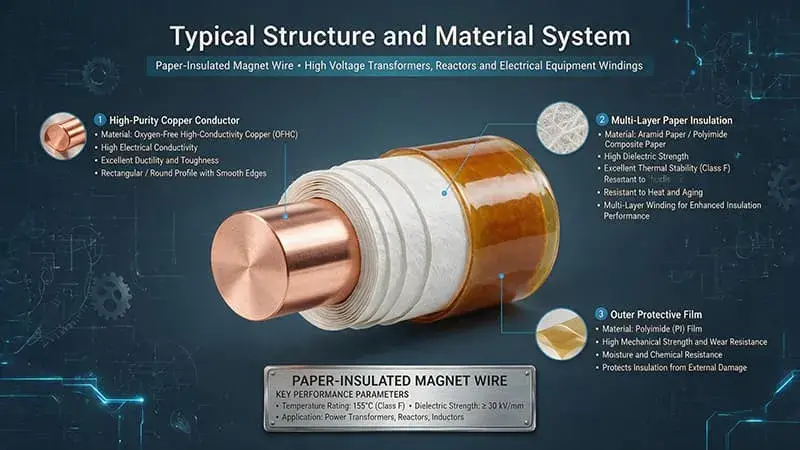
[1] Conductor: Round copper / Round aluminum / Flat copper / Flat aluminum / Rectangular copper / Rectangular aluminum ↓ [2] enamel coating (optional): PEW 155°C / PEI 180°C / PAI 200°C / PI 220°C ↓ [3] Paper insulation (core): Kraft 0.05–0.15 mm / Nomex 410 0.05–0.76 mm / Crepe 0.10–0.25 mm / Mica 0.05–0.20 mm ↓ [4] Impregnation medium (customer processing): Mineral oil (oil immersion) / VPI resin (dry) ` Total thickness δ_total = 2δᵥ + 2δₚ (double-sided enamel coating + double-sided paper insulation)
Conductor Materials
– Round Copper Wire: 0.100–5.000 mm (ISO R20 series), C11000 ETP containing 0.02–0.04% Cu₂O – Round Aluminum Wire: 0.250–5.000 mm, 1350-O annealed – Flat Copper Wire: Thickness 0.5–5.0 mm × Width 2.0–15.0 mm, Cross-sectional Area 1–75 mm² – Flat Aluminum Wire: Thickness 0.8–5.0 mm × Width 3.0–16.0 mm – Rectangular Copper/Aluminum Wire: For high current transformers, width ratio 4:1–10:1 Transformer Selection Considerations: – ≤630 kVA: Primarily round copper/round aluminum – 800 kVA–2.5 MVA: Round + flat hybrid – 2.5 MVA–50 MVA: Flat copper/flat aluminum – ≥50 MVA: Rectangular/Multi-strand Parallel/Transposed Wires ### enamel coating layer (finished at the power plant) | enamel coating | thermal class | enamel coating thickness | breakdown voltage | main applications | PEW (modified polyester) | Class F 155°C | G1/G2/G3 | 1.5–6.0 kV | Small to medium-sized dry-type transformers | | UEW (polyurethane) | Class B 130°C | Single layer | 1.5 kV | Solder joints | | PEI (polyester imide) | Class H 180°C | G1/G2/G3 | 1.5–6.0 kV | Mainstream dry-type transformers | | PAI (polyamide imide) | Class 200°C | G1/G2/G3 | 1.5–6.0 kV | High-voltage dry type, high-speed rail traction | | PI (Polyimide) | Class 220°C | G1/G2/G3 | 1.5–6.0 kV | Military, special transformer | ### Paper insulation layer (core) 6 mainstream insulating papers: | Paper type | Thickness | thermal class | Dielectric strength | Main applications | Kraft kraft paper | 0.05–0.15 mm | Class A 105°C | Oil immersion 30–40 kV/mm | Mainstream oil immersion transformer | | Crepe paper | 0.10–0.25 mm | Class A 105°C | Oil-immersed 25–35 kV/mm | Oil-immersed interlayer insulation | | Nomex 410 | 0.05–0.76 mm | Class H 180°C | Dry type 18–25 kV/mm | Mainstream dry type transformer | | Nomex 414 | 0.10–0.76 mm | Class H 180°C | Dry type 18–25 kV/mm | Dry type + High mechanical strength | | Mica mica paper | 0.05–0.20 mm | Class 220°C | Dry type 25–40 kV/mm | Fire resistant, high voltage | | DMD-NMN | 0.10–0.30 mm | Class F/H | Dry type 20–30 kV/mm | Composite insulation | Core selection principle: – 99% of oil-immersed insulation uses Kraft paper + Mineral oil – Dry transformer 70% using Nomex 410/414 – Fire-resistant transformer 100% using Mica paper + Nomex – High-speed rail traction transformer 50% using PI enamel coating + Nomex 410
Table 1. Conductor insulation materials in transformer manufacturing industry
| Enamel Coating | Thermal Class | Coating Thickness | Breakdown Voltage | Main Applications |
|---|---|---|---|---|
| PEW (Modified Polyester) | Class F 155°C | G1 / G2 / G3 | 1.5–6.0 kV | Small to medium dry-type transformers |
| UEW (Polyurethane) | Class B 130°C | Single layer | 1.5 kV | Solder joints |
| PEI (Polyesterimide) | Class H 180°C | G1 / G2 / G3 | 1.5–6.0 kV | Mainstream dry-type transformers |
| PAI (Polyamide-imide) | Class 200°C | G1 / G2 / G3 | 1.5–6.0 kV | High-voltage dry-type, high-speed rail traction |
| PI (Polyimide) | Class 220°C | G1 / G2 / G3 | 1.5–6.0 kV | Military, special transformers |
Paper-insulated wire manufacturing process wrapping method
| Method | Overlap rate | Applicable wire diameter | Process characteristics |Overlapping wrapping | 40–50% | round wire ≥0.5 mm / flat wire all | Mainstream, highest dielectric strength | | Gap wrapping | 0% (with gap) | round wire ≥1.0 mm | Low cost, low dielectric | | Seam wrapping | 0% (with seam) | Large flat wire | Rarely used | | Multi-layer wrapping | 40% per layer | High voltage ≥35 kV | Kraft ×3-6 layers | Key Process Parameters: – Wrapping speed: round wire 80–150 m/min, flat wire 30–80 m/min – Wrapping tension: round wire 1.5–8.0 N, flat wire 3.0–30.0 N – Tension control accuracy: ±5% – Ambient humidity: 45–65% RH (Kraft paper anti-embrittlement) – Workshop cleanliness: ISO 14644-1 Class 8 (million-level) – Defect detection: Online CCD camera + breakdown voltage sampling inspection Typical Manufacturers: – Global: Dahrentrad (Germany), Essex Furukawa (USA/Japan), Sumitomo Electric (Japan), Fujikura (Japan), LS Cable (Korea) – China: Great Wall Electric (Electric Factory No. 1), Wuxi Huanyu Electric wire}, Dongguan Songfeng Electric, Haoneng Electric magnet wire, Tongling Jingda Special Electric magnet wire, Luxiao Technology—
Table 2. Comparison of paper-wrapped wire standards (IEC / NEMA / GB / JIS)
| Wrapping Method | Overlap Rate | Applicable Wire Diameter | Process Characteristics |
|---|---|---|---|
| Overlap Wrapping | 40–50% | Round wire ≥0.5 mm / all flat wire | Mainstream, highest dielectric strength |
| Gap Wrapping | 0% (with gap) | Round wire ≥1.0 mm | Low cost, low dielectric |
| Seam Wrapping | 0% (with seam) | Large flat wire | Rarely used |
| Multi-Layer Wrapping | 40% per layer | High voltage ≥35 kV | Kraft ×3-6 layers |
Transformer Types and Paper-Sheathed Wire Selection Matrix
Oil-Immersed Power Transformers (Largest Market)
| Voltage Rating | Capacity Range | Conductor Material | Enameled Coating | Paper Insulation | Number of Wrapping Layers | Total Thickness |≤10 kV | 50–2,500 kVA | Round Copper/Round Aluminum | PEW/PEI | Kraft 0.10–0.13 mm | 2–3 Layers | 0.20–0.50 mm | | 35 kV | 800–20,000 kVA | Round + Flat | PEI/PAI | Kraft 0.13–0.18 mm | 3–4 Layers | 0.50–1.20 mm | | 110 kV | 5,000–90,000 kVA | Flat Copper | PEI | Kraft 0.13 + Crepe | 4–6 layers | 1.00–2.50 mm | | 220 kV | 31,500–500,000 kVA | Flat Copper + Transposed | PEI / PAI | Kraft 0.18 + Crepe | 5–8 layers | 1.50–4.00 mm | | 500 kV | 250,000–1,500,000 kVA | Transposed Conductor | PAI | Kraft 0.20 + Crepe | 6–10 layers | 3.00–6.00 mm | | 1000 kV UHV | 1,000,000+ kVA | Transposed Conductor | PAI / PI | Kraft + Crepe + DMD | 8–12 Layer | 5.00–8.00 mm | Key Selection Points for Oil-Immersed Transformer Paper-Sheathed Wire: – Oil Compatibility: Kraft paper must have a moisture content ≤8% to avoid air bubbles in the oil. – Partial Discharge (PD): PDIV ≥1.5 × operating voltage for voltages above 110 kV. – tan δ Loss: ≤0.005 at 20°C, ≤0.015 at 90°C. – Moisture Content Control: Paper insulation moisture content ≤0.5% before oil immersion.
Table 3. Enamel coating types and thermal classes
| Voltage Class | Capacity Range | Conductor Material | Enamel Coating | Paper Insulation | Wrapping Layers | Total Thickness |
|---|---|---|---|---|---|---|
| ≤10 kV | 50–2,500 kVA | Round copper / round aluminum | PEW / PEI | Kraft 0.10–0.13 mm | 2–3 layers | 0.20–0.50 mm |
| 35 kV | 800–20,000 kVA | Round + flat | PEI / PAI | Kraft 0.13–0.18 mm | 3–4 layers | 0.50–1.20 mm |
| 110 kV | 5,000–90,000 kVA | Flat copper | PEI | Kraft 0.13 + Crepe | 4–6 layers | 1.00–2.50 mm |
| 220 kV | 31,500–500,000 kVA | Flat copper + transposed | PEI / PAI | Kraft 0.18 + Crepe | 5–8 layers | 1.50–4.00 mm |
| 500 kV | 250,000–1,500,000 kVA | Transposed conductor | PAI | Kraft 0.20 + Crepe | 6–10 layers | 3.00–6.00 mm |
| 1000 kV UHV | 1,000,000+ kVA | Transposed conductor | PAI / PI | Kraft + Crepe + DMD | 8–12 layers | 5.00–8.00 mm |
Dry Transformer (Fastest Growth)
| Voltage Rating | Capacity Range | Enameled Coating | Paper Insulation | Process | Main Applications | ≤1 kV | 30–2,500 kVA | PEW / PEI | Nomex 410 0.18–0.25 mm | VPI | Commercial Buildings, Hospitals | 1–10 kV | 100–3,150 kVA | PEI | Nomex 410 0.25–0.51 mm | VPI / Casting | Industrial, New Energy | 10–35 kV | 315–25,000 kVA | PEI / PAI | Nomex 410 0.51–0.76 mm | Casting / Vacuum Pressure | Wind Power, Data Centers | 35 kV+ | ≥10,000 kVA | PAI | Nomex 410 + Mica | Vacuum Pressure | High-Speed Rail, Subway | Key Selection Points for Dry-Type Transformer Paper-Sheathed Wire: – Fire Resistance Rating: F0 (Non-self-igniting), F1 (Flame-retardant), F2 (90 min fire resistance) – thermal Class: F (155°C) / H (180°C) / 200°C – VPI Process: 145–155°C curing for 8–14 hours after resin impregnation – Casting Process:** Epoxy resin vacuum casting + 130–140°C curing –
Noise Level: ≤55 dB (Commercial) / ≤70 dB (Industrial) ### Special Transformers #### Rectifier Transformers – Paper-insulated wire requirements: Harmonic resistance (THD 30–80%), vibration resistance, low loss – Typical: Flat copper + PAI (enamel coating) + Nomex 410 (3–5 layers) – Applications: Electrolytic aluminum, electrochemical, rail traction #
Table 4. Insulating paper types and dielectric properties
| Voltage Class | Capacity Range | Enamel Coating | Paper Insulation | Process | Main Applications |
|---|---|---|---|---|---|
| ≤1 kV | 30–2,500 kVA | PEW / PEI | Nomex 410 0.18–0.25 mm | VPI | Commercial buildings, hospitals |
| 1–10 kV | 100–3,150 kVA | PEI | Nomex 410 0.25–0.51 mm | VPI / Casting | Industrial, new energy |
| 10–35 kV | 315–25,000 kVA | PEI / PAI | Nomex 410 0.51–0.76 mm | Casting / vacuum pressure | Wind power, data centers |
| 35 kV+ | ≥10,000 kVA | PAI | Nomex 410 + Mica | Vacuum pressure | High-speed rail, subway |
Electric Furnace Transformers – Paper-insulated wire requirements
Surge current resistance (10–20 × rated), short-time overload resistance – Typical: Rectangular copper + PEI enamel coating + Kraft + Crepe paper – Applications: Electric arc furnace, induction furnace, electroslag furnace Traction transformer (rail transit) – Paper-insulated wire requirements: Vibration resistance (IEC 61373 Cat 1 Class B), thermal shock resistance, low noise – Typical: Rectangular copper + PI enamel coating + Nomex 410 + Mica (30-year lifespan) – Applications: High-speed rail, subway, light rail HVDC converter transformer – Paper-insulated wire requirements: DC + AC superposition resistance, polarity reversal, low PD – Typical: Transposed conductor + PAI enamel coating + Kraft + Crepe paper – Applications: ±500 kV / ±800 kV / ±1100 kV DC transmission Offshore wind power transformer – Paper-insulated wire requirements: Salt spray resistance (IEC 60068-2-52) 96h), vibration resistant, low noise – Typical: flat copper + PAI enamel coating + Nomex 410 + resin impregnation – Applications: 5–18 MW offshore wind turbine nacelles / offshore substations—
Paper-wrapped Wire Manufacturing Process and Quality Control
Key Process Equipment
enamel coating equipment: – Vertical enameling machine (MAG, Austria; Procond, Italy; Setic, Germany) – Number of coating coats: 4–16 (depending on enamel coating thickness grade) – Curing oven temperature zones: 320–420°C (three temperature zones) – Coating speed: round wire 80–250 m/min, flat wire 10–80 m/min Paper wrapping machine: – Vertical/horizontal paper wrapping machine (Guilin, Hefei, China; Dahrentrad, Germany) – Tension control: servo drive + floating roller closed loop – Paper tape width: 6–40 mm – Rotation speed: round wire 80–150 m/min, flat wire 30–80 m/min – Online inspection: CCD camera + laser diameter measurement Auxiliary equipment: – Continuous annealing furnace (enamel coating equipment) (Pre-coating conductor annealing) – enamel coating continuity tester (IEC 60851-5) – Online breakdown voltage tester – Eccentricity tester
Key Quality Control Indicators
| Indicators | Test Standards | Typical Requirements | Test Frequency | Conductor Dimensions | IEC 60851-2 | Tolerance ±0.005–0.013 mm | 100% Online | | enamel coating thickness | IEC 60851-2 | G1 0.015–0.030 / G2 0.030–0.050 / G3 0.050–0.080 mm | 100% Online + Sampling Inspection | | enamel coating continuity | IEC 60851-5 | ≤5 pinholes/30 m | 100% Online | Breakdown Voltage | IEC 60851-3 | G1 1.5 kV / G2 2.5 kV / G3 4.0 kV | Spot Check for Each Batch | Elongation | IEC 60851-3 | ≥30% (Copper) / ≥15% (Aluminum) | Spot Check | Springback Angle | IEC 60851-3 | ≤5° | Spot Check | Adhesion | IEC 60851-3 | No Cracking Under Sudden Pull | Spot Check | Tape Overlap Rate | NEMA MW 60 / GB/T 4074 | ≥40% | 100% Online Camera | Tape Tension | Process Specifications | round wire 1.5–8.0 N, flat wire 3.0–30.0 N | 100% Online | Ambient Humidity | Process Specifications | 45–65% RH | 100% Online |
Table 5. Paper-insulated wire wrapping methods
| Indicator | Test Standard | Typical Requirement | Test Frequency |
|---|---|---|---|
| Conductor Dimensions | IEC 60851-2 | Tolerance ±0.005–0.013 mm | 100% online |
| Enamel Coating Thickness | IEC 60851-2 | G1 0.015–0.030 / G2 0.030–0.050 / G3 0.050–0.080 mm | 100% online + sampling |
| Enamel Coating Continuity | IEC 60851-5 | ≤5 pinholes / 30 m | 100% online |
| Breakdown Voltage | IEC 60851-3 | G1 1.5 kV / G2 2.5 kV / G3 4.0 kV | Sampling per batch |
| Elongation | IEC 60851-3 | ≥30% (copper) / ≥15% (aluminum) | Sampling |
| Springback Angle | IEC 60851-3 | ≤5° | Sampling |
| Adhesion | IEC 60851-3 | No cracking under sudden pull | Sampling |
| Tape Overlap Rate | NEMA MW 60 / GB/T 4074 | ≥40% | 100% online camera |
| Tape Tension | Process specification | Round wire 1.5–8.0 N, flat wire 3.0–30.0 N | 100% online |
| Ambient Humidity | Process specification | 45–65% RH | 100% online |
Common Quality Problems and Solutions
| Defects | Causes | Impacts | Solutions | enamel coating pinholes | Low coating viscosity, low curing temperature | Breakdown voltage drop | Increase viscosity, check oven temperature | | Paper tape breakage | Too low humidity, too high tension | Localized lack of insulation | Adjust humidity, adjust tension | | Paper tape wrinkles | Excessive overlap, uneven tension | Uneven thickness, PD | Tension closed loop | | enamel coating eccentricity | Mold wear, conductor eccentricity | Uneven thickness | Change mold, adjust center | | Low breakdown voltage | enamel coating / Paper tape defects | transformer short circuit | Strengthen online detection | | Conductor blackening | Annealing temperature too high | Welding difficulties | Adjust annealing parameters | | Ellipticity out of tolerance | Uneven stretching | Difficulty in winding | Adjusting tension parameters |
Table 6. Oil-immersed power transformer paper-sheathed wire selection
| Defect | Cause | Impact | Solution |
|---|---|---|---|
| Enamel coating pinholes | Low coating viscosity, low curing temperature | Breakdown voltage drop | Increase viscosity, check oven temperature |
| Paper tape breakage | Humidity too low, tension too high | Localized lack of insulation | Adjust humidity, adjust tension |
| Paper tape wrinkles | Excessive overlap, uneven tension | Uneven thickness, PD | Tension closed loop |
| Enamel coating eccentricity | Mold wear, conductor eccentricity | Uneven thickness | Change mold, adjust center |
| Low breakdown voltage | Enamel / paper tape defects | Transformer short circuit | Strengthen online detection |
| Conductor blackening | Annealing temperature too high | Welding difficulties | Adjust annealing parameters |
| Ellipticity out of tolerance | Uneven stretching | Winding insertion difficulty | Adjust tension parameters |
ISO 2859-1 AQL Sampling Standard
The transformer manufacturing industry typically uses AQL 1.0–2.5 Level II Normal Inspection: – Critical defects (breakdown, enamel coating continuity): AQL 0.65 – Major defects (dimensions, adhesion): AQL 1.0 – Minor defects (appearance, color difference): AQL 2.5 Typical AQL 1.0 Level II Sample Size (lot 501–1,200): | Lot | Sample Size | Ac (Pass) | Re (Reject)| 51–90 | 13 | 0 | 1 | | 91–150 | 13 | 0 | 1 | | 151–280 | 20 | 0 | 1 | | 281–500 | 32 | 1 | 2 | | 501–1,200 | 50 | 1 | 2 | | 1,201–3,200 | 80 | 2 | 3 | | 3,201–10,000 | 125 | 3 | 4 | —
Table 7. Dry-type transformer paper-sheathed wire selection
| Lot Size | Sample Size | Ac (Pass) | Re (Reject) |
|---|---|---|---|
| 51–90 | 13 | 0 | 1 |
| 91–150 | 13 | 0 | 1 |
| 151–280 | 20 | 0 | 1 |
| 281–500 | 32 | 1 | 2 |
| 501–1,200 | 50 | 1 | 2 |
| 1,201–3,200 | 80 | 2 | 3 |
| 3,201–10,000 | 125 | 3 | 4 |
Typical Application Case of Paper-Sheathed Wire in Transformer Manufacturing
Case: 110 kV 50 MVA Oil-Immersed Power Transformer Scenario
Main transformer in an urban substation Conductor: Flat copper 1.50 × 7.00 mm (high voltage winding) Enamel Coating: PEI G3 (Class H 180°C), thickness 0.080 mm Paper Insulation: Kraft 0.13 mm × 4 layers, overlap 50% Total Thickness: δ = 2 × 0.08 + 2 × 0.13 × 4 = 1.20 mm Breakdown Voltage: ≥15 kV rms (after oil immersion) PDIV: ≥1.5 × 110 kV = 165 kV tan δ: 0.003 (20°C), 0.012 (90°C) Immersion Medium: Mineral oil 25# Expected Life: 30
Case Study: 10 kV 2.5 MVA Dry-Type Transformer Scenario
Commercial Building Power Distribution Conductor: Round copper 2.50 mm (low voltage) + Flat copper 1.20 × 4.50 mm (high voltage) Enamel Coating: PEI G2 (Class H 180°C) Paper Insulation: Nomex 410 0.18 mm × 3 layers Total Thickness: 0.40 mm (low voltage) / 0.50 mm (high voltage) Breakdown Voltage: ≥10 kV rms Process: VPI impregnation + 145°C curing for 10 h Fire Rating: F1 (Flame Retardant) Noise: ≤58 dB Expected Lifespan: 25 years ### Case Study: 35 kV 8 MVA Wind Farm Step-Up Transformer Scenario: Onshore Wind Farm Box-Type Substation Conductor: Flat copper 1.40 mm × 4.5 … × 5.00 mm enamel coating: PAI G3 (Class 200°C) Paper insulation: Nomex 410 0.25 mm × 4 layers + Nomex 414 0.25 mm outer protection Total thickness: 0.85 mm Breakdown voltage: ≥20 kV rms Salt spray resistance: IEC 60068-2-52 96h Vibration resistance: IEC 60068-2-6 Fc 4g Process: VPI + epoxy casting Expected life: 25 years ### Case: 25 kV / 4 MVA High-speed rail traction transformer Scenario: CR450 high-speed train Conductor: Rectangular copper 2.00 × 8.00 mm + transposed conductor enamel coating: PI G3 (Class 220°C) Paper insulation: Nomex 410 0.25 mm × 5 layers + Mica 0.10 mm × 2 layers Total Thickness: 1.55 mm Breakdown Voltage: ≥30 kV rms Vibration Resistance: IEC 61373 Cat 1 Class B Temperature Shock Resistance: Class 220 240°C Process: Vacuum pressure impregnation + 200°C curing Expected Lifespan: 30 years
Case Study: ±800 kV Converter Scenario
HVDC transmission project converter station Conductor: 60 transposed 0.45 mm round copper conductors in parallel enamel coating: PAI G2 (Class 200°C) Paper Insulation: Kraft 0.13 mm × 6 layers + Crepe 0.20 mm × 3 layers Total Thickness: 2.50 mm Breakdown Voltage: ≥50 kV rms PDIV: ≥1.5 × 800 kV = 1,200 kV Polarity Reversal Tolerance: 1,000 cycles tan δ: 0.003 (20°C) Immersion Medium: Synthetic ester oil Expected Life: 40 years
Paper-Sheathed Wire Procurement Specifications and Acceptance Process
Key Points of Procurement Technical Specifications
When procuring paper-sheathed wire, the manufacturer should specify the following elements in the Procurement Technical Specifications: 1. Conductor Specifications – Material: C11000 round copper / C11000 flat copper / 1350 round aluminum – Nominal dimensions: round wire 0.500–5.000 mm, flat wire 1.00×3.00–3.00×12.00 mm – Tolerance: round wire ±0.005–0.013 mm, flat wire ±0.010–0.030 mm – Surface roughness: Ra ≤1.6 μm – Ellipticity: ≤50% tolerance 2. Enamelable Coating – Type: PEW / PEI / PAI / PI – Grade: G1 / G2 / G3 – Thickness: 0.015–0.080 mm – Breakdown Voltage: ≥1.5 / 2.5 / 4.0 kV rms – Continuity: ≤5 pinholes/30 m 3. Paper Insulation – Paper Type: Kraft / Nomex 410 / Nomex 414 / Crepe / Mica – Thickness: 0.05–0.76 mm – Number of Layers: 1–12 layers – Overlap Rate: ≥40% – Moisture Content: ≤8% (Kraft paper at the time of manufacture) 4. Electrical Properties – Breakdown Voltage: Minimum thickness on one side × 11,800 V/mm – Dielectric Loss: tan δ ≤0.005 (20°C) – Partial Discharge: PDIV ≥1.5 × Working Voltage 5. Mechanical Properties – Elongation: ≥30% (copper) / ≥15% (aluminum) – Springback Angle: ≤5° – Bending: round wire 1×/2×/3× diameter without cracking6. Thermal Properties – Temperature Index: Class F 155 / H 180 / 200 / 220 – Thermal Shock: ≥175 / 200 / 220 / 240°C × 0.5 h – Softening Breakdown: ≥300°C 7. Processability – Solderability: UEW enamel coating 380±5°C ≤2 s – Immersion Compatibility: Oil immersion or resin immersion – Shelf Life: 12–24 months
Acceptance Process Incoming Quality Control (IQC)
1. Document Review: Supplier COA, Factory Test Report, RoHS/REACH Declaration 2. Visual Inspection: 100% Visual Inspection + Sampling Inspection 3. Dimensional Measurement: AQL 1.0 Level II Sampling 4. Electrical Testing: 3-5 rolls per batch will be randomly selected for breakdown, PD, and tanδ tests. Mechanical Testing: Strength, rebound, and adhesion will be randomly checked.
Thermal Performance: Type testing (first article + annually). Type Testing (first article + annually): – 20,000 h thermal life extrapolation (IEC 60172) – Oil compatibility test (90°C × 168 h) – Immersion process test – transformer whole machine testing and verification.
Key Supplier Management
| Level | Supplier Type | Key Requirements | Typical Representatives | |——|———-|———|———| | Level A (Strategic) | International First-Class | ISO 9001 + IATF 16949 + UL Certification | Dahrentrad, Essex, Furukawa, Sumitomo | | Level B (Core) | Domestic Leader | ISO ISO 9001 + ISO 14001 + System Certification | Great Wall Electric, Jingda, Luxiao | | Level C (General) | Small and Medium Enterprises | ISO 9001 Basic | Numerous Domestic Manufacturers | Dual-Source Procurement Principle: Maintain at least 2 qualified suppliers for each type of critical paper-insulated wire to avoid single points of failure. —
Table 8. Key quality control indicators for paper-insulated wire
| Tier | Supplier Type | Key Requirements | Typical Representatives |
|---|---|---|---|
| Level A (Strategic) | International first-class | ISO 9001 + IATF 16949 + UL certification | Dahrentrad, Essex, Furukawa, Sumitomo |
| Level B (Core) | Domestic leader | ISO 9001 + ISO 14001 + system certification | Great Wall Electric, Jingda, Luxiao |
| Level C (General) | Small and medium enterprises | ISO 9001 basic | Numerous domestic manufacturers |
Cost Structure and Economic Analysis of Paper-Sheathed Wire
Cost Composition
Paper-sheathed wire cost = Conductor cost (60–70%) + enamel coating cost (5–10%) + Paper insulation cost (10–15%) + Manufacturing overhead (10–15%) + Packaging and transportation (2–5%) Typical Paper-Sheathed Wire Unit Price (2025 China market, including tax): | Type | specifications | Unit Price (RMB/meter) | Round copper PEW + Kraft 0.10 mm ×2 | 1.50 mm round | 0.45–0.65 | | Round copper PEI + Nomex 410 0.25 mm ×3 | 2.00 mm round | 0.85–1.20 | | Flat copper PAI + Nomex 410 0.51 mm ×4 | 1.50×5.00 mm Flat | 4.50–6.50 | | Rectangular Copper PI + Kraft 0.18 mm ×5 | 2.00×8.00 mm Rectangular | 12.00–18.00 | | Transposed Conductor PAI + Kraft 0.13 mm ×6 | 60×0.45 mm Transposed | 35.00–55.00 |
Table 9. Common quality problems and solutions
| Type | Specification | Unit Price (RMB/meter) |
|---|---|---|
| Round copper PEW + Kraft 0.10 mm ×2 | 1.50 mm round | 0.45–0.65 |
| Round copper PEI + Nomex 410 0.25 mm ×3 | 2.00 mm round | 0.85–1.20 |
| Flat copper PAI + Nomex 410 0.51 mm ×4 | 1.50×5.00 mm flat | 4.50–6.50 |
| Rectangular copper PI + Kraft 0.18 mm ×5 | 2.00×8.00 mm rectangular | 12.00–18.00 |
| Transposed conductor PAI + Kraft 0.13 mm ×6 | 60×0.45 mm transposed | 35.00–55.00 |
Economic Comparison
| Insulation Scheme | Cost Index | Lifespan | Applicable Scenarios |Paper-insulated Wire + Oil | 1.0 (Baseline) | 30 Years | 110 kV + Oil-immersed | | enameled wire + VPI | 1.3–1.5 | 20–25 Years | Dry Type ≤10 kV | | Glass Wire Insulated + Impregnated | 1.5–1.8 | 25 years | Dry type 10–35 kV | Copper foil + insulation | 1.8–2.2 | 20 years | High current rectification | Conclusion: For oil-immersed transformers above 35 kV, paper-insulated wire + mineral oil is the only economically feasible solution; for dry type transformers ≤10 kV, enameled wire + VPI is the most cost-effective; for 35 kV dry type, paper-insulated wire (Nomex) + casting and glass fiber insulated wire + impregnation are equally viable options.
Table 10. ISO 2859-1 AQL sampling plan (Level II, AQL 1.0)
| Insulation Scheme | Cost Index | Lifespan | Applicable Scenarios |
|---|---|---|---|
| Paper-Covered Wire + Oil | 1.0 (Baseline) | 30 years | 110 kV+ oil-immersed |
| Enameled Wire + VPI | 1.3–1.5 | 20–25 years | Dry-type ≤10 kV |
| Glass-Fiber-Covered Wire + Impregnation | 1.5–1.8 | 25 years | Dry-type 10–35 kV |
| Copper Foil + Insulation | 1.8–2.2 | 20 years | High-current rectification |
Price Fluctuation Factors – Copper Price (LME Copper)
Accounts for 60-70% of costs; fluctuations of ±20% directly affect copper conductor prices. – Aluminum Price (LME Aluminum): Copper conductor prices are affected by aluminum prices. – Nomex Paper Price: Exclusively supplied by DuPont; prices are expected to increase by 25-35% from 2020 to 2024. – Energy Price: Energy consumption in curing, annealing, and copper conductor processes. – Exchange Rate: Imported copper conductor prices are affected by the USD/EUR exchange rate.
Hedging Strategies: – Sign 6-12 month price linkage agreements with suppliers (adjusted based on the LME monthly average price). – Maintain 3-6 month safety stock for key materials. – Futures hedging (for companies with annual consumption ≥ 1,000 tons of copper conductor).
International Standards Comparison and Global Compliance
Compliance Requirements in Major Markets
| Market | Mandatory Certification | Key Standards | Special Requirements | |——|———|———|———| | China | CCC (partial) | GB/T 4074, GB/T 7095, GB/T 1094 | China Energy Efficiency Label | | EU | CE / EN | EN 60317, IEC 60076 | RoHS 2.0, REACH SVHC, ErP Directive | | USA | UL / DOE | UL 1446, IEEE Std 1, NEMA MW 1000 | DOE 10 CFR 431 Energy Efficiency | | Canada | CSA | CSA C22.2 No.38 | Canadian Energy Efficiency Regulations | | Japan | PSE / JIS | JIS C 3202, JIS C 4003 | Energy Conservation Law | | South Korea | KC | KS C IEC 60317 | South Korean Energy Efficiency | | India | BIS | IS 13730 (equivalent to IEC 60317) | BEE Energy Efficiency |
Global Energy Efficiency Regulations – US DOE 10 CFR 431
Mandatory Transformer Energy Efficiency Standard (2023 Revision) – EU Ecodesign 548/2014 Tier 2 (From 2021) – China GB 20052-2020: Minimum Values for Transformer Energy Efficiency in Electricity – Japan Top Runner: Transformer Energy Efficiency Leader System – India BEE (Bureau of Energy Efficiency)
Environmental and Safety Compliance
– RoHS 2.0 (2011/65/EU): Lead, Mercury, Cadmium, Hexavalent Chromium, PBB, PBDE, 4 Phthalate Salts – REACH SVHC: Substances of Very High Concern (e.g., certain enamel coating solvents) – PFAS Restriction: EU restrictions on perfluorinated and polyfluoroalkyl substances by 2024, affecting some enamel coatings – POPs Regulation: Restrictions on Persistent Organic Pollutants – WEEE Directive**: Recycling of Waste Electrical and Electronic Equipment—
Selection Decision Framework and Best Practices
5-Step Selection Method
` [1] Scenario Determination → Oil Immersion / Dry Type / Special [2] thermal class → Class A 105 / B 130 / F 155 / H 180 / 200 / 220 [3] Voltage Level → ≤1 / 1-10 / 10-35 / 35-110 / 110-500 / ≥500 kV [4] enamel coating + Paper Type → enamel coating (PEW/PEI/PAI/PI) + Paper (Kraft/Nomex/Mica) [5] Process Verification → Breakdown + Aging + Impregnation + Whole Machine Test `
Common Selection Misconceptions
| Misconceptions | Consequences | Correct Practices | Excessive Insulation | Volume increases by 30%, cost increases by 40% | Select the thinnest suitable solution according to voltage level | | Insufficient insulation | Breakdown accidents, shortened lifespan | Leave a safety margin of 1.2–1.5 × | | Incompatibility between enamel coating and oil | Gas generation in oil | Oil compatibility must be verified for oil-immersed systems | | Insufficient paper tape overlap | PD breakdown | ≥40% overlap + online detection | | Ignoring environmental factors | Salt spray/vibration/temperature failure | Special environment-specific verification | | Mixed use of enamel coating from different manufacturers | Inconsistent processes | Single source + strict incoming material inspection |
5 dimensions of reliability 1. Electrical reliability
Long-term stability of breakdown voltage, PD, tan δ 2. Mechanical reliability: Vibration resistance, shock resistance, bending resistance 3. Thermal reliability: Thermal life ≥20,000 h, no failure under thermal shock 4. Chemical reliability: Oil compatibility, hydrolysis resistance, refrigerant resistance 5. Environmental Reliability: Resistant to salt spray, damp heat, and weathering.
Conclusion: Five Golden Rules for Paper-Sheathed Wire in the Transformer Manufacturing Industry
1. Scenario-Driven Selection: Oil-immersed wire uses Kraft + mineral oil; dry-type uses Nomex + resin casting; HVDC uses Kraft + synthetic ester; high-speed rail uses Nomex + Mica + PI. 2. Global Standards Alignment: IEC 60851 + IEC 60317 + NEMA MW 1000 + GB/T 4074 + IEEE Std 1 five-dimensional standard system. 3. Reasonable Margin Design: Voltage margin 1.2–1.5×, temperature margin ≥ Class 1 thermal rating, mechanical margin ≥ 30%. 4. Full-Process Quality Control: 100% online inspection + AQL 1.0 sampling + type testing + whole-machine verification. 5. Dual-Source Supply Chain Strategy: A-level (international) + B-level (domestic) dual-source supply chain, 3–6 With a 6-12 month safety stock and price linkage over 6-12 months, paper-insulated wire, as a fundamental strategic material in the transformer manufacturing industry, connects the two major links of enameled wire manufacturing and winding manufacturing. It is an irreplaceable key insulation solution for oil-immersed and dry-type transformers, special transformers, and new energy transformers. Against the backdrop of energy transition, power grid upgrades, new infrastructure construction, and the explosive growth of data centers, the paper-insulated wire industry has established its long-term and stable strategic position in the transformer manufacturing industry chain thanks to its five core advantages: Class 220 high temperature resistance, 30-110 kV high breakdown voltage, oil immersion compatibility, long lifespan, and sustainability. — Reference Standards: – IEC 60851-1/-2/-3/-4/-5/-6 (Magnet wire test methods) – IEC 60317-0-1/-1/-3/-8/-11/-13/-25/-38/-46 (Magnet wire specifications) – IEC 60076-1/-2/-3/-4/-5/-11 (Electrical transformers) – IEC 60172 / IEEE Std 1 (Thermal life) – ANSI/NEMA MW 1000-2018 (US comprehensive magnet wire standard) – GB/T 4074.1–6, GB/T 7095.1–5, GB/T 1094, GB/T 11021, GB/T 10579 – UL 1446, IEEE Std 259, ASTM D149/D1676/D2307, ISO 2859-1 – EN 60317, CSA C22.2 No.38, JIS C 3202, KS C IEC 60317