

Magnet wire (also called winding wire) serves as the core conductive element in motors, transformers, reactors, and induction coils. Its insulation structure directly determines equipment lifespan, reliability, thermal class, and application boundary. Within the magnet wire family, paper covered wire (Paper Insulated Wire) and glass fiber insulated wire (Fiberglass Covered Wire) are two long-established composite-insulation products. Unlike enameled wire, which relies on a single enamel film, both types use a multi-layer composite insulation structure of “organic/inorganic fiber + enamel base layer + impregnation treatment,” providing longer electrical life and mechanical reliability under harsher operating conditions.
However, paper covered wire and glass fiber insulated wire differ systematically in material system, thermal class, dielectric performance, mechanical strength, process path, application scenarios, testing standards, and price range. Engineers are often puzzled when selecting between them: which is right for oil-immersed transformers? For Class H 200°C dry-type applications? Are they interchangeable? The answer is not simply “which is better,” but a comprehensive trade-off across five engineering dimensions: thermal class, electrical stress, mechanical stress, insulation medium, and cost constraint.
This article, using IEC 60851, NEMA MW 1000, GB/T 4074, GB/T 7672 as core reference standards, systematically compares paper covered wire and glass fiber insulated wire across nine dimensions: material structure, thermal class, electrical performance, mechanical performance, process path, application scenarios, testing standards, price and cost, and selection decision framework, helping engineers make scientific decisions in procurement, design, and acceptance.
Basic Concepts of Paper Covered Wire and Glass Fiber Insulated Wire
Definition and Typical Structure of Paper Covered Wire
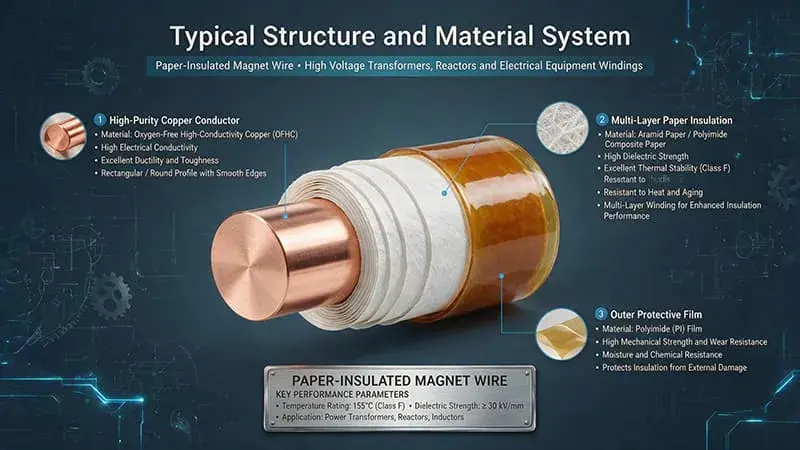
Paper covered wire (Paper Insulated Wire) is a composite insulated winding wire that uses insulating paper (kraft paper, crepe paper, Nomex® 410/414, mica paper) as the main insulation medium, wrapped on the outside of enameled copper or enameled aluminum wire through a wrapping process (2-12 layers overlapping). Its typical structure is “conductor (C11000 copper or aluminum) + enamel base layer (PEW/PEI/PAI/PI) + insulating paper wrapping layer + impregnation layer (VPI/VVPI).” Paper covered wire dates back to the 1890s, with over 130 years of application history, making it one of the oldest insulation structures in the magnet wire family. It is primarily used in oil-immersed power transformers, dry-type transformers, high-voltage motors, traction motors, mining transformers, and other high-end winding wire applications.
Definition and Typical Structure of Glass Fiber Insulated Wire
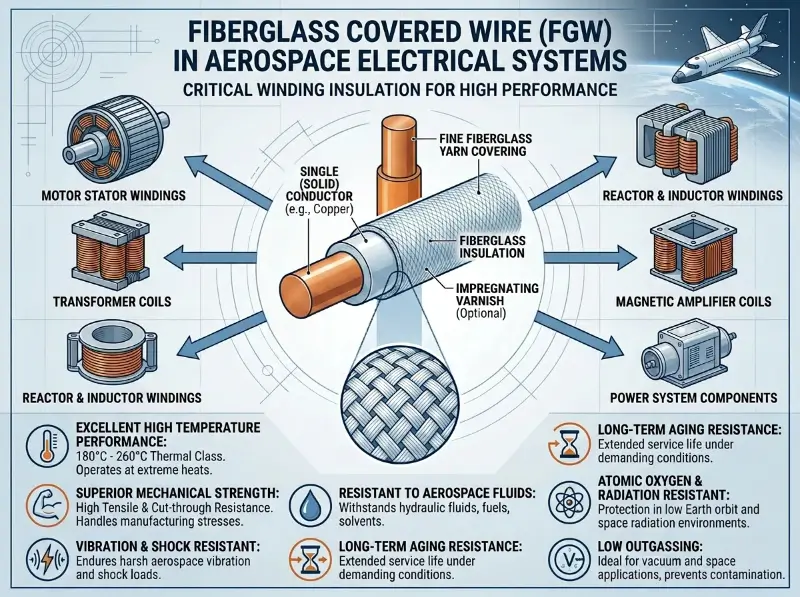
Glass fiber insulated wire (Fiberglass Covered Wire) is a composite insulated winding wire that uses alkali-free glass fiber yarn (E-glass fiber yarn) as the main insulation medium, covered on the outside of enameled copper or aluminum wire through braiding or serving processes. Its typical structure is “conductor + enamel base layer + glass fiber braiding/serving layer + impregnation layer (silicone/epoxy/polyester resin).” The industrial application of glass fiber insulated wire began in the 1940s, approximately 50 years later than paper covered wire. However, its advantages in temperature resistance (Class F 155°C / H 180°C / C 220°C) and mechanical strength made it dominant in mid-to-high-end magnet wire applications such as dry-type transformers, traction motors, household appliance motors, and power tools.
Essential Differences Between the Two Insulation Structures
The essential difference between paper covered wire and glass fiber insulated wire lies in the chemical composition and physical form of the insulation medium: paper covered wire uses organic fiber paper (cellulose or aramid), while glass fiber insulated wire uses inorganic fiber yarn (alkali-free glass fiber). This difference determines their systematic differences in thermal class, flame retardancy, chemical resistance, mechanical elastic modulus, coefficient of thermal expansion, moisture absorption, and recyclability. From a magnet wire selection decision perspective, the two products should be viewed as “complementary rather than competitive”—the same application often uses a “paper + glass fiber mixed” design, such as dry-type transformers where the low-voltage winding uses paper covered wire (cost advantage) and the high-voltage winding uses glass fiber insulated wire (temperature advantage).
Material System Comparison
The material system is the root cause of the differences between the two types of winding wires, determining their thermal class, mechanical properties, chemical resistance, and flame retardant properties.
Conductor and Enamel Base Layer
Both paper covered wire and glass fiber insulated wire use C11000 electrical copper (ETP) or aluminum conductor (1350-O/1370/1100), with conductor diameters of 0.5-5.0 mm round wire or 0.8-10 mm × 2-25 mm flat wire. There is no difference between the two at the conductor level. For the enamel base layer, both types of winding wires rely on enameled wire as the substrate. Common enamel coating types include Modified Polyester PEW 155°C (most commonly used), Polyesterimide PEI 180°C, Polyamide-imide PAI 200°C, and Polyimide PI 240°C (highest grade). The enamel coating provides substrate insulation, adhesion base, and copper/aluminum conductor surface passivation function.
Insulation Paper Types and Thermal Classes
Insulation paper for paper covered wire is divided into four categories by chemical composition, each corresponding to different thermal classes and application scenarios.
| Insulating Paper Type | Chemical Composition | Thickness Range (mm) | Thermal Class | Dielectric Strength (kV/mm) | Main Applications |
|---|---|---|---|---|---|
| Kraft Paper | Cellulose (wood pulp) | 0.05-0.13 | Class 105 (oil-immersed) | 8-10 | Oil-immersed power transformer |
| Crepe Paper | Cellulose (stretched and crinkled) | 0.13-0.25 | Class 105 | 7-9 | Transformer leads, impact resistance |
| Nomex® 410/414 | Poly(m-phenylene isophthalamide) (PMIA) | 0.05-0.25 | Class 180-220 | 20-30 | H/C dry-type transformers, traction motors |
| Mica Paper | Aluminum silicate (mica/phlogopite) + glass fiber reinforcement | 0.10-0.50 | Class 220-240 | 30-40 | High-voltage motors, fire-resistant cables |
Glass Fiber Types and Thermal Classes
Alkali-free glass fiber (E-glass fiber) for glass fiber insulated wire is divided into four categories by weaving process and treatment method.
| Glass Fiber Type | Chemical Composition | Single Filament Diameter (μm) | Thermal Class | Dielectric Strength (kV/mm) | Main Applications |
|---|---|---|---|---|---|
| E-glass Braided Tape | Calcium aluminosilicate fiber | 5-10 | Class F 155°C / H 180°C | 5-8 | Dry-type transformers, household appliance motors |
| E-glass Wound Yarn | Calcium aluminosilicate fiber | 5-10 | Class F/H | 5-8 | Traction motors, power tools |
| Silicone Rubber Coated Glass Fiber | E-glass + silicone rubber coating | 5-13 | Class H 180°C / C 220°C | 8-12 | High-temperature motors, aerospace electrical |
| Ceramicized Glass Fiber | E-glass + ceramicized coating | 5-13 | Class C 220°C / >250°C | 8-12 | Fire-resistant cables, nuclear power |
Impregnation Resin Types
The impregnation systems for paper covered wire mainly include epoxy-anhydride (most commonly used, curing at 150-180°C), polyester resin (Class F dry-type transformer), silicone resin (Class H/C high temperature), and polyester imide-epoxy mixture (Class H traction motor). The impregnation systems for glass fiber insulated wire are similar but with a different focus—since glass fiber is an inorganic fiber, its compatibility with silicone resin and polyester resin is better than that with epoxy resin. After curing, the glass fiber-resin interface bonding strength is higher. Therefore, over 90% of glass fiber insulated wire uses silicone or polyester resin, while epoxy systems are only used for Class F dry-type transformers.
Thermal Class Comparison
Thermal class is the core parameter for winding wire selection, determining the insulation system’s resistance to thermal aging during long-term operation.
IEC 60085 / NEMA MW 1000 Thermal Class Naming System
IEC 60085 and NEMA MW 1000 adopt a unified thermal class naming system: Y 90°C / A 105°C / E 120°C / B 130°C / F 155°C / H 180°C / N 200°C / R 220°C / 250°C. The material selection for the two types of winding wires under different thermal classes is as follows.
| Thermal Class | Paper Covered Wire Main Insulation | Glass Fiber Insulated Wire Main Insulation | Common Enamel Base Layer |
|---|---|---|---|
| Class A 105°C | Kraft Paper (oil-immersed) | Not available (glass fiber requires Class F+) | PEW 155°C enamel |
| Class E 120°C | Kraft Paper (dry type) | Not available | PEW 155°C enamel |
| Class B 130°C | Kraft / Crepe Paper | E-glass + polyester resin | PEW 155°C enamel |
| Class F 155°C | Nomex® 410 | E-glass + polyester/silicone | PEI 180°C enamel |
| Class H 180°C | Nomex® 410/414 | E-glass + silicone resin | PEI/PAI enamel |
| Class N 200°C | Nomex® 414 | E-glass + modified silicone | PAI 200°C enamel |
| Class R 220°C | Mica-Aramid composite | Silicone rubber coated glass fiber | PAI enamel |
| Class 250°C | Mica paper + glass fiber reinforcement | Ceramicized glass fiber | PI 240°C enamel |
Key Insights from Thermal Class Comparison
The minimum thermal class for glass fiber insulated wire is Class F 155°C (because glass fiber itself is heat-resistant to 300°C+, but the impregnating resin is usually Class F polyester or Class H silicone). The minimum thermal class for paper covered wire is Class A 105°C (under Kraft Paper oil-immersed conditions), and through Nomex® aramid paper it can be elevated to Class H/N 220°C. Mica paper composite systems can bring paper covered wire to Class 250°C (on par with glass fiber ceramicized systems). Key Insights: For low-temperature applications (Class A/B 105-130°C), paper covered wire is the only option; for medium-high temperature applications (Class F/H 155-180°C), both types are usable, but glass fiber insulated wire has an advantage in mechanical strength; for ultra-high temperature applications (Class R/250 220°C+), mica paper or ceramicized glass fiber is required.
Electrical Performance Comparison
Electrical performance includes four core indicators: breakdown voltage, insulation resistance, dielectric loss, and partial discharge.
Breakdown Voltage Comparison
Breakdown voltage is the single most important electrical indicator. The breakdown voltage of paper covered wire depends on the number of layers and thickness of insulating paper. A single layer of Kraft Paper (0.05-0.13 mm) has a breakdown voltage of 0.5-2 kV rms @ 0.5 mm conductor; multiple layers (e.g., 4 layers) can reach 5-8 kV rms. The breakdown voltage of glass fiber insulated wire depends on the glass fiber braiding density and the impregnating resin thickness. A single layer of glass fiber braided tape has a breakdown voltage of 0.5-1.5 kV rms @ 0.5 mm conductor; multiple layers (e.g., 4 layers of braided tape + impregnation) can reach 3-6 kV rms. Key Differences: For the same insulation thickness, paper covered wire (especially Nomex®) typically has a higher breakdown voltage than glass fiber insulated wire because the dielectric strength of aramid paper (20-30 kV/mm) is much higher than that of glass fiber braided tape (5-8 kV/mm).
Dielectric Loss Tangent (tan δ)
tan δ reflects the sum of polarization loss and leakage conduction loss within the insulation. The oil-immersed Kraft Paper system has the lowest tan δ (20°C ≤ 0.005), which is the core reason for choosing Kraft Paper in oil-immersed transformers. The Nomex® aramid paper dry-type system has a slightly higher tan δ (20°C ≤ 0.025). The glass fiber insulated wire + silicone resin system has a moderate tan δ (20°C ≤ 0.020-0.030). Key Differences: Oil-immersed power transformers (110 kV and above) can only use Kraft Paper paper covered wire with mineral insulating oil, because the tan δ of the glass fiber insulated wire + silicone resin system is too high (>0.030), which cannot meet the low-loss requirements of high-voltage oil-immersed transformers.
Partial Discharge (PD)
PD testing is an essential test for high-voltage insulation (≥6 kV operating voltage). The PDIV of paper covered wire depends on the quality of the insulating paper and the uniformity of impregnation. Nomex® 410 paper covered wire has a PDIV ≥ 1.5 × U_n (typically at 8-12 kV test voltage). The PDIV of glass fiber insulated wire is usually slightly lower than that of paper covered wire (PDIV ≥ 1.3 × U_n), because the interfacial air gaps of the glass fiber braid are more difficult to completely fill through impregnation than those of aramid paper. Key Differences: High-voltage motor stator windings (6-13.8 kV) typically use mica paper + glass fiber reinforcement + VPI process (paper covered wire), with PDIV ≥ 3.0 × U_n.
Enamel Coating Continuity (Online Pinhole Detection)
The enamel coating continuity of both types of winding wires passes online pinhole detection (100% full inspection), typically requiring ≤ 5 pinholes per meter of enamel coating. Since the glass fiber braided layer of glass fiber insulated wire provides additional mechanical protection, the enamel coating under the glass fiber is less susceptible to damage from friction. Therefore, the enamel coating continuity test pass rate of glass fiber insulated wire is generally higher than that of pure enameled wire, but online detection is still required.
Mechanical Performance Comparison
Mechanical performance determines the reliability of the winding wire under winding, embedding, and vibration conditions, and is a significant advantage of glass fiber insulated wire over paper covered wire.
Tensile Strength and Elongation
The tensile strength and elongation of the conductor reflect the metallurgical quality of the conductor. Both paper covered wire and glass fiber insulated wire use the same copper/aluminum conductor, so this indicator shows no difference between the two. Annealed copper has an elongation ≥ 30% and tensile strength of 220-260 MPa; hard copper has an elongation ≥ 5% and tensile strength of 330-400 MPa.
Bending Performance and Springback Angle
Bending performance is the ability of the winding wire to withstand bending stress during winding and embedding processes, and is the core advantage of glass fiber insulated wire. When paper covered wire is bent, the insulating paper is prone to wrinkles, bulges, and even tearing (especially Kraft Paper), and the insulation integrity decreases significantly after repeated bending. When glass fiber insulated wire is bent, the high elastic modulus of glass fiber (70-80 GPa, far exceeding the 10-15 GPa of cellulose) allows it to withstand tight bending at 1-3 × mandrel diameter without cracking. Key Difference: In flat wire/irregular winding, motor stator embedding, and tight winding scenarios, the bending life of glass fiber insulated wire is typically 3-10 times longer than that of paper covered wire.
Vibration Resistance
Vibration resistance is a key indicator for applications with vibration conditions such as traction motors, power tools, and compressor motors. Due to the high elastic modulus of glass fiber and the buffering effect of the braided layer, the vibration resistance of glass fiber insulated wire is significantly better than that of paper covered wire. Under IEC 60068-2-6 vibration testing (10-500 Hz, 10 g), the glass fiber insulated wire + silicone resin system maintains insulation integrity ≥ 95% after 1000 hours of testing, while the paper covered wire + epoxy resin system typically maintains 70-85%. Key Difference: In high-frequency vibration scenarios such as rail transit traction motors, aerospace electrical systems, and power tools, glass fiber insulated wire is the preferred choice.
Impact and Abrasion Resistance
The abrasion resistance of glass fiber is far superior to that of cellulose paper. Glass fiber insulated wire exhibits better scratch resistance than paper covered wire during assembly, handling, and embedding processes. This is particularly important for modern motor production lines using automated winding, robotic embedding, and high-speed winding machines.
Chemical and Environmental Performance Comparison
Chemical and environmental performance includes six dimensions: oil resistance, solvent resistance, hydrolysis resistance, refrigerant resistance, damp heat aging, and flame retardancy.
Oil Resistance
Oil resistance is a core indicator for oil-immersed transformers. Kraft Paper paper covered wire + mineral insulating oil system exhibits the best oil resistance (oil-paper composite system), retaining ≥ 90% breakdown voltage and ≥ 70% IR after 168 hours of immersion in mineral oil at 100°C. Nomex® paper covered wire + mineral oil system has moderate oil resistance (Nomex® swells slightly in mineral oil). Glass fiber insulated wire + silicone resin system has poor oil resistance (silicone resin swells 5-15% in mineral oil). Therefore, glass fiber insulated wire cannot be used in oil-immersed transformers.
Hydrolysis Resistance
Hydrolysis resistance is a key indicator for damp heat environment applications. Glass fiber insulated wire exhibits superior hydrolysis resistance compared to paper covered wire (especially Kraft Paper)—glass fiber itself does not absorb water (water absorption < 0.1%), while Kraft Paper absorbs 5-10%. Nomex® aramid paper has a water absorption < 1%, and its hydrolysis resistance is close to that of glass fiber. Key Difference: In tropical, maritime climate, and damp heat environments, glass fiber insulated wire or Nomex® paper covered wire outperforms Kraft Paper paper covered wire.
Refrigerant Resistance
Refrigerant resistance is a specific test for refrigeration compressor motor windings. New environmentally friendly refrigerants such as R290 (propane, GWP=3) impose stringent compatibility requirements on insulation materials. Nomex® 410 paper covered wire + epoxy impregnation exhibits volume expansion ≤ 3% and breakdown voltage retention ≥ 85% in the R290 + mineral oil 100°C/168 h test, superior to the glass fiber insulated wire + silicone resin system (volume expansion 5-10%).
Flame Retardant Performance
Flame retardant performance is a key indicator for fire-resistant applications. Glass fiber itself is non-combustible (LOI > 100), and the flame retardant rating of glass fiber insulated wire typically reaches UL 94 V-0 (depending on the impregnating resin). Nomex® aramid paper has excellent flame retardant performance (LOI 28-32), and Nomex® paper covered wire also reaches UL 94 V-0. Kraft Paper has poor flame retardant performance (LOI 18-20) and must rely on impregnating resin or external coating to achieve flame retardancy. Key Difference: For fire-resistant applications such as fire-resistant motors, nuclear power, and subway traction, glass fiber insulated wire or Nomex® paper covered wire is preferred.
Process Path Comparison
The process path determines production difficulty, cost, and batch stability, making it an important dimension in selection decisions.
Winding Process
Paper covered wire uses a paper tape wrapping process: the insulating paper tape is spirally wound around the outer layer of the enameled wire with an overlap rate of 50-67% via a wrapping head, with a wrapping speed of 15-30 m/min, requiring precise control of overlap rate, tension, and angle. Glass fiber insulated wire uses a glass fiber braiding process or glass fiber serving process. Braiding machines come in different specifications (16 spindles, 24 spindles, 32 spindles, etc.), with a braiding speed of 8-20 m/min, and braiding density controlled by the number of spindles per centimeter. Process Difference: Paper covered wire wrapping speed is faster and the cost is lower; glass fiber insulated wire braiding process is more complex but the mechanical strength is higher.
Impregnation Process
The impregnation process for paper covered wire is mainly VPI (Vacuum Pressure Impregnation)—vacuum degree ≤ 100 Pa, pressure holding 4-8 h, pressure impregnation 0.3-0.5 MPa, pressure holding 8-24 h, curing temperature gradient 80-100-150-200°C. The impregnation process for glass fiber insulated wire is mainly atmospheric pressure impregnation or VPI—the atmospheric pressure impregnation process for silicone resin is simple (impregnation → drip drying → curing), while atmospheric pressure impregnation for epoxy resin is used for Class F dry-type transformer. Process Difference: The VPI process for paper covered wire is more complex but has higher impregnation uniformity; the atmospheric pressure impregnation process for glass fiber insulated wire is simpler but has slightly poorer impregnation uniformity.
Process Cost Comparison
| Process Step | Paper Covered Wire | Glass Fiber Insulated Wire | Cost Difference |
|---|---|---|---|
| Conductor (copper/aluminum) | Same | Same | No difference |
| Enamel base layer | Same | Same | No difference |
| Wrapping/braiding | Paper tape wrapping 15-30 m/min | Glass fiber braiding 8-20 m/min | Glass fiber cost +30-50% |
| Impregnation | VPI process is complex | Atmospheric pressure/VPI process | Paper covered wire is slightly more expensive |
| Overall raw material cost | Kraft Paper low cost / Nomex® high cost | Glass fiber medium cost | Nomex® paper covered wire +20-40% vs glass fiber |
| Equipment investment | Moderate (wrapping machine + VPI tank) | Moderate (braiding machine + impregnation tank) | No significant difference |
Application Scenarios Comparison
The application scenario is the ultimate basis for selection decisions. Both types of winding wires have their advantages in different application scenarios.
Oil-Immersed Power Transformer (110 kV-500 kV)
Sole Choice: Kraft Paper paper covered wire + mineral insulating oil. Reasons: ① The oil-paper composite system has the lowest tan δ (20°C ≤ 0.005), meeting the low-loss requirements of high-voltage transmission; ② Kraft Paper exhibits excellent dimensional stability in mineral oil (swelling after oil absorption < 2%); ③ The oil-paper composite has high dielectric strength (single-layer Kraft Paper after oil immersion has breakdown voltage ≥ 4 kV rms @ 0.5 mm conductor); ④ Most cost-effective (Kraft Paper is only 1/20 the price of Nomex® and 1/5 the price of glass fiber). Glass fiber insulated wire cannot be used in oil-immersed transformers—silicone resin swells and fails in mineral oil.
Dry-Type Transformer (10-40 kV)
The insulation system selection for dry-type transformers varies by thermal class and voltage rating. Class F 155°C dry-type transformers: Nomex® 410 paper covered wire (preferred) + glass fiber reinforcement (optional) + epoxy/polyester VPI impregnation. Class H 180°C dry-type transformers: Nomex® 410/414 paper covered wire + silicone VPI impregnation, or E-glass glass fiber insulated wire + silicone atmospheric pressure impregnation. Key Difference: Nomex® paper covered wire has higher dielectric strength (20-30 kV/mm vs glass fiber 5-8 kV/mm), suitable for 35 kV dry-type transformer high-voltage windings; glass fiber insulated wire has higher mechanical strength, suitable for 10 kV dry-type transformer low-voltage windings (high winding tightness requirements).
High-Voltage Motor Stator Winding (6-13.8 kV)
Preferred Option: Mica paper + glass fiber reinforcement + VPI process (belongs to “paper + glass fiber” composite insulation, essentially a variant of high-end paper covered wire). Alternative Solution: Nomex® 410/414 paper covered wire + VPI process (suitable for 6 kV medium-voltage motors). High-voltage motor stator windings require PDIV ≥ 3.0 × U_n, and the mica paper + glass fiber system is the only insulation solution that can meet ≥ 25 kV PDIV.
Traction Motor (Rail Transit, Electric Vehicle)
Preferred Choice: E-glass glass fiber insulated wire + silicone resin impregnation (Class H 180°C) or ceramicized glass fiber (Class R 220°C). Reasons: ① Traction motors have high vibration intensity (IEC 61373 Cat 1 Class B vibration test), and the vibration resistance of glass fiber insulated wire is better than that of paper covered wire; ② Traction motors have high power density and high temperature rise, requiring Class H/R thermal class; ③ EN 45545-2 HL3 fire resistance standard requires the flame retardancy of glass fiber insulated wire. Paper Covered Wire Application Scenario: Traction transformers (oil-immersed) use Kraft Paper + mineral oil.
Mining Transformer and Explosion-Proof Motor
The insulation requirements for mining and explosion-proof scenarios are flame retardancy + impact resistance + oil resistance + long life. Preferred Choice: Nomex® 410 paper covered wire + flame-retardant epoxy impregnation (Class H 180°C) or E-glass glass fiber insulated wire + silicone impregnation. Reasons: ① Mining equipment needs to operate at 95% humidity within a wide temperature range of -40°C to +60°C, which both Nomex® and glass fiber can withstand; ② Explosion-proof requirements demand non-flammable insulation materials (LOI > 28).
Household Appliance Motor and Power Tool
Preferred Choice: E-glass glass fiber insulated wire + polyester/epoxy resin impregnation (Class F 155°C). Reasons: ① Household appliance motors have an annual production of billions of units and are cost-sensitive. The medium cost of glass fiber insulated wire (between Kraft Paper and Nomex®) fits the household appliance market; ② The high-frequency vibration of power tools requires the vibration resistance of glass fiber insulated wire; ③ The UL 94 V-0 flame retardancy requirement of household appliance motors is met by glass fiber insulated wire.
Standards System Comparison
Paper covered wire and glass fiber insulated wire belong to different sub-series in the international standards system, but both fall under the coverage of the three mainstream standards: IEC 60851, NEMA MW 1000, and GB/T 4074.
Core Standard Mapping
| Standard Number | Paper Covered Wire Correspondence | Glass Fiber Insulated Wire Correspondence |
|---|---|---|
| IEC 60851-1~6 | General test methods | General test methods |
| IEC 60317-0-1 / 60317-1 | Round copper (paper covered wire substrate) | Round copper (glass fiber insulated wire substrate) |
| IEC 60317-27 | – | Glass fiber insulated round copper wire (special specification) |
| IEC 60317-28 / 60317-29 | Paper insulated round copper wire / rectangular copper wire | – |
| IEC 60317-44 / 60317-45 | – | Glass fiber insulated rectangular copper wire / aluminum wire |
| NEMA MW 31-A/C / 33-A/C | Paper insulated round copper wire / rectangular copper wire | – |
| NEMA MW 41-44 / 46 / 48 | – | Glass fiber insulated round copper wire / rectangular copper wire |
| NEMA MW 50 / 51 / 52 / 53 | – | Glass fiber insulated aluminum wire / rectangular aluminum wire |
| NEMA MW 60-67 | Paper insulated aluminum wire | – |
| GB/T 4074.1~6 | General test methods (Chinese equivalent to IEC 60851) | General test methods |
| GB/T 7672 | – | Glass fiber insulated winding wire (Chinese standard) |
| GB/T 11021 | Thermal class naming | Thermal class naming |
| ASTM D149/D1676/D2307 | General test methods | General test methods |
Key Differences in Standards
Paper covered wire-specific standards include NEMA MW 31-A/C (round copper), MW 33-A/C (rectangular copper), MW 60-67 (aluminum), covering 130+ product specifications. Glass fiber insulated wire-specific standards include NEMA MW 41-44 (round copper), MW 46/48 (rectangular copper), MW 50-53 (aluminum), covering 80+ product specifications. China’s GB/T 7672 is the Chinese national standard for glass fiber insulated wire, equivalent to IEC 60317-27/-44/-45, but with process parameter adjustments for the Chinese market. China’s paper covered wire currently mainly implements GB/T 4074 + IEC 60317-28/-29 equivalent standards and has not yet formed an independent national standard for paper covered wire.
Price and Cost Comparison
Cost is one of the ultimate factors in selection decisions.
Raw Material Cost Comparison (2026 China Market Reference)
| Raw Material | Unit Price Range (USD/kg) | Percentage Impact |
|---|---|---|
| Enameled round copper wire (PEW enamel) | 8-12 | Baseline |
| Kraft Paper | 2-4 | Low cost |
| Nomex® 410 aramid paper | 80-120 | High cost (DuPont patent) |
| Mica Paper | 30-50 | Medium-high cost |
| E-glass alkali-free glass fiber yarn | 5-10 | Medium cost |
| Silicone resin (Class H) | 10-15 | Medium cost |
| Epoxy resin (Class F) | 5-8 | Low cost |
| Polyester resin (Class F) | 3-5 | Low cost |
Overall Cost Comparison
Based on a 0.5 mm round copper wire 4-layer insulation structure: ① Kraft Paper paper covered wire total cost approximately 1.0 × (baseline); ② Nomex® 410 paper covered wire total cost approximately 2.5-3.5 ×; ③ Mica paper + glass fiber reinforced paper covered wire total cost approximately 2.0-3.0 ×; ④ E-glass glass fiber insulated wire total cost approximately 1.5-2.0 × (polyester impregnation) / 2.0-2.5 × (silicone impregnation). Key Insights: Kraft Paper paper covered wire has the lowest cost but is limited to Class A 105°C oil-immersed applications; Nomex® paper covered wire has the highest cost but the highest thermal class (Class N 200°C); glass fiber insulated wire has medium cost and Class F/H 155-180°C temperature resistance, making it the cost-effective choice for medium-high temperature applications.
Selection Decision Framework
A 5-step selection decision framework helps engineers make scientific choices between paper covered wire and glass fiber insulated wire.
5-Step Selection Decision Process
The 5-step selection decision framework incorporates the following evaluation dimensions, decision criteria, and recommended selections for systematic comparison and decision-making.
| Step | Evaluation Dimension | Condition/Category | Recommended Selection | Selection Rationale |
|---|---|---|---|---|
| Step 1 | Application Scenario and Thermal Class | Oil-immersed transformer (Class A 105°C) | Kraft Paper paper covered wire | Sole choice: oil-paper composite compatibility |
| Step 1 | Application Scenario and Thermal Class | Dry-type Class F transformer | Nomex® paper covered wire or E-glass glass fiber insulated wire | Both options meet Class F 155°C requirements |
| Step 1 | Application Scenario and Thermal Class | Dry-type Class H transformer | Nomex® 410/414 paper covered wire or glass fiber + silicone | Both options meet Class H 180°C requirements |
| Step 1 | Application Scenario and Thermal Class | High-voltage motor | Mica paper + glass fiber reinforcement | Paper + glass fiber composite system |
| Step 1 | Application Scenario and Thermal Class | Traction motor | E-glass glass fiber insulated wire + silicone or ceramicized glass fiber | Vibration resistance + temperature resistance |
| Step 1 | Application Scenario and Thermal Class | Household appliance motor | E-glass glass fiber insulated wire + polyester | Cost-effective |
| Step 1 | Application Scenario and Thermal Class | Power tool | E-glass glass fiber insulated wire + epoxy or polyester | Vibration resistance |
| Step 2 | Voltage Class and Insulation Strength | ≤ 1 kV | Enameled wire only | No composite insulation required |
| Step 2 | Voltage Class and Insulation Strength | 1-10 kV | Glass fiber insulated wire or paper covered wire single-layer | 4-8 kV breakdown voltage |
| Step 2 | Voltage Class and Insulation Strength | 10-40 kV | Nomex® paper covered wire multi-layer or mica paper composite | Multi-layer or composite structure |
| Step 2 | Voltage Class and Insulation Strength | ≥ 40 kV | Mica paper + glass fiber reinforcement + VPI | High-voltage motor application |
| Step 3 | Mechanical Stress | Low vibration (transformer) | Paper covered wire or glass fiber insulated wire | Both options acceptable |
| Step 3 | Mechanical Stress | Medium vibration (household appliance motor) | Glass fiber insulated wire (preferred) | Vibration resistance advantage |
| Step 3 | Mechanical Stress | High vibration (traction motor, power tool) | Glass fiber insulated wire (mandatory) | Vibration resistance requirement |
| Step 4 | Environmental Medium | Oil-immersed medium | Only Kraft Paper paper covered wire | Glass fiber + silicone resin cannot be used |
| Step 4 | Environmental Medium | Dry air | Glass fiber insulated wire or paper covered wire | Both options acceptable |
| Step 4 | Environmental Medium | Damp heat environment (>80% RH) | Nomex® paper covered wire or glass fiber insulated wire | Kraft Paper not recommended |
| Step 4 | Environmental Medium | Refrigerant environment | Nomex® paper covered wire | R290 compatibility |
| Step 4 | Environmental Medium | Flame retardancy UL 94 V-0 | Glass fiber insulated wire or Nomex® paper covered wire | Both options meet requirements |
| Step 5 | Cost Constraint | Cost priority (household appliance, low-end motor) | Glass fiber insulated wire + polyester | Lowest cost |
| Step 5 | Cost Constraint | Performance priority (traction, nuclear power) | Nomex® paper covered wire or ceramicized glass fiber | Top performance |
| Step 5 | Cost Constraint | Balanced (dry-type transformer) | Glass fiber insulated wire + silicone (Class H) | Best cost-performance ratio |
Selection Decision Matrix
| Application Scenario | Thermal Class | Voltage Class | Recommended Selection | Key Reason |
|---|---|---|---|---|
| Oil-immersed power transformer | Class A 105°C | 110-500 kV | Kraft Paper paper covered wire | Sole choice: low tan δ, oil-paper compatibility |
| Dry-type Class F transformer | Class F 155°C | 10-35 kV | Nomex® 410 paper covered wire / glass fiber insulated wire | High dielectric strength / mechanical strength |
| Dry-type Class H transformer | Class H 180°C | 10-35 kV | Nomex® 410/414 paper covered wire / glass fiber insulated wire + silicone | High temperature / flame retardancy |
| High-voltage motor stator | Class F/H | 6-13.8 kV | Mica paper + glass fiber reinforcement VPI | Sole choice: PDIV ≥ 3 × U_n |
| Traction motor | Class H/R | 400-800 V | E-glass glass fiber insulated wire + silicone | Vibration resistance, flame retardancy, temperature resistance |
| Mining transformer | Class H | 6-10 kV | Nomex® paper covered wire / glass fiber insulated wire | Flame retardancy, damp heat stability |
| Household appliance motor | Class F | 220-380 V | E-glass glass fiber insulated wire + polyester | Cost-performance ratio, mechanical strength |
| Power tool | Class F/H | 18-36 V | E-glass glass fiber insulated wire + epoxy | Vibration resistance, wear resistance |
Interchangeability Principles
Prohibited Interchange Scenarios: ① Kraft Paper cannot be replaced by glass fiber insulated wire in oil-immersed transformers (silicone resin swells and fails in mineral oil); ② Mica paper systems cannot be replaced by pure glass fiber insulated wire in high-voltage motor stators (PDIV does not meet requirements). Permissible Interchange Scenarios: ① In dry-type Class F transformers, Nomex® 410 paper covered wire and E-glass glass fiber insulated wire (polyester impregnation) are interchangeable, but mechanical stress needs re-evaluation; ② In dry-type Class H transformers, Nomex® 414 paper covered wire and E-glass glass fiber insulated wire (silicone impregnation) are interchangeable. Partial Compatibility: Glass fiber insulated wire + silicone rubber coating can replace Nomex® 414 paper covered wire in dry-type Class H transformers, but PDIV and dielectric strength need re-evaluation.
Testing Methods and Quality Verification
Both paper covered wire and glass fiber insulated wire follow IEC 60851-1~6 test methods, but some specific tests differ.
Common Test Items
Tests executed by both types of winding wires: ① Breakdown voltage (IEC 60851-3); ② Insulation resistance (IEC 60851-5); ③ Dielectric loss (IEC 60851-5); ④ Tensile strength (IEC 60851-3); ⑤ Bending test (IEC 60851-3); ⑥ Springback angle (IEC 60851-3); ⑦ Thermal shock (IEC 60851-6); ⑧ Thermal aging (IEC 60172); ⑨ AQL sampling (ISO 2859-1).
Differentiated Test Items
Paper Covered Wire Specific: ① Oil resistance (IEC 60851-4, most important); ② Oil-paper composite tan δ test; ③ Impregnation uniformity (ultrasonic or X-ray detection). Glass Fiber Insulated Wire Specific: ① Flame retardant rating (UL 94 / IEC 60695-11-10, most important); ② Braiding density (spindles per centimeter); ③ Glass fiber integrity (no broken yarns, no skipped yarns); ④ Silicone resin cure degree (hardness test or DSC).
Third-Party Certification
| Certification Type | Paper Covered Wire Applicable Certification | Glass Fiber Insulated Wire Applicable Certification | Certification Scope |
|---|---|---|---|
| Electrical Insulation System | UL 1446 EIS (Electrical Insulation System) | UL 1446 EIS (Electrical Insulation System) | Complete insulation system certification |
| Product Standard | CE EN 60317 | CE EN 60317 | EU CE marking |
| China Compulsory | CCC (GB/T 4074) | – | China Compulsory Certification |
| Flame Retardant Rating | – | UL 94 VTM-0/V-0 | UL flame retardant rating |
| Rail Transit Fire Protection | – | EN 45545-2 HL3 | Rail transit fire protection |
| Marine Electrical | – | IEC 60092 | Marine electrical equipment |
Conclusion
Paper covered wire and glass fiber insulated wire are two complementary products in the magnet wire insulation structure family. Core Decision Principles: Oil-immersed power transformers select Kraft Paper paper covered wire (sole choice); dry-type Class F/H transformers select Nomex® paper covered wire or E-glass glass fiber insulated wire based on mechanical stress and cost constraints; high-voltage motor stators select mica paper + glass fiber reinforcement composite system; traction motors, household appliance motors, and power tools prioritize E-glass glass fiber insulated wire (mechanical strength + flame retardancy advantages).
The ultimate basis for selection decisions is the comprehensive trade-off across six dimensions: application scenario, thermal class, voltage class, mechanical stress, environmental medium, and cost constraint. There is no absolute answer to “which is better”—only the relatively optimal solution for “which is more suitable for a specific scenario.”