


Paper covered wire (Paper Insulated Wire) is one of the most historically significant insulation structures in the magnet wire (winding wire) family, with a history spanning over 130 years from the late 19th century to today. Its typical structure is a composite insulation system consisting of “copper or aluminum conductor + enamel base coat + 0.05-0.50 mm insulating paper wrapping + impregnation (VPI/VVPI)”, which is widely used in oil-immersed power transformers, dry-type transformers, high-voltage motor windings, traction motors, mining transformers, and other high-end magnet wire applications. Unlike enameled copper wire that relies on enamel film as a single insulation layer, paper covered wire’s “paper + enamel + impregnation” three-layer synergistic insulation design provides longer electrical endurance and more reliable dielectric performance in extreme environments such as high temperature, high humidity, high voltage, and oil immersion.
This guide systematically organizes the complete testing system for paper covered wire from raw material incoming inspection, production process, factory inspection, to type test, third-party certification, and AQL sampling. It uses core standards such as IEC 60851, NEMA MW 1000, GB/T 4074, and ASTM D series as comparison benchmarks to help engineers make scientific decisions in scenarios such as procurement, process optimization, quality dispute handling, and reliability assessment.
Three high-frequency engineering questions need to be answered: First, what tests does paper covered wire actually need? What is the relationship between different tests? Second, what are the differences in test methods among the three major standard systems: IEC, NEMA, and GB/T? Third, for different application scenarios such as oil-immersed transformers, dry-type transformers, and high-voltage motors, how to select appropriate test combinations?
Paper-insulated wire structure and material fundamentals
The insulation reliability of paper covered wire depends on the synergistic effect of four major components: conductor, enamel film, insulating paper, and adhesive. Failure of any layer will lead to overall insulation breakdown or shortened electrical life.
Three-Layer Insulation Structure
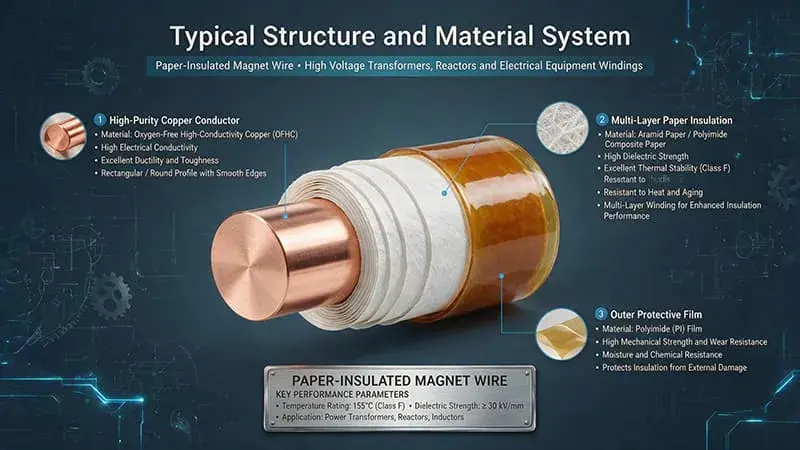
A typical paper covered wire consists of a four-layer structure from inside to outside. The conductor layer is usually C11000 electrical copper (ETP, containing 0.02-0.04% Cu₂O) or C13500 tough-pitch copper (containing 0.75-1.25% Cd to raise softening temperature), with round wire diameter 0.5-5.0 mm and rectangular wire thickness 0.8-5.0 mm × width 2-25 mm. The enamel base coat provides base insulation and adhesion foundation, with common types including Modified Polyester PEW 155°C, Polyesterimide PEI 180°C, Polyamide-imide PAI 200°C, and Polyimide PI 240°C. The insulating paper wrapping layer is the core insulation medium, providing main insulation strength through 2-12 layers of overlap wrapping (typical overlap rate 50-67%). The outermost impregnation layer (VPI vacuum pressure impregnation or VVPI) fills the air gaps between paper layers and forms an integral cured structure.
Insulating Paper Types and Temperature Classes
Insulating paper selection directly determines the temperature class and dielectric performance of paper covered wire. According to the IEC 60085 / NEMA MW 1000 naming system, insulating paper is divided into four major categories by temperature class.
| Insulating Paper Type | Chemical Composition | Thickness Range (mm) | Temperature Class | Dielectric Strength (kV/mm @ 0.25 mm) | Main Applications |
|---|---|---|---|---|---|
| Kraft Paper | Cellulose (wood pulp) | 0.05-0.13 | Class 105 (oil-immersed) / Class 90 (dry-type) | 8-10 | Oil-immersed power transformers, low-voltage motor windings |
| Crepe Paper | Cellulose (stretched and creped) | 0.13-0.25 | Class 105 (oil-immersed) / Class 105 (dry-type) | 7-9 | Transformer lead insulation, impact resistance requirements |
| Nomex® 410/414 | Poly(m-phenylene isophthalamide) (PMIA) | 0.05-0.25 | Class 180-220 | 20-30 | H/C-class dry-type transformers, traction motors, aerospace electrical |
| Mica Paper (Mica-Aramid Laminate) | Aluminum silicate (mica/phlogopite) + glass fiber/aramid reinforcement | 0.10-0.50 | Class 220-240 | 30-40 | High-voltage motor stators, nuclear generators, fire-resistant cables |
Selection decision principles: For oil-immersed applications, Kraft paper is preferred (good compatibility with mineral insulating oil, oil-paper composite dielectric constant 2.2-2.4); for dry-type Class F/H applications, Nomex® aramid paper is preferred (heat resistance 220°C, moisture resistance, flame retardant); for high-voltage motor / fire-resistant applications, Mica paper + glass fiber reinforcement is preferred (highest dielectric strength, insulation retention for 90+ minutes under flame).
Adhesives and VPI Impregnation Process
The impregnation process determines the air gap filling rate between paper layers and the overall insulation density. Common impregnation systems include epoxy-anhydride system (most commonly used, curing temperature 150-180°C), polyester resin system (Class F dry-type transformers), silicone resin system (Class H/C high-temperature environments), and polyesterimide-epoxy hybrid system (Class H traction motors). Key VPI process parameters: vacuum degree ≤ 100 Pa, holding time 4-8 hours, pressure impregnation 0.3-0.5 MPa, holding time 8-24 hours, curing temperature gradient 80-100-150-200°C step-up heating. Impregnation defects will directly lead to a 30-60% decrease in partial discharge inception voltage (PDIV) and a 50-100% increase in dielectric loss tangent (tan δ).
Overview of Test Method Categories
The paper covered wire testing system is divided into seven major categories according to test purposes. All tests should be conducted under standard atmospheric conditions of temperature 23±2°C and relative humidity 50±5% (GB/T 2423.1 / ISO 23529).
Seven Categories of the Test System
- Electrical Performance Testing – Evaluates the dielectric strength and electrical life of insulation, including breakdown voltage, insulation resistance, dielectric loss tangent, partial discharge, and enamel coating continuity, 5 core indicators.
- Mechanical Performance Testing – Evaluates the mechanical reliability of conductor and insulation layer, including tensile strength, elongation, bending, adhesion, springback angle, and scrape resistance, 6 indicators.
- Chemical and Environmental Testing – Evaluates chemical resistance in extreme environments, including oil resistance, solvent resistance, hydrolytic stability, refrigerant resistance, and damp heat aging, 5 indicators.
- Thermal Performance Testing – Evaluates insulation stability under thermal stress, including thermal shock, thermal aging (Arrhenius model), and softening breakdown, 3 indicators.
- Physical Dimensions and Appearance Testing – Evaluates geometric dimensions and appearance defects, including conductor diameter/width/thickness, insulation thickness, ellipticity, and appearance quality, 4 indicators.
- Online Process Testing – 100% continuous monitoring on production line, including enamel coating continuity (online pinhole detection), conductor resistance (DC four-wire method), and outer diameter/insulation thickness (online laser diameter measurement).
- Sampling and Reliability Testing – Batch quality assessment and long-term reliability, including AQL sampling (ISO 2859-1), accelerated aging (Arrhenius model), and statistical analysis (SPC control charts).
Test priority matrix: For oil-immersed transformers, mandatory execution of breakdown voltage + oil resistance + thermal aging; for dry-type VPI transformers, mandatory execution of breakdown voltage + thermal shock + adhesion; for high-voltage motor stators, mandatory execution of breakdown voltage + dielectric loss + partial discharge + vibration + flame retardant.
Electrical Performance Testing
Electrical performance is the core dimension of paper covered wire quality assessment. Breakdown voltage is the single most important indicator, but it needs to be judged in conjunction with IR, tan δ, and PD.
Breakdown Voltage – Three Test Methods
Breakdown voltage test methods are divided into three categories according to conductor diameter (IEC 60851-3 Clause 4).
| Conductor Diameter | Test Method | Test Apparatus | Voltage Rise Rate | Pass Criteria |
|---|---|---|---|---|
| ≤ 0.1 mm | Twisted pair | Two conductors twisted together 125 mm long × 6 turns | 500 V/s | Breakdown ≥ 100 V (Grade 1) |
| 0.1-2.5 mm | Metal cylinder method | Conductor passes through metal cylinder electrode, 50 Hz AC voltage applied | 100-500 V/s | Breakdown ≥ depends on insulation grade |
| > 2.5 mm | U-bend + particle bath | U-bend sample immersed in metal particle bath | 500-1000 V/s | Breakdown ≥ depends on insulation grade |
Typical Grade 1/2/3 breakdown voltage requirements (IEC 60317): 0.5 mm conductor with single-layer insulation ≥ 1.5 / 2.5 / 4.0 kV rms respectively. Grade 2 is the minimum requirement for most application scenarios, and Grade 3 is used for VFD-driven high dv/dt stress scenarios (≥ 1 kV/μs).
Insulation Resistance (IR)
IR test applies 100-1000 V DC voltage between the conductor and the outer surface of insulation, measures the steady-state current, and calculates the volume resistivity (IEC 60851-3 Clause 5). Typical IR requirements: normal state ≥ 10⁸ Ω·cm (Class 105 oil-immersed), ≥ 10¹² Ω·cm (Class 180 dry-type); after 24h water immersion ≥ 10⁶ Ω·cm (Class 105 oil-immersed), ≥ 10⁹ Ω·cm (Class 180 dry-type). The key to IR testing is isothermal and isohumid conditions (GB/T 2423.1) and test voltage stabilization time (usually 1 minute reading).
Dielectric Loss Tangent (tan δ / Dissipation Factor)
tan δ reflects the sum of polarization loss and leakage conduction loss inside the insulation, and is one of the most sensitive indicators for evaluating insulation aging (IEC 60851-3 Clause 6). Typical requirements: Class 105 oil-immersed paper ≤ 0.005 @ 20°C; Class 180 dry-type paper ≤ 0.025 @ 20°C; Class 220 high-temperature paper ≤ 0.040 @ 20°C. tan δ is significantly affected by temperature, and the test should be measured at multiple temperature points of 20°C, 90°C, 130°C, and 180°C and the tan δ-T curve drawn. The rate of tan δ rise with temperature (d(tan δ)/dT) is a key parameter for evaluating thermal stability and should be ≤ 0.001/°C.
Partial Discharge (PD)
PD test is a mandatory item for high-voltage insulation (≥ 6 kV working voltage) (IEC 60851-3 Clause 7 / IEC 61934). Typical PDIV (Partial Discharge Inception Voltage) requirements: oil-immersed transformer 110 kV ≥ 1.5×U_n / 220 kV ≥ 1.3×U_n / 500 kV ≥ 1.2×U_n; dry-type transformer 10-35 kV ≥ 1.5×U_n; high-voltage motor 6-13.8 kV ≥ 3.0×U_n. PRPD (Phase Resolved Partial Discharge) analysis can identify PD types (internal discharge, surface discharge, tip discharge, corona discharge) and is a key diagnostic tool for process improvement.
Enamel Coating Continuity (Online Pinhole Detection)
Online testing is a 100% full inspection item, with the typical requirement that the number of pinholes per meter of enamel film ≤ 5 (IEC 60851-3 Clause 8). Test method: The sample is immersed in copper sulfate solution or mercury bath, and 12-30 V DC voltage is applied. The pinhole is identified by current surge. Production speed 15-30 m/min full inspection.
Mechanical Performance Testing
Mechanical performance determines the reliability of paper covered wire under winding, embedding, and vibration conditions.
Conductor Tensile Strength and Elongation
Conductor tensile strength and elongation reflect the metallurgical quality of the conductor (IEC 60851-3 Clause 9). Typical requirements: annealed state (O state) elongation ≥ 30%, tensile strength 220-260 MPa; half-hard state (1/2H) elongation ≥ 15%, tensile strength 250-310 MPa; hard state (H) elongation ≥ 5%, tensile strength 330-400 MPa. Test speed 50-200 mm/min, gauge distance 200 mm. Round wire is tested directly, and special attention should be paid to preventing fixture slip when testing rectangular wire.
Bending Test
The bending test evaluates the synergistic bending performance of the conductor and insulation layer (IEC 60851-3 Clause 10). Method: The sample is bent 180° around a mandrel with a diameter of 3-10× the conductor diameter, and the insulation layer is checked for cracking, peeling, or delamination. Class 130-200 series paper covered wire should pass 1× mandrel bending without cracking, and Class 220-240 series needs to be relaxed to 3× mandrel due to the high hardness of PI enamel film.
Insulating Paper Adhesion and Flexibility
The adhesion test evaluates the bonding strength between the enamel film and the paper layer, and between the paper layers (IEC 60851-3 Clause 11). Method: 90° peel test or 180° peel test is performed on the sample, and the peel force is measured (typical ≥ 0.5 N/mm). Insufficient adhesion will cause the winding to delaminate under vibration conditions, directly leading to electrical breakdown.
Springback Angle
Springback angle reflects the elastic recovery of the insulation layer (IEC 60851-3 Clause 12). Method: The sample is bent 180° around a mandrel with a diameter of 4× the conductor diameter, held for 5 seconds, and the springback angle is measured. Typical requirements ≤ 5° (Class 130-180), ≤ 8° (Class 200-240). Excessive springback angle indicates serious plastic deformation of the insulation layer and insufficient winding tightness.
Scrape Resistance
Scrape resistance evaluates the ability of the insulation layer to resist mechanical scraping (IEC 60851-3 Clause 13). Method: Use a standard scrape needle (diameter 0.63 mm, applying 1.0-10 N increasing load) to scrape the sample surface, and record the minimum load that causes the insulation layer to be scraped through. Typical requirements ≥ 30 times (under 5 N load), ≥ 10 times (under 10 N load).
Chemical and Environmental Testing
Chemical and environmental testing evaluates insulation stability in extreme working conditions, and is a mandatory item for high-end applications (traction motors, mining transformers, offshore wind power).
Transformer Oil Resistance
Oil resistance is the core indicator for oil-immersed transformers (IEC 60851-4 Clause 4). Method: The sample is immersed in mineral insulating oil (typical ASTM D3487 Type II or IEC 60296 standard oil), at a temperature of 100°C for 168 hours. After the test, the breakdown voltage, IR, tan δ, and adhesion changes are measured. Pass criteria: breakdown voltage retention ≥ 90%, IR retention ≥ 70%, adhesion retention ≥ 80%.
Solvent Resistance
Solvent resistance reflects the resistance of the insulation layer to chemical cleaning agents (IEC 60851-4 Clause 5). Typical solvents: acetone (very fast evaporation), xylene (medium evaporation), ethanol (cleaning), isopropanol (cleaning). Test: Immerse in solvent at 23°C for 24 hours, and observe whether the enamel film bubbles, peels, or discolors. Insufficient solvent resistance will cause the cleaning process during manufacturing to damage the insulation.
Hydrolytic Stability
Hydrolytic stability is a key indicator for humid and hot environment applications (IEC 60851-4 Clause 6). Method: The sample is placed in an environment with 95% relative humidity and a temperature of 40°C for 168 hours, and the IR, tan δ, and breakdown voltage are measured after the test. Pass criteria: IR retention ≥ 50% (Class 105-180), ≥ 30% (Class 200-240). Insulation with poor hydrolytic stability will fail quickly in tropical and marine climates.
Refrigerant Resistance
Refrigerant resistance is a special test for refrigerant compressor motor windings (IEC 60851-4 Clause 7). Typical refrigerants: R22 (second-generation refrigerant), R410A (third-generation refrigerant), R32 (third-generation substitute), R290 (propane, GWP=3 new refrigerant). Test: The sample is immersed in a refrigerant + mineral oil mixture, at a temperature of 80-100°C for 168 hours. After the test, the volume expansion rate (≤ 5%), breakdown voltage retention (≥ 80%), and IR retention (≥ 50%) are measured.
Damp Heat Aging
Damp heat aging is an accelerated test to evaluate long-term humid and hot stability (IEC 60068-2-78 / GB/T 2423.10). Method: The sample is continuously exposed in an environment of temperature 40°C and relative humidity 95% for 168 / 504 / 1000 hours, and samples are taken periodically to measure IR, tan δ, breakdown voltage, and adhesion. After 1000 hours of damp heat aging, IR retention ≥ 30%, tan δ increment ≤ 0.015, and adhesion retention ≥ 60% are the basic requirements for high-end applications.
Thermal Performance Testing
Thermal performance directly determines the long-term life of paper covered wire, and the Arrhenius model is the standard method for thermal life assessment.
Thermal Shock
Thermal shock evaluates the cracking resistance of the insulation layer under rapid temperature changes (IEC 60851-6 Clause 4). Method: The sample is placed in a high-temperature oven for 30 minutes (typical temperatures Class 105 → 130°C, Class 130 → 155°C, Class 155 → 180°C, Class 180 → 200°C, Class 200 → 220°C, Class 220 → 240°C), and then immediately immersed in room temperature water or low-temperature bath (-30°C to room temperature) for 5 minutes. Pass criteria: No cracking, delamination, or peeling of the insulation layer.
Thermal Aging and Thermal Life Assessment (Arrhenius Model)
The Arrhenius model is the standard method for predicting the thermal life of insulation materials (IEC 60172 / IEEE Std 1 / ASTM D2307). Method: Measure the sample failure time at 3-4 accelerated temperature points (typically 20-40°C higher than the target temperature), draw a log₁₀(L) vs 1/T straight line, and extrapolate to the target temperature to obtain the temperature index (TI) corresponding to 20,000 hours of life. Typical TI: Class 105 → 105°C, Class 130 → 130°C, Class 155 → 155°C, Class 180 → 180°C, Class 200 → 200°C, Class 220 → 220°C, Class 240 → 240°C. The key assumption of the Arrhenius model is a single activation energy, but paper covered wire is a multi-layer heterogeneous system, and the actual life should consider the two-segment Arrhenius model (IEC 60216-3).
Softening Breakdown
Softening breakdown reflects the mechanical stability of the insulation layer at high temperatures (IEC 60851-6 Clause 5). Method: The sample is subjected to a 1-5 N tensile load at both ends, placed in an oven, and heated at 2°C/min. The temperature at which the insulation layer softens and breaks down is recorded. Typical requirements: Class 130 ≥ 170°C, Class 155 ≥ 200°C, Class 180 ≥ 230°C, Class 200 ≥ 250°C, Class 220 ≥ 300°C, Class 240 ≥ 320°C.
Key Standards System Comparison
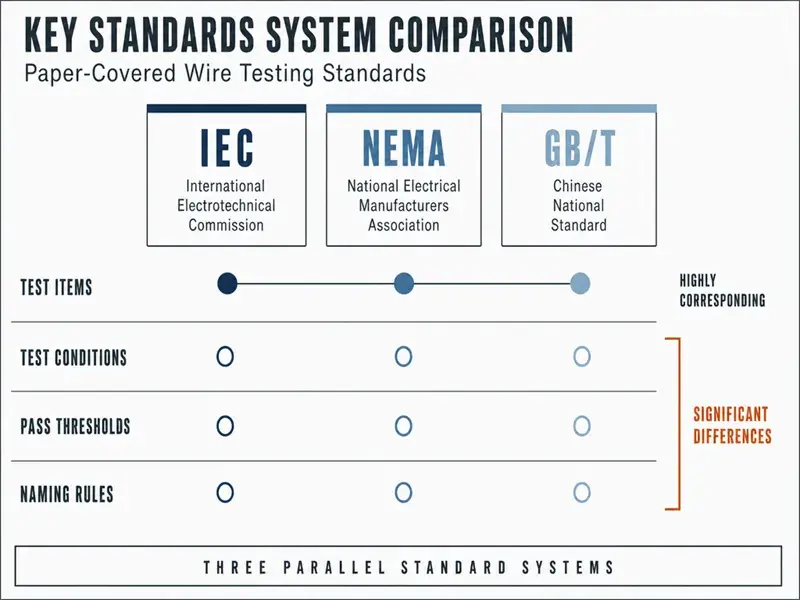
The paper covered wire testing standard system has three major streams: IEC (International Electrotechnical Commission), NEMA (National Electrical Manufacturers Association), and GB/T (Chinese National Standard). The three standards are highly corresponding in test items, but there are significant differences in test conditions, pass thresholds, and naming rules.
Overview of International Standards
| Standard Number | Full Name | Applicable Scope |
|---|---|---|
| IEC 60851-1 | Winding wires – Test methods – General | General requirements, sample preparation |
| IEC 60851-2 | Determination of dimensions | Diameter/width/thickness/ellipticity |
| IEC 60851-3 | Mechanical properties | Tensile/bending/adhesion/springback/scrape |
| IEC 60851-4 | Chemical properties | Solvent/oil/refrigerant resistance |
| IEC 60851-5 | Electrical properties | Breakdown/IR/tan δ/PD/continuity |
| IEC 60851-6 | Thermal properties | Thermal shock/softening/thermal aging |
| IEC 60172 | Thermal endurance | Arrhenius model + TI assessment |
| IEC 60085 | Thermal classification | Thermal classes Y/A/E/B/F/H/N/R/250 |
| IEC 60317 | Product specification series | Detailed specifications for product models |
| IEC 60216 | Electrical insulating materials – Thermal endurance | General thermal aging methods |
| IEC 61934 | Partial discharge measurements | PD test methods |
| IEC 60068-2-78 | Damp heat, steady state | Damp heat aging |
| IEC 60068-2-52 | Salt mist, cyclic | Salt mist cyclic |
| NEMA MW 1000 | Magnet Wire Standard | NEMA comprehensive standard |
| NEMA MW 31-A/C | Paper covered round copper wire | Round copper paper-covered wire |
| NEMA MW 33-A/C | Paper covered rectangular copper wire | Rectangular copper paper-covered wire |
| NEMA MW 60/61-A/C | Paper covered aluminum wire | Aluminum conductor paper-covered wire |
| GB/T 4074 | Winding wire test methods | China equivalent to IEC 60851 |
| GB/T 7672 | Glass-fiber covered winding wire | Glass-fiber covered wire |
| GB/T 11021 | Electrical insulation – Thermal classification | Thermal class naming |
| ASTM D149 | Dielectric Breakdown Voltage | Dielectric breakdown voltage |
| ASTM D1676 | Film-insulated magnet wire | Film-insulated magnet wire |
| ASTM D2307 | Thermal endurance | Thermal life Arrhenius |
| IEEE Std 1 | General Principles for Temperature Limits | Temperature limit principles |
| ISO 2859-1 | Sampling procedures for inspection by attributes | AQL sampling |
| UL 1446 | Systems of Insulating Materials | Insulation system certification |
Key Differences Between IEC 60851 and NEMA MW 1000
| Test Item | IEC 60851 | NEMA MW 1000 | Main Differences |
|---|---|---|---|
| Breakdown Voltage | 500 V/s rise | 500 V/s rise | Basically consistent |
| IR Test | 100-1000 V DC | 500 V DC | NEMA fixed at 500 V |
| tan δ | 20°C, 90°C multi-point | 25°C single point | IEC requires more temperature points |
| Bending Test | 1-3× mandrel | 1-5× mandrel | NEMA has wider range |
| Thermal Aging | Arrhenius model | Arrhenius model | Consistent but specific temperature points differ |
| Naming Convention | Class 105/130/155/180/240 | Class 105/130/155/180/220/240 | NEMA includes Class 220, IEC includes Class 250 |
| Marking Requirements | Color coding | Identification code | Different systems |
GB/T 4074 vs IEC 60851 Correspondence
The GB/T 4074 series is the Chinese equivalent adoption version of IEC 60851, with the main differences being: ① GB/T 4074.1 has more detailed regulations on sample preparation adapted to Chinese climate conditions; ② GB/T 4074.5 has made minor adjustments to the breakdown voltage pass threshold for products common in the Chinese market; ③ Added GB/T 4074.7 (refrigerant resistance) and other special tests, corresponding to the needs of the Chinese refrigeration industry; ④ The GB/T 4074 series is used in conjunction with GB/T 11021 (thermal class naming), GB/T 10580 (test conditions) and other basic standards.
Application-Specific Testing
Paper covered wire needs to perform special tests in different application scenarios, with focus on three types of high-end applications: oil-immersed transformers, dry-type VPI transformers, and high-voltage motors.
Oil-Immersed Transformer Paper-Insulated Wire Special Tests
Oil-immersed power transformer is the most classic application scenario for paper covered wire, with working voltage 110-500 kV and 5-50 tons of paper covered wire per unit. Special tests include: ① Breakdown voltage (mandatory, ≥ 5 kV rms @ 0.5 mm conductor, single layer); ② Oil resistance (100°C mineral oil immersion 168 h, breakdown retention ≥ 90%); ③ tan δ (20°C ≤ 0.005 @ 0.5 mm conductor single layer); ④ PD test (PDIV ≥ 1.5×U_n, oil-immersed 110 kV transformer); ⑤ Thermal aging (Arrhenius model 20,000 h TI assessment).
Process focus for oil-immersed applications: Air gap filling rate between paper layers ≥ 95%, oil-paper composite dielectric constant 2.2-2.4, water content ≤ 0.1% after 24h oil immersion. The dielectric loss of oil-immersed transformers mainly comes from the oil-paper composite system, and the tan δ-T curve characteristics are: 20°C → 0.5-1.0%, 90°C → 2-3%, with the peak temperature corresponding to cellulose degradation.
Dry-Type Transformer VPI Paper-Insulated Wire Special Tests
Dry-type transformer VPI (Vacuum Pressure Impregnation) paper covered wire works at 10-40 kV. Special tests include: ① Breakdown voltage (≥ 4 kV rms @ 0.5 mm conductor, single layer); ② Thermal shock (Class F 180°C / Class H 200°C no cracking); ③ Adhesion (≥ 0.5 N/mm); ④ tan δ (20°C ≤ 0.025, 90°C ≤ 0.040); ⑤ Damp heat aging (40°C/95% RH/168 h, IR retention ≥ 30%); ⑥ Flame retardant (UL 94 V-0 or IEC 60695-11-10 V-0).
Dry-type VPI process focus: Vacuum degree ≤ 50 Pa, holding 6-12 h, pressure impregnation 0.4-0.6 MPa, holding 12-24 h, step curing (80-100-150-200°C). Impregnation defects will directly lead to a 30-60% decrease in partial discharge inception voltage and a 50-100% increase in tan δ.
High-Voltage Motor Stator Paper-Wrapped Windings Special Tests
High-voltage motor (6-13.8 kV) stator windings adopt mica paper + glass fiber reinforcement + VPI process. Special tests include: ① Breakdown voltage (≥ 10 kV rms @ multi-layer insulation); ② tan δ (20°C ≤ 0.020, 90°C ≤ 0.040, 130°C ≤ 0.060); ③ PD test (PDIV ≥ 3.0×U_n); ④ Vibration resistance (IEC 60068-2-6, 10-500 Hz, 10 g); ⑤ Flame retardant (IEC 60695-11-10 V-0); ⑥ Thermal aging (Class F 155°C / Class H 180°C).
Process difficulties of high-voltage motors: ① Coil forming accuracy (tolerance ± 0.5 mm); ② VPI impregnation uniformity (large coils are prone to insufficient filling at the bottom); ③ Mica paper tape wrapping angle (typical 80-85° oblique wrap); ④ End field strength control (adopting nonlinear resistance anti-corona layer).
Third-party testing and certification
High-end application scenarios (nuclear power, rail transit, marine engineering) require third-party certification.
Third-Party Testing Organizations
Major international certification bodies: ① UL (Underwriters Laboratories): UL 1446 insulation system certification, UL 1581 burning test, UL 94 flame retardant grade; ② CSA (Canadian Standards Association): CSA C22.2 No. 38 enameled wire, C22.2 No. 154 transformer windings; ③ TÜV (German Technical Inspection Association): TÜV 2 PfG 1169 photovoltaic application certification; ④ VDE (German Association of Electrical Engineers): VDE 0530 rotating machine winding test; ⑤ Intertek (UK): ASTA Diamond certification, ETL mark; ⑥ SGS (Swiss General Notary): general testing services; ⑦ CTI (China Huace Testing): Chinese national laboratory certification CNAS/CMA. Chinese local institutions: ① China Electric Power Research Institute (under State Grid): high-voltage transformer paper covered wire special; ② Shanghai Cable Research Institute: magnet wire comprehensive testing; ③ National Insulation Material Testing Center (Guilin Electric Science Research Institute): insulation material special.
Certification Process
Typical third-party certification process (3-6 months): ① Pre-assessment (1-2 weeks): Customer provides product specifications, application scenarios, target markets; ② Test plan (2-3 weeks): Certification body formulates test plan and quotation; ③ Sample preparation (4 weeks): Customer submits ≥ 100 m paper covered wire samples, covering all specification models; ④ Test execution (4-12 weeks): Execute electrical/mechanical/chemical/thermal/aging tests according to the plan; ⑤ Report review (2-4 weeks): Certification body reviews data and issues report; ⑥ Certificate issuance (1-2 weeks): Annual review + quarterly sampling inspection.
Certification Test Package
UL 1446 EIS (Electrical Insulation System) certification is the core certification for transformer windings in the North American market, requiring the entire insulation system (enameled wire + paper covered wire + impregnation resin + insulating paper + slot insulation + end insulation) joint certification. UL 1446 test package includes: ① UL 1446 system thermal aging (Arrhenius model 9 data points, 20,000 h TI assessment); ② UL 1581 burning test (VW-1, FT1, FT2); ③ UL 94 flame retardant grade (V-0, V-1, V-2, HB); ④ System vibration test (IEC 60068-2-6); ⑤ System damp heat aging (IEC 60068-2-78). CE certification (EU) requires compliance with EN 60317 + RoHS 2.0 + REACH SVHC; CCC certification (China) requires compliance with GB/T 4074 + GB 8978-1996 waste liquid treatment.
Sampling of Internal QC and AQL in the Factory
Factory internal QC is the core of factory inspection and determines batch quality stability.
AQL Sampling Standards
AQL (Acceptable Quality Level) sampling follows ISO 2859-1 / GB/T 2828.1 standard. Typical AQL levels for paper covered wire: ① Critical defect AQL = 0 (zero tolerance, such as breakdown voltage below specification lower limit); ② Major defect AQL = 0.65 (such as IR, tan δ seriously exceeding specification); ③ Minor defect AQL = 1.0-2.5 (such as appearance scratches, slight dimension deviation); ④ Slight defect AQL = 4.0 (such as label error, outer package damage).
Inspection Levels
ISO 2859-1 specifies three types of inspection levels: ① Inspection level I: Reduced inspection, suitable for mature processes and low-risk customers; ② Inspection level II: Normal inspection, most commonly used; ③ Inspection level III: Tightened inspection, suitable for new processes and high-risk customers. Special inspection levels S-1, S-2, S-3, S-4 are used for destructive tests (such as breakdown voltage, thermal aging).
Sampling Plan Example (AQL 1.0, Level II)
| Batch Size (N) | Sample Size (n) | Ac (Acceptance) | Re (Rejection) |
|---|---|---|---|
| 2-8 | 2 | 0 | 1 |
| 9-15 | 3 | 0 | 1 |
| 16-25 | 5 | 0 | 1 |
| 26-50 | 8 | 0 | 1 |
| 51-90 | 13 | 0 | 1 |
| 91-150 | 20 | 1 | 2 |
| 151-280 | 32 | 1 | 2 |
| 281-500 | 50 | 2 | 3 |
| 501-1200 | 80 | 3 | 4 |
| 1201-3200 | 125 | 5 | 6 |
Online Testing and Final Testing
Production line 100% online testing includes: ① Enamel coating continuity (pinhole detection, 100% full inspection); ② Conductor resistance (DC four-wire method, 100% full inspection); ③ Outer diameter/insulation thickness (online laser diameter measurement, 1 point sampled every 10 m); ④ Appearance (CCD visual inspection, 100% full inspection). Final testing (factory inspection) includes: ① Breakdown voltage (sampled by AQL); ② IR (sampled by AQL); ③ Tensile strength + elongation (sampled by AQL); ④ Appearance + dimensions (100% full inspection).
Selection, Procurement and Acceptance Practices
Scientific selection and strict acceptance are the key to ensuring the quality of paper covered wire.
Selection Decision Framework
5-step selection decision framework: Step 1 – Define application scenario: Oil-immersed vs dry-type vs high-voltage motor vs special reactor, determining the basic insulation system; Step 2 – Determine temperature class: Class B 130 / Class F 155 / Class H 180 / Class N 200 / Class R 220 / Class 250, determining enamel film and insulating paper combination; Step 3 – Select insulating paper type: Oil-immersed → Kraft paper; Dry-type Class F → Nomex® 410; Dry-type Class H → Nomex® 410/414; High-voltage motor → Mica paper + glass fiber reinforcement; Step 4 – Select conductor specification: Round wire AWG 6-30 / rectangular wire 0.8-10 mm × 2-25 mm; copper vs aluminum (weight reduction vs cost); Step 5 – Match test requirements: Mandatory tests (Tier 1) + recommended tests (Tier 2) + enhanced tests (Tier 3).
Acceptance Criteria
Supplier incoming acceptance criteria: ① Appearance inspection (intact paper layer, no damage, no pollution); ② Dimension measurement (diameter/width/thickness, 5-10 samples/batch); ③ Breakdown voltage test (3-5 samples/batch); ④ Conductor resistance test (5 samples/batch); ⑤ Certificate verification (certificate of conformity + third-party inspection report). Non-conformance handling: ① Critical defect (such as breakdown voltage below specification lower limit) → return the entire batch; ② Major defect (such as IR below specification lower limit) → double sampling re-inspection, return if re-inspection fails; ③ Minor defect (such as appearance scratches) → rework or accept at reduced price; ④ Slight defect (such as label error) → accept but require supplier to improve.
Long-Term Reliability Assessment
Long-term reliability assessment methods: ① Accelerated aging test (Arrhenius model, multiple temperature points); ② On-site sampling analysis (sample measurement of IR, tan δ, breakdown voltage after 5-10 years of operation); ③ Statistical analysis (SPC control charts, PFMEA failure mode analysis); ④ Supplier audit (annual on-site audit IATF/SOA); ⑤ Batch trend analysis (monitoring of key indicator trends between batches, such as monthly average tan δ). Long-term reliability data should be incorporated into the supplier quality file as a reference for the next procurement.
Conclusion
As the most historically significant insulation structure in the magnet wire family, the quality assurance of paper covered wire requires a complete testing system established from four dimensions: material, process, chemistry, and environment. The material dimension needs to ensure the metallurgical and chemical quality of conductor, enamel film, insulating paper, and adhesive; the process dimension needs to ensure wrapping tension, overlap rate, impregnation uniformity, and curing temperature gradient; the chemistry dimension needs to ensure the stability of oil resistance, solvent resistance, hydrolytic stability, and refrigerant resistance in extreme environments; the environment dimension needs to ensure long-term reliability under thermal shock, damp heat aging, and salt mist cycling.
The core of the testing system is the synergistic assessment of five key indicators: breakdown voltage + IR + tan δ + PD + thermal aging, combined with AQL sampling, third-party certification, and SPC statistical process control to form a complete quality assurance framework.
Future development trends: ① Composite insulation systems (mica paper + glass fiber + aramid + VPI resin) will dominate the Class 220+ high-end market; ② Intelligent online detection (machine vision + AI defect recognition + digital twin) will replace traditional sampling inspection; ③ Green manufacturing (water-based impregnation resin, solvent-free enamel film, recyclable insulating paper) will respond to REACH / RoHS 2.0 / WEEE directives.