


Introduction: Why Safe Stripping of Enameled Copper Wire Matters
The insulation coating of enameled copper wire (magnet wire) is crucial for the reliable operation of motors, transformers, and induction coils. However, in maintenance, recycling, research and development, and connection scenarios, it is necessary to remove parts of the enameled coating to achieve electrical connections. This seemingly simple “enameling” operation actually involves three major engineering dimensions: enameled coating chemistry, operational safety, and copper conductor protection. Choosing the wrong method can lead to copper conductor scratches, conductor softening during annealing, VOC poisoning for operators, or even fires. Safe stripping of the enameled copper wire coating is one of the most easily underestimated process steps in the electrical wire industry. From motor repair shops to laboratory research benches, from scrap copper recycling yards to PCB soldering lines, almost every engineer who works with enameled wire has faced this problem. This paper constructs a complete engineering framework for the safe stripping of enameled copper wires based on five major process methodologies (mechanical, thermal melting, chemical, electrochemical, and laser/ultrasonic), four major safety dimensions (ventilation, personal protection, fire prevention, and waste liquid treatment), and a enamel coating type-process adaptation decision matrix.
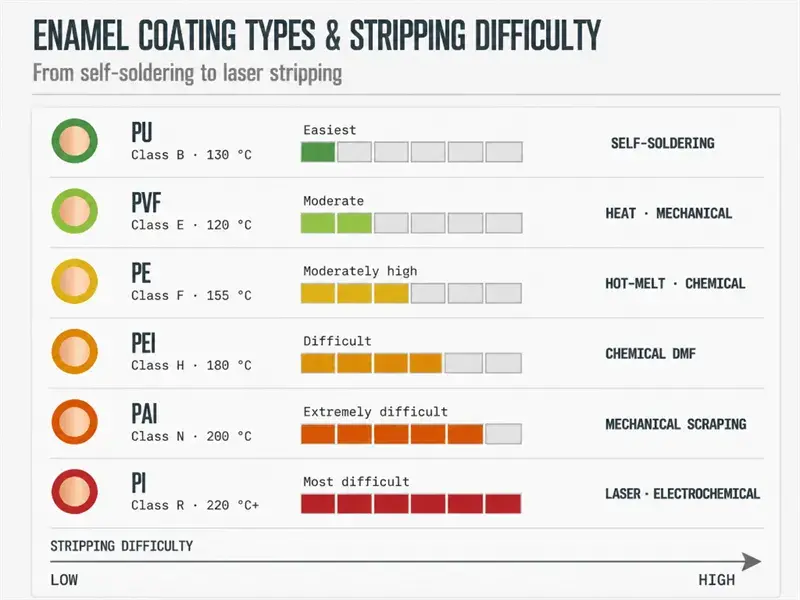
Enameled Coating Types and Stripping Difficulty Classification
The chemical structures of different enamel coating types determine the vastly different levels of difficulty in peeling them. Understanding this classification is the first step in selecting a process method.
Polyurethane Enameled Coating (PU / Class B 130)
Polyurethane (PU) is the easiest type of enameled wire with an enamel coating to peel off. Its core characteristic is its self-soldering property—it can be directly peeled off and simultaneously soldered at standard soldering iron temperatures. This is a typical process according to standards such as IEC 60317-3, IEC 60317-8, and IEC 60317-11. PU enamel coatings have a relatively low thermoplastic temperature and a relatively moderate thermal shock temperature, allowing for complete peeling and simultaneous soldering in a short time when used with a standard soldering iron—making it the most user-friendly “peel-and-solder integrated” process among all enameled wires.
Polyvinyl Formal Enameled Coating (PVF / Class E 120)
Polyvinyl formal (PVF) was a representative of early enameled wire enamel coatings, mainly used in oil-immersed transformers. PVF enamel coatings are of moderate difficulty to remove—due to their low thermoplastic temperature, they can be removed by mechanical scraping or low-temperature heating; however, they have good chemical resistance, so careful selection of chemical paint removers is necessary.
Polyester Enameled Coating (PE / Class F 155)
Polyester (PE) is currently the most widely used type of enamel coating in the world for enameled wire. The difficulty of peeling off PE enamel coating is moderately high – hot-melt peeling requires higher temperatures, and mechanical scraping requires sharper tools; chemical peeling is relatively easier.
Polyesterimide Enameled Coating (PEI / Class H 180)
Polyesterimide (PEI) is an upgraded version of PE. Peeling off PEI enamel coatings is relatively difficult—the risks of high-temperature hot-melt combined with copper annealing limit the use of pure thermal methods; chemical peeling (such as dimethylformamide (DMF) and cresol-like acids) is the mainstream process.
Polyamide-imide Enameled Coating (PAI / Class N 200)
Polyamide-imide (PAI) is a representative of high-grade enamel coatings in enameled wires. Peeling off PAI enamel coatings is extremely difficult—its excellent chemical resistance (resistance to R-134a/R-1234yf refrigerants) means that choosing the right chemical remover is challenging; high-temperature melting can easily cause copper softening during annealing; mechanical scraping is the mainstream method, but it can easily damage the fine wires.
Polyimide Enameled Coating (PI / Class R 220+)
Polyimide (PI) is the highest grade representative of enamel coatings. PI enamel coatings are extremely difficult to remove—they are resistant to almost all organic solvents (except concentrated sulfuric acid) and extremely high temperatures. Conventional methods are difficult to use; laser stripping, electrochemical stripping, and high-concentration chemical paint removers are among the few feasible solutions.
Method 1: Mechanical Scraping (Blades/Sandpaper/Fiberglass Wheel)
Mechanical scraping is the most traditional method for stripping enamel coatings from enameled wires. It is applicable to all types of enamel coatings, but it requires high precision and operator skill.
Manual Scraping (Blades/Utility Knife/Scissors)
The simplest mechanical method involves scraping off the enamel coating along the conductor’s axis using a sharp blade. Suitable for: – Temporary stripping in repair shops (small quantities, single strands) – Laboratory research sampling – Thin Grade 1 enameled wire (fine wire, AWG high grade) Risks and Precautions: – Fine wire is easily scratched—AWG 30 and above enameled wire can be easily cut during scraping. – Operator is at risk of cuts—blade exposed. – Enameled coating residue may enter the respiratory tract—wear a mask.
Sandpaper/Abrasive Grinding (Fine Grit)
Use fine sandpaper to sand along the conductor axis to remove the enamel coating. Suitable for: – Grade 2/3 enameled wire with a thicker enamel coating – Batch pretreatment (enameled wire stripping from rolls) – PEI/PAI with a strong bond between the enamel coating and copper. Risks and Precautions: – Inappropriate sandpaper grit selection may scratch the copper (medium to fine grit recommended) – Prolonged sanding will generate copper powder/enamel coating mixed dust – ventilation is required – Sandpaper life is short (check before each use).
Fiberglass Wheel/Steel Wire Wheel (Industrial Grade)
Industrial-grade mechanical stripping method using a high-speed motor to drive a glass or steel wire brush wheel for frictional stripping of the coating. Suitable for: – Batch pretreatment on industrial production lines – Large diameter enameled wire (AWG low-number) – High melting point enamel coating (PAI/PI) Risks and Precautions: – High temperatures generated by friction may cause the enamel coating to ignite – fire protection required – Glass/steel wire breakage and shards – safety goggles and face shield required – High-speed rotation may eject enamel coating debris – work area protection required
High-Speed Rotating Blade (Precision Type)
Professional wire strippers use high-speed rotating blades (such as Eraser products) to precisely cut enamel coatings without damaging the copper. Suitable for: – Precision coil production (motor windings, transformers) – Ultra-fine wire (AWG high-number) enamel stripping – Scenarios requiring high consistency. Advantages: High precision, can handle almost all enamel coating types.
Method 2: Thermal Melting (Soldering Iron/Hot Air Gun/Open Flame/Solder Pot)
The hot melt method utilizes the difference in thermoplasticity of the enamel coating, heating it to soften, carbonize, and peel it off. It is suitable for medium to low melting point enamel coatings (PU/PVF/PE), but not for PAI/PI.
Soldering Iron Stripping (Preferred for PU Enameled Coatings)
Use a standard soldering iron to contact the end of the enameled wire. Once the enamel coating softens from the heat, peel it off with tweezers or stripping pliers. Suitable Enameled Coatings: PU (best for self-soldering), PVF, PE. Typical Process Parameters: Moderate soldering iron temperature, short contact time; a temperature-controlled soldering station is recommended. Advantages: Low cost, portable, simultaneous stripping and soldering of PU enamel coatings. Risks and Precautions: – Excessive temperature may cause copper annealing, softening the copper and reducing its strength. – Prolonged heating may damage nearby insulation (such as interlayer insulation in transformers). – Risk of burns to the operator—use heat-resistant gloves.
Hot Air Gun Stripping (Larger Areas)
Use a heat gun to evenly heat the enameled wire, softening the enamel coating, then scrape it off with a tool. Suitable for: PU, PVF, PE (thin enamel coating, Grade 1) Advantages: Even heating, suitable for larger areas, simultaneous processing of multiple wires Risks and Precautions: – Uneven heating may cause partial carbonization of the enamel coating (difficult to peel off) – High ventilation requirements (enamel coating releases VOCs/fumes upon thermal decomposition) – Prohibited in flammable environments (PVC conduits, etc.)
Open Flame Burning (Emergency/Repair)
Use a lighter, alcohol lamp, or miniature welding torch to briefly burn the end of the enameled wire with an open flame. The enamel coating will quickly carbonize and peel off. Suitable Scenarios: Emergency repairs, fieldwork, small quantities of enameled wire. Risks and Precautions: – Strictly prohibited from use in poorly ventilated indoor environments. – Burning the enamel coating produces toxic fumes (PI enamel coating combustion products are particularly dangerous). – Copper wire is prone to annealing—keep the wire moving along the edge of the flame, not the center. – After burning, carbonized residue must be removed (using fine sandpaper or a glass fiber brush).
Solder Pot Immersion (Batch Pretreatment, Industrial Grade)
Immerse the enameled wire end in a molten solder pot. The enamel coating is burned off while the copper wire is simultaneously tinned. Suitable for: PU (self-soldering enamel coating), PVF (partially). Advantages: Batch processing, integrated stripping and tinning, immediate solderability of copper surface. Risks and Precautions: – Only suitable for solderable enamel coatings—PU; not suitable for PE/PEI/PAI/PI. – High pot temperature may cause copper annealing. – High risk of burns from solder pot operation—wear heat-resistant apron, gloves, and safety goggles. – Ventilation requirements (solder fumes contain lead/rosin).
Method 3: Chemical Stripping (Solvents/Acids-Alkalis/Commercial Strippers)
Chemical paint stripping uses chemical reagents to dissolve or swell the enamel coating, causing it to detach from the copper conductor. It is suitable for high-volume, high-melting-point enamel coatings (PEI/PAI/PI).
Solvent Stripping (Organic Solvents)
Soak the enameled wire in organic solvents (acetone, ethanol, dimethylformamide (DMF), N-methylpyrrolidone (NMP), dichloromethane, etc.) to cause the enamel coating to swell and peel off. Applicable enamel coatings: PU (removable with acetone), PE (removable with DMF/NMP), PVF (partially). Advantages: Suitable for large-scale production, complete enamel coating removal. Risks and Precautions: – VOC Release: Must be handled in a fume hood (with strong ventilation). – Toxicity: DMF, NMP, and dichloromethane are toxic to the liver and kidneys; a gas mask (organic vapor filter) is required. – Flammability: Acetone and ethanol have low flash points; keep away from open flames. – Waste Disposal: Classified as hazardous waste; must be disposed of according to REACH/RoHS/EPA regulations.
Acid/Alkali Stripping (Inorganic Chemistry)
Soaking the enameled wire in strong acids (concentrated sulfuric acid, nitric acid, hydrochloric acid) or strong alkalis (sodium hydroxide, NaOH) chemically destroys the enamel coating structure. Suitable for: PEI (can be removed by concentrated sulfuric acid), PI (requires strong acid), PVF (partially). Advantages: Can peel off extremely difficult-to-treat enamel coatings such as PI. Risks and Precautions: – Severe corrosion from strong acids and alkalis—Operators must wear acid- and alkali-resistant gloves, masks, and protective clothing. – Concentrated sulfuric acid reacts violently with water and releases heat—Handling must be slow. – Copper may be corroded—Improper concentration/time control can damage the copper conductor. – Waste liquid must be neutralized (discharge only after neutralization to pH).
Commercial Strippers (Professional Formulations)
Commercially available professional paint removers (such as Eraser’s Dip Strip) are specifically designed for enameled wires with enamel coatings, containing specific solvents, activators, and corrosion inhibitors. Suitable for: Almost all types of enamel coatings (including PI). Advantages: Highly efficient, professionally formulated, does not corrode copper, relatively safe to use. Risks and Precautions: – Higher price (professional grade has higher cost per liter) – Ventilation is still required (VOC release) – Waste liquid disposal must be carried out according to the supplier’s MSDS.
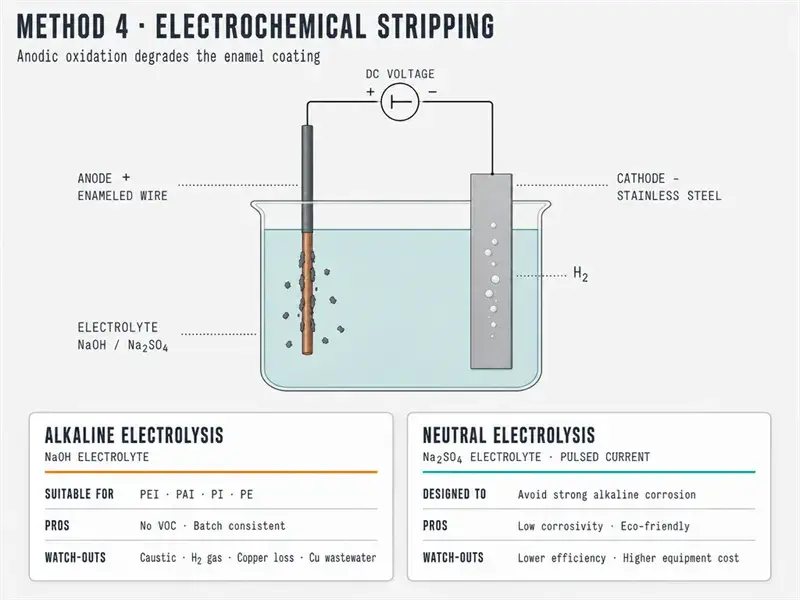
Method 4: Electrochemical Stripping (Electrolytic Removal)
The electrochemical method uses the principle of electrolysis, with the enameled wire as the anode, and an electric current is passed through the electrolyte to oxidize and degrade the enamel coating.
Alkaline Electrolysis (NaOH Electrolyte)
In NaOH electrolyte, the enameled wire is connected to the anode (+), and the stainless steel is connected to the cathode (-). A DC voltage is applied, and the enamel coating gradually degrades under anodic oxidation. Suitable for: PEI/PAI/PI (high-grade enamel coating), PE (medium-grade). Advantages: Can handle extremely difficult-to-remove enamel coatings (PI/PAI), no VOC release, good batch consistency. Risks and Precautions: – Electrolyte is strongly alkaline—Alkali-resistant gloves and goggles must be worn. – Hydrogen generation—Hydrogen is generated at the cathode; keep away from open flames. – Slight dissolution of copper—Control current density to avoid excessive corrosion. – Wastewater contains copper—Must be treated as hazardous heavy metal waste.
Neutral Electrolysis (Environmentally Friendly)
Use a neutral salt (such as Na₂SO₄) electrolyte to avoid strong alkaline corrosion. Pulsed current or a specialized waveform is required to improve the degradation efficiency of the enamel coating. Advantages: Low corrosivity, environmentally friendly. Limitations: Lower efficiency than alkaline electrolysis, higher equipment cost.
Method 5: Laser and Ultrasonic Stripping (Precision Medical/Aerospace)
Laser Stripping (Precision Medical, Aerospace)
Precise ablation of the enamel coating using pulsed lasers (UV laser 355 nm or green laser 532 nm) removes only the enamel coating without damaging the copper. Applicable Scenarios: – Micro motors, medical devices (AWG ultra-high grade ultra-fine wire) – High-reliability coils for aerospace – Mass production (in-line laser stripping) Advantages: Extremely high precision, no mechanical contact, no VOCs, can handle extremely difficult PI/PAI enamel coatings. Risks and Precautions: – Laser radiation—Requires wearing appropriate wavelength goggles (OD ≥ 4) – High equipment cost (typically high price for industrial-grade equipment) – Fog extraction—Efficient ventilation is required for enamel coating vaporization products – Copper surface modification—Laser may alter the copper surface microstructure, requiring subsequent treatment.
Ultrasonic Stripping (Precision Laboratory)
Immersing the enameled wire in a chemical solvent followed by an ultrasonic cleaner utilizes ultrasonic cavitation to accelerate the dissolution and removal of the enamel coating. Suitable Scenarios: Laboratory research and development, pretreatment of special enamel coating samples. Advantages: Gentle, effective for fine wires, complete enamel coating removal. Limitations: Low efficiency, unsuitable for mass production.
Method 6: Enameled Coating-Process Selection Decision Matrix
In practical engineering, the appropriate process should be selected based on the enamel coating type, conductor diameter, batch size, and cost constraints:
| Enameled Coating Type | Conductor Diameter | Recommended Process | Alternative Process |
|---|---|---|---|
| PU | Any | Solder pot immersion | Soldering iron stripping, acetone soaking |
| PVF | Fine wire | Mechanical scraping + soldering iron | Low-temperature hot melt |
| PE | Fine wire | DMF/NMP chemical soaking | Sandpaper grinding + hot melt |
| PEI | Fine wire | Chemical paint remover (DMF/NMP) | Concentrated sulfuric acid (acid-resistant scenarios) |
| PAI | Fine wire | Electrochemical stripping (NaOH electrolysis) | High-concentration chemical paint remover |
| PI | Any | Laser stripping | Concentrated sulfuric acid (emergency) |
| Fine wire (AWG high number) | Any | Laser stripping | Ultrasonic + chemical (laboratory) |
| Heavy duty wire (AWG low number) | Industrial batch | Fiberglass wheel (industrial grade) | Solder pot immersion |
| Repair shop (small quantity) | Any | Soldering iron + manual scraping | Sandpaper grinding |
| Scrap copper recycling (large batch) | Any | Industrial grade fiberglass wheel + chemical | Thermal method (non-incinerable) |
Safety Protection: Four Major Dimensions of Systematization
Enameled wire and enamel coating stripping involves multiple hazards and requires systematic protection:
Dimension 1: Ventilation and Air Quality Management
enamel coating releases VOCs (volatile organic compounds), fumes, and acid/alkali vapors through pyrolysis, combustion, and chemical dissolution. Mandatory Requirements: – Chemical paint stripping must be performed in a fume hood (with strong ventilation). – Fume extraction systems must be installed in areas where thermal processes are performed. – Open flame burning is limited to outdoor areas or environments with strong ventilation. – Operators must wear organic vapor filter respirators (such as 3M 6001/6003 series).
Dimension 2: Personal Protective Equipment (PPE)
Mandatory equipment according to OSHA 29 CFR 1910 standard:
| Process Type | Goggles | Gloves | Respiratory Protection | Protective Clothing |
|---|---|---|---|---|
| Mechanical scraping | ✅ Essential | ✅ Cutting protection | ⚠️ Dust | ⚠️ Apron |
| Thermal process | ✅ Essential | ✅ Scalding protection | ✅ Smoke protection | ⚠️ Flame retardant |
| Chemical process | ✅ Essential | ✅ Chemical protection | ✅ VOC protection | ✅ Splash protection |
| Electrochemical process | ✅ Essential | ✅ Alkali protection | ⚠️ Hydrogen | ✅ Alkali resistance |
| Laser | ✅ OD ≥4 | ✅ Laser protection | ✅ Smoke protection | ✅ Protection |
Dimension 3: Fire and Explosion Prevention
- Store chemical solvents away from open flames/electric sparks (anti-static measures) – Keep CO₂ fire extinguishers around soldering pots (do not use ABC dry powder – it contaminates copper) – Flammable solvents are strictly prohibited in open flame operation areas – Ventilation systems use explosion-proof motors
Dimension 4: Waste Liquid Treatment and Environmental Compliance
Disposal according to EPA 40 CFR + REACH + RoHS 2.0 standards: – Organic waste liquid (DMF/NMP/acetone) → Hazardous waste, to be disposed of by a qualified unit. – Acidic and alkaline waste liquid → Neutralized to pH neutral before discharge (according to GB 8978-1996). – Copper-containing waste liquid → Heavy metal hazardous waste, must be collected separately. – Exhaust gas → Exhaust gas from fume hoods is discharged after activated carbon adsorption.
Conductor Protection: Avoiding Copper Damage and Annealing
Mechanical Damage Control
- Cutting depth should not exceed the thickness of the enamel coating. – Keep the tool sharp (a dull tool is more likely to scratch the copper). – For fine lines (AWG high-grade), laser stripping or chemical paint stripping is recommended.
Thermal Annealing Control
- Short soldering iron contact time (PU enamel coating) – Solder pot immersion temperature should not be too high – The tensile strength of copper decreases after heating – Bending is prohibited after annealing.
Chemical Corrosion Control
- After soaking in strong acid, neutralization (alkaline solution) must be performed immediately. – After soaking in strong alkali, rinse with water immediately. – The copper surface may discolor (Cu₂O reddish-brown) after chemical treatment – it can be lightly polished with fine sandpaper.
International Standards and Global Compliance
Enameled wire and enamel coating stripping involves multiple international standards:
| Standard | Scope | Application |
|---|---|---|
| IEC 60851-3 | Enameled wire electrical/mechanical testing | Post-stripping breakdown voltage verification |
| ASTM D1676 | Enamel coating chemical resistance testing | Chemical stripper selection verification |
| NEMA MW 1000 | Magnet wire general specification | Process quality baseline |
| UL 1446 | Electrical insulation system (EIS) | Post-repair system certification |
| OSHA 29 CFR 1910 | US occupational safety and health | PPE mandatory requirements |
| REACH (SVHC) | EU chemical restrictions | DMF/NMP restrictions |
| RoHS 2.0 (2011/65/EU) | Heavy metal restrictions | Solder/chemical waste liquid |
| EPA 40 CFR | US environmental regulations | Waste liquid disposal |
| GB 8978-1996 | China integrated wastewater discharge | Acid/alkali waste liquid discharge |
| GBZ 2.1-2007 | Hazardous factors in Chinese workplaces | VOC limits |
Conclusion: Engineering Decision Framework for Safe Enameled Coating Stripping
The safe stripping of enameled copper wire is not a simple process selection, but a systematic project involving enameled wire identification → process matching → safety protection → conductor protection → compliant disposal. Engineers should follow five steps in process selection: 1. Identify enameled wire type: Differentiate between PVF/PU/PE/PEI/PAI/PI through supplier specifications or combustion tests. 2. Match process methods: Consult the enameled wire type-process compatibility decision matrix. 3. Assess safety risks: A four-dimensional assessment of ventilation, PPE, fire prevention, and waste liquid. 4. Control conductor damage: Three-dimensional control of mechanical depth, thermal annealing, and chemical time. 5. Compliant disposal: Dispose of waste liquid and exhaust gas according to REACH/RoHS/EPA/GB standards. Mastering these five steps allows engineers to complete enameled wire stripping tasks safely, compliantly, and with minimal damage, from small-scale processing in repair shops to batch pretreatment on industrial production lines. — About Zhengzhou LP Industry Co., Ltd.: As a source manufacturer with 30 years of experience in the wire industry, we provide enameled round wire (diameter 0.016-7.0 mm) and enameled flat wire (thickness 0.8-10 mm × width 2-25 mm) conforming to IEC 60317, NEMA MW 1000, and GB/T 6109 standards, covering all grades of PU/PE/PEI/PAI/PI enameling. For technical consultation or sample support, please contact us at office@cnlpzz.com or WhatsApp 0086-19337889070.