


What Is Magnet Wire and Why Does Conductor Selection Matter?
Magnet wire, also known as enameled wire or electric magnet wire, is a core material used in the electrical industry to manufacture windings for motors, transformers, inductors, sensors, and various electromagnetic devices
Applications and Historical Evolution of Magnet Wire
It consists of a metallic conductor (copper or aluminum) and an insulating coating (enamel coating or cladding layer), making it an irreplaceable key material in modern power electronics, automation equipment, and new energy technologies. Magnet wire has extremely wide applications, covering almost all fields requiring electromagnetic conversion, including industrial motors, home appliances, power transformers, new energy vehicle drive motors, 5G communication base station filters, wind turbines, rail transit traction systems, medical imaging equipment (MRI), and aerospace instruments
According to data from the China Electrical Equipment Industry Association, the global magnet wire market size exceeded US$28 billion in 2025, with a stable compound annual growth rate between 4.5% and 5.8%. The history of magnetic wire development is almost synchronous with the history of electromagnetism
After Faraday discovered the law of electromagnetic induction in 1831, humans began systematically studying the behavior of conductors in alternating magnetic fields
Six Decisive Impacts of Conductor Selection on Magnet Wire Performance
From the late 19th to the early 20th century, with the industrialization of power systems, copper, due to its excellent conductivity, quickly became the preferred material for winding conductors
1. Resistance and Copper Loss: Determines winding temperature rise and energy efficiency.
2. Current Carrying Capacity: Current carrying capacity per unit cross-sectional area.
3. Thermal Conductivity: Determines winding heat dissipation capacity.
4. Mechanical Strength: Determines winding process and vibration resistance.
5. Corrosion Resistance and Solderability: Determines the reliability of terminal connections.
6. Cost and Processability: Determines the market feasibility of the product.
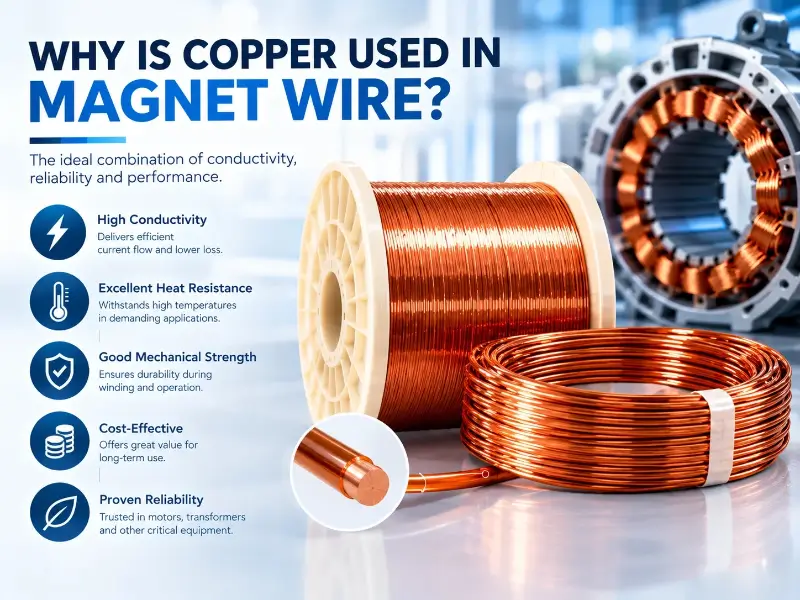
Five Core Physical Properties That Make Copper the Top Choice for Magnetic Wire
Electrical Conductivity: Copper Is the 100% IACS Benchmark Material
The promulgation of the International Standard for Annealed Copper (IACS) in 1914 established copper as the performance benchmark for conductive materials, a status it retains to this day. ### Six Decisive Factors in Conductor Material Selection for Magnetic Wire Performance The conductor material directly determines six key performance characteristics of magnetic wire: 1. Resistance and Copper Loss: Determines winding temperature rise and energy efficiency. 2. Current Carrying Capacity: Current carrying capacity per unit cross-sectional area. 3. Thermal Conductivity: Determines winding heat dissipation capacity. 4. Mechanical Strength: Determines winding process and vibration resistance. 5. Corrosion Resistance and Solderability: Determines the reliability of terminal connections. 6. Cost and Processability: Determines the market feasibility of the product. ## Copper’s Top 5 Core Properties as the Preferred Component for Magnetic Wire Copper’s dominance as the mainstream magnetic wire conductor is a result of the combined effect of its five core materials science properties. ### Electrical Conductivity: Copper is the 100% benchmark material of IACS. Copper’s volume resistivity at 20°C is only 1.724 μΩ·cm (16.78 nΩ·m), and its electrical conductivity is defined as the 100% benchmark value by the International Association of Annealed Copper Standards (IACS). This means that among all non-precious metals, copper has the strongest electrical conductivity, and the performance evaluation of almost all conductive materials uses copper as a reference. ### Thermal Conductivity: Copper’s heat dissipation capacity is 1.7 times that of aluminum
Thermal Conductivity: Copper’s Heat Dissipation Is 1.7 Times That of Aluminum
Copper’s thermal conductivity at room temperature is as high as 401 W/(m·K), which is about 1.7 times that of aluminum (237 W/(m·K)) and 25 times that of stainless steel (16 W/(m·K)). This characteristic is crucial in winding applications—the Joule heat generated by current passing through the conductor needs to be dissipated quickly, otherwise it will lead to excessive winding temperature rise, accelerated insulation aging, or even burnout. ### Mechanical Strength: Balance between High Ductility and Tensile Strength Annealed pure copper has a tensile strength of 220–260 MPa and an elongation of 35%–45%; hard copper has a tensile strength of 380–450 MPa, but the elongation drops below 5%. Annealed copper (Cu-ETP / C11000 or OFHC / C10100) is typically used in production to ensure both ductility during winding and sufficient mechanical strength. ### Oxidation and Corrosion Resistance: Copper’s Self-Protective Properties in Atmospheric Environments Copper slowly oxidizes in the atmosphere to form Cu₂O and CuO, creating a dense oxide layer
Mechanical Strength: Balance Between High Ductility and Tensile Strength
This oxide film acts as a protective layer, preventing further oxidation
Oxidation and Corrosion Resistance: Copper’s Self-Protection in Atmospheric Environments
This characteristic allows copper wire to maintain long-term stability even in harsh environments such as humidity, salt spray, and industrial pollution. ### Solderability and Connection Reliability: Copper’s Natural Advantages Copper can be easily soldered using conventional tin-lead solder and lead-free solder (Sn-Ag-Cu, Sn-Cu) at temperatures of 250–350°C, without the need for special flux or surface treatment
Solderability and Connection Reliability: Copper’s Natural Advantages
In contrast, aluminum wire requires ultrasonic welding, cold pressure welding, or special flux for reliable connections, significantly increasing process complexity. ## Conductivity: Comparison of Copper with Aluminum, CCA, and Silver Conductivity is the most crucial indicator for measuring the performance of wire conductors. ### IACS Standard and Copper’s Benchmark Status The International Annealed Copper Standard (IACS) was promulgated by the U.S. Department of Commerce in 1914, defining the conductivity of annealed pure copper as 100% IACS. The conductivity of all other metals and alloys is converted to IACS as a reference
Electrical Conductivity: Copper vs Aluminum vs CCA vs Silver Comparison
IACS Standard and Copper’s Benchmark Position
This standard has been used for over 110 years, becoming the fundamental specification of the global electrical industry. ### Comparison of Conductivity of 4 Major Conductor Materials | Conductor Material | Resistivity (μΩ·cm @20°C) | IACS (%) | Density (g/cm³) | Thermal Conductivity (W/m·K) | Tensile Strength (MPa) | Price Ratio (relative to Copper) | |———-|———————–|———-|————–|—————-|—————-|——————| | Copper (C11000) | 1.724 | 100 | 8.94 | 401 | 220–450 | 1.0× | | Aluminum (1350-O) | 2.826 | 61 | 2.70 | 237 | 70–180 | 0.3× | | CCA (Class 15H) | 2.40–2.60 | 65–68 | 3.63–4.10 | 190–250 | 100–200 | 0.6× | | Silver (Ag 99.99%) | 1.59 | 106 | 10.49 | 429 | 140–250 | 80–100× | As can be seen from the table, copper ranks first with 100% IACS, and its price is only 1/80–1/100 of silver, making its cost-effectiveness unmatched. ### Skin Effect Correction in High-Frequency Applications At 50/60 Hz power frequencies, copper’s conductivity advantage is already very significant
Conductivity Comparison of Four Major Conductor Materials
| Conductor Material | Resistivity (μΩ·cm @20°C) | IACS (%) | Density (g/cm³) | Thermal Conductivity (W/m·K) | Tensile Strength (MPa) | Price Ratio (relative to copper) |
|---|---|---|---|---|---|---|
| Copper (C11000) | 1.724 | 100 | 8.94 | 401 | 220–450 | 1.0× |
| Aluminum (1350-O) | 2.826 | 61 | 2.70 | 237 | 70–180 | 0.3× |
| CCA (Class 15H) | 2.40–2.60 | 65–68 | 3.63–4.10 | 190–250 | 100–200 | 0.6× |
| Silver (Ag 99.99%) | 1.59 | 106 | 10.49 | 429 | 140–250 | 80–100× |
From the table above, copper ranks first at 100% IACS, with a price only 1/80–1/100 of silver—unmatched cost-effectiveness.
Skin Effect Correction in High-Frequency Applications
However, in high-frequency applications above 100 kHz (such as wireless charging, Litz cables, high-frequency transformers, SMPS), the skin effect will significantly increase the AC resistance of the conductor
Thermal Conductivity and Winding Heat Dissipation Performance
Three Basic Paths of Winding Heat Dissipation
The penetration depth of copper is calculated using the formula δ_Cu = 0.0661/√f (mm), which is only 0.21 mm at 100 kHz and only 0.066 mm at 1 MHz
Three Major Heat Dissipation Advantages of Copper’s High Thermal Conductivity
This means that Litz wire or copper foil windings are often used in high-frequency applications to counteract the skin effect, but copper is still the preferred conductor material. ## Thermal Conductivity and Winding Heat Dissipation Performance The heat dissipation capacity of the winding during operation directly determines the upper limit of the current density of the magnet wire. ### Three Basic Paths of Winding Heat Dissipation There are three basic paths for winding heat dissipation: conduction, convection, and radiation
Copper Winding Advantages in High Power Density Equipment
In enclosed motors or {transformers}, heat dissipation is mainly achieved through internal thermal conduction of the conductor + thermal conduction of the insulation layer + impregnation oil/air convection. Among these, internal thermal conduction of the conductor is the first step, determining whether heat can be transferred from the conductor core to the surface. ### Three Major Heat Dissipation Advantages of Copper’s High Thermal Conductivity 1. Lower Hot Spot Temperature: Copper windings have a smaller internal temperature gradient, resulting in hot spot temperatures 15–25°C lower than aluminum windings. 2. Stronger Short-Time Overload Capacity: Copper windings have a 30% higher short-time overload capacity at 1.5 times the rated current compared to aluminum windings. 3. Longer Insulation Life: For every 10°C decrease in winding operating temperature, the insulation aging rate is halved (Arrhenius Law). The insulation life of copper windings is typically 2–4 times that of aluminum windings. ### Advantages of Copper Windings in High Power Density Equipment In high power density equipment such as new energy vehicle drive motors, data center server power supplies, and 5G base station filters, the high thermal conductivity of copper windings is particularly advantageous
Mechanical Strength, Ductility, and Manufacturing Processability
Wire Drawing Performance: Copper’s High Ductility Is the Key
A 250 kW new energy vehicle drive motor using copper windings can operate stably at an operating temperature of 180°C, while using aluminum windings would require derating to 120 kW or employing a more complex forced cooling system. ## Mechanical Strength, Ductility, and Processing Technology The manufacturing of magnet wire involves more than 10 processes, including wire drawing, annealing, enameling, and winding
Bending and Winding: Copper Has a Wider Elastic Limit
The conductor material needs to simultaneously meet multiple mechanical performance requirements. ### Wire Drawing Performance: Copper’s high ductility is key
Enamel Coating Adhesion and Insulation Integrity
The first step in magnet wire production is drawing a copper rod (typically Φ8 mm) to the target wire diameter (Φ0.012–Φ8 mm). Annealed pure copper has an elongation of 35%–45% and a reduction of area of 80%–90%, allowing for dozens of consecutive drawing passes without intermediate annealing
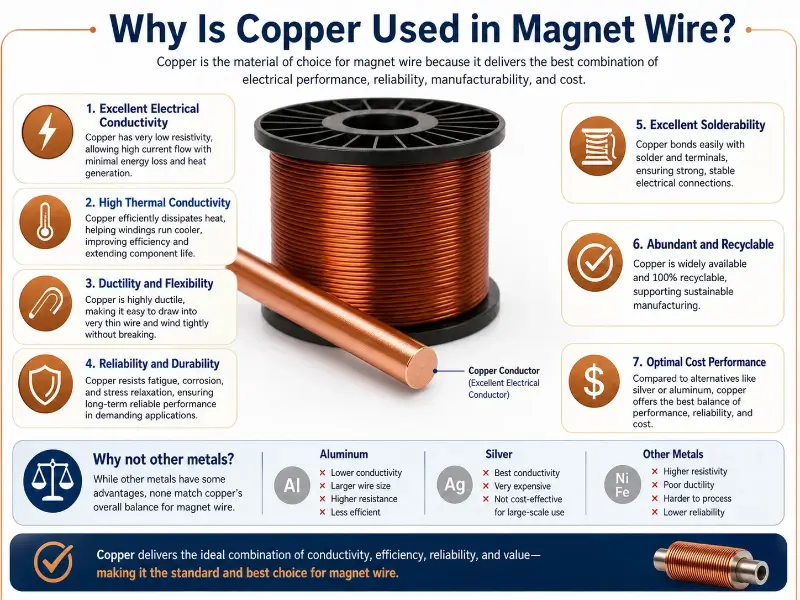
Oxidation Resistance, Solderability, and Winding Connection Reliability
Copper’s Natural Anti-Oxidation Properties
In contrast, while aluminum has a higher elongation (30%–40%), it requires intermediate annealing every 2–3 passes. ### Bending and Winding: Copper has a wider elastic limit
Copper’s Solderability Advantages
When winding motor or transformer windings, the conductor needs to withstand multiple bends (the minimum bending radius is typically 1–3 times the conductor diameter). Annealed copper has an elastic limit of 70–100 MPa and can withstand 5–10 180° folds without cracking
Challenges in Connecting Aluminum Magnetic Wires
Aluminum has an elastic limit of only 30–50 MPa, and its bending resistance under the same conditions is only 50%–70% of that of copper. ### enamel coating adhesion and insulation integrity: Copper surfaces have strong adhesion to insulating varnishes (such as polyester, polyester imide, polyamide imide), good coating continuity, and are free of pores with a low pinhole rate (typically <1 pinhole/m @ 1.5 kV). Aluminum surfaces easily form an oxide film (Al₂O₃), requiring pretreatment (priming or chemical treatment) to ensure coating adhesion. ## Oxidation resistance, solderability, and winding connection reliability: The long-term reliability of winding terminal connections, wiring terminals, and solder joints depends on the conductor’s oxidation resistance and solderability. ### Copper’s Natural Anti-Oxidation Properties Copper forms a dense oxide layer (Cu₂O/CuO) in atmospheric environments
Standardization, Cost, and Industrial Availability of Copper Magnet Wire
International Standards System for Copper Magnet Wire
This oxide film is only 1–5 μm thick and tightly bonded to the substrate, thus providing protection
Standard Lag and Market Limitations of Aluminum Magnet Wire
In industrial atmospheres, coastal salt spray, and humid environments, copper conductors can last 30–50 years. ### Copper’s Solderability Advantages Copper can be soldered using the following four common soldering processes: – Tin-lead soldering (Sn-Pb, melting point 183–230°C) – Lead-free soldering (Sn-Ag-Cu, melting point 217–220°C) – Silver soldering (Ag-Cu-Zn, melting point 600–800°C) – Resistance welding (spot welding/but welding) The tensile strength of the welded joint can reach 80%–95% of the base material, ensuring high long-term reliability. ### Challenges in Connecting Aluminum Magnetic Wires Connecting aluminum magnetic wires requires: – Ultrasonic welding (using specialized equipment) – Cold pressure welding (mechanical pressure connection) – Special flux (containing ZnCl₂, etc.) – Anti-oxidation coating The long-term reliability of aluminum welded joints is poor, mainly because the Al₂O₃ film continues to grow at high temperatures, leading to increased joint resistance and accelerated temperature rise, which may eventually cause failure
Copper Magnet Wire Price Trend and Supply Stability
This is the main reason why the application of aluminum magnetic wires in high-reliability fields such as home appliances and automotive electronics is limited. ## Standardization, Cost, and Industrialization The industrial application of magnetic wires depends not only on the performance of the material itself, but also on the completeness of the standardization system and the maturity of the supply chain. ### International Standards System for Copper Copper wire has a complete international standards system: – IEC 60851 / IEC 60317: International Electrotechnical Commission standards, covering wire testing methods, insulation classes, and naming rules. – NEMA MW 1000: American Institute of Electrical Manufacturers standard, covering all major grades such as MW 35-C (polyester). – JIS C 3202: Japanese Industrial Standard. – GB/T 6109: Chinese National Standard. ### Standard Lag and Market Limitations for Aluminum Aluminum wire has only a few specific standards in IEC 60317 (such as IEC 60317-24 Round Aluminum), with far less comprehensive coverage than copper wire
Application Scenario Selection: When Is Copper the Best Choice?
Material Selection Recommendations for Eight Typical Application Scenarios
| Application Scenario | Recommended Conductor | Main Reason | Alternative |
|---|---|---|---|
| New Energy Vehicle Drive Motor | Copper (C11000) | High power density, low loss, excellent high-frequency characteristics | None |
| Power Transformer (Oil-Immersed) | Copper / Aluminum | Copper: high efficiency and compact; Aluminum: low cost and high current | Aluminum acceptable |
| Household Motor (AC/Small) | Copper / CCA | Copper: reliable; CCA: weight reduction and cost reduction | CCA acceptable |
| Wireless Charging Coil | Copper (Litz) | High-frequency low loss, low skin effect | None |
| High-Frequency Transformer (SMPS) | Copper (Litz/Copper Foil) | Only feasible solution above 1 MHz | None |
| Aerospace Winding | Copper (Silver-Plated/Nickel-Plated) | Extreme reliability, temperature stability | None |
| High-Current Power Transmission | Aluminum / CCA | Lightweight, low cost | Copper acceptable |
| 5G Communication Inductor | Copper (high purity) | High Q value, low signal loss | None |
Four Applications Where Copper Is Irreplaceable
This results in long certification cycles, inconsistent testing specifications, and poor interregional interchangeability for aluminum wire. ### Copper Price Trends and Supply Stability While copper prices fluctuate (LME copper prices ranged from $8,000 to $11,000/ton in 2024–2026), compared to silver ($800,000+/ton) and silver-plated copper wire, copper supply is stable and prices are relatively predictable
Three Scenarios Where Aluminum Magnet Wire Remains Applicable
Global copper reserves are approximately 870 million tons (USGS 2025 data), with a mineable lifespan exceeding 50 years, ensuring long-term supply security. ## Application Scenarios and Material Selection Decisions: When is Copper the Best Choice? While copper is the preferred choice in most scenarios, aluminum or CCA also has advantages in certain specific applications. ### Material Selection Recommendations for 8 Typical Application Scenarios
| Application Scenarios | Recommended Conductor | Main Reasons | Alternatives | |———-|———-|———-|———-| | New Energy Vehicles (Drive Motors) | Copper (C11000) | High power density, low loss, excellent high-frequency characteristics | None | | Power Transformers (Oil-Immersed) | Copper/Aluminum | Copper: High efficiency and compact; Aluminum: Low cost and high current | Aluminum acceptable | | Household Motors (AC/Small) | Copper/CCA | Copper: Reliable; CCA: Weight reduction and cost reduction | CCA acceptable | | Wireless Charging Coils | Copper (Litz) | High frequency, low loss, low skin effect | None | | High Frequency Transformers (SMPS) | Copper (Litz/Copper Foil) | Only feasible solution for frequencies above 1 MHz | None | | Aerospace Windings | Copper (Silver Plated/Nickel Plated) | Extreme reliability, temperature stability | None | High Current Power Transmission | Aluminum/CCA | Lightweight, Low Cost | Copper Acceptable | | 5G Communication Inductors | High Purity Copper | High Q Value, Low Signal Loss | None | ### Four Applications Where Copper Is Irreplaceable The following four applications must use copper (magnet wire) and cannot be replaced by aluminum or CCA: 1. High Power Density Motors: New energy vehicles (drive motor, servo motor, traction motor). 2. High Frequency Inductors and Transformers: Wireless charging, SMPS, LLC resonant converters. 3. Precision Instruments and Sensors: Medical MRI, measuring coils, precision transformers. 4. Extreme Environment Applications: Aerospace, deep sea, nuclear power, high vacuum. ### Three Scenarios Where Aluminum Magnetic Wire Remains Applicable While copper is the mainstream material, aluminum magnetic wire still has a market in the following three scenarios: 1. Power Distribution Transformers: Especially oil-immersed transformers above 1000 kVA. 2. Low-Cost Home Appliance Motors: Air conditioner outdoor fan motors, washing machine motors, etc. 3. Power Transmission Busbars: High-current, low-voltage industrial busbars. ## Engineering Summary: Why Copper Remains the Dominant Material for Magnetic Wire After the above systematic analysis across six dimensions, the fundamental reason for copper’s dominant position in magnetic wire can be summarized as a combination of advantages in both materials science and engineering economics. In the frequency dimension, copper is the optimal choice across the entire frequency band, from power frequency (50/60 Hz) to high frequency (several MHz). At power frequency, copper’s low resistivity reduces copper losses; at high frequency, copper’s high-frequency characteristics, combined with Litz wire and copper foil windings, can effectively suppress the skin effect.
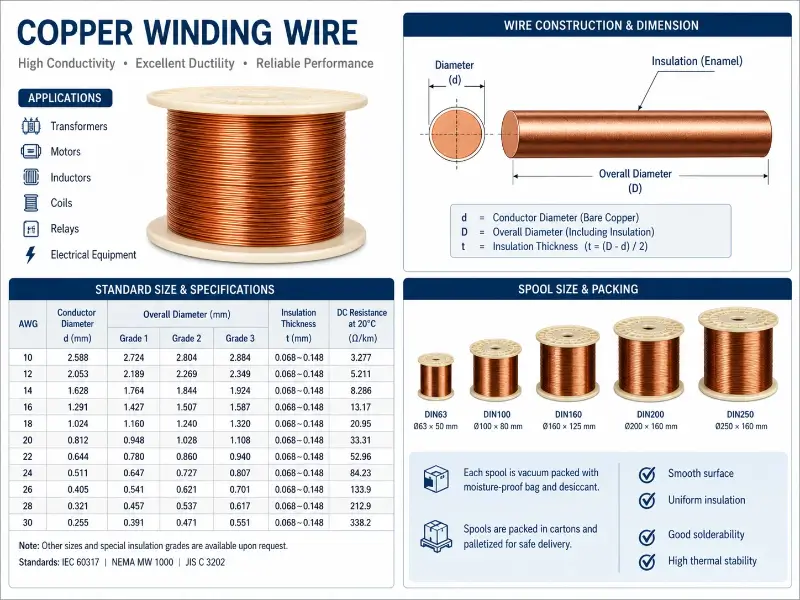
Engineering Summary: Why Copper Remains the Dominant Magnet Wire Material
While silver has higher electrical conductivity (106% IACS), its price is 80–100 times that of copper, limiting its use to extreme applications such as military and aerospace. In terms of applications, copper covers almost all high-end applications, including new energy vehicle drive motors, power transformers, 5G communication inductors, medical imaging equipment, wind turbines, and rail transit traction systems
In these applications, the combined advantages of copper windings in energy efficiency, reliability, lifespan, and cost are irreplaceable. In terms of engineering and economics, copper boasts a mature global supply chain, a recycling rate exceeding 60% (far higher than aluminum’s 30%), a comprehensive standardization system (fully covering IEC 60317, NEMA MW 1000, JIS C 3202, and GB/T 6109), and stable manufacturing processes
These factors have enabled copper to maintain its dominant position throughout over 100 years of industrialization.