

The Real Impact of Humid Workshop Environments on Enameled Copper Wires
I’ve encountered many clients and noticed an interesting phenomenon—many engineers, when selecting enameled wire, only focus on the thermal class, comparing 220, 200, and 180 grades, only to find in a humid workshop that the wire is burned, the enamel is cracked, and verdigris has formed. Why? Because the damaging effects of a humid environment on enameled wire are often more insidious than temperature.
Enameled wire faces three threats in humid workshops that must be clearly understood:
The first is water molecule penetration. The enameled coating surface is not absolutely sealed. Under a microscope, you can see micron-sized pores on the enameled coating surface, and water molecules will slowly penetrate through these pores to the copper conductor interface. Over time, the copper surface begins to oxidize, and the insulation resistance slowly drops from the GΩ level to the MΩ level, eventually leading to breakdown.
The second is hydrolysis. The molecular structures of polyurethane (UEW) and polyester (PEW) enamel coatings contain ester bonds (—COO—). Ester bonds undergo hydrolysis upon contact with water, especially in environments with high temperature and humidity, where the hydrolysis rate is catalyzed—a typical example of reaction rate theory in chemistry. The enamel coating becomes brittle, cracks, peels off, and loses its insulating properties. The third issue is enamel coating swelling. The enamel coating expands in volume after absorbing moisture, and microcracks appear after repeated wet-dry cycles. This is why the breakdown voltage of many manufacturers’ enameled wires drops particularly quickly after several “dry-wet-dry-wet” cycles. A real-world example from an engineer: A customer in Jiangsu who manufactures small transformers reported in 2024 that their workshop humidity reached 95% RH during the rainy season. Using ordinary polyester enameled wire, the breakdown rate of the transformer primary coil increased eightfold within three months. Later, when the coating was changed to polyamide-imide (AIW), the problem was completely solved—not a single defective product was produced in a year.
Classification of Humid Environment Levels and Comparison with Workshop Scenarios
| Environment Level | Relative Humidity Range | Temperature Range | Typical Scenarios | Recommended Coatings |
|---|---|---|---|---|
| Dry Workshop | <60% RH | Room Temperature | General Assembly Workshop, Cleanroom | PEW / UEW |
| General Workshop | 60-75% RH | Room Temperature | General Machining Workshop | EIW |
| Humid Workshop | 75-90% RH | Room Temperature | Pump Workshop, Basement, Near Restrooms | AIW / Double Coating |
| High Humidity Workshop | 90-100% RH | High Temperature | Coastal Workshop, Tropical Workshop, Near Steam | PIW / Double Coating AIW+UEW |
| Steam/Water Mist Environment | 100% RH | High Temperature | Chemical Workshop, Offshore Platform, Submersible Pump | Sealing and Encapsulation + AIW/PIW |
Many engineers confuse “workshop humidity” with “usage environment humidity.” For example, an air conditioner outdoor unit fan motor might be installed outdoors and exposed to rain, but the humidity in the production workshop might only be 50%. When selecting a model, you shouldn’t choose based on the humidity level of the usage environment, but rather on the most severe operating conditions.
Comparison of enamel coating material systems
| Coating Type | Code | Thermal Class | Moisture Resistance | Solderability | Cost | Typical Applications |
|---|---|---|---|---|---|---|
| Polyurethane | UEW | 130-155°C | Medium | Excellent | Low | Coils, Electronic Transformers |
| Polyester | PEW | 155-180°C | Medium | Medium | Medium | General Purpose Motors, Transformers |
| Polyesterimide | EIW | 180°C | Good | Medium | Medium-High | High Temperature Motors, Traction Motors |
| Polyamide-imide | AIW | 200-220°C | Excellent | Poor | High | Humid Environment, High Frequency, High Temperature |
| Polyimide | PIW | 220-240°C | Excellent | Poor | Very High | Military, Aerospace, Special Operating Conditions |
| Double Coating (UEW+AIW) | — | 180-200°C | Excellent | Good | High | Humid + Welding Scenarios |
Solderability—UEW is the best, soldering directly at 380°C; PEW is second best; AIW and PIW are almost unsolderable, requiring a primer before soldering. This is why many products for humid environments use “AIW+UEW double coating”—AIW on the outside blocks water, and UEW on the inside ensures solderability.
Cost—PIW is the most expensive, costing 5-8 times more than ordinary PEW; AIW is 3-5 times more expensive than PEW; UEW is the cheapest. Unless it’s for military use or extreme operating conditions, there’s no need for PIW.
Selection Decision Process for Enameled Wire in Humid Workshops
Follow this order to ensure a safe choice:
Step 1: Assess the humidity and temperature under the most severe operating conditions. Don’t choose based on average conditions, choose based on peak conditions. Consider typhoon season in coastal areas and rainy season in basements.
Step 2: Determine the thermal class. The motor insulation class (F class 155°C / H class 180°C / C class 220°C) is a hard requirement; the thermal class of the enameled wire must be equal to or higher than the motor insulation class.
Step 3: Provided the temperature resistance meets the standard, select the coating with the highest moisture resistance. If Class H (180°C) is acceptable, both PEW and EIW are suitable, but EIW (polyester imide) is preferred in humid environments, as its moisture resistance is a level higher than PEW. Fourth step: Consider whether soldering is required. If the coil requires direct soldering (e.g., high-frequency transformers), double-coated AIW+UEW is preferred; if the motor windings are directly wound without soldering, single-coated AIW is sufficient. Fifth step: Consider cost. AIW is 3-5 times more expensive than PEW, but in humid environments, AIW’s lifespan can be 5-10 times that of PEW—resulting in a lower overall cost.
Specific Testing Standards and Quality Verification for Humid Environments
| Test Item | Standard | Test Conditions | Acceptance Criteria |
|---|---|---|---|
| Damp Heat Test | IEC 60851 / JIS C3202 | 40°C ± 2°C / 90-95% RH / ≥96 hours | Insulation resistance drop <50% |
| Hydrolysis Stability | IEC 60851-5 | 95% RH / 80°C / 168 hours | No cracking or peeling of enamel coating |
| Breakdown Voltage Retention | GB/T 6109 / IEC 60317 | Before and after damp heat aging | Retention rate ≥85% |
| Salt Spray Test | ASTM B117 / ISO 9227 | 5% NaCl / 35°C / ≥96 hours | No blistering or peeling of enamel coating |
| Cyclic Damp Heat | IEC 60068-2-30 | 25°C/40°C cycling + 95% RH | Insulation resistance ≥10⁹ Ω |
The “moisture resistance rating” of enameled wire is not solely determined by the manufacturer; it is based on international standard testing.
Moisture Control in the Production Workshop
Even with a high moisture resistance rating, improper storage and use render it useless. Storage Area Control: – Temperature: 20-25°C constant temperature – Humidity: 40-60% RH – Packaging: Vacuum aluminum foil bag + desiccant (silica gel or molecular sieve) – Turnover: FIFO (First In First Out), shelf life 6-12 months – Avoid light: UV rays will accelerate the aging of the enamel coating. Production Area Control: – Ambient humidity: 50-70% RH – After opening: Use within 24 hours – If not used up: Reseal + replace desiccant – Winding tension: Avoid excessive stretching that could cause micro-cracks in the enamel coating – Welding temperature: 380-420°C, time <3 seconds Workshop Humidity Control Solutions: – Small investment: Dehumidifier + air conditioning, investment 50,000-100,000 RMB – Medium investment: Constant temperature and humidity workshop, investment 300,000-500,000 RMB – Large investment: Cleanroom + positive pressure ventilation, investment 1 million+ RMB A customer in Henan who manufactures micro motors has a workshop humidity of 80% RH year-round. They initially spent 80,000 yuan to buy four industrial dehumidifiers, which reduced the humidity to 55% RH and the scrap rate from 15% to 3%. The annual savings in scrap costs exceeded 600,000 yuan—they recouped their investment in just six months.
Typical Application Cases in Humid Workshops
Case 1: Submersible Pump Motor – Operating Conditions: Long-term underwater operation, 100% RH – Recommended Coating: AIW (Polyamide-Imide) 200°C + Epoxy Encapsulation – Recommended Wire Diameter: 0.8-2.0 mm – Lifespan Requirement: >10 years Case 2: Air Conditioner Outdoor Unit Fan Motor – Operating Conditions: Outdoor rain + direct sunlight, 80-95% RH – Recommended Coating: Double-coated AIW + UEW, 180-200°C – Recommended Wire Diameter: 0.5-1.2 mm – Lifespan Requirement: >8 years Case 3: Coastal Wind Turbine Generator – Operating Conditions: Marine salt spray + high humidity + vibration, 90-100% RH – Recommended Coating: PIW (Polyimide) 220°C + Conformal Coating – Recommended Wire Diameter: 2.0-5.0 mm – Lifespan Requirement: >20 years Case Study 4: Pump Workshop Motor – Operating Conditions: High humidity in the workshop + frequent start-stop – Recommended Coating: EIW (polyester imide) 180°C – Recommended Wire Diameter: 0.6-1.5 mm – Lifespan Requirement: >5 years Case Study 5: Tropical Household Motor – Operating Conditions: Tropical climate + indoor 70-85% RH – Recommended Coating: AIW 200°C – Recommended Wire Diameter: 0.4-1.0 mm – Lifespan Requirement: >7 years
Standard System and Procurement Acceptance Guidelines
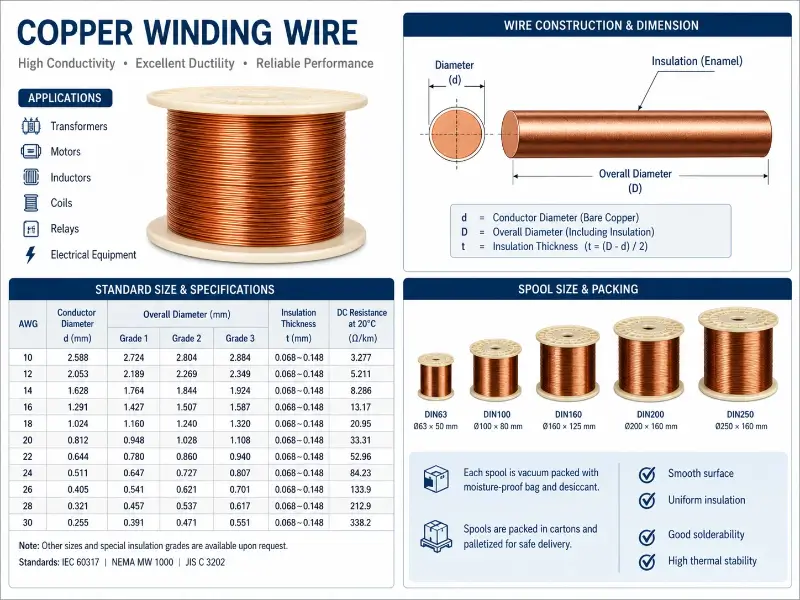
For the procurement and acceptance of enameled copper wire in humid environments, three things must be checked: First, check the standards. It must comply with IEC 60317 series (General Specification for Enameled Round Copper Wire), IEC 60851 (Test Methods for Winding Wire), NEMA MW 1000 (North American enameled wire standard), and GB/T 6109 (Chinese National Standard). For humid and hot environments, IEEE 117 (electrical insulation testing) and UL 1446 (insulation systems) standards should also be considered. Secondly, check the reports. Third-party testing reports (SGS, Intertek, TÜV) must include two key data points: – Insulation resistance reduction rate after damp heat aging (<50% is acceptable) – Breakdown voltage retention rate (≥85% is acceptable). Thirdly, check the coating thickness. Recommended coating thicknesses for humid environments are: UEW ≥18 μm; PEW ≥20 μm; EIW ≥22 μm; AIW ≥25 μm; PIW ≥30 μm. Insufficient coating thickness is a common problem with substandard enameled wire. Our factory (Zhengzhou LP Industry) manufactures enameled wires, and all models designed for humid environments have passed IEC 60317-0-1, IEC 60851-5 damp heat aging tests, and SGS certification. With 30 years of export experience, we cover more than 50 countries. We can provide original third-party test reports and coating thickness data.
Recommendations for Enameled Wire Applications in Humid Workshops
First, select the model based on the most severe operating conditions, not average conditions. Peak humidity, peak temperature, salt spray, vibration—choose the most severe condition.
Second, prioritize moisture-resistant coatings (AIW / PIW / double coating), don’t just look at the unit price. Considering overall lifecycle cost, AIW actually has a lower total cost—its lifespan is 5-10 times that of PEW, and the scrap rate is reduced from 15% to 3%.
Third, workshop humidity control is more critical than the selection of the enameled wire itself. An investment of 500,000-500,000 RMB in a dehumidifier + constant temperature and humidity workshop can result in annual savings of over 500,000-3,000,000 RMB in scrap costs—an extremely high ROI.
Fourth, storage and process control are equally important. Vacuum aluminum foil bags + desiccant, FIFO turnover, and 24-hour opening and use—these details determine whether the enameled wire reaches the production line as a “qualified product.”
Sixth, third-party testing reports are indispensable. Request damp heat aging data, breakdown voltage retention rate, and coating thickness testing during procurement—with all three data points available, the moisture resistance of the enameled wire is guaranteed.
Appendix: Common Coating Moisture Resistance Comparison Table
| Coating Code | Thermal Class (°C) | Breakdown Voltage Retention After Damp Heat | Salt Spray Resistance | Typical Applications |
|---|---|---|---|---|
| UEW | 130-155 | 70-80% | Medium | Coils, Transformers |
| PEW | 155-180 | 75-85% | Medium | General Purpose Motors |
| EIW | 180 | 85-90% | Medium-High | High Temperature Motors |
| AIW | 200-220 | 90-95% | High | Humid, High Temperature, Outdoor |
| PIW | 220-240 | 95%+ | Extremely High | Military, Marine, Special |
| Double Coating AIW+UEW | 180-200 | 92-96% | High | Humid + Welding Scenarios |
|
Appendix: Common Failure Modes and Diagnosis
| Failure Phenomenon | Possible Causes | Solution |
|---|---|---|
| Enamel coating blistering | Moisture penetration + sudden temperature change | Replace AIW coating + control workshop humidity |
| Enamel coating cracking | Hydrolysis reaction | Replace polyimide coating |
| Verdigris formation | Enamel coating micropores + long-term high humidity | Thicken coating + double coating |
| Breakdown voltage decrease | Insulation resistance decrease | Third-party re-inspection + change supplier |
| Enamel coating peeling off during winding | Poor coating adhesion | Return to supplier + change grade |
Summary: The key to selecting enameled wire for humid workshop environments is matching the moisture resistance level of the enameled coating to the most demanding operating conditions. In terms of application frequency, water pump motors and submersible pump motors start and stop thousands of times per week, requiring high moisture resistance and high mechanical strength; AIW is the first choice. Coastal wind power and offshore platforms require salt spray resistance and long lifespan; PIW + conformal coating is standard. For ordinary industrial motors, where workshop humidity is controllable, EIW offers the best cost-performance ratio. For household appliance motors, the operating environment is humid but not extreme; AIW 200°C balances moisture and temperature resistance. Summary: In scenarios with limited budgets but high workshop humidity, prioritize investing in workshop dehumidification (50,000-100,000 RMB) rather than replacing with more expensive enameled wire. In scenarios with ample budgets and high product lifespan requirements (submersible pumps, wind power), prioritize investing in coating upgrades (AIW/PIW). The return on investment in both directions far exceeds “no treatment”—the latter may seem cheaper in the short term, but the long-term scrap costs and brand reputation damage far outweigh any upgrade investment. Summary:
The future direction for enameled wire in humid environments lies in “coating composites” (AIW + UEW dual coatings) + “process standardization” (FIFO + constant temperature and humidity) + “data-driven testing” (third-party reports + online coating thickness monitoring). By advancing these three directions simultaneously, enameled wire can achieve “zero failures” in humid workshops.