

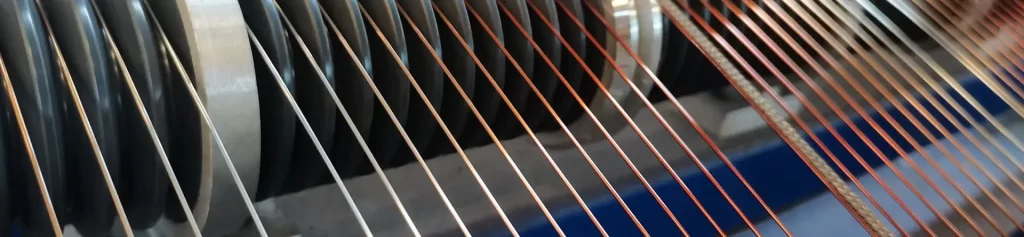
Magnet wire is the core conductive component of a fan motor winding.
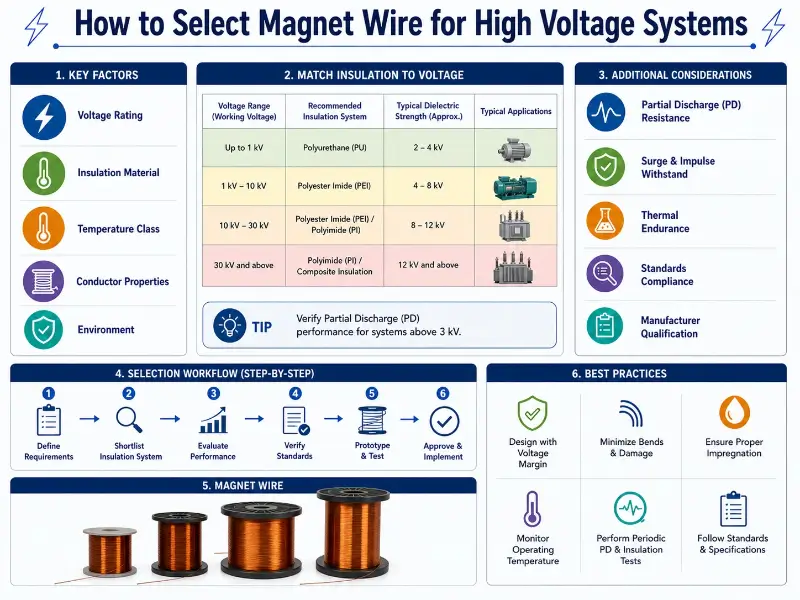
Its material, wire diameter, enamel coating structure, and thermal class Understanding Insulation Classes (F, H, C) in Enameled Wire directly determine the winding’s electrical performance, thermal life, and electromagnetic noise characteristics.
Fan motors operate under a wide range of conditions—from miniature DC fans (5W) for CPU cooling to electric vehicle battery cooling fans (several kW), from cross-flow and indoor circulation systems in air conditioning to condensing towers and data center EC fans—the requirements for magnet wire vary significantly depending on the specific operating conditions.
In engineering practice, early failures caused by incorrect magnet wire selection (choosing enamel coating grade based on price, or applying standards based on wire diameter) far outweigh design flaws in the motor itself.
This article systematically explains the selection logic of fan motor windings from four dimensions: material, wire diameter, enamel coating, and temperature, based on the two main routes of AC induction motors (shaded-pole, PSC) and DC brushless motors (BLDC/ECM Copper Winding Wire for Small Electric Motors).
Differences in Fan Motor Types and Operating Conditions
The winding structure, current density, and operating temperature of fan motors vary significantly depending on their type; the motor type must be clearly identified before selecting wires.
Single-phase AC Shaded-pole Motor
This type uses concentrated windings directly wound on salient poles, forming a shading coil with short-circuited copper rings.
Typical power is 5–50 W, operating temperature is usually below Class 130 B, with a relatively high starting current but a sustained current density maintained at 4–6 A/mm².
Typical applications include small table fans, range hoods, microwave oven fans, and copier cooling fans.
Single-phase AC PSC Permanent Magnet Capacitor Motor
This type uses distributed windings embedded in the stator slots, resulting in significantly better operational stability than shaded-pole motors and an efficiency improvement of 30–50%.
Typical power ranges from 50 to 500 W, with operating temperatures reaching Class 155 F and even 180 H.
Typical applications include HVAC fan coil units, commercial ventilation systems, and outdoor unit fans for air conditioners.
DC brushless motors (BLDC/ECM)
are electronically commutated and achieve efficiencies of 70–90%, making them a mainstream solution for data centers, thermal management in new energy vehicles, and residential inverter air conditioners.
Power ranges from 5 W (CPU cooling fans) to several kW (electric vehicle battery cooling).
Their operating conditions are unique: the high-frequency PWM (10–50 kHz) controller introduces additional eddy current losses and voltage stress, requiring the enamel coating to have corona resistant and low dielectric loss characteristics. ##
Magnet wire material: Engineering choices between copper, aluminum, and copper-clad aluminum How Copper Clad Aluminum Wire Is Made
between copper, aluminum, and copper-clad aluminum.
Copper enameled wire
is the default choice for fan motor windings.
Copper has low volume resistivity (1.724 μΩ·cm @ 20℃), good mechanical strength, and mature welding technology, covering over 90% of applications.
Copper exhibits a skin effect at high frequencies, causing current to concentrate on the conductor surface.
However, this effect is limited in power frequency (50/60 Hz) and low-frequency PWM (<20 kHz) conditions, making copper the preferred conductor.
Aluminum enameled wire
offers significant advantages in weight and cost—weighing approximately one-third that of copper and costing only one-third to one-half the price.
However, its volume resistivity is approximately 1.6 times that of copper (2.826 μΩ·cm @ 20℃).
To maintain performance under the same resistance conditions, the cross-sectional area needs to be increased by 1.6 times, or the wire diameter by approximately 1.26 times (√1.6).
Aluminum wire faces risks of electrochemical corrosion and thermal expansion fatigue under continuous high current conditions, but it is widely used in light-load, short-time, or cost-sensitive applications (such as household decorative fans, range hoods, and low-power HVAC fans).
Copper-clad aluminum (CCA) wire
uses an outer copper layer covering an aluminum core with a volume fraction of 10–15%, balancing conductivity and lightweight design.
At power frequencies, CCA’s conductivity is approximately 65% of the IACS of pure copper.
However, at high frequencies above 5 MHz, the skin effect makes the outer copper layer dominate conductivity, resulting in performance close to pure copper while weighing only about 50% of pure copper.
This characteristic gives CCA advantages in scenarios such as high-frequency driver boards in data centers and cooling fans for 5G equipment.
However, in high-current, low-frequency fan motors (such as high-power HVAC fans), CCA is not the first choice because the increased wire diameter offsets the lightweight benefits. ##
Typical wire diameter and enamel coating level — operating conditions correspondence
to the fan motor winding wire diameter determined by two constraints: current density and slot fill factor.
Based on motor type and typical operating conditions, the following correlation can be established: Miniature DC fans (CPU/chassis cooling) typically use AWG 30–34 (0.25–0.16 mm), current density 6–10 A/mm², UEW/130 or UEW/155; Household AC fans (table fans, floor fans, ceiling fans) typically use AWG 24–28 (0.51–0.32 mm), Class 130 B, PEW or UEW; HVAC and commercial fans (coil units, exhaust fans) typically use AWG 18–22 (1.02–0.64 mm), Class 155 F, PEW or EIW; Air conditioning compressor and condenser fans typically use AWG 16–20 (1.29–0.81 mm), Class 180 H, EIW.
Alternatively, an EIW/AIW dual-coating may be used; data center EC fans typically use AWG 22–26 (0.64–0.40 mm), Class 155–180 F/H grade, with an enamel coating that must withstand PWM shock (PEW+AIW composite coating recommended); cooling fans for new energy vehicles typically use AWG 18–22, Class 180–200 H/N grade, with an EIW/AIW dual-coating and high PDIV (corona resistant).
The correspondence between enamel coating codes and thermal classes follows IEC 60317 and NEMA MW 1000 standards.
UEW (polyurethane) covers Class 130/155 B/F and is mainly used in miniature and household fans.
Its advantage lies in its direct soldering capability after a 2-second immersion in a solder pot at 380±5℃, without the need for mechanical stripping.
PEW (polyester) covers Class 155 F and is a cost-effective solution for HVAC and commercial fans.
EIW (polyester imide) covers Class 180 H and is suitable for industrial fans and automotive cooling.
EIW/AIW (polyester imide + polyamide imide dual coating) covers Class 200 N and is designed specifically for high-temperature motors and variable frequency drives.
AIW (polyamide imide) covers Class 220–240 R and is suitable for extreme operating conditions and aerospace applications.
Although fan motors have small power outputs, the operating environment temperature is not low.
The ambient temperature in places such as air conditioner outdoor units, condensing towers, and data center server rooms can reach 50–60℃.
Combined with the motor’s temperature rise, the winding hotspot temperature can easily exceed the Class 130 limit.
Therefore, the common misconception that “all fan motors should use Class 130” is incorrect.
The Class rating must be determined by considering the actual ambient temperature and temperature rise margin. ##
Key Process Details and Procurement Technical Requirements
Integrity of the enamel coating
a critical quality indicator for fan motor windings.
Fan motor slot fill factor often exceeds 70%, and the enamel coating is subjected to friction and compression when the winding is embedded in the stator slots.
Pinhole defects will become partial discharge points under PWM high voltage, leading to breakdown failure over long-term operation.
The NEMA MW 1000 standard requires ≤ 1 pinhole within a 30-meter length.
When purchasing, it is essential to request third-party test reports (SGS, CTI, etc.) rather than in-house inspection reports.
Conductor roundness
winding quality High Efficiency Motor Winding Wire.
Fan motors are mostly produced using automatic winding machines.
A conductor out-of-roundness exceeding 0.005 mm will cause fluctuations in winding tension.
Uneven tension will increase resistance and localized temperature rise in areas with thinner wire diameters.
Both NEMA MW 1000 and IEC 60317 standards have specific requirements for conductor roundness.
Solderability of the enamel coating
is particularly important for small AC fans.
UEW enamel coatings can be directly soldered after immersion in a 380±5℃ solder pot for 2 seconds without mechanical stripping, which is a core advantage of this enamel coating in the fan motor field.
PEW and EIW enamel coatings require mechanical or chemical stripping, making the process more complex.
Refrigerant and oil resistance
for refrigerator compressor fans and air conditioning system fans.
The refrigerant (Freon, R410A, R32) and lubricating oil (POE oil, mineral oil) used in the windings can cause swelling or corrosion of some enamel coatings, necessitating the use of enamel coating systems that have undergone refrigerant compatibility testing (typically EIW/AIW composite coatings).
Certification compliance
separately for each target market.
Fan motors exported to Europe and America must meet RoHS 2.0 (restricting lead, mercury, cadmium, hexavalent chromium, PBB, PBDE, DEHP, BBP, DBP) and REACH SVHC declarations; for the North American market, UL 1446 (electrical insulation systems) or UL 758 (electronic wire) certification is required.
Engineering Sequence for Selection Decisions
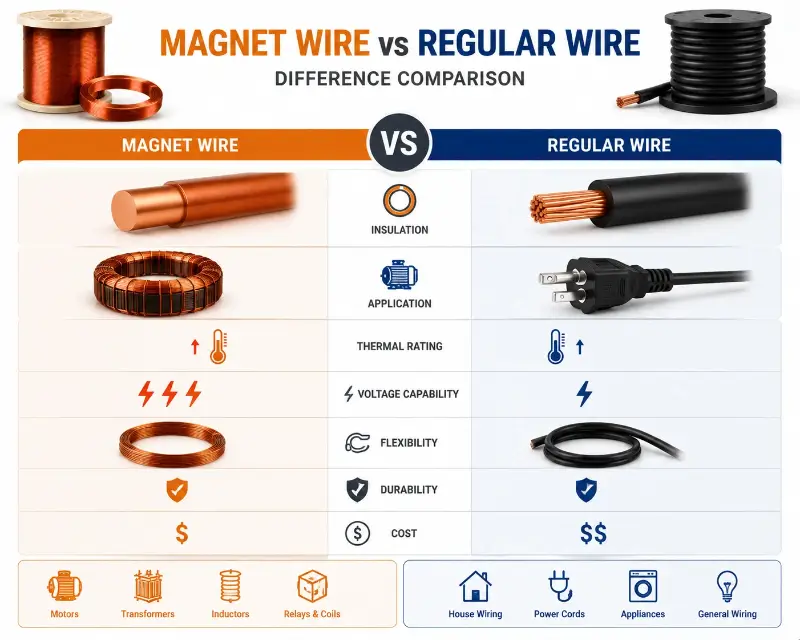
The selection of fan motor windings should follow this engineering sequence: First, determine the basic operating conditions and current density based on the motor type (salient pole/PSC/BLDC); second, determine the Class (130/155/180/200/220) based on the operating environment temperature; third, work backwards from the current density (4–8 A/mm² AC, 6–10 A/mm² DC) and slot fill factor constraints to determine the wire diameter; fourth, select the enamel coating based on operating characteristics—UEW prioritizes solderability, PEW prioritizes cost-effectiveness, and EIW/AIW prioritizes high temperature and reliability; fifth, select the certification (RoHS/REACH/UL) based on the target market.
Common design errors in engineering practice include: selecting the enamel coating grade solely based on price, ignoring the impact of PWM high-frequency voltage stress on the enamel coating, failing to verify refrigerant compatibility, and neglecting to consider the impact of winding processes on the integrity of the enamel coating.
It is recommended to request the following from the supplier before bulk purchasing: a third-party breakdown voltage report, a pinhole test report, measured data on enamel coating thickness tolerance, measured data on conductor ellipticity, and compatibility documentation for specific operating conditions (refrigerant/oil/temperature).
The selection of the magnetic wire winding is a systematic engineering project, encompassing constraints from multiple disciplines including electromagnetics, thermodynamics, mechanics, and chemistry.
In specific applications of fan motors, a reliable winding solution can only be obtained by starting with the motor type, considering operating conditions, and basing decisions on material properties, in conjunction with standardized test data.