

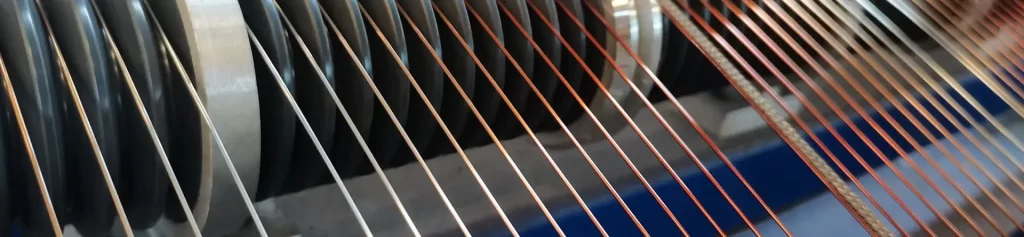
What Are Industrial Magnet Wire Quality Standards?
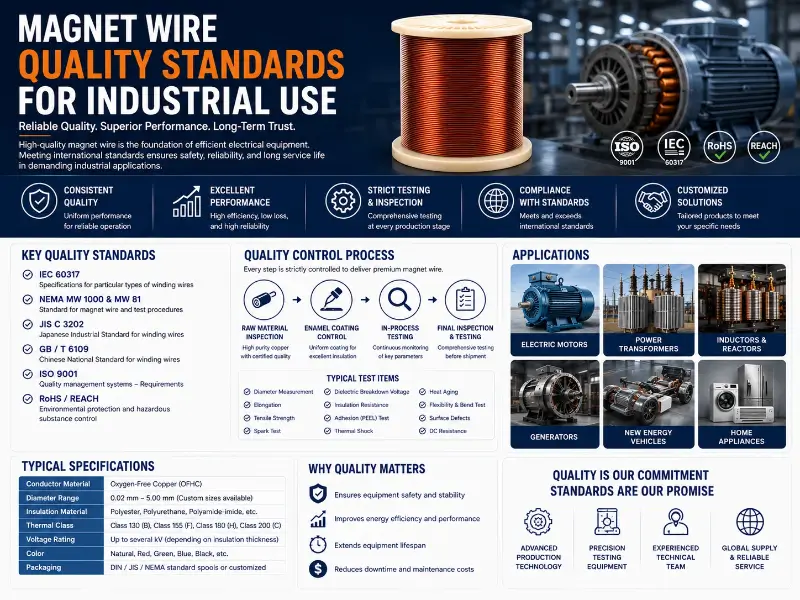
Industrial magnet wire quality standards constitute a comprehensive technical specification system governing electromagnetic wires—including enameled wire, wrapped wire, and silk-wrapped wire—used in industrial motors, transformers, generators, and electrical equipment. These standards define requirements across multiple dimensions: conductor materials, insulation coatings, mechanical strength, thermal class ratings, electrical performance, test methods, and certification frameworks.
They encompass:
- **International standards**: IEC 60317, IEC 60851
- **North American standards**: NEMA MW 1000
- **Chinese national standards**: GB/T 6109
- **Japanese standards**: JIS C 3202
- **European standards**: BS EN 60317 (equivalent to EN 60317)
- **Industry-specific standards**:
- Automotive: IATF 16949
- Rail: IRIS
- Medical devices: ISO 13485
- Transformers: UL 1446
- Flame retardancy: UL 94
The fundamental distinction between industrial magnet wire and general-purpose enameled wire lies in the significantly higher performance demands of industrial applications—particularly regarding long-term reliability, thermal cycling endurance, resistance to mechanical vibration and chemical corrosion, dielectric strength, and consistency of service life. For example, a 100 kW industrial motor must operate continuously for 20 years (~175,000 hours) with its enamel insulation rated at 180°C; any quality defect may result in catastrophic failure and unplanned downtime. The core objective of the quality standard system is to ensure *predictable*, *verifiable*, and *traceable* performance consistency across manufacturers, production batches, and application environments.
Core Classification System of Industrial Magnet Wire Quality Standards
Industrial magnet wire quality standards are organized into four hierarchical levels, each corresponding to distinct application requirements and quality expectations.
**Level 1: International Fundamental Standards** — These constitute the global foundational specifications for industrial magnet wire. Key standards include IEC 60317 (enamel-coated round copper/aluminum wire), IEC 60317-0-1 / 0-2 (general requirements), and IEC 60851 (test methods for winding wires). The IEC 60317 series is classified by insulation material type—for example:
- IEC 60317-13: Polyester/polyamide-imide dual-coated wire
- IEC 60317-46: Polyimide-coated wire
- IEC 60317-48: Glass-fiber-bonded round copper wire
Each standard specifies a defined temperature index (per IEC 60085) and corresponds to a specific insulation material system.
**Level 2: Regional Standards** — North America adopts NEMA MW 1000 (the National Electrical Manufacturers Association’s comprehensive magnet wire standard), recognized as the world’s most detailed magnet wire standard system. MW 1000-2018 comprises 86 MW designations (MW 1-C through MW 86-C), with each designation specifying a unique combination of insulation material, conductor dimensions, dimensional tolerances, and test procedures. Europe, China, and Japan adopt BS EN 60317, GB/T 6109, and JIS C 3202, respectively. While technically equivalent to IEC 60317 in core content, these regional standards differ in terminology, numbering conventions, test methodology details, and acceptance criteria.
**Level 3: Industry-Specific Standards** — Specialized applications impose additional compliance requirements on magnet wire:
- **Automotive**: IATF 16949 quality management system; mandates PPAP (Production Part Approval Process), APQP (Advanced Product Quality Planning), FMEA (Failure Mode and Effects Analysis), and SPC (Statistical Process Control) for magnet wire suppliers.
- **Railway**: ISO/TS 22163 (IRIS – International Railway Industry Standard), EN 45545-2 (fire protection), and IEC 61373 (vibration and shock resistance).
- **Aerospace**: AS9100D.
- **Medical Devices**: ISO 13485.
- **Transformers**: UL 1446 (insulation systems) and UL 94 (flammability ratings).
**Level 4: Environmental Compliance Standards** — Regulatory frameworks strictly limit hazardous substances in magnet wire components (e.g., enamel coatings, glass fiber binders, adhesives, and impregnating resins):
- EU RoHS Directive (2011/65/EU): Restricts lead, mercury, cadmium, hexavalent chromium, polybrominated biphenyls (PBB), and polybrominated diphenyl ethers (PBDE).
- EU REACH Regulation (EC No. 1907/2006): Requires declaration of Substances of Very High Concern (SVHC).
- US California Proposition 65: Mandates clear and reasonable warnings for exposure to listed chemicals.
- China RoHS 2.0 (SJ/T 11364-2014): Controls analogous hazardous substances.
Conductor Material Quality Standards
Key quality parameters for magnet wire conductors include material purity, electrical conductivity, resistivity, mechanical strength, elongation, and surface finish.
**Copper Conductors** — Industrial magnet wire primarily uses Electrolytic-Tough-Pitch (ETP) copper (UNS C11000), with a minimum copper content of ≥99.9%, conductivity of 100% IACS (International Annealed Copper Standard), and resistivity of 1.724 µΩ·cm at 20°C. ASTM B49 and ASTM B170 specify standard requirements for round electrolytic copper wire. Mechanical property requirements include tensile strength ≥220 MPa (annealed/soft temper), elongation ≥35%, and a surface free of cracks and oxide layers. For high-precision windings (e.g., precision motors, instrument transformers), oxygen content in the copper rod must be ≤0.04% to prevent hydrogen embrittlement.
**Aluminum Conductors** — Electrical-grade pure aluminum (alloy 1350-O or 1350-H19) is used, with a minimum aluminum content of ≥99.5%, conductivity of 61% IACS, resistivity of 2.654 µΩ·cm at 20°C, and density of 2.70 g/cm³ (30% that of copper). ASTM B233 and B609 define standard specifications for round aluminum wire. Mechanical requirements include tensile strength of 90–180 MPa and elongation ≥10%. A critical quality challenge with aluminum is its native Al₂O₃ oxide layer (thickness ~5–10 nm, resistivity 10¹⁴–10¹⁶ Ω·cm), which necessitates special solutions—such as copper–aluminum transition joints or copper-clad aluminum (CCA) wire—to ensure reliable electrical contact.
**Copper-Clad Aluminum (CCA) Conductors** — Employed as a lightweight, cost-optimized alternative, CCA wire is standardized under ASTM B566. A typical cross-section comprises a copper cladding layer occupying 10–15% of total cross-sectional area over an aluminum core, delivering conductivity of 65–85% IACS. Key quality metrics for CCA include copper layer thickness uniformity (tolerance ±5%), copper–aluminum bond strength (≥85 MPa), and copper layer continuity (no exposed aluminum spots).
**Conductor Diameter Tolerance** — Per NEMA MW 1000, bare conductor diameter tolerances for magnet wire in AWG 14–30 range from ±0.0005 to ±0.0010 inch (±0.013 to ±0.025 mm). For precision windings (e.g., micro-motors, sensors), tighter tolerances of ±0.0003 inch are required.
Insulation Coating Material Quality Standards
Industrial magnet wire insulation coatings are categorized into three types: enamel-coated, tape-wrapped, and composite. Each type conforms to distinct quality standards.
**Enamel Coatings** — Applied as polymer-based insulating varnish onto conductor surfaces and cured by baking. The most common materials include:
| Enamel Type | IEC Standard | NEMA MW Designation | Temperature Class | Typical Applications |
|---|---|---|---|---|
| Polyurethane (UEW) | IEC 60317-20 | MW 79 | 155°C | Relays, coils, solderable windings |
| Polyester (PEW) | IEC 60317-3 | MW 5 | 155°C | General-purpose motors and transformers |
| Polyester-imide (EIW) | IEC 60317-8 | MW 30 | 180°C | Industrial motors and transformers |
| Polyester-imide / Polyamide-imide (EI/AIW) | IEC 60317-13 | MW 35 | 200°C | High-temperature motors, new-energy vehicles |
| Polyimide (PIW) | IEC 60317-46 | MW 16 | 240°C | Extreme-environment applications, aerospace |
| Polyamide-imide (AIW) | IEC 60317-26 | MW 81 | 220°C | High-temperature transformers, traction motors |
**Tape-Wrapped Insulation** — Achieved by wrapping films, fiber tapes, or paper tapes around conductors or enamel-coated wires. Common materials include:
- **Glass Fiber** — NEMA MW 41-C through MW 65-C series (for round/flat wire; single/double/multi-layer), temperature class 155–220°C. Used with VPI (Vacuum Pressure Impregnation) processing in high-voltage transformers, traction motors, rail transit systems, and wind turbine generators.
- **Nomex Paper (Aramid Paper)** — Nomex 410, 414, and 418 grades; thermal class 220°C; dielectric strength 30–50 kV/mm. Widely applied in dry-type transformers and traction motors.
- **Polyimide Film (Kapton®)** — Thermal class 240°C; dielectric strength up to 200 kV/mm. Employed in extreme high-temperature motors and inverter-duty applications.
- **Kraft Paper** — Traditional material for oil-immersed transformers; dielectric strength ~30 kV/mm (oil-impregnated).
**Composite Insulation** — Multi-layer (typically dual- or triple-layer) coating systems combining complementary properties. MW 35 (polyester + polyamide-imide, PEW+AIW) is the world’s most widely used dual-coated magnet wire for motor applications. MW 36 (polyester-imide + polyamide-imide) offers enhanced thermal endurance. MW 80 (polyester + polyamide-imide + thick enamel layer) is specifically designed for high-voltage transformers.
Enamel Coating Thickness Grades Standard
Enamel coating thickness (Grade) is a critical quality parameter for industrial magnet wire, directly determining electrical insulation strength and mechanical robustness.
**Grade 1 (Thin Coating)** — Single-layer enamel. Minimum standard coating thickness. Increases overall diameter by 0.0008–0.0024 in (0.020–0.061 mm). Dielectric breakdown voltage rating: 1.5–2.5 kV (@ 0.5 mm round wire). Used in low-voltage applications, miniature coils, relays, and solenoids.
**Grade 2 (Heavy Coating)** — Double-layer enamel. Standard industrial-grade coating thickness. Increases overall diameter by 0.0013–0.0031 in (0.033–0.079 mm). Dielectric breakdown voltage rating: 2.5–5.0 kV (@ 0.5 mm round wire). Widely used in general-purpose motors, transformers, and chokes. Grade 2 is the most common specification for industrial motors.
**Grade 3 (Extra-Heavy Coating)** — Triple-layer enamel. Extra-thick coating. Increases overall diameter by 0.0031–0.0047 in (0.079–0.119 mm). Dielectric breakdown voltage rating: 5.0–8.0 kV (@ 0.5 mm round wire). Used in high-voltage motors, variable-frequency drive (VFD) applications, and rail traction motors.
**Dielectric Breakdown Voltage Standards** — Tested per NEMA MW 1000 §3.5 (twisted-pair method): For 0.5 mm diameter round wire (AWG 24, 4-turn twist), Grade 1 ≥ 2.4 kV, Grade 2 ≥ 4.8 kV, and Grade 3 ≥ 7.2 kV. Per IEC 60317, minimum breakdown voltages are Grade 1 ≥ 1.4 kV, Grade 2 ≥ 2.8 kV, and Grade 3 ≥ 4.2 kV (0.5 mm round wire, single-strand test).
**Coating Continuity (Pinhole Test)** — Tested per IEC 60851-5.3 (saltwater immersion with electrical continuity detection). Maximum allowable pinholes: Grade 1 ≤ 5 per 30 m, Grade 2 ≤ 3 per 30 m, Grade 3 ≤ 1 per 30 m. This is a key indicator of enamel film integrity.
Thermal Class Standards (IEC 60085)
IEC 60085 (*Electrical Insulation — Thermal Evaluation and Classification*) defines seven temperature classes, each specifying the maximum continuous operating temperature for magnet wire with a service life of 20,000 hours.
| Class | Temperature | Symbol | Typical Magnet Wire Types |
|---|---|---|---|
| E | 90°C | E | Early enamel wires; rarely used today |
| B | 105°C | B | Modified polyurethane |
| F | 155°C | F | Polyurethane, modified polyester, and selected polyester-imide grades |
| H | 180°C | H | Polyester-imide, polyester-nylon |
| N | 200°C | N | Polyester/polyamide-imide |
| R | 220°C | R | Polyamide-imide |
| 240°C | 240°C | 240 | Polyimide, aromatic polyimide |
**NEMA Nomenclature Differences** — NEMA MW 1000 employs a similar but not identical classification system: 105°C, 130°C, 155°C, 180°C, 200°C, 220°C, and 240°C. The correspondence between IEC and NEMA classes is as follows: IEC E = NEMA 105°C, IEC B = NEMA 130°C, IEC F = NEMA 155°C, IEC H = NEMA 180°C, IEC N = NEMA 200°C, IEC R = NEMA 220°C, IEC 240 = NEMA 240°C.
**Temperature Index (TI) Testing** — Conducted per IEC 60172 / ASTM D2304, this method subjects magnet wire specimens to accelerated aging at multiple temperature points (typically 3–5), based on the Arrhenius life model, and extrapolates the highest temperature corresponding to a 20,000-hour service life. For example, PEW (polyester-imide enamel) specimens aged for 1,000–5,000 hours at 200°C, 220°C, 240°C, and 260°C are used to construct an Arrhenius plot; the temperature intercept at 20,000 hours yields the TI value. Typical TI values: PEW ≈ 155°C; PEI ≈ 180°C.
**Thermal Shock Temperature** — Tested per NEMA MW 1000 §3.50 / IEC 60851-6.2: magnet wire specimens are baked at 155°C for 30 minutes, then rapidly quenched in cold water or alcohol; the enamel coating is examined for cracking. Required thermal shock temperatures are: Class 155 → 175°C, Class 180 → 200°C, Class 200 → 220°C, Class 220 → 240°C, Class 240 → 260°C.
**Softening Point (Breakdown Temperature)** — Tested per NEMA MW 1000 §3.50: magnet wire is heated on a hot plate until the enamel softens and collapses under its own weight; the temperature at which breakdown occurs is recorded. Typical values: PAI = 330–350°C; PI > 400°C.
Electrical Performance Quality Standards
Electrical performance testing of industrial magnet wire includes breakdown voltage, insulation resistance, dielectric constant, dielectric loss tangent (tan δ), corona resistance, and DC resistance.
**Breakdown Voltage** — Tested per NEMA MW 1000 §3.5 / IEC 60851-5.4 / ASTM D149. For Grade 1 round wire (0.5 mm diameter): ≥1.4 kV (IEC) or ≥2.4 kV (NEMA, 4-turn twisted); Grade 2: ≥2.8 kV / ≥4.8 kV; Grade 3: ≥4.2 kV / ≥7.2 kV. Flat wire exhibits higher breakdown voltage, graded by insulation thickness.
**Insulation Resistance** — Tested per IEC 60851-5.3: magnet wire is immersed in salt water for 24 hours, then insulation resistance is measured. Typical values: ≥10¹⁰ Ω·cm (enamel-coated wire); Nomex® 410 paper: ≥10¹⁴ Ω·cm.
**Corona Resistance** — Tested per IEC 60851-5.5: corona resistance lifetime is measured under high-frequency, high-voltage stress. Inverter-duty magnet wire requires a minimum corona resistance lifetime of ≥100 hours (typically 200–500 hours). Achieved via corona-resistant coatings (e.g., CrO₃ or TiO₂ nanoparticles).
**DC Resistance** — Tested per NEMA MW 1000 §3.4 / IEC 60851-5.1. At 20°C, resistivity of copper magnet wire is 1.724 μΩ·cm (100% IACS); aluminum magnet wire is 2.654 μΩ·cm (61% IACS). Temperature coefficients: copper = 0.00393/°C; aluminum = 0.0043/°C. Resistance increases by ~16% (copper) or ~20% (aluminum) at 60°C.
**Dielectric Loss Tangent (tan δ)** — Tested per ASTM D150 / IEC 60250. At 1 kHz frequency: PEW enamel tan δ ≈ 0.01–0.03; PI enamel tan δ ≈ 0.005–0.015. Lower tan δ indicates lower dielectric loss, which significantly improves efficiency in high-frequency motors and transformers.
Mechanical Performance Quality Standards
Industrial magnet wire is subjected to mechanical stresses—including tension, bending, scraping, and vibration—during winding, insertion into slots, and operation. It must therefore meet the following mechanical performance standards.
**Tensile Strength** — Tested per ASTM E8 / NEMA MW 1000 §3.6.
- Annealed copper (O): 220–260 MPa
- Half-hard copper (½H): 240–300 MPa
- Hard-drawn copper (H): 280–380 MPa
- Aluminum 1350-O: 90–130 MPa
- Aluminum 1350-H19: 180–220 MPa
**Elongation** — Tested per ASTM E8 / NEMA MW 1000 §3.6.
- Annealed copper: ≥35%
- Half-hard copper: ≥15%
- Hard-drawn copper: ≥5%
- Annealed aluminum: ≥25%
- Hard-drawn aluminum: ≥5%
Elongation directly affects bendability and slotting quality; excessively low elongation may cause insulation cracking during winding.
**Flexibility** — Tested per NEMA MW 1000 §3.8 / IEC 60851-3.3. The wire is bent 180° around a cylindrical mandrel of specified diameter (typically 1× to 5× the wire’s overall diameter), and the insulation must show no cracking or flaking.
- Grade 1: No cracking at 1× diameter
- Grade 2: No cracking at 2× diameter
- Grade 3: No cracking at 3× diameter
**Insulation Adherence** — Tested per NEMA MW 1000 §3.9. After stretching the wire to 10–20% elongation, the insulation must remain intact—without peeling or cracking. A similar test is specified in IEC 60851-3.5.
**Scrape Resistance** — Tested per NEMA MW 1000 §3.55 / IEC 60851-3.7. A 0.4 mm tungsten carbide stylus applies constant pressure while repeatedly scraping the wire surface; the number of scrapes required to penetrate the insulation is recorded. Typical values:
- PEW: ≥100 cycles
- PEI: ≥150 cycles
- PAI: ≥300 cycles
- PI: ≥500 cycles
This is a key indicator of insulation hardness and abrasion resistance.
**Flexibility After Thermal Shock** — Tested per NEMA MW 1000 §3.50 / IEC 60851-6.2. The wire is heated at 175–260°C for 30 minutes, then immediately quenched in 0°C ice water; the insulation must show no cracking. This is a critical indicator of thermal stability of the insulation system.
Quality Management System Standards
Industrial magnet wire suppliers must implement a robust quality management system—this is the essential “entry requirement” for industrial procurement.
**ISO 9001** — The world’s most widely adopted quality management system standard. The 2015 edition emphasizes risk-based thinking, the process approach, and the PDCA (Plan–Do–Check–Act) cycle. Suppliers must establish documented quality manuals, procedure documents, work instructions, and inspection records—and undergo annual third-party audits by accredited bodies such as SGS, TÜV, Bureau Veritas (BV), and DNV.
**ISO 14001** — Environmental Management System. Specifies requirements for VOC emissions control, wastewater treatment, hazardous waste disposal, and energy consumption management in magnet wire manufacturing. Widely mandated by EU and North American customers.
**ISO 45001** — Occupational Health and Safety Management System. Addresses safety controls for solvent vapor exposure during enamel coating, high-temperature baking, and acid cleaning operations.
**IATF 16949** — Automotive Quality Management System. An industry-specific extension of ISO 9001, requiring suppliers to implement PPAP (Production Part Approval Process), APQP (Advanced Product Quality Planning), FMEA (Failure Mode and Effects Analysis), SPC (Statistical Process Control), and MSA (Measurement Systems Analysis). Suppliers to new-energy vehicle traction motor manufacturers must be certified to IATF 16949.
**ISO/TS 22163 (IRIS)** — Railway Industry Quality Management System. An ISO 9001–based standard tailored for rail, mandating RAMS (Reliability, Availability, Maintainability, and Safety) management, configuration management, and lifecycle management. Magnet wire suppliers serving the rail transportation sector must achieve IRIS Silver or Gold certification.
**AS9100D** — Aerospace Quality Management System. An ISO 9001–based standard with aerospace-specific requirements, including First Article Inspection (FAIR), critical characteristic control, and configuration management. Suppliers of magnet wire for aircraft motors must be AS9100D certified.
**ISO 13485** — Medical Device Quality Management System. Governs design documentation, risk management (per ISO 14971), clinical evaluation, and post-market surveillance. Suppliers of magnet wire for MRI coils and medical-grade motors must comply with ISO 13485.
**Certification Bodies** — Accredited certification bodies include SGS (Switzerland), TÜV (Germany), Bureau Veritas (France), DNV (Norway), Intertek (UK), UL (USA), CSA (Canada), and CQC (China). Recognition varies by region and customer: European and U.S. customers typically accept SGS, TÜV, UL, and BV; North American customers prefer UL and CSA; Chinese customers recognize CQC.
Industry-Specific Standards
Different industrial applications impose specific compliance requirements on magnet wire, mandating adherence to corresponding industry-specific standards.
**Motor Applications**
- General industrial motors: IEC 60034 (Rotating electrical machines), NEMA MG 1 (Motors and generators), UL 1004 (Motors).
- New-energy vehicle (NEV) traction motors: ISO 26262 (Functional safety), AEC-Q200 (Stress testing qualification for passive components), LV 215 (High-voltage components).
- Traction motors (rail): IEC 60349 (Electric traction – Rotating electrical machines for rail vehicles), EN 45545-2 (Fire protection – Requirements for fire behavior of materials and components in railway applications, hazard levels R1–R23).
**Transformer Applications**
- Power distribution transformers: IEC 60076-1/-2/-3 (Power transformers), IEEE C57.12.00 (General requirements for liquid-immersed distribution, power, and regulating transformers), UL 1561 (Standard for Safety for Transformers and Related Equipment), CSA C802 (Energy efficiency of distribution transformers).
- Dry-type transformers: IEC 60076-11 (Dry-type power transformers), UL 1562 (High-voltage dry-type transformers), UL 1446 (Electrical insulation systems).
- Energy efficiency standards: U.S. DOE 2016 Rule, EU Tier 2 (Ecodesign Directive No. 548/2014), China GB 20052-2020.
**High-Frequency Electronic Equipment**
- Switch-mode power supplies (SMPS), variable-frequency drives (VFDs), uninterruptible power supplies (UPS): IEC 61800 (Adjustable speed electrical power drive systems), IEC 62040 (Uninterruptible power systems – UPS), IEC 60601 (Medical electrical equipment).
- VFD-driven motors require magnet wire with corona resistance ≥100 hours (some applications specify ≥300 hours).
**Automotive Electronics**
- On-board motors, inductors, relays: AEC-Q200 (Stress test qualifications for passive components), AEC-Q100 (Stress test qualifications for integrated circuits), ISO 16750 (Road vehicles – Environmental conditions and testing for electrical and electronic equipment), ISO 7637 (Road vehicles – Electrical disturbances from conduction and coupling).
- Operating temperature range: −40 °C to +150 °C; some applications require up to +180 °C.
**Railway Transportation**
- Traction motors, transformers, auxiliary systems: EN 45545-2 (Fire protection), TB/T 3237 (China high-speed train EMU technical specifications), DIN 5510-2 (German railway fire safety standard), NFPA 130 (Standard for fixed guideway transit and passenger rail systems), IEC 61373 (Railway applications – Shock and vibration tests), IEC 60068-2-52 (Environmental testing – Salt mist test), IEC 60068-2-10 (Environmental testing – Fungal test), ISO/TS 22163 (IRIS – Railway applications – Quality management system requirements).
**New Energy Applications**
- Photovoltaic (PV) inverters, energy storage systems (ESS): IEC 62109 (Safety of power converters for use in photovoltaic power systems), IEC 62619 (Industrial secondary lithium cells and batteries), UL 1741 (Inverters, converters, controllers and interconnection system equipment for use with distributed energy resources).
- Wind turbine generators: IEC 61400 (Wind energy generation systems), DNV-GL Wind Certification.
**Medical Equipment**
- MRI magnet coils, CT auxiliary motors, medical pumps: IEC 60601 (Medical electrical equipment), ISO 13485 (Medical devices – Quality management systems), FDA 21 CFR Part 820 (Quality system regulation – U.S.), MDR 2017/745 (EU Medical Device Regulation).
Test Method Standards
Each quality parameter of industrial magnet wire corresponds to a standardized test method to ensure comparability of test results across different manufacturers.
**IEC 60851 Series** — Standard test methods for winding wires. Comprises six parts:
- IEC 60851-1: General requirements
- IEC 60851-2: Measurement of dimensions
- IEC 60851-3: Mechanical properties (tensile strength, elongation, flexibility, adhesion, scrape resistance)
- IEC 60851-4: Chemical properties (solvent resistance, refrigerant resistance)
- IEC 60851-5: Electrical properties (resistance, dielectric breakdown voltage, insulation resistance, corona resistance)
- IEC 60851-6: Thermal properties (thermal shock, softening point/breakdown, thermal aging)
**NEMA MW 1000 §3** — Specifies detailed test procedures, acceptance criteria, and specimen preparation for each test. Key sections include: §3.6 Elongation, §3.8 Flexibility, §3.9 Enamel Adhesion, §3.50 Thermal Shock, §3.52 Hot Dielectric Breakdown, §3.55 Scrape Resistance.
**ASTM Standards Series** — Includes: ASTM D149 (Dielectric Breakdown Voltage), ASTM D150 (Dielectric Constant), ASTM D2304 (Temperature Index), ASTM E8 (Tensile Testing), ASTM B117 (Salt Spray Corrosion), ASTM G21 (Fungal Resistance).
**Specimen Preparation** — For dielectric breakdown testing, the magnet wire must be wound under 1 kg tension onto a round mandrel of 4–6 mm diameter for four turns, then twisted into a “twisted pair” configuration and tested using pressurized electrodes. For scrape resistance testing, the wire is clamped in a scrape tester, and a 0.4 mm tungsten carbide stylus scrapes the enamel at a 90° angle; the number of strokes required to expose the conductor is recorded.
**First-Article Inspection & Lot Inspection** — Mass production requires First-Article Inspection (FAI), In-Process Inspection (IPI), and Final Inspection (FI). Each lot of magnet wire must be accompanied by a Certificate of Conformance (CoC) or Mill Test Certificate (MTC), listing critical parameters including conductor diameter, enamel thickness, dielectric breakdown voltage, elongation, resistivity, and enamel continuity.
**Third-Party Testing** — For critical applications (e.g., aerospace, medical, nuclear), type testing must be performed by accredited third-party laboratories (e.g., SGS, TÜV, Intertek), with formal test reports issued.
Industrial Magnet Wire Quality Standard Selection Guide
When selecting magnet wire quality standards for industrial applications, follow this five-step methodology:
**Step 1: Define Application Context and Performance Requirements** Identify the operating environment temperature, working voltage, operating frequency, mechanical stress, and service life requirements.
- General-purpose industrial motors typically require Class F (155°C) or Class H (180°C) thermal ratings.
- Traction motors require 200°C or 220°C thermal classes.
- Aerospace applications demand 240°C-rated insulation.
- High-voltage motors (>1 kV) require Grade 3 enamel coating.
- Inverter-fed motors require corona-resistant insulation.
**Step 2: Select Conductor Material and Dimensions**
- Choose conductor cross-sectional area (mm² or AWG) based on rated current.
- Select conductor material—copper, aluminum, or copper-clad aluminum (CCA)—according to application requirements.
- Consider mechanical strength, weight constraints, and cost-effectiveness.
**Step 3: Choose Insulation Material and Enamel Grade**
- Select insulation polymer based on thermal class: Polyester Enamel Wire (PEW), Polyetherimide (PEI), Polyamide-imide (PAI), or Polyimide (PI).
- Specify enamel thickness grade (Grade 1 / Grade 2 / Grade 3) per voltage class.
- Account for special performance requirements: corona resistance, chemical resistance, or radiation resistance.
**Step 4: Verify Certifications and Regulatory Compliance**
- Identify industry-specific mandatory certifications:
- Automotive: IATF 16949, AEC-Q200
- Rail: EN 45545-2 (fire safety), IRIS
- Medical: ISO 13485, UL 60601-1
- Aerospace: AS9100D, NADCAP
- Confirm regional regulatory compliance: RoHS, REACH (EU), UL (North America), CCC (China), etc.
**Step 5: Select Supplier and Quality Management System**
- Prioritize suppliers certified to applicable QMS standards: ISO 9001, IATF 16949, ISO 13485, IRIS, or AS9100D.
- Require documented evidence: inspection reports, material certificates (e.g., mill test reports), and third-party test reports (e.g., IEC 60851, IEC 60317, UL 94, GB/T 6109, JIS C 3202, EN 45545-2).
- Suppliers with PPAP and APQP capabilities are strongly preferred in automotive and medical device sectors.
**Common Pitfalls**
- Avoid selecting suppliers solely on price while neglecting critical factors: batch-to-batch quality consistency, lifetime prediction data (e.g., thermal aging per IEC 60085), and supplier capability for continuous improvement.
- Do not over-specify insulation (e.g., 240°C polyimide) without technical justification—this leads to unnecessary cost escalation and potential processing challenges (e.g., higher winding tension, reduced flexibility).
Trends in Industrial Magnet Wire Quality Standards
Industrial magnet wire quality standards are evolving along five key directions:
**Direction 1: Higher Frequency & Higher Voltage Operation** With the widespread adoption of SiC and GaN third-generation semiconductor devices, motor and transformer operating frequencies have increased from 50–60 Hz to 100 kHz–1 MHz. IEC 60851 is undergoing revision to update high-frequency dielectric loss test methods. For inverter-driven motors, corona resistance requirements have been raised from 100 hours to 300–500 hours.
**Direction 2: Higher Temperature Operation & Extended Service Life** Applications in new-energy vehicles, aerospace, deep-well drilling, and nuclear power demand long-term stable operation of magnet wire at 200–250°C. IEC 60085 is actively studying a Class 250 temperature rating (250°C). Polyimide (PI) and aromatic polyimide (PAI) insulation materials are seeing expanded application.
**Direction 3: Environmental Compliance & Lead-Free Requirements** EU RoHS 2.0, Japan RoHS, and China RoHS 2.0 continue tightening restrictions on hazardous substances. Lead-free solderable magnet wires (e.g., MW 79 and MW 80 series) are replacing traditional lead-containing solderable types. Bio-based insulating varnishes—derived from plant oils—are emerging as a key research focus.
**Direction 4: Digitalization & Full Traceability** Magnet wire suppliers are increasingly adopting MES (Manufacturing Execution Systems), digital twin technology, and AI-driven quality prediction models. Each coil or batch is equipped with a QR code or RFID tag, capturing comprehensive data—including raw material origin, process parameters, test results, and logistics information. Customers can trace the complete lifecycle of magnet wire via blockchain-enabled systems.
**Direction 5: Customization & Collaborative Design** Collaborative design between magnet wire suppliers and equipment manufacturers—via Engineering Change Request (ECR) / Engineering Change Notice (ECN) processes—is becoming standard practice. Suppliers now engage early in customers’ R&D phases, delivering integrated solutions covering electromagnetic simulation, product selection, and performance validation testing.
Summary and Recommendations
Industrial-grade magnet wire quality standards form the foundation for ensuring the long-term, reliable operation of motors, transformers, and other electrical equipment. A thorough understanding of core standards—including **IEC 60317**, **NEMA MW 1000**, **IEC 60085**, and **IEC 60851**—is essential for procurement and application of industrial magnet wire.
**Key Takeaways**:
- Industrial magnet wire quality standards are structured across **four tiers**: international (e.g., IEC), regional (e.g., EN, GB/T, JIS), industry-specific (e.g., automotive, aerospace, rail), and environmental compliance (e.g., RoHS, REACH)—each aligned with distinct application requirements.
- A comprehensive quality framework is built upon **six critical dimensions**: conductor material, insulation coating type, enamel film thickness, thermal class rating, electrical performance (e.g., dielectric strength, breakdown voltage), and mechanical properties (e.g., elongation, adhesion, abrasion resistance).
- Five major management system certifications—**ISO 9001**, **IATF 16949**, **ISO 13485**, **IRIS**, and **AS9100D**—address diverse sectoral entry requirements (automotive, medical, rail, aerospace).
- Standardized test methods (**IEC 60851**, **NEMA MW 1000 §3**, **ASTM D2307**, **ASTM D1676**, etc.) ensure cross-manufacturer comparability and reproducibility of test results.
- Magnet wire selection should follow a disciplined **five-step process**: *application requirements → conductor material (Cu/Al, purity, conductivity %IACS) → insulation system (PEW, UEW, EIW, AIW, PIW, PAI, PEI, PI, etc.) → regulatory/certification compliance (UL, CSA, VDE, CCC, EN 45545-2, etc.) → supplier quality system maturity*.
**Recommendations for Procurement Engineers**:
- Look beyond unit price—evaluate **total cost of ownership (TCO)**: procurement cost + failure cost (downtime, warranty, recall) + maintenance/rework cost.
- Prioritize suppliers with proven capabilities in **PPAP**, **APQP**, and **FMEA**, especially for safety-critical applications.
- Require documented evidence: **First Article Inspection Reports (FAIR)**, **batch inspection reports**, and **third-party test reports** (e.g., from UL, TÜV, SGS, or accredited labs).
- For mission-critical, long-life applications (aerospace, nuclear power, medical devices), mandate **type testing** (per IEC 60317 or NEMA MW 1000) and **accelerated life testing** (e.g., thermal aging per IEC 60216 or MIL-STD-2164).
**Recommendations for Equipment Manufacturers**:
- Involve magnet wire suppliers early in the design phase—**collaborative design engagement** improves manufacturability, reliability, and time-to-market.
- Establish a formal **magnet wire supplier evaluation program**, including quarterly performance reviews and annual on-site audits.
- Maintain an internal **magnet wire failure case database**, with root-cause analysis and structured feedback loops to suppliers for continuous improvement.
- Actively monitor and adopt the latest revisions of key standards: currently **NEMA MW 1000–2018**, **IEC 60317 (Ed. 4.0, 2022)**, **IEC 60085 (Ed. 3.0, 2022)**, and **IEC 60851 (Ed. 5.0, 2021)**.
**Recommendations for Magnet Wire Suppliers**:
- Continuously invest in robust quality management systems: **IATF 16949**, **IRIS**, and **AS9100D** are non-negotiable gateways to high-value markets (automotive Tier 1, rail, aerospace).
- Cultivate **co-design engineering capability** with OEMs—this is a key differentiator in competitive bidding and long-term partnerships.
- Embrace **digital quality management**: deploy MES-integrated real-time monitoring, inline optical/enamel thickness gauging, and AI-driven predictive quality analytics.
- Ensure full compliance with global environmental regulations—**RoHS**, **REACH**, **POPs**, and **Conflict Minerals Reporting**—as mandatory prerequisites for market access in North America, EU, and Japan.