

Introduction
HVAC motors encompass compressor drive motors for residential split air conditioners, commercial variable refrigerant flow (VRF) systems, central air-conditioning chillers, and heat-pump water heaters; cross-flow and axial-flow fan motors for indoor and outdoor units; and motors for dehumidification and fresh-air circulation systems. Their power ratings span from small indoor cross-flow fans to large central chiller compressors. Traditionally, their windings have employed enameled round wire and enameled rectangular (flat) wire. However, with the progressive efficiency upgrades from IE3 → IE5, persistently high copper prices, and the trend toward higher power density and miniaturization, copper foil winding—offering advantages including larger cross-sectional area, shorter end-windings, higher slot fill factor, and lower DC copper loss—is gradually penetrating both residential and commercial HVAC motor applications.
In contrast to new-energy vehicle (NEV) traction motors—which operate under 800 V high-voltage conditions, employ SiC MOSFETs, and follow cell-to-pack (CTP) battery-chassis integration strategies—HVAC motors operate in low-voltage, household-appliance-grade environments: 220 V AC single-phase or 380 V AC three-phase. While their power density requirements are moderate, demands for cost-effectiveness, reliability, low vibration, low acoustic noise, and environmental robustness (e.g., humid–hot conditions and high-temperature refrigerant exposure) are significantly higher. This distinction dictates that HVAC motor copper foil windings must inherit the electromagnetic advantages of conventional transformer-grade copper foil windings while undergoing appliance-specific optimization in material specifications, surface treatment, insulation systems, and manufacturing processes.
This systematic review focuses specifically on copper foil for HVAC motor windings, covering: fundamental material systems (chemical composition and conductivity of C11000 ETP / C10100 OFHC / C10200 OFHC / C12200 DHP); key performance metrics (electrical conductivity / thermal conductivity / skin effect / mechanical strength); surface treatments and insulation coverings (vacuum pressure impregnation [VPI], pre-coated enamel film, Nomex 410 composite, organic solderability preservative [OSP] passivation); engineering comparison of copper foil versus enameled round wire and enameled rectangular wire; applications in compressor motors (PSC, three-phase induction, BLDC, inverter-driven); indoor/outdoor fan motors and other HVAC scenarios; manufacturing processes and quality control; failure modes and reliability; and engineering selection criteria and design guidelines.
Copper Foil Material System Fundamentals
Chemical Composition and Purity Grades
The base material for copper foil used in air-conditioning motor windings primarily comprises two grades: C11000 (Electrolytic Tough Pitch, ETP) and C12200 (Deoxidized High Phosphorus, DHP). C11000 is the predominant grade for transformer and motor winding applications, with a minimum copper content of 99.90 % and an electrical conductivity of 100 % IACS. C12200 contains phosphorus, which improves solderability and resistance to hydrogen embrittlement after annealing; it is therefore better suited for motor stator windings requiring subsequent welding (e.g., end-ring TIG welding, resistance welding, or laser welding), albeit at a slight reduction in electrical conductivity. In high-precision BLDC permanent-magnet synchronous compressor motor applications, certain premium products employ C10100 or C10200 (Oxygen-Free High-Conductivity, OFHC) to maximize electrical conductivity, resulting in significantly increased material cost.
Dimensions and Geometric Precision
Copper foil windings for air-conditioning motors span both thin and thick cross-sectional extremes, with widths ranging from several millimeters up to the 30 mm class. Thickness tolerances are classified into precision-grade and standard-grade categories. The width-to-thickness ratio of the rectangular cross-section is typically controlled within the range of 5:1 to 15:1—excessively narrow or thin foils are difficult to form, whereas excessively wide or thick foils are prone to microcracking at bend locations. Thin-to-medium thickness specifications are commonly adopted in domestic air-conditioning compressor motors; in contrast, commercial VRF and central air-conditioning systems utilize thicker and wider specifications to accommodate higher current loads.
Mechanical Properties and Annealing Process
The mechanical properties of copper foil directly determine the vibration resistance and short-circuit impact resistance of the wound stator assembly. In the annealed condition (O60 / O61 / O65), tensile strength and elongation after fracture are relatively high; in the hard condition (H00 / H02 / H04), tensile strength increases further but elongation after fracture decreases markedly. Stator winding fabrication requires a compromise between the hard and annealed conditions—semi-hard temper (H02) offers a balanced combination of formability and mechanical strength and is thus the prevailing choice. Annealing is typically conducted under medium-temperature conditions, with medium-duration holding time, under protective atmospheres of hydrogen or nitrogen; recrystallization annealing promotes grain growth to a size suitable for subsequent forming operations.
Key Performance Indicators
Electrical Conductivity
The core advantage of copper foil lies in its exceptionally high electrical conductivity. C11000 exhibits an extremely low resistivity at room temperature, corresponding to the 100% IACS standard. The actual resistivity of annealed copper foil is influenced by purity, grain boundary density, and impurity distribution, resulting in slight deviations from the theoretical value. At elevated operating temperatures, resistivity increases with the temperature coefficient; under compressor winding hotspot temperatures, resistivity increases further. In contrast, aluminum foil exhibits significantly higher resistivity (corresponding to approximately 61% IACS), and the DC resistance losses of copper foil are substantially lower than those of aluminum foil—constituting the fundamental material basis for achieving IE5 efficiency targets in air-conditioning motors.
Thermal Conductivity
Copper foil possesses a thermal conductivity far exceeding that of aluminum and stainless steel—by a factor of several to tens of times. High thermal conductivity enables copper foil windings to rapidly conduct Joule heat to the stator core and motor housing, which is subsequently removed via refrigerant circulation. This property is the critical material factor enabling compressor motors—immersed in refrigerant—to maintain winding hotspot temperatures below design limits even under low-boiling-point refrigerant operating conditions.
Skin Effect and High-Frequency Impedance
At power frequency, the skin depth of copper foil is considerably greater than typical foil thicknesses, rendering the skin effect negligible. However, in BLDC permanent-magnet synchronous compressor motors driven by variable-frequency speed control (IPM intelligent power modules), the PWM switching frequency is relatively high, causing the skin depth to decrease significantly—to a magnitude comparable with the copper foil thickness. Under these conditions, current density becomes concentrated near the foil surface, and the AC resistance rises markedly above the DC resistance. The flat cross-section of copper foil inherently accommodates this impedance behavior: thinner copper foils exhibit more uniform current distribution at high frequencies compared to enameled round wires of larger diameter.
Mechanical Strength and Formability
Rectangular-section copper foil exhibits pronounced directional behavior during bending—the bending performance along the wide edge direction is superior to that along the narrow edge direction. Annealed copper foil can be bent 180° without cracking even at small bending radii, whereas hard-drawn copper foil begins to exhibit surface wrinkling and microcracking at comparatively larger bending radii. The bending radius at motor winding end turns must therefore be carefully designed, and copper foil with an appropriate balance of softness and hardness must be selected to simultaneously satisfy formability and mechanical strength requirements.
Surface Treatment and Insulation Coating
Bare Copper Foil + Subsequent Varnish Impregnation
The most common manufacturing route for air-conditioning motor windings is to wind with bare copper foil followed by overall varnish impregnation. Impregnation processes include: ① Vacuum Pressure Impregnation (VPI) — windings are immersed in insulating varnish (e.g., epoxy resin, modified polyester, polyester-imide, polyurethane) under vacuum, then subjected to moderate pressure to force varnish into capillary pores; ② Dip Coating — immersion at atmospheric pressure followed by draining; ③ Trickle Impregnation — insulating varnish is dripped onto rotating windings from above. Among these three methods, VPI delivers the best film uniformity and void-fill ratio, and is the standard process for IE4 / IE5 high-efficiency air-conditioning motors.
Pre-coated Enameled Copper Foil
Pre-coated enameled copper foil is manufactured by applying a medium-thickness insulating varnish film (polyester PE / polyester-imide PEI / polyamide-imide PAI) onto copper foil prior to slitting—using either a flow-coating or roll-coating method—followed by slitting into final dimensions. This process endows each foil strip with an integral insulation layer, resulting in significantly improved inter-layer insulation uniformity compared to bare copper foil + VPI. A drawback is that the varnish film is prone to cracking at bend locations during winding; therefore, annealed (soft temper) copper foil must be used, and bending radius must be strictly controlled.
Epoxy-Coated Copper Foil and Composite Insulation
Some commercial central air-conditioning BLDC motors employ epoxy-coated copper foil—copper foil coated with a relatively thick epoxy resin layer (glass-fiber reinforced or unreinforced), providing both electrical insulation and mechanical support. Windings constructed using this structure maintain stable insulation performance at elevated temperatures, making them especially suitable for high-frequency voltage stress and localized high-temperature hot-spot conditions encountered in inverter-driven compressors.
Nomex 410 and Polyimide Composite Insulation
High-end commercial VRF air-conditioning motors incorporate additional insulation layers—Nomex 410 (DuPont aramid paper) or Kapton HN / FN (DuPont polyimide film)—between copper foil layers. This composite insulation system (rated for Class H / Class N / Class R high-temperature operation) exhibits high dielectric strength and superior thermal endurance beyond Class F varnish systems, rendering it appropriate for high-temperature heat-pump cycles and inverter-driven compressors.
Surface Passivation Treatment
OSP (organic solderability preservative) and BTA (benzotriazole) represent two widely adopted copper foil surface passivation processes. OSP forms a thin organic protective film on the copper foil surface, preventing oxidation and discoloration during storage and winding fabrication. BTA forms a copper–benzotriazole complex film, offering superior anti-tarnish performance but slightly reduced solderability. Since air-conditioning motor windings typically do not rely on subsequent soldering, OSP passivation is predominantly employed to preserve the intrinsic electrical conductivity and thermal conductivity of the copper foil.
Copper Foil vs. Enameled Round Wire vs. Enameled Rectangular (Flat) Wire: Engineering Comparison
Space Factor and Slot Fill Factor
Copper foil windings achieve an exceptionally high space factor within motor stator slots—significantly exceeding those of enameled round wire and enameled rectangular (flat) wire. This implies that, for a given slot cross-sectional area, the effective conductive cross-sectional area of copper foil windings is substantially greater than that of enameled round wire—constituting the fundamental geometric factor enabling reduction of DC copper losses and enhancement of motor power density. In domestic air-conditioning compressor stators, slots with a moderate depth-to-width ratio are employed in rectangular geometry; copper foil windings permit significant reduction in slot depth compared to enameled round wire, thereby markedly shortening the motor’s axial length.
End-Winding Height and Copper Losses
The end-winding height of copper foil windings is considerably lower than that of enameled round wire, owing to the more compact bending and more orderly stacking enabled by the rectangular cross-section. A reduced end-winding height directly decreases resistive copper losses (due to shorter total winding length) and concurrently mitigates additional losses arising from end-winding leakage flux. Both effects are particularly advantageous under variable-frequency drive conditions involving high-frequency operation: the end-winding copper loss of IE5-efficiency air-conditioning motors is significantly lower than that of equivalent-power IE3 motors.
Cost and Manufacturability
The raw material cost of copper foil is lower than that of both enameled round wire and enameled rectangular (flat) wire. However, winding formation equipment investment is higher (requiring dedicated flat-winding or vertical-winding machines), and process consistency requirements for insulation varnish vacuum pressure impregnation (VPI) / dip impregnation are stringent. Overall, copper foil offers a clear total cost of ownership (TCO) advantage for high-volume production of air-conditioning motors—such as hermetic compressor motors for domestic split-type air conditioners.
Process Compatibility
Enameled round wire is compatible with automated winding machines (enabling high-speed production). Copper foil windings require dedicated equipment for slitting, corner chamfering, and flat/vertical winding, resulting in relatively slower production takt times. Enameled rectangular (flat) wire occupies an intermediate position, necessitating specialized flat-wire winding machines. Given the extremely high annual production volume of air-conditioning motors (exceeding 200 million units per year in China alone), production takt time and equipment investment constitute core selection criteria.
Applications of Compressor Motors
Single-Phase Permanent-Split Capacitor (PSC) Induction Motors
Single-phase permanent-split capacitor (PSC) induction motors have traditionally dominated compressor motor applications in residential split-type air conditioners (1–3 HP, 220 V, 50/60 Hz). Both the main and auxiliary windings employ enameled round wire. In certain inverter-driven air conditioner models, copper foil windings are adopted instead to achieve IE4 energy efficiency. Copper foil windings significantly reduce end-winding height, thereby shortening overall motor length and reducing weight—constituting a key technical pathway toward miniaturization of air conditioner motors.
Three-Phase Induction Compressor Motors
Compressor motors for commercial central air conditioning systems and variable refrigerant flow (VRF) multi-split systems are three-phase induction motors (380 V, 50 Hz, three-phase), with power ratings extending from mid-range up to over 30 kW. Application of copper foil windings in this power range is now mature. These motors employ either star (Y) or delta (Δ) connection configurations and comply with IE4 / IE5 efficiency classes. Brushless DC (BLDC) permanent magnet synchronous compressor motors have become mainstream in inverter-driven central air conditioning systems, offering wide and continuously adjustable speed ranges. Mechanical strength of copper foil end-windings is especially critical at high rotational speeds.
BLDC Permanent Magnet Inverter Compressor Motors
Interior permanent magnet (IPM) BLDC permanent magnet synchronous compressor motors represent the mainstream solution for high-end inverter air conditioners—both high-capacity residential units and commercial systems. Their power density far exceeds that of induction motors. In such motors, copper foil windings feature fewer turns per slot and achieve exceptionally high slot fill factors. BLDC drive employs intelligent power modules (IPMs) (IGBTs or SiC MOSFETs), operating at high PWM switching frequencies; under these conditions, copper foil exhibits superior high-frequency skin effect performance compared to enameled round wire.
Refrigerant Compatibility and Hot-Spot Temperature
The operating temperature of motor windings inside compressors is influenced by refrigerant evaporation temperature and condensing pressure. Under conventional refrigerants, winding hot-spot temperatures are maintained within design upper limits. As novel environmentally friendly refrigerants, R290 (propane, GWP = 3) and R744 (CO₂, GWP = 1) feature lower evaporation temperatures, resulting in more non-uniform winding hot-spot temperature distribution and imposing higher requirements on thermal conductivity uniformity of copper foil. Additionally, R290 presents flammability hazards; therefore, motor winding insulation must pass the stringent refrigerant leakage ignition test specified in Annex BB of IEC 60335-2-40.
Applications of Indoor and Outdoor Fan Motors
Indoor Cross-Flow Fan Motors
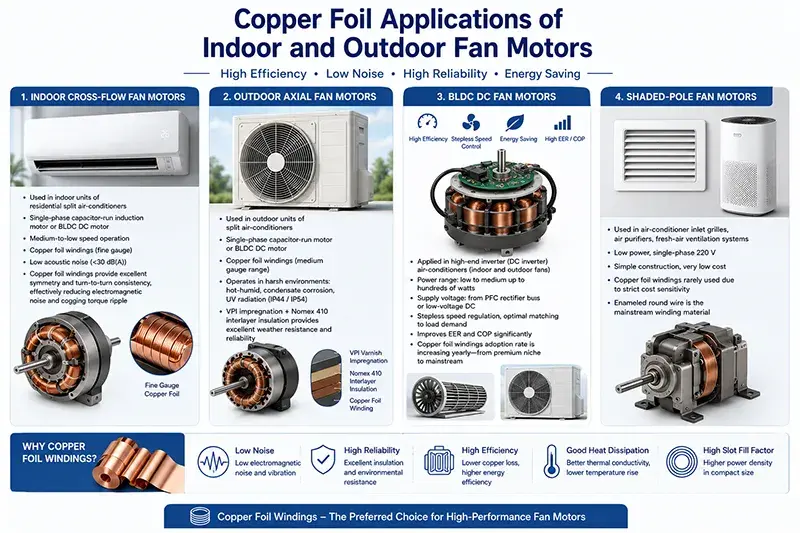
The cross-flow fan in the indoor unit of residential split air-conditioning systems is driven by either a single-phase capacitor-run induction motor or a BLDC DC motor, operating at medium-to-low rotational speeds. The copper foil windings employed are relatively fine in gauge. A core requirement for cross-flow fans is low acoustic noise (below 30 dB(A)); copper foil windings exhibit superior symmetry and turn-to-turn consistency compared to enameled round wire, significantly reducing electromagnetic noise—particularly cogging torque ripple.
Outdoor Axial Fan Motors
The axial fan in the outdoor unit is driven by either a single-phase capacitor-run motor or a BLDC DC motor. Copper foil windings used herein fall within an intermediate thickness range—between thin and medium gauges. Outdoor units operate under harsh environmental conditions, including humid–hot climates (IP44 / IP54 ingress protection), condensate corrosion, and ultraviolet (UV) radiation aging. The VPI (vacuum pressure impregnation) varnish impregnation process applied to copper foil windings, combined with interlayer insulation using Nomex 410, provides an additional weather-resistant barrier.
BLDC DC Fan Motors
In high-end inverter-driven air-conditioning systems (DC inverter), both indoor and outdoor fans have been upgraded to BLDC DC motors, achieving substantial efficiency gains. Power ratings extend from low-to-medium power levels up to the hundred-watt range, with supply voltages derived either from the PFC rectifier bus or from low-voltage DC sources. BLDC fan motors enable stepless speed regulation, allowing optimal matching to air-conditioning load demands and thereby maximizing energy efficiency ratio (EER) and coefficient of performance (COP). The adoption rate of copper foil windings in BLDC fan motors has increased annually, transitioning from an early niche, premium option to mainstream application.
Shaded-Pole Fan Motors
Shaded-pole induction motors continue to be employed in residential air-conditioning inlet grilles, air purifiers, and fresh-air ventilation systems. These motors feature low power output, single-phase 220 V operation, simple construction, and extremely low cost. Copper foil windings are rarely used in this motor type due to stringent cost sensitivity; enameled round wire remains the predominant winding material.
Other HVAC Household Appliance Motor Applications
Heat Pump Water Heater Circulating Pump Motors
Heat pump water heater circulating pump motors span from low-to-medium power up to medium power. These motors operate under elevated ambient temperatures corresponding to high water temperatures, imposing stringent requirements on winding thermal class (Class F / Class H).
Air Purifier and Fresh Air System Motors
Fan motors for air purifiers and fresh air systems range from low-to-medium power up to medium power, with broad rotational speed ranges. Such motors emphasize low-noise operation (e.g., bedroom environments), where the electromagnetic symmetry advantage of copper foil windings is particularly pronounced.
Central Air Conditioning AHU Fan Motors
Air handling unit (AHU) supply and return fan motors for central air conditioning systems range from medium power up to high power, operating at relatively low speeds. These motors are predominantly three-phase induction asynchronous motors or permanent magnet synchronous motors, requiring high energy efficiency (IE4 / IE5) and extended service life (design life exceeding 20 years).
Automotive HVAC Blower Motors
Automotive HVAC blower motors—including evaporator fans and condenser fans—operate across DC voltage ratings of 12 V DC, 24 V DC, and 48 V DC (for next-generation electric vehicles). These motors face comprehensive environmental challenges, including wide operating temperature ranges, vibration, and mechanical shock; the environmental robustness advantage of copper foil windings is thus highly evident.
Manufacturing Process and Quality Control
Slitting–Chamfering–Deburring
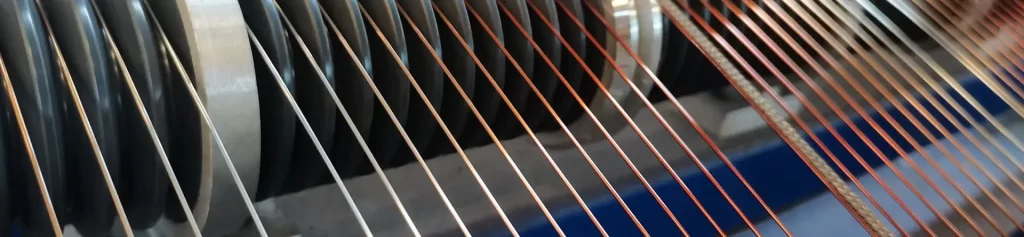
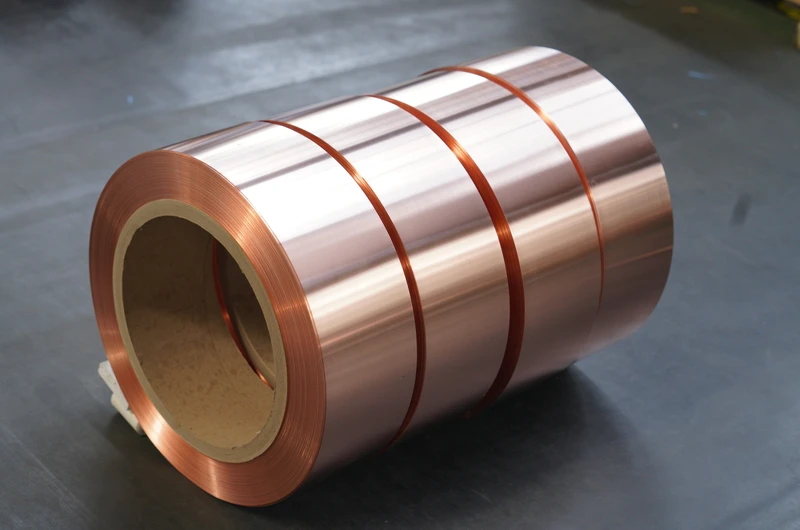
The first process step for copper foil windings is precision slitting, wherein large copper foil rolls are slit into finished-width strips. Slitting accuracy is classified into precision grade and standard grade. Following slitting, chamfering is performed to eliminate sharp edges and prevent insulation film damage during winding formation. Deburring is accomplished either via abrasive belts or electrochemical polishing, ensuring end-face surface roughness complies with process specifications.
Flat Winding / Edge Winding Formation
Flat winding bends the copper foil along its wide edge into a helical configuration and is suitable for disc-type motors with constrained axial dimensions. Edge winding bends the copper foil along its narrow edge into a helical configuration and constitutes the standard process for cylindrical compressor motors. The winding equipment must incorporate servo-controlled tension regulation; both bend radius accuracy and turn pitch accuracy must be rigorously controlled. Post-formation stress-relief annealing is required to restore ductility and electrical conductivity.
Interlayer Insulation and End-Winding Bracing
Interlayer insulation employs Nomex 410 or DMD (Dacron–Mylar–Dacron) composite paper, applied either by mechanical insertion or automated wrapping. End-winding bracing utilizes polyester binding tapes or epoxy binding wires, with moderate binding force to ensure that windings remain immobile under short-circuit electromagnetic forces and mechanical vibration.
Vacuum Pressure Impregnation (VPI)
The VPI process sequence comprises: ① pre-heating of windings to remove moisture; ② vacuum degassing; ③ immersion in insulating varnish (epoxy resin / modified polyester / polyester-imide); ④ pressure-assisted impregnation; ⑤ varnish recovery and drip-drain; ⑥ bake curing. A complete VPI cycle typically requires half a day to one day and may be repeated multiple times to enhance insulation film thickness and void-fill ratio.
End-Ring Welding and End-Connection
End-ring connections for three-phase induction motors or BLDC motors employ tungsten inert gas (TIG) welding, projection resistance welding, fiber laser welding, or cold pressure welding. TIG welding is most widely applied; fiber laser welding is suitable for fine-gauge copper foils and features a minimal heat-affected zone; cold pressure welding eliminates thermal input entirely and thereby prevents thickening of aluminum–copper intermetallic compounds (IMCs), making it the preferred method for high-reliability joints.
Quality Inspection and Dynamic Balancing
Quality inspection items for copper foil windings include: ① dielectric withstand voltage (Hi-pot) test; ② inter-turn insulation surge test; ③ DC resistance measurement (three-phase balance); ④ dynamic balancing (G2.5 / G6.3 grade); ⑤ temperature-rise test; ⑥ vibration test (IEC 60068-2-6); ⑦ shock test (IEC 60068-2-27); ⑧ noise measurement.
Failure Modes and Reliability Assessment
Insulation Breakdown and Enamel Pinholes
Insulation breakdown is the primary failure mode of air-conditioning motors. Enamel pinholes are a typical defect in enameled copper foil—microscopic pores resulting from enamel scratching during slitting, chamfering, or forming, or from non-uniform enamel coating. Under high voltage, these pinholes initiate partial discharge (PD). Pinhole density must be controlled to an extremely low level, and windings must undergo AC or DC dielectric withstand screening prior to assembly. Vacuum Pressure Impregnation (VPI) impregnation effectively fills enamel pinholes and is critical for reducing early-life failures.
End-Winding Fatigue and Copper Foil Fracture
Winding end-turns experience bending fatigue under start-stop cycling and vibratory shock. Air-conditioning compressor motors undergo several start-stop cycles per day (more frequently under variable-frequency drive conditions), accumulating tens of thousands of cycles over their service life. When the bending radius at the copper foil end-turn is excessively small, hard-temper copper foil begins to develop surface microcracks after several thousand cycles; annealed-temper copper foil, by contrast, withstands more than tens of thousands of cycles without fracture when subjected to larger bending radii.
Intermetallic Compound (IMC) Formation and Cracking at Weld Joints
Intermetallic compounds (IMCs)—such as Cu–Al, Cu₉Al₄, and Cu₃Al—form at Al–Cu dissimilar-metal weld joints under elevated temperature. These IMCs exhibit high brittleness and high electrical resistivity, constituting the principal root cause of joint failure. In air-conditioning motors, connections between copper foil windings and aluminum end-rings or aluminum lead wires require strict control of welding temperature and time. IMC-related risks are mitigated via copper–aluminum clad transition strips or ultrasonic welding (USW).
Thermal Aging and Insulation Lifetime
The VPI enamel film applied to copper foil windings (Class F / Class H) follows the Arrhenius model for high-temperature lifetime: lifetime halves with every 10 °C increase in temperature. When the winding hot-spot temperature of an air-conditioning motor is maintained within its design upper limit, achieving industrial-grade service life is attainable.
Short-Circuit Shock and Vibration Tolerance
Compressor start-stop events, short-circuit faults, and lightning surge currents induce electromagnetic forces in the windings that reach several times the rated current. The stress imposed on winding end-turns may instantaneously reach extremely high levels—far exceeding those experienced under steady-state operation. Copper foil windings possess superior mechanical strength compared to enameled round wire windings (whose conductor tensile strength is inherently limited). Consequently, pass rates in vibration endurance testing and shock testing are higher for copper foil windings than for enameled round wire windings.
Selection Engineering and Design Criteria
Power vs. Copper Foil Specification Matching
Household air-conditioning compressors employ thin-to-moderate thickness copper foil specifications; commercial central air-conditioning systems utilize thicker and wider specifications; chiller units for central air-conditioning systems require the thickest and widest specifications. Copper foil width is constrained by stator slot width; exceeding the slot width necessitates consideration of parallel double-layer copper foil winding.
Voltage vs. Insulation Thickness
Under operating voltages of 220 V AC single-phase or 380 V AC three-phase, insulation thickness is typically moderate. Higher voltage ratings require increased insulation thickness. High dv/dt transients associated with variable-frequency drive (VFD) operation demand insulation thickness design incorporating impulse withstand capability, with an appropriate safety margin reserved.
Energy Efficiency vs. Copper Foil Purity
IE3 efficiency motors may employ standard-grade copper foil; IE4 efficiency motors require high-purity-grade copper foil; IE5 premium-efficiency motors mandate oxygen-free high-conductivity (OFHC) grade copper foil. Each incremental increase in purity level incurs higher material cost but further reduces DC copper loss—this reduction is critical to achieving the IE5 efficiency target.
Safety Certification vs. Insulation System
Household air conditioners destined for the North American market must comply with UL 60335-1 / UL 60335-2-40; those for the European market must comply with IEC 60335-1 / IEC 60335-2-40; products for the Chinese market must comply with GB 4706.1 / GB 4706.32; commercial VRF and central air-conditioning systems must comply with IEC 60034-1 + IEC 60335-2-89. The insulation system shall satisfy safety requirements for Class F or Class H insulation.
Space Constraints vs. Copper Foil Geometric Design
Compact indoor units impose strict limitations on winding end-turn height; copper foil thickness and bending radius must therefore be rigorously controlled. Larger commercial units impose relaxed geometric constraints on copper foil, permitting use of thicker specifications. Design engineers must strike a compromise between power density and spatial constraints—multi-slot parallel winding or double-layer winding may be adopted where necessary.
Noise vs. Slot Fit and Winding Symmetry
Low-noise indoor units require strictly symmetric windings; cutting precision of copper foil and winding forming accuracy are critical parameters. Slot fit must ensure uniform air-gap distribution to prevent unilateral magnetic pull forces that induce vibration. Cogging torque ripple must be minimized to an extremely low level—achieved via skewed slots, skewed poles, or non-uniform air-gap configurations.
Cost vs. Performance Trade-off
Copper foil thickness selection directly impacts both copper loss and cost. Thicker copper foil yields lower resistance and lower copper loss, yet entails higher material cost. Design engineers must balance energy-efficiency targets against material cost: thinner specifications are selected when efficiency targets are modest; thicker specifications are selected when stringent efficiency targets apply.
Conclusions and Outlook
The application of copper foil windings in air conditioning motors is undergoing a gradual replacement of enameled round wire and enameled rectangular wire. Its core advantages include: high slot fill factor enabled by high space factor; short winding configuration resulting from significantly reduced end-winding height; and low copper loss and low hot-spot temperature enabled by exceptionally high electrical and thermal conductivity. The material system is dominated by C11000 ETP (Electrolytic Tough Pitch), with C12200 DHP (Deoxidized High Phosphorus) reserved specifically for welding applications, and high-end C10100 / C10200 OFHC (Oxygen-Free High Conductivity) designated as candidates for IE5 ultra-high-efficiency motors. Available specifications span thin-to-medium thickness × medium width ranges. Surface treatments encompass multiple pathways: bare foil + VPI (Vacuum Pressure Impregnation), pre-coated foil, epoxy coating, Nomex 410 composite, and OSP/BTA passivation.
In terms of application, copper foil windings exhibit the highest penetration rate in BLDC permanent-magnet synchronous compressor motors and variable-frequency three-phase induction motors. Penetration is steadily increasing in domestic cross-flow / outdoor axial fan motors and in AHU (Air Handling Unit) fans for commercial central air-conditioning systems. Emerging adoption is observed in automotive air-conditioning evaporator / condenser fans. Manufacturing processes are dominated by VPI impregnation, with pre-coated foil employed in premium configurations; joining methods include TIG welding, laser welding, and cold-pressure welding. Quality control covers all dimensions: slitting precision, dynamic balancing, dielectric withstand voltage, temperature rise, vibration and shock (IEC 60068-2-6, IEC 60068-2-27, IEC 60068-2-29), and acoustic noise.
Future development directions include:
① Further requirements on copper foil purity and cross-sectional area imposed by IE5 / IE6 ultra-high-efficiency targets;
② Higher demands on high-frequency impedance of copper foil and insulation impulse-withstand capability under variable-frequency drive (high-frequency PWM);
③ Stricter requirements on insulation systems and sealing processes arising from compatibility with environmentally friendly refrigerants (R290 / R744);
④ Deeper integration of winding temperature online monitoring (e.g., fiber Bragg grating sensors / thermistors) driven by smart air-conditioning systems (IoT / AI-based speed control);
⑤ The massive market scale—200 million units annually for residential air conditioners in China, plus 10 million units annually for commercial central air-conditioning systems and VRF (Variable Refrigerant Flow) systems—will continue to drive iterative advancement and widespread adoption of copper foil winding technology.
As the HVAC industry evolves toward higher energy efficiency, lower noise, extended service life, and green environmental performance, copper foil windings will become the core technical choice for air-conditioning motors and will transition from a niche premium solution to a mainstream standard configuration between 2025 and 2030.