

Why Selecting the Right Copper-Clad Aluminum (CCA) Wire Manufacturer Is a Critical Decision
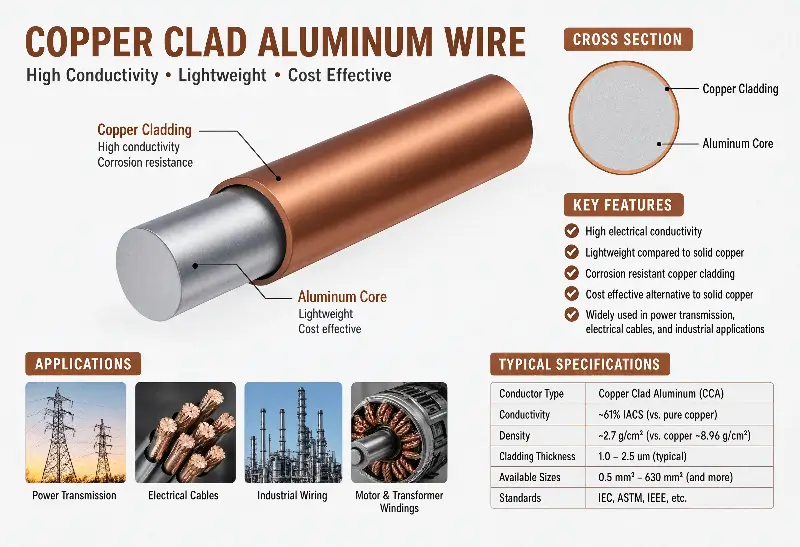
Copper-clad aluminum (CCA) wire is a bimetallic composite conductor consisting of an aluminum core with a concentric outer layer of oxygen-free copper. At the same weight, CCA wire achieves 2.45–2.7 times the length of pure copper wire—but exhibits a 40–50% increase in DC resistance. This trade-off—“lightweight advantage versus increased electrical loss”—defines CCA’s suitability for high-frequency, lightweight, and signal-transmission applications, while rendering it unsuitable for primary current-carrying or long-term high-current applications.
Why is manufacturer selection so critical? Because CCA wire is not a single-specification product. It involves multi-dimensional technical parameters—including ASTM B566 grade (Class 10A / 15A / 10H / 15H), copper volume fraction (10% / 15% / 27%), metallurgical bond strength, and enamel compatibility. A manufacturer unfamiliar with its own process capabilities may encounter systemic failures in high-frequency applications—such as copper–aluminum delamination, signal distortion, or enamel coating peeling.
We recently worked with a customer who reported degraded signal integrity and localized blistering of the enamel coating on their CCA wire at 5 MHz. Root-cause analysis revealed that the actual copper volume fraction was only 7%—well below the 10% minimum required by ASTM B566-04a(2011) for Class 10A. This was not a process failure; it stemmed from the supplier’s use of non-compliant raw materials.
Ultimately, the cost of selecting the wrong CCA manufacturer extends far beyond a few thousand dollars in unit price—it jeopardizes end-product reliability, leads to certification failures, and triggers costly warranty claims. Therefore, this article systematically evaluates CCA manufacturers across eight critical dimensions.
II. Verification of Standards Compliance and Certifications
Understanding ASTM B566 Standard Grades
ASTM B566-04a(2011) is the core specification for CCA wire, defining four grades:
- **Grade 10A**: 10% copper volume fraction, annealed condition—suitable for soft-winding applications and low-bend-radius scenarios
- **Grade 15A**: 15% copper volume fraction, annealed condition—the mainstream balanced solution
- **Grade 10H**: 10% copper volume fraction, hard-drawn condition—designed for applications requiring high tensile strength
- **Grade 15H**: 15% copper volume fraction, hard-drawn condition—optimized for high-frequency + high-strength applications
**Critical Note**: The “10%” and “15%” specified in the standard refer to **volume fraction**, *not* weight fraction. For 15% volume-fraction CCA, the copper cladding thickness typically ranges from **0.05–0.15 mm**, depending on wire diameter. If a supplier claims “30% copper content,” they are almost certainly quoting *weight fraction*—a misleading practice. Given copper density of **8.96 g/cm³** and aluminum density of **2.70 g/cm³**, a 30% weight fraction corresponds to only ~11% volume fraction—barely meeting the lower threshold of Grade 10A.
International Standards & Compatibility with Enamelled Wire
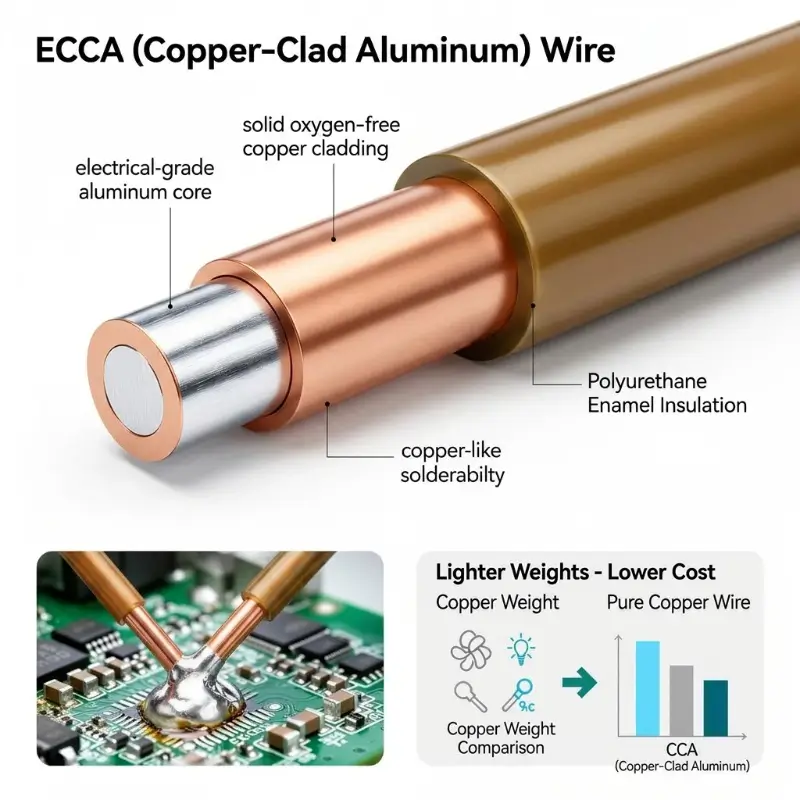
CCA wire is rarely shipped as bare conductor—overwhelmingly, it is supplied as enamelled CCA (ECCA). Confirm that the supplier complies *simultaneously* with:
- **IEC 60317-0-1**: General specifications for enamelled winding wires
- **IEC 60851-5**: Test methods for enamelled winding wires (electrical and mechanical)
- **NEMA MW 1000-C**: North American magnet wire standard
- **UL 1446**: Insulation systems (covering thermal classes **130°C / 155°C / 180°C / 200°C / 220°C**)
- **IEC 60085**: Electrical insulation—thermal evaluation and classification
Management System Certifications
- **ISO 9001**: Foundational quality management system requirement
- **ISO 14001**: Environmental management system (frequently mandated by European and North American customers)
- **IATF 16949**: Mandatory for automotive supply chain (essential for EV/HEV applications)
- **RoHS / REACH**: EU market access requirements
Suppliers lacking even **ISO 9001** certification should be disqualified outright.
III. Evaluation of Production Processes and Equipment Capabilities
Three Mainstream CCA Manufacturing Processes
| Process | Metallurgical Bonding Quality | Production Capacity | Typical Manufacturers |
|---|---|---|---|
| **Clad Welding** | Medium (primarily mechanical bonding) | High | Common among small- and medium-sized manufacturers |
| **Continuous Extrusion** | High (metallurgical bonding) | Medium–High | Dominant process adopted by leading manufacturers |
| **Hydrostatic Extrusion** | Highest (atomic-level diffusion) | Medium | Used for high-end/specialized applications |
Key distinctions among these processes:
- Clad welding offers low cost but risks discontinuous Cu–Al interdiffusion layers at the interface;
- Continuous extrusion achieves metallurgical bonding via high temperature and pressure, and is selected by 95% of top-tier manufacturers;
- Hydrostatic extrusion incurs the highest cost but delivers the most stable interface, primarily applied in defense, aerospace, and medical sectors.
Production Capacity and Equipment Scale
CCA wire manufacturing is a capital-intensive industry—a single continuous extrusion production line requires an investment of approximately RMB 20–50 million. For manufacturers with annual capacity below 1,000 tons, due diligence is strongly advised:
- **Equipment Investment**: Number of continuous extruders (≥3 units indicates scale production);
- **In-line Inspection**: Whether online resistance testing and online diameter measurement systems are standard equipment;
- **Automation Level**: Whether SPC (Statistical Process Control) systems are fully deployed and operational;
- **Enameling Capability**: Whether the manufacturer operates its own magnet wire enameling facility, or relies on external suppliers for enameling prior to CCA compounding.
Consistency Control
Batch-to-batch consistency remains the most persistent challenge in CCA wire production. Request the supplier’s SPC data from the past six months—specifically: diameter range (max–min), resistance range (max–min), and Cpk values for tensile strength. If the supplier cannot provide this data, that alone signals a significant quality control concern.
IV. Evaluate Product Line Breadth and Customization Capabilities
Standard Wire Gauge Coverage
Mainstream CCA wire gauges span from AWG 6 (13.3 mm²) to AWG 46 (0.0127 mm²). Verify whether the supplier covers your target gauge range:
- High-power applications: AWG 6–14 (13–2 mm²)
- General-purpose motors/transformers: AWG 18–30 (0.8–0.05 mm²)
- High-frequency inductors/precision coils: AWG 32–46 (0.03–0.012 mm²)
ECCA Enamel Types
Enamelled CCA wire is *not* simply “coated with any enamel.” Enamel selection must strictly comply with IEC 60317 series standards:
- **UEW (QA)**: Polyurethane, 130°C rating, excellent solderability
- **PEW (QZ)**: Polyester, 155°C rating, general-purpose
- **EIW (QZXY)**: Polyester-imide, 180°C rating
- **AIW (QZY)**: Polyamide-imide, 220°C rating, high-temperature grade
If your application operates above 180°C, the supplier must demonstrate proven, mature expertise in AIW enamel processing.
Customization Capabilities
Customization is the key differentiator for CCA wire. Assess the supplier’s capabilities in:
- Special copper-to-aluminum volume ratios (e.g., high-conductivity variants with 27% Cu volume fraction)
- Self-bonding ECCA (thermally fusable adhesive layer enabling coil self-fixation after winding)
- Dual-layer or multi-layer enamel structures
- Non-circular cross-sections (e.g., rectangular or tape-shaped CCA)
V. Quality Control and Testing Capabilities
ASTM B566 Mandatory Inspection Items
CCA wire must pass the following standardized tests prior to shipment:
- **Diameter and Roundness**: Measured continuously using a laser micrometer
- **DC Resistance**: Measured via four-wire method or bridge, temperature-corrected to 20°C per standard
- **Density Test**: Performed using the Archimedes principle to verify Cu/Al ratio
- **Tensile Strength**: Tested using a universal material testing machine
- **Elongation**: Percentage elongation at break
- **Copper Layer Bond Strength**: 180° bend + peel test
- **Enamel Film Continuity**: ASTM B566 does not cover enamel film; however, ECCA must pass the pinhole test per IEC 60851-5 (≤5 pinholes per 30 m, specified for given enamel thickness)
Traceable Test Reports
Each CCA batch must be accompanied by a comprehensive test report containing:
- **Batch number + Production date + Raw material batch number**
- **Actual measured values for all test items + Corresponding specification limits**
- **Test equipment ID numbers + Calibration dates**
- **Signature of QC engineer**
If a supplier provides only a “Certificate of Conformance” without full test data—this is a red flag.
Failure Analysis Capability
Premium CCA manufacturers should maintain an in-house failure analysis laboratory equipped with:
- Metallographic microscope (for cross-sectional Cu/Al distribution analysis)
- SEM (Scanning Electron Microscope) for interfacial diffusion layer analysis
- EDS (Energy-Dispersive Spectroscopy) analyzer for elemental composition analysis
VI. Supply Chain Stability and Logistics Capability
Raw Material Supply Chain
The core raw materials for CCA wire are electrolytic copper (Grade 1 Cathode Copper Cu-CATH-1) and aluminum ingots (A00 aluminum). Fluctuations in raw material prices constitute the primary variable affecting CCA wire pricing. Key evaluation criteria include:
- **Raw Material Inventory Strategy**: Maintenance of a three-month safety stock
- **Raw Material Sourcing**: Copper sourced from industry leaders such as Jiangxi Copper and Tongling Nonferrous; aluminum sourced from top-tier suppliers including Weiqiao Group and Chalco
- **Futures Hedging**: Implementation of hedging mechanisms (e.g., futures contracts) to mitigate price volatility risk in raw material procurement
MOQ and Lead Time
Minimum Order Quantities (MOQs) vary significantly across manufacturers:
- **Large-Scale Custom Production**: MOQ typically ranges from 500 kg to 1,000 kg
- **Small-Scale Spot Supply**: MOQ as low as 50 kg, though with limited specification availability
Lead times: 2–3 weeks for standard specifications; 4–6 weeks for custom specifications. Geographic location also impacts logistics—manufacturers in Jiangsu, Zhejiang, and Guangdong generally require 18–25 days by sea to North America and 22–30 days to Europe.
Customs and Certification Support
Manufacturers exporting to Europe and the U.S. must provide the following documentation:
- **Certificate of Origin (C/O)**
- **FORM E / FORM A** (preferential certificates under China–ASEAN and China–Pakistan Free Trade Agreements)
- **Third-Party Test Reports** (SGS / BV / TÜV)
- **REACH / RoHS Compliance Test Reports**
VII. Technical Support & After-Sales Service
Sample Response Time
A qualified CCA wire manufacturer should be able to supply samples—including custom specifications—within 3–7 days, and deliver complete test reports within 2 weeks. If sample delivery requires more than 4 weeks, the manufacturer may face capacity constraints or technical responsiveness bottlenecks.
Application Engineering Support
CCA wire performance within end systems involves:
- Winding process parameters (tension, speed, take-up)
- Termination methods (soldering, silver brazing, crimping, wrapping)
- Compatibility between enamel coating and impregnating resins
- High-frequency characteristics (skin effect, proximity effect)
The presence of dedicated application engineers—and their ability to provide on-site support—is a critical evaluation criterion.
Failure Analysis Support
When CCA-related failures occur in your products, can the supplier:
- Initiate Root Cause Analysis (RCA) within 48 hours
- Deliver comprehensive test reports
- Provide actionable process improvement recommendations
This “technical safety net” capability represents the buyer’s most critical risk mitigation safeguard.
VIII. Commercial Terms & Total Cost of Ownership (TCO)
Unit Price vs. TCO
Do not compare unit prices alone. The Total Cost of Ownership (TCO) for CCA wire includes:
- **Unit Price**: Price per kilogram or per kilometer
- **Certification Costs**: Whether the supplier can share costs for special certifications
- **Quality Costs**: Batch defect rate, return rate
- **Logistics Costs**: Varying terms—FOB / CIF / DDP
- **Inventory Costs**: High MOQ ties up working capital
A supplier quoting USD 9.5/kg with a 5% defect rate may be more expensive than one quoting USD 10.0/kg with only a 0.5% defect rate.
Payment Terms
Standard options:
- **T/T 30/70**: 30% advance deposit, 70% against copy of Bill of Lading (most common)
- **L/C at Sight**: Irrevocable sight letter of credit (common for large orders)
- **O/A 30/60/90**: Net 30/60/90 days (offered to long-term cooperative customers)
- **D/P at Sight**: Documents against Payment (typically for first-time cooperation)
Value of Long-Term Partnership
If your annual CCA consumption exceeds 10 metric tons, establishing a long-term partnership is strongly recommended:
- Annual Framework Agreement
- Price Lock for 3–6 months
- Priority Supply allocation
- Joint Development initiatives
IX. Practical Inspection Checklist & Selection Workflow
Red-Line Criteria (Mandatory Verification)
- ISO 9001 certification (copy + certificate number)
- Third-party ASTM B566-04a(2011) test report (issued within the last 6 months)
- Minimum 3 years of proven CCA wire manufacturing experience
- Annual production capacity ≥1,000 tons
- In-house enameled wire coating process (full ECCA process control)
- Comprehensive batch-level test reporting system
Yellow-Line Criteria (Recommended Verification)
- ISO 14001 environmental management certification
- IATF 16949 certification (mandatory for automotive applications)
- ≥5 reference cases from Tier-1 customers
- Dedicated application engineering team of ≥3 FTEs
- Real-time SPC data sharing capability
Green-Line Criteria (Value-Add Differentiators)
- Hydrostatic extrusion process capability
- In-house metallography / SEM failure analysis laboratory
- Raw material futures hedging mechanism
- Global logistics infrastructure (e.g., North America / Europe warehouses)
Key Elements of RFP Quotation Template
When issuing an RFP, include the following:
- **Target Application** (e.g., BLDC motor / high-frequency transformer / 5G communications)
- **Technical Specifications** (wire diameter range / copper volume fraction / enamel type / thermal class)
- **Estimated Annual Volume**
- **Target Unit Price Range** (optional)
- **Certification Requirements** (UL 1446 / IATF 16949 / REACH / RoHS)
- **Preferred Payment Terms**
- **Initial Sample Requirements**
Upon receiving quotations, conduct a cross-vendor comparison across these five non-negotiable dimensions: unit price, MOQ, lead time, sample policy, payment terms, and technical support capability.
Final Decision-Making Recommendations
In practice, follow these three recommendations:
**First: Samples Before Orders.** Regardless of how polished a supplier’s presentation materials appear, any samplewithout your own process validation is speculative. Request samples simultaneously from 3–5 qualified suppliers and conduct small-batch pilot runs on your actual production line.
**Second: Small Orders Before Large Orders.** For initial collaboration, place a trial order of 100–500 kg to verify quality consistency before scaling up. We have observed numerous cases where customers placed a first order of 5 tons—only to encounter an 8% defect rate. Such risks are avoidable.
**Third: Technical Dialogue Before Contract Signing.** Pose technical questions to potential suppliers and assess their responsiveness and depth of expertise. A supplier failing to respond within 24 hours raises serious concerns about its technical backup capability.
Ultimately, CCA wire is a highly process-sensitive product. Selecting a supplier is equivalent to selecting a long-term partner—its process maturity, technical response speed, and quality control rigor will directly impact your product reliability over the next 3–5 years. A 5% lower unit price may seem attractive upfront, but a single quality incident could cost you 50% of your gross margin.
Share this article with colleagues currently evaluating CCA wire suppliers—the above evaluation criteria will help you avoid most common pitfalls.