


A Power Battery is the “heart” of an EV — it is indispensable in four scenarios: BEV, PHEV, HEV, and commercial vehicles. The mainstream copper foil usage per EV is 10–30 kg (cell tab + module + Pack output), which is the current mainstream consumption. The 800V high-voltage architecture + 4C–6C ultra-fast charging impose more stringent requirements on copper foil for high current density, low resistance, and vibration resistance. Copper foil plays five major roles in power batteries: single tab, multi-layer tab, Cu-Al transition (copper-aluminum transition), signal tab, and Pack output copper bar. Copper conductivity is ≥100% IACS (vs. aluminum at only 61%), contact resistance is ≤0.05 mΩ, easy to weld, and vibration resistance ≥5G — these are the core reasons copper foil is the preferred material for power battery tabs. Below, we clarify the specifications of copper foil for power battery tabs based on the latest 2025–2026 market data.
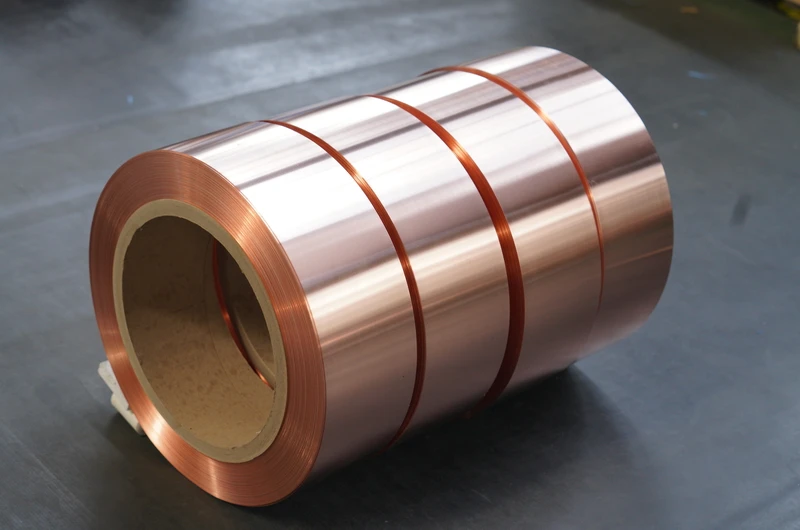
I. Four Mainstream Types of Power Batteries
- **BEV (Battery EV, 50–100 kWh)** — Single vehicle 50–100 kWh, copper foil per vehicle 15–30 kg, emphasizing 800V high-voltage architecture, 4C–6C ultra-fast charging, and 500+ km range. Representatives: Tesla Model Y / BYD Han EV / Hyundai IONIQ 5.
- **PHEV (Plug-in Hybrid, 15–30 kWh)** — Single vehicle 15–30 kWh, copper foil per vehicle 5–10 kg, emphasizing dual-power switching, 50–100 km pure electric range, and home slow charging. Representatives: BYD DM-i / Li Auto L7.
- **HEV (Hybrid EV, 1–5 kWh)** — Single vehicle 1–5 kWh, copper foil per vehicle 1–3 kg, emphasizing frequent start-stop, energy recovery, and 10+ year battery life. Representatives: Toyota THS / Honda i-MMD.
- **E-Bus / E-Truck Commercial Vehicles (100–500 kWh)** — Single vehicle 100–500 kWh, copper foil per vehicle 50–150 kg, emphasizing long cycle life (>5000 cycles), high energy density (160+ Wh/kg), and CCS2 fast charging. Representatives: BYD K9 / Yutong U12 / Tesla Semi.
Impact on copper foil: BEV + E-Bus emphasize 0.2–0.5 mm thick multi-layer Tab + Cu-Al transition + Pack output copper bar; PHEV emphasizes 0.1–0.3 mm thin tab; HEV emphasizes high-frequency cycle life + low cost.
II. Four Mainstream Cell Form Factors
- **Prismatic Aluminum Case** — The mainstream cell form (CATL Qilin + BYD Blade), single cell 50–300 Ah, cell tab on top (aluminum tab + copper tab), laser welding + Cu-Al transition.
- **Cylindrical Steel Case (21700/4680)** — Tesla mainstay, 21700 single cell 4.5–5.0 Ah, 4680 single cell 26–32 Ah, full-tab design (no main tab) + current collector disc.
- **Large Cylindrical (4680/46105)** — The next-generation mainstream, 4680 = 46 mm × 80 mm, full-tab (Tabless) reduces resistance by 5× and boosts charging speed by 5×.
- **Pouch Cell** — The early mainstream of LG + Sony + AESC, single cell 20–100 Ah, thin cell tab (0.1–0.3 mm) + aluminum laminate film packaging.
III. Five Major Applications of Copper Foil in Power Batteries
- **Single Tab** — Mainstream for pouch + cylindrical cells, thickness 0.1–0.3 mm × width 5–15 mm, alloy C11000 / C10100, with nickel plating (anti-oxidation + anti-galvanic corrosion).
- **Multi-Layer Tab** — Mainstream for large cylindrical + prismatic cells, thickness 0.2 mm × N layers (2–4 layers), alloy C11000 / C10100, nickel or tin plating, current carrying 200–800 A.
- **Cu-Al Transition (Copper-Aluminum Transition)** — The core of prismatic aluminum case cells, copper tab + aluminum busbar transition, with ultrasonic welding or friction stir welding (FSW), contact resistance ≤0.05 mΩ.
- **Signal Tab** — For BMS signal acquisition (voltage + temperature), thickness 0.1–0.2 mm, alloy C11000 / pure nickel, with nickel plating; stable signal impedance + anti-interference.
- **Pack Output Copper Bar** — From module to Pack external output, thickness 1.0–3.0 mm × width 20–60 mm, alloy C11000 / T2 copper, nickel or tin plating, current carrying 300–600 A.
- **Tabless 4680 Large Cylindrical** — Tesla innovation — current collector disc + no main tab design, reducing resistance by 5× and boosting charging speed by 5×.
IV. Key Specifications and Typical Values
| Category | Thickness (mm) | Alloy | Surface Treatment | Typical Application | Key Indicator |
|---|---|---|---|---|---|
| Multi-Layer Tab | 0.2 × N layers | C11000 / C10100 | Nickel / Tin Plating | Large Cyl./Prismatic | Current 200–800 A |
| Cu-Al Transition | 0.2–0.5 | C11000 + 1060 | Nickel Plating + USW | Prismatic Al Case | Contact Resistance ≤ 0.05 mΩ |
| Signal Tab | 0.1–0.2 | C11000 / Ni | Nickel Plating | BMS Signal | Stable Impedance |
| Pack Output Copper Bar | 1.0–3.0 | C11000 / T2 | Nickel / Tin Plating | Pack External | Current 300–600 A |
| Tabless 4680 | 0.3–0.5 | C10100 / C11000 | Nickel Plating | Tesla 4680 | Tabless / Low Resistance |
Key figures: C11000 ETP (Cu ≥ 99.9%) is the mainstream alloy for power battery tabs; 0.1–0.3 mm thick single Tab is mainstream for pouch/cylindrical cells; 0.2 mm × N layers laminated Tab is mainstream for large cylindrical/prismatic cells; nickel plating is the key for corrosion protection. ASTM B566 (international standard for battery tab copper foil), UL 2580 (EV battery safety), IEC 62660 (power battery performance testing), GB/T 31438 / GB 38031 (Chinese power battery safety), GB/T 5231 (wrought copper and copper alloy), and GB/T 3190 (aluminum and aluminum alloy) are the main reference standards.
V. Market Size and Growth
Comparing four independent data sources side by side:
| Data Source | 2024–2025 (USD Billion) | 2030–2034 (USD Billion) | CAGR |
|---|---|---|---|
| Business Research Insights (Lithium Battery Copper Foil, Total) | 2024 = 10.07 → 2025 = 12.02 | 2033 = 49.65 | 19.4% |
| Dataintelo (Ultra-Thin EV Copper Foil) | 2024 = 1.82 | — | — |
| Dataintelo (Electrodeposited LiB Copper Foil) | 2025 = 7.28 | 2034 = 21.01 | 12.5% |
Taken together, the global power battery copper foil market in 2024–2025 ranged from USD 1.5 to 12.02 billion (large differences in scope), growing to USD 4.8–49.65 billion by 2030–2034, with a CAGR of 11.5%–19.4% (all four institutions show high prosperity). The VMR mainstream scope (EV LiB copper foil): USD 1.50 → 4.80 billion (CAGR 11.5%); the BRI total scope (lithium battery copper foil): USD 10.07 → 49.65 billion (CAGR 19.4%) — the latter includes tab + current collector + module connection.
Note: This article focuses on cell Tab copper foil (0.1–0.5 mm thick), not 6–9 μm current collector ultra-thin copper foil. Tab copper foil demand estimation: approximately 10–30 kg per EV, global 17 million EVs (2024 sales) × 15 kg average = 2.55 million tons per year of tab copper foil, corresponding to a market size of USD 1.5–3.0 billion (C11000 average price USD 60–120/kg). Pack output copper bar is calculated separately.
VI. Competitive Landscape and Applications
- **CATL (China)**: Qilin Battery / Shenxing Ultra-Charging — the world’s No.1 power battery, 43% market share (2024).
- **BYD (China)**: Blade Battery / Flash-Charging Blade — LFP leader, 17% market share (2024), full industry chain vertical integration.
- **LG Energy Solution (Korea)**: Korea’s No.1, 11% market share (2024), pouch cell leader (VW / Ford / GM).
- **SK On (Korea)**: Korea’s No.2, 5% market share (2024), pouch + prismatic dual lines.
- **Samsung SDI (Korea)**: Korea’s No.3, 4% market share (2024), prismatic aluminum case + 21700 cylindrical.
- **Panasonic (Japan)**: Tesla’s main supplier, 4% market share (2024), 21700 cylindrical + 4680 trial production.
- **EVE Energy (China)**: Large cylindrical + energy storage, 3% market share (2024), BMW / Daimler customers.
- **CALB (China)**: Third-tier leader, 3% market share (2024), GAC / XPeng / Changan customers.
VII. Procurement Notes
1. **Identify the copper grade clearly**: C11000 ETP (Cu ≥ 99.9%) is the mainstream for power battery tabs; C10100 is used for 4680 / high-end cells (4N high-purity copper).
2. **Thickness tolerance**: Single tab 0.1–0.3 mm, tolerance ≤ ±0.005 mm (5 μm); laminated tab 0.2 mm × N layers, single-layer tolerance ≤ ±0.01 mm.
3. **Surface treatment**: Nickel plating 1–3 μm is the standard for battery cell tabs (anti-oxidation + anti-galvanic corrosion); tin plating 3–5 μm is for large cylindrical cells; gold plating is for high-end signal tabs.
4. **Current carrying and resistance**: Single-point contact resistance ≤ 0.1 mΩ (battery tab); current carrying 200–800 A (laminated tab); Pack output copper bar 300–600 A.
5. **Mechanical properties**: Tensile ≥ 200 MPa (C11000-O), yield ≥ 70 MPa, elongation ≥ 35%; vibration resistance ≥ 5G (automotive-grade).
6. **Weldability**: Laser welding + ultrasonic welding are mainstream; contact area ≥ 80% welding area; shear strength ≥ 30 MPa.
7. **Inspection items**: Thickness tolerance, resistivity (≤ 1.72 × 10⁻⁸ Ω·m), tensile strength, elongation, plating adhesion (≥ 3.4 N), salt spray test (≥ 96h), flame retardant (UL94 V-0), thermal cycling (-40°C ~ 85°C, 500 cycles), RoHS 6 items.
8. **Certifications and compliance**: ASTM B566 (international standard for battery tab copper foil); UL 2580 (EV battery safety); IEC 62660 (power battery performance); GB/T 31438 / GB 38031 (Chinese power battery); IATF 16949 (automotive quality management); RoHS / REACH (environmental).
Final Thoughts
When selecting copper foil for power battery tabs, the key is to remember “five major roles + 800V high voltage + large cylindrical 4680” — these are the biggest differences from portable energy storage + solenoid valve copper foil. The global power battery copper foil market will reach USD 4.8–49.65 billion by 2030–2034, with a CAGR of 11.5%–19.4%. For copper foil suppliers, each EV uses 10–30 kg of copper foil, and the global 17 million EVs sold correspond to 170,000–510,000 tons per year of tab copper foil demand, a USD 2.5–3.0 billion market, which is an automotive-grade, high-customization, long-cycle B2B track.
If you are evaluating power battery tab copper foil suppliers (single Tab / multi-layer Tab / Cu-Al transition / signal tab / Pack output copper bar / 4680 tabless), please contact Zhengzhou LP Industry Co., Ltd. Email: office@cnlpzz.com, WhatsApp: 0086-19337889070. We offer full-alloy copper foil (C11000 / C10100 / T2) + full-process surface treatment (nickel / tin / gold plating), with tab contact resistance ≤ 0.05 mΩ, current carrying 200–800 A, and vibration resistance ≥ 5G. Customized specifications and OEM processing are supported. ASTM B566 / UL 2580 / IEC 62660 / GB 38031 / IATF 16949 compliance support is available.