


A Portable Power Station (PPS) is the “walking battery warehouse” — it is indispensable in four scenarios: outdoor camping, emergency backup, vanlife/RV, and professional operation. The mainstream setup is 500 W–3,500 W + 0.5–10 kWh LiFePO4 per unit. At its core, it relies on DC-AC bidirectional conversion + high-power output + multi-interface fast charging. Copper foil plays five major roles in portable power stations: battery cell tab, BMS busbar, inverter busbar, DBC power substrate, and USB Type-C busbar. Copper conductivity is ≥100% IACS (vs. aluminum at only 61%), it has excellent ductility, easy welding, and UL94 V-0 flame-retardant rating — these are the core reasons copper foil is the preferred material for portable power supplies. Below, we clarify the specifications of copper foil for portable power stations based on the latest 2025–2026 market data.
I. Four Mainstream Types of Portable Power Stations
- **Outdoor Camping (500 W–2 kWh)** — Single unit 500 W–1 kW + 0.5–1 kWh, copper foil per unit 0.2–0.8 kg, emphasizing lightweight design (1–7 kg), Type-C PD 100W, and multi-interface (AC + DC + USB-A + Type-C). Representatives: Jackery Explorer 1000, EcoFlow RIVER 2 Pro, DJI Power 500.
- **Emergency Backup (1–3 kWh)** — Single unit 1–2 kW + 1–3 kWh, copper foil per unit 0.5–2 kg, emphasizing UPS switchover, AC pure sine wave, and medical-grade safety (UL 2743). Representatives: Jackery Explorer 1500, EcoFlow DELTA 2, Bluetti EB70.
- **Vanlife/RV (500 W–1 kWh)** — Single unit 500 W–1 kW + 0.5–1 kWh, copper foil per unit 0.3–1 kg, emphasizing shock resistance, automotive-grade quality, and V2L reverse discharge compatibility. Representatives: Jackery Explorer 500, EcoFlow RIVER 2, Anker 521.
- **Professional Operation (3–10 kWh)** — Single unit 2–3.5 kW + 3–10 kWh, copper foil per unit 2–6 kg, emphasizing high-power AC output, multiple AC sockets, UPS dual-mode, and low-temperature tolerance -10°C. Representatives: EcoFlow DELTA Pro, Bluetti AC200MAX, Goal Zero Yeti 3000X.
Impact on copper foil: Professional operation requires 2.0–3.0 mm thick inverter busbar (3000W+ output); emergency backup emphasizes 0.5–1.0 mm thick busbar (1500–2000W); outdoor camping + vanlife emphasizes flexible copper foil lamination (0.1–0.3 mm × N layers, shock absorption + buffering).
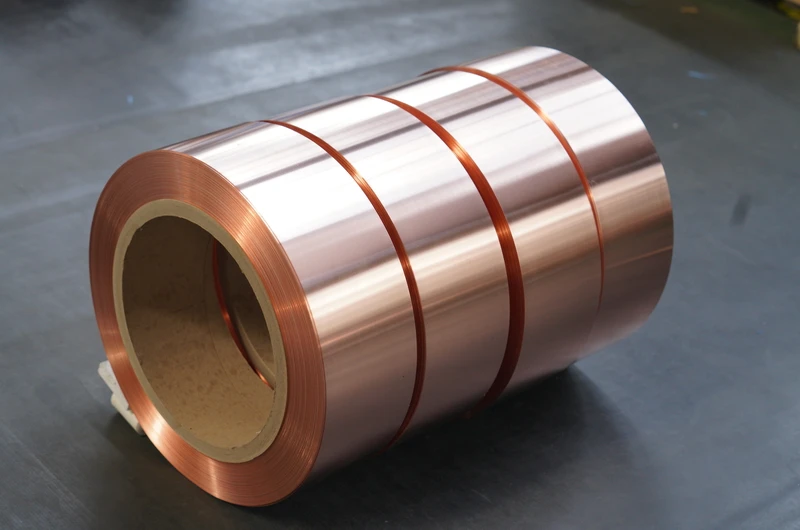
II. Five Major Applications of Copper Foil in Portable Power Stations
- **Battery Cell Tab** — Connection of pouch/cylindrical/prismatic cells, thickness 0.1–0.5 mm × width 5–20 mm, alloy C11000 / C10100, with nickel or tin plating (anti-oxidation + anti-galvanic corrosion). Representatives: EVE battery, CATL LiFePO4.
- **BMS Internal PCB Busbar** — Protection board + current distribution, thickness 0.1–0.3 mm × width 2–10 mm, alloy C11000 electrolytic copper foil, OSP / ENIG surface treatment (PCB standard).
- **Inverter Copper Busbar** — DC-AC conversion core, thickness 0.5–3.0 mm × width 10–50 mm, alloy C11000 / T2 copper, nickel or tin plating, current carrying 100–300 A, pure sine wave output. Representatives: Automotive-grade IGBT modules.
- **DBC Power Substrate (Direct Bonded Copper)** — Ceramic substrate with bonded copper, thickness 0.2–0.6 mm, alloy OFC / C10100 (oxygen-free copper / 4N), ceramic bonding (Al₂O₃ / AlN), for IGBT / MOSFET packaging. Representatives: Tesla, Sungrow inverter solutions.
- **USB Type-C Busbar** — PD 100W fast-charging interface, thickness 0.1–0.3 mm × width 1–5 mm, gold or nickel plating, current carrying 5A (20V). Representatives: Anker, Bluetti PD interface.
- **Flexible Connecting Copper Foil** — Multi-layer copper foil lamination (0.1 mm × N layers) + PVC dip insulation, shock absorption / buffering / vibration resistance, suitable for vanlife + outdoor scenarios. Representatives: LiFePO4 280Ah flexible connection solution.
III. Key Specifications and Typical Values
| Category | Thickness (mm) | Alloy | Surface Treatment | Typical Application | Key Indicator |
|---|---|---|---|---|---|
| BMS PCB Busbar | 0.1–0.3 | C11000 (Electrolytic) | OSP / ENIG | BMS Internal | 1–2 oz Copper |
| Inverter Copper Busbar | 0.5–3.0 | C11000 / T2 | Nickel / Tin Plating | DC-AC Conversion | Current 100–300 A |
| DBC Power Substrate | 0.2–0.6 | OFC / C10100 | Ceramic Bonding | IGBT / MOSFET | Bond Strength ≥ 5 N/mm |
| USB Type-C Busbar | 0.1–0.3 | C11000 (Electrolytic) | Gold / Nickel Plating | PD 100W | Current 5A (20V) |
| Flexible Copper Foil | 0.1 × N layers | C11000 | PVC Dipping | Shock Absorption / Buffering | Vibration Resistance ≥ 5G |
Key figures: C11000 (Cu ≥ 99.9%) is the mainstream alloy for portable power stations (distinct from C10100 4N high-purity copper); thickness 0.5–3.0 mm is mainstream for inverter busbars (professional operation reaches 3.0 mm); flexible connections use 0.1 mm multi-layer lamination (for vanlife + outdoor vibration resistance); nickel / tin plating is critical for corrosion protection. GB/T 5231 (wrought copper and copper alloy grades and chemical composition), ASTM B152 (copper sheet/strip/bar), UL 2743 (portable power station safety standard), and IEC 62619 (industrial lithium battery) are the main reference standards.
IV. Market Size and Growth
Comparing four independent data sources side by side:
| Data Source | 2024–2025 (USD Billion) | 2030–2035 (USD Billion) | CAGR |
|---|---|---|---|
| Insightace Analytic (Global PPS) | 2025 = 0.808 | 2035 = 1.896 | 9.1% |
| Statifacts (US PPS) | 2024 = 2.014 | 2034 = 3.041 | ~4.2% |
| Grand View Research (Global PPS) | 2025 Li-ion 87.6% / Emergency 48.6% | — | — |
Taken together, the global PPS market in 2024–2025 ranged from USD 0.66 to 2.014 billion (large differences in scope), growing to USD 1.20–3.04 billion by 2030–2035, with a CAGR of 4.2%–9.1% (all four institutions show upward trends). The FBI mainstream scope: USD 0.66 → 1.20 billion (CAGR 6.58%); the Insightace scope: USD 0.808 → 1.896 billion (CAGR 9.1%) — the latter is more optimistic.
Copper foil demand estimation: Each 1 kWh PPS unit uses 0.5–2 kg of copper foil. By 2030, the global PPS shipments will reach approximately 20 million units per year (5–10 GWh), corresponding to a global annual demand for PPS copper foil of 10,000–40,000 tons, with a market size of USD 50–200 million (including processing). Note that the copper foil usage per PPS unit is far smaller than for energy storage modules + PV-Storage integration, but the per-unit value density is higher (small batches, high customization).
V. Competitive Landscape and Applications
- **Jackery (China/USA)**: Explorer 1000/1500/2000 Pro — the PPS industry pioneer, the global outdoor power leader.
- **EcoFlow (China)**: RIVER 2 + DELTA 2/Pro — fast-charging + high-power leader, X-Stream fast-charging patent.
- **Bluetti (China/USA)**: EB70 + AC200MAX/AC300 — large-capacity + long-lifespan, LiFePO4 3500+ cycles.
- **Anker (China)**: PowerHouse 521/535/757 — consumer electronics accessories + PPS, GaNPrime technology.
- **Goal Zero (USA)**: Yeti 3000X/6000X — US outdoor power leader, can be chained with solar panels.
- **DJI (China)**: Power 500/1000 — drone companion power, DJI Power SDC ultra-fast charging.
- **PISEN (China)**: PISEN outdoor power — Chinese consumer electronics leader, multi-category power solutions.
- **Huawei (China)**: iSitePower-M mobile power — communication base station + emergency integrated solution.
VI. Procurement Notes
1. **Identify the copper grade clearly**: C11000 (Cu ≥ 99.9%) is the mainstream for portable power stations (distinct from C10100 4N high-purity copper); C10100 is used for DBC substrates (high-end inverter).
2. **Thickness tolerance**: Battery tab 0.1–0.5 mm, tolerance ≤ ±0.01 mm; inverter busbar 0.5–3.0 mm, tolerance ≤ ±0.05 mm.
3. **Surface treatment**: Nickel / tin plating is mandatory for battery cell tabs (anti-oxidation); OSP / ENIG is mainstream for BMS PCBs; ceramic bonding is critical for DBC substrates.
4. **Current carrying and resistance**: Single-point contact resistance ≤ 0.1 mΩ (battery tab); current carrying 100–300 A (inverter busbar); Type-C 5A/20V (PD 100W).
5. **Flexibility and vibration resistance**: Flexible copper foil lamination 0.1 mm × N layers is key for vanlife + outdoor scenarios; vibration resistance ≥ 5G (automotive-grade).
6. **Inspection items**: Thickness tolerance, resistivity (≤ 1.72 × 10⁻⁸ Ω·m, C11000), tensile strength (≥ 200 MPa, C11000-O), elongation (≥ 35%), plating adhesion (≥ 3.4 N), salt spray test (≥ 96h), flame retardant (UL94 V-0), RoHS 6 items.
7. **Certifications and compliance**: UL 2743 (North America portable power safety); IEC 62619 (industrial lithium battery safety); UN 38.3 (lithium battery transport); UL 9540 (energy storage system); FCC Part 15 / CE-EMC (electromagnetic compatibility); RoHS / REACH (environmental).
Final Thoughts
When selecting copper foil for portable power stations, the key is to remember “five major roles + miniaturization + high power density” — these are the biggest differences from energy storage module + solenoid valve copper foil. The global PPS market will reach USD 1.20–3.04 billion by 2030–2035, with a CAGR of 4.2%–9.1%, and consumer-grade copper foil has a higher per-unit value density. For copper foil suppliers, each 1 kWh unit uses 0.5–2 kg of copper, and global 20 million units per year by 2030 correspond to 10,000–40,000 tons per year of copper foil demand — a high-customization, high-frequency consumer-grade B2B track.
If you are evaluating portable power station copper foil suppliers (battery cell tab / BMS busbar / inverter busbar / DBC substrate / USB Type-C busbar / flexible copper foil), please contact Zhengzhou LP Industry Co., Ltd. Email: office@cnlpzz.com, WhatsApp: 0086-19337889070. We offer full-alloy copper foil (C11000 / C10100 / T2) + full-process surface treatment (nickel / tin plating / OSP / ENIG / gold plating), with inverter busbar current carrying 300 A and contact resistance ≤ 0.1 mΩ, and flexible copper foil lamination vibration resistance ≥ 5G. Customized specifications and OEM processing are supported. UL 2743 / IEC 62619 / UN 38.3 / RoHS compliance support is available.