

Introduction
In urban rail transit traction drive systems (trams, metros, light rail vehicles), copper foil refers to high-purity flat-rolled or electrolytic copper strip employed in tram traction motor stator and rotor windings, field windings, and auxiliary converter systems. Typical thickness ranges from 0.05 mm to 3.0 mm, with width-to-thickness ratios generally exceeding 50:1; for certain hairpin (hairpin-shaped flat wire) windings, flat copper foil thickness can reach 4.0–8.0 mm and width 4.0–10.0 mm. Distinct from new energy vehicle (NEV) drive motors, tram traction motors operate under substantially different environmental conditions, power supply regimes, and reliability requirements: trams commonly employ DC 750 V or DC 1500 V overhead catenary or third-rail power supply, feeding asynchronous traction induction motors (TIM) or permanent magnet synchronous traction motors (PMSM) through VVVF (Variable Voltage Variable Frequency) inverters; motors undergo repeated start-brake-coast duty cycles, with individual traction motor rated power typically ranging 150–750 kW, full trains driven by 4–16 motors in distributed configuration, rated voltage 1000–1800 V DC, and peak current 400–800 A. Metro, light rail, modern tramway, and extended suburban rapid rail systems impose comprehensive requirements on tram traction motors: high power density, high torque density, low acoustic noise, wide constant power speed range (CPSR), and 25–30 year service-life reliability.
Historically, tram traction motor windings employed round enameled copper wire, fiberglass-covered wire, paper-covered wire, and mica/tape insulation systems, forming a complete standards framework including IEC 60310, IEC 60851, IEC 60034, and TB/T 3230. However, with the large-scale adoption of hairpin winding technology in NEV drive motors, flat copper strip (i.e., thick copper foil) has systematically entered tram traction motor stator windings. Meanwhile, planar transformer windings, IGBT/SiC inverter busbars, and onboard auxiliary power unit (APU) foil-type windings also widely use copper foil as fundamental conductive material. A systematic understanding of “Copper Foil for Tram Winding” requires progressive analysis along five dimensions: material fundamentals, key performance characteristics, typical applications, manufacturing processes, and quality verification. This article focuses on stator windings, rotor bars, field windings, and auxiliary converter copper foil windings in tram traction motors, emphasizing high-purity copper foil application specifications, material selection frameworks, critical process pathways, and reliability verification methodologies for rail traction applications.
Material System for Tram Winding Copper Foil
Chemical Composition and Conductivity Purity Grades
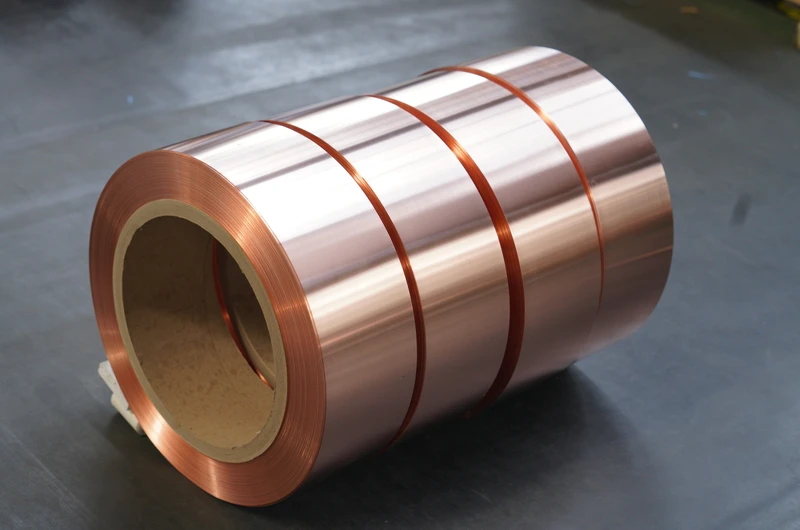
Tram traction motor winding copper foil commonly employs oxygen-free high-conductivity copper (OFHC) as the base material. Typical designations include C11000 (ETP, Electrolytic Tough Pitch; Cu ≥ 99.95 %, O = 0.02–0.04 %), C10200 (Oxygen-Free Copper; Cu ≥ 99.95 %, O < 0.001 %), and C10100 (Extra-High-Purity Oxygen-Free Copper; Cu ≥ 99.99 %). The chemical purity of copper foil directly determines electrical conductivity, thermal conductivity, hydrogen embrittlement resistance, and long-term reliability. For example, when metro vehicles frequently transition between underground and surface sections, temperature-humidity cycling (−40 °C to +85 °C, relative humidity 5 %–95 %) continuously drives grain boundary oxidation and hydrogen diffusion; if oxygen content exceeds 0.04 %, intergranular micro-cracking may develop within copper foil over extended service, significantly reducing motor life. Annealed (O-temper) C11000 copper foil achieves electrical conductivity of 100–101 % IACS (International Annealed Copper Standard); due to near-zero oxygen content, C10200 and C10100 reach 101–102 % IACS. For low-voltage windings of tram traction transformers and planar transformer windings of onboard auxiliary power supplies—applications sensitive to high-frequency skin effect—C10200 or C10100 is preferred to minimize AC impedance.
Surface Treatment and Plating Architecture
Bare copper foil rapidly develops a cuprous oxide (Cu₂O) layer under ambient atmospheric exposure, causing increased contact resistance and degraded solderability. Consequently, surface treatment is mandatory for tram-grade copper foil. Options include: electroplated tin (Sn, thickness 1–5 µm) to ensure solderability and oxidation resistance, primarily used as pre-plating prior to hairpin end laser welding; electroplated silver (Ag, thickness 1–3 µm) for high-frequency and high-temperature applications, where silver plating maintains conductivity at 200 °C and significantly reduces skin-effect losses above 100 kHz; electroplated nickel (Ni, thickness 1–3 µm) serving as a diffusion barrier and corrosion-resistant layer, commonly applied at traction motor rotor bar and collector ring connections; and OSP (Organic Solderability Preservative) coating providing temporary oxidation protection during storage and prior to reflow soldering. For fire-critical applications such as vehicle cable duct wiring and auxiliary power busbars, certain manufacturers integrate ceramic-filled insulation coatings with copper foil to satisfy EN 45545-2 HL3 fire safety requirements.
Mechanical Properties and Temper Processing
Copper foil mechanical performance is jointly determined by temper condition, grain size, and trace impurity content. Common tempers include O (annealed, elongation ≥ 30 %), 1/4H (H01), 1/2H (H02, elongation 10–20 %), and full-hard H (H04, tensile strength 350–450 MPa). Tram hairpin winding copper foil typically adopts 1/4H or 1/2H temper to balance bending and stamping formability with mechanical strength; copper strips for tram traction motor rotor bars and squirrel-cage bars generally employ O-temper or 1/4H-temper to ensure tight fit within rotor slots. Pure copper has a coefficient of thermal expansion (CTE) of 16.5×10⁻⁶ /K—close to silicon steel (11–13×10⁻⁶ /K)—yet additional CTE buffering from lamination insulation and enamel coatings remains necessary. Tram traction motor stators must pass vibration and shock testing per IEC 60034-1 and IEC 61373 across temperature cycling from −40 °C to +155 °C; thermo-mechanical coupling stability between copper foil and insulation layers constitutes the core parameter for lifetime prediction.
Key Performance Indicator System for Tram Winding Copper Foil
Electrical Conductivity and Skin Effect
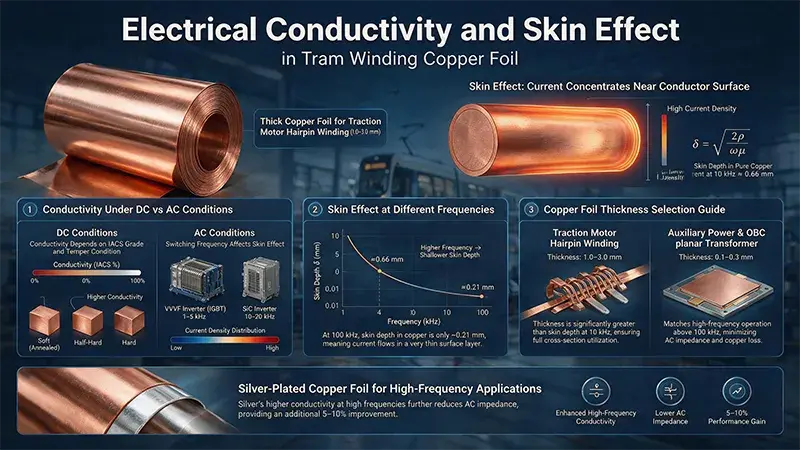
Electrical conductivity is the most fundamental physical parameter of tram winding copper foil. Under DC conditions, conductivity depends on IACS grade and temper condition; under AC conditions, VVVF inverter IGBT switching frequency typically ranges 1–5 kHz, while SiC inverter switching frequencies can reach 10–20 kHz. Skin depth δ = √(2ρ/(ωμ)) for pure copper is approximately 0.66 mm at 10 kHz and ~0.21 mm at 100 kHz. Therefore, tram hairpin winding copper foil is typically selected at thicknesses of 1.0–3.0 mm (substantially exceeding the 10 kHz skin depth), ensuring the entire conductor cross-section participates in current conduction; by contrast, thin copper foils of 0.1–0.3 mm are employed for onboard auxiliary power planar transformer windings and on-board charger windings to match high-frequency operation above 100 kHz. Silver-plated copper foil leverages silver’s superior high-frequency conductivity to further reduce AC impedance by 5–10 %.
Thermal Conductivity and Temperature Rise Control
Annealed C11000 copper foil exhibits thermal conductivity as high as 391 W/(m·K), substantially exceeding aluminum (~205 W/(m·K)) and any polymeric material, constituting a critical heat transfer path for stator winding thermal management in tram traction motors. Tram traction motor typical power density is 1.0–2.5 kW/kg (exceeding NEV drive motors at 0.5–1.5 kW/kg); winding temperature rise control relies primarily on the high thermal conductivity of copper foil to conductively transfer copper-loss heat from the slot interior through insulation layers and motor housing to external water jackets or forced-air cooling fins. Per IEC 60310 and IEC 60034-1, traction motor stator winding temperature rise under rated operating conditions shall not exceed 130 K (Class F) or 155 K (Class H), and stator core temperature rise shall not exceed 120 K. When hairpin flat copper foil windings are employed, slot fill factor reaches 70–80 % (substantially higher than round enameled wire windings at 45–55 %), reducing hot-spot temperature by 10–15 K.
Mechanical Strength and Vibration Durability
Tram traction motors endure prolonged mechanical shock and vibration induced by starting, braking, hill climbing, and cornering; stator windings must withstand over 10⁷ vibration cycles throughout the vehicle service life. Copper foil mechanical strength is jointly characterized by tensile strength, elongation after fracture, and bending fatigue life. Annealed C11000 copper foil (0.2 mm thickness) exhibits tensile strength of ~220 MPa and elongation ≥ 30 %; 1/2H-temper foil achieves tensile strength 250–300 MPa with elongation reduced to 10–20 %. Tram winding copper foil must pass rigorous testing per IEC 61373 “Railway applications—Rolling stock equipment—Shock and vibration tests” under Category I, Class B vehicle body mounting conditions: random vibration (5–200 Hz, RMS acceleration 0.75–2.58 g) and half-sine shock (30 ms duration, peak acceleration 5–10 g), without insulation damage, turn-to-turn short circuits, or winding loosening.
Welding and Interconnection Process Compatibility
Interconnection processes for tram winding copper foil include fiber laser or blue laser welding (spot or seam), ultrasonic welding (20–40 kHz, pressure 1–5 kN), resistance welding (spot or projection), and reflow soldering. Each process imposes specific requirements on copper foil surface condition, thickness uniformity, and hardness: laser welding demands clean, oxide-free surfaces (typically tin- or silver-plated) with thickness tolerance ≤ ±5 %; ultrasonic welding requires micro-rough surfaces (Ra 1.0–2.5 µm) to ensure stable frictional coupling; reflow soldering requires OSP or tin plating with controlled intermetallic compound (IMC) growth. In modern tram traction motor production lines, dual-pulse fiber laser welding has become the mainstream process for hairpin end joining, achieving welding speeds exceeding 50 mm/s, narrow heat-affected zone (HAZ), and excellent repeatability.
Primary Application Scenarios for Copper Foil Windings in Trams
Stator and Rotor Bars of Asynchronous Traction Motors (TIM)
Asynchronous traction motors (TIM) are the most common traction power source for metros, light rail transit (LRT), and modern trams, with single-unit power ratings of 150–500 kW, rated speeds of 1500–3000 r/min, and maximum speeds up to 6000 r/min. TIM stator windings have traditionally employed enameled round copper wire combined with mica/tape composite insulation; however, a recent industry shift toward hairpin flat copper foil windings is underway. Hairpin windings utilize C11000 1/4H or 1/2H flat copper foil with thicknesses of 1.0–3.0 mm and widths of 4.0–10.0 mm; winding ends are joined via laser welding to form closed loops. Compared to conventional enameled round wire windings, hairpin flat copper foil windings achieve slot fill factors of 70–80 %, increase power density by 15–20 %, and reduce thermal path length by approximately 30 %. TIM rotor bars continue to use pure copper or copper alloys (micro-alloyed with Cr, Zr) as cage conductor materials; high-power TIMs may adopt TIG-welded or electron-beam-welded copper end rings and copper bars.
Stator Windings of Permanent Magnet Synchronous Traction Motors (PMSM)
Permanent magnet synchronous traction motors (PMSM) have become the mainstream traction power choice for next-generation metros and metropolitan rapid transit systems, owing to high power density, high efficiency, and wide constant-power speed range. The trend toward hairpin stator windings in PMSMs is significantly more pronounced than in TIMs—beyond standard hairpin flat copper foil, certain PMSMs employ wave-form flat copper foil or continuous flat copper strip windings to further reduce end-winding height. Demagnetization risk in PMSMs correlates closely with temperature field distribution: the high thermal conductivity of hairpin flat copper foil reduces permanent magnet hot-spot temperature by 8–12 K, markedly enhancing sustained output capability under low-speed, high-torque operating conditions. Flat copper foil for PMSMs requires strict control of thickness tolerance (within ±3 %) and surface insulation uniformity to prevent reduction in partial discharge (PD) inception voltage.
Field Windings and Excitation Windings of Synchronous Traction Motors
Certain legacy tram and metro systems (e.g., some European tram and metro networks) still employ synchronous traction motors requiring independent field windings to generate rotor magnetic fields. Field windings operate under low-voltage, high-current conditions (typical 50–200 V DC, 100–500 A); copper foil thickness is typically 0.5–2.0 mm, with width determined by turn count and current density. Material selection centers on C11000 O-temper or 1/4H-temper copper, insulated using mica/tape composite systems or mica tape combined with vacuum pressure impregnation (VPI) processing. Electromigration and thermal fatigue of field winding copper foil under prolonged DC excitation constitute key lifetime-limiting factors, requiring validation through long-term thermal endurance testing per IEC 60310 and IEC 60034-1 (≥ 1000 h).
Copper Foil Windings in Traction Transformers and Auxiliary Converters
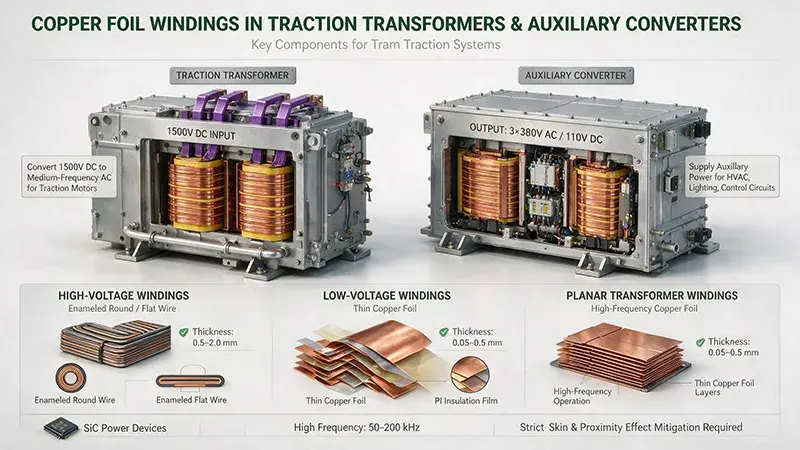
Tram traction transformers convert overhead line or third-rail supply voltages (1500 V DC or 750 V DC) into medium-frequency AC suitable for traction motors; auxiliary converters supply auxiliary power—including three-phase 380 V AC and low-voltage 110 V DC—for air conditioning, lighting, and control circuits. High-voltage windings, low-voltage windings, and planar transformer windings in both device types widely employ copper foil as the conductive material: high-voltage windings use enameled round wire or enameled flat wire (corresponding thickness 0.5–2.0 mm), whereas low-voltage and planar transformer windings utilize thin copper foil (0.05–0.5 mm) with polyimide (PI) film insulation. Increasing adoption of SiC power devices in main and auxiliary inverters for trams elevates planar transformer operating frequency to 50–200 kHz, imposing stricter requirements on skin effect and proximity effect mitigation in copper foil windings.
Manufacturing Process for Tram Winding Copper Foil
Rolled Annealed (RA) Process Route
Tram winding copper foil is predominantly manufactured via the Rolled Annealed (RA) process: starting from continuously cast copper billets (C11000 or C10200, thickness 10–20 mm), the material undergoes hot-rolling for slabbing, followed by multi-pass cold rolling with intermediate annealing, final rolling to finished thickness (0.05–3.0 mm; up to 8.0 mm for certain hairpin flat copper strips), and concluding with cleaning, annealing, tempering, and slitting. RA-processed copper foil exhibits low anisotropy, high elongation (O-temper ≥ 30 %), and uniform mechanical properties—making it the mainstream process for tram hairpin windings and field windings. Key process control parameters include mill precision, tension control, flatness control, and annealing furnace atmosphere (bell-type annealing furnace with protective atmosphere containing trace nitrogen or hydrogen).
Continuous Casting and Rolling plus Conform Continuous Extrusion
For large-section flat copper foil required in tram hairpin windings (thickness 1.0–3.0 mm, width 4.0–10.0 mm), continuous casting and rolling and Conform continuous extrusion processes have recently been introduced. In continuous casting and rolling, molten copper is continuously solidified into copper rod via a graphite mold, then fed through a series of tandem rolling stands to produce finished flat copper strip. This process offers advantages including lower energy consumption (30–50 % energy savings), continuous length (single coil up to several kilometers), and fine uniform grain structure. Conform continuous extrusion enables near-net-shape production of profiled copper bars and high-precision flat copper strips, already adopted on select European tram traction motor production lines.
Surface Treatment and Insulation Cladding
Surface treatment lines for tram winding copper foil typically comprise degreasing, micro-etching (acidic cleaning using sulfuric acid–hydrogen peroxide), oxidation prevention treatment (OSP, benzotriazole derivatives, or imidazole derivatives), and electroplating of tin, silver, or nickel. OSP coating thickness ranges 0.1–0.3 µm, providing storage protection for 6–12 months; tin plating thickness is 1–5 µm, commonly followed by reflow to form Cu–Sn intermetallic compound (IMC) layers; silver plating thickness is 1–3 µm, primarily used in high-frequency and high-temperature applications. Some tram winding copper foils are insulated prior to shipment—for instance, via thermal lamination with polyimide (PI) film or mica tape—yielding integrated semi-finished products comprising “copper foil + insulation,” enabling motor manufacturers to proceed directly to winding formation.
Slitting, Stamping, and Winding Formation
Finished copper foil is slit into narrow strips (tolerance ≤ ±0.05 mm), then subjected to progressive stamping to produce hairpin U-shaped components or rotor bar blanks. Subsequent operations—including bending, twisting, and end forming—complete the winding formation. A typical hairpin winding formation sequence for tram traction motors is: uncoiling of flat copper strip → leveling → progressive stamping of U-shaped components → insertion of U-shaped components into stator slots → end expansion (twisting & expanding) → laser welding of ends → vacuum pressure impregnation (VPI) or resin-rich molding. VPI employs epoxy or polyester resins under vacuum-pressure conditions; the impregnating varnish system must comply with EN 45545-2 HL3 fire protection and low smoke/toxicity requirements.
Quality Inspection and Reliability Verification for Tram Winding Copper Foil
Electrical, Mechanical, and Thermal Performance Test Standards
Quality inspection of tram winding copper foil encompasses five dimensions: electrical, mechanical, thermal, chemical, and surface properties. Electrical testing includes direct-current resistivity (per ASTM B193 or IEC 60028), alternating-current impedance and skin-effect resistance (per IPC TM-650 2.5.5), and dielectric withstand voltage of the insulation layer (per ASTM D149). Mechanical testing includes tensile strength and elongation at break (per ASTM E8), bending fatigue life (per ASTM E796), and hardness (per ASTM E384). Thermal testing includes thermal conductivity (per ASTM E1461—laser flash method), coefficient of thermal expansion (CTE, per ASTM E228), and thermal cycling durability (per IPC-9701). Surface testing includes surface roughness (per ISO 4287), coating thickness (X-ray fluorescence per ASTM B568), and solderability (per IPC J-STD-002). To address specific tram winding operating conditions, supplementary tests include IEC 60034-1 motor winding temperature-rise testing, IEC 60310 traction motor dedicated tests, and IEC 61373 vibration and shock testing.
Railway Industry Standards and Fire Safety Requirements
Final acceptance of tram winding copper foil must comply with railway-specific industry standards and fire safety requirements. Electrical and system-level standards include IEC 60310 (traction motors and generators), IEC 60851 (test methods for winding wires), IEC 60034-1 (ratings and performance of rotating electrical machines), TB/T 3230 (China Railway Standard—Traction Motors), and GB/T 25123.1 (Chinese National Standard—Electric Traction—Rotating Electrical Machines for Rail Vehicles); mechanical and vibration standards include IEC 61373 (shock and vibration testing) and ISO 16773 (environmental testing); fire safety standards include EN 45545-2 (fire protection of materials used in railway vehicles—R1/R7 classification), NFPA 130 (standard for fixed guideway transit and passenger rail systems), and TB/T 3237 (China Railway standard for fire-resistant materials). EN 45545-2 Hazard Level 3 (HL3) represents the highest fire safety classification, mandating materials exhibit maximum smoke density (Ds,max) ≤ 300 at 600 °C and toxicity index (CIT) ≤ 0.75—this is a mandatory threshold for tram winding copper foil insulation systems.
Long-Term Reliability and Lifetime Prediction
The design service life of tram traction motors is typically 25–30 years, corresponding to accumulated operational mileage of 1.2–1.5 million km and approximately 30,000–40,000 operating hours for motor windings. During extended operation, copper foil windings are subjected to coupled electrical, thermal, mechanical, and environmental stresses: Electrically, high dv/dt pulses (typical 5–10 kV/µs) generated by VVVF inverters induce partial discharge (PD) within turn-to-turn insulation, leading to cumulative insulation aging; thermally, periodic stator winding overloads (e.g., during hill climbing or acceleration) combined with natural cooling cycles produce thermal cycling, resulting in thermo-mechanical fatigue at the insulation-copper foil interface; mechanically, vehicle vibration, shock, and acceleration loads arising from gradients and curves (typical peak 5–10 g) cause relative displacement between copper foil and insulation layer; environmentally, temperature-humidity cycling and airborne contaminants (dust, salt mist, oil mist) accelerate insulation degradation. Reliability verification of tram winding copper foil requires full type testing per IEC 60310, IEC 60034-1, IEC 61373, and EN 45545-2, supplemented by lifetime prediction based on the Arrhenius thermal aging model and cumulative damage modeling (Miner’s rule).
Conclusion
The selection of copper foil for tram winding is a multidimensional engineering decision encompassing material purity (C11000, C10200, C10100, or C12200), surface finish (bare copper, OSP, tinned, silver-plated, or nickel-plated), temper condition (O, 1/4H, 1/2H, or H), thickness (0.05–8.0 mm), insulation system (polyimide film, mica tape, epoxy VPI, or ceramic coating), and manufacturing process (RA, continuous casting and rolling, or Conform). Across four major application families—traction motor stators and rotors (asynchronous TIM hairpin flat copper foil windings, PMSM waveform flat copper strip windings, synchronous motor field windings using copper foil), traction transformers (enameled flat copper foil for high-voltage side, thin copper foil windings for low-voltage side, planar transformer foil windings), auxiliary converters (onboard charger windings, DC-DC converter planar transformers, auxiliary power supply windings for HVAC and lighting), and vehicle body wiring and busbars (DC 750 V/1500 V busbars, underfloor conduit wiring copper foil)—tram winding copper foil must simultaneously satisfy comprehensive requirements: high electrical conductivity (≥ 100 % IACS), high thermal conductivity (≥ 390 W/m·K), vibration resistance (IEC 61373), thermal endurance (IEC 60034-1 Class F/H), fire protection (EN 45545-2 HL3), and extended service life (25–30 years). As metros, suburban rapid rail, and modern trams evolve toward PMSM magnetization, SiC power device-based high-frequency operation, 800 V/1500 V high-voltage architecture, and intelligent control, demand for high-purity, high-reliability, and highly engineered copper foil for tram windings will continue to expand. Next-generation technical evolution directions for tram winding copper foil may include: higher-strength Cu-Cr-Zr microalloyed copper foil for high-power traction motors; copper foil with ceramic insulation coatings meeting more stringent EN 45545-2 HL3 fire protection requirements; continuous flat copper strip hairpin windings coupled with AI vision-driven end-welding quality control—further consolidating copper foil’s status as a core foundational material in tram traction drive systems.