

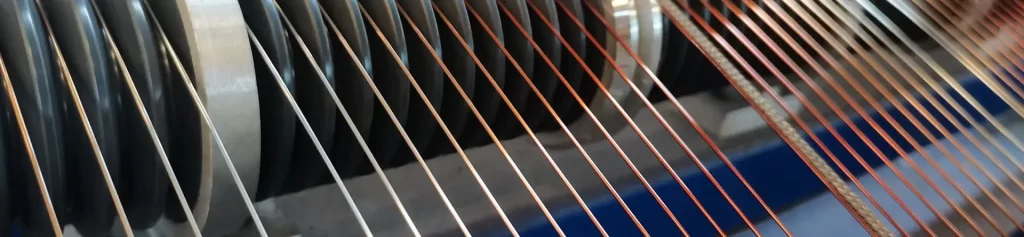
Servo motors are the “heart” of industrial automation — their positioning accuracy (±0.001 mm), response time (< 1 ms), and power density (> 5 kW/kg) far exceed those of ordinary motors. Behind this ultimate performance, the demands on winding materials are also rising — servo motors commonly use C10100 Oxygen-Free Electronic copper (4N, purity ≥ 99.99%), rather than ordinary C11000 (3N, purity ≥ 99.9%). Below, we clarify the specifications of high purity copper foil for servo motors based on the latest 2025–2026 market data.
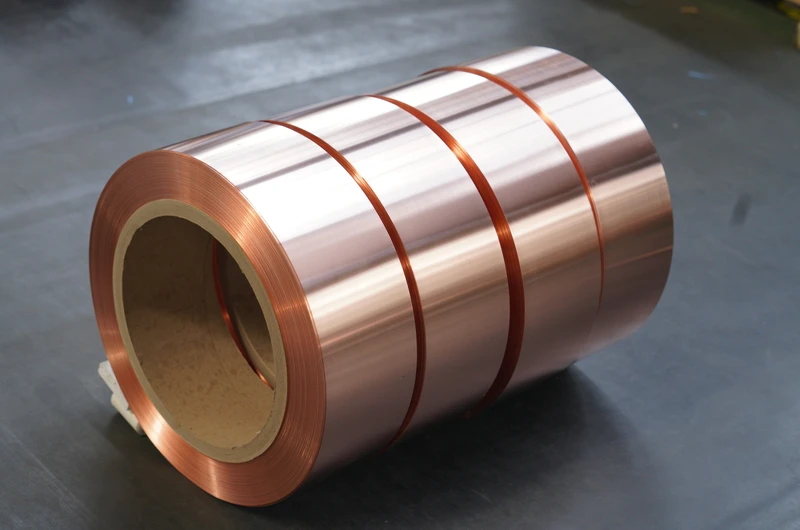
I. Three Mainstream Types of Servo Motors
- **AC Permanent Magnet Synchronous Servo Motor (PMSM)** — Mainstream solution. The rotor uses rare-earth permanent magnets (NdFeB), with high power density (5–10 kW/kg), fast response (< 1 ms), and high efficiency (IE5). Representatives: Yaskawa Σ-X series, Inovance ISMH series.
- **AC Asynchronous Servo Motor** (Squirrel-Cage Induction IM) — Mid-to-low-end solution. Simple structure, low cost, but efficiency and response are inferior to PMSM. Representatives: Siemens 1PH7 series.
- **Linear Servo Motor** — High-end solution. No mechanical transmission (no ball screw), directly producing linear motion, with precision of ±0.001 mm. Representatives: Fanuc Linear Motor series.
Impact on copper foil: PMSM has high power density and large heat generation. Copper usage per motor is 30–50% higher than that of asynchronous motors, and the thermal class requires Class H (180°C) or even Class N (200°C).
II. Three Main Applications of High Purity Copper Foil in Servo Motors
- **Stator Winding Copper Foil (Hairpin Winding)** — Mainstream solution. Thickness 1.0–3.0 mm × width 5–10 mm, purity ≥ 99.99% (C10100 OFE copper), with PI / AIW (polyimide) enamel coating (heat resistance 220°C), Class H/N (180–200°C) thermal class.
- **Encoder Winding (Optical / Magnetic Encoder)** — Ultra-high purity copper. Purity ≥ 99.999% (5N / 6N), mainly used as signal winding. Resistance stability is more important than purity (temperature coefficient of resistance TCR ≤ 0.004 / °C).
- **Busbar / Terminal Connection** — Motor terminals connecting to the servo drive. T2 copper foil thickness 0.5–1.0 mm, using C10100 or C11000, with tin or nickel plating.
III. Key Specifications and Typical Values
| Category | Thickness (mm) | Width (mm) | Purity | Resistivity (Ω·m) | Enamel/Surface Treatment |
|---|---|---|---|---|---|
| PMSM Stator (High-End) | 1.5–3.0 | 5–10 | **C10100 (≥ 99.99%)** | ≤ 1.724 × 10⁻⁸ | PI Enamel (220°C) |
| Hairpin Winding | 1.5–3.0 | 5–10 | **C10100 (≥ 99.99%)** | ≤ 1.724 × 10⁻⁸ | Bare Copper + Terminal Welding |
| Encoder Winding (Optical) | 0.1–0.5 | 1–3 | **5N/6N (≥ 99.999%)** | ≤ 1.724 × 10⁻⁸ | Bare Copper + Insulating Varnish |
| Linear Servo Stator | 1.0–2.5 | 4–8 | C10100 (≥ 99.99%) | ≤ 1.724 × 10⁻⁸ | PI Enamel (220°C) |
| Busbar / Terminal | 0.5–1.0 | 10–30 | C11000 / C10100 | ≤ 1.724 × 10⁻⁸ | Tin / Nickel Plating |
Key figures: **1.0–3.0 mm is the PMSM stator mainstream**; **purity ≥ 99.99% (C10100) is the industrial standard for servo motors** (distinguishing it from C11000 used in home appliances); **5N/6N is dedicated to encoder windings** (99.999% / 99.9999%); **PI / AIW enamel (220°C)** is the mainstream for high-end servo motors. **IEC 60317-29** (rectangular copper magnet wire) and **GB/T 5584** (electrical copper flat wire) are the main reference standards.
**C10100 vs C11000 Comparison**:
- C10100 (OFE Oxygen-Free Electronic, 4N): Purity ≥ 99.99%, oxygen content ≤ 5 ppm, conductivity ≥ 101% IACS
- C11000 (ETP Electrolytic Tough Pitch, 3N): Purity ≥ 99.9%, oxygen content 100–650 ppm, conductivity ≥ 100% IACS
- Key difference: C10100 oxygen content is 20–130 times lower, **suitable for high-temperature annealing under hydrogen protection** (servo enamel curing requires 220°C long-term annealing; C11000 will produce hydrogen embrittlement cracks at high temperatures)
IV. Market Size and Growth
Comparing four independent data sources side by side:
| Data Source | 2024 (USD Billion) | 2030–2033 (USD Billion) | CAGR |
|---|---|---|---|
| LinkedIn (High Torque Servo) | 2024 = 1.20 | 2033 = 2.10 | ~7.5% |
| Electric Motor Market (Global Motors) | 2025 base | 2031 = 177.80 | 5.5% |
| IFR World Robotics 2025 | 2024 = 542,000 units | — | Doubled in 10 years |
Taken together, **the global industrial robot servo motor market will reach USD 42.8 billion by 2033 (CAGR 13.47%)**; **the global motor market will reach USD 177.8 billion by 2031 (CAGR 5.5%)**; **542,000 industrial robots were installed globally in 2024** (doubled in 10 years).
Copper foil demand estimation: Based on PMSM servo motor copper usage of 0.3–1.0 kg per motor, 542,000 industrial robots correspond to 1,600–5,400 tons of copper foil (only main motors for robots). Including CNC, semiconductor, AGV, AMR, and other industrial automation scenarios, **global annual servo motor copper foil demand is 50,000–100,000 tons**, corresponding to a market size of USD 0.6–1.2 billion (including processing).
V. Competitive Landscape and Applications
- **Inovance (China)**: ISMH series PMSM servo motors, **No. 1 in domestic market share**, with annual capacity of over 2 million units, mainly using 1.0–2.0 mm C10100 enameled flat copper wire.
- **Yaskawa (Japan)**: Σ-7 / Σ-X series, emphasizing ±0.001 mm precision, with Hairpin solutions used in high-end models.
- **Mitsubishi (Japan)**: J4 / J5 series, emphasizing 23-bit high-resolution encoder, copper usage per motor 0.5–1.0 kg.
- **Fanuc (Japan)**: α-i series + Linear Motor, **global CNC leader**.
- **Siemens (Germany)**: V90 / S210 series, emphasizing IE5 high efficiency (≥ 89%).
- **Delta (Taiwan, China)**: ASDA-B3 / A3 series, cost-performance oriented.
VI. Procurement Notes
1. **Identify the alloy grade clearly**: **C10100 (OFE Oxygen-Free Electronic, 4N) is the industrial standard for servo motors**. Avoid using C11000 — C11000 will produce hydrogen embrittlement cracks during high-temperature annealing (220°C), affecting long-term reliability.
2. **Oxygen content control**: C10100 oxygen content ≤ 5 ppm. **Above 10 ppm cannot be used for servo motors**.
3. **Enamel thickness tolerance**: PI enamel thickness 0.05–0.10 mm, tolerance ≤ ±0.01 mm, otherwise the slot fill design will be compromised.
4. **Edge quality**: Hairpin bending requires copper foil edges to be burr-free (burr height ≤ 0.02 mm), otherwise the enamel will be pierced and short circuits will occur.
5. **Inspection items**: Thickness tolerance (±0.02 mm), width tolerance (±0.05 mm), oxygen content (≤ 5 ppm), tensile strength (≥ 220 MPa), elongation (≥ 35%), resistivity (≤ 1.724 × 10⁻⁸ Ω·m), dielectric breakdown (≥ 3,543 V/mm).
6. **Certifications and compliance**: IEC 60317-29 / GB/T 5584 (rectangular copper flat wire); ISO 13715 (servo motor standard); IEC 60034 (rotating electrical machine standard); RoHS / REACH (environmental).
Final Thoughts
When selecting high purity copper foil for servo motors, the key is to remember “C10100 + PI enamel + 4N purity” — these are the three core differences from ordinary motors. The global industrial robot servo motor market will reach USD 42.8 billion by 2033 (CAGR 13.47%). For copper foil suppliers, each PMSM servo motor uses 0.3–1.0 kg of copper, and global robot installations of 5 million units per year correspond to 50,000–100,000 tons per year of copper foil demand — making it the fastest-growing industrial-grade B2B track for high purity copper foil (C10100).
If you are evaluating high purity copper foil suppliers for servo motors (PMSM stator / Hairpin bare copper / encoder winding), please contact Zhengzhou LP Industry Co., Ltd. Email: office@cnlpzz.com, WhatsApp: 0086-19337889070. We offer C10100 (OFE 4N copper) copper foil + PI enamel processing, with oxygen content ≤ 5 ppm, Hairpin bending burr height ≤ 0.02 mm, and support customized specifications and OEM processing.