

In practical electrical engineering work, engineers face a question every day—Should we use magnet wire or regular wire? This question sounds simple, but choosing the wrong one can lead to decreased efficiency or even burn out the entire system.
I’ve seen many cases myself: some people stuffed regular PVC wire into transformer windings, and it burned out after three months of operation. Others used magnet wire for electrical wiring, and the enamel coating was easily damaged, causing the leakage protection to trip.
Therefore, the difference between these two types of wire is not just a matter of “thickness.” This article provides a complete comparison from 8 engineering dimensions.
I. The essential difference between magnet wire and regular wire
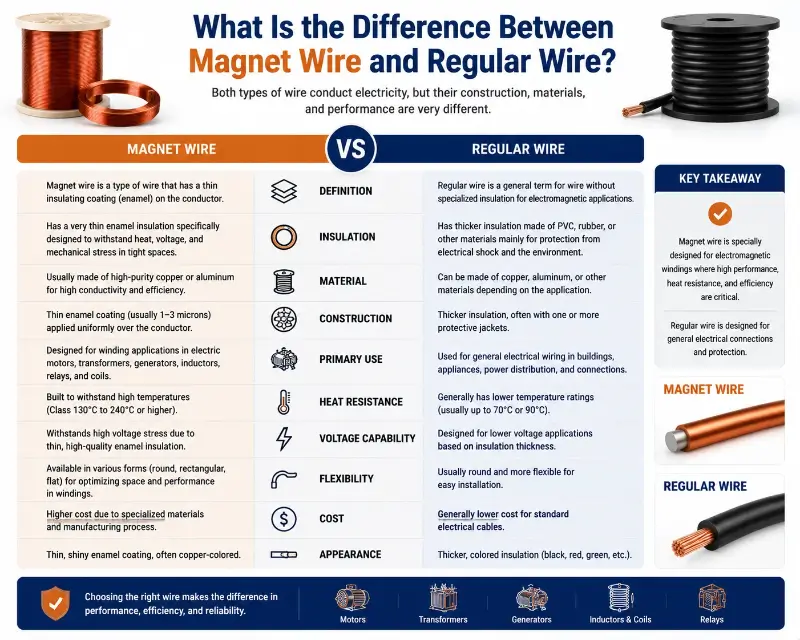
Magnet wire, also called enameled wire or winding wire, is a special type of wire with a conductor surface coated with an ultra-thin enamel coating. The enamel coating thickness is typically only 20–100 micrometers—thinner than a human hair.
Regular wire, also called building wire, power line, or power cable, consists of a conductor covered with a relatively thick layer of plastic or rubber insulation. For example, common PVC insulated wires typically have an insulation thickness between 0.5 and 2.0 mm, which is dozens of times thicker than the enamel coating of magnet wire.
Their design goals also differ. Magnet wire aims to maximize the number of turns in the smallest space to generate the strongest electromagnetic effect; regular wire prioritizes the safe transmission of electrical energy—thick insulation, strong mechanical protection, and good environmental resistance are essential. These two design philosophies diverge from the outset.
II. Engineering Comparison of Insulation Structures
2.1 Insulation Structure of Magnet Wire
The insulation of magnet wire is a multi-layer coating of enamel coating (usually 1–3 layers):
- Single Layer: Polyurethane (UEW), polyester (PEW), etc.
- Double Layer: Polyester-imide underlayer + polyamide-imide top layer (EIW/AIW)
- Triple Layer: Primer + intermediate varnish + topcoat, used in special high-temperature applications.
Each enamel coating layer may only be 5–30 micrometers thick, which, when stacked, provides sufficient electrical insulation strength. Polyurethane enamel can be soldered at low temperatures (the enamel can be removed at 180°C); polyester-imide is heat-resistant to 180°C; polyamide-imide can withstand 220°C or even higher.
2.2 Insulation Structure of Regular Wires
The insulation of regular wires is a thick extruded sheath, usually only one layer (a few high-voltage cables have multiple layers co-extruded). Common materials: PVC (70–90°C), XLPE (90–110°C), EPR (90–130°C), silicone rubber (180–200°C).
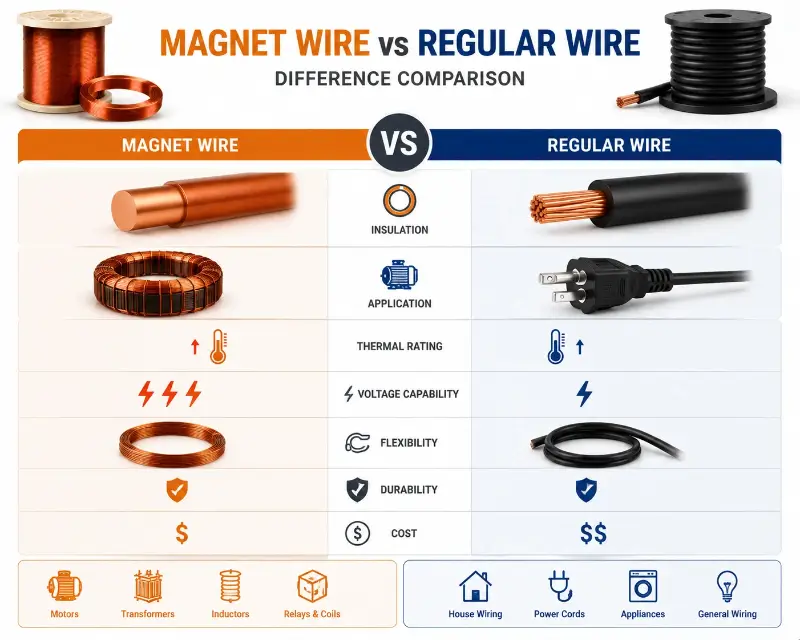
The comparison is very intuitive: magnet wire insulation relies on a chemical coating; regular wire insulation relies on a sheath, built up through physical thickness.
III. Differences in Conductor Specifications
Magnet wire conductors are almost always round copper or round aluminum wires, with a very wide diameter range: ultra-fine 0.016 mm (used in miniature inductors, headphone coils, hearing aids), standard 0.10–2.0 mm (mainstream in motors and transformers), and large 3.0–7.0 mm (large transformers and welding machines). There are also rectangular/flat wire (thickness 0.8–10 mm, width 2–25 mm) for motor stator windings, which can increase slot fill factor by 15%–25%.
Regular wire conductor specifications are relatively “standardized”: household wiring AWG 14–AWG 10 (1.6–2.6 mm), power cables AWG 8–AWG 4/0 (3.3–12 mm and above), and signal cables AWG 20–AWG 24 (multi-core structure). The shape is mostly round or multi-stranded—making conduit installation easier.
IV. Engineering Comparison of Electrical Performance
4.1 Breakdown Voltage
This is a key indicator for engineers when selecting wires. Single-layer magnet wire ≥ 1.5 kV (AWG 24 / 0.51 mm), double-layer ≥ 3.5 kV, and triple-layer can reach over 5 kV. While the voltage may seem low, the voltage of magnet wire is inherently low in applications (generally below 600 V). Regular wires: 600 V PVC ≥ 2.5 kV; 1 kV XLPE ≥ 4 kV; high-voltage cables can reach tens to hundreds of kV. Conclusion: For the same wire diameter, the breakdown voltage of regular wires is much higher than that of magnet wire, but this is achieved through increased thickness.
4.2 Thermal Class
Thermal class of magnet wire (by NEMA/IEC standards):
| Class | Temperature | Typical Enamel Coating |
|---|---|---|
| Class 105 | 105°C | Oil-based enamel (essentially obsolete) |
| Class 130 | 130°C | Polyurethane (UEW) |
| Class 155 | 155°C | Polyester (PEW) |
| Class 180 | 180°C | Polyester-imide (EIW) |
| Class 200 | 200°C | Polyamide-imide (AIW) |
| Class 220 | 220°C | Polyimide (PIW) |
Regular wires typically have a temperature resistance of only 70°C (PVC) to 200°C (silicone rubber), and special materials are required for anything above 130°C. An interesting finding: magnet wire thermal class is 30–50°C higher than regular wire of the same specifications—because the enamel coating itself is heat-resistant and does not require plasticizers like PVC.
4.3 Resistance and Current Carrying Capacity
Resistance is mainly determined by the conductor cross-sectional area. Current carrying capacity differs: magnet wire is densely stacked in windings, resulting in poor heat dissipation; the rated current density needs to be derated by 20–30%. Regular wires have good heat dissipation and can be checked against standard current carrying capacity tables. An engineering rule of thumb: the current density of magnet wire in motor windings is typically 4–6 A/mm²; for regular power wires, it can be 5–8 A/mm².
V. Mechanical Performance Comparison
5.1 Flexibility
Magnet wire must be flexible—it needs to be repeatedly bent and wound in slots. The specifications include: Elongation of copper ≥ 30% (soft state), Spring Angle as small as possible (< 5°), Bending Performance able to be wound around a 1× diameter round rod without breaking. Regular wires have low requirements for flexibility—the bending radius only needs to be sufficient during installation.
5.2 Abrasion Resistance
Magnet wire enamel coating is very susceptible to scratches. This is its biggest weakness. During the winding process, the magnet wire passes through tension wheels, winding nozzles, and dies; any hard object can scratch the enamel coating. Therefore, the magnet wire winding workshop must be kept clean, and the dies must be polished. Regular PVC wires have excellent abrasion resistance—they will not break when running through conduits or bending at corners.
5.3 Chemical Resistance
Regular PVC wires have good resistance to oil, water, and acids and alkalis. For magnet wire enamel coating, the choice depends on the material—polyurethane enamel has poor solvent resistance, while polyester-imide has good chemical resistance. Therefore, magnet wire immersed in transformer oil must be EIW, not UEW.
VI. Fundamental Differences in Application Scenarios
6.1 Application Scenarios of Magnet Wire
Magnet wire can only be used for coil windings, not for power transmission lines. Typical applications: motor stator/rotor windings (accounting for approximately 50% of magnet wire usage), transformer coils, electromagnet/relay/contactor coils, inductors/chokes, speaker voice coils, induction heating coils, and automotive ignition coils. In short: magnet wire is indispensable in any application requiring the generation of a magnetic field.
6.2 Application Scenarios of Regular Wires
Regular wires cannot be used for coil windings. They are mainly used for power transmission and connection: household power distribution (BV, BVR), industrial power cables (VV, YJV), internal equipment connections (UL 1007, 1015, etc.), outdoor overhead lines, marine cables, mining cables, signal lines, and control lines.
6.3 What Happens If You Choose the Wrong One?
Using regular wire as magnet wire—the winding size will explode, it simply won’t fit in the slot, and the number of turns will be impossible to achieve. Using magnet wire as regular wire—enamel coating will wear and leak electricity, insulation will fail, endangering personal safety. The two cannot be used interchangeably. This is basic common sense for engineers.
VII. Differences in Standard Systems
Magnet wire and regular wire use two almost non-overlapping standard systems:
| Category | Magnet Wire Standard | Regular Wire Standard |
|---|---|---|
| International (IEC) | IEC 60317 Enamelled round winding series | IEC 60227 PVC cable / IEC 60502 Extruded insulated power cable |
| USA | NEMA MW 1000 | UL 83 THHN/THWN |
| China | GB/T 6109 | GB/T 5023 |
| Japan | JIS C 3202 | JIS C 3605, etc. |
The design logic of the two standards also differs: magnet wire standards focus on winding performance—enamel coating integrity, enamel coating uniformity, and solderability; regular wire standards focus on transmission safety—insulation resistance, flame retardancy, and mechanical strength.
VIII. Procurement and Cost Comparison
For the same weight, magnet wire is 30%–200% more expensive than regular wire. Reasons: the enamel coating process is complex (multiple coats and baking cycles), the enamel itself is expensive (special polyimide enamel), and the inspection standards are strict (each roll undergoes enamel coating continuity testing). However, the amount of magnet wire used is calculated as “number of turns × length,” and a motor winding may only weigh a few hundred grams, so the total cost is not exorbitant.
When purchasing magnet wire, be sure to check the following: conductor material (pure copper TU1 / oxygen-free copper OFHC / copper-clad aluminum CCA), enamel coating type (UEW/PEW/EIW/AIW/PIW), thermal class (Class 130–220), enamel coating grade (Grade 1 thin / Grade 2 medium / Grade 3 thick), and standard (IEC 60317 / NEMA MW 1000 / GB/T 6109). For regular electrical wires, check the conductor cross-sectional area, insulation material, rated voltage, and flame retardant rating (e.g., IEC 60332).
Summary: A Table to Understand the Differences
| Comparison Items | Magnet Wire | Regular Wire |
|---|---|---|
| Insulation Type | Ultra-thin enamel coating (20–100 μm) | Thick plastic/rubber sheath (0.5–2 mm) |
| Design Objectives | Tight winding, high turn count | Safe power transmission |
| Conductor Specifications | 0.016–7.0 mm round wire + flat wire | AWG 24–4/0 and above, round wire/multi-strand |
| Typical Temperature | 105–220°C | 70–200°C |
| Breakdown Voltage | 1.5–5 kV | 2.5 kV–hundreds of kV |
| Main Applications | Motors/transformers/inductors | Power wiring/equipment connections |
| International Standards | IEC 60317 / NEMA MW 1000 | IEC 60227 / IEC 60502 |
| Key Differences | Scratch-resistant, highly flexible | Wear-resistant, safe, good heat dissipation |
Summary in one sentence: magnet wire is a precision conductor “designed for magnetic fields,” while regular wire is an engineering material “designed for safe transmission.” They each have their specific functions and should never be used interchangeably.