

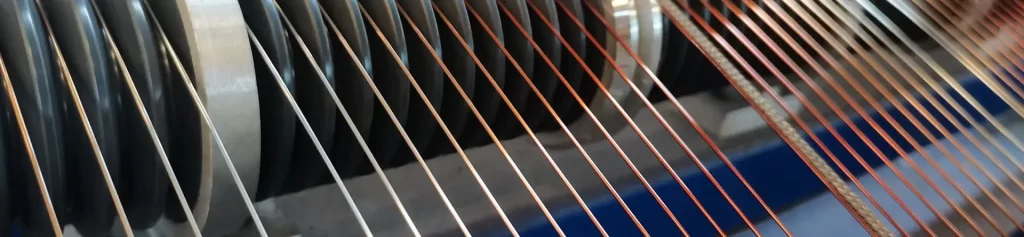
A typical price quote for fiberglass covered wire includes four fields: specifications, unit price, minimum order quantity (MOQ), and delivery time. However, the actual procurement cost far exceeds the simple product of these four items, influenced by a combination of factors such as conductor material, number of insulation layers, thermal class, enamel coating system, processing precision, order volume, processing technology, and certification qualifications. Based on LP factory’s 30 years of experience in the magnetic wire export industry, this article systematically analyzes eight core elements in fiberglass covered wire pricing, providing technical support and cost reference for procurement decisions.
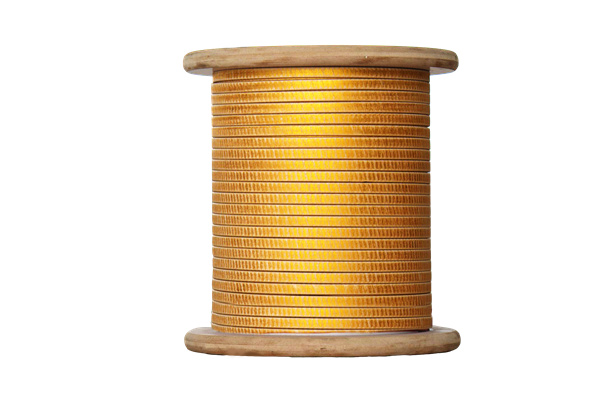
I. Conductor Material
Fiberglass covered wire conductors are classified into three major systems based on material: copper, aluminum, and copper-clad aluminum (CCA).
Copper conductors conform to GB/T 3953 or ASTM B49 standards. Common grades include TU1 (99.97% purity), TU2 (99.95% purity), and T2 (99.90% purity). Conductivity is 100% IACS, and resistivity at 20℃ is 1.724 × 10⁻⁸ Ω·m. Round wire diameter ranges from 0.018 to 5.000 mm, and flat wire thickness ranges from 0.80 to 5.60 mm, with a width of 2.00 to 16.00 mm. The price difference between TU1 and TU2 is approximately 5-10%.
Aluminum conductors conform to GB/T 3955 standards. Common grades include 1060 (99.60% purity), 1050 (99.50% purity), and 1350 (99.50% purity, higher tensile strength). Electrical conductivity 61% IACS, resistivity 2.826 × 10⁻⁸ Ω·m at 20℃. Under the same current carrying capacity, the cross-sectional area is approximately 1.56 times that of copper, and the mass is approximately 30% of copper.
Copper-clad aluminum (CCA) conforms to ASTM B566 or GB/T 30552, with copper volume fraction of 10-30% (corresponding to Class 10/15/20/30). Electrical conductivity 63-71% IACS, density 75-85% of copper.
Material cost ranking (from highest to lowest): TU1 copper > TU2 copper > T2 copper > Class 30 CCA > Class 20 CCA > Class 15 CCA > Class 10 CCA > 1350 aluminum > 1060 aluminum.
Selection Recommendations: TU1/TU2 copper conductors are recommended for high-current, high-frequency, and continuous operation; 1350 aluminum or Class 15-20 CCA are recommended for lightweight and portable equipment; Class 10 CCA or 1060 aluminum can be used for cost-sensitive low-to-mid-range motors.
II. Number of Fiberglass Layers
The number of fiberglass layers is directly related to the breakdown voltage. According to NEMA MW 1000-2018 Part 2, it is divided into single-layer, double-layer, and multi-layer structures.
- Single-layer fiberglass—Breakdown voltage ≥3000 V (round copper Grade 1), suitable for low-voltage motors and transformer windings of 600 V and below.
- Double-layer fiberglass—Breakdown voltage ≥5000 V (round copper Grade 2), suitable for medium-voltage equipment of 1000 V and below.
- Four-layer fiberglass—Breakdown voltage ≥ 8000 V, suitable for high-voltage motors of 3000 V and above and special transformer windings.
Cost increases progressively—from single layer to double layer, the price increases by approximately 30-40%; from double layer to four layers, the price increases by approximately 40-60%. If the actual operating voltage exceeds the withstand voltage range of the selected layer number, it will lead to insulation breakdown and complete machine repair, with the overall cost far exceeding the increased wire cost of upgrading the fiberglass layer number.
III. Thermal Class
Fiberglass-coated wire is classified according to IEC 60085 / NEMA MW 1000-2018 Part 1, and is divided into five classes: B / F / H / N / R, based on the maximum permissible operating temperature.
| Class | Temperature Limit | Typical Applications |
|---|---|---|
| Class B | 130℃ | Household motors, small transformers |
| Class F | 155℃ | Industrial motors |
| Class H | 180℃ | Traction motors, wind turbines |
| Class N | 220℃ | New energy vehicle drive motors, aviation equipment |
| Class R | 240℃ | Military, nuclear power |
For each thermal class upgrade, the price increases by 20-40%. The price difference between Class H and Class N is the largest. Class N requires a polyester imide-polyamide-imide (PEI-PAI) composite enamel coating system to replace ordinary polyester enamel coating. According to Montsinger’s rule of thumb, insulation life is halved for every 10℃ increase. Class B wires require replacement after approximately 10,000 hours of operation at 160℃, while Class H wires can last up to 40,000 hours under the same conditions. The selection of thermal class wires should match the actual operating temperature; over-selection will result in a 30-50% cost redundancy, while under-selection will significantly shorten insulation life.
IV. Fiberglass Wires with Enamelled Coatings
Fiberglass insulation can be divided into two main systems based on their insulation structure: fiberglass + enamel coating composite and fiberglass + insulating paper composite.
Fiberglass + enamel coating composite employs a double-layer structure of primer and topcoat. The primer is typically polyester (PEW), polyester imide (EIW), or polyurethane (UEW), primarily functioning to fill the gaps between fiberglass layers and provide basic electrical insulation. The topcoat is typically polyamide imide (AIW) or polyester imide, primarily functioning to provide heat resistance, chemical resistance, and moisture protection. The fiberglass + double enamel coating composite structure offers a 30-70% increase in breakdown voltage and a 20-30℃ increase in temperature resistance compared to single fiberglass coating, but at a 15-25% higher price.
The fiberglass + insulating paper composite type is suitable for oil-immersed transformer windings, with a cost 10-15% lower than the fiberglass + enamel coating composite type, but requires a VPI (vacuum pressure impregnation) process—vacuum degree ≤50 Pa, pressure 0.2-0.5 MPa, temperature 50-70℃, and impregnation time 8-24 hours.
V. Specifications
Conductor diameter tolerance grades are classified according to IEC 60317-0-1 / NEMA MW 1000-2018.
- Ordinary accuracy grade—tolerance ±0.020-0.030 mm, suitable for general motors with a slot fill factor of 60-70%.
- High Precision Grade—Tolerance ±0.005-0.015 mm, suitable for micro motors, precision instruments, and voice coil motors (VCM).
Each grade increase in precision raises processing costs by 20-40%. High-precision fiberglass-coated wire is mainly used for products with micro-diameters of 0.10-0.50 mm. The width-to-thickness ratio of flat wire typically ranges from 1:1 to 8:1. A width-to-thickness ratio exceeding 4:1 requires specialized rolling equipment, increasing processing costs by 30-50%.
VI. Order Quantity
Order quantity has the greatest impact on unit price. Orders are categorized into four price ranges based on size:
| Order Type | Batch Size Range | Unit Price Adjustment |
|---|---|---|
| Trial Orders | 50-200 kg | +30%~+60% |
| Small Batch | 200-1000 kg | +15%~+30% |
| Medium Batch | 1000-5000 kg | Standard Price |
| Large Batch | ≥5000 kg | -10%~-20% |
LP factory Pricing Strategy—Monthly payment terms are offered for batches ≥5000 kg, and quarterly prices are locked for batches ≥10000 kg. Large batch orders, in addition to unit price discounts, also enjoy priority production scheduling and customized specifications services.
VII. Processing Technology
The fiberglass wrapping process consists of three core steps: wrapping, impregnation, and baking. Processing fees account for 35-50% of the total cost.
- Wrapping Process—Fiberglass yarn is evenly wound onto the conductor surface with a tension of 30-50 N at a wrapping speed of 5-30 rpm. An alarm must be triggered and the machine stopped if the tension fluctuation exceeds ±5 N. The investment for a single wrapping machine is approximately 500,000-1,000,000 RMB.
- Impregnation Process—Vacuum pressure impregnation (VPI) is used, with a vacuum degree ≤50 Pa, working pressure 0.2-0.5 MPa, temperature 50-70℃, and impregnation time 8-24 hours. The impregnation varnish system includes polyester imide, polyamide imide, and silicone.
- Baking Process—After impregnation, the material is cured by step-up heating at 80-150℃ for 4-8 hours. Excessive heating rate will cause blistering defects in the enamel coating.
Process Cost Comparison—Under the same specifications, fiberglass-wrapped wire costs 50-100% more than enameled wire and 30-60% more than paper-wrapped wire.
VIII. Certification Qualifications
The compliance costs of export orders with certification qualifications are determined by the certification system, which is divided into five levels according to the certification category.
| Certification Category | Main Standards | Individual Fees |
|---|---|---|
| Basic Certification | CE / RoHS / REACH | $5,000-$10,000 |
| International Standards | IEC 60317 / NEMA MW 1000-2018 / GB/T 7672 | $10,000-$20,000 |
| Industry Certification | UL / CSA / VDE | $15,000-$30,000 |
| System Certification | ISO 9001 / ISO 14001 / ISO 45001 / IATF 16949 | $20,000-$40,000 |
| Specialized Industries | AS9100 (Aerospace) / ISO 13485 (Medical) / Nuclear Power Certification | $30,000-$50,000 |
Certified suppliers typically include certification costs in their quotes (generally 5-15% of the unit price). While uncertified suppliers offer lower prices, they carry compliance risks such as customs seizure and end-customer rejection. LP factory possesses full certifications including UL / IEC / NEMA / CE / RoHS / REACH / ISO 9001 / ISO 14001 / ISO 45001, and its products are exported to over 50 countries. Test reports and certificates of origin are available.
Conclusion
The pricing of fiberglass-coated wire is determined by eight core factors: conductor material, number of fiberglass layers, thermal class, enamel coating system, specifications precision, order quantity, processing technology, and certification qualifications. When comparing quotations, it is recommended to confirm the following technical parameters with the supplier:
- Conductor grade (TU1/TU2/T2 or 1060/1050/1350 or CCA Class)
- Number of glass fiber layers and enamel coating system
- Certification cost sharing method and minimum order quantity.