

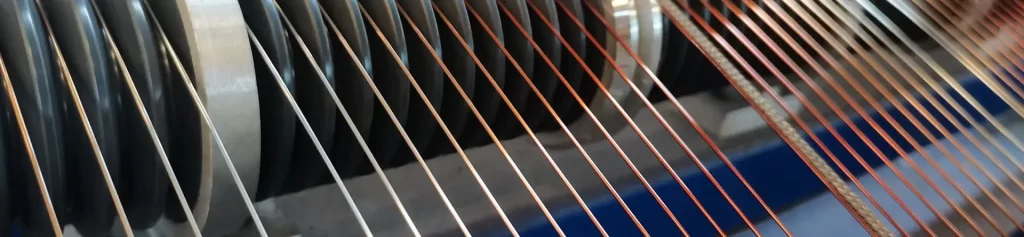
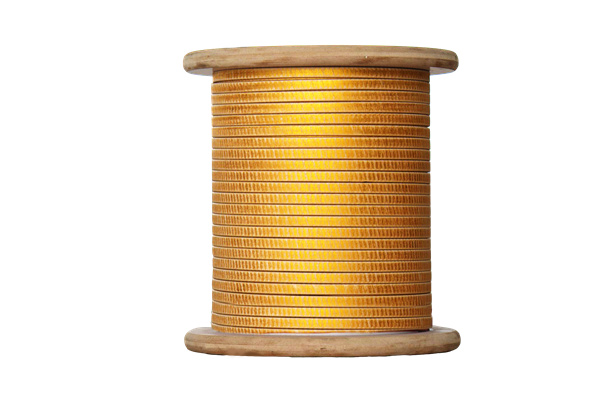
Fiberglass covered wire is a composite insulated wire formed by tightly winding, braiding, or covering bare copper or enameled copper wire with continuous fiberglass yarn (mostly E-glass alkali-free fiberglass), followed by vacuum impregnation and curing with insulating varnish. Under the IEC 60317-48 and NEMA MW 41-C standards, it belongs to the Class 155 (heat-resistant below F grade) magnet wire branch, forming a “enamel coating + fiber” double-layer insulation structure with pure enameled wire.
I. Significant Differences in Market Size and Growth Forecasts Based on Different Data Sources
Wise Guy Reports estimates the market size at approximately $2.129 billion in 2024, projecting it to reach $2.227 billion in 2025 and $3.5 billion in 2035, with a CAGR of approximately 4.6%. 24chemicalresearch, focusing solely on glass-covered wire, estimates the market size at approximately $783 million in 2024, increasing to $1.2 billion in 2032, with a CAGR of 5.7%. Verified Market Reports, using a broader definition of “glass-insulated wire,” estimates the market size at $1.5 billion in 2024, reaching $2.5 billion in 2033, with a CAGR of 6.5%. While these three sets of data differ in their data sources, they all point to the same trend—steady growth, with a CAGR between 4.6% and 6.5%. North America, Europe, and China together account for over 75% of global demand, with China contributing the most to the incremental growth.
II. Core Growth Drivers
The first driver is new energy vehicles. New energy vehicle drive motors often operate at temperatures reaching 180°C–200°C, requiring long lifespan and high PDIV (Power Demand Index). Enameled wire alone cannot meet these requirements, making fiberglass + polyamide-imide composite insulation the standard solution.
The second driving force is ultra-high voltage (UHV) and wind power transformers. The inter-turn insulation requirements of 66 kV offshore wind power and UHV converters on land have significantly increased the use of fiberglass-coated rectangular copper wire/flat wire.
The third driving force is the trend towards frequency conversion in home appliances. The demand for materials with both excellent heat resistance and insulation in the compressor motors of variable frequency air conditioners and refrigerators has surged. Industrial automation and robot servo motors are also experiencing continuous growth.
III. Regional Market Structure
North America, centered on the United States, is dominated by manufacturers such as Elektrisola and MWS Wire, which lead the high-end customized market and emphasize NEMA MW 1000 and UL 1446 standards. Europe is represented by Germany and France, with Deutsche Nickel and Block focusing on industrial transformers and rail transportation. China presents a two-tiered structure: large enterprises like Jingda Shares and Guancheng Datong produce enameled round wire; while companies like Zhengzhou LP Industry Co., Ltd. focus on niche categories like glass fiber coated flat/rectangular wire, specializing in Class 180 heat-resistant products, and have exported to over 50 countries.
IV. Technological Development Trends
On the materials side, alkali-free E-glass remains the mainstream, while high-purity S-glass is penetrating the aerospace field. Solvent-free, low-VOC insulating varnish processes are gradually replacing traditional solvent-based varnishes, driven by environmental pressures. Composite insulation systems (polyester + glass fiber, polyamide-imide + glass fiber) have become the de facto standard for high heat resistance Class 180/200.
On the processes side, continuous fiber winding + vacuum pressure impregnation (VPI) is now widespread, and automated pultrusion is replacing some manual weaving. On the standards front, IEC 60317-48, NEMA MW 41-C, GB/T 7673, and JIS C 3202 form a global collaborative system, with a breakdown voltage of 170–540 V (single/double) as a key acceptance indicator.
V. Competitive Landscape and Supply Chain
Upstream fiberglass yarn suppliers are highly concentrated—China’s Jushi, Taishan Fiberglass, US-based AGY, and Japan’s NEG are key sources. Midstream fiberglass coating yarn manufacturers are most numerous in China, with the fastest capacity expansion. Downstream applications are highly fragmented, with transformers, motors, home appliances, and new energy each accounting for a certain proportion.
When selecting suppliers, buyers are advised to focus on five key points: whether they simultaneously hold UL/IEC/NEMA multi-system certifications; actual breakdown voltage test reports for Class 180 and higher thermal classes; consistency of fiberglass weaving density and enamel coating uniformity; export experience and ocean shipping packaging capabilities; and the ability of the factory to provide direct quotes.
VI. Risks and Challenges
The trend of aluminum replacing copper puts structural pressure on fiberglass-coated copper wire. Low-priced manufacturers’ inferior fiberglass yarn (high impurity content, loose weaving) impacts the high-end market. RoHS and REACH regulations are imposing increasingly stringent environmental requirements on insulating varnishes, forcing solvent-based varnish companies to face transformation costs. The tariff uncertainty brought about by the US-China trade friction continues to affect cross-border supply chains.
VII. 2026–2030 Outlook
Over the next five years, the global fiberglass-coated wire market is expected to maintain a CAGR of 5%–7%. New energy vehicles, ultra-high voltage (transformer) power transmission, and frequency conversion in home appliances are the three major certain growth drivers. The proportion of Class 180+ high-heat-resistant products will increase from the current 30% to over 50%. Solvent-free varnish and low-loss fiberglass weaving technology will become a watershed moment.
For buyers, the key decision points for the next 3–5 years are clear: first, whether the certification system covers the target market; second, the actual mass production capacity of Class 180; and third, whether the supplier can deliver in tandem with capacity expansion. Grasping these three points is more important than simply comparing prices.
If you are evaluating suppliers of fiberglass-coated round copper wire, fiberglass-coated enameled flat copper wire, or fiberglass-paper-coated flat copper wire, please contact Zhengzhou LP Industry Co., Ltd. Email: office@cnlpzz.com, WhatsApp: 0086-19337889070. We offer direct factory supply with 30 years of export experience.