

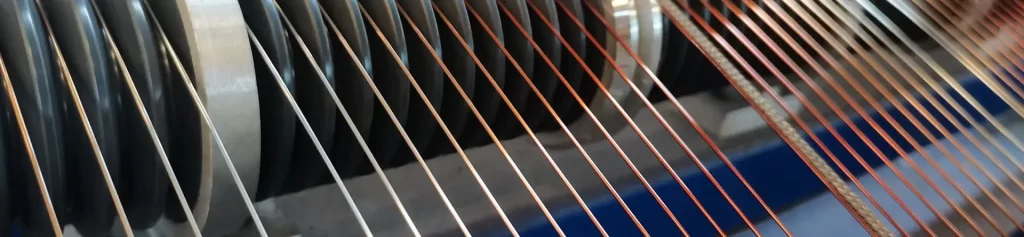
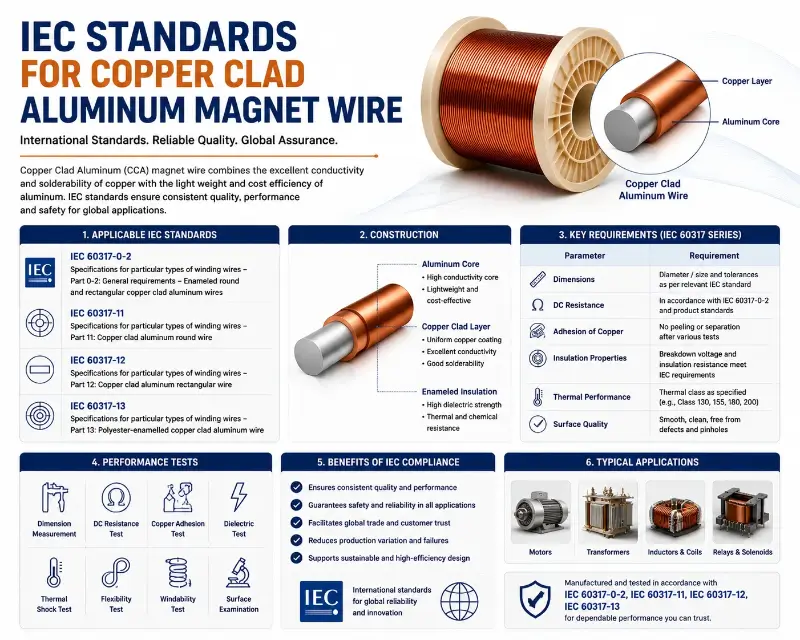
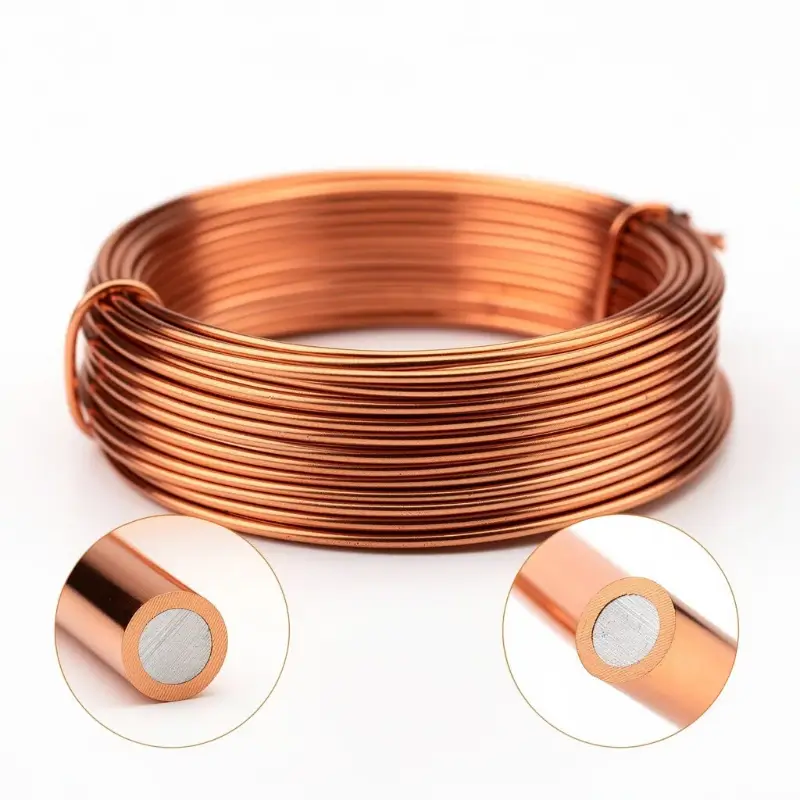
Copper clad aluminum magnet wire (CCAW, CCA enameled wire, ECCA, enameled copper clad aluminum wire), as a key subclass of winding wire (enameled wire, electromagnetic wire, magnet wire, winding wire), combines the excellent electrical conductivity and oxidation resistance of copper with the lightweight nature and cost-effectiveness of aluminum, and is increasingly applied in medium-frequency transformers, audio transformers, high-frequency inductors, household appliances, UPS uninterruptible power supplies, special-purpose motors, auxiliary windings for new-energy vehicles, magnetic components for 5G/6G communications, and inductive ballasts. International standardization of copper clad aluminum magnet wire forms the foundation for quality control, trade compliance, procurement acceptance, and product development—understanding the parameter requirements, nomenclature rules, test methods, and acceptance criteria specified in standards from the International Electrotechnical Commission (IEC), China’s National Standards (GB/T), China’s Electronic Industry Standards (SJ/T), ASTM International (ASTM), the National Electrical Manufacturers Association (NEMA), and the Japanese Industrial Standards (JIS) is an essential prerequisite for qualified suppliers, engineering design, and procurement acceptance. Because copper clad aluminum magnet wire belongs both to winding wire (enameled wire) and to copper clad aluminum wire (a bimetallic composite material), its standard system exhibits a dual nature:
– As enameled wire: Must comply with enameled wire series standards including IEC 60851 (test methods), IEC 60317 (product specifications), GB/T 6109, GB/T 4074, NEMA MW 1000, and JIS C 3202
– As copper clad aluminum composite wire: Must comply with composite wire standards including SJ/T 11223 (China’s electronic industry standard), IEC 61196-1-308 (copper clad aluminum for coaxial cables), and ASTM B566 / B986 (copper clad aluminum round/flat wire)
Since IEC currently lacks a dedicated standard specifically for “copper clad aluminum enameled wire”, industry practice is to adopt a combined reference approach, drawing upon:
– Enameled aluminum wire standards: IEC 60317-0-3 and the aluminum-enamelled-wire sections of GB/T 6109
– Copper clad aluminum wire standards: SJ/T 11223 and ASTM B566
– Enamel coating-related standards: Selection of relevant parts of IEC 60317 based on enamel chemistry and temperature class
This document systematically presents an overview of the standard system for copper clad aluminum enameled wire (IEC/GB/SJ/ASTM/NEMA/JIS), the IEC 60851 series test method standards, the IEC 60317 series product specification standards, IEC 60317-0-3 (General Specification for Enamelled Round Aluminium Wire—the primary reference for CCA enameled wire), the requirements for enameled wire stipulated in the GB/T 6109 series national standards, the SJ/T 11223 industry standard for copper clad aluminum wire (covering copper volume ratio classification, diameter tolerances, and copper layer thickness), ASTM B566 / B986 (U.S. CCA standards), NEMA MW 1000 (U.S. magnet wire standard), JIS C 3202 / C 3003 (Japanese standards), nomenclature rules for CCA enameled wire, copper volume ratio requirements (10%/15%/20%/30%), diameter and tolerance requirements, enamel coating grades (Grade 1/2/3), dielectric breakdown voltage requirements, thermal shock temperature requirements, softening breakdown requirements, acceptance criteria and test methods, and a CCA enameled wire project acceptance checklist—aiming to provide magnet wire manufacturers, quality control engineers, procurement engineers, testing laboratories, and R&D engineers with a comprehensive, actionable, and data-supported international/national standard system comparison manual for copper clad aluminum enameled wire.
Overview of the Copper Clad Aluminum Enameled Wire Standard System
Complexity Arising from Dual Nature
The standard system for copper clad aluminum enameled wire (CCA enameled wire) exhibits a dual nature:
| Attribute | Primary Standard Series | International Standards | Chinese Standards |
|---|---|---|---|
| Winding Wire (Enameled Wire) | Enameled wire specifications | IEC 60317, IEC 60851 | GB/T 6109, GB/T 4074 |
| Composite Wire (Copper Clad Aluminum) | Copper clad aluminum composite wire | ASTM B566, IEC 61196-1-308 | SJ/T 11223 |
Because no dedicated international standard exists for CCA enameled wire, the industry generally adopts the following three referencing approaches:
- Approach 1: Reference the applicable part(s) of IEC 60317 according to enamel chemistry and temperature class (using either the aluminum or copper version)
- Approach 2: Concurrently reference IEC 60851 (test methods) and SJ/T 11223 (composite wire requirements)
- Approach 3: Customer-defined technical specifications supplemented by selected clauses from IEC 60851 and IEC 60317-0-3
Main Standard Comparison Table
| Standard | Scope | Application to Copper Clad Aluminum Enameled Wire |
|---|---|---|
| IEC 60851 | Test methods for winding wires (6 parts) | Foundational test method standard |
| IEC 60317 | Specifications for special winding wires (40+ parts) | Selection based on enamel type and temperature class |
| IEC 60317-0-3 | General specification for enamelled round aluminium wire | Primary reference for CCA enameled wire |
| GB/T 4074 | Test methods for winding wires (identical to IEC 60851) | Testing in the Chinese market |
| GB/T 6109 | Enamelled round winding wires (identical to IEC 60317) | Product specifications in the Chinese market |
| SJ/T 11223 | Copper clad aluminum wire (electronic industry standard) | Dedicated Chinese standard for CCA wire |
| IEC 61196-1-308 | Copper clad aluminum wire for coaxial cables | High-frequency cable CCA applications |
| ASTM B566 | Copper clad aluminum round wire | North American market |
| ASTM B986 | Copper clad aluminum flat wire | North American market |
| NEMA MW 1000 | Magnet wire standard | North American market |
| JIS C 3202 | Enamelled copper/aluminium wire | Japanese market |
| JIS C 3003 | Test methods for enamelled wire | Testing in the Japanese market |
IEC 60851 Series: Test Methods for Winding Wires (Fundamental Standard)
IEC 60851 constitutes the fundamental international standard for test methods for winding wires (enameled wires), comprising six parts.
IEC 60851-1: General Requirements
- Title: Winding wires – Test methods – Part 1: General
- Scope: Definition of terms, specimen preparation, general principles of test methods, and nomenclature rules
- Key content:
- Definition of nominal conductor diameter
- Enamel coating thickness grading (Grade 1/2/3)
- Specimen length (e.g., 600 mm for twisted specimens)
- Test temperature (20 ± 5 °C or 23 ± 2 °C)
IEC 60851-2: Determination of Dimensions
- Title: Winding wires – Test methods – Part 2: Determination of dimensions
- Key content:
- Conductor diameter: micrometer (accuracy 0.001 mm)
- Enamel coating thickness: measuring microscope or laser micrometer
- Eccentricity: ratio of maximum to minimum coating thickness
- Minimum insulation thickness
- Overall diameter tolerance
IEC 60851-3: Mechanical Properties
- Title: Winding wires – Test methods – Part 3: Mechanical properties
- Key tests:
- Elongation at break (≥ 25%)
- Spring-back angle
- Flexibility (wrap test)
- Enamel adhesion (rapid pull test)
- Enamel abrasion resistance
- Enamel cut-through resistance
IEC 60851-4: Chemical Properties
- Title: Winding wires – Test methods – Part 4: Chemical properties
- Key tests:
- Test 12: Solvent resistance (standard solvents)
- Test 15: Refrigerant resistance (R22, R134a)
- Test 16: Transformer oil resistance
IEC 60851-5: Electrical Properties
- Title: Winding wires – Test methods – Part 5: Electrical properties
- Key tests:
- Test 5: Conductor resistance
- Test 13: Dielectric breakdown voltage (twist method/steel ball method)
- Test 14: Insulation continuity (pinhole test)
- Test 19: Dielectric loss factor
- Test 23: Pinhole count
IEC 60851-6: Thermal properties
- Title: Winding wires – Test methods – Part 6: Thermal properties
- Key tests:
- Test 9: Heat shock resistance (30 min at grade temperature)
- Test 10: Softening breakdown resistance
- Test 11: Weight loss (volatiles at elevated temperature)
- Key parameters:
- Test temperature: According to enamel temperature class
- Test duration: 30 min
- Specimen: Enamelled round wire
Application of IEC 60851 to CCA enamelled wire
Since IEC 60851 is a general winding wire standard, it is fully applicable to copper-clad aluminum (CCA) enamelled wire—all test methods (dimensional, mechanical, chemical, electrical, thermal) follow conventional winding wire testing procedures; however, conductor resistance is a special consideration for CCA (significantly different from copper wire).
IEC 60317 series: Product specifications for special winding wires
IEC 60317 comprises over 40 parts, organized by enamel chemistry/temperature class, specifying product requirements.
IEC 60317-0-X series: General specifications
- IEC 60317-0-1: General requirements for enamelled round copper wire (diameter range: 0.018–1.600 mm)
- IEC 60317-0-2: General requirements for enamelled flat copper wire
- IEC 60317-0-3: General requirements for enamelled round aluminum wire (diameter range: 0.250–3.150 mm)
- IEC 60317-0-4: Enamelled round aluminum wire, class 200
Key content of IEC 60317-0-3 (primary reference for CCA enamelled wire):
- Diameter range: 0.250–3.150 mm
- Enamel grade: Grade 1/2/3 (corresponding to enamel thickness)
- Dielectric breakdown voltage (segmented by diameter)
- Heat shock temperature (by enamel grade)
- Softening breakdown temperature (by enamel grade)
- Elongation (≥ 25%)
- Nomenclature rules
IEC 60317-X series: Specifications by enamel chemistry/temperature class
| Part | Enamel chemistry | Temperature class | Diameter range | Standard number |
|---|---|---|---|---|
| -1 | PEW polyester | 130 | 0.018–1.600 mm | IEC 60317-1 |
| -2 | PEW solderable polyester | 130 | 0.018–1.600 mm | IEC 60317-2 |
| -3 | PEW polyester | 155 | 0.018–1.600 mm | IEC 60317-3 |
| -4 | UEW polyurethane | 130 | 0.020–0.800 mm | IEC 60317-4 |
| -7 | PEI polyesterimide | 180 | 0.018–1.600 mm | IEC 60317-7 |
| -8 | PEI polyesterimide | 180 (modified) | 0.018–1.600 mm | IEC 60317-8 |
| -11 | UEW polyurethane | 155 | 0.020–0.800 mm | IEC 60317-11 |
| -13 | PEI/PAI dual coating | 200 | 0.050–5.000 mm | IEC 60317-13 |
| -25 | PE polyester | 155 (modified) | 0.020–1.600 mm | IEC 60317-25 |
| -30 | PI polyimide | 220 | 0.050–3.150 mm | IEC 60317-30 |
| -35 | UEW dual coating (bonding layer) | 155 | 0.020–0.800 mm | IEC 60317-35 |
| -42 | PE polyester | 155 (for aluminum wire) | 0.250–3.150 mm | IEC 60317-42 |
IEC 60317-13: Class 200 PEI/PAI dual-coated wire (key reference for CCA enamelled wire)
Standard content:
- Title: Polyester or polyesterimide overcoated with polyamide-imide enamelled round copper wire, class 200
- Scope: Grade 1 (0.050–2.000 mm), Grade 2 (0.050–5.000 mm)
- Enamel structure: Primer (PE/PEI) + topcoat (PAI)
- Key requirements:
- Temperature index ≥ 200
- Heat shock temperature ≥ 220 °C
- Dielectric breakdown voltage (segmented by diameter)
- Elongation (≥ 25%)
- Abrasion resistance test
Application to CCA enamelled wire: Serves as the primary reference for class 200 CCA enamelled wire with PAI topcoat.
IEC 60317-0-3 nomenclature rules
Nomenclature format:
IEC 60317-<part> - <temperature class> - <enamel chemistry> - <diameter> - <enamel grade> - <conductor material>
Examples:
- IEC 60317-7-180-PEI-1.000-G2-Al: PEI enamel, class 180, 1.000 mm, Grade 2 enamel, aluminum conductor
- IEC 60317-13-200-PEI+PAI-1.000-G2-Al: PEI+PAI dual coating, class 200, 1.000 mm, Grade 2, aluminum conductor
SJ/T 11223: Chinese electronic industry standard for copper-clad aluminum wire
SJ/T 11223 is the most direct Chinese electronic industry standard (SJ = industry standard) for copper-clad aluminum (CCA) wire.
Standard information
- Standard number: SJ/T 11223-2000
- Title: Copper-clad aluminum wire
- Scope: Copper-clad aluminum round wire (bare wire, suitable for insulation)
- Administrative authority: Ministry of Information Industry
Classification by copper volume ratio (key parameter)
| Category | Copper volume ratio range | Designation |
|---|---|---|
| 10A / 10H | 8–12% | 10% |
| 15A / 15H | 13–17% | 15% |
| 20A / 20H | 18–22% | 20% |
Temper classification:
- A (Soft Annealed): Annealed condition—elongation ≥ 15%
- H (Hard): As-drawn condition—elongation ≤ 10%
Minimum copper layer thickness requirement (key parameter)
- 10A / 10H wire: Minimum copper layer thickness ≥ 3.5% of radius
- 15A / 15H wire: Minimum copper layer thickness ≥ 5% of radius
Example (1.000 mm CCA wire, radius = 0.500 mm):
- 10A: Minimum copper layer thickness ≥ 0.500 × 3.5% = 0.0175 mm
- 15A: Minimum copper layer thickness ≥ 0.500 × 5% = 0.025 mm
Diameter tolerance
- < 0.254 mm: ±0.0001 in (±0.003 mm)
- ≥ 0.254 mm: ±0.0002 in (±0.005 mm)
Copper volume ratio calculation
Formula:
S = [1 − (D−2t)² / D²] × 100%
Where:
- S: Copper volume ratio (%)
- D: Overall diameter of copper-clad aluminum wire (mm)
- t: Average copper layer thickness (mm)
Test methods (per SJ/T 11223)
Minimum copper layer thickness measurement:
- Equipment: Wire cutters, measuring microscope
- Method: Cross-section polishing and measurement
- Procedure:
1. Cut an appropriate length from one end of the sample
2. Grind and polish the cross-section
3. Measure using a measuring microscope (magnification ≥ 100×)
4. Measure copper layer thickness at four perpendicular positions
5. Include the location of minimum copper layer thickness
6. Calculate average value and volume ratio
Resistivity test:
- Test instrument: Wheatstone bridge or four-terminal resistance measurement
- Unit: Ω·m or Ω·mm²/m
- Typical value (10% Cu): ~2.74 × 10⁻⁸ Ω·m
- Typical value (15% Cu): ~2.55 × 10⁻⁸ Ω·m
- Typical value (20% Cu): ~2.40 × 10⁻⁸ Ω·m
- Typical value (30% Cu): ~2.20 × 10⁻⁸ Ω·m
Density test:
- Method: Archimedes’ water displacement method
- Typical value (10% Cu): ~3.91 g/cm³
- Typical value (15% Cu): ~4.20 g/cm³
- Typical value (20% Cu): ~4.50 g/cm³
- Typical value (30% Cu): ~5.10 g/cm³
- Reference: Pure aluminum 2.70 g/cm³, pure copper 8.96 g/cm³
CCA wire appearance requirements (per SJ/T 11223)
Surface quality:
- Smooth surface
- Uniform color
- No blisters
- No paint lumps, black spots, or black streaks
- No oxidation, cracking, impact damage, or scratches
- No bare-wire patterns
- Non-tacky at ambient temperature
- Uniform winding alignment
Visual inspection instruments:
- Diameter ≥ 1.83 mm: Normal vision
- Diameter < 1.83 mm: ≤ 10× magnifier
GB/T 6109: Chinese enamelled round winding wire specification
GB/T 6109 series is the Chinese national equivalent of IEC 60317.
Main parts of GB/T 6109
| Part | Content | Corresponding IEC |
|---|---|---|
| GB/T 6109.1 | General requirements | IEC 60317-0-1 |
| GB/T 6109.2 | Polyester enamelled round copper wire (Class 130) | IEC 60317-1 |
| GB/T 6109.7 | Polyester enamelled round copper wire (Class 155) | IEC 60317-3 |
| GB/T 6109.9 | Polyurethane enamelled round copper wire | IEC 60317-4 |
| GB/T 6109.13 | Polyester or polyester-imide enamelled round copper wire (Class 180) | IEC 60317-7 |
| GB/T 6109.14 | Polyester-imide enamelled round copper wire (Class 180) | IEC 60317-8 |
| GB/T 6109.20 | Polyester-imide/polyamide-imide dual-coated wire (Class 200) | IEC 60317-13 |
| GB/T 6109.X | Other coating/temperature classes | Corresponding IEC 60317 parts |
GB/T 6109.20: Class 200 dual-coated wire (commonly used for CCA enamelled wire)
Key requirements:
- Diameter: 0.050–5.000 mm
- Coating system: PE/PEI primer + PAI topcoat
- Temperature index: ≥ 200
- Thermal shock temperature: ≥ 220°C
- Dielectric breakdown voltage: As specified in IEC 60317-13
- Elongation: ≥ 25%
GB/T 4074: Test methods (equivalent to IEC 60851)
- GB/T 4074.1: General requirements (equivalent to IEC 60851-1)
- GB/T 4074.2: Dimensions (equivalent to IEC 60851-2)
- GB/T 4074.3: Mechanical properties (equivalent to IEC 60851-3)
- GB/T 4074.4: Chemical properties (equivalent to IEC 60851-4)
- GB/T 4074.5: Electrical properties (equivalent to IEC 60851-5)
- GB/T 4074.6: Thermal properties (equivalent to IEC 60851-6)
ASTM B566 / B986: U.S. CCA standards
ASTM B566
- Title: Standard Specification for Copper-Clad Aluminum Wire
- Scope: Copper-clad aluminum round wire (bare)
- Key requirements:
- Copper volume ratio: 10% / 15% / 20% / 30%
- Diameter tolerance: Per AWG standard
- Elongation: Hard temper ≥ 1.5%, soft temper ≥ 15%
- Resistivity: Calculated per copper volume ratio
ASTM B986
- Title: Standard Specification for Copper-Clad Aluminum Rectangular Wire
- Scope: Copper-clad aluminum rectangular wire (for transformers, motors)
- Key requirements:
- Thickness range: 0.50–6.00 mm
- Width range: 2.00–25.00 mm
- Copper volume ratio: 10% / 15% / 20%
- Applications: Transformers, traction motors
ASTM B258 / B263
- ASTM B258: Standard specification for standard diameters and cross-sectional areas of solid round wires
- ASTM B263: Standard test method for determining copper layer thickness and mass ratio of copper-clad aluminum wire
NEMA MW 1000: U.S. magnet wire standard
NEMA MW 1000 is the magnet wire standard published by the National Electrical Manufacturers Association.
Main parts
- Part 1: General requirements
- Part 2: Test methods (referencing ASTM standards)
- Part 3: Thermal life (referencing ASTM D2307)
- Part 4: Enamel identification system
- Part 5: Bare conductors
- Part 6: Enamelled round copper wire
- Part 7: Enamelled aluminum wire (including CCA)
- Part 8: Enamelled rectangular copper/aluminum wire
Application of NEMA MW 1000 to CCA enamelled wire
- References copper volume ratio per ASTM B566
- References test methods per IEC 60851 / ASTM D2307
- Naming convention follows MW 1000 Part 4
- Enamel chemistry references MW 1000 Parts 6–8
JIS C 3202 / C 3003: Japanese standards
JIS C 3202
- Title: Enamelled Round Winding Wires
- Scope: Enamelled round winding wires (copper, aluminum, CCA)
- Key requirements: Aligned with IEC 60317
- Temperature classes: Corresponding to IEC classes
JIS C 3003
- Title: Testing Methods for Enamelled Wires
- Scope: Test methods for enamelled wires
- Key tests: Aligned with IEC 60851
CCA enamelled wire project acceptance checklist
Acceptance items and standard reference
| Item | Referenced Standard | Acceptance Method | Typical Value |
|---|---|---|---|
| Conductor diameter | IEC 60851-2 | Micrometer (0.001 mm resolution) | 1.000 ± 0.005 mm |
| Coating thickness | IEC 60851-2 | Microscopic micrometer | G2: 0.025–0.060 mm |
| Minimum copper layer thickness | SJ/T 11223 | Cross-section polishing method | ≥ 3.5–5% of radius |
| Copper volume ratio | SJ/T 11223 | Calculation method | 10% / 15% / 20% / 30% |
| Eccentricity | IEC 60851-2 | Microscope | ≤ 0.8 (max/min) |
| Conductor resistance | IEC 60851-5 | Bridge method | Per copper volume ratio |
| Dielectric breakdown voltage | IEC 60851-5 | Twisting method | ≥ 6 kV |
| Insulation resistance | IEC 60851-5 | High-resistance meter | ≥ 10⁶ Ω·m |
| Elongation | IEC 60851-3 | Tensile testing machine | ≥ 25% (soft temper) |
| Flexibility | IEC 60851-3 | Mandrel wrap test | No cracking on 1× mandrel |
| Coating adhesion | IEC 60851-3 | Rapid pull-off test | No delamination |
| Thermal shock resistance | IEC 60851-6 | Oven + wrap test | At class-rated temperature |
| Softening breakdown | IEC 60851-6 | High-temperature test | At class-rated temperature |
| Weight loss | IEC 60851-6 | Gravimetric method | < Class-specified limit |
| Appearance | SJ/T 11223 | Magnifier (≤ 10×) | Defect-free |
Sampling plan
Per GB/T 2828.1 or IEC 60410:
- Normal inspection, single sampling, Inspection Level I
- AQL 0.4–1.0 (based on criticality of specification)
- Typical lot size 500–1200 kg, sample size n = 80
Nonconformance handling
- Physical isolation + “Nonconforming” labeling
- Return / sorting / downgrading / scrap
- SCAR (Supplier Corrective Action Request)
- Improvement tracking
CCA Enamelled Wire Selection Decision
Selection by Application
| Application | Recommended Enamel System | Temperature Class | Referenced Standards |
|---|---|---|---|
| Medium-frequency transformers | UEW (solderable) | 130/155 | IEC 60317-4/-11 |
| Audio transformers | PEW / UEW | 130/155 | IEC 60317-1/-2/-4 |
| High-frequency inductors | UEW / PEI | 155/180 | IEC 60317-11/-7 |
| Household appliances | PEW / UEW | 130/155 | IEC 60317-1/-4 |
| UPS inductors | PEI / dual-coating | 180/200 | IEC 60317-7/-13 |
| Special-purpose motors | PEI/PAI dual-coating | 200 | IEC 60317-13 |
Selection by Copper Volume Ratio
| Application | Recommended Copper Volume Ratio | Rationale |
|---|---|---|
| High-frequency cables | 10% | Lowest cost; sufficient skin-effect coverage |
| Medium-frequency transformers | 15% | Balanced cost vs. conductivity |
| Motor windings | 15–20% | Optimized conductivity vs. weight |
| General-purpose transformers | 15–20% | Standard configuration |
| Special applications (high conductivity) | 20–30% | High copper content |
| Aerospace/military | 20–30% | High reliability |
Selection by Standard Combinations
| Application Scenario | Referenced Standard Combinations |
|---|---|
| Sales in China | GB/T 4074 (test methods) + GB/T 6109 (product specifications) + SJ/T 11223 (CCA) |
| Sales in Europe | IEC 60851 + IEC 60317 |
| Sales in North America | ASTM B566 + ASTM D2307 + NEMA MW 1000 |
| Sales in Japan | JIS C 3003 + JIS C 3202 |
| Global use | IEC 60851 + IEC 60317 + ASTM B566 |
CCA Enamelled Wire Supplier Qualification Checklist
Incoming Material Inspection Checklist
Basic Items:
– [ ] Specification sheet (diameter, enamel thickness, copper volume ratio, enamel class)
– [ ] Batch number, manufacturing date, shelf life
– [ ] Supplier’s factory test report
– [ ] Third-party test report (if required)
Critical Inspections:
– [ ] Diameter tolerance (micrometer)
– [ ] Enamel thickness (microscope)
– [ ] Minimum copper layer thickness (cross-section polishing method)
– [ ] Copper volume ratio (calculation method)
– [ ] Dielectric breakdown voltage (twist test, 5 wires)
– [ ] Visual appearance (magnifier)
Critical Certifications:
– [ ] ISO 9001 (baseline)
– [ ] RoHS test report
– [ ] REACH test report
– [ ] OEM customer approval (e.g., automotive)
Common Nonconformance Modes
| Nonconformance Mode | Root Cause | Corrective Action |
|---|---|---|
| Insufficient copper layer thickness | Extrusion process issue | Strengthen process control |
| Eccentric copper layer | Die misalignment | Adjust die |
| Eccentric enamel coating | Enamelling process | Optimize enamelling parameters |
| Low dielectric breakdown voltage | Enamel defects | Enhance in-line inspection |
| Thermal shock cracking | Poor enamel adhesion | Improve pre-treatment |
| Resistance out of specification | Deviation in copper volume ratio | Calibrate process parameters |
Summary
Copper-clad aluminum (CCA) enamelled wire, as a critical subclass of winding wire, combines the excellent electrical conductivity and oxidation resistance of copper with the lightweight and low-cost advantages of aluminum, and is widely applied in medium-frequency transformers, audio transformers, high-frequency inductors, household appliances, UPS systems, auxiliary windings for new-energy vehicles, and magnetic components for 5G/6G communications. Its international standardization system exhibits dual attributes: it belongs both to the category of enamelled wire (referencing IEC 60851 test methods, IEC 60317 product specifications, GB/T 4074, GB/T 6109) and to the category of copper-clad aluminum composite wire (referencing SJ/T 11223, ASTM B566, IEC 61196-1-308). As IEC currently lacks a dedicated standalone standard for CCA enamelled wire, the industry adopts a combined referencing approach: IEC 60317-0-3 (General requirements for enamelled round aluminum wire) + SJ/T 11223 (Copper-clad aluminum wire) + relevant parts of IEC 60317 (by enamel type and temperature class). This document systematically outlines: the overall CCA enamelled wire standard framework (six systems: IEC/GB/SJ/ASTM/NEMA/JIS); IEC 60851 series test method standards (Parts 1–6: General rules / Dimensions / Mechanical / Chemical / Electrical / Thermal); IEC 60317 series product specifications (Part 0-X general provisions + individual parts by enamel type and temperature class); IEC 60317-0-3 (General requirements for enamelled round aluminum wire — primary reference for CCA enamelled wire); GB/T 6109 series national standards for enamelled wire; SJ/T 11223 industry standard for copper-clad aluminum wire (specifying copper volume ratios of 10%/15%/20%, minimum copper layer thickness requirements, diameter tolerances, and test methods); ASTM B566 / B986 U.S. CCA standards; NEMA MW 1000 U.S. magnet wire standard; JIS C 3202 / C 3003 Japanese standards; CCA enamelled wire project acceptance checklist (15 acceptance items + sampling + nonconformance handling); CCA enamelled wire selection decision (by application / copper volume ratio / standard combination); and CCA enamelled wire supplier qualification checklist (basic items + critical inspections + critical certifications + common nonconformance modes).
Core Standard Cross-Reference Table:
| Dimension | International Standard | Chinese Standard |
|---|---|---|
| Test Methods | IEC 60851 (Parts 1–6) | GB/T 4074 |
| Product Specifications | IEC 60317 (40+ parts) | GB/T 6109 |
| General Requirements for Enamelled Round Aluminum Wire | IEC 60317-0-3 | Corresponding part of GB/T 6109 |
| Copper-Clad Aluminum Composite Wire | ASTM B566 | SJ/T 11223 |
| CCA for Coaxial Cables | IEC 61196-1-308 | — |
| Thermal Life | ASTM D2307 | GB/T 4074 |
| General Requirements for Magnet Wire | NEMA MW 1000 | — |
Core Parameter Requirements:
– Copper Volume Ratio: 10% (8–12%), 15% (13–17%), 20% (18–22%), 30% (25–35%)
– Minimum Copper Layer Thickness: 10A/10H ≥ 3.5% of radius; 15A/15H ≥ 5% of radius
– Diameter Tolerance: < 0.254 mm: ±0.003 mm; ≥ 0.254 mm: ±0.005 mm
– Dielectric Breakdown Voltage: ≥ 6 kV (for 1.000 mm diameter CCA enamelled wire)
– Elongation: Soft temper ≥ 25%; Hard temper ≥ 1.5%
– Temperature Index: 130–240 °C, per enamel class
– Thermal Shock Temperature: Per enamel class temperature
Core Selection Principles:
– High-frequency cables: 10% Cu + UEW (IEC 60317-4)
– Medium-frequency transformers: 15% Cu + UEW/PEW (IEC 60317-4/-11)
– General-purpose transformers: 15–20% Cu + PEI (IEC 60317-7)
– Automotive windings: 15–20% Cu + dual-coating (IEC 60317-13)
– Aerospace/military: 20–30% Cu + PI (IEC 60317-30)
As emerging applications—including new-energy vehicles, AI data centers, 5G/6G communications, wind power, photovoltaics, and energy-efficient household appliances—impose increasingly stringent requirements on CCA enamelled wire, the standardization system is evolving toward “refined enamel classification, standardized copper layer ratios, intelligent test methods, and stricter green compliance.” Engineers are advised to establish a core standard framework comprising “IEC 60851 test methods + IEC 60317 product specifications + SJ/T 11223 copper layer requirements,” and perform systematic matching based on specific application needs (high/medium/low frequency; low/medium/high temperature; automotive/household/general-purpose).