

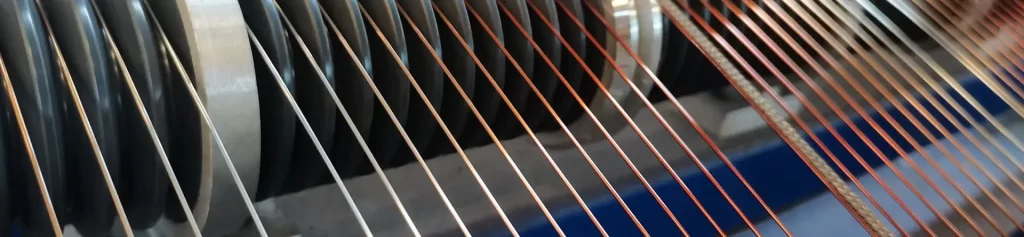
Introduction: Why Is “Smoothness” Key in the Automatic Winding Era?
In modern motor/transformer production lines, automatic winding machines have replaced traditional manual winding and become the absolute mainstream. A high-speed automatic winding machine can reach line speeds of 30–50 m/s, with the enameled wire contacting guide wheels, molds, and tensioners at frequencies of dozens of times per second.
Under such extreme working conditions, enameled wire surface characteristics become the “core variable” determining production efficiency, product quality, and equipment life. And the most critical characteristic is “surface smoothness”.
Why is “smoothness” so important?
- Lower friction coefficient μ: Reduce friction heating between enameled wire and guide wheels (temperature rise is the main cause of enamel damage);
- Higher winding speed: Low μ allows higher line speeds without damaging the enamel;
- Reduced tension fluctuation: Low μ reduces tension spikes during winding (automatic winding requires tension stability within ±5%);
- Extended equipment life: Low μ reduces wear on guide wheels and molds;
- Lower breakage rate: Low μ reduces localized stress concentration on enamel causing wire breakage;
- Improved slot fill rate: Low μ enameled wire packs more tightly in slots.
However, “smooth” ≠ “abrasion-resistant” ≠ “self-lubricating”. These three concepts are easily confused, but their physical meanings are completely different:
| Concept | Physical Meaning | Typical Indicator |
|---|---|---|
| Smooth Surface | Low surface roughness Ra, low friction coefficient μ | Ra ≤0.3μm, μ ≤0.18 |
| Abrasion-Resistant Enameled Wire | Strong enamel mechanical wear resistance | Abrasion cycles ≥100 |
| Self-Lubricating Enameled Wire | Enamel contains lubricant, extremely low friction | μ ≤0.10 |
A common misconception is that “abrasion-resistant equals smooth”. In fact:
– Abrasion-resistant focuses on “how many friction cycles the enamel can withstand before being worn through”;
– Smooth focuses on “how much heat and tension is generated during friction”.
– Self-lubricating goes further, with the enamel itself releasing lubricating molecules.
This article focuses on “smooth surface enameled wire adaptability in automatic winding“, systematically explaining:
- Surface tribology mechanism (roughness Ra / friction coefficient μ / surface energy γ / contact angle θ)
- 3 major smooth surface enamel systems (PEI modified / self-lubricating coating / composite nano coating)
- Automatic winding machine process requirements and matching relationships
- 5+ key testing methods (Ra / μ / contact angle / temperature rise / enamel continuity)
- Selection decision tables for different application scenarios (home appliance/automotive/micro-special/transformer/industrial)
- Common problems and future trends
Core Insight:
Smooth surface is the “soft power” of automatic winding machines. A high-end automatic winding machine can only truly realize the advantages of high speed, low tension fluctuation, and low breakage rate when paired with appropriately smooth enameled wire.
Whether you are an equipment selection engineer for automatic winding machines, a motor/transformer process engineer, an enameled wire procurement engineer, or a quality engineer evaluating enameled wire suppliers, this article will provide you with professional, practical, and actionable references.
Article Covers 9 Core Dimensions:
- Basic concept: What is “smooth surface enameled wire”
- Surface tribology mechanism: 4 core indicators (Ra / μ / γ / θ)
- 3 major smooth surface enamel systems
- Automatic winding machine process requirements (speed / tension / mold / temperature rise)
- Smooth surface to winding speed matching relationship
- 5+ key testing methods
- Application scenario comparison (5 major scenarios)
- Selection decision table (by equipment + speed recommendation)
- Common problems + future trends
Let us begin this systematic “smooth surface” exploration journey.
1. Basic Concept: What Is “Smooth Surface” Enameled Wire
1.1 Multi-Layer Structure of Enameled Wire Surface
Enameled wire is not a simple “copper + enamel” two-layer structure, but a multi-layer composite system:
┌──────────────────────┐  ← Surface (most critical)
│   Self-lubricating coating (optional)  │     Thickness 0.5–2μm
├──────────────────────┤
│   Main enamel (PEI/PES etc.)  │     Thickness 20–60μm
├──────────────────────┤
│   Primer (adhesive)  │     Thickness 2–5μm
├──────────────────────┤
│   Copper conductor    │     Main body
└──────────────────────┘
“Surface smoothness” mainly depends on:
– Curing uniformity of main enamel (determines base Ra)
– Presence of self-lubricating coating (determines μ)
– Stability of coating process (determines batch consistency)
1.2 Common Defects on Enameled Wire Surface
| Defect | Morphology | Impact on Automatic Winding |
|---|---|---|
| Enamel Bead | Local enamel protrusion | Friction coefficient sudden change, tension fluctuation |
| Scratch | Linear surface damage | Enamel weak point, breakage risk |
| Blister | Surface bulge | Breakdown voltage weak point |
| Orange Peel | Surface rough like orange peel | μ rises, winding temperature rises |
| Flow Mark | Surface wave pattern | Tension fluctuation, uneven winding |
| Pin Hole | Tiny pores | Enamel continuity defect |
Smooth Surface Enameled Wire Goal: None of the above 6 types of defects, and Ra controlled below 0.3μm.
1.3 Essential Differences from “Abrasion-Resistant” and “Self-Lubricating”
| Dimension | Smooth Surface | Abrasion-Resistant | Self-Lubricating |
|---|---|---|---|
| Core Indicator | Low Ra (smooth surface) | High abrasion cycles (wear resistant) | Extremely low μ (lubricating) |
| Physical Essence | Surface morphology optimization | Enamel toughness enhancement | Enamel contains lubricant |
| Typical Ra | 0.1–0.3μm | 0.4–0.8μm | 0.2–0.5μm |
| Typical μ | 0.10–0.18 | 0.20–0.30 | ≤0.10 |
| Main Effect | Reduce friction heat | Resist mechanical wear | Continuous lubrication to reduce friction |
| Typical Scenario | Automatic winding (high speed) | Frequent friction occasions | Extremely high speed winding |
| Price | Medium (+30–50%) | Medium (+30–50%) | High (+80–120%) |
Key Insights:
- Abrasion-resistant enameled wire focuses on “still usable after being worn”;
- Smooth enameled wire focuses on “initial surface quality + low friction coefficient”;
- Self-lubricating enameled wire focuses on “continuous lubrication capability”.
All Three Can Be Combined: High-end enameled wire can simultaneously have “abrasion-resistant + smooth + self-lubricating” three characteristics, but the cost is extremely high.
2. Surface Tribology Mechanism: 4 Core Indicators
The surface tribology characteristics of enameled wire are determined by 4 core indicators: surface roughness Ra, friction coefficient μ, surface energy γ, and contact angle θ. These 4 indicators are interrelated and jointly determine automatic winding adaptability.
2.1 Surface Roughness Ra (Surface Roughness)
Definition: Ra is the arithmetic mean deviation of surface profile, reflecting the microscopic unevenness of the enameled wire surface.
Typical Range:
| Grade | Ra Range | Enameled Wire Type |
|---|---|---|
| Ultra-Smooth | ≤0.1μm | Top-grade special enameled wire |
| Smooth | 0.1–0.3μm | High-end automatic winding |
| Standard | 0.3–0.6μm | Ordinary enameled wire |
| Rough | 0.6–1.0μm | Low-grade enameled wire |
| Very Rough | >1.0μm | Non-conforming product |
Impact of Ra on Automatic Winding:
- Every 0.1μm reduction in Ra reduces friction coefficient by approximately 5–8%
- Excessively high Ra (>0.6μm) causes winding tension fluctuation to increase by ±30–50%
- Extremely low Ra (<0.1μm) increases actual contact area between enamel and guide wheel, which may conversely increase adhesion risk
Testing Method: Surface profilometer (contact type or optical type).
2.2 Friction Coefficient μ (Friction Coefficient)
Definition: μ is the friction coefficient between enameled wire and guide wheel material, determining friction force and friction heat.
Typical Range:
| Grade | μ Range | Enameled Wire Type |
|---|---|---|
| Extremely Low Friction | <0.08 | Self-lubricating special |
| Low Friction | 0.10–0.18 | Smooth enameled wire |
| Medium Friction | 0.18–0.25 | Ordinary enameled wire |
| High Friction | 0.25–0.35 | Rough enameled wire |
| Extremely High Friction | >0.35 | Not suitable for automatic winding |
Impact of μ on Automatic Winding:
| Impact Item | Formula/Law | Numerical Relationship |
|---|---|---|
| Friction Force | F = μ × N (N is normal force) | μ↑ → Friction force↑ |
| Friction Heat | Q = μ × F × v (v is line speed) | μ↑ → Friction heat↑ |
| Enamel Temperature Rise | ΔT ∝ Q / m×c | μ↑ → Enamel temperature rise↑ |
| Tension Fluctuation | σ ∝ μ × Δv | μ↑ → Tension fluctuation↑ |
Testing Method: Friction coefficient tester (enameled wire against standard material).
2.3 Surface Energy γ (Surface Energy)
Definition: γ is the measure of intermolecular force on the enameled wire surface, determining the wettability and adhesion of enameled wire.
Typical Range:
| Grade | γ Range (mN/m) | Enameled Wire Type |
|---|---|---|
| Low Surface Energy | <20 | Self-lubricating |
| Medium-Low Surface Energy | 20–30 | Smooth enameled wire |
| Medium Surface Energy | 30–40 | Ordinary enameled wire |
| High Surface Energy | 40–50 | Rough enameled wire |
| Extremely High Surface Energy | >50 | Metal type |
Impact of γ on Automatic Winding:
- Low γ → Small adhesion between enameled wire and guide wheel → Small friction, low temperature rise
- High γ → Large adhesion between enameled wire and guide wheel → Large friction, high temperature rise, easy breakage
Testing Method: Contact angle meter (converted through Young’s equation).
2.4 Contact Angle θ (Contact Angle)
Definition: θ is the contact angle of water droplets on the enameled wire surface, reflecting the hydrophilic/hydrophobic characteristics of enameled wire.
Typical Range:
| Grade | θ Range (Water Droplet) | Enameled Wire Type |
|---|---|---|
| Super-Hydrophobic | ≥110° | Self-lubricating |
| Hydrophobic | 90–110° | Smooth enameled wire |
| Medium | 70–90° | Ordinary enameled wire |
| Hydrophilic | 50–70° | Rough enameled wire |
| Strong Hydrophilic | <50° | Not applicable |
Relationship between θ and γ (Young’s Equation):
γ_SV = γ_SL + γ_LV × cos(θ)

γ_SV: Solid-vapor interfacial energy
γ_SL: Solid-liquid interfacial energy
γ_LV: Liquid-vapor interfacial energy
θ: Contact angle
Key Relationships:
- Large θ (hydrophobic) → Small γ_SV → Small μ → Suitable for automatic winding
- Small θ (hydrophilic) → Large γ_SV → Large μ → Not suitable for automatic winding
2.5 Synergistic Relationship of 4 Indicators
Complete Diagram:
                  Low γ (hydrophobic)
                    ↓
                Large θ (hydrophobic)
                    ↓
            Low Ra + Low μ
                    ↓
            Small friction heat + Small tension fluctuation
                    ↓
                Automatic winding adaptable
Mutual Relationships of 4 Indicators:
| Relationship | Physical Essence |
|---|---|
| Ra ↓ → μ ↓ | The smoother the surface, the smaller the actual contact area, the lower the friction coefficient |
| Ra ↓ → θ ↑ | The smoother the surface, the stronger the hydrophobicity (interfacial energy decreases) |
| θ ↑ → μ ↓ | Hydrophobic surface has small adhesion to guide wheel, low friction coefficient |
| γ ↓ → μ ↓ | Low surface energy, small intermolecular force, small friction |
Ideal Smooth Enameled Wire: Ra ≤0.2μm + μ ≤0.15 + γ ≤30 mN/m + θ ≥100°.
3. 3 Major Smooth Surface Enamel Systems
To achieve “smooth surface”, there are 3 mainstream enamel systems in industry. This section details their formulations, processes, and performance characteristics.
3.1 PEI Modified Polyesterimide Enamel
Basic Introduction:
PEI (Polyesterimide) modified enamel is the most commonly used enamel system for high-end automatic winding enameled wire. By introducing siloxane groups or fluorine groups into the PEI main chain, surface smoothing is achieved.
Modification Methods:
| Modification Method | Principle | Effect |
|---|---|---|
| Siloxane Modification | Introduce -Si-O-Si- segments | Surface energy reduced to 25–30 mN/m |
| Fluorine Modification | Introduce -CF2- groups | Surface energy reduced to 18–22 mN/m |
| Nano SiO2 Blending | Add 0.5–2% nano SiO2 | Ra reduced by 30–50% |
| Wax Micro-powder Blending | Add 0.1–0.5% wax micro-powder | μ reduced by 20–30% |
Typical Performance:
- Ra: 0.15–0.30μm
- μ: 0.12–0.18
- γ: 25–30 mN/m
- Temperature Class: Class 180 (some can reach Class 200)
- Abrasion Cycles: ≥80 (still maintains enamel integrity)
- Price: 30–50% higher than ordinary PEI
Applicable Scenarios: Home appliance motors, automotive motors, industrial motors (most automatic winding scenarios).
3.2 Self-Lubricating Coating
Basic Introduction:
Self-lubricating coating is an additional coating of lubricant-containing thin layer (typical thickness 0.5–2μm) applied on top of the main enamel. The lubricant is slowly released during winding, significantly reducing the friction coefficient.
Lubricant Types:
| Lubricant | Type | Lubrication Effect | Persistence |
|---|---|---|---|
| Paraffin Micro-powder | Solid lubricant | Medium | Medium |
| PTFE Micro-powder | Solid lubricant | High | High |
| MoS2 Nano-powder | Solid lubricant | High | High |
| Silicone Oil Microcapsule | Liquid lubricant | High | Medium (fails after microcapsule rupture) |
| Graphene | Solid lubricant | Extremely high | Extremely high |
| Tungsten Disulfide (WS2) | Solid lubricant | High | High |
Typical Performance:
- Ra: 0.20–0.40μm
- μ: 0.06–0.10 (extremely low)
- γ: 18–25 mN/m
- Temperature Class: Depends on coating system (typical Class 155–180)
- Abrasion Cycles: ≥50 (lubricating coating will be worn off)
- Price: 80–120% higher than ordinary PEI
Applicable Scenarios: Extremely high-speed winding (30–50 m/s), military/aerospace special coils, high-precision micro-special motors.
3.3 Composite Nano Coating
Basic Introduction:
Composite nano coating is the latest cutting-edge technology, achieving “self-smoothing” of enamel by embedding inorganic nano particles (SiO2, Al2O3, TiO2, graphene, etc.) into the main enamel.
Technical Principle:
┌──────────────────────────────┐
│   Surface nano particle enrichment layer │  ← Nano particles "float" on surface forming lubricating layer
├──────────────────────────────┤
│   PEI main enamel + nano particles uniformly dispersed │  ← Particles "anchored" in enamel
├──────────────────────────────┤
│   Primer layer               │
├──────────────────────────────┤
│   Copper conductor           │
└──────────────────────────────┘
Nano Particle Types and Effects:
| Nano Particle | Diameter | Addition Amount | Effect |
|---|---|---|---|
| Nano SiO2 | 20–50nm | 0.5–2% | Ra ↓ 30–50%, μ ↓ 20–30% |
| Nano Al2O3 | 30–80nm | 0.5–1.5% | Ra ↓ 40–60%, Abrasion cycles ↑ 50% |
| Nano TiO2 | 20–50nm | 0.3–1% | Ra ↓ 25–40%, Temperature resistance ↑ |
| Graphene | 1–5 layers | 0.1–0.5% | Ra ↓ 50–70%, μ ↓ 40–60% |
| Carbon Nanotube | Diameter 10–30nm | 0.1–0.3% | Ra ↓ 30–50%, Conductivity ↑ (need to control) |
Typical Performance:
- Ra: 0.10–0.25μm (optimal)
- μ: 0.10–0.15
- γ: 22–28 mN/m
- Temperature Class: Class 180–200 (depending on nano particles)
- Abrasion Cycles: ≥120 (nano particles enhance)
- Price: 100–200% higher than ordinary PEI
Applicable Scenarios: High-end home appliance, automotive motor, precision micro-special motor, special high-frequency coil.
3.4 Comparison of Three Systems
| Dimension | PEI Modified | Self-Lubricating Coating | Composite Nano Coating |
|---|---|---|---|
| Ra (μm) | 0.15–0.30 | 0.20–0.40 | 0.10–0.25 |
| μ | 0.12–0.18 | 0.06–0.10 | 0.10–0.15 |
| Temperature Class | Class 180 | Class 155–180 | Class 180–200 |
| Abrasion Cycles | ≥80 | ≥50 | ≥120 |
| Persistence | Long-term | Medium-term (lubricant consumed) | Long-term (nano particles not consumed) |
| Price | +30–50% | +80–120% | +100–200% |
| Applicable Speed | 20–35 m/s | 35–50 m/s | 25–45 m/s |
| Batch Stability | High | Medium (coating thickness difficult to control) | Medium (particle dispersion difficult) |
Selection Recommendations:
- Home appliance motor/general scenario: PEI modified (best cost-performance)
- Extremely high-speed winding: Self-lubricating coating (lowest μ)
- Extreme working conditions (high abrasion + smooth): Composite nano coating (optimal comprehensive)
4. Automatic Winding Machine Process Requirements and Matching
4.1 4 Major Process Parameters of Automatic Winding Machine
The process requirements of automatic winding machine for enameled wire are reflected in 4 major parameters:
Parameter 1: Line Speed v
| Speed Grade | Speed Range | Typical Scenario |
|---|---|---|
| Low Speed | <10 m/s | Large transformer, special motor |
| Medium Speed | 10–20 m/s | Ordinary motor, home appliance |
| High Speed | 20–35 m/s | High-speed motor, automotive |
| Ultra-High Speed | 35–50 m/s | Micro-special motor, special coil |
| Extreme Speed | >50 m/s | Experimental |
Challenges of Speed to Enameled Wire:
- v ↑ → Friction heat Q ↑ → Enamel temperature rise ΔT ↑
- v ↑ → Tension fluctuation σ ↑
- v ↑ → Enamel local stress ↑
Parameter 2: Tension T
| Tension Grade | Tension Range | Typical Scenario |
|---|---|---|
| Low Tension | 3–8g (Φ0.10mm) | Micro-special coil |
| Medium Tension | 8–20g (Φ0.10mm) | General motor |
| High Tension | 20–50g (Φ0.10mm) | Large transformer |
Challenges of Tension to Enameled Wire:
- T ↑ → Enamel local stress ↑ → Enamel cracking risk ↑
- T fluctuation → Winding tightness uneven
Parameter 3: Die Material M
| Die Material | Surface Hardness | Friction Coefficient (with Enameled Wire) |
|---|---|---|
| Ceramic (Al2O3) | High | 0.15–0.25 |
| Cemented Carbide (WC) | Extremely High | 0.10–0.18 |
| Polycrystalline Diamond (PCD) | Extremely High | 0.05–0.10 |
| Steel (HSS) | Medium | 0.20–0.35 |
| Plastic (PEEK) | Low | 0.25–0.40 |
Recommendation: Automatic winding machine dies prioritize PCD or cemented carbide.
Parameter 4: Temperature Rise Tolerance ΔT
| Enamel Type | Softening Temperature | Recommended ΔT Upper Limit |
|---|---|---|
| PEW (Polyester) | 130–155°C | 80°C |
| PEI (Polyesterimide) | 180–200°C | 120°C |
| PI (Polyimide) | 220–240°C | 160°C |
| Composite Nano Coated PEI | 200–220°C | 140°C |
4.2 Calculation of Enamel Temperature Rise
Simplified Model:
Q_friction = μ × F × v
ΔT = Q_friction / (m × c)

Q_friction: Friction heat (W)
μ: Friction coefficient
F: Tension (N)
v: Line speed (m/s)
ΔT: Temperature rise (°C)
m: Unit length enameled wire mass (kg/m)
c: Enamel specific heat capacity (J/(kg·K), typical 1500)
Example Calculation:
Φ0.30mm enameled wire, tension F = 0.2N, v = 30 m/s:
– Ordinary enameled wire (μ = 0.30): Q = 0.30 × 0.2 × 30 = 1.8 W/m; ΔT ≈ 80°C
– Smooth enameled wire (μ = 0.15): Q = 0.15 × 0.2 × 30 = 0.9 W/m; ΔT ≈ 40°C
– Self-lubricating (μ = 0.08): Q = 0.08 × 0.2 × 30 = 0.48 W/m; ΔT ≈ 22°C
Conclusion: Under the same conditions, the temperature rise of smooth enameled wire is 50% lower than ordinary enameled wire, and self-lubricating is 73% lower.
4.3 Transfer of Tension Fluctuation
Tension Fluctuation Transfer Model:
σ_out = σ_in × (1 + μ × π × n)

σ_out: Outlet tension fluctuation
σ_in: Inlet tension fluctuation
μ: Friction coefficient
n: Number of guide wheels
Example:
10-guide-wheel automatic winding machine, inlet tension fluctuation σ_in = 1%:
– Ordinary enameled wire (μ = 0.30): σ_out = 1% × (1 + 0.30 × π × 10) ≈ 10.4%
– Smooth enameled wire (μ = 0.15): σ_out = 1% × (1 + 0.15 × π × 10) ≈ 5.7%
– Self-lubricating (μ = 0.08): σ_out = 1% × (1 + 0.08 × π × 10) ≈ 3.5%
Conclusion: Smooth enameled wire reduces outlet tension fluctuation by 45–66%.
5. Smooth Surface and Winding Speed Matching Relationship
5.1 Speed-Friction Coefficient Curve (μ-v Curve)
The relationship between friction coefficient μ and winding speed v of smooth enameled wire is not simply linear:
Three-Stage μ-v Relationship:
μ
↑
│      ╱───
│     ╱
│    ╱
│   ╱
│──╱─────────
└─────────────→ v
   Boundary layer lubrication  Mixed lubrication  Boundary friction
   (Low speed)     (Medium speed)   (High speed)
| Speed Range | Lubrication State | μ Trend |
|---|---|---|
| Low Speed (<10 m/s) | Boundary layer lubrication | μ high (local enamel contact) |
| Medium Speed (10–30 m/s) | Mixed lubrication | μ medium (best working range) |
| High Speed (>30 m/s) | Boundary friction | μ rises (local enamel overheating) |
Best Working Speed Range: For smooth enameled wire, the medium speed range (10–30 m/s) is the “sweet spot” where μ is lowest.
5.2 Recommended Speed-Smoothness Matching
| Equipment Type | Recommended Speed | Recommended Ra | Recommended μ | Recommended Enamel |
|---|---|---|---|---|
| Low-speed Large Transformer | 5–10 m/s | 0.3–0.5μm | 0.18–0.25 | Ordinary PEI |
| Medium-speed General Motor | 10–20 m/s | 0.2–0.3μm | 0.12–0.18 | PEI Modified |
| High-speed Automotive Motor | 20–35 m/s | 0.15–0.25μm | 0.10–0.15 | PEI Modified / Composite Nano |
| Ultra-high-speed Micro-special Motor | 35–50 m/s | 0.10–0.20μm | 0.06–0.10 | Self-lubricating / Composite Nano |
| Extreme Speed Experiment | >50 m/s | ≤0.10μm | ≤0.06 | Self-lubricating + Composite Nano |
5.3 Relationship Between Speed and Breakage Rate
Breakage Rate = f(v, μ, Ra):
| Speed | Ordinary Enameled Wire Breakage Rate | Smooth Enameled Wire Breakage Rate | Improvement |
|---|---|---|---|
| 10 m/s | 0.5 times/10,000m | 0.2 times/10,000m | -60% |
| 20 m/s | 1.5 times/10,000m | 0.5 times/10,000m | -67% |
| 30 m/s | 4 times/10,000m | 1.0 times/10,000m | -75% |
| 40 m/s | 10 times/10,000m | 2.0 times/10,000m | -80% |
| 50 m/s | 25 times/10,000m | 4.0 times/10,000m | -84% |
Conclusion: Under high-speed scenarios, the improvement of breakage rate for smooth enameled wire is particularly significant (above -80%).
6. 5+ Key Testing Methods
Quality testing of smooth surface enameled wire requires 5+ professional methods.
6.1 Surface Roughness Ra Testing
Method 1: Contact Profilometer
- Equipment: Taylor Hobson / Bruker contact profilometer
- Principle: Stylus traverses enameled wire surface, records height variations
- Precision: ±0.01μm
- Advantages: High precision, industry standard
- Disadvantages: May scratch enamel (requires low contact force)
Method 2: Optical Profilometer
- Equipment: Bruker / Zygo optical profilometer
- Principle: White light interferometry or confocal
- Precision: ±0.005μm
- Advantages: Non-contact, no enamel damage
- Disadvantages: Expensive equipment
Method 3: Atomic Force Microscope (AFM)
- Equipment: Bruker / Veeco AFM
- Principle: Probe scans surface
- Precision: ±0.001μm (sub-nanometer level)
- Advantages: Ultra-high precision, can measure nano structures
- Disadvantages: Slow speed, extremely high cost
6.2 Friction Coefficient μ Testing
Equipment: Enameled wire-specific friction coefficient tester (such as KETHLEY, Yasuda Seiki)
Method:
- Enameled wire rubs against standard material (steel, aluminum, ceramic)
- Apply constant normal force F_N
- Measure friction force F_f
- Calculate μ = F_f / F_N
Key Parameters:
| Parameter | Typical Value |
|---|---|
| Normal Force | 0.5–5N |
| Line Speed | 0.5–30 m/s |
| Counter Material | Steel (HRC 60), Aluminum, Ceramic |
| Counter Length | ≥10 meters |
| Measurement Times | ≥3 times average |
6.3 Contact Angle θ Testing
Equipment: Contact angle meter (Kruss / DataPhysics)
Method:
- Drop 2–5μL deionized water on enameled wire surface
- High-speed camera captures water droplet profile
- Fit Young-Laplace equation
- Calculate contact angle θ
Calculate Surface Energy (Young’s Equation):
γ_SV = γ_SL + γ_LV × cos(θ)
Fowkes Method (Calculate γ):
γ_S = γ_S^d + γ_S^p
γ_L (1 + cos θ) = 2(√(γ_S^d × γ_L^d) + √(γ_S^p × γ_L^p))
By measuring the contact angles of two known liquids (water + diiodomethane), the dispersive component γ_S^d and polar component γ_S^p of the enameled wire surface energy can be calculated.
6.4 Enamel Temperature Rise Testing
Equipment: Thermocouple + Automatic winding machine
Method:
- Install micro thermocouple near contact point between enameled wire and guide wheel
- Enameled wire winds according to actual process
- Record enamel temperature variation over time
- Calculate steady-state temperature rise ΔT
Evaluation Criteria:
| ΔT Range | Grade | Evaluation |
|---|---|---|
| <20°C | Excellent | Suitable for high-speed winding |
| 20–40°C | Good | Suitable for medium-speed winding |
| 40–60°C | Medium | Need to control speed |
| 60–80°C | Poor | Not suitable for high speed |
| >80°C | Bad | Enamel has failure risk |
6.5 Enamel Continuity Testing
Method: Water immersion method (Standard IEC 60851)
Steps:
- Enameled wire immersed in 5% NaCl solution
- Pass 50V DC current (enameled wire as positive electrode)
- Detect current sudden change (enamel damage point)
- Calculate enamel damage points per kilometer
Evaluation Criteria:
| Damage Points / km | Grade |
|---|---|
| 0 | Excellent |
| 1–2 | Good |
| 3–5 | Medium |
| >5 | Non-conforming |
6.6 Enamel Abrasion Cycles Testing
Method: Enameled wire abrasion testing machine
Steps:
- Enameled wire passes through two guide wheels, applying constant tension (such as 0.5N)
- Guide wheels reciprocate at certain speed (simulating winding friction)
- Enameled wire moves with guide wheels
- Use water immersion method to continuously detect enamel damage
- Record reciprocation cycles before enamel damage appears
Evaluation Criteria:
| Abrasion Cycles | Grade |
|---|---|
| ≥120 | Excellent (suitable for ultra-high speed winding) |
| 80–120 | Good (suitable for high speed) |
| 50–80 | Medium (suitable for medium speed) |
| <50 | Poor (low speed occasion) |
7. Application Scenario Comparison
7.1 Home Appliance Motor
Typical Equipment: Air conditioner compressor motor, washing machine motor, refrigerator compressor motor, range hood motor
Process Characteristics:
- Line speed: 15–25 m/s
- Tension: Medium (8–15g)
- Temperature rise: Medium (ΔT <40°C)
- Winding machine type: High-speed automatic winding machine
Recommended Enameled Wire:
| Parameter | Recommended Value |
|---|---|
| Ra | 0.15–0.25μm |
| μ | 0.12–0.18 |
| Enamel | PEI Modified |
| Temperature Class | Class 180 |
| Price Range | Medium (+30–50%) |
Typical Specifications: Φ0.20–0.50mm PEI modified enameled wire
7.2 Automotive Motor
Typical Equipment: Drive motor, starter motor, wiper motor, seat motor, EPS motor
Process Characteristics:
- Line speed: 20–35 m/s (drive motor higher)
- Tension: Relatively high (15–30g)
- Temperature rise: Relatively high (ΔT 40–60°C)
- Winding machine type: High-speed/ultra-high-speed automatic winding machine
Recommended Enameled Wire:
| Parameter | Recommended Value |
|---|---|
| Ra | 0.10–0.20μm |
| μ | 0.08–0.12 |
| Enamel | PEI Modified / Composite Nano Coating |
| Temperature Class | Class 180–200 |
| Price Range | High (+50–100%) |
Typical Specifications: Φ0.30–1.00mm rectangular enameled wire (drive motor)
7.3 Micro-Special Motor
Typical Equipment: Mobile phone vibration motor, camera focusing motor, drone motor, medical pump motor
Process Characteristics:
- Line speed: 30–50 m/s (extremely high)
- Tension: Low (3–8g, fine wire)
- Temperature rise: High (ΔT >60°C)
- Winding machine type: Ultra-high-speed micro winding machine
Recommended Enameled Wire:
| Parameter | Recommended Value |
|---|---|
| Ra | 0.10–0.15μm |
| μ | 0.06–0.10 |
| Enamel | Self-lubricating / Composite Nano |
| Temperature Class | Class 155–180 |
| Price Range | Extremely High (+100–200%) |
Typical Specifications: Φ0.03–0.15mm self-lubricating enameled wire
7.4 Transformer
Typical Equipment: High-frequency transformer, switching power supply transformer, inductor
Process Characteristics:
- Line speed: 5–15 m/s
- Tension: Medium-low (5–15g)
- Temperature rise: Low (ΔT <30°C)
- Winding machine type: Medium-speed automatic winding machine
Recommended Enameled Wire:
| Parameter | Recommended Value |
|---|---|
| Ra | 0.25–0.40μm |
| μ | 0.15–0.22 |
| Enamel | Ordinary PEI / Modified PEI |
| Temperature Class | Class 155–180 |
| Price Range | Medium-low (+20–40%) |
Typical Specifications: Φ0.10–0.50mm PEI enameled wire
7.5 Industrial Motor
Typical Equipment: Industrial pump motor, fan motor, compressor motor, servo motor
Process Characteristics:
- Line speed: 10–25 m/s
- Tension: High (20–50g, thick wire)
- Temperature rise: Medium (ΔT 30–50°C)
- Winding machine type: Medium-high-speed automatic winding machine
Recommended Enameled Wire:
| Parameter | Recommended Value |
|---|---|
| Ra | 0.15–0.30μm |
| μ | 0.12–0.18 |
| Enamel | PEI Modified / Composite Nano |
| Temperature Class | Class 180–200 |
| Price Range | Medium (+30–60%) |
Typical Specifications: Φ0.50–2.00mm enameled wire (thick wire)
7.6 Comparison Summary of Five Major Scenarios
| Scenario | Speed | Temperature | Ra Recommended | μ Recommended | Enamel System |
|---|---|---|---|---|---|
| Home Appliance | Medium | Medium | 0.15–0.25 | 0.12–0.18 | PEI Modified |
| Automotive | High | High | 0.10–0.20 | 0.08–0.12 | PEI Mod / Nano |
| Micro-Special | Extremely High | High | 0.10–0.15 | 0.06–0.10 | Self-lubricating / Nano |
| Transformer | Medium-Low | Low | 0.25–0.40 | 0.15–0.22 | Ordinary / Modified |
| Industrial | Medium-High | Medium | 0.15–0.30 | 0.12–0.18 | Modified / Nano |
8. Selection Decision Table
8.1 Selection by Equipment Type
| Equipment Type | Speed Range | Recommended Ra | Recommended μ | Recommended Enamel | Price Grade |
|---|---|---|---|---|---|
| Large Transformer | <10 m/s | 0.30–0.50μm | 0.18–0.25 | Ordinary PEI | ⭐ |
| Medium-speed General Motor | 10–20 m/s | 0.20–0.30μm | 0.12–0.18 | PEI Modified | ⭐⭐ |
| High-speed Automotive Motor | 20–35 m/s | 0.15–0.25μm | 0.10–0.15 | Modified / Nano | ⭐⭐⭐ |
| Ultra-high-speed Micro-special | 35–50 m/s | 0.10–0.20μm | 0.06–0.10 | Self-lubricating / Nano | ⭐⭐⭐⭐ |
| Extreme Experiment | >50 m/s | ≤0.10μm | ≤0.06 | Self-lubricating + Nano | ⭐⭐⭐⭐⭐ |
8.2 Selection by Temperature Requirements
| Working Temperature | Recommended Enamel | Recommended Ra | Recommended μ |
|---|---|---|---|
| <130°C | Ordinary PEW | 0.25–0.40μm | 0.15–0.22 |
| 130–155°C | Modified PEW | 0.20–0.35μm | 0.12–0.18 |
| 155–180°C | PEI Modified | 0.15–0.25μm | 0.10–0.15 |
| 180–200°C | Composite Nano PEI | 0.10–0.20μm | 0.08–0.12 |
| 200–240°C | PI + Nano | 0.10–0.15μm | 0.06–0.10 |
8.3 Selection by Certification Requirements
| Certification | Typical Scenario | Recommended Enamel |
|---|---|---|
| CCC | Domestic home appliance | Ordinary PEI / Modified PEI |
| UL | North American market | UL certified PEI |
| VDE | European market | VDE certified PEI |
| AEC-Q200 | Automotive electronics | Automotive-grade PEI / Composite Nano |
| RoHS / REACH | Environmental | Lead-free cadmium-free enamel |
| IEC 60851 / IEC 60317 | International | International standard enamel |
8.4 Selection Decision Flow Chart
Start
  ↓
Equipment type?
├─ Transformer → Ra 0.25–0.40μm + Ordinary PEI
├─ Home appliance motor → Ra 0.15–0.25μm + Modified PEI
├─ Automotive motor → Ra 0.10–0.20μm + Modified/Nano
├─ Micro-special motor → Ra 0.10–0.15μm + Self-lubricating/Nano
└─ Industrial motor → Ra 0.15–0.30μm + Modified/Nano
  ↓
Working temperature?
├─ <155°C → Ordinary/Modified PEW
├─ 155–180°C → PEI Modified
├─ 180–200°C → Composite Nano PEI
└─ >200°C → PI + Nano
  ↓
Certification requirements?
├─ CCC/UL/VDE → Standard enamel
├─ AEC-Q200 → Automotive grade
└─ RoHS/REACH → Environmental
  ↓
Budget?
├─ Low (+0–30%) → Ordinary PEI
├─ Medium (+30–60%) → Modified PEI
├─ High (+60–120%) → Composite Nano
└─ Extremely High (+120%+) → Self-lubricating + Composite Nano
  ↓
Determine model
9. Common Problems and Solutions
9.1 Problem 1: Difficult to Ensure Consistency of Smooth Surface Enameled Wire
Phenomenon: Ra fluctuation between batches above ±30%, causing inconsistent winding tension fluctuation.
Root Causes:
- Unstable enamel coating process
- Drying temperature/speed fluctuation
- Enamel viscosity fluctuation
- Coating mold wear
Solutions:
| Measure | Effect |
|---|---|
| Online laser Ra monitoring | Real-time feedback, adjust process |
| Enamel viscosity automatic control | Reduce batch fluctuation |
| Regular replacement of coating mold | Ensure dimensional accuracy |
| Closed-loop control of drying temperature | Reduce temperature rise fluctuation |
9.2 Problem 2: Surface Performance Degradation After Storage
Phenomenon: After 3–6 months storage of enameled wire, Ra and μ significantly deteriorate.
Root Causes:
- Lubricant in self-lubricating coating volatilizes/migrates
- Surface tension changes after enamel absorbs moisture
- Enamel reacts with oxygen in air (oxidation)
Solutions:
| Storage Condition | Recommendation |
|---|---|
| Temperature | 15–25°C (avoid high temperature) |
| Humidity | 40–60% RH (avoid high humidity) |
| Light Avoidance | Avoid UV radiation |
| Packaging | Vacuum sealed or nitrogen protection |
| Storage Period | Self-lubricating coating ≤3 months, others ≤12 months |
9.3 Problem 3: Lubricant Failure in Self-Lubricating Coating
Phenomenon: After a period of use, μ rises to 0.18–0.25, no different from ordinary enameled wire.
Root Cause: Lubricant gradually depleted during high-speed friction.
Solutions:
- Select “embedded” self-lubricating (lubricant inside enamel, slowly released during friction)
- Select nano particle type (not consumed)
- Regularly replace enameled wire (high-speed occasion)
9.4 Problem 4: Uneven Particle Dispersion in Composite Nano Coating
Phenomenon: Ra fluctuation between batches ±50%, with local particle agglomeration points in enamel.
Root Causes:
- Nano particles easy to agglomerate
- Unstable enamel dispersion process
- Particle sedimentation during storage
Solutions:
- Use dispersant (surfactant)
- High-speed dispersion equipment (ultrasonic, ball mill)
- Continuous stirring during storage
- Select pre-dispersed enamel products
9.5 Problem 5: Matching Between Smooth Surface and Winding Tension
Phenomenon: After switching to smooth enameled wire, tension parameters not adjusted, causing wire breakage.
Root Cause: Smooth enameled wire has small friction, tension response characteristics different.
Solutions:
| Parameter | Ordinary Enameled Wire | Smooth Enameled Wire | Adjustment |
|---|---|---|---|
| Target Tension | 100% | 80–90% | Lower |
| Tension Fluctuation | ±10% | ±5% | Narrow |
| PID Parameter | Standard | Re-tune | Adjust |
| Tension Sensor | Standard | Faster response | Upgrade |
10. Future Trends
10.1 AI Visual Surface Defect Detection
Current Status: Manual sampling or optical sampling (slow speed).
Future Direction:
- 100% Online AI Visual Inspection: Each enameled wire automatically scanned as it passes
- Sub-micron Resolution: Identify 0.5μm level defects
- Defect Classification: Automatically classify as enamel bead/scratch/blister/orange peel, etc.
- Predictive Maintenance: Predict equipment maintenance time based on defect trend
10.2 Digital Twin Process Simulation
Future Direction:
- Complete digital twin model of enameled wire surface + winding machine + enamel temperature rise
- Simulate and predict performance of different Ra/μ enameled wire on different winding machines
- Optimize enamel design (predict performance before manufacturing)
10.3 Extreme Speed Winding
Future Direction:
- Winding speed breakthrough 50 m/s (developing toward 80–100 m/s)
- Enamel temperature rise remains core challenge
- Need ultra-smooth (Ra ≤0.05μm) + self-lubricating (μ ≤0.05) enameled wire
10.4 Bio-based and Recyclable Enamel
Future Direction:
- Replace petroleum-based enamel with bio-based materials (environmental)
- Enamel recyclable/degradable (circular economy)
- Maintain smooth surface characteristics while achieving environmental protection
10.5 Multi-functional Integrated Enamel
Future Direction:
- Smooth + abrasion-resistant + self-lubricating + corrosion-resistant integrated
- Achieve “four-in-one” through molecular design
- More simplified enamel system (one enamel meeting multiple needs)
11. FAQ
Q1: How much is the price difference between smooth surface enameled wire and ordinary enameled wire?
A: Typical difference +30–200%:
- PEI Modified: +30–50% (best cost-performance)
- Self-Lubricating Coating: +80–120%
- Composite Nano Coating: +100–200%
Specific depends on specifications, order quantity, enamel thickness. Bulk orders can obtain 10–20% discount.
Q2: Is smooth enameled wire always better than ordinary enameled wire?
A: Not necessarily. Smooth enameled wire has specific advantageous scenarios:
| Scenario | Recommendation |
|---|---|
| High-speed winding (>20 m/s) | ✅ Smooth enameled wire significantly improves |
| Low-speed winding (<10 m/s) | ❌ Ordinary enameled wire already sufficient |
| Frequent start-stop | ✅ Smooth enameled wire reduces temperature rise |
| Thick wire (Φ>1.0mm) | Neutral (thick wire friction force impact small) |
| Fine wire (Φ<0.10mm) | ✅ Smooth enameled wire significantly improves (fine wire sensitive to tension) |
Q3: How to quickly judge whether enameled wire is “smooth”?
A: 3 simple methods:
- Visual: Smooth enameled wire surface is bright, ordinary enameled wire surface slightly dim
- Touch: Smooth enameled wire feels “smooth”, ordinary enameled wire feels “rough”
- Contact Angle: Water droplets form “beads” on smooth enameled wire surface, “spread out” on ordinary enameled wire surface
Precise judgment requires surface profilometer (Ra) and friction coefficient tester (μ).
Q4: How long is the storage period of smooth enameled wire?
A:
- Ordinary enameled wire: Typical 12 months
- PEI Modified: Typical 12 months
- Self-Lubricating Coating: Typical 3–6 months (lubricant may volatilize/migrate)
- Composite Nano: Typical 12–18 months (nano particles not consumed)
Storage conditions: Temperature 15–25°C, humidity 40–60% RH, avoid light.
Q5: Does smooth enameled wire affect welding performance?
A: Depends on enamel type:
- PEI Modified: Welding performance comparable to ordinary enamel
- Self-Lubricating Coating: May affect welding (lubricant contaminates solder joint)
- Composite Nano: Basically no impact (nano particles inside enamel)
If welding is required, recommend PEI modified or composite nano, avoid self-lubricating coating.
Q6: Does the abrasion cycles of smooth enameled wire decrease?
A: Depends on system:
- PEI Modified: Abrasion cycles may slightly decrease (-10%), but still ≥80
- Self-Lubricating Coating: Abrasion cycles decrease (coating will be worn off), typical ≥50
- Composite Nano: Abrasion cycles increase (nano particles enhance), typical ≥120
Abrasion cycles and smoothness are two dimensions, can be simultaneously optimized (composite nano coating).
Q7: Winding machine speed 30 m/s, what enameled wire should be selected?
A: 30 m/s belongs to high-speed winding:
| Recommended Plan | Details |
|---|---|
| Ra | ≤0.20μm |
| μ | ≤0.15 |
| Enamel | PEI Modified / Composite Nano |
| Price | +30–100% |
If budget is sufficient, pursue ultimate performance, select composite nano coating; budget limited, select PEI modified.
Q8: Is smooth enameled wire environmentally friendly (RoHS / REACH)?
A: Mainstream smooth enamel systems comply with RoHS / REACH:
- PEI Modified: Does not contain lead, cadmium, hexavalent chromium, etc.
- Self-Lubricating Coating: PTFE / graphene compliant, but some lubricants need confirmation
- Composite Nano: SiO2 / Al2O3 and other inorganic nano compliant
When purchasing, need to request RoHS / REACH test reports from manufacturer.
12. Conclusion: Smooth Surface is the “Soft Power” of the Automatic Winding Era
The importance of smooth surface enameled wire in the automatic winding era is increasingly prominent. This article systematically explains through 10 major dimensions from tribology mechanism, enamel system, testing methods to selection decisions.
Core Conclusions:
- Smooth ≠ Abrasion-Resistant ≠ Self-Lubricating: The three have different physical essences, being surface morphology, wear resistance, and lubrication capability respectively.
- 4 Core Indicators: Ra (roughness), μ (friction coefficient), γ (surface energy), θ (contact angle), 4 interrelated.
- 3 Major Enamel Systems: PEI modified (cost-performance) / self-lubricating coating (lowest μ) / composite nano coating (optimal comprehensive).
- Speed Matching: 10–30 m/s is the best working range for smooth enameled wire.
- 5+ Testing Methods: From Ra/μ measurement to contact angle, temperature rise, abrasion cycles.
- 5 Major Scenarios: Home appliance / automotive / micro-special / transformer / industrial, requirements vary.
- 8 Common Problems: Storage, consistency, tension matching, etc., all have solutions.
- 5 Future Trends: AI detection, digital twin, extreme speed, bio-based, multi-functional.
Key Success Factors:
- Clear Requirements: Clarify equipment type, speed, temperature, certification requirements
- Enamel System Matching: Select PEI modified / self-lubricating / composite nano based on scenario
- Key Indicator Verification: Ra / μ / θ three must be actually measured, not relying on manufacturer statements
- Batch Consistency: Require manufacturer to provide SPC data, avoid batch fluctuation
- Tension Parameter Adjustment: After changing enameled wire, need to re-tune tension PID parameters
- Storage Management: Self-lubricating coating strictly controls storage period (≤3 months)
Final Recommendations:
- Home appliance/general scenario: PEI modified enameled wire (+30–50%, best cost-performance)
- Automotive/high-speed scenario: Composite Nano PEI (+100–200%, optimal comprehensive)
- Micro-special/ultra-high speed: Self-lubricating coating (+80–120%, lowest μ)
- Transformer/low-speed scenario: Ordinary PEI sufficient (+0–20%)
- Storage Management: Self-lubricating strictly control period, others can be stored 12 months at room temperature
Smooth surface is the core differentiated competitiveness of enameled wire in the automatic winding era. Only by truly understanding the physical essence, process system, testing methods, and selection logic of “smoothness” can maximum value be obtained in process matching of automatic winding machines.