


Introduction
Glass fiber-insulated wire and paper-insulated wire represent two long-established, widely applied insulated conductor types in transformer winding insulation. Glass fiber-insulated wire achieves electrical insulation and mechanical protection via a composite structure comprising an inorganic E-glass fiber braid layer impregnated with insulating varnish; paper-insulated wire relies on multi-layer cellulose-based paper materials for dielectric insulation, primarily functioning within a paper–oil composite insulation system in conjunction with transformer oil. Systematic differences exist between the two types across dielectric performance, thermal endurance, mechanical characteristics, environmental adaptability, and cost-effectiveness. This article focuses on the “glass fiber-insulated wire versus paper-insulated wire” comparison, presenting a quantitative analysis across multiple dimensions—including conceptual clarification, dielectric performance, thermal endurance and thermal life, mechanical properties, environmental adaptability, cost-effectiveness, and selection decision-making—to provide transformer design engineers, winding manufacturing engineers, and procurement technical evaluators with an engineering-referable technical framework. The comparative perspective adopted herein emphasizes quantitative evaluation of electrical stability and life-cycle cost-effectiveness, complementing conventional material-level comparative analyses.
Fundamental Concepts and Terminology Clarification
Glass Fiber Insulated Wire Concept
Glass fiber insulated wire is a magnet wire whose insulation consists of a woven layer of E-glass (alkali-free glass fiber) impregnated and cured with insulating varnish. As an inorganic, non-metallic structural framework, the glass fiber provides high-temperature resistance, flame retardancy, and mechanical strength; the impregnating varnish fills interstitial voids within the glass fiber matrix, delivering adhesion, electrical insulation, and moisture protection. The resulting fiber-varnish composite exhibits a typical dielectric strength ranging from 8 kV to 20 kV, with thermal classes spanning F-class (155°C) to R-class (220°C). Glass fiber insulated wire is primarily employed in dry-type transformers, high-thermal-endurance applications, and oil-free winding environments.
Paper Insulated Wire Concept
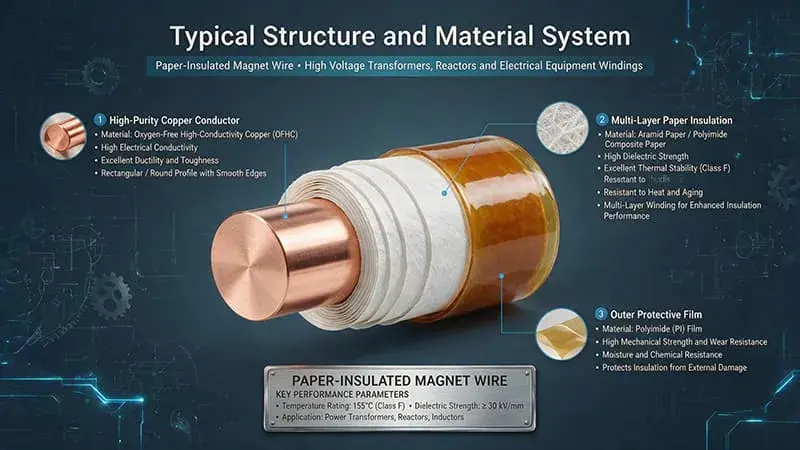
Paper insulated wire is a magnet wire whose insulation comprises multiple layers of cellulose paper tape—such as cable paper, thermally upgraded kraft paper, or aramid paper—wrapped around the conductor at specified overlap ratios and tension. In conjunction with transformer oil, it forms a paper-oil composite insulation system. The dielectric strength of paper insulated wire depends on the number of paper layers, base paper material, and quality of oil-paper impregnation, with typical values ranging from 30 kV/mm to 60 kV/mm (per unit paper thickness). Paper insulated wire is predominantly used in oil-immersed transformers, covering distribution transformers, power transformers, and ultra-high-voltage (UHV) transformers across various winding configurations.
Terminological Differences and Nomenclature Background
The terms “Glass Fiber Insulated Wire” and “Paper Insulated Wire,” as used herein, have multiple synonymous designations in industrial practice. Common alternative terms for glass fiber insulated wire include Fiberglass Covered Wire, Fiberglass Insulated Wire, Glass Fiber Covered Magnet Wire, and Glass Fiber Wrapped Wire. Common alternative terms for paper insulated wire include Paper Covered Wire, Paper Insulated Wire, Paper Wrapped Wire, and Cellulose Insulated Wire. Minor terminological variations typically stem from regional standardization conventions and manufacturer-specific product line nomenclatures; however, the underlying insulation structures remain identical. This article consistently adopts the terms “glass fiber insulated wire” and “paper insulated wire.”
Dielectric Performance Comparison
Dielectric Strength
Dielectric strength is the most critical electrical performance parameter for insulated wire. The typical dielectric strength of E-glass fiber-insulated wire ranges from 8 kV to 20 kV, influenced by braid density, impregnating varnish type, degree of cure, and conductor surface treatment quality. For paper-insulated wire, dielectric strength—expressed per unit paper thickness—reaches 30 kV/mm to 60 kV/mm; typical single-layer insulation thickness ranges from 0.05 mm to 0.5 mm, yielding an overall dielectric strength in the order of 5 kV to 50 kV, depending on the number of paper layers. Under ambient temperature and pressure in dry conditions, paper-insulated wire exhibits superior dielectric strength compared to E-glass fiber-insulated wire; however, under elevated temperature or humid conditions, the dielectric strength of paper-insulated wire degrades more significantly, whereas that of E-glass fiber-insulated wire declines more gradually.
Dielectric Loss Factor
The dielectric loss factor (tan δ) is a core parameter for evaluating long-term stability of insulating media. The typical tan δ of E-glass fiber-insulated wire falls within the range of 0.005 to 0.020, primarily affected by the degree of cure of the impregnating varnish and impurity content. For paper-insulated wire (in combination with transformer oil), the typical tan δ ranges from 0.002 to 0.010, strongly influenced by moisture content in the paper substrate and oil quality. Under well-dried and fully oil-impregnated conditions, paper-insulated wire exhibits lower tan δ than E-glass fiber-insulated wire; however, under elevated temperature or moisture ingress conditions, tan δ of paper-insulated wire increases markedly more than that of E-glass fiber-insulated wire. The two curves intersect near 100 °C, reflecting the differing thermal sensitivity of these two insulating media.
Partial Discharge Characteristics
Partial discharge (PD) characteristics are a key reliability indicator for insulating media. The partial discharge inception voltage (PDIV) of E-glass fiber-insulated wire typically ranges from 1.5 U_N to 2.0 U_N, influenced by impregnating varnish fill quality and E-glass braid density. For paper-insulated wire (in combination with transformer oil), PDIV typically ranges from 1.5 U_N to 2.5 U_N, dependent on impregnation quality, oil cleanliness, and paper lap ratio. Under dry conditions, paper-insulated wire exhibits marginally higher PDIV than E-glass fiber-insulated wire; however, during long-term operation, E-glass fiber-insulated wire demonstrates lower sensitivity to internal void formation, resulting in superior PDIV stability compared to paper-insulated wire.
Lightning Impulse Withstand Voltage (LIWV)
Lightning impulse withstand voltage (LIWV) is a critical parameter for assessing an insulating medium’s capability to withstand transient over voltages. The LIWV of E-glass fiber-insulated wire typically ranges from 30 kV to 100 kV, influenced by insulation thickness and impregnation quality. For paper-insulated wire, LIWV typically ranges from 50 kV to 200 kV, dependent on the number of paper layers and oil-impregnation quality. Regarding transient overvoltage withstand capability, paper-insulated wire holds an advantage due to its higher dielectric strength; however, with respect to cumulative aging under repeated impulse stress, E-glass fiber-insulated wire exhibits superior impulse aging resistance compared to paper-insulated wire.
Thermal Resistance and Thermal Life Comparison
Upper Limit of Long-Term Operating Temperature
The upper limit of long-term operating temperature is the most critical thermal endurance parameter when selecting insulated wire. For glass fiber–insulated wire, this limit is primarily determined by the thermal class of the impregnating varnish; common combinations include Class F (155°C), Class H (180°C), Class N (200°C), and Class R (220°C). For paper-insulated wire, the upper limit is governed by the base paper material: standard kraft paper—up to 105°C; thermally upgraded kraft paper—up to 130°C; and aramid paper—up to 220°C. At equivalent thermal classes, glass fiber–insulated wire offers broader selection flexibility across medium-, high-, and ultra-high-temperature ranges; whereas paper-insulated wire requires aramid paper for applications exceeding 130°C.
Thermal Lifetime Curves and Arrhenius Relationship
Thermal lifetime curves describe the expected service life of insulation media at various temperatures and conform to the Arrhenius relationship. The design lifetime of glass fiber–insulated wire at Class H (180°C) typically exceeds 20,000 hours, corresponding to a design service life of over 25 years for dry-type transformers operating at rated temperature. For paper-insulated wire (kraft paper), the design lifetime at 105°C typically exceeds 180,000 hours, corresponding to a design service life of 30–40 years for oil-immersed transformers. Thermally upgraded paper enables operation up to 130°C, though its lifetime curve slope differs slightly from that of glass fiber–insulated wire. Extrapolating via the Arrhenius relationship, both insulation types exhibit similar lifetime decay rates at elevated temperatures—approximately halving lifetime for every 8°C to 10°C increase in temperature.
Comparison of Accelerated Aging Behavior
Accelerated aging tests obtain insulation aging data by elevating temperature, voltage, or frequency. Glass fiber–insulated wire retains a relatively high percentage of dielectric strength after accelerated aging; dominant aging mechanisms include impregnating varnish degradation and interfacial delamination between E-glass fibers and varnish. Paper-insulated wire exhibits a pronounced decline in dielectric strength retention following accelerated aging; primary aging mechanisms involve cellulose degradation, reduction in degree of polymerization (DP), and accumulation of acidic by-products at the oil-paper interface. Aging by-products of paper insulation—such as furfural and organic acids—exert autocatalytic effects, accelerating the aging process; in contrast, aging of glass fiber–insulated wire proceeds more linearly, with no significant autocatalytic effect.
Mechanical Property Comparison
Short-Circuit Withstand Capability
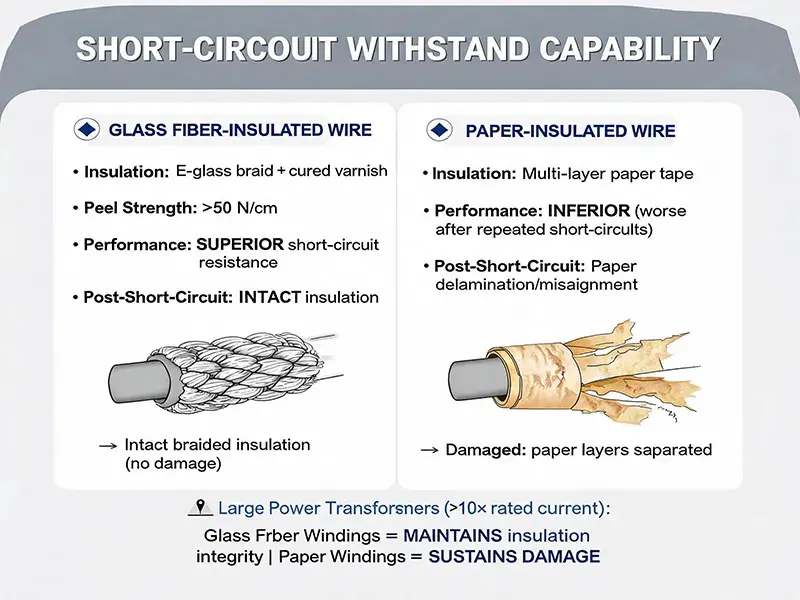
Short-circuit withstand capability is a critical parameter for evaluating the mechanical shock resistance of insulated conductors under instantaneous high-current conditions. Glass fiber-insulated wire exhibits significantly superior short-circuit withstand capability compared to enamel-coated wire, owing to the composite mechanical strength provided by the E-glass braided layer and the cured impregnating varnish; peel strength typically exceeds 50 N/cm. Paper-insulated wire features a multi-layer paper tape insulation system, which demonstrates comparatively lower short-circuit withstand capability—particularly after repeated short-circuit events, where paper layer misalignment and delamination risks increase markedly. In large power transformers (subject to short-circuit currents exceeding 10× rated current), winding assemblies fabricated with glass fiber-insulated wire maintain superior insulation integrity post-short-circuit compared to those using paper-insulated wire.
Vibration and Abrasion Resistance
Vibration and abrasion resistance assess an insulated conductor’s ability to endure operational vibration and mechanical wear. Glass fiber-insulated wire offers distinct advantages in both vibration and abrasion resistance: the E-glass braid substantially enhances conductor resistance to abrasion, cutting, and impact. Paper-insulated wire exhibits limited vibration and abrasion resistance in dry environments; prolonged vibration may cause paper layer loosening and wear. Dry-type and mobile transformers impose stringent requirements on vibration and abrasion resistance; here, glass fiber-insulated wire holds a clear advantage. In oil-immersed transformers, paper-insulated wire is impregnated with transformer oil, thereby experiencing relatively reduced mechanical wear.
Bendability and Formability
Bendability and formability influence the winding manufacturing process of insulated conductors. Glass fiber-insulated wire requires strict control of the minimum bending radius during forming operations; excessively small bending radii may induce E-glass fiber breakage and insulation damage—the typical minimum bending radius ranges from 4× to 6× the conductor diameter. Paper-insulated wire exhibits excellent bendability and formability, tolerating smaller bending radii (2× to 3× the conductor diameter) during winding. In complex winding configurations—such as disc-type, continuous, and helical windings—the formability advantage of paper-insulated wire is pronounced; conversely, for simple cylindrical windings, the processing difficulty difference between the two insulation types is negligible.
Environmental Adaptability Comparison
Moisture and Oil Resistance
Moisture and oil resistance are key indicators for evaluating the stability of insulated magnet wire in diverse environmental media. E-glass fiber-insulated wire exhibits excellent moisture resistance: E-glass itself is inert to moisture, and the cured varnish matrix acts as a moisture barrier; however, prolonged exposure to high-humidity environments may still allow trace moisture absorption through microscopic pores on the varnish surface, potentially degrading dielectric performance. Kraft paper–insulated wire is highly moisture-sensitive due to the strong hygroscopicity of cellulose; long-term exposure to humid conditions results in a marked reduction in dielectric strength. In contrast, under oil-immersed conditions, kraft paper–insulated wire forms a stable paper–oil composite system with transformer oil, delivering outstanding oil resistance. Consequently, E-glass fiber-insulated wire is suitable for dry or humid environments, whereas kraft paper–insulated wire requires oil immersion to maintain its performance.
Chemical and Aging Resistance
Chemical and aging resistance determine the long-term stability of insulated magnet wire. E-glass inherently possesses excellent chemical resistance, remaining inert to most acids, alkalis, and salts; the cured varnish matrix provides a certain degree of barrier protection against common chemicals; thus, E-glass fiber-insulated wire demonstrates stable performance in industrial corrosive atmospheres, acid mists, and salt mists. Kraft paper–insulated wire exhibits comparatively weak chemical resistance, as cellulose is sensitive to acids and alkalis; aging by-products (e.g., organic acids and water) formed at the oil–paper interface accelerate cellulose degradation. Regarding aging resistance, degradation of E-glass fiber-insulated wire primarily involves oxidative degradation of the varnish, whereas aging of kraft paper–insulated wire entails a decline in cellulose polymerization degree and mechanical strength loss.
Thermal Cycling Resistance
Thermal cycling resistance reflects the structural stability of insulated magnet wire under alternating temperature conditions. In E-glass fiber-insulated wire, the significant mismatch in coefficients of thermal expansion (CTE) between E-glass fibers and the varnish matrix renders the fiber–varnish interface prone to microcracking during thermal cycling; cumulative damage over extended cycles may lead to insulation performance deterioration. High-quality E-glass fiber-insulated wire achieves markedly improved thermal cycling resistance through optimized varnish formulation and curing profiles. Kraft paper–insulated wire operated within transformer oil experiences gradual temperature changes, with the oil medium providing elastic buffering—thus exhibiting good thermal cycling resistance. However, bare kraft paper–insulated wire operating without oil exhibits limited thermal cycling resistance, with paper layers susceptible to cracking. In outdoor applications or scenarios involving severe thermal cycling, E-glass fiber-insulated wire is more suitable.
Cost-Effectiveness and Engineering Selection
Unit Insulation Cost Comparison
Unit insulation cost is a direct metric for evaluating the economic viability of insulated wire. The cost structure of glass fiber–insulated wire centers on E-glass fiber, impregnating varnish, and manufacturing processes, resulting in a typically higher unit-length cost compared to paper-insulated wire. The cost structure of paper-insulated wire primarily comprises kraft paper, thermally upgraded kraft paper, or aramid paper, yielding a relatively lower unit-length cost; however, it requires transformer oil to form a complete insulation system. From the perspective of single-coil cost, winding using paper-insulated wire generally incurs lower costs than winding using glass fiber–insulated wire; yet, when factoring in transformer oil procurement, purification, and maintenance expenses, the total cost of the paper–oil insulation system may exceed that of the glass fiber insulation system.
Total Life-Cycle Cost (LCC) Comparison
Total life-cycle cost (LCC) is a comprehensive metric for assessing the economic performance of insulated wire. LCC integrates initial procurement cost, installation cost, operational and maintenance cost, failure-related loss cost, and end-of-life disposal cost. Glass fiber–insulated wire exhibits an LCC profile characterized by “high initial cost, low maintenance cost, and long service life”; paper-insulated wire (in oil-immersed systems) displays an LCC profile characterized by “moderate initial cost, moderate maintenance cost, and moderate service life.” When considering total costs over a typical 25- to 30-year service life, LCC differences between these two insulation types are not significant in standard application scenarios. However, under stringent fire-safety requirements, limited maintenance accessibility, or demanding long-service-life conditions, glass fiber–insulated wire demonstrates clear LCC advantages.
Typical Selection Decision Scenarios
Engineering selection decisions must comprehensively consider voltage class, capacity rating, operating environment, service life requirements, fire-safety requirements, and economic factors.
10 kV to 35 kV distribution transformers: Paper-insulated wire is predominant, forming a mature and reliable insulation system with transformer oil; glass fiber–insulated wire is suitable for indoor or commercial installations where fire safety is critical.
110 kV to 500 kV power transformers: Paper-insulated wire remains predominant, paired with high-dielectric-strength cable paper or thermally upgraded kraft paper; glass fiber–insulated wire finds limited application in dry-type power transformers.
500 kV to 1000 kV ultra-high-voltage (UHV) transformers: Paper-insulated wire is the absolute mainstream solution, employing multilayer high-dielectric-strength cable paper; glass fiber–insulated wire is unsuitable for this application due to dielectric strength limitations.
Fire-critical environments (e.g., metro systems, marine vessels, commercial buildings, and high-occupancy facilities): Glass fiber–insulated wire is the predominant choice.
Oil-immersed environments requiring extended service life: Paper-insulated wire is the predominant choice.
Conclusion
Glass fiber insulated wire and paper insulated wire are two widely used types of insulated conductors in transformer winding insulation applications. They exhibit systematic differences in dielectric performance, thermal endurance, mechanical properties, environmental adaptability, and cost-effectiveness. Glass fiber insulated wire employs a composite structure comprising inorganic E-glass fibers and organic impregnating varnish, delivering advantages in high-temperature resistance, flame retardancy, and mechanical strength; it is primarily applied in dry-type transformers and high-thermal-endurance applications. Paper insulated wire utilizes a multi-layer cellulose-based paper substrate (e.g., kraft paper, thermally upgraded kraft paper, or aramid paper) in conjunction with transformer oil to form a paper-oil composite insulation system, predominantly employed in oil-immersed transformers. Regarding dielectric performance, paper insulated wire exhibits superior characteristics under well-dried and well-oil-impregnated conditions; concerning thermal endurance, glass fiber insulated wire offers greater flexibility in selecting upper temperature limits (e.g., F-class/H-class/N-class/R-class); with respect to mechanical properties, glass fiber insulated wire demonstrates superior short-circuit current withstand capability, vibration resistance, and abrasion resistance; regarding environmental adaptability, glass fiber insulated wire is suitable for dry or humid environments, whereas paper insulated wire requires an oil-immersed environment; and in terms of cost-effectiveness, glass fiber insulated wire entails higher initial investment but delivers lower life-cycle cost (LCC) in fire-safety-critical and long-service-life applications. Engineering selection shall be based on a comprehensive trade-off analysis considering the specific application’s voltage class, power rating, operating environment, service life requirement, fire safety requirements, and economic constraints to determine the most appropriate insulated conductor type.