

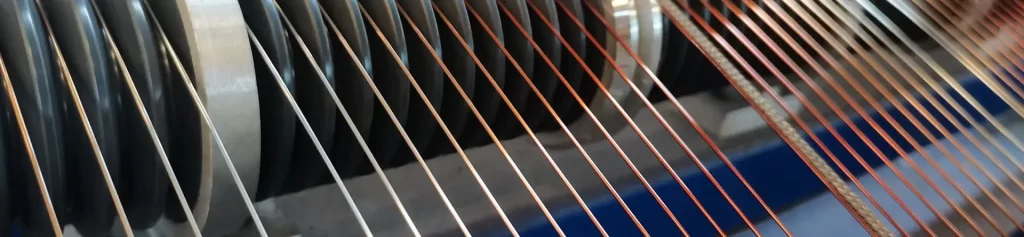
Introduction: Why Do We Need “Special Shape” Enameled Wire?
In the field of enameled copper wire engineering applications, most designers are accustomed to using round enameled wire—because it is the “standard answer” of the wire industry, corresponding to the most popular winding equipment and process flows.
However, in certain special application scenarios, round enameled wire is no longer the optimal choice:
- New energy vehicle drive motors: Need to pass 50–200A high current; rectangular enameled wire has a slot fill rate 20–30% higher than round wire;
- Special military radar: Need ultimate precision inductance control; diamond enameled wire has superior electromagnetic characteristics;
- Micro medical sensors: Need micro coils below 0.05mm; oval enameled wire saves space;
- Aerospace coils: Need extreme environment tolerance; special enamel + special shape combinations.
In these scenarios, “standard round enameled wire” becomes a design bottleneck. Thus, custom special shape enameled wire non-standard projects become the “trump card” for electrical engineers.
However, custom special shape enameled wire is far from simple “changing the cross-section shape”:
- High production difficulty: Requires custom molds, optimized drawing processes, and recalibration of enamel coating uniformity;
- High minimum order quantity: Manufacturers set MOQ of 100–500kg to amortize mold and process development costs;
- Long prototype cycle: From inquiry to first sample requires 4–8 weeks;
- High cost: Unit price is 30–200% higher than standard products;
More importantly, custom projects involve deep collaboration between customers and manufacturers. Customers need to clearly describe requirements, and manufacturers need to accurately understand technical parameters. Any deviation in any link may result in “enameled wire that cannot be used.”
The uniqueness of this article lies in focusing on “practical full process of special shape enameled wire non-standard custom projects“, covering 8+ special shape illustrated catalog, 4 real project cases, complete customer-manufacturer collaboration process, common challenges and response strategies for non-standard projects, and selection matrix for custom manufacturers.
Core Insight:
Special shape enameled wire is a “project” not a “product”. Every non-standard custom project involves unique design challenges, process innovations, and team collaboration capabilities.
Whether you are a motor/transformer designer needing special profile wire solutions, a procurement engineer looking for custom manufacturers, a quality engineer evaluating custom enameled wire suppliers, or a manufacturer process engineer designing custom solutions, this article will provide you with professional, practical, and actionable references.
Article Covers 10 Core Dimensions:
- What is “special shape enameled wire” (differences from round wire and standard profile wire)
- 8+ Special Shape Illustrated Catalog (rectangular/square/flat ribbon/oval/triangle/hexagonal/diamond/kidney/hourglass)
- Special Profile Enameled Wire Production Process (mold, drawing, enamel coating, testing)
- Complete Non-Standard Custom Process (8-step process from inquiry to mass production)
5-8. 4 Real Project Cases (traction motor rectangular wire / special winding triangle wire / military diamond wire / medical sensor special profile) - Common Challenges of Non-Standard Projects (MOQ, cost, delivery, mold, trust building)
- How to Select Custom Enameled Wire Manufacturers (capability evaluation matrix)
Let us begin this systematic non-standard project practical journey.
1. Basic Concept: What Is “Special Shape / Special Profile / Non-Standard”
1.1 Terminology Clarification
Before discussing special shape enameled wire, we need to clarify several easily confused terms:
| Term | Definition | Example |
|---|---|---|
| Round Enameled Wire | Standard circular cross-section | Φ0.10mm, Φ0.50mm, Φ2.00mm |
| Standard Profile Wire | Standard special cross-section in manufacturer catalog | Rectangular 1.0×3.0mm, Square 1.5×1.5mm |
| Special Shape | Non-standard special cross-section requiring customization | Triangle, hexagonal, kidney shape, diamond |
| Non-Standard Project | Project fully customized according to customer needs | Customer-specified irregular cross-section, special enamel |
Key Differences:
- Round enameled wire is an industry standard product that almost all manufacturers can produce.
- Standard profile wire (rectangular, square) is special but usually included in the manufacturer’s catalog and can be ordered directly by specification.
- Special shape enameled wire is usually customized according to customer drawings and does not belong to any manufacturer’s catalog standard product.
- Non-standard project involves the full customization process from specification definition, mold development, first sample delivery, to mass production.
1.2 Why Use Special Shape Enameled Wire
Reason 1: Optimize Electrical Performance
| Shape | Electrical Advantage |
|---|---|
| Rectangular / Square | Large cross-section, low resistance, high current capacity |
| Flat Ribbon | Small skin effect, low high-frequency loss |
| Diamond | Uniform electromagnetic field distribution, high Q value |
| Oval / Kidney Shape | Accommodates larger cross-section in limited space |
Reason 2: Improve Slot Fill Rate
Motor/transformer winding slot space is limited. Rectangular enameled wire has a slot fill rate 20–30% higher than round wire, allowing more copper to be installed and increasing power density.
Reason 3: Special Spatial Constraints
Some equipment has specific spatial shapes (such as oval slots, kidney-shaped slots), and must use matching shape enameled wire to efficiently utilize space.
Reason 4: Ultimate Performance Requirements
High-end fields such as military, aerospace, and medical have ultimate requirements for electrical performance, space utilization, and reliability. Standard products cannot satisfy, and customization is necessary.
1.3 Application Fields of Special Shape Enameled Wire
| Application Field | Typical Special Shape | Project Characteristics |
|---|---|---|
| New Energy Vehicle Drive Motor | Rectangular 4×8mm, 6×10mm | Large cross-section, high slot fill rate, high power |
| Rail Transit Traction Motor | Rectangular 6×12mm, 8×15mm | Very large cross-section, super high power |
| Industrial Special Motor | Custom special profile | Special slot shape, special voltage |
| Military Radar | Diamond, hexagonal | Ultimate precision, high reliability |
| Aerospace | Special profile + special enamel | Extreme environment, long life |
| Medical Sensors | Oval, kidney shape, micro special profile | Miniaturization, biocompatibility |
| High-Frequency Special Coils | Flat ribbon, diamond | Low loss, high Q value |
| Special Transformers | Rectangular + special enamel | High power density, low noise |
2. Dimension 1: 8+ Special Shape Illustrated Catalog
This section systematically introduces common special shapes. Each shape contains [cross-section diagram + typical specifications + mainstream applications + production process + customization capability].
2.1 Rectangular
Cross-section Diagram:
┌─────────────────┐  Thickness (a)
│                 │
│   Copper conductor  │ ← Width (b)
│   (enamel coating)  │
│                 │
└─────────────────┘
Typical Specifications:
| Size Range | Typical Applications |
|---|---|
| a × b = 0.5×2.0mm ~ 10×30mm | Motor, transformer, traction |
Mainstream Applications:
- Wind power/hydroelectric generator stator windings
- Traction motors (subway, high-speed rail, electric vehicles)
- High-power transformer low-voltage windings
- High-power reactors
Production Process:
- Rectangular cross-section formed by rectangular mold drawing
- Enamel coating applied through mold (enamel dip coating + scraping control)
- Key technology: 4-corner enamel uniformity (enamel tends to be thin at rounded corners)
Customization Capability:
- Minimum thickness: 0.3mm
- Maximum width: 30mm
- Corner radius R: 0.1–2.0mm (affects enamel distribution)
- Length-to-width ratio: 1:1 ~ 1:30 (extreme elongated type)
2.2 Square
Cross-section Diagram:
┌─────────────┐
│             │
│   Copper   │  a × a
│  conductor  │
│             │
└─────────────┘
Typical Specifications:
| Size Range | Typical Applications |
|---|---|
| a × a = 1.0×1.0mm ~ 6×6mm | High-power high-current |
Mainstream Applications:
- Industrial special motors (high current, heavy-duty starting)
- Welding machines, electroplating power supplies
- Induction heating coils
- High-power density transformers
Production Process:
- Square mold drawing
- Enamel coating requires special attention to enamel integrity at 4 corners
Customization Capability:
- Minimum size: 0.5×0.5mm
- Maximum size: 8×8mm
- Corner precision: ±0.05mm
2.3 Flat Ribbon
Cross-section Diagram:
┌──────────────────────┐
│   Copper conductor    │  Very thin thickness, large width
│   (enamel coating)    │
└──────────────────────┘
Typical Specifications:
| Size Range | Length-to-Width Ratio | Typical Applications |
|---|---|---|
| Thick 0.05–0.5mm, Wide 3–50mm | 10:1 ~ 100:1 | High frequency, low loss |
Mainstream Applications:
- High-frequency transformers (switching power supplies, UPS)
- Wireless power transmission coils
- Induction heating flat coils
- Flexible flat cables (FFC)
Production Process:
- Rolling drawing (roll forming)
- Difficult enamel coating (thin edge enamel control)
- Key technology: Edge enamel integrity + thickness tolerance ±5μm
Customization Capability:
- Thinnest thickness: 0.03mm (close to metal foil)
- Maximum width: 100mm
- Enamel thickness: 5–50μm
2.4 Oval (Oval / Elliptical)
Cross-section Diagram:
    ╱─────────╲
   ╱             ╲
  │   Copper       │  Long axis a, short axis b
   ╲             ╱
    ╲─────────╱
Typical Specifications:
| Long Axis × Short Axis | Length-to-Width Ratio | Typical Applications |
|---|---|---|
| 0.5×0.3mm ~ 5×2.5mm | 1.5:1 ~ 3:1 | Special motor, sensor |
Mainstream Applications:
- Oval slot special motors
- Micro medical sensors
- High-frequency low-loss coils
- Custom special profile components
Production Process:
- Oval mold drawing (special mold)
- Enamel coating more difficult than rectangular
Customization Capability:
- Minimum size: 0.3×0.2mm
- Maximum size: 10×5mm
- Ovality precision: ±0.05mm
2.5 Triangular
Cross-section Diagram:
       /\
      /   \
     /     \  Side length a
    / Copper \
   /           \
  /______\
Typical Specifications:
| Side Length | Typical Applications |
|---|---|
| 1.0mm ~ 5.0mm | Special winding, custom components |
Mainstream Applications:
- Special winding structures
- High-density inductors
- Custom special motors
Production Process:
- Triangular mold drawing (mold processing difficult)
- Enamel coating requires optimizing enamel integrity at 3 corners
- Key technology: Enamel uniformity at 3 sharp corners (most difficult point)
Customization Capability:
- Minimum side length: 0.5mm
- Maximum side length: 8mm
- Angle precision: ±0.5°
2.6 Hexagonal
Cross-section Diagram:
     ╱╲    ╱╲
    ╱  ╲  ╱  ╲
   ╱    ╲╱    ╲
   ╲    ╱╲    ╱
    ╲  ╱  ╲  ╱
     ╲╱    ╲╱
Typical Specifications:
| Edge-to-Edge Distance | Typical Applications |
|---|---|
| 1.0mm ~ 5.0mm | High-density winding, custom |
Mainstream Applications:
- High-density coils (15% higher slot fill rate than round wire)
- Custom special motors
- High-frequency special coils
Production Process:
- Hexagonal mold drawing
- Enamel uniformity at 6 corners is the difficult point
Customization Capability:
- Minimum size: 0.5mm
- Maximum size: 8mm
2.7 Diamond (Diamond / Rhombus)
Cross-section Diagram:
       /╲
      ╱    ╲
     ╱      ╲
    ╲        ╱
     ╲      ╱
      ╲    ╱
       ╲  ╱
        ╲╱
Typical Specifications:
| Long Diagonal × Short Diagonal | Typical Applications |
|---|---|
| 1.0×0.5mm ~ 5×2mm | Military radar, special |
Mainstream Applications:
- Military radar coils (ultimate precision)
- High Q value special inductors
- Custom electromagnetic components
Production Process:
- Diamond mold drawing
- 4 sharp corner enamel control is the difficult point
Customization Capability:
- Minimum size: 0.5×0.3mm
- Maximum size: 8×4mm
- Angle precision: ±0.5°
2.8 Kidney Shape (Kidney Shape)
Cross-section Diagram:
   ╱───────╲
  │           │
  │   Copper   │
  │           │
   ╲────╮───╱
        ╲╱
Typical Specifications:
| Size Range | Typical Applications |
|---|---|
| Length 1.0–5.0mm, thickness 0.5–2.0mm | Slot fill optimization, special motor |
Mainstream Applications:
- High slot fill rate special motors
- Micro medical sensors
- Custom special profile coils
Production Process:
- Special profile mold drawing
- Concave area enamel coating is difficult
Customization Capability:
- Minimum size: 0.5×0.3mm
- Maximum size: 10×3mm
2.9 Hourglass (Hourglass / Sandglass)
Cross-section Diagram:
   ╱─────────╲
  │             │
   ╲           ╱
    ╲         ╱
     ╲       ╱
    ╱         ╲
   ╱           ╲
  │             │
   ╲─────────╱
Typical Specifications:
| Length × Maximum Width | Typical Applications |
|---|---|
| 2×1mm ~ 8×3mm | Special coil, custom winding |
Mainstream Applications:
- Special coils
- Micro transformers
- Custom special profile components
Production Process:
- Hourglass mold drawing
- Concave groove enamel coating is the biggest technical challenge
Customization Capability:
- Minimum size: 1×0.5mm
- Maximum size: 10×4mm
2.10 Fully Custom Profile
In addition to the 9 standard special profiles above, customization according to any cross-section shape provided by customers is also possible, including:
- Irregular polygons
- Arch shape
- T-shape
- I-shape
- Semi-circular
- Multi-hole
- Other fully custom shapes
Customization Process:
- Customer provides cross-section drawing (CAD) or sample
- Manufacturer conducts Design for Manufacturing (DFM) assessment
- Design drawing mold
- Mold trial + process debugging
- First sample submitted for customer confirmation
3. Dimension 2: Production Process of Special Profile Enameled Wire
The production process of special shape enameled wire differs from round wire. Key processes are mold design, drawing process, enamel coating, and enamel uniformity.
3.1 Mold Design
Mold Classification:
| Mold Type | Applicable Shape | Precision | Cost |
|---|---|---|---|
| Single-hole Drawing Mold | Simple special profile (small batch) | ±0.02mm | Low |
| Multi-hole Drawing Mold | Medium batch | ±0.01mm | Medium |
| Precision Multi-station Mold | Large batch | ±0.005mm | High |
| Polycrystalline Mold (PCD) | Ultra-precision, ultra-long life | ±0.003mm | Very High |
Mold Materials:
- Cemented Carbide (WC): Standard special profile wire
- Polycrystalline Diamond (PCD): Precision special profile wire (ultra-long life)
- High-Speed Steel: Trial production, small batch
Mold Design Key Points:
- Shrinkage angle (5–15°): Affects drawing force
- Working cone angle: Affects surface finish
- Entry corner radius: Avoids drawing cracks
- Exit sizing band: Ensures dimensional accuracy
- Corner radius design for special shapes: Affects enamel uniformity (key!)
3.2 Drawing Process
Special Challenges of Special Profile Wire Drawing:
- Uneven stress distribution: Special profile cross-sections have different cooling rates in different directions, causing uneven stress
- Drawing ratio control: Special profile wires need smaller drawing ratios (typical 1.1–1.3, round wire 1.2–1.5)
- Intermediate annealing: Special profile wires require more frequent intermediate annealing (typically every 2–4 passes)
- Drawing speed: Special profile wire drawing speed is lower than round wire (typically 5–20 m/s)
Typical Process Flow:
Round copper rod → Pickling → Pre-drawing into special profile → Multi-pass drawing (including intermediate annealing)
    → Final annealing → Enamel coating → Drying → Winding
3.3 Enamel Coating
The difficulty of enamel coating for special profile wire is much higher than round wire:
Challenge 1: Enamel Flow
- Round wire has uniform enamel around it, while special profile wire has enamel accumulation in concave areas (such as inner concave of hourglass and kidney shape)
- At sharp corners (such as triangle and diamond corners), enamel flows away causing thin enamel
Challenge 2: Enamel Scraping Control
- Round wire uses circular hole scraper
- Special profile wire requires special profile scraper (must match cross-section)
- Scraping precision directly determines enamel thickness uniformity
Challenge 3: Drying
- Different positions and postures of special profile wire in the drying oven affect enamel uniformity
- Thick cross-section special profile wire requires longer drying time
Enamel Uniformity Grades:
| Grade | Enamel Thickness Tolerance | Applicable Scenarios |
|---|---|---|
| Standard | ±15% | Ordinary motor, transformer |
| Precision | ±8% | High-voltage motor, automotive motor |
| Ultra-precision | ±3% | High frequency, medical, military |
3.4 Testing Methods
Testing of special profile enameled wire is much more complex than round wire:
Testing Items:
| Testing Item | Special Profile Specificity | Testing Method |
|---|---|---|
| Cross-section Size | Multi-directional measurement required | Laser diameter gauge (multi-directional), profilometer |
| Enamel Thickness | Multiple position measurement required | Cross-section microscopy, eddy current thickness measurement (multi-channel) |
| Breakdown Voltage | Different electric field distribution for special profile | Multi-electrode breakdown test |
| Conductivity | Special profile cross-section area needs accurate calculation | Resistance calculation method |
| Enamel Continuity | Special profile surface curvature differs | Water immersion method (improved electrodes required) |
| Mechanical Properties | Special profile cross-section stress distribution | Bending test (multi-directional), tensile test |
3.5 Production Cost Comparison with Round Wire
| Item | Round Wire | Special Profile Wire |
|---|---|---|
| Mold Cost | Low (standard mold) | High (special mold 50–500K RMB) |
| Drawing Process | Standard | Complex (more passes, more intermediate annealing) |
| Enamel Coating | Round scraper | Special profile scraper (5–20× cost) |
| Testing | Standard | Custom (3–10× cost) |
| Small Batch Cost | Low | Very high (high amortization cost) |
| Large Batch Cost | Low | Medium (acceptable after amortization) |
Key Insight: Special profile wire is very suitable for large batch projects (amortizing mold and process development costs), unsuitable for small batch trial production (unless customer willing to bear high unit price).
4. Dimension 3: Complete Non-Standard Custom Process (8-Step Process)
Non-standard custom projects involve deep collaboration between customers and manufacturers. Clear process is the key to project success.
4.1 Process Overview
Step 1: Customer Requirement → Step 2: Manufacturer Technical Evaluation → Step 3: Solution Design → Step 4: Commercial Quotation
                                                                                                                                                  ↓
Step 8: Mass Production Delivery ← Step 7: Small Batch Verification ← Step 6: First Sample Testing ← Step 5: Prototype Production
4.2 Step 1: Customer Requirement Submission (Inquiry)
Customers need to clearly describe the following information:
Key Technical Parameters:
| Parameter Item | Description | Example |
|---|---|---|
| Cross-section Shape | Cross-section diagram (CAD or sample) | Rectangular 4×8mm, Diamond 2×1mm |
| Dimensional Tolerance | Permissible deviation of width and thickness | Width ±0.05mm |
| Enamel Type | Enamel type and temperature class | PEI enamel, Class 180 |
| Enamel Thickness | Single-side enamel thickness | 0.04–0.06mm |
| Breakdown Voltage | Minimum withstand voltage | ≥5 kV |
| Conductor Resistance | 20°C resistance requirement | ≤0.5 Ω/km |
| Mechanical Properties | Tensile, elongation | ≥200 MPa, ≥30% |
| Target Quantity | Single batch order quantity | 500kg, 2000kg |
| Target Unit Price | Customer budget | ¥200/kg |
| Delivery Time | Expected delivery date | 8 weeks later |
Additional Information:
- Application scenario (motor/sensor/military)
- Environmental conditions (temperature, humidity, chemical media)
- Industry certification requirements (UL, CCC, AEC-Q200, etc.)
- Packaging and logistics requirements
4.3 Step 2: Manufacturer Technical Evaluation (Technical Evaluation)
The enameled wire manufacturer conducts internal evaluation after receiving the inquiry:
Evaluation 1: Design for Manufacturing (DFM) Assessment
| Evaluation Item | Evaluation Content |
|---|---|
| Cross-section Feasibility | Whether the cross-section shape can be produced, complexity grade |
| Size Attainability | Whether the size required by the customer is within the manufacturer’s capability |
| Precision Attainability | Whether the tolerance requirement can be achieved |
| Enamel Attainability | Whether the enamel type and thickness can be coated |
| Material Attainability | Whether copper material quality meets requirements |
Evaluation 2: Process Assessment
| Evaluation Item | Evaluation Content |
|---|---|
| Mold Requirement | Whether new mold is needed (cost, cycle) |
| Drawing Process | Whether new process development is needed |
| Enamel Process | Whether new enamel formula is needed |
| Testing Capability | Whether new testing equipment/method is needed |
Evaluation 3: Risk Assessment
| Risk Item | Response Plan |
|---|---|
| Technical Risk | Whether qualified samples can be delivered |
| Delivery Risk | Mold development cycle, prototype cycle |
| Cost Risk | Whether customer budget can cover actual cost |
| Capacity Risk | Whether order can be completed within delivery time |
4.4 Step 3: Solution Design (Solution Design)
After passing the evaluation, the manufacturer formulates a detailed plan:
Plan 1: Technical Solution
- Mold design drawings
- Drawing process route (passes, annealing)
- Enamel coating process (enamel formula, scraper, drying curve)
- Testing plan (special equipment/method)
- Key technical risks and countermeasures
Plan 2: Quality Plan
- Key Control Points (KCP)
- Sampling plan (AQL grade)
- Factory testing item list
- Acceptance standards and judgment rules
Plan 3: Delivery Plan
- Detailed schedule (mold development, first sample, small batch, mass production)
- Risk warning and backup plan
- After-sales service commitment
4.5 Step 4: Commercial Quotation (Quotation)
Quotation Composition:
| Cost Item | Description |
|---|---|
| Mold Fee | Usually 50–300K RMB (higher for special parts) |
| First Sample Fee | Includes small batch production cost (high unit price for first order) |
| Mass Production Unit Price | Unit price after amortizing mold (typical 30–200% markup) |
| Packaging Fee | Special packaging requirements |
| Transportation Fee | Includes transportation insurance |
| Certification Fee | UL/CCC etc. certification (amortized) |
Quotation Validity Period: Usually 7–30 days (may be longer for special profile wire projects).
4.6 Step 5: Prototype Production (Prototype Production)
Key Milestone: First sample delivery is the most critical project node.
First Sample Process:
| Stage | Content | Time |
|---|---|---|
| Mold Development | Design→Processing→Trial mold | 2–4 weeks |
| Trial Drawing | Trial drawing special profile copper wire | 1 week |
| First Enamel Coating | First enamel coating trial | 1 week |
| Process Debugging | Drawing + enamel process optimization | 1–2 weeks |
| First Sample Submission | Provide 5–10kg first sample | 1 week |
First Sample Submission:
- Certain length sample
- Testing report (size, enamel thickness, breakdown voltage, resistance)
- Process parameter records
4.7 Step 6: First Sample Testing (Sample Validation)
Customer Testing:
- Customer conducts actual application testing on first sample
- Winding testing, electrical testing, environmental testing
- Feedback test results
Typical Problems and Solutions:
| Problem Type | Root Cause | Solution |
|---|---|---|
| Uneven Enamel Thickness | Scraper, enamel viscosity | Adjust scraper, modify enamel formula |
| Corner Enamel Damage | Mold corner too small | Optimize corner radius R≥0.1mm |
| Low Breakdown Voltage | Enamel has defects | Strengthen enamel quality control |
| Resistance Not Qualified | Cross-section too small | Adjust drawing ratio |
| Insufficient Mechanical Properties | Insufficient annealing | Optimize annealing process |
4.8 Step 7: Small Batch Verification (Small Batch Validation)
After passing the first sample, enter the small batch verification stage:
Small batch typically 50–500kg, used for:
- Verify mass production process stability
- Customer conducts small batch application verification
- Collect quality inspection data, optimize process
Key Milestone: After passing small batch verification, enter large batch production.
4.9 Step 8: Mass Production Delivery (Mass Production)
Mass Production Stage:
- Batch production according to order
- 100% full inspection of key indicators (appearance, enamel continuity, resistance)
- Sampling test (AQL) other indicators
- Packaging and logistics
Common Problems in Mass Production Stage:
- Inter-batch consistency issues
- Enamel thickness tolerance expansion
- Customer requirement changes
- Delivery emergencies
5. Dimension 4: Project Case 1—Rectangular Enameled Wire for High-Power Traction Motor
5.1 Project Background
Customer: A new energy vehicle drive motor manufacturer
Application: 200kW permanent magnet synchronous motor (drive motor)
Goal: Replace round wire with rectangular enameled wire to improve slot fill rate
5.2 Customer Requirements
| Parameter | Requirement |
|---|---|
| Cross-section | Rectangular 4.0×8.0mm |
| Dimensional Tolerance | Width ±0.05mm, thickness ±0.05mm |
| Corner R | 0.5mm |
| Enamel | PEI, Class 180 |
| Enamel Thickness | 0.04–0.06mm (single side) |
| Breakdown Voltage | ≥5 kV |
| Conductor Resistance | ≤0.30 Ω/km @ 20°C |
| Elongation | ≥30% |
| Target Quantity | Monthly supply 2000kg (order 12 months) |
| Target Unit Price | ¥300/kg |
5.3 Project Challenges
Challenge 1: High Dimensional Precision
- The dimensional tolerance of ±0.05mm for rectangular 4×8mm is relatively strict
- Width/thickness ratio 1:2, process difficulty relatively high
Challenge 2: Enamel Uniformity
- Enamel tends to be thin at 4 corners
- Must use special profile scraper
Challenge 3: Large Batch Stability
- Monthly supply 2000kg is a large batch order
- Must ensure inter-batch consistency
5.4 Solutions
Solution 1: Precision Mold
- Cemented carbide mold (WC)
- Multi-station continuous drawing (6 passes)
- Working cone angle optimization: 20°
Solution 2: Drawing Process
- Drawing ratio: 1.15 (moderate, avoid deformation)
- Intermediate annealing: Once every 3 passes
- Final annealing: 380°C × 4h
Solution 3: Enamel Process
- Special special profile scraper (custom)
- Enamel viscosity: 85 ± 5 mPa·s
- Drying curve: Multi-stage heating (150°C → 280°C → 380°C)
Solution 4: Testing Plan
- Online laser profilometer (multi-directional)
- 100% enamel continuity testing (water immersion method)
- Sampling breakdown testing (AQL 0.65)
- Sampling enamel thickness at key points (4 corners)
5.5 Project Results
| Indicator | Requirement | Actual | Result |
|---|---|---|---|
| Cross-section Size | 4.0×8.0 ±0.05mm | 4.02×8.03mm | ✅ |
| Corner R | 0.5mm | 0.5 ± 0.05mm | ✅ |
| Enamel Thickness | 0.04–0.06mm | 0.045–0.055mm | ✅ |
| Breakdown Voltage | ≥5 kV | Average 7.2 kV | ✅ |
| Conductor Resistance | ≤0.30 Ω/km | 0.27 Ω/km | ✅ |
| Elongation | ≥30% | 35% | ✅ |
| Small Batch Verification | Pass | Pass within 4 weeks | ✅ |
Project Delivery:
- Mold development: 4 weeks
- First sample delivery: 6 weeks
- Small batch verification: 8 weeks (passed)
- Mass production: Starting from 12 weeks
- Customer feedback: Slot fill rate improved 25%, motor power density improved 12%
5.6 Project Lessons Learned
Lesson 1: Early Customer Participation
- Customer participated in review at the mold design stage, identifying size definition issues in advance
- Reduced later change costs
Lesson 2: Key Role of Special Profile Scraper
- Special profile scraper is key equipment for enamel uniformity
- Must be consistent with enameled wire cross-section
Lesson 3: Importance of Corner R
- Customer initially required R=0.3mm, but manufacturer suggested changing to R=0.5mm
- R=0.5mm corner enamel is complete, no damage
- Engineering thinking (not just “do what the drawing says”)
6. Dimension 5: Project Case 2—Custom Triangular Enameled Wire (Special Winding)
6.1 Project Background
Customer: A special motor manufacturer
Application: 6-pole 18-slot special motor, using triangular enameled wire to achieve high-density winding
Goal: Use triangular enameled wire to achieve ultimate slot fill rate and winding symmetry
6.2 Customer Requirements
| Parameter | Requirement |
|---|---|
| Cross-section | Equilateral triangle side length 2.5mm |
| Angle Precision | ±0.5° |
| Enamel | PEI, Class 180 |
| Enamel Thickness | 0.04–0.06mm |
| Breakdown Voltage | ≥4 kV |
| Quantity | 300kg (single batch) |
| Target Unit Price | ¥380/kg |
6.3 Project Challenges
Challenge 1: Enamel Control at 3 Sharp Corners
- Triangle has 3 corners with 60° angles
- Enamel is thinnest at corners, which is the weak breakdown point
Challenge 2: Mold Design Difficulty
- Triangular drawing mold processing is difficult
- 3 sides prone to uneven deformation
Challenge 3: Single Batch 300kg is Small
- Mold amortization to 300kg makes unit price relatively high
- Customer accepts high unit price
6.4 Solutions
Solution 1: Mold Optimization
- 3 sides designed with independent working cones
- Corner radius R=0.1mm (minimum feasible value)
- Mold material: Cemented carbide + PCD composite
Solution 2: Drawing Process
- Drawing ratio: 1.10 (gentle drawing)
- Multiple passes (8 passes)
- Intermediate annealing: Once every 2 passes
Solution 3: Enamel Process
- Three-side separate control of enamel flow
- Enameled wire slowly rotates during drying (ensure uniformity)
- Two-time coating (first thin then thick)
Solution 4: 100% Full Inspection
- Individually detect enamel thickness at 3 corners (key quality control point)
- 100% full inspection of breakdown voltage
6.5 Project Results
Key Indicators:
| Indicator | Requirement | Actual | Result |
|---|---|---|---|
| Triangle Angle | 60° ±0.5° | 60° ±0.3° | ✅ |
| Side Length | 2.5 ±0.02mm | 2.5 ±0.015mm | ✅ |
| Corner Enamel | ≥0.04mm | 0.045–0.05mm | ✅ |
| Breakdown Voltage | ≥4 kV | Average 6.5 kV | ✅ |
| Project Delivery | Pass | Customer feedback “slot fill rate improved 18%” | ✅ |
6.6 Project Experience
Experience: Enamel control at the corners is the core for triangular enameled wire. Corner radius cannot be too small (R≥0.1mm), and enamel requires multiple coatings to ensure corner thickness.
7. Dimension 6: Project Case 3—Military Diamond Enameled Wire (Precision Radar)
7.1 Project Background
Customer: A military radar manufacturer
Application: High-frequency phased array radar precision inductor coil
Goal: Use diamond enameled wire to achieve ultimate Q value and precision
7.2 Customer Requirements
| Parameter | Requirement |
|---|---|
| Cross-section | Diamond, long diagonal 2.0mm, short diagonal 0.8mm |
| Angle Precision | ±0.2° (extremely high) |
| Enamel | PI (Polyimide), Class 220 |
| Enamel Thickness | 0.02–0.03mm (thin enamel) |
| Breakdown Voltage | ≥3 kV |
| Dimensional Tolerance | ±0.01mm (extremely high) |
| Quantity | 50kg (extremely small batch) |
| Unit Price | ¥1200/kg |
7.3 Project Challenges
Challenge 1: Extremely Small Batch + Extremely High Requirements
- 50kg is extremely small batch
- Customer unit price high (¥1200/kg) can cover mold cost
Challenge 2: Diamond Sharp Corner Enamel
- Diamond 4 sharp corner enamel control more difficult than triangle
- Thin enamel (0.02–0.03mm) amplifies defects
Challenge 3: Military-grade Quality
- 100% full inspection of each enameled wire
- Traceability
- Military certification
7.4 Solutions
Solution 1: Precision PCD Mold
- Polycrystalline Diamond (PCD) mold
- Precision ±0.003mm
- Mold life ≥ 1 million meters enameled wire
Solution 2: Slow Drawing + Multiple Annealing
- Drawing speed: 1 m/s (extremely slow)
- 10 passes drawing + 5 intermediate annealing
- Final annealing: 450°C × 6h
Solution 3: Thin Enamel Multiple Coatings
- Coating 4 times (each thin enamel overlay)
- Each enamel thickness 0.006–0.008mm
- 4 coats accumulated 0.024–0.032mm
Solution 4: 100% Full Inspection
- 100% cross-section profile detection (automatic)
- 100% enamel thickness detection (multi-channel eddy current)
- 100% breakdown voltage detection
- Each enameled wire has unique identification, traceable
7.5 Project Results
| Indicator | Requirement | Actual | Result |
|---|---|---|---|
| Diamond Angle | 60° ±0.2° | 60° ±0.15° | ✅ |
| Diagonal Precision | ±0.01mm | ±0.008mm | ✅ |
| Enamel Thickness | 0.02–0.03mm | 0.024–0.028mm | ✅ |
| Breakdown Voltage | ≥3 kV | Average 4.5 kV | ✅ |
| Q Value Improvement | Customer measurement | Improved 30% | ✅ |
7.6 Project Experience
Experience: For military projects with extremely small batch + extremely high requirements, unit price can bear mold cost. Key success factors are PCD precision mold + 100% full inspection capability + military-grade quality system.
8. Dimension 7: Project Case 4—Special Profile Enameled Wire for Micro Medical Sensor
8.1 Project Background
Customer: A medical device manufacturer
Application: Implantable blood pressure sensor
Goal: Replace round wire with kidney shape enameled wire to save sensor internal space
8.2 Customer Requirements
| Parameter | Requirement |
|---|---|
| Cross-section | Kidney shape, length 0.8mm × thickness 0.3mm |
| Dimensional Tolerance | ±0.01mm |
| Enamel | Class 180 + Medical-grade enamel (biocompatible) |
| Enamel Thickness | 0.01–0.015mm |
| Quantity | 100kg |
| Unit Price | ¥2500/kg |
8.3 Project Challenges
Challenge 1: Miniaturization Process
- Cross-section size 0.8×0.3mm, high process difficulty
- Mold processing precision requires ±0.003mm
Challenge 2: Biocompatible Enamel
- Enamel needs ISO 10993 certification
- Enamel formula needs customization
Challenge 3: High Consistency
- Medical implantable devices, each enameled wire must be consistent
- 100% full inspection
8.4 Solutions
Solution 1: Micro Precision Mold
- PCD mold
- Corner radius R=0.05mm (extremely small)
- Multiple precision trimming
Solution 2: Medical-grade Enamel
- Jointly develop medical-grade enamel with enamel supplier
- Pass ISO 10993 cytotoxicity, sensitization, irritation tests
- Pass USP Class VI certification
Solution 3: 100% Full Inspection + Traceability
- 100% cross-section size detection (machine vision)
- 100% enamel continuity (water immersion method)
- 100% breakdown voltage
- Each spool enameled wire unique identification + process traceability
8.5 Project Results
| Indicator | Requirement | Actual | Result |
|---|---|---|---|
| Cross-section Size | 0.8×0.3 ±0.01mm | 0.8×0.3 ±0.005mm | ✅ |
| Enamel Thickness | 0.01–0.015mm | 0.012–0.014mm | ✅ |
| Biocompatibility | ISO 10993 Passed | Passed | ✅ |
| Breakdown Voltage | ≥100V | Average 150V | ✅ |
| Application Volume | Reduced | Reduced 35% | ✅ |
8.6 Project Experience
Experience: Core challenges of medical implantable devices are biocompatibility + miniaturization + high consistency. Enamel manufacturer needs to cooperate with customer to customize medical-grade enamel, representing high unit price non-standard projects.
9. Dimension 8: Common Challenges and Response Strategies for Non-Standard Projects
Non-standard custom enameled wire projects are not as simple as “pay and wait for delivery”. Multiple challenges will be faced during the process.
9.1 Challenge 1: Minimum Order Quantity (MOQ)
Challenge Description:
- Special profile enameled wire manufacturers usually set MOQ 100–500kg
- Customer may only need 10–50kg for trial production
Response Strategies:
| Strategy | Description |
|---|---|
| Multi-customer Amortization | Manufacturer coordinates multiple customers to share MOQ (different customers customize same specification) |
| Pay Premium | Customer pays high unit price to amortize small batch cost |
| Reduced First Order | Customer accepts 30–50kg first order, reaching MOQ at mass production |
| Inventory Strategy | Manufacturer pre-stocks small batch inventory |
Empirical Value: Customer needs to bear at least 3–5 times standard unit price to cover 50kg small order.
9.2 Challenge 2: Mold Development Cycle
Challenge Description:
- Special profile enameled wire mold development usually 2–4 weeks
- Complex special profile may take 6–8 weeks
- Customer difficult to accept more than 8 weeks
Response Strategies:
- Plan in advance (start mold development at project establishment)
- Modular mold design (standardize parts for reuse)
- Collaborative design with manufacturer (shorten review cycle)
- Accept mold prepayment (manufacturer priority production)
9.3 Challenge 3: Cost Overrun
Challenge Description:
- Manufacturer may underestimate when quoting
- Customer may modify multiple times during process
- Final cost much higher than budget
Response Strategies:
- Clear quotation decomposition (mold fee + mass production unit price)
- Customer requirement freeze (freeze design after first sample testing)
- Change management (design changes require re-quotation)
- Price increase warning (notify 30 days before mass production)
9.4 Challenge 4: Insufficient Technical Capability
Challenge Description:
- Some special profile specifications exceed manufacturer capability
- Customer requirements cannot be satisfied
- Project forced to terminate
Response Strategies:
- Early evaluation of manufacturer capability during project
- Through prototype verification (DFM)
- Select manufacturers with special profile wire experience (refer to historical projects)
- Multi-manufacturer verification when necessary (select 2–3 for sampling simultaneously)
9.5 Challenge 5: Delivery Delay
Challenge Description:
- Enamel coating quality issues recurrent
- Mold life expired
- Customer urgent order
Response Strategies:
- Reasonable scheduling (do not squeeze delivery time)
- Process pre-verification (small batch trial production)
- Material preparation strategy (key raw materials in inventory)
- Reserve buffer (delivery time advance +2 weeks)
9.6 Challenge 6: Customer-Manufacturer Trust Building
Challenge Description:
- Customer worries manufacturer cannot produce qualified samples
- Manufacturer worries customer requirement changes
- Information asymmetry
Response Strategies:
- Early technical exchange (project establishment meeting)
- Joint technical solution review
- Small batch verification (build trust)
- Long-term cooperation intention (manufacturer prioritizes service)
10. Dimension 9: How to Select Custom Enameled Wire Manufacturers
The selection of custom enameled wire manufacturers is key to project success. The following is a systematic capability evaluation matrix.
10.1 Capability Evaluation Matrix (10 Items)
| Dimension | Evaluation Item | Key Question | Score |
|---|---|---|---|
| 1. Technical Capability | Special profile wire experience | Does the manufacturer have special profile wire experience? What shapes have been done? | /10 |
| 2. Mold Capability | Self-owned mold workshop | Self-owned mold design/processing? Mold material? | /10 |
| 3. Drawing Process | Multi-pass drawing experience | Number of drawing passes? Intermediate annealing capability? | /10 |
| 4. Enamel Process | Special profile enamel capability | Enamel type? Special profile enamel success rate? | /10 |
| 5. Testing Capability | Special profile testing equipment | Laser profilometer? Multi-channel eddy current? | /10 |
| 6. Quality System | Certification system | ISO 9001 / IATF 16949 / ISO 13485? | /10 |
| 7. R&D Capability | Process R&D | Whether there is a process engineer team? | /10 |
| 8. Commercial Flexibility | MOQ policy | Minimum order quantity? Does it support small batch? | /10 |
| 9. Delivery Capability | On-time delivery rate | Historical on-time delivery rate? Urgent response? | /10 |
| 10. After-sales Service | After-sales support | Technical support? Warranty period? Problem response? | /10 |
Total Score Rating:
| Total Score | Recommended Grade |
|---|---|
| ≥85 points | ⭐⭐⭐⭐⭐ Strongly Recommended |
| 70–84 points | ⭐⭐⭐⭐ Recommended |
| 55–69 points | ⭐⭐⭐ Cautious Selection |
| <55 points | ⭐⭐ Not Recommended |
10.2 Technical Evaluation Key Question Checklist
Ask candidate manufacturers the following 5 questions to evaluate their true capability:
Question 1: “What special profile enameled wires has your company produced? Please provide historical project cases.”
- 5+ project experience → Excellent
- 1–4 project experience → Medium
- No special profile wire experience → Poor
Question 2: “Can this special profile wire cross-section be produced? What technical challenges exist?”
- Manufacturer can list specific technical challenges → Excellent (experienced)
- Manufacturer gives general answers → Medium
- Manufacturer says “we can do anything” → Poor (dishonest)
Question 3: “Can you provide 1–5kg first sample for process verification? How long is the cycle?”
- Manufacturer willing to provide first sample and clarify cycle → Excellent
- Manufacturer unwilling or cycle unclear → Poor
Question 4: “Can you provide actual testing reports of similar products?”
- Manufacturer can provide → Excellent
- Manufacturer cannot → Poor
Question 5: “If testing fails, how does the manufacturer handle it?”
- Manufacturer promises to redo or replace → Excellent
- Manufacturer evades responsibility → Poor
10.3 Commercial Evaluation Key Provisions
| Provision | Content |
|---|---|
| Price Composition | Mold fee + mass production unit price + packaging fee + transportation fee |
| Quotation Validity Period | At least 30 days |
| Payment Terms | Mold fee prepaid 50%, settled after first sample acceptance; mass production payment conditions |
| Intellectual Property | Customer drawings belong to customer, manufacturer confidentiality |
| Quality Assurance | Factory inspection + warranty period (typical 1 year) |
| Delivery Terms | Breach of contract liability |
| Dispute Resolution | Arbitration institution |
11. Dimension 10: Future Trends
11.1 Multi-Profile Wire
In the future, special enameled wires containing multiple cross-sections in the same spool may emerge:
- Programmatically control cross-section changes during drawing
- Single enameled wire has different cross-sections at different positions
- Applied to customized special motors
11.2 Composite Shape Enameled Wire
In the future, composite structure enameled wires may emerge:
- Cross-section contains special structures (such as hollow, embedded wire, reinforcement ribs)
- Used for ultimate performance applications (such as superconductivity, ultra-high temperature)
11.3 Intelligent Production Line
In the future, custom enameled wire production lines will become more intelligent:
- AI Visual Inspection: 100% automated defect identification
- Digital Twin: Simulation of drawing process
- Adaptive Control: Automatically adjust parameters based on batch characteristics
11.4 Ultra-Small Size Special Profile Wire
In the future, special shape enameled wires will develop toward smaller sizes:
- Special profile wire below 0.02mm (for quantum sensors)
- Special profile wire below 0.01mm (for nano coils)
11.5 Ultra-High Performance Special Profile Wire
In the future, the performance boundaries of special profile enameled wire will continue to break through:
- Tensile strength ≥500 MPa (nanocrystalline copper)
- Temperature class ≥300°C
- Breakdown voltage ≥20 kV (high frequency/high voltage)
13. Conclusion: Key Success Factors for Custom Special Shape Enameled Wire Non-Standard Projects
Custom special shape enameled wire non-standard projects are key capabilities for motor/transformer/special coil design, but also the most challenging project type in the enameled wire industry. This article systematically explains the entire process from shape selection, process, project management to manufacturer selection through 10 dimensions.
Core Conclusions:
- 8+ Special Shape Illustrated Catalog: Rectangular/square/flat ribbon/oval/triangle/hexagonal/diamond/kidney/hourglass, each with unique applications.
- Special Profile Wire Production Process: Mold design (precision PCD mold) → Drawing process (multiple passes, multiple intermediate annealing) → Enamel coating (special profile scraper) → Testing (multi-directional profile + 100% inspection).
- 8-Step Non-Standard Custom Process: Inquiry → Evaluation → Design → Quotation → Prototyping → Verification → Small batch → Mass production.
- 4 Real Project Cases: Traction motor rectangular wire, special winding triangle wire, military diamond wire, medical kidney shape wire, covering mainstream application scenarios.
- 6 Common Challenges: MOQ, cost, delivery, mold, technical capability, trust building.
- 10-Item Capability Evaluation Matrix: Comprehensive evaluation from technology, mold, drawing, enamel, testing to commerce, after-sales.
- Future Trends: Multi-profile, composite shape, intelligent production line, ultra-small size, ultra-high performance.
Key Success Factors:
- Early DFM: Initiate manufacturer evaluation at project establishment
- Clear Requirements: Customer requirements precisely described, avoid mid-process changes
- First Sample Milestone: First sample passing is the prerequisite for small batch
- Small Batch Verification: Build trust foundation between customer and manufacturer
- Long-term Cooperation: Choose manufacturers with special profile wire capability for deep cooperation
- Quality Traceability: 100% full inspection + traceability is necessary for high-end projects
Final Recommendations:
- Customer Perspective: Communicate with 2–3 special profile wire manufacturers at project initiation, evaluate capability; clarify requirements, avoid mid-process changes; accept high unit price for small batch.
- Manufacturer Perspective: Accumulate special profile wire project experience, form “shape library + mold library”; establish DFM evaluation capability; provide first sample prototyping service.
- Industry Perspective: Special profile wire custom enameled wire market grows strongly, especially in new energy vehicles, military, medical and other demanding fields; manufacturers with special profile wire customization capability will gain differentiated competitive advantages.
Custom special shape enameled wire is not simply “changing the cross-section shape”, but a systematic engineering for deep collaboration between customer and manufacturer. Every successful non-standard project requires clear requirements, professional process, strict quality, and sufficient trust. This is the core value of special shape enameled wire custom projects.