


Enameled wire (also known as magnet wire or winding wire) serves as the critical insulated conductor material in all electromagnetic devices—including transformers, motors, inductors, relays, electromagnets, induction heating systems, aerospace equipment, rail transit systems, and defense applications—where its thermal reliability directly determines equipment safety and operational service life. During long-term operation, enameled wire is subjected to cumulative thermal stress comprising the operating hot-spot temperature (Tp), short-term overload temperature (Tpe), and fault transient temperature (Tf). This induces thermal aging of the insulation film—characterized by polymer chain scission, oxidative degradation, plasticizer volatilization, embrittlement of the enamel coating, reduced adhesion, and decreased dielectric breakdown voltage—ultimately resulting in turn-to-turn short circuits, phase-to-phase breakdowns, and ground faults.
The high temperature aging test is the core standardized test for evaluating the thermal reliability of enameled wire, determining the Temperature Index (TI), deriving the thermal class rating, verifying supplier product quality, and supporting procurement contract agreements. This test is not a single measurement but rather a complete Standard Operating Procedure (SOP) encompassing standard selection → equipment preparation → sample preparation → aging oven control → intermediate inspections → endpoint determination → data processing → lifetime extrapolation, primarily governed by standards including IEC 60851 series (test methods for winding wires), ASTM D2307 (thermal endurance of magnet wire with film insulation), ASTM D3145 (thermal aging), ASTM D4880 (thermal life of enameled wire), NEMA MW 1000 Part 3 (thermal life), GB/T 4074 series (test methods for winding wires), GB 4074.25 (high-temperature failure test for enameled wire), and JIS C 3003 (test methods for Japanese electromagnetic wires). High temperature aging testing is principally categorized into two typical application scenarios: short-term high temperature failure testing (conducted at +80°C above rated use temperature, within 1–1000 h, to assess overload capability) and long-term thermal endurance testing (aging at ≥3 temperature points until endpoint, followed by Arrhenius extrapolation to determine the temperature corresponding to 20,000 h lifetime—the Temperature Index TI).
This document systematically addresses the engineering significance and necessity of high temperature aging testing; an overview of the test standard framework (IEC 60851 / ASTM D2307 / NEMA MW 1000 / GB/T 4074 / JIS C 3003); test equipment and sample preparation; standardized procedures for short-term high temperature failure testing (GB 4074.25 / IEC 60851-6); standardized procedures for long-term thermal endurance testing (ASTM D2307 / IEC 60216); key parameters and controls during testing; inspection items during aging (breakdown voltage, insulation resistance, enamel flexibility, adhesion, appearance); Arrhenius-based lifetime extrapolation and TI calculation; test result evaluation and failure criteria; common issues and best practices; and test recordkeeping and reporting—providing enameled wire manufacturers, quality control engineers, laboratory test technicians, procurement quality engineers, and motor/transformer design engineers with a complete, executable, and data-supported high temperature aging test operational guide and lifetime assessment methodology.
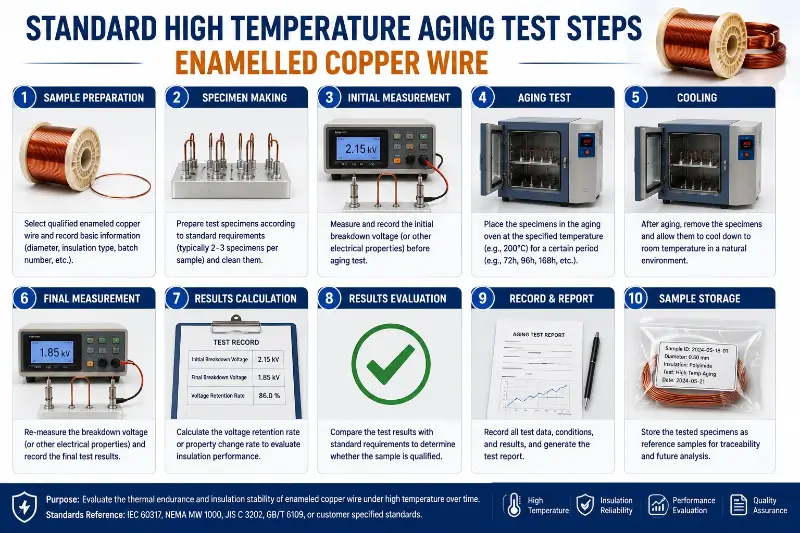
Overview and Engineering Significance of High Temperature Aging Testing
What Is High Temperature Aging Testing for Enameled Wire?
High Temperature Aging Test for Enameled Wire subjects enameled wire to thermal stress, and in some standards also electrical stress, under controlled high-temperature conditions, followed by measurement of key performance parameters (breakdown voltage, insulation resistance, enamel adhesion, flexibility, and appearance) after prescribed durations, to evaluate the wire’s thermal stability and residual lifetime under prolonged elevated temperatures.
Core Objectives:
- Determine the Temperature Index (TI): the temperature corresponding to a 20,000 h lifetime
- Determine the Thermal Class: Class 130 / 155 / 180 / 200 / 220 / 240
- Assess short-term overload capability: time-to-failure at +80°C above rated use temperature
- Verify product quality: batch-to-batch consistency and supplier capability
- Establish accelerated lifetime models: via multi-temperature-point Arrhenius regression
- Support new product development: thermal performance evaluation of new materials or processes
Engineering Significance of High Temperature Aging Testing
Impact on Equipment Reliability:
- Insulation failure of enameled wire is the primary cause (40–60%) of motor/transformer burnout
- Enamel degradation reduces breakdown voltage at an annual rate of 1–3%
- “Halving rule” for high-temperature life: lifetime halves for every 10 K increase in temperature
- Aging testing remains the only standardized method for predicting actual service life
Importance to Equipment Safety:
- Failure of traction motors, mining motors, or aerospace motors may lead to major safety incidents
- Transformer failure can trigger grid blackouts and fire hazards
- Aging testing constitutes a mandatory basis for equipment standards such as IEC 60034, IEEE 522, and UL 1446
Value to Procurement Decisions:
- Significant variation exists in enamel quality (TI differences of 10–20 K for identical specifications)
- Aging data form the core technical specification for procurement
- Aging testing is a key criterion in supplier qualification audits
Classification of High Temperature Aging Tests
Categorized by duration and objective:
| Test Type | Duration | Temperature | Objective |
|---|---|---|---|
| Short-term High Temperature Failure | 1–1000 h | Tp + 80°C (minimum 250°C) | Evaluate overload capability |
| Accelerated Lifetime (≥3 points) | 1000–10,000 h | ≥3 temperature points (above TI) | Arrhenius extrapolation to determine TI |
| Real-time Lifetime (1–2 points) | 10,000–30,000 h | 1–2 temperature points (including Tp) | Validate model accuracy |
| Cyclic Thermal Shock + Aging | 500–5000 cycles | Tp ± 10 K | Comprehensive reliability assessment |
Categorized by applied stress:
- Pure Thermal Aging: Heating only; breakdown voltage measurement
- Thermo-electric Aging: Heating + applied voltage (e.g., GB 4074.25)
- Thermal-humid Aging: Heating + humidity
- Thermal-vibration Aging: Heating + vibration
Limitations of High Temperature Aging Testing
- Long test duration: Long-term lifetime tests require 10,000–30,000 h
- Extrapolation risk: Arrhenius assumption may fail due to multiple concurrent failure mechanisms
- Test environment discrepancy: Not fully representative of actual operating conditions
- Multi-mode enamel failure: No single metric fully captures overall degradation
Overview of the Test Standard Framework
High temperature aging testing for enameled wire involves multiple international and national standards. Understanding this framework is fundamental to correct standard selection.
IEC 60851 Series (International Electrotechnical Commission, Widely Adopted)
IEC 60851-1: Test methods for winding wires — Part 1: General requirements
- Definitions, general test method principles, and nomenclature
- Covers generic requirements applicable to all enameled wire tests
IEC 60851-4: Chemical properties
- Test 12: Solvent resistance
- Test 15: Refrigerant resistance
- Test 16: Transformer oil resistance
IEC 60851-5: Electrical properties
- Test 5: Resistance
- Test 13: Breakdown voltage
- Test 14: Insulation continuity
- Test 19: Dielectric loss factor
- Test 23: Pinhole detection
IEC 60851-6: Thermal properties
- Test 9: Thermal shock resistance
- Test 10: Softening breakdown resistance (breakdown at elevated temperature)
- Test 11: Weight loss test
- Core standard related to aging
Corresponding Chinese National Standards GB/T 4074 Series:
- GB/T 4074.1: General requirements
- GB/T 4074.4: Chemical properties
- GB/T 4074.5: Electrical properties (breakdown voltage)
- GB/T 4074.6: Thermal shock resistance, thermal bonding, etc.
- GB 4074.25: High-temperature failure test (a dedicated “high-temperature aging + energized” standard)
ASTM D2307 (American Society for Testing and Materials)
ASTM D2307:
- Title: Standard Test Method for Thermal Endurance of Film-Insulated Round Magnet Wire
- Scope: Thermal endurance testing of film-insulated round enameled wire
- Core: Arrhenius extrapolation of Thermal Index (TI) using multiple temperature points
- Origin: ASTM D-9 Committee, 1960s
ASTM D3145:
- Title: Standard Test Method for Thermal Endurance of Electrical Insulating Varnishes
- Scope: Thermal aging test for insulating varnishes
- Application: Primer/topcoat for magnet wire
ASTM D4880:
- Title: Standard Test Method for Thermal Endurance of Film-Insulated Round Magnet Wire
- Similar to ASTM D2307, specifically for enameled wire
ASTM D1676:
- General test methods for magnet wire
- Includes dielectric breakdown voltage, elongation, flexibility, and adhesion
NEMA MW 1000 (National Electrical Manufacturers Association)
NEMA MW 1000 Part 3:
- Title: Magnet Wire – Thermal Endurance
- Scope: Thermal life and Temperature Index (TI) of enameled wire
- Core: Based on IEC 60851 and ASTM D2307
Relationship with IEC 60851:
- NEMA MW 1000 integrates U.S.-market-specific requirements onto the foundation of IEC 60851
- Data are interoperable
GB/T 4074 and GB 4074.25 (Chinese National Standards)
GB/T 4074 Series:
- Identical adoption of IEC 60851 series
- GB/T 4074.1 – General requirements
- GB/T 4074.2 – Dimensions
- GB/T 4074.3 – Mechanical properties
- GB/T 4074.4 – Chemical properties
- GB/T 4074.5 – Electrical properties
- GB/T 4074.6 – Thermal properties
GB 4074.25–1983 (Special national standard for high-temperature failure testing of enameled wire):
- Title: Test Methods for Enamelled Wire – High-Temperature Failure Test
- Scope: Determination of overload performance of round enameled wire under short-term elevated temperature and voltage stress
- The most directly applicable Chinese national standard for “high-temperature aging”
Key Parameters of GB 4074.25:
- Oven temperature: Rated operating temperature of the test enameled wire + 80°C (or 250°C if < 250°C)
- Specimen specification: Nominal diameter 1.000 mm, Class 2 insulation film, length 600 mm
- Number of specimens: 5
- Specimen preparation: Twisted pair method (per GB/T 4074.5)
- Test voltage: AC 50 Hz, power frequency
- Breakdown criterion: Power supply cutoff when current ≥ 10 ± 5 mA
- Leakage current trip threshold: 5 mA
- Transformer capacity: ≥ 100 VA
- Test termination: All 5 specimens fail or prescribed time reached
JIS C 3003 (Japanese Industrial Standards)
JIS C 3003:
- Title: Test Methods for Winding Wires for Electrical Machinery
- Scope: Test methods for winding wires (enameled wires) used in electrical machinery
- Thermal aging correlation: Part 5 of JIS C 3003
Comparison of Major Standards
| Dimension | IEC 60851 | ASTM D2307 | NEMA MW 1000 | GB/T 4074 | GB 4074.25 | JIS C 3003 |
|---|---|---|---|---|---|---|
| Nature | Test method | Test method | Performance standard | Test method | Specialized standard | Test method |
| Short-term high-temperature failure | ✓ (60851-6) | Partial | Partial | ✓ | ✓✓ Focus | ✓ |
| Long-term thermal life | Partial | ✓✓ Focus | ✓✓ Focus | Partial | ✗ | Partial |
| Arrhenius extrapolation | Partial | ✓✓ Focus | ✓ | Partial | ✗ | ✗ |
| Applicability in China | ✓ (Identical national standard) | ✗ | ✗ | ✓✓ Identical | ✓✓ Specialized | ✗ |
| Industry application | International | Americas | Americas | China | China | Japan |
Standard Selection Principles
When to select GB 4074.25:
- For the Chinese market
- Short-term high-temperature failure testing
- Test duration: 1–1000 h
- Simulating overload conditions
When to select ASTM D2307:
- For international customers (Americas)
- Long-term thermal life extrapolation
- Requirement for Temperature Index (TI)
- Test duration ≥ 10,000 h
When to select IEC 60851-6:
- Globally accepted standard
- Short-term thermal shock resistance + softening breakdown
- Test duration: 500–1000 h
When to select NEMA MW 1000 Part 3:
- For the North American market
- Compatibility with NEMA-standard enameled wire
- Long-term thermal life + TI extrapolation
Test Equipment and Specimen Preparation
Aging Oven
Key parameters:
- Temperature range: Ambient + 10 °C to 450 °C (GB 4074.25 maximum: 450 °C)
- Temperature uniformity: ±1% or ±2 °C (GB 4074.25 specifies ±1%)
- Temperature stability: ±0.5 °C over 24 h
- Heating time: ≤ 60 min from ambient to 400 °C
- Chamber material: Stainless steel (corrosion-resistant)
- Chamber dimensions: ≥ 500 × 500 × 500 mm
- Forced-air circulation (recommended)
- Temperature control: PID controller with over-temperature protection
Recommended equipment:
- Domestic: Jiaxing Dingbao, Suzhou Donghua, Shanghai Yiheng
- International: Memmert (Germany), Binder (Germany), Thermo Fisher (USA), ESPEC (Japan)
Calibration requirements:
- Annual calibration once per year
- Calibration certificate traceable to national metrological standards
- Calibration points: 50 / 100 / 200 / 300 / 400 °C
- Multi-point calibration (≥ 9 points)
Voltage Test Apparatus
GB 4074.25 requirements:
- Test transformer capacity: ≥ 100 VA
- Secondary parallel capacitance: 1–2 μF (for overvoltage suppression)
- Current trip threshold: 5 mA leakage current
- Cutoff current: 10 ± 5 mA
- Timer accuracy: ±0.1%
- Number of test stations: ≥ 5
- Terminal posts: Independent per station
International standard requirements (IEC 60851-5):
- Test voltage: AC 50/60 Hz
- Voltage ramp rate:
- < 500 V: 20 V/s
- 500–2500 V: 100 V/s
-
2500 V: 500 V/s
- Breakdown criterion: Leakage current ≥ 5 mA
- Power supply capacity: ≥ 500 VA
Dielectric Breakdown Voltage Tester
Breakdown voltage tester:
- AC 0–10 kV or 0–20 kV (selected according to enameled wire voltage rating)
- 50/60 Hz power frequency
- Adjustable voltage ramp rate (20 / 100 / 500 V/s)
- Breakdown criterion: 5 mA leakage current
- Automatic voltage ramping and automatic data recording
- Multiple test stations (5–10 specimens simultaneously)
Electrode types:
- Steel ball method: Enamelled wire immersed in metal beads
- Mandrel method: Enamelled wire wound around a metal rod
- Twist pair method: Two enameled wires twisted together
- Flat plate method: Enamelled wire clamped between parallel plates
Insulation Resistance Tester
Parameters:
- DC test voltage: 100–1000 V
- Measurement range: 10⁶ – 10¹⁵ Ω
- Accuracy: ±5%
- Charging time: 60 s
Typical equipment:
- Megger (UK), Keithley (USA), Agilent (USA)
- Domestic: Tonghui, Victoreen
Enamel Film Flexibility Testing Equipment
Test requirements:
- Mandrel diameters: 1×, 2×, 3×, and 4× wire diameter
- Winding speed: 1–3 turns/sec
- Post-winding inspection: Cracking assessment under magnifier or microscope
Enamel Film Adhesion Testing Equipment
Snap test:
- Pull force: 1–3 kg
- Post-snap inspection at 10× magnification
Peel test:
- Continuous tensile loading
- Peel force recording
Specimen Preparation
Per GB 4074.25:
- Nominal diameter: 1.000 mm (preferred)
- Enamel coating thickness: Grade 2
- Length: approx. 600 mm
- Quantity: 5 pieces
General Requirements:
- Diameter range: 0.50–2.50 mm (IEC 60851)
- Enamel coating: as per actual specification of the test enameled wire
- Length: 300–1000 mm
- Quantity: 5–10 pieces
Sample Preparation Procedure:
- Incoming Inspection: visual appearance, diameter, enamel coating thickness
- Preconditioning:
– Store at room temperature for 24 h
– Dry (to prevent moisture absorption affecting test results) - End Treatment:
– Scrape enamel off ends over 5–10 mm
– Solder or crimp leads - Specimen Formation:
– Twisting method: twist two wires together at 6–12 turns/m
– Mandrel winding method: wind around a 25 mm diameter round mandrel
– Single-wire method: test directly - Identification and Recordkeeping:
– Assign specimen numbers, date, and specifications
– Maintain test plan sheet
Short-Term High-Temperature Failure Test Procedure (GB 4074.25 / IEC 60851-6)
The short-term high-temperature failure test simulates overload or transient overheating conditions to measure the “overload life” of enameled wire under extreme elevated temperatures.
Scope
- Evaluates failure time of enameled wire under combined short-term extreme high temperature + voltage
- Simulates: motor locked-rotor condition, transformer overload, fault conditions
- Applicable standards: GB 4074.25-83, IEC 60851-6, ASTM D1676
Test Equipment Preparation
Step 1: Oven Preheating
- Set temperature: rated operating temperature of the test enameled wire + 80°C (minimum 250°C if result < 250°C)
- Example: Class H enameled wire (180°C) → test temperature = 180 + 80 = 260°C
- Example: Class F enameled wire (155°C) → test temperature = max(235, 250) = 250°C
- Soak time: stabilize at set temperature for 30 min
Step 2: Specimen Loading
- Switch off oven blower
- Open oven door
- Load five twisted specimens
- Connect high-voltage leads
- Close oven door
- Restart blower
Step 3: Voltage Application
- Wait until oven temperature re-stabilizes at set point
- Activate voltage test system
- Apply AC 50 Hz test voltage
- Voltage level: 1.5–2.5 × rated working voltage (per product specification)
Key Parameters:
- Test temperature: Tp + 80°C (minimum 250°C)
- Test voltage: 50 Hz AC
- Voltage ramp rate: 100 V/s
- Leakage current trip threshold: 5 mA
- Current cutoff threshold: 10 ± 5 mA
Test Procedure
Step 4: Continuous Monitoring
- Monitor current of each specimen
- If current of any specimen reaches 5 mA, record as breakdown of that specimen
- Continue timing
- Test terminates when all five specimens have broken down or when prescribed duration (typically 1000 h) is reached
Step 5: Data Recording
- Breakdown time of each specimen (h, min)
- Instantaneous breakdown voltage
- Breakdown current
- Breakdown location (winding section, end region, span)
- Oven temperature (recorded every 8 h)
Step 6: Termination Criteria
- All five specimens broken down: use longest breakdown time as failure time
- Duration reaches 1000 h with no breakdown: deemed compliant
- Any test anomaly occurs: repeat test
Test Result Evaluation
Evaluation Principle:
- All five specimens ≥ 1000 h: pass (compliant)
- Any one specimen < 100 h: fail
- Intermediate values: evaluate per product specification
Evaluation Criteria Reference Table:
| Application | Test Temperature | Test Duration | Pass Criterion |
|---|---|---|---|
| General Class F | 250°C | 1000 h | All 5/5 breakdown times ≥ 1000 h |
| General Class H | 260–280°C | 1000 h | All 5/5 breakdown times ≥ 1000 h |
| Class C | 300–360°C | 500 h | All 5/5 breakdown times ≥ 500 h |
| Special Military | 300–450°C | 100–500 h | Per specification |
Test Report Content
- Enameled wire specification (diameter, enamel type, enamel grade)
- Test temperature and test voltage
- Breakdown time of each specimen (h, min)
- Breakdown location
- Oven temperature records
- Tester name and test date
- Compliance/non-compliance determination

Long-Term Thermal Life Test Procedure (ASTM D2307 / IEC 60216)
The long-term thermal life test determines the Temperature Index (TI) of enameled wire via Arrhenius extrapolation using ≥3 temperature points, constituting the core methodology for establishing thermal class rating.
Scope
- Determines thermal life of enameled wire under prolonged high-temperature exposure
- Extrapolates Temperature Index (TI) corresponding to 20,000 h life
- Establishes thermal class rating
- Applicable standards: ASTM D2307, ASTM D4880, IEC 60216, IEEE 98
Key Principle: Arrhenius Model
Core Assumption:
- Enamel aging follows first-order reaction kinetics
- Relationship between life L and temperature T:
$$\ln(L) = A + \frac{B}{T}$$
where T is absolute temperature (K), and A and B are constants
Engineering Simplification:
- 8–10 K rule: life halves for every 8–10 K increase in temperature
- Empirical: Class H (180°C) life = 20,000 h; at 190°C ≈ 10,000 h
Selection of Test Temperature Points
Number of Temperature Points: ≥3 (recommended: 4)
Selection Criteria:
- At least one temperature point with expected life < 5000 h (accelerated aging)
- At least one temperature point with expected life > 5000 h (validation)
- Temperature interval: 10–20 K
Typical Test Temperature Points for Class H Enameled Wire (TI = 180):
- Point 1: 220°C (expected life ~2000 h)
- Point 2: 210°C (expected life ~4000 h)
- Point 3: 200°C (expected life ~8000 h)
- Point 4: 190°C (expected life ~16,000 h)
- Optional Point 5: 180°C (validation point, 20,000 h)
Typical Test Temperature Points for Class C Enameled Wire (TI = 240):
- Point 1: 300°C (~500 h)
- Point 2: 280°C (~1500 h)
- Point 3: 260°C (~5000 h)
- Point 4: 240°C (~20,000 h)
Test Procedure
Step 1: Specimen Grouping
- Five to ten specimens per temperature point
- Minimum total specimens: 3 temperature points × 5 = 15
- Recommended: 4 temperature points × 10 = 40 (higher precision)
Step 2: Initial Performance Testing
- Measure breakdown voltage at time zero (baseline)
- Measure insulation resistance at time zero
- Assess visual appearance, flexibility, and adhesion at time zero
- Perform multiple measurements and average results
Step 3: Aging Oven Loading
- Assign one group of specimens per temperature point
- Ramp oven to target temperature
- Load specimens
- Record start time
Step 4: Periodic Removal and Testing
- Time points: 48 h, 96 h, 168 h, 336 h, 504 h, 1000 h, 2000 h, 3000 h, 5000 h, 8000 h, 12,000 h, 20,000 h, etc.
- Remove 1–2 specimens per time point
- Test breakdown voltage, insulation resistance, visual appearance, flexibility, and adhesion
- Record all data
Step 5: End-Point Determination
- Life endpoint reached when breakdown voltage drops to 50% of initial value
- Or when insulation resistance drops to 10⁶ Ω·m
- Or when enamel exhibits severe cracking or delamination
Step 6: Repeat Until All Temperature Points Reach Endpoint
- Higher-temperature points reach endpoint first (months)
- Lower-temperature points reach endpoint later (years)
Data Processing and Arrhenius Extrapolation
Step 1: Compile Data Table
| Temperature Point (°C) | Absolute Temperature T (K) | Failure Time L (h) | ln(L) | 1000/T (1/K) |
|---|---|---|---|---|
| 220 | 493 | 2000 | 7.601 | 2.028 |
| 210 | 483 | 4000 | 8.294 | 2.070 |
| 200 | 473 | 8000 | 8.987 | 2.114 |
| 190 | 463 | 16000 | 9.680 | 2.160 |
Step 2: Linear Regression
- Fitting equation: ln(L) = A + B × (1/T)
- Slope B and intercept A
- Coefficient of determination R² ≥ 0.95 (goodness of fit)
Step 3: Extrapolation of temperature for 20,000 h lifetime
- ln(20,000) = 9.903
- 9.903 = A + B × (1/T)
- 1/T = (9.903 − A) / B
- T = 1 / [(9.903 − A) / B]
- This T (°C) = TI − 273.15
Example calculation:
- Fitting equation: ln(L) = −23.5 + 15,300 / T
- Set L = 20,000 h: ln(20,000) = 9.903
- 9.903 = −23.5 + 15,300 / T
- 33.403 = 15,300 / T
- T = 458.0 K = 184.9°C
- TI ≈ 185°C → nominal Class 180
Thermal class determination
IEC 60085 classification:
- Measured TI = 184.9°C
- TI ≥ 180 and < 200: classified as Class 180 (Class H)
Classification rules:
- TI < 105: Class Y
- 105 ≤ TI < 120: Class A
- 120 ≤ TI < 130: Class E
- 130 ≤ TI < 155: Class B
- 155 ≤ TI < 180: Class F
- 180 ≤ TI < 200: Class H
- 200 ≤ TI < 220: Class N
- 220 ≤ TI < 250: Class R
- TI ≥ 250: Class 250
Test duration and cost
Typical test durations:
- Three-temperature-point test: 6–18 months
- Four-temperature-point test: 12–24 months
- Full data validation: 24–36 months
Test costs:
- Equipment investment: CNY 500,000–2,000,000 (oven + dielectric breakdown tester + ancillary equipment)
- Single test: CNY 5,000–50,000 (depending on number of specimens)
- Long-term testing: electricity cost + labor + equipment depreciation
Critical parameters and controls during testing
Temperature control
Temperature accuracy:
- Deviation between setpoint and actual temperature: ≤ ±1°C
- Temperature uniformity within oven: ≤ ±1% (GB 4074.25)
- Long-term drift: ≤ ±0.5°C / 24 h
Temperature monitoring:
- Multi-point thermocouple monitoring (≥ 3 points)
- Independent temperature data logger (backup)
- Manual recording every 8 h
- Immediate alarm upon anomaly
Specimen loading
Loading principles:
- Spacing between specimens ≥ 10 mm
- Spacing between specimens and oven wall ≥ 50 mm
- No stacking or contact between specimens
- Forced hot air must pass uniformly through specimens
Prohibited loading errors:
- Specimens touching oven wall (localized overheating)
- Specimens densely packed (localized cooling)
- Specimens placed directly over air outlet (temperature non-uniformity)
Test voltage control
Voltage stability:
- Voltage fluctuation ≤ ±2%
- Frequency stability: 50 ± 0.5 Hz
- Sinusoidal waveform, total harmonic distortion < 5%
Leakage current monitoring:
- Continuous leakage current monitoring per specimen
- Breakdown declared at 5 mA
- Automatic shutdown at 10 mA
Environmental control
Ambient conditions:
- Laboratory temperature: 20–25°C
- Ambient humidity: 45–75% RH
- Atmospheric pressure: normal (no special requirements)
Ventilation requirements:
- Minor volatiles released during aging
- Laboratory must be well ventilated
- Volatile concentration < occupational exposure limit
Safety requirements
High-voltage safety:
- Grounding protection
- Interlocked safety door
- Operators wear insulating gloves
- Operators hold high-voltage electrical work certification
High-temperature safety:
- Heat-resistant gloves
- Face shield
- Caution against burns during specimen loading/unloading
- Oven exterior surface temperature < RT + 35°C (GB standard)
Inspection items during aging
Dielectric breakdown voltage (most critical)
Test equipment:
- Dielectric breakdown voltage tester
- Electrodes: twisted-wire method / steel-ball method / cylindrical-rod method
- Voltage ramp rate: 100 V/s
- Breakdown criterion: 5 mA leakage current
Test frequency:
- Short intervals: 48 h, 96 h, 168 h, 336 h, 504 h
- Long intervals: 1,000 h, 2,000 h, 5,000 h, 10,000 h
- Reduced interval near endpoint
Data recording:
- Breakdown voltage value per specimen
- Time to breakdown
- Breakdown location
- Calculation of mean and standard deviation
Acceptance criteria:
- Breakdown voltage < 50% of initial value: end-of-life
- Breakdown voltage < absolute threshold (e.g., 1 kV): end-of-life
Insulation resistance
Test equipment:
- High-resistance meter (10⁶ – 10¹⁵ Ω)
- DC test voltage: 100–500 V
Test frequency:
- Concurrent with breakdown voltage tests
- Or every 168 h
Acceptance criteria:
- Insulation resistance < 10⁶ Ω·m: end-of-life
- Insulation resistance < 1% of initial value: end-of-life
Enamel film flexibility
Test method:
- Wrapping around 1× mandrel
- Visual inspection under 10× magnification
- Cracking indicates failure
Test frequency:
- Every 1,000 h in long-term tests
- Every 500 h near endpoint
Acceptance criteria:
- Visible cracking: enamel film failure
- Enamel flaking: enamel film failure
Enamel film adhesion
Test method:
- Snap test (rapid pull-off)
- Sustained tensile pull
- Delamination of enamel from conductor: insufficient adhesion
Test frequency:
- Every 2,000 h in long-term tests
- Mandatory at aging endpoint
Acceptance criteria:
- Delaminated area > 5%: adhesion failure
Visual appearance
Inspection items:
- Color change (yellow, brown, black)
- Loss of enamel gloss (dulling)
- Chalking, blistering, peeling
Acceptance criteria:
- Severe discoloration: aging indication
- Blistering or peeling: failure
Dielectric loss tangent (tanδ) (optional)
Test equipment:
- Dielectric loss analyzer
- Test frequency: 1 kHz or 50 Hz
Significance:
- Reflects molecular structural changes in enamel film
- Sensitive early indicator of aging
- May change prior to breakdown voltage decline
Acceptance criteria:
- tanδ increase > 100%: early aging
Mass loss (optional)
Test method:
- Weigh specimens before and after aging
- Calculate mass loss percentage
Acceptance criteria:
- Mass loss > 5%: aging indication
- Mass loss > 10%: severe aging
Arrhenius lifetime extrapolation and temperature index (TI)
Principle of extrapolation
Enamel film aging is fundamentally a chemical reaction rate process. Within a limited temperature range, the reaction rate constant k obeys the Arrhenius equation:
k = A × exp(−Ea / RT)
Since failure time L is inversely proportional to reaction rate:
L = 1 / k = (1/A) × exp(Ea / RT)
Taking natural logarithm:
ln(L) = ln(1/A) + (Ea / R) × (1/T)
              ↑             ↑
            intercept      slope
Let:
- A_const = ln(1/A)
- B = Ea / R
- ln(L) = A_const + B × (1/T)
Linear regression of experimental (1/T, ln(L)) data across multiple temperatures yields A_const and B.
Extrapolation procedure
Step 1: Data preparation
Collect all temperature points (T_i, L_i), where:
- T_i: thermodynamic temperature (K)
- L_i: failure lifetime of enameled wire at that temperature (h)
Step 2: Unit conversion
- T (K) = T (°C) + 273.15
- 1/T unit: K⁻¹ (retain 5 decimal places)
Step 3: Logarithmic transformation
- x_i = 1 / T_i
- y_i = ln(L_i)
Step 4: Linear regression
Least-squares method:
B = [n×Σ(xy) − Σx×Σy] / [n×Σ(x²) − (Σx)²]
A_const = (Σy − B×Σx) / n
Step 5: Correlation coefficient verification
R² = [n×Σ(xy) − Σx×Σy]² / {[n×Σ(x²) − (Σx)²] × [n×Σ(y²) − (Σy)²]}
Evaluation:
- R² ≥ 0.95: good fit
- R² ≥ 0.90: acceptable fit
- R² < 0.90: poor fit; retest required
Step 6: Extrapolation of temperature for 20,000 h lifetime
Let L_target = 20000 h, ln(L_target) = 9.903:
1/T_target = (9.903 - A_const) / B
T_target (K) = 1 / [(9.903 - A_const) / B]
TI (°C) = T_target (K) - 273.15
Step 7: Confidence Interval
95% confidence interval (based on t-distribution):
TI_lower, TI_upper = TI ± t(α/2, n−2) × σ
where σ is the standard error of the estimated TI.
Estimation Example
Test Data:
| T (°C) | T (K) | 1/T (1/K) | L (h) | ln(L) |
|---|---|---|---|---|
| 220 | 493.15 | 2.0278 | 1800 | 7.4955 |
| 210 | 483.15 | 2.0696 | 4000 | 8.2940 |
| 200 | 473.15 | 2.1134 | 8200 | 9.0115 |
| 190 | 463.15 | 2.1591 | 16500 | 9.7112 |
Linear Regression:
- n = 4
- Σ(1/T) = 8.3699
- Σ(ln(L)) = 34.5122
- Σ(1/T × ln(L)) = ?
- 2.0278 × 7.4955 = 15.2014
- 2.0696 × 8.2940 = 17.1653
- 2.1134 × 9.0115 = 19.0451
- 2.1591 × 9.7112 = 20.9676
- Σ = 72.3794
- Σ(1/T²) = ?
- 2.0278² = 4.1120
- 2.0696² = 4.2833
- 2.1134² = 4.4665
- 2.1591² = 4.6617
- Σ = 17.5235
- Σ(ln(L)²) = ?
- 7.4955² = 56.1825
- 8.2940² = 68.7904
- 9.0115² = 81.2071
- 9.7112² = 94.3074
- Σ = 300.4874
- B = (4 × 72.3794 − 8.3699 × 34.5122) / (4 × 17.5235 − 8.3699²)
- = (289.5176 − 288.8732) / (70.0940 − 70.0553)
- = 0.6444 / 0.0387
- = 16664
- A_const = (34.5122 − 16664 × 8.3699) / 4
- = (34.5122 − 139488.4) / 4
- = −34863.5
Estimated TI:
- ln(20000) = 9.903
- 9.903 = −34863.5 + 16664 × (1/T)
- 34873.4 = 16664 / T
- T = 1/2.0927 × 1000 = 477.85 K
- TI = 477.85 − 273.15 = 204.7°C
Classification:
- TI = 204.7°C
- 200 ≤ 204.7 < 220 → Class N (200 °C)
Limitations of Arrhenius Estimation
Applicability Conditions:
- Single failure mode
- No phase transition within temperature range
- Unchanged chemical reaction mechanism
- Sufficient aging data (≥ 3 temperature points)
Inapplicable Cases:
- Coexistence of multiple failure modes
- Change in chemical reaction mechanism at elevated temperatures
- Extremely low temperatures (near Tg)
- Severe enamel degradation
Test Result Evaluation and Failure Criteria
Short-Term High-Temperature Failure Evaluation (GB 4074.25)
Evaluation Table:
| Test Temperature | Test Duration | Number of Breakdowns | Evaluation |
|---|---|---|---|
| Tp + 80°C (≥250°C) | 1000 h | 0/5 | Excellent |
| Tp + 80°C | 1000 h | 1–2/5 | Good |
| Tp + 80°C | 1000 h | 3/5 | Marginal |
| Tp + 80°C | 1000 h | 4–5/5 | Fail |
Long-Term Thermal Life Evaluation (ASTM D2307)
Evaluation Table (based on TI vs. nominal value):
| Measured TI (°C) | Nominal Class | Evaluation |
|---|---|---|
| ≥ Nominal + 10 | Class N | Excellent |
| Nominal to Nominal + 10 | Class N | Pass |
| Nominal − 10 to Nominal | Class N−1 | Marginal |
| < Nominal − 10 | Class N−1 | Fail |
Failure Mode Analysis
Primary Failure Modes:
| Mode | Manifestation | Proportion |
|---|---|---|
| Thermal Degradation | Decrease in breakdown voltage | 60% |
| Thermal Oxidation | Enamel embrittlement and discoloration | 25% |
| Interfacial Failure | Reduced adhesion | 10% |
| Stress-Induced Failure | Enamel cracking | 5% |
Failure Location Analysis
Typical Failure Locations:
- Twisted sections: stress concentration, common
- Termination ends: electric field concentration, common
- Mid-span: thermal aging, breakdown path
- Near oven wall: overheating risk
Significance of Location Recording:
- Reflects failure mechanism
- Guides process improvement
- Assesses product consistency
Common Issues and Best Practices
Issue 1: High Data Scatter
Causes:
- Variability in specimen preparation
- Oven temperature non-uniformity
- Testing equipment error
- Inherent enamel quality variation
Best Practices:
- Increase specimen count (from 5 to 10)
- Verify oven temperature uniformity
- Calibrate testing equipment
- Conduct intra-batch comparison
- Apply statistical methods (e.g., Weibull analysis)
Issue 2: Excessive Acceleration at High-Temperature Points
Causes:
- Excessively high test temperature
- Poor inherent enamel quality
- Oven temperature overshoot
Best Practices:
- Adjust temperature increments (10–20 K steps)
- Control ramp rate
- Perform repeated verification
- Retain backup specimens
Issue 3: Excessively Slow Aging at Low-Temperature Points
Causes:
- Test temperature too low (close to Tp)
- Conservative test protocol
Best Practices:
- Add 1–2 higher-temperature points
- Accept longer test duration
- Apply Arrhenius extrapolation (with caution)
Issue 4: Large Breakdown Voltage Measurement Error
Causes:
- Fluctuating voltage ramp rate
- Poor electrode contact
- Specimen preparation variability
Best Practices:
- Calibrate voltage ramp rate
- Standardize electrode preparation
- Adopt twisted-wire method (standardized)
- Perform multiple measurements and average
Issue 5: Subjective Adhesion Testing
Causes:
- Inconsistent pull-off force
- Visual judgment variability
Best Practices:
- Use standardized pull-off device (controlled force)
- Employ multi-operator evaluation with averaging
- Document results via photography
Issue 6: Poor Arrhenius Fit
Causes:
- Mechanism change due to excessive test temperature
- Multiple concurrent failure modes
- Insufficient data points
Best Practices:
- Exclude outliers
- Increase number of data points
- Verify test temperature range
- Apply segmented Arrhenius modeling
Test Records and Reporting
Test Record Content
Basic Records:
- Magnet wire specification (grade, diameter, enamel type, batch number)
- Test standard (GB 4074.25 / ASTM D2307)
- Test temperature and duration
- Test voltage
- Specimen count
- Test equipment (model, calibration date)
- Tester name and date
Data Records:
- Breakdown voltage per specimen
- Time-to-breakdown
- Breakdown location
- Intermediate test data during aging
- Temperature log
- Ambient conditions
Test Report Content
Report Structure:
- Report Number
- Client
- Sample Information
- Test Standard
- Test Conditions
- Test Equipment
- Test Data
- Data Analysis
- Conclusion
- Reporter, Reviewer, Approver
The Conclusion shall include:
- Pass/fail determination
- Measured Temperature Index (TI), if applicable
- Nominal Class
- Failure mode analysis
- Improvement recommendations
Example Report Template
======= Magnet Wire High-Temperature Aging Test Report =======

Report Number: TR2026-07-001
Client: ABC Motor Co., Ltd.
Sample Information:
- Type: Class H Polyamide-imide Enamelled Round Copper Wire
- Diameter: 1.000 mm
- Enamel Grade: Grade 2
- Batch No.: 2026-06-A001
Test Standard: GB 4074.25-83
Test Period: 2026-07-01 to 2026-08-01
Test Temperature: 260°C
Test Voltage: 1.5 kV AC, 50 Hz
Number of Specimens: 5

Test Results:
- Specimen 1: Breakdown time = 1247 h
- Specimen 2: Breakdown time = 1392 h
- Specimen 3: Breakdown time = 1456 h
- Specimen 4: Breakdown time = 1502 h
- Specimen 5: Breakdown time = 1611 h
Average Breakdown Time: 1442 h
Standard Deviation: 131 h

Judgment: Pass (≥ 1000 h)

Test Technician: Zhang San
Reviewer: Li Si
Approver: Wang Wu
Summary
High-temperature aging testing of magnet wire is the core standardized methodology for evaluating thermal reliability, determining Temperature Index (TI), and assigning thermal Class—encompassing two primary applications: short-term high-temperature failure testing (GB 4074.25 / IEC 60851-6) and long-term thermal life testing (ASTM D2307 / IEC 60216).
This document systematically outlines the engineering significance of high-temperature aging testing (TI determination, Class assignment, life prediction, quality verification, equipment safety assurance), the test standard framework (IEC 60851, ASTM D2307, NEMA MW 1000, GB/T 4074, GB 4074.25, JIS C 3003), test equipment (aging oven, voltage test apparatus, dielectric breakdown tester, insulation resistance meter, enamel flexibility tester, adhesion tester), sample preparation (nominal diameter 1.000 mm, Grade 2 enamel, length 600 mm, 5 specimens), short-term high-temperature failure test procedure (test temperature = Tp + 80°C, minimum 250°C; preheating; loading; voltage application; monitoring; recording; termination; judgment), long-term thermal life test procedure (≥3 temperature points, Arrhenius-based extrapolation, TI calculation), critical parameter control (temperature accuracy ±1°C, voltage fluctuation ±2%, environmental conditions), in-process inspection items (dielectric breakdown voltage, insulation resistance, enamel flexibility, enamel adhesion, visual appearance, tanδ, mass loss), Arrhenius-based life extrapolation and TI calculation (multi-point regression, confidence interval), test result evaluation and failure criteria, common issues and best practices, and test recordkeeping and reporting.
Summary of Core Procedures:
- Short-term High-Temperature Failure Test: Temperature = Tp + 80°C (minimum 250°C); AC 50 Hz voltage; 1.5–2.5× operating voltage; 5 twisted specimens; record individual breakdown times; pass criterion: all 5 specimens ≥ 1000 h
- Long-term Thermal Life Test: 3–4 temperature points (spacing 10–20 K); Arrhenius regression ln(L) = A + B/T; TI defined as the temperature corresponding to 20,000 h life
- Critical Parameters: Oven uniformity ±1%, voltage frequency 50 Hz, breakdown current threshold 5 mA
- Inspection Items: Dielectric breakdown voltage, insulation resistance, enamel flexibility, enamel adhesion
- Data Processing: Linear Arrhenius regression, R² ≥ 0.95
- Evaluation Principle: Compare measured TI against nominal Class
With continuously increasing demands from emerging applications—including new-energy vehicles, wind power, photovoltaics, aerospace, rail transit, AI servers, and 5G/6G communications—for higher thermal Class, improved lifetime reliability, and accurate failure prediction, high-temperature aging testing is evolving toward multi-point precision testing, intelligent Arrhenius modeling, and integration of accelerated testing with real-time monitoring. Engineers are advised to adopt a holistic testing mindset integrating “standards + equipment + procedures + data + judgment,” tailoring comprehensive reliability assessment loops to specific application requirements, product specifications, and lifetime targets.