

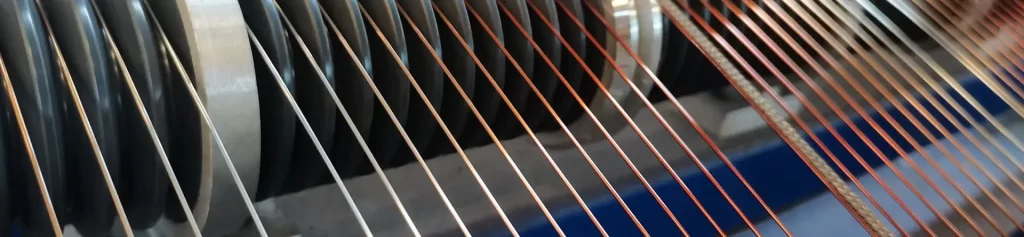
The “enamel” in enameled wire is the core — it accounts for 8-15% of cost and determines 90% of performance. A wire’s thermal class, dielectric strength, solderability, and chemical resistance all come from the enamel coating. This article breaks down the entire coating process: the formulation logic behind seven mainstream resins, key parameters for five coating steps, and five common defects with their root causes. This is an “insider’s view” for B2B buyers to evaluate enameled wire quality.
1. Seven Mainstream Enamel Resins: Formulation Logic Compared
Enamel resin is not a single chemical — each resin determines a wire’s core characteristics:
- Polyester (PE): The earliest commercial enamel, 120-130°C class, the main choice for oil-immersed transformers. Low cost, good flow, but modest thermal shock resistance.
- Modified Polyester (Mod. PE): Modified with glycerin/pentaerythritol, raising heat resistance to 155°C. Widely used in appliance motors and general-purpose transformers.
- Polyurethane (UEW): Its core selling point is “solderability” — direct tinning at a 380°C solder pot, no enamel stripping needed. Eliminates terminal processing and is the top choice for electronic coils. 155-180°C class.
- Polyesterimide (PEI): Polyester + imide structure, 180-200°C class. The workhorse for medium-high temperature enamels, widely used in industrial motors, wind turbines, and home-appliance compressors.
- Polyamide-imide (PAI): The “champion” of high temperature resistance, usable on its own or as an outer coating, lifting dual-coat systems to 200-220°C. Outstanding chemical resistance, suited for variable-frequency drives and wind power.
- Polyimide (PI): The “temperature king” above 240°C, used in aviation, military, and nuclear applications. Costs 5-10 times that of ordinary enamels and is used only in extreme scenarios.
- Polyester/Polyamide Composite + Self-Bonding Layer: A three-coat structure, PEI + PAI + PA self-bonding layer, that allows coils to be fixed by hot-air heating after winding, eliminating the need for vacuum-pressure impregnation.
2. Key Parameters in Five Coating Steps
Enamel film formation requires repeated “coat — cure — coat” cycles. A typical complete coating process:
- Annealing: Before entering the coating machine, the conductor passes through an annealing furnace at 280-320°C to release drawing stress and improve conductor softness. Annealing temperature + tension are the keys to base-coat adhesion.
- Base Coat: The first dip, wipe, and cure pass; curing furnace temperature is 350-450°C, with cure time 3-8 seconds. The base coat sets adhesion and the insulation foundation.
- Repeated Coating (2-8 Passes): According to enamel thickness requirements, 2-8 coating passes are repeated. Each pass is 4-10μm, with finished enamel thicknesses typically 20-60μm (Grade 1-3).
- Top Coat: The final coating, typically PAI or modified PEI, providing protection against chemicals, abrasion, and thermal shock.
- Lubricant Coat: An extremely thin final coat (<1μm) of wax or silicone oil-based lubricant, facilitating threading through automatic winding machines.
“Film thickness uniformity” and “film continuity” after every step are at the heart of quality. Grade 2 (0.06mm+ enamel) enameled wires require continuous, pinhole-free films — the test is immersing the wire in saturated copper sulfate solution for one minute; no copper deposition means pass.
3. Five Common Enamel Defects and Their Causes
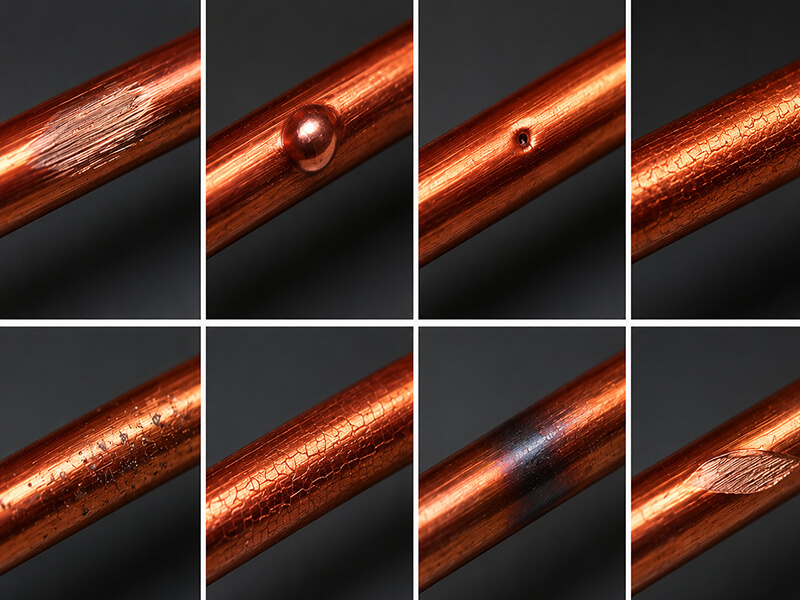
- Pin Holes: Curing temperature too low, bake time insufficient so the film retains solvent; or curing furnace airflow too high, causing the film to crack.
- Film Peeling: Base-coat temperature too high, conductor surface oxidation not cleaned, or conductor drawn without annealing. 90% of peeling cases trace to “annealing + base coat.”
- Film Blistering: Air bubbles in enamel liquid; or curing temperature too high so solvents cannot escape the film in time. Common when enamel has stood too long without degassing.
- Film Thickness Variation: Worn wiping dies, enamel viscosity fluctuation (within ±5% is acceptable, beyond that it alarms), or unstable line speed. ±10% is the precision of high-quality product.
- Film Yellowing/Carbonization: Curing temperature overtemperature or residence time too long — premature thermal aging of the film. The most severe hidden defect; requires every 5 meters of in-line inspection before shipping.
4. Four Key Quality Indicators for Enameled Wire
- Breakdown Voltage (BDV): Single-layer 1.5-3kV, dual-layer 4-6kV, three-layer 8-12kV. Standardized tests per GB/T 4074 / IEC 60851.
- Film Continuity: Pass through the copper sulfate pinhole test; no copper deposition after immersion for five turns of wire means pass.
- Softening Breakdown Temperature: The film retains insulation at 350-400°C. The core indicator for high-temperature enamels.
- Solderability: Only polyurethane enameled wire has it; immersion at 380°C with full tinning within 3-8 seconds means excellent.
Practical reminder: under the same nominal 180°C class, the gap between major factories and “self-labeled 180 grade” is huge. Lower-end factories use modified polyester to pretend it’s PEI, where aging life plummets from 20,000 hours to 5,000 hours, and the film embrittles within 3 years. To judge the enamel, look for five documents: enamel supplier’s CoA, film thermal aging curve, factory 1,000-hour accelerated aging report, third-party SGS/UL test, and batch traceability records.
5. Procuring Enameled Wire: Examine 5 Documents (Not 1 Specification)
Many procurement officers only look at one specification sheet before ordering — and 60%+ hit potholes. Professional procurement looks at five documents:
- Enamel CoC/CoA: Each batch of enamel has a chemical composition, solids content, viscosity, and acid value report — directly tied to enamel base performance.
- Film Thermal Aging Curve: Arrhenius curve, 1,000+ hours of accelerated aging at 200-220°C, showing enamel life.
- Factory Inspection Report: Breakdown voltage, film continuity, solderability (UEW), resistance, elongation.
- Third-Party Certifications/Tests: UL 1446, IEC 60851, RoHS, REACH — independent third-party verification.
- Batch Traceability Records: Each enameled wire batch tied to the enamel batch, production line, production time, and operator. A hard requirement from medical/automotive customers.
One last word: enameled wire is decided by the “enamel,” not the “wire”. Most buyers only look at wire diameter, resistance, and elongation while ignoring the enamel. Once equipment has an insulation failure, 99% of problems trace to the enamel — and enamel problems are 80% process, 20% material. Before selecting a supplier, ask “who is your enamel supplier, what curing temperature do you use, and what accelerated aging data do you have” — these three questions will eliminate 70% of fake 180-grade factories.
One more layer: the same enameling machine producing 2.0mm and below fine wire and 2.5mm and above coarse wire delivers enamel quality differing by more than 30%. The reason is straightforward: fine wire needs higher annealing temperature, different enamel viscosity, and re-tuned equipment parameters. Producing every spec on one machine by adjusting parameters looks efficient but is essentially shooting in the dark. Professional factories divide production lines by spec series — that is true respect for the process.