

Introduction
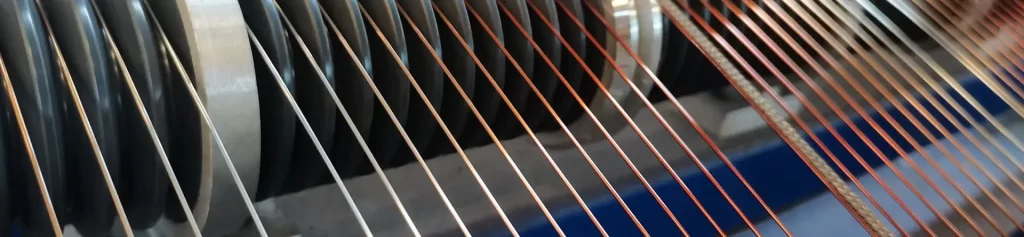
Paper-wrapped wire is one of the longest-established and most widely applied composite insulated conductors in the manufacturing of windings for power transformers and reactors. Its typical construction comprises a metallic conductor (copper or aluminum), a base enamel insulation film, and an outer layer of cellulose or synthetic fiber paper tape, applied via multi-layer winding to achieve electrical isolation, mechanical protection, and thermal stability for the conductor. In industrial transformer applications, paper-wrapped wire has long been employed in critical winding sections—including high-voltage windings, low-voltage high-current windings, interlayer and inter-coil insulation, electrostatic shielding windings, and end-turn insulation. As dry-type transformers, oil-immersed transformers, mining transformers, and traction transformers diversify in rated capacity, voltage class, and operating environment, the insulation systems, paper substrate selection, winding processes, and quality verification methods for paper-wrapped wire continue to evolve. This paper systematically addresses the material system, insulation construction, mechanical and dielectric properties, application scenarios, manufacturing processes, typical selection methodologies, and quality testing and failure analysis of paper-wrapped wire—based on the insulation structural requirements of industrial transformers—with the aim of providing a technically referenced framework for transformer designers, winding manufacturing engineers, and procurement specialists.
Core Insulation Requirements for Industrial Transformer Windings
The operating conditions of industrial transformer windings dictate that the insulation material must simultaneously satisfy requirements across four dimensions: electrical, mechanical, thermal, and chemical. Electrically, the winding must withstand the combined effects of power-frequency withstand voltage, impulse voltage, and long-term operating voltage; its insulation system must therefore exhibit sufficient dielectric strength, low dielectric loss factor, and high volume resistivity. Mechanically, during short-circuit conditions, the winding experiences enormous electromagnetic forces generated by currents tens of times the rated value; the insulation layer must retain integrity—without cracking or delamination—under dynamic mechanical stress. Thermally, the winding operates continuously under elevated temperature rise; the insulation material must possess adequate thermal stability, thermal life, and thermal expansion compatibility. Chemically, the insulation material must resist transformer oil, impregnating resins, moisture, acidic substances, and by-products generated during operation.
Under these comprehensive requirements, paper-based insulation materials have long served as the primary insulation carrier for windings, owing to their favorable electrical properties, processability, and compatibility with other insulation materials. Paper-wrapped wire is formed by helically wrapping multiple layers of paper tape over either enameled or bare conductors, thereby creating a composite insulation structure in which paper serves as the principal dielectric medium. The multi-layer overlapping configuration of the paper tape ensures adequate dielectric strength while providing necessary mechanical cushioning and facilitating effective penetration during subsequent impregnation, casting, or vacuum-pressure impregnation (VPI) processes. The insulation performance of paper-wrapped wire is jointly determined by conductor surface condition, enamel film integrity, paper substrate characteristics, number of paper tape layers and lap configuration, impregnant properties, and drying/vacuum processing parameters; deviation in any single step may compromise the reliability of the overall insulation system.
Typical Structure and Material System of Paper-Insulated Magnet Wire
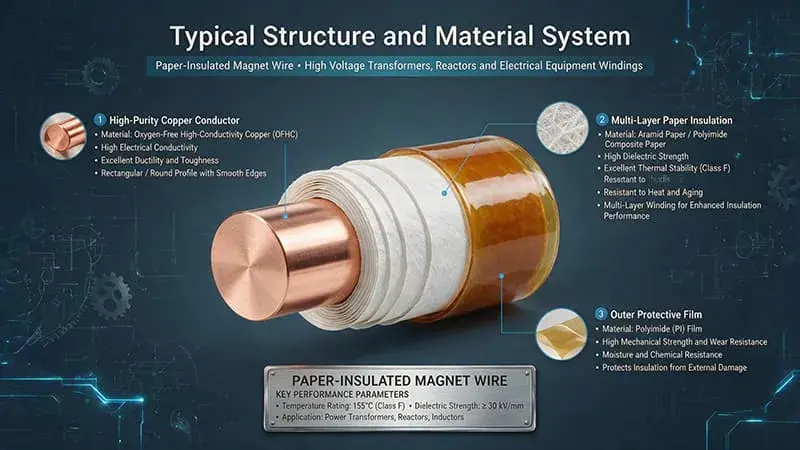
Paper-insulated magnet wire typically comprises three layers. The conductor layer serves the current-carrying function and may be fabricated from electrical-grade copper, electrical-grade aluminum, or aluminum-clad copper; its cross-section may be round, rectangular, or sector-shaped. The resistivity, conductivity, mechanical strength, and mass of the conductor material directly determine transformer losses, temperature rise, and mechanical characteristics. Round conductors are predominantly used in low-voltage, low-capacity windings; rectangular conductors offer higher space utilization and superior heat dissipation in high-voltage, high-capacity windings; sector-shaped conductors are employed in high-voltage windings of large power transformers to optimize electric field distribution and insulation structure. The base enamel layer fills microscopic surface defects of the conductor, enhances the conductor’s partial discharge inception voltage, and improves paper tape adhesion. Common base enamel types include polyester, polyurethane, polyester-imide, and polyamide-imide. Base enamel thickness typically ranges from 0.02 mm to 0.10 mm; insufficient thickness fails to form a continuous insulating layer, whereas excessive thickness increases susceptibility to cracking during bending. The paper layer constitutes the core insulating medium of paper-insulated magnet wire, formed by helically winding 2 to 8 layers of paper tape with a minimum overlap ratio of 40% to achieve a continuous insulating wrap. Significant differences exist among paper base materials in terms of thermal class, dielectric strength, and mechanical performance. The principal paper base materials used in industrial transformers include the following categories.
Kraft paper—the most common cellulose-based paper—is manufactured from unbleached sulfate wood pulp and exhibits high mechanical strength, excellent impregnation performance, and low cost. Its thermal class is typically 105°C to 120°C, and it has been widely applied in oil-immersed transformer windings for extended service life. Thermally upgraded kraft paper incorporates thermal stabilizers or undergoes chemical modification to elevate its thermal class above 130°C, thereby maintaining stable physical and electrical performance at elevated temperatures. Aramid paper—produced from aromatic polyamide fibers—offers outstanding thermal resistance, mechanical strength, and dielectric performance, achieving a thermal class up to 220°C. It provides reliable insulation protection in dry-type transformers, high-temperature oil-immersed transformers, and traction transformers. NEMA MW 1000-2018 specifies Type MW 60-A, which mandates aramid paper as the insulating medium and explicitly defines requirements for paper tape winding method, minimum thickness, dielectric breakdown voltage, and bendability—serving as a critical reference for design and acceptance of paper-insulated magnet wire in industrial transformers.
Selection of paper base material must comprehensively consider thermal class, dielectric strength, mechanical strength, impregnation compatibility, and cost. Cellulose paper demonstrates excellent stability and oil compatibility in transformer oil, making it the traditional choice for oil-immersed transformers. Aramid paper maintains stable dielectric and mechanical performance at elevated temperatures, rendering it the preferred option for dry-type and high-temperature transformers. Composite paper base materials—formed by combining cellulose paper with synthetic fibers—balance cost and performance, finding application in certain medium-sized transformers.
Technical Highlights: Dielectric and Mechanical Properties
The dielectric performance of paper-wrapped enameled wire is critical for its application in transformer windings. The dielectric breakdown voltage is jointly determined by paper tape thickness, base paper material, overlap ratio, impregnation process, and operating environment. For paper tapes with thicknesses ranging from 0.05 mm to 0.13 mm, each layer withstands hundreds of volts to over one kilovolt of power-frequency breakdown voltage. Multi-layer winding yields cumulative insulation thickness, and the overall breakdown voltage increases approximately linearly with the number of layers; however, surface discharge and partial discharge must still be considered under high electric field gradients. Partial discharge commonly occurs at internal voids within the insulation layer, conductor edges, or paper tape overlap regions; its inception voltage is closely related to insulation uniformity, void dimensions, and the dielectric constant of the impregnating medium.
The dielectric loss factor of paper-wrapped magnet wire is strongly correlated with moisture content in the base paper material. Cellulose paper exhibits high hygroscopicity; insufficiently dried paper-wrapped wire may experience increased dielectric loss and reduced partial discharge inception voltage during operation due to moisture absorption. Therefore, paper-wrapped wire is typically subjected to thorough drying in a vacuum oven prior to winding, and residual gases and moisture are removed via vacuum-pressure impregnation (VPI) during impregnation or casting processes. Aramid paper exhibits relatively lower hygroscopicity, yet drying remains necessary even in high-humidity environments. Volume resistivity and surface resistivity are key parameters for evaluating the insulation performance of paper-wrapped magnet wire; after impregnation with insulating oil, cellulose paper typically achieves a volume resistivity exceeding 10^12 Ω·m, satisfying industrial transformer insulation requirements.
Regarding mechanical properties, paper-wrapped magnet wire must maintain insulation integrity under bending, torsion, and impact conditions. During winding manufacturing, paper-wrapped wire undergoes repeated bending and forming operations; the paper tape must remain tightly wound without loosening or cracking. NEMA MW 1000-2018 specifies that, after bending around a mandrel with a diameter equal to six times the bare conductor thickness, the insulation on rectangular or square aluminum magnet wire shall exhibit no visible loosening or exposure of bare conductor. Under short-circuit impulse conditions, paper-wrapped wire endures enormous instantaneous electromagnetic forces; the adhesion between insulation and conductor, as well as the intrinsic tensile strength of the insulation layer, directly determine the winding’s short-circuit resistance capability. Tensile strength, elongation at break, and peel strength are critical indicators for evaluating the mechanical performance of paper-wrapped magnet wire; their values depend closely on the fiber structure of the base paper, paper tape winding tension, and varnish film adhesion.
Applications in Oil-Immersed Transformers
Oil-immersed transformers are the most widely used transformer type in industrial power grids and distribution systems, with windings continuously immersed in mineral oil or vegetable-based insulating oil. Paper-covered magnet wire serves primarily as insulation for high-voltage windings, low-voltage windings, and tap-changing windings in oil-immersed transformers. High-voltage windings typically employ enameled rectangular copper or aluminum wire wrapped with multiple layers of thermally upgraded kraft paper or aramid paper, forming cylindrical, sectional, or disc-type winding structures. The multi-layer paper tape of the paper-covered wire, together with the transformer oil, constitutes a composite dielectric medium; its dielectric strength is jointly determined by the oil gaps, paper layers, and oil-impregnated paper. In large power transformers, paper-covered wire must also be integrated with insulating pressboard, insulating blocks, and insulating end rings to form complete longitudinal and main insulation systems.
Low-voltage, high-current windings impose stringent requirements on conductor cross-sectional area and thermal dissipation performance; they commonly adopt rectangular copper or aluminum wire wrapped with paper tape to form helical or foil-type winding structures. In low-voltage windings, paper-covered wire primarily provides inter-turn insulation and ground insulation, while simultaneously acting as an oil-permeation channel during impregnation to enhance overall winding thermal dissipation. In tap-changing windings and on-load tap-changer (OLTC) windings, paper-covered wire must withstand frequent current switching and temperature fluctuations; its insulation system must exhibit excellent resistance to thermal aging and electric arcing.
The operating temperature of oil-immersed transformers typically ranges from 80°C to 105°C, with hot-spot temperatures exceeding 120°C. During long-term operation, paper-covered wire is subjected to combined stresses from temperature, oil flow, electric field, and mechanical vibration, resulting in gradual degradation of insulation performance. Routine maintenance requires periodic testing of transformer oil for moisture content, acid number, and dielectric properties, along with dissolved gas analysis (DGA) to assess potential insulation defects.
Applications in Dry-Type Transformers
Dry-type transformers primarily employ solid insulating media such as epoxy resin, polyester resin, or silicone rubber, and are commonly used in indoor power distribution, metro traction, wind power generation, marine applications, and locations requiring high fire-resistance ratings. In dry-type transformers, paper-covered magnet wire is typically utilized for interlayer insulation and ground insulation of windings. The paper tape material is predominantly aramid paper to meet stringent requirements for thermal class and mechanical strength. During vacuum-pressure impregnation (VPI) or casting processes, the paper tape layer of the paper-covered wire provides pathways for resin penetration, enabling thorough filling of voids within the winding and formation of a dense, homogeneous insulation structure.
Heat generated by windings during operation in dry-type transformers is dissipated mainly via air convection and radiation; thus, the thermal endurance of paper-covered wire directly influences winding temperature-rise design and long-term operational reliability. For Class H and Class C dry-type transformers, paper-covered wire shall employ aramid or composite paper-based materials with a thermal class rating of not less than 180°C to 220°C. Aramid papers such as Nomex® have established mature technical systems in dry-type transformer applications, with proven compatibility with epoxy resins, dielectric stability, and mechanical toughness validated through extensive engineering experience.
Dry-type transformers impose stringent fire-performance requirements; therefore, flame-retardant properties of paper-covered wire constitute a critical performance indicator. Aramid paper inherently exhibits excellent flame retardancy—resisting ignition and combustion at elevated temperatures—and effectively retards fire propagation under fault conditions. Some high-end dry-type transformers utilize specialized paper substrates, such as ceramicizable silicone rubber paper or inorganic fiber paper, to fulfill more demanding fire-resistance and thermal endurance requirements.
Applications in Mining, Traction, and Special-Purpose Transformers
Mining transformers, traction transformers, and electric furnace transformers impose higher requirements on winding insulation. Mining transformers typically operate in humid, dusty, and highly vibratory environments; therefore, paper-covered magnet wire must exhibit moisture resistance, mold resistance, and vibration resistance. Paper substrates are preferably moisture-resistant aramid paper or composite paper substrates. Traction transformers—used in locomotives, subways, and high-speed trains—are frequently subjected to vibration, mechanical shock, and thermal cycling; thus, paper-covered magnet wire must demonstrate superior fatigue resistance and thermal stability. Electric furnace transformers experience severe current fluctuations and short-circuit stresses during operation; consequently, the mechanical strength and short-circuit resistance of paper-covered magnet wire are critical—typically achieved via thickened paper tape or multi-layer cross-wound insulation to enhance mechanical reliability.
Additionally, paper-covered magnet wire is widely employed in the insulation of windings for high-voltage test transformers, reactors, instrument transformers, and capacitors. These devices impose stricter requirements on dielectric strength, dielectric loss, and partial discharge characteristics of the insulation; accordingly, the paper substrate selection, winding process, and impregnation treatment of paper-covered magnet wire must strictly comply with the technical specifications of the respective equipment. For high-voltage test transformers, paper-covered magnet wire commonly employs multi-layer aramid paper wrapping combined with vacuum-pressure impregnation (VPI) to withstand high electric field stress under test voltage conditions.
Manufacturing Process and Quality Control
The manufacturing process of paper-wrapped magnet wire directly determines its performance and reliability. Conductor pre-treatment includes surface cleaning, annealing, and varnishing. Surface cleaning removes oils, oxides, and contaminants from the conductor surface; annealing eliminates internal stresses in the conductor and improves electrical conductivity; varnishing forms a continuous, uniform varnish film on the conductor surface. Varnish film thickness, uniformity, and adhesion constitute the foundation for subsequent paper tape wrapping quality.
Paper tape wrapping is the core process in paper-wrapped magnet wire manufacturing. The paper tape must be wrapped tightly, uniformly, and continuously onto the conductor, with an overlap ratio of not less than 40%; paper tape layer count, tension, and wrapping angle must strictly comply with technical specifications. Wrapping defects—including wrinkles, misalignment, excessive overlap, and cracking—must be avoided. For rectangular or square cross-section conductors, the paper tape wrapping method and overlap configuration must be adjusted according to the geometric characteristics of the conductor cross-section to ensure tight conformity of the paper tape at corners and edges. Wrapping equipment typically employs CNC tape-wrapping machines capable of precisely controlling paper tape tension, speed, and overlap position. Ambient temperature and humidity during wrapping must also be strictly controlled to prevent moisture absorption by the paper substrate or electrostatic charge accumulation on the paper tape.
Impregnation and drying constitute critical post-processing steps in paper-wrapped magnet wire manufacturing. Vacuum-pressure impregnation effectively removes moisture and gases from both the paper substrate and varnish film while enabling thorough penetration of insulating oil or resin into the interior of the insulation system. Drying parameters—including temperature, time, and vacuum level—must be rigorously controlled to prevent cracking of the insulation layer due to thermal stress or over-drying. Standards such as NEMA MW 1000-2018 and IEC 60851 specify detailed requirements for dimensions, electrical properties, mechanical properties, thermal properties, and chemical properties of paper-wrapped magnet wire, serving as essential references for manufacturing and acceptance.
Regarding quality control, paper-wrapped magnet wire shall undergo visual inspection, dimensional measurement, elongation testing, dielectric breakdown testing, adhesion and flexibility testing, and thermal shock testing. Visual inspection primarily evaluates the uniformity, continuity, and integrity of paper tape wrapping. Dimensional measurements include conductor diameter, conductor thickness and width, varnish film thickness, paper wrap thickness, and overall outer diameter. Elongation testing assesses the conductor’s plastic deformation capability, requiring a minimum value of 15%. Dielectric breakdown testing is the key indicator for evaluating insulation strength; NEMA MW 60-A specifies a minimum breakdown voltage of 300 V per mil of paper wrap thickness. Adhesion and flexibility testing evaluates bonding strength between the insulation layer and conductor, as well as paper tape integrity under bending conditions, via bend testing. Thermal shock testing assesses insulation stability and service life under elevated temperatures, typically involving exposure at 175°C to 220°C for a specified duration followed by re-measurement of dielectric breakdown voltage.
Selection and Design Considerations
Selection of paper-covered magnet wire shall comprehensively consider transformer type, capacity rating, voltage class, temperature rise limitation, operating environment, and cost factors. In oil-immersed distribution transformers, thermally upgraded kraft paper-covered enameled copper or aluminum wire is commonly employed; the number of paper tape layers is determined based on voltage class and insulation clearance. In dry-type transformers, aramid paper-covered enameled copper or aluminum wire shall be prioritized to simultaneously satisfy thermal class and mechanical strength requirements. For high-voltage windings, paper-covered wire must be co-designed with insulating pressboard, insulating blocks, and other components to ensure uniform electric field distribution and adequate insulation margin. For low-voltage, high-current windings, the conductor cross-sectional area of paper-covered wire must meet current density and temperature rise requirements; the number of paper tape layers may be adjusted according to interlayer voltage and heat dissipation requirements.
Conductor material selection likewise influences paper-covered wire application. Copper conductors offer superior electrical conductivity and mechanical strength, making them suitable for high-voltage, high-capacity, and high-reliability transformers. Aluminum conductors feature lower cost and reduced weight, rendering them appropriate for distribution transformers and weight-sensitive applications. Copper-clad aluminum conductors combine certain advantages of both copper and aluminum; however, their compatibility with paper insulation requires validation via dedicated process qualification. Conductor cross-sectional shape affects winding fill factor and thermal performance; selection shall be based on transformer capacity and winding configuration.
Paper-covered wire design must also ensure compatibility with the transformer’s overall insulation system. Components—including insulating pressboard, insulating blocks, insulating end rings, and insulating bushings—shall form a synergistic insulation structure with the paper-covered wire to guarantee uniform electric field distribution, reliable mechanical support, and unimpeded heat transfer pathways. During design, reliability of the insulation system shall be verified through electric field simulation, thermal simulation, and mechanical simulation; comprehensive type tests and special tests shall be conducted during prototype testing.
Failure Modes and Quality Improvement Directions
Common failure modes of paper-covered magnet wire in transformers include insulation breakdown, partial discharge, paper layer delamination, thermal aging, and mechanical cracking. Insulation breakdown is frequently caused by insufficient paper tape thickness, inadequate lap ratio, defects in the base paper material, or incomplete impregnation. Partial discharge typically occurs at internal voids within the insulation layer, conductor edges, or paper tape lap joints, and is closely related to impregnation process parameters and electric field distribution. Paper layer delamination is generally attributable to insufficient adhesion between the enamel coating and the paper tape or mismatched coefficients of thermal expansion. Thermal aging and mechanical cracking represent cumulative damage under long-term operating conditions, directly correlated with operating temperature, vibration, and frequency of short-circuit surges.
To address these failure modes, quality improvement initiatives focus on optimizing the formulation and processing of base paper materials; enhancing adhesion between the enamel coating and paper tape; improving winding processes to ensure uniformity and achieve target lap ratios; strengthening vacuum-pressure impregnation (VPI) to eliminate voids and moisture; and refining in-line and final-product quality inspection systems. Standards such as NEMA MW 1000, IEC 60317, and GB specify mandatory performance requirements for paper-covered magnet wire; manufacturers must strictly adhere to these standards for material selection, process control, and product validation.
At the material level, development of advanced base paper materials continues. Ceramicizable silicone rubber paper forms a ceramic protective layer at elevated temperatures, significantly improving fire resistance and impact resistance of the insulation system. Nano-modified cellulose paper incorporates nanofillers to enhance dielectric strength and mechanical strength. Hybrid structures combining polyimide film with aramid paper synergize the high dielectric strength of film with the flexibility of paper, offering promising applications in high-frequency transformers and specialized power supplies. At the process level, adoption of automated winding equipment and in-line inspection systems enhances consistency and reliability of paper-covered magnet wire. Machine vision technology enables real-time monitoring of paper tape winding quality, while artificial intelligence algorithms leverage historical data to predict insulation service life and reliability—supporting transformer predictive maintenance strategies.
Conclusion
Paper-covered magnet wire serves as a core insulation material in industrial transformer winding manufacturing, and its performance directly affects the transformer’s electrical reliability, mechanical durability, and thermal stability. Standards such as MW 60-A specified in NEMA MW 1000-2018 provide unified technical specifications for paper-covered magnet wire regarding materials, insulation construction, and electrical and mechanical properties, forming a critical basis for design and acceptance. In diverse application scenarios—including oil-immersed transformers, dry-type transformers, and special-purpose transformers—selection of paper-based substrates, control of wrapping processes, and impregnation and drying treatments must be optimized according to specific voltage class, capacity rating, and operating environment. With ongoing industrial transformer requirements for higher voltage, higher power density, and enhanced reliability, the material systems and manufacturing processes of paper-covered magnet wire must continue advancing in dielectric performance, mechanical performance, thermal life, and environmental compliance to meet increasingly stringent insulation requirements for transformer windings in modern power systems. The integration of novel paper-based materials, automated manufacturing processes, and intelligent inspection technologies will expand the application prospects of paper-covered magnet wire in the industrial transformer sector.