

Introduction
Industrial Uses of Fiberglass Covered Wire is a core topic addressing the comprehensive industrial applications of fiberglass covered wire (also referred to as fiberglass insulated wire or glass fiber covered wire) in winding wire engineering and industrial electrical applications. Fiberglass covered wire employs braided or wound glass fiber as its primary insulation, bonded and protected by organic coatings—such as polyester resin, polyurethane resin, epoxy resin, silicone resin, and polyimide resin—enabling thermal classes ranging from Class 155 (F) to Class 220 (R). It exhibits significantly superior mechanical strength, flame resistance, and chemical resistance compared to enamel-coated wire, making it a critical winding material for demanding industrial applications involving high temperature, high vibration, high overload, and severe operating conditions. A thorough understanding of the full spectrum of industrial applications of fiberglass covered wire, selection criteria across diverse industrial use cases, synergies between the glass fiber substrate and the organic coating system, representative industrial application examples, and applicable compliance standards holds substantial practical significance for procurement and electrical engineers, as well as winding wire selection engineers, at B2B industrial motor manufacturers, transformer manufacturers, electrical equipment manufacturers, and specialized industrial manufacturers (e.g., metallurgy, chemical, mining, petroleum, marine, and aerospace sectors).
From the perspective of winding wire engineering practice, glass-fiber-covered magnet wire represents a critical technical option beyond the application boundaries of enameled wire in industrial electrical applications. Leveraging the high melting point, high mechanical strength, and high flame resistance of glass fiber, glass-fiber-covered magnet wire compensates for the limitations of enameled wire and is the preferred insulation solution for industrial electrical equipment operating under severe conditions.
The engineering implications of fiberglass-covered wire for industrial applications can be systematically elaborated from eight dimensions: fundamental understanding of fiberglass-covered wire, comprehensive overview of industrial applications, high-temperature industrial motor applications, specialized transformer and reactor applications, industrial applications under severe operating conditions, emerging industrial applications, selection considerations and design guidelines, and compliance standards and certifications. This article provides a systematic engineering reference for procurement and electrical engineers, as well as winding wire selection engineers, at B2B industrial motor manufacturers, transformer manufacturers, electrical equipment manufacturers, and specialized industrial manufacturers.
Fundamental Understanding of Glass-Fiber-Insulated Magnet Wire
Glass-Fiber-Insulated Magnet Wire Construction and Composition
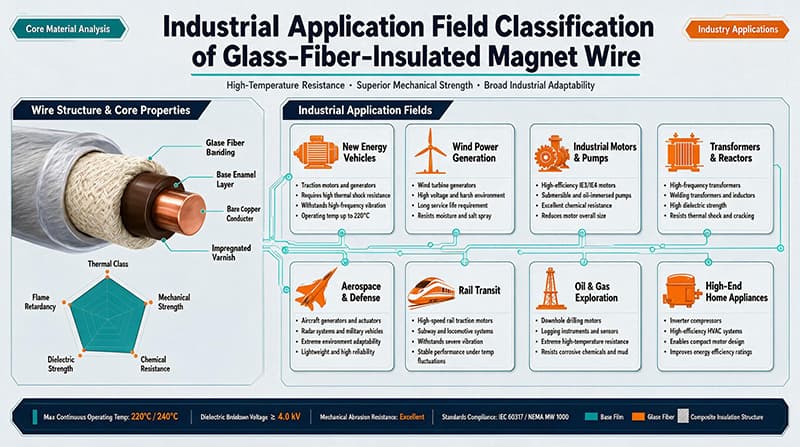
The insulation structure of fiberglass-covered wire consists of a fiberglass braided or wrapped layer combined with an organic coating. The fiberglass used is E-glass fiber, which exhibits engineering properties including high tensile strength, high temperature resistance, high electrical insulation performance, low smoke emission, and low toxicity. Fiberglass braiding or wrapping configurations include single-layer, double-layer, and multi-layer fiberglass coverings; braid density and wrap angle influence the electrical and mechanical properties of the fiberglass-covered wire.
Organic coatings are critical complementary materials for glass-fiber-covered magnet wire. Their functions include bonding the glass fibers, filling interstitial voids between fibers, providing surface smoothness, enhancing dielectric strength, and improving resistance to chemical media. Common organic coatings include polyester resin coatings, polyurethane resin coatings, epoxy resin coatings, silicone resin coatings, and polyimide coatings. Different coatings are matched to distinct temperature ratings and application scenarios.
Temperature Rating and Enamel System
The temperature rating of glass-covered magnet wire depends on the combined effect of the glass fiber (which has an extremely high temperature resistance) and the organic coating (which is the limiting factor for temperature resistance). Common temperature rating configurations include: polyester resin coating rated for Class 155 (F), polyurethane resin coating rated for Class 155 (F), epoxy resin coating rated for Class 155 to Class 180 (F to H), silicone resin coating rated for Class 180 to Class 220 (H to R), and polyimide coating rated for Class 220 (R).
The synergistic effect between the glass fiber and the organic coating is central to the performance of glass-covered magnet wire. The glass fiber provides mechanical strength, high-temperature structural support, and flame-retardant properties; the organic coating provides adhesion, protective encapsulation, dielectric strength, and resistance to chemical media. Their synergy delivers the comprehensive performance advantages of glass-covered magnet wire.
Core Engineering Advantages
Glass-fiber-covered magnet wire offers several core engineering advantages over enameled wire. In terms of mechanical strength, glass fiber exhibits significantly higher tensile strength, flexural strength, and abrasion resistance than polymer insulation films, enabling glass-fiber-covered magnet wire to withstand mechanical stresses encountered during winding processes. Regarding flame retardancy, glass fiber is an inert inorganic material that is non-combustible and non-supporting of combustion; thus, the flame-retardant performance of glass-fiber-covered magnet wire is irreplaceable by enameled wire.
Regarding resistance to chemical media, glass fiber exhibits excellent resistance to most chemicals (acids, alkalis, salts, and solvents). Regarding radiation resistance, glass fiber demonstrates high resistance to ultraviolet (UV) radiation, gamma (γ) rays, and other forms of radiation. Regarding thermal performance, glass-fiber-covered magnet wire is available in temperature classes ranging from Class 155 to Class 220, making it the preferred choice for high-temperature industrial electrical applications.
Comprehensive Overview of Industrial Applications
Industrial Application Field Classification
Applications of glass-filament-covered magnet wire in industrial sectors can be classified by industry, temperature class, and special requirements. By industry, industrial applications of glass-filament-covered magnet wire include: the power industry (transformers, generators); metallurgical industry (blast furnaces, continuous casting, rolling mills); chemical industry (reactors, pumps, compressors); petroleum industry (downhole motors, submersible motors); mining industry (coal mining, mineral extraction); marine industry (shipboard motors, auxiliary motors); rail transit industry (traction motors); automotive industry (drive motors for new-energy vehicles); aerospace industry (aerospace motors); and nuclear power industry (main coolant pump motors for nuclear power plants).
Classified by temperature class, glass-filament-covered magnet wire covers the full industrial thermal endurance range from Class 155 to Class 220. Classified by special requirements, glass-filament-covered magnet wire is applied in industries with high flame-retardancy requirements (e.g., explosion-proof motors, mining motors), high chemical resistance requirements (e.g., chemical industry motors, marine motors), high vibration resistance requirements (e.g., traction motors, marine propulsion motors), and high radiation resistance requirements (e.g., nuclear power plant motors, aerospace motors).
Fundamental Application Advantages of Glass-Fiber-Insulated Magnet Wire
The advantages of glass-filament-covered magnet wire in industrial applications stem from a comprehensive integration of thermal, mechanical, flame-retardant, chemical, and radiation resistance properties. The thermal advantage enables glass-filament-covered magnet wire to meet industrial temperature classes ranging from Class 155 to Class 220. The mechanical advantage allows it to withstand industrial operating conditions characterized by high vibration, high impact, and high centrifugal force.
The flame-retardant advantage enables glass-fiber-covered magnet wire to meet stringent safety requirements in industrial applications such as explosion-proof, chemical, and mining environments. The chemical resistance advantage ensures stable performance of glass-fiber-covered magnet wire in corrosive industrial environments, including chemical processing, marine, and oil & gas applications. The radiation resistance advantage allows glass-fiber-covered magnet wire to be suitable for industrial applications involving radiation exposure, such as nuclear power and aerospace.
Drivers of Industrial Application Development
Key drivers for the industrial application development of glass-covered magnet wire include industrial electrification upgrades, enhanced industrial energy efficiency requirements, expanded applications under harsh operating conditions, and upgraded safety standards. Industrial electrification upgrades broaden the application scope of industrial motors and transformers. Enhanced industrial energy efficiency requirements promote the adoption of high-temperature, high-efficiency motors, where the thermal endurance advantage of glass-covered magnet wire becomes critical.
Expansion of applications under harsh operating conditions—such as high temperature, high voltage, high vibration, strong corrosion, and intense radiation—drives the extended application boundaries of glass-film-covered magnet wire. Upgraded safety standards—including explosion-proof standards, chemical industry safety standards, and nuclear power safety standards—increases the adoption ratio of glass-film-covered magnet wire in industrial applications with stringent safety requirements.
High-Temperature Industrial Motor Applications
High-Temperature Motor Application Scenarios
The application of glass-covered magnet wire is a core use case in industrial high-temperature motors. Industrial high-temperature motors include blast furnace blower motors and continuous casting motors in the metallurgical industry; high-temperature pump motors and high-temperature compressor motors in the chemical industry; high-temperature fan motors and high-temperature feedwater pump motors in the power industry; furnace motors and heat treatment motors in the glass industry; and so on.
The operating ambient temperature of industrial high-temperature motors typically exceeds 150 °C to 200 °C, imposing stringent thermal endurance requirements on winding insulation. Glass-fiber-covered magnet wire—offering thermal classes ranging from Class 155 to Class 220 and high mechanical strength—is the preferred winding material for industrial high-temperature motors.
Selection Considerations for High-Temperature Motors
Selection considerations for glass-fiber-covered magnet wire used in industrial high-temperature motors include thermal class, type of organic coating, number of glass fiber layers, and conductor specifications. Thermal class selection is based on the motor’s designed long-term operating temperature and peak temperature, typically selecting a class that meets the long-term operating temperature requirement with an appropriate safety margin. Organic coating type selection involves a comprehensive trade-off among thermal performance, mechanical properties, and resistance to chemical media.
The selection of the number of glass fiber layers is based on voltage class, insulation requirements, and mechanical requirements. The conductor size is determined comprehensively according to motor capacity, current density, and fill factor.
High-Temperature Motor Application Case Studies
A blast furnace blower motor in the metallurgical industry operates at elevated temperatures (peak temperature exceeding 180 °C) and endures severe conditions including high vibration, high overload, and high humidity/heat. The winding insulation employs Class 180 (Class H) glass-fiber-covered magnet wire (dual-layer glass fiber with silicone resin coating), with flat copper conductor. Field operation has validated the reliability of glass-fiber-covered magnet wire under high-temperature, high-vibration, and high-humidity/heat conditions typical of the metallurgical industry.
A high-temperature pump motor for a chemical industry reactor operates at elevated temperatures and is exposed to corrosive chemical media, requiring high flame-retardant performance. The winding insulation employs Class 180 (H-class) glass-fiber-covered magnet wire (dual-layer glass fiber with epoxy resin coating), with round copper conductor. Field operation has verified the reliability of glass-fiber-covered magnet wire under high-temperature and chemically aggressive conditions in the chemical industry.
Special Applications for Transformers and Reactors
Electric Furnace Transformer Applications
The application of glass-covered magnet wire in electric furnace transformers represents a typical scenario for specialty transformer applications. Electric furnace transformers—including arc furnace transformers, induction furnace transformers, and resistance furnace transformers—operate at high temperatures, endure frequent overloads, and are subjected to severe operating conditions. Winding insulation must exhibit excellent thermal endurance, high mechanical strength, and strong overload capability.
Glass-fiber-covered magnet wire, with thermal classes ranging from Class 180 to Class 220, high mechanical strength, and high overload capacity, is the preferred winding material for electric furnace transformers. It typically employs double- or multi-layer glass fiber combined with high-temperature-resistant coatings (e.g., silicone resin or polyimide), and the conductor is usually rectangular copper wire.
Applications in Rectifier Transformers and Traction Transformers
Glass-covered magnet wire is critically applied in rectifier transformers and traction transformers. Rectifier transformers withstand harmonic currents and harmonic voltages and operate under elevated ambient temperatures. Traction transformers supply power to rail transit traction systems and are subjected to frequent overloads, high operating temperatures, and demanding service conditions.
Glass-fiber-covered magnet wire provides multiple safeguards—thermal endurance, mechanical strength, and overload capacity—in rectifier transformers and traction transformers. It typically features thermal classes ranging from Class 180 to Class 220, double- or multi-layer glass fiber, and coatings of silicone resin or polyimide.
Reactor Applications
Glass-covered magnet wire is applied in reactors, including current-limiting reactors, filter reactors, smoothing reactors, series reactors, and shunt reactors. Reactors operate under various conditions, such as standard industrial environments, high-frequency environments, and high-voltage environments; some reactors must also withstand harmonic currents and transient current surges.
Reactor winding design must account for the combined effects of mechanical stress (electrodynamic forces) and thermal stress (temperature rise); the mechanical and thermal endurance advantages of glass-filament-covered magnet wire meet reactor design requirements.
Industrial Applications for Harsh Operating Conditions
Explosion-Proof Motor and Mining Motor Applications
The application of glass-covered magnet wire in explosion-proof motors and mine motors represents a typical scenario for demanding operating conditions. Explosion-proof motors are used in hazardous, explosive environments such as coal mines, petroleum, and chemical industries, where insulation must exhibit exceptional flame retardancy and explosion-proof performance. Mine motors impose stringent requirements on insulation properties—including flame retardancy, abrasion resistance, and impact resistance.
Glass-fiber magnet wire, leveraging the flame-retardant properties and high mechanical strength of glass fiber, is the preferred winding material for explosion-proof motors and mining motors. It is typically manufactured with Class 180 temperature index, double-layer glass fiber, and silicone resin or flame-retardant epoxy coating.
Chemical Industry Motors and Marine Motors Applications
Glass-covered magnet wire represents a typical application in chemically resistant environments, particularly in chemical motors and marine motors. Chemical motors operate in chemical production environments—exposed to acidic, alkaline, saline, and solvent-based chemical media—and require insulation with high resistance to chemical media. Marine motors are used in ships, offshore platforms, and coastal facilities, demanding insulation with high resistance to salt fog and humid heat.
Glass-fiber-covered magnet wire, leveraging the excellent chemical resistance of glass fiber to most chemical media, is the preferred material for chemical-process motors and marine motors. It typically employs chemically resistant coatings (e.g., epoxy resin or silicone resin), with conductors commonly made of copper or copper alloys.
Traction Motors and Rail Transit Applications
Glass-filament-wrapped magnet wire is applied in traction motors for metro vehicles, light rail vehicles, mainline locomotives, and urban rail transit vehicles. Traction motors operate at elevated temperatures (peak temperature up to 180 °C) and endure severe operating conditions including frequent start-stop cycles, overload, and vibration.
Glass-fiber magnet wire, with thermal classes ranging from Class 180 to Class 200, high mechanical strength, and long-term reliability, is the preferred winding material for traction motors. It is typically manufactured with a double-layer glass fiber construction, coated with silicone or polyimide.
Marine Motors and Naval Applications
Glass-filament-covered magnet wire is applied in marine motors and naval vessels, including marine propulsion motors, auxiliary marine motors, and specialized naval motors. Marine motors operate under harsh environmental conditions—such as high humidity, high salt fog, vibration, mechanical shock, and wide temperature fluctuations—imposing stringent requirements on the comprehensive performance of the insulation system.
Glass-fiber-covered magnet wire, leveraging the moisture- and heat-resistant, salt-spray-resistant, and vibration-resistant properties of glass fiber, is the preferred material for marine motors. It is typically manufactured with Class 180 temperature rating, double-layer glass fiber, and moisture- and heat-resistant coating.
Emerging Industrial Applications
Application in New Energy Vehicle Traction Motors
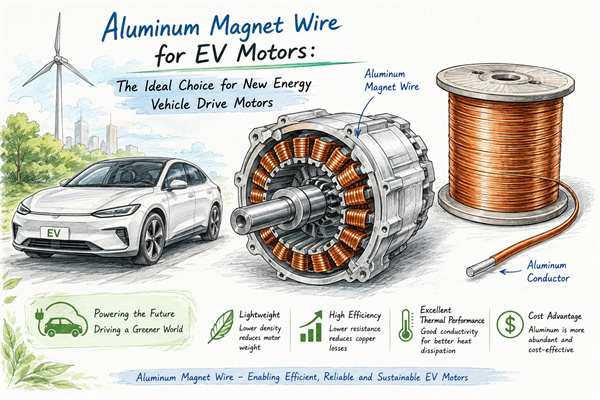
The application of glass-filament-wrapped magnet wire in new-energy-vehicle (NEV) traction motors represents an emerging industrial use case. NEV traction motors operate at elevated temperatures (peak temperatures up to 180°C–200°C), require high power density, high efficiency, and long-term reliability. The hairpin winding process employed in NEV traction motors imposes stringent requirements on the winding insulation’s temperature rating, enamel adhesion, and geometric precision.
Glass-fiber-covered magnet wire, featuring thermal classes 180 to 200, high mechanical strength, and long-term reliability, is applied in certain windings of new-energy-vehicle traction motors. It is typically manufactured with a double-layer glass fiber substrate and coated with silicone or polyamide-imide enamel.
Wind Turbine Applications
Glass-film magnet wire finds limited application in wind turbine generators, particularly in certain windings of large-scale offshore wind turbine generators. Wind turbine generators operate under high ambient temperatures, high humidity, severe salt fog corrosion, and demand extremely high long-term reliability (design life exceeding 20 years). The unique operating environment of offshore wind turbine generators imposes stringent requirements on winding insulation performance—specifically weather resistance, salt fog resistance, and damp-heat resistance.
Glass-fiber-covered magnet wire for offshore wind turbine applications typically employs Class 180 thermal class, double-layer glass fiber, and weather-resistant coating (modified silicone resin, specially formulated polyester).
Energy Storage Systems and Emerging Industrial Applications
Glass-filament-covered magnet wire finds limited application in emerging industrial sectors such as energy storage systems, Industrial Internet of Things (IIoT) equipment, and grid-connected new-energy equipment. Certain electrical components within energy storage systems—e.g., energy storage inverters and energy storage transformers—operate under conditions demanding high reliability and elevated temperature resistance from winding insulation. The expansion of these novel industrial applications provides new use cases for glass-filament-covered magnet wire.
Selection Considerations and Design Guidelines
Fundamental Selection Principles
The fundamental principle for selecting glass-covered magnet wire for industrial applications is a comprehensive trade-off among multiple factors, including temperature requirements, mechanical requirements, chemical resistance requirements, safety requirements, reliability requirements, and cost constraints, all based on the specific application scenario. Temperature requirements constitute the primary criterion for selecting glass-covered magnet wire; the long-term operating temperature and peak temperature of motors or transformers determine the selection of thermal class.
Mechanical requirements—including vibration resistance, impact resistance, and short-circuit resistance—determine the selection of glass fiber layer count and conductor gauge. Chemical requirements—including acid resistance, alkali resistance, salt resistance, and solvent resistance—determine the selection of organic coating type. Safety requirements—including flame retardancy and explosion protection—determine the selection of coating formulation and flame-retardant properties. Reliability requirements determine the selection of product certifications and quality grades.
Selection Recommendations for Different Industrial Applications
For high-temperature motors in the metallurgical industry, Class 180 (H-class) glass-fiber-covered magnet wire (double-layer glass fiber + silicone resin coating) is recommended, offering comprehensive performance in thermal resistance, mechanical strength, and flame retardancy. For high-temperature pump motors in the chemical industry, Class 180 (H-class) glass-fiber-covered magnet wire (double-layer glass fiber + epoxy resin coating) is recommended, offering comprehensive performance in thermal resistance and chemical resistance.
For explosion-proof motors and mining motors, Class 180 (H-class) glass-fiber-covered magnet wire (double-layer glass fiber with silicone resin or flame-retardant epoxy coating) is recommended, offering combined flame-retardant and mechanical performance. For traction motors, Class 180 to Class 200 (N-class) glass-fiber-covered magnet wire (double-layer glass fiber with silicone or polyimide coating) is recommended, providing integrated high-temperature resistance, mechanical performance, and reliability.
For marine motors and offshore motors, Class 180 (Class H) glass-fiber-covered magnet wire (dual-layer glass fiber + modified silicone resin coating) is recommended, offering comprehensive resistance to humid heat and salt fog. For new-energy-vehicle traction motors, Class 180 to Class 200 glass-fiber-covered magnet wire (dual-layer glass fiber + silicone or polyamide-imide coating) is recommended.
Common Selection Misconceptions
Common selection misconceptions for glass-covered magnet wire in industrial applications include: over-specifying high temperature ratings (increasing cost without corresponding performance benefits), neglecting the matching of glass fiber layer count to voltage class (resulting in insufficient dielectric strength or unnecessary cost), overlooking the chemical resistance of the organic coating (leading to insulation failure in chemically aggressive environments), and ignoring compatibility between glass-covered magnet wire and other insulation materials such as impregnating varnish and slot insulation.
Accurate selection based on actual operating conditions in industrial applications is essential to avoid misselection. Selection of temperature class must balance design temperature with safety margin. Number of glass fiber layers must be selected according to voltage class and insulation requirements. Coating selection must be based on resistance requirements for specific chemical media environments.
Compliance Standards and Certifications
IEC International Standards
The IEC 60317 series standards cover product standards for magnet wire and winding wire, with certain standards addressing glass-fiber-covered winding wire. The IEC 60851 series standards specify test methods for winding wire, defining key performance test methods for glass-fiber-covered winding wire. Other relevant IEC standards include IEC 60085 (Electrical insulation—Thermal classification) and IEC 60216 (Electrical insulating materials—Properties of electrical insulating materials for use in electrotechnical products—Determination of the resistance to thermal ageing).
NEMA and UL Standards
The NEMA MW 1000 series standards cover specifications for magnet wire and winding wire, with certain standards addressing glass-fiber-covered wire. UL 1446 is the standard for motor insulation systems; glass-fiber-covered wire, as a component of motor insulation systems, must comply with the relevant requirements of UL 1446. UL certification is a critical safety certification for glass-fiber-covered wire entering the North American market.
UL explosion-proof standards (e.g., UL Class I Division 1, Class I Division 2) serve as critical certification criteria for glass-fiber-covered magnet wire used in explosion-proof motors. UL certification encompasses product safety testing, factory inspections, and follow-up surveillance, providing reliable assurance of the quality and safety of glass-fiber-covered magnet wire.
Chinese National Standards
The GB/T 7095 series standards are China’s national standards for enameled wire, with some standards covering glass-filament-wrapped wire. The GB/T 4074 series standards specify test methods for enameled wire. The GB/T 11026 series standards define thermal endurance testing methods for electrical insulating materials. Compliance with China’s national standards is a fundamental requirement for glass-filament-wrapped wire entering the Chinese market.
Industry-Specific Certifications
Industrial applications of glass-covered magnet wire must comply with industry-specific certification requirements. Nuclear power applications must conform to nuclear standards such as IEEE 323 and IEEE 383. Rail transit applications must conform to rail transit standards such as IEC 61373 (Railway applications – Shock and vibration testing). Marine applications must conform to marine standards such as IEC 60092 (Electrical installations in ships), ABS (American Bureau of Shipping), and LR (Lloyd’s Register).
Explosion-proof applications must comply with explosion-proof standards such as IEC 60079 (Explosive atmospheres), ATEX (European Explosion Protection Directive), and GB 3836 (Chinese Explosion-Proof Standard). Certification requirements vary across industries and countries; industrial application certifications for glass-fiber-covered magnet wire must be based on specific application scenarios and target market requirements.
Conclusion
The engineering implications of fiberglass-covered wire encompass eight core engineering dimensions: fundamental understanding of fiberglass-covered wire (structure and composition, temperature class and enamel system, core engineering advantages); comprehensive overview of industrial applications (application domain classification, foundational application advantages, development drivers); high-temperature industrial motor applications (application scenarios, selection considerations, application case studies); specialized transformer and reactor applications (furnace transformers, rectifier and traction transformers, reactors); industrial applications under severe operating conditions (explosion-proof and mining motors, chemical and marine motors, traction and rail transit motors, marine and naval ship motors); emerging industrial applications (new-energy vehicle traction motors, wind turbine generators, energy storage systems and novel industrial applications); selection considerations and design guidelines (fundamental selection principles, application-specific selection recommendations, common selection pitfalls); and compliance standards and certifications (IEC international standards, NEMA and UL standards, Chinese national standards, industry-specific certifications).
Glass-fiber-covered magnet wire, a specialty winding wire exhibiting outstanding comprehensive performance in temperature resistance, mechanical strength, flame retardancy, chemical resistance, and radiation resistance within winding wire engineering, finds broad application in industrial high-temperature motors, specialty transformers, motors operating under severe service conditions, and emerging industrial motors. The engineering value of glass-fiber-covered magnet wire lies in bridging the industrial application gap between enamel-coated magnet wire (with limited temperature rating and mechanical strength) and other specialty winding wires (characterized by high cost and complex processing).
Selection of glass-covered magnet wire for industrial applications requires comprehensive trade-offs across multiple dimensions, including temperature requirements, mechanical requirements, chemical resistance requirements, safety requirements, reliability requirements, and cost constraints specific to the application. Recommended glass-covered magnet wire selections for different industrial applications must be based on the specific characteristics of each application scenario. Compliance with standards and certifications is a critical safeguard for industrial applications of glass-covered magnet wire; certification requirements vary by industry and country.
Glass-covered magnet wire manufacturers shall continuously optimize the glass fiber braiding process, improve organic coating formulations, and enhance quality control to deliver higher-performance, more reliable, and more cost-competitive glass-covered magnet wire products for industrial electrical applications.