

Aluminum magnet wire is increasingly replacing copper in applications ranging from home appliances and transformers to new-energy vehicles and wind power — and choosing the right supplier can make or break a project. But the market is full of mixed players: source factories, traders, and contract manufacturers, with wildly different quality, pricing, and after-sales service. This article breaks down five dimensions to help you spot the real factory versus the fake source, drawing on the pitfalls we have hit, the contracts we have signed, and the factories we have audited over the years.
1. Why Choose Aluminum Magnet Wire: Three Driving Forces
Cost: Aluminum prices are only one-third to one-quarter of copper prices (based on 2024-2025 LME ranges: aluminum USD 2,400-2,700/ton, copper USD 8,500-9,500/ton). At equivalent conductivity design, switching to aluminum saves 40-60% in conductor cost — a single 5kW motor redesign with aluminum wire can reduce total cost by ¥200-400.
Weight: Aluminum’s density is 2.7 g/cm³, only one-third that of copper. New-energy vehicle traction motors using aluminum wire reduce overall vehicle weight by 15-20% — a 30kg weight reduction in a battery-electric sedan extends range by 2-3%. For wind turbine pitch motors using aluminum wire, the entire nacelle can shed up to 200kg.
Supply Security: Global copper mining is highly concentrated (Chile and Peru account for 50%), while aluminum ore is more widely distributed (China, Australia, Guinea, India, Brazil). After the Russia-Ukraine conflict, European customers have widely adopted aluminum wire as a copper alternative to guard against copper supply chain disruptions.
Among the customers we work with, the number of home appliance factories and transformer manufacturers launching formal “aluminum-for-copper” projects has tripled since 2023. A well-known European appliance brand’s 2024 annual report explicitly listed “aluminum wire replacing copper wire” as a cost-reduction strategy.
2. Real Profiles of the Four Supplier Types
- Source Factory: Operates the full aluminum rod melting, wire drawing, and enamel coating process in-house. Pros: stable quality, low pricing, flexible customization; cons: high MOQ (usually 500kg minimum), 15-25 day lead time. In China, these factories are concentrated in Henan, Guangdong, and Jiangsu.
- OEM Contract Manufacturer: Produces on behalf of major brands. Pros: mature processes, strict quality control; cons: customization is constrained by the brand owner, opaque pricing, hard to slot in rush orders.
- Trader: Sources from multiple factories and resells. Pros: flexible MOQ (50kg accepted), can bundle multiple product categories, lenient payment terms; cons: uneven quality, hard to trace problems when they occur, 10-20% markup.
- Cross-Border E-commerce Platform Seller: “Factory stores” on Made-in-China, Alibaba. Pros: transparent information, easy price comparison, translation support; cons: 80% are traders pretending to be factories — you need to know how to tell them apart.
Practical reminder: many “factory stores” are actually registered trading companies — the “Business Scope” on their business license gives them away. If it reads “trading, import/export” rather than “production, manufacturing,” it is almost certainly a trader.
3. Six Hard Indicators to Verify the “Real Factory”
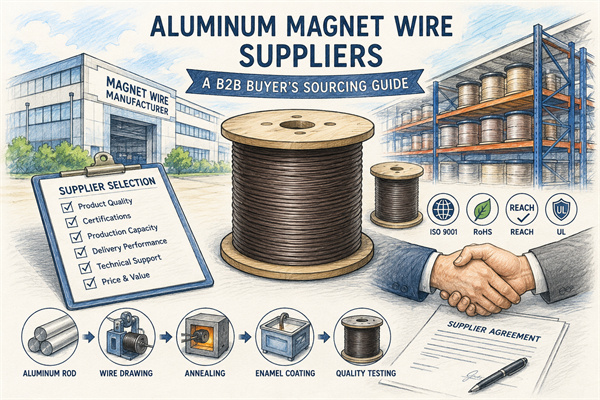
- Business License + On-Site Factory Audit: Ask for live video of the production workshop, and ideally visit in person. The video must include the enamel coating workshop — coating environment directly affects coating quality.
- Aluminum Rod Source: Does the factory have its own aluminum melting furnace, or does it buy aluminum rod from outside? In-house melting is the defining feature of a source factory. A factory that can customize aluminum rod grades (such as 1050, 1060, 1350) has far deeper process capability than an ordinary contract manufacturer.
- Enamel Coating Process: How many stages from drawing to coating does the factory run? A proper factory runs 6-12 stages, with curing ovens between each (oven temperature profile 200-450°C). Fewer than 4 stages should raise red flags.
- Monthly Capacity: Be cautious of small workshops under 50 tons/month — process stability is insufficient. A proper source factory typically runs 300-1,500 tons/month.
- Third-Party Certifications: Are ISO 9001, UL, RoHS, and REACH in place? Are they within validity? Can the certificate numbers be verified on the certifying body’s website? 90% of unverifiable certificates are fake.
- Export Experience: Does the factory export to Europe, the US, Japan, or Korea? Factories with over 50% export ratio generally have more disciplined quality management. When we audit factories, those with high export ratios consistently show better 6S housekeeping.
4. Four Common Traps
- “Factory Price” Trap: A quote 20% below market likely uses recycled aluminum or re-coated scrap wire, with conductor resistance exceeding standards. Last year we audited a factory claiming “factory pricing” — they actually bought waste enamel wire, stripped the old coating, and re-coated it; conductor resistivity was 35% above standard.
- “Fast Delivery” Trap: Promising 3-day delivery without stock on hand usually means sourcing from elsewhere on the fly, with uncontrollable quality. Custom enameled wire normally has a 15-20 day lead time.
- “Test Report” Trap: One-off reports, expired reports, un-stamped photocopies — always demand originals plus website verification. The testing lab on the report also needs to be verified (look for CNAS and CMA accreditation).
- “Direct from Manufacturer” Trap: 80% of Made-in-China listings are traders in disguise. Key identifying point: “new factories” under 5 years old deserve extra scrutiny — the enamel wire industry requires at least 5-10 years of technical accumulation.
5. Procurement Decision Checklist (5 Steps)
- Define Requirements: Conductor specification (diameter 0.1-7mm), thermal class (130/155/180/220°C), coating grade (Grade 1-3), packaging (PT4-PT25 spools).
- Shortlist 3-5 Candidates: Initial filtering via Made-in-China, Alibaba, and industry shows (WireShow, Electric Motor Expo). Look at factory age, export ratio, and certification completeness.
- Request Samples for Testing: Request 1-2kg samples from each candidate and run breakdown voltage (>5kV), heat aging (220°C × 72h), and solderability (370°C × 3s) tests. Sample testing takes 1-2 weeks.
- Audit + Compare Quotes: On-site or video audits; compare three quotes (note MOQ and payment terms). Quote sheets should detail coating thickness, conductor diameter tolerance, packaging fees, and freight.
- Trial Order: Place a small 200-500kg trial order first to validate lead time, quality, and after-sales service before scaling up. Don’t go straight to bulk — we have seen too many customers skip this step and end up with quality variations in full production.
One last word: when choosing a supplier, look at stability, not just price. 10% cheaper with delivery delays and quality fluctuations ends up 30% more expensive. Selecting a factory means selecting a long-term partner — one deal sets the tone for life, and that rings especially true in the enamel wire industry.
We have seen too many customers cycle through 3-4 suppliers, get burned by each one, and finally realize that “paying 5% more for a real source factory” is the truth. Enamel wire is not a commodity — it is a custom product. Mold setup, process parameters, varnish formulations are all the factory’s core know-how. Switching suppliers means starting from scratch.