


Electrical equipment such as inverter-duty motors, high-speed railway traction motors, wind turbine generators, new-energy vehicle drive motors, and servo motors—powered by PWM (Pulse Width Modulation) inverters—are subjected to significantly higher voltage stress on their winding insulation than conventional power-frequency motors. High-frequency pulse voltages generated by IGBTs (Insulated Gate Bipolar Transistors) in PWM inverters—combined with steep du/dt transients (voltage rise rate), reflected wave superposition, common-mode voltage, and harmonic components—induce sharp overvoltage spikes at the motor winding terminals, triggering partial discharge (PD) and corona discharge within the insulation, ultimately leading to insulation breakdown. Conventional enameled wire exhibits an electrical lifetime of only several hundred to several thousand hours under high-frequency PWM pulses—far below the expected service life of the motor.
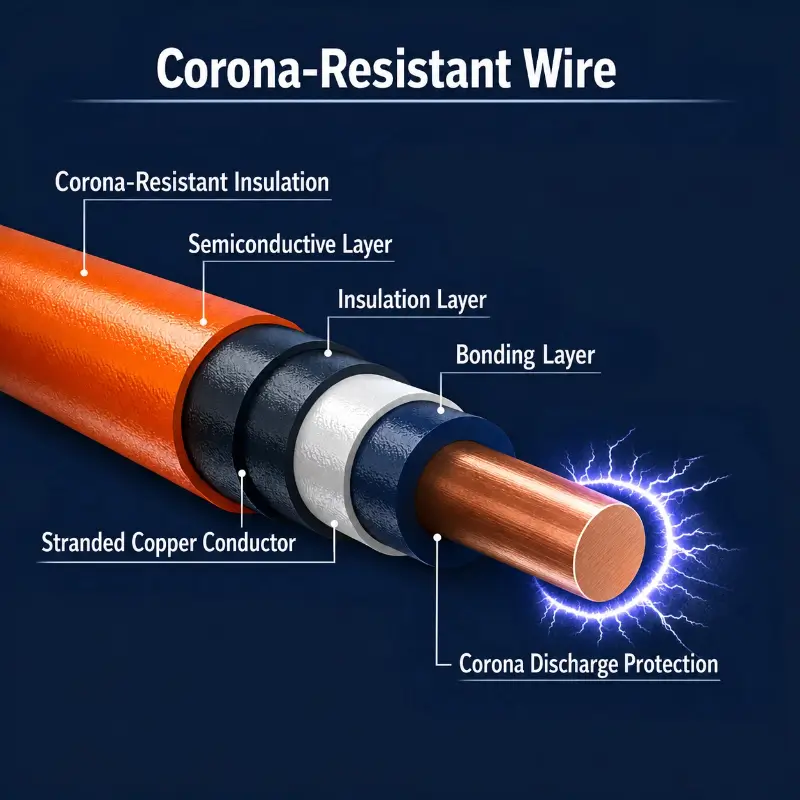
Corona-resistant wire (Corona-Resistant Magnet Wire, Inverter-Duty Magnet Wire) is a specialized enameled wire engineered specifically for high-frequency PWM applications including inverter-duty motors, high-speed rail traction, wind power generation, new-energy vehicles, and industrial automation. Its multilayer structure—comprising a polyimide (PI) base film plus a corona-resistant nanocomposite topcoat—achieves a dramatic improvement in corona resistance lifetime, ranging from 1,000 to 50,000 hours, making it a critical foundational material for winding insulation in inverter-driven motors. This article systematically addresses: fundamentals of corona discharge; definition of corona-resistant wire; corona-resistant material systems; structural design of corona-resistant wire; manufacturing processes; comparison between corona-resistant wire and conventional enameled wire; corona-resistance test methods; corona-resistance lifetime prediction; application domains; selection criteria and decision-making; failure modes and quality control; technical standards and certifications (e.g., IEC 60317, NEMA MW 1000, ASTM B566, UL 1446, IATF 16949); and future trends and developments—providing inverter motor engineers, designers, and procurement professionals with a comprehensive technical selection and application guide.
Corona Discharge Fundamentals
Understanding corona discharge is a prerequisite for mastering the application of corona-resistant magnet wire.
Corona Discharge Definition
Corona discharge is a specific form of partial discharge occurring in non-uniform electric fields, where ionization of gas or insulating material leads to a discharge phenomenon.
Fundamental characteristics of corona discharge:
- Non-uniform electric field: highly non-uniform electric field distribution
- Partial discharge: breakdown occurring only at locations of electric field concentration
- Sustained discharge: continuous energy release
- Visible light: ultraviolet light, violet light
- Ozone generation: O₃
- Noise: hissing sound
- Chemical corrosion: NOₓ, reactive species
Location of corona discharge occurrence:
- Conductor tip
- Electrode edge
- Internal insulation voids
- Insulation–conductor interface
- Winding slot opening
- Winding end
Fundamentals of Partial Discharge (PD)
Partial discharge is a discharge that occurs in a localized region of the insulation without bridging the entire space between the electrodes.
Partial discharge types:
- Internal discharge: within the insulation
- Surface discharge: on the insulation surface
- Corona discharge: at electrode tips
- Dendritic discharge: within the polymer
Partial discharge basic parameters:
- Apparent charge (q): picocoulomb (pC)
- Discharge repetition rate (n): times/second
- Discharge energy: microjoule (μJ)
- PDIV (Partial Discharge Inception Voltage): partial discharge inception voltage
- PDEV (Partial Discharge Extinction Voltage): partial discharge extinction voltage
Factors affecting partial discharge:
- Voltage amplitude: Higher voltage increases partial discharge
- Frequency: Higher frequency increases partial discharge
- Temperature: Elevated temperature aggravates partial discharge
- Humidity: High humidity affects partial discharge
- Insulation thickness: Thinner insulation is more prone to partial discharge
- Material: Corona-resistant materials suppress partial discharge
Failure Mechanisms of Insulation under Variable-Frequency Drive (VFD) Conditions
The particularities of PWM variable-frequency drives generate unique insulation failure mechanisms:
PWM waveform characteristics:
- IGBT switching frequency: 1–20 kHz (typical)
- Switching rise time: 50–200 ns (typical)
- du/dt: 1–15 kV/μs (typical)
- Overvoltage spike: 1.5–2 times line voltage
- Reflected wave: Standing waves may form depending on cable length
Insulation failure path in variable frequency drive (VFD) applications:
Path 1: Partial Discharge Damage
- High-frequency pulses → localized electric field concentration in insulation
- Localized electric field strength > 5 kV/mm
- Initiates partial discharge
- Discharge erodes insulation
- Degrades enamel coating
Path 2: Thermal Degradation
- Increased dielectric loss
- Localized temperature rise
- Accelerated insulation aging
- Reduced service life
Path 3: Chemical Degradation
- Discharge generates ozone (O₃)
- Ozone + discharge energy + NO + moisture → HNO₃
- HNO₃ + organic insulation → chemical corrosion
- Accelerated insulation aging
Path 4: Mechanical Damage
- Discharge shock wave
- Mechanical fatigue
- Enamel microcracks
- Cumulative failure
Impact of PWM Stress on Magnet Wire
Effects of PWM stress on magnet wire insulation systems:
First-Coil Stress:
– PWM overvoltage is concentrated at the winding’s first turn.
– The first turn experiences the highest du/dt.
– The voltage-to-ground on the first turn can reach up to four times the peak line voltage.
– The first turn is the critical failure location.
Issues with conventional insulation coatings under PWM conditions:
- Polyester (PEW): breakdown in 1–100 hours
- Modified polyester (PEW+): breakdown in 10–500 hours
- Polyester-imide (EIW): breakdown in 50–1,000 hours
- Polyamide-imide (AIW): >1,000 hours (in some cases)
- Polyimide (PIW): significant improvement
- Conventional PI still insufficient
Phenomena of General Insulation Failure:
- Insulation film blackens within several hours
- Breakdown occurs near the first turn
- Insulation film forms dendritic carbonized paths
- Complete failure typically occurs in <1000 hours
Definition and Principle of Corona Resistant Wire
Corona-resistant wire is a specialty enameled wire designed for high-frequency PWM applications.
Corona-Resistant Wire Definition
Corona-Resistant Magnet Wire (Inverter-Duty Magnet Wire) is:
- Magnet wire with significantly extended service life under high-frequency PWM pulses
- Typical corona resistance life ≥500 hours (standard)
- Premium products ≥10,000 hours
- Core feature: Nanocomposite coating suppressing partial discharge
Core characteristics of corona-resistant wire:
- Basic corona resistance: PI base layer + corona-resistant coating
- Corona resistance lifetime: ≥1000 hours (standard)
- Corona resistance class: IEC 60317-57 Classes 1–4
- PDIV ≥1.5 kV (standard)
- Compatible with PWM inverters
Corona Resistance Principle
Physical and chemical mechanisms of corona resistance:
Mechanism 1: Charge Trapping Effect of Nanoparticles
- Inorganic nanoparticles (Al₂O₃, SiO₂, TiO₂)
- Forming extensive interfaces with the polyimide (PI) matrix
- Deep traps at interfaces capturing charge carriers
- Preventing space charge accumulation
- Reducing local electric field concentration
Mechanism 2: Uniform Electric Field Effect
- Nanoparticles exhibit high dielectric constants
- Al₂O₃: k ≈ 9
- TiO₂: k ≈ 80–100
- BaTiO₃: k ≈ 1000–5000
- SiO₂: k ≈ 4
- Tuning the overall composite dielectric constant
- Uniform local electric field
- Reducing electric field concentration factor
- Delaying partial discharge inception
Mechanism 3: Barrier Effect
- Nanoparticles obstruct the electron acceleration path
- Increase collision frequency
- Reduce electron energy
- Suppress impact ionization
- Inhibit discharge development
Mechanism 4: Electrochemical Corrosion Resistance
- Nanoparticle-based chemical resistance (HNO₃)
- Protection against ozone and NOx corrosion
- Protection of the polyimide (PI) matrix
- Maintenance of insulation performance
Mechanism 5: Enhanced Heat Dissipation
- Certain nanoparticles (AlN, BN) exhibit high thermal conductivity
- Enhance localized heat dissipation
- Reduce temperature rise
- Retard aging
Corona Resistance Life and Failure Modes
Corona-resistant wire lifetime curve:
Life curve phase:
- Phase 1 (Initial): Life 0–10%
- Phase 2 (Stable): Life 10–90%
- Phase 3 (Failure): Life 90–100%
Factors Affecting Corona Resistance Life:
- Voltage: Higher voltage results in shorter lifetime (exponential decay)
- Frequency: Higher frequency results in shorter lifetime
- Temperature: Higher temperature results in shorter lifetime
- Duty cycle: Standardized at D = 0.5
- Polarity: Different effects between unipolar and bipolar operation
- Waveform: du/dt, tr (rise time), tf (fall time)
Corona resistance failure modes:
- Dielectric breakdown: Complete insulation penetration
- Local carbonization: Formation of carbonized channels
- Surface discharge: Surface dendritic carbonization
- Local corrosion: Chemical corrosion
- Thermal melting: Extreme overload
Corona Resistant Material System
The core of corona-resistant wire lies in its material system.
Base Material: Polyimide (PI)
Polyimide (PI) is the most commonly used base material for corona-resistant magnet wire.
Molecular structure and properties of polyimide (PI):
- Backbone: aromatic ring + imide ring
- Glass transition temperature: 300–400 °C
- Long-term thermal rating: 240 °C+
- Dielectric strength: ≥200 kV/mm
- Chemical resistance: acid-resistant, solvent-resistant
- Dielectric constant: 3.2–3.5
Corona-resistant mechanism of polyimide (PI):
- High dielectric breakdown strength (≥200 kV/mm) as baseline
- High-temperature stability (240 °C+)
- However, PI alone remains insufficient under PWM conditions
- Requires inorganic nanoparticle reinforcement
Nanoparticle Additives
The core of nanoparticles is the selection of appropriate types and particle sizes.
Common Nanoparticles:
Aluminum oxide (Al₂O₃):
- Dielectric constant: 9
- Particle size: 10–50 nm
- Function: Standard corona resistance, electron blocking
- Content: 5–15 wt%
- Advantages: Moderate cost, excellent performance
Titanium dioxide (TiO₂):
- Dielectric constant: 80–100 (rutile)
- Dielectric constant: 40–50 (anatase)
- Particle size: 10–30 nm
- Function: High-dielectric, uniform electric field
- Content: 5–10 wt%
- Note: Rutile is preferred (higher dielectric constant)
Silicon dioxide (SiO₂):
- Dielectric constant: 4
- Particle size: 10–50 nm
- Function: Low-loss, auxiliary
- Content: 5–15 wt%
- Advantages: Low cost, low loss
Boron Nitride (BN):
- Dielectric constant: 4–6
- Particle size: 50–200 nm
- Function: High thermal conductivity, auxiliary corona resistance
- Advantage: Heat dissipation
Aluminum Nitride (AlN):
- Dielectric constant: 9
- Particle size: 50–200 nm
- Function: High thermal conductivity, corona resistance
- Content: 5–15 wt%
Barium titanate (BaTiO₃):
- Dielectric constant: 1000–5000
- Particle size: 100–500 nm
- Function: Ultra-high dielectric for uniform electric field distribution
- High-end applications
Polyimide (PI) Film System
Polyimide (PI) Single-Layer Coating:
- Single-layer polyimide (PI) coating
- Limited corona resistance
- Typically compounded with nanoparticles
- Pure PI exhibits only 100–1,000 hours lifetime under PWM conditions
Polyimide + Nanocomposite Coating:
- Polyimide (PI) base coating + nano-composite topcoat
- Standard corona-resistant construction
- Corona resistance lifetime: 1,000–50,000 hours
- Dual-layer design: PI base insulation + corona-resistant topcoat
Multi-layer PI Composite:
– Multiple polyimide (PI) nanocomposite layers
– Optimized electric field distribution
– High-end product design
Other Corona-Resistant Materials
Fluororesin Composite:
- PI + ETFE (Ethylene-Tetrafluoroethylene)
- Chemical resistance (acids, alkalis, solvents)
- Temperature rating: 200 °C
- Suitable for extreme environments
- Moderate corona resistance
Polyimide + Mica:
- Mica tape + polyimide (PI)
- High dielectric strength + high thermal resistance
- High-voltage applications
Polyamide-imide (PAI) + Nano
- PAI-based (220°C)
- Nanoparticle-reinforced
- High temperature resistance + corona resistance
- Premium product
Polyetheretherketone (PEEK) + Nano
- High temperature (250 °C+)
- Chemical resistance
- Premium applications
Coating Material Grades
Entry-level (low-cost):
- PI + SiO₂ (5–10 wt%)
- Corona resistance lifetime: 500–1000 hours
- Application: Low-end variable-frequency motors
Standard Grade (Medium):
- PI + Al₂O₃ (5–15 wt%)
- Corona resistance life: 1000–5000 hours
- Application: General-purpose inverter-duty motors
High-end (mid-to-high-end):
- PI + Al₂O₃ + TiO₂ composite
- Corona resistance lifetime: 5,000–20,000 hours
- Applications: High-end variable-frequency motors, new-energy vehicles
Top-tier (High-end):
- Multi-layer polyimide (PI) + multiple types of nanoparticles
- Corona resistance lifetime: 20,000–100,000+ hours
- Applications: High-speed rail traction, wind power generation, ultra-high-voltage (UHV) systems
Structure of Corona Resistant Wire
The typical structure of corona-resistant wire is conductor + multi-layer coating.
Typical Construction
Basic Structure:
- Conductor: Round copper wire / Rectangular copper wire
- First layer: Polyimide (PI) film (basic insulation)
- Second layer: Corona-resistant nanocomposite coating
- Surface: Lubricating layer (partial)
Double-layer structure (IEC 60317-57):
- Conductor
- Polyimide (PI) base coat
- Corona-resistant nanocomposite coating
- Total insulation thickness: Grade 1–3
Multi-layer structure (high-end):
- Conductor
- Polyimide (PI) First Layer
- Nanocomposite Intermediate Layer
- Corona-Resistant Outer Layer
- Total Insulation Film Thickness: Grade 2–3
Conductor Materials
Copper Conductor:
- Round copper wire: 0.10–3.0 mm diameter
- Rectangular copper wire: 1–15 mm width × 1–5 mm thickness
- Base insulation coating: Polyimide (Class H, 240 °C)
- Overall thermal class after coating: Class H, 180 °C+
Aluminum Conductor:
- Round aluminum wire: 0.50–3.0 mm
- Rectangular aluminum wire
- Application: Lightweighting applications
- Limitation: Joining process
Considerations for Film Thickness
Standard polyimide (PI) coating thickness:
- Grade 1: 0.030–0.050 mm
- Grade 2: 0.050–0.080 mm
- Grade 3: 0.080–0.110 mm
Corona-resistant coating thickness:
- Typically 30–50% thicker than standard polyimide (PI)
- Dual-layer structure: PI + corona-resistant coating
- Total thickness: 0.060–0.130 mm
Enamel Thickness and Corona Resistance Class
Corona resistance class (IEC 60317-57), classified by lifetime:
- Grade 1: 0.060–0.090 mm
- Grade 2: 0.080–0.110 mm
- Grade 3: 0.100–0.140 mm
Corona-resistant wire dimensional standards:
- GB/T 7095.4 (China)
- IEC 60317-57 (round wire)
- IEC 60317-58 (rectangular wire)
- NEMA MW 1000 (in conjunction with AWG)
Manufacturing Process of Corona Resistant Wire
The manufacturing process of corona-resistant magnet wire involves critical operations such as varnish formulation, coating, and sintering.
Enamel Solution Preparation
PI precursor (polyamic acid, PAA):
– Dianhydride monomer (ODA) + diamine monomer
– DMAC/NMP solvent
– High-temperature curing to convert into polyimide (PI)
– Molecular weight control
Nanoparticle dispersion:
- Ultrasonic dispersion
- High-speed shear dispersion
- Surface modification (silane coupling agent)
- Agglomeration prevention
- Stable dispersion
Varnish formulation:
- Polyimide (PI) precursor: 70–90%
- Nanoparticles: 5–20%
- Solvent (DMAC/NMP): viscosity adjustment
- Additives (flow agents, anti-settling agents)
Coating Process
PI undercoat:
- Mold Coating: Standard
- Felt Coating: Conventional
- Die Coating: Novel
- Multiple Coating (3–6 times)
- Baking Temperature: 300–400 °C
Corona-resistant coating application:
- On PI base film
- Coating with nanocomposite varnish
- Multiple coating (2–4 times)
- Baking temperature: 300–400 °C
- Stepwise curing (80 °C → 200 °C → 350 °C → 400 °C)
Sintering and Curing
- Polyimide (PI) imidization temperature: 300–400 °C
- Stepwise curing: low temperature → high temperature
- Baking cycles: 6–10 times
- In-line solvent removal
- Complete imidization
Precision Testing
Online Inspection:
- Enamel coating thickness: online laser thickness measurement
- Enamel coating continuity: pinhole detection
- Enamel-coated outer diameter: online diameter measurement
- Defect detection: 100% surface inspection
Offline inspection:
- Breakdown voltage: ≥5 kV
- Dielectric loss: tan δ test
- Corona resistance life: Standard method (IEC 60317-57)
- Partial discharge inception voltage (PDIV) test: ≥1.5 kV
- Heat resistance test: Withstands 240 °C
Packaging and Storage
- Winding: Standard spool
- Packaging: Moisture-proof bag + desiccant
- Storage: Constant temperature and humidity
- Marking: Specification, batch number, grade
Corona Resistant Wire vs Ordinary Magnet Wire
Corona-resistant magnet wire differs significantly from conventional enameled wire across multiple dimensions.
Performance Comparison
| Dimension | Conventional Polyimide (PI) Enamelled Wire | Corona-Resistant Wire |
|---|---|---|
| Corona Resistance Life | 100–1,000 hours | 1,000–50,000 hours |
| Partial Discharge Inception Voltage (PDIV) | 800–1,200 V | 1,500–3,000 V |
| Thermal Class | Class H (180 °C), Class C (220 °C) | Class H (180 °C) and above |
| Dielectric Loss | Low | Slightly higher (due to nanoparticles) |
| Chemical Resistance | Good | Excellent |
| Insulation Film Thickness | 0.030–0.080 mm | 0.060–0.130 mm |
| Cost | Low | High (2–5×) |
| Weight Increase | Minor | Moderate |
| Applicable Applications | Power frequency, low-frequency | PWM, high-frequency |
Life Comparison Table
| Enamel Type | Lifetime (2 kV PWM, 500 Hz) |
|---|---|
| Polyester (PEW) | 1–100 hours |
| Modified Polyester | 10–500 hours |
| Polyester-imide (EIW) | 50–1000 hours |
| AIW Single-layer | 100–1000 hours |
| PI Single-layer | 500–5000 hours |
| PI + SiO₂ | 1000–5000 hours |
| PI + Al₂O₃ | 2000–10000 hours |
| PI + Al₂O₃ + TiO₂ | 5000–30000 hours |
| Multi-layer PI Composite | 10000–100000 hours |
Application Scenario Comparison
Suitable for General-Purpose Magnet Wire:
- Power frequency motors (50/60 Hz)
- DC motors
- General household appliance motors
- Low-voltage motors (<1000 V)
- Simple operating conditions
Corona-resistant wire applicable:
- PWM inverter-fed motors
- High-speed rail traction motors
- Wind power converter motors
- New energy vehicle drive motors
- Servo motors
- High-frequency power transformers
- Industrial automation motors
Cost Comparison
Cost Multiplier (Relative to Standard Coating):
- Single-layer PI: 1.5–2×
- Conventional PI magnet wire: 2–3×
- Corona-resistant magnet wire (basic): 3–5×
- Corona-resistant magnet wire (standard): 5–8×
- Corona-resistant magnet wire (premium): 8–15×
- Top-tier multilayer PI corona-resistant: 15–30×
Cost considerations:
- Enamel cost vs. motor service life
- Cost of early failure with standard polyimide (PI)
- Overall cost-effectiveness of corona-resistant magnet wire
Corona Testing Methods
Corona resistance testing is critical for evaluating the performance of corona-resistant magnet wire.
Corona Resistance Life Test (Corona Resistance Test)
IEC 60317-57 Test Method:
Sample Preparation:
- Twisted Pair
- Conductor diameter: 0.40–1.60 mm
- Twist length: 125 mm
- Twist pitch: 13–20 × diameter
Test parameters:
- Voltage: 1.0–3.0 kV rms (typically 1.5–2.0 kV)
- Frequency: 50 Hz or 1 kHz
- Temperature: 90 °C, 155 °C, or 200 °C
- Duty cycle: D = 0.5
- Duration: Until breakdown
Test equipment:
- High-voltage power supply (high-frequency)
- High-voltage electrode
- Heating chamber
- Breakdown detection
- Automatic recording
Test Result Evaluation:
- Breakdown time
- Median life
- Failure probability
- Accelerated life curve
ASTM D2275 Corona Resistance Life:
- Standard test method
- Sample: Twisted pair
- Voltage: 2 kV
- Frequency: 60 Hz or 1 kHz
- Ambient temperature
- Time to failure
ASTM D3421 Corona Resistance:
- Test voltage: ramped up to breakdown
- Breakdown voltage (kV)
- Reflects short-term corona resistance
PDIV Test (Partial Discharge Inception Voltage)
PDIV Test Method:
Samples: Stranded wire pairs or simulated windings
Parameters:
- Voltage: Gradually increased from 0
- Frequency: 50 Hz or 1 kHz
- Ambient temperature or elevated temperature
- Detection of partial discharge inception
- Sensitivity: 1 pC
PDIV Testing Equipment:
- High-voltage power supply
- Partial discharge detector
- Standard PD capacitor
- Coupling impedance
- Oscilloscope
PDIV Performance Requirements:
– Standard corona-resistant wire: ≥1.5 kV
– Premium product: ≥2.0 kV
– Top-tier product: ≥2.5 kV
– High-speed rail application: ≥3.0 kV
Dielectric Loss (tan δ) Test
- Test frequencies: 1 kHz, 10 kHz, 100 kHz, 1 MHz
- Test temperature: ambient temperature to 200 °C
- Evaluation of insulating dielectric performance
- High dielectric loss indicates aging or contamination
Withstand Voltage Test
- Standard method: Stranded wire dielectric breakdown
- Test voltage ramp rate (500 V/s)
- Location of breakdown point
- Breakdown voltage value (kV)
- Reflects the insulation’s ultimate capability
Accelerated Life Testing
Estimation of actual service life via acceleration factor:
Acceleration factor calculation:
- Voltage acceleration: AF_V = e^(B × (1/V_actual – 1/V_stress))
- Frequency acceleration: AF_f = (f_stress / f_actual)^n
- Temperature acceleration: Arrhenius model
Life conversion:
- Test duration × Acceleration factor = Actual lifetime
- Example: 1000 hours test × Acceleration factor 10 = Actual 10,000 hours
Application Fields of Corona Resistant Wire
Corona-resistant wire has been widely applied in multiple fields.
Inverter Air-Conditioning Compressor Motors
Application Parameters:
- Power: 0.5–15 kW
- Voltage: 220–380 V
- PWM frequency: 5–20 kHz
- Operating temperature: 120–140 °C
- Service life requirement: ≥15 years
- Start-up frequency: Frequent (compressor start/stop)
Corona-Resistant Wire Specifications:
- Type: PI + Al₂O₃
- Grade: Grade 2 (Corona-Resistant)
- Diameter: 0.30–1.0 mm
- Insulation Thickness: ≥0.080 mm
- Corona Resistance Life: ≥1000 hours (typical)
Major Manufacturers:
– China: Datong, Great Wall, Aishi, etc.
– International: Essex, Axalta, Furukawa
Traction Motors for New Energy Vehicles
Application Parameters:
- Power: 100–300 kW
- Voltage: 400–800 V (800 V platform)
- PWM frequency: 5–15 kHz
- du/dt: 3–10 kV/μs
- Operating temperature: 150–180 °C
- High speed: 15,000–20,000 rpm
- Service life requirement: 10–15 years
- Start-stop cycles: Frequent
Corona-Resistant Wire Specifications:
- Type: PI + Al₂O₃ + TiO₂
- Grade: Grade 2–3
- Diameter: 0.80–2.0 mm (round wire)
- Rectangular wire: Hairpin-type
- Insulation thickness: ≥0.100 mm
- Corona resistance life: ≥5000 hours
- PDIV: ≥2 kV
Major Manufacturers:
– China: Datong, Kobe, Jinggong
– International: Essex, Axalta, Hitachi, Furukawa
– Applications: Tesla, BYD, NIO, XPeng
High-Speed Railway Traction Motors
Application Parameters:
- Power: 250–1500 kW
- Voltage: 1.5–3 kV
- PWM frequency: 1–5 kHz
- du/dt: ≥10 kV/μs
- Operating temperature: 150–200 °C
- Service life requirement: 25–30 years
- Frequent start-stop cycles and emergency braking
Corona-Resistant Wire Specifications:
- Type: Multi-layer polyimide (PI) + multiple types of nanoparticles
- Grade: Grade 3–4
- Diameter: 1.0–2.5 mm
- Insulation coating thickness: ≥0.130 mm
- Corona resistance lifetime: ≥20,000 hours
- Partial Discharge Inception Voltage (PDIV): ≥2.5 kV
Wind Turbine Generators
Application Parameters:
- Power: 2–10 MW
- Voltage: 690 V–3 kV
- PWM frequency: 2–5 kHz
- Operating temperature: 120–140 °C
- Service life requirement: 20–25 years
- High-altitude, low-temperature, and offshore high-temperature-differential environments
Corona-Resistant Wire Specifications:
- Type: PI + Al₂O₃
- Grade: Grade 2–3
- Large-diameter or rectangular wire
- Corona resistance life: ≥10,000 hours
- Marine environment: Salt mist resistant
Industrial Servo Motors
Application Parameters:
- Power: 0.5–50 kW
- Voltage: 220–380 V
- PWM frequency: 4–16 kHz
- du/dt: 3–8 kV/μs
- High-speed positioning
- Service life requirement: ≥10 years
Corona-Resistant Wire Specifications:
- Type: PI + Al₂O₃
- Grade: Grade 2
- Diameter: 0.30–1.5 mm
- Corona resistance life: ≥2000 hours
EV Charger Transformer
Application Parameters:
- Power: 50–300 kW
- Frequency: 20–200 kHz (high frequency)
- PWM: High-frequency switching
- Temperature: 100–150 °C
Corona-Resistant Wire Specifications:
- Type: High-frequency corona-resistant enameled wire
- Grade: Special high-frequency grade
Robotics / CNC Motors
Application Parameters:
- Power: 0.1–15 kW
- Voltage: 220–380 V
- PWM: 5–15 kHz
- High dynamic response
Corona-Resistant Wire Specifications:
- Polyimide + nanocomposite
- Medium corona resistance class
Medium-Voltage Inverter-Fed Motors
Application Parameters:
- Power: 500–5000 kW
- Voltage: 3–10 kV
- PWM frequency: 2–5 kHz
- du/dt: ≥5 kV/μs
Corona-Resistant Wire Specifications:
- High-grade corona-resistant magnet wire
- Thickness: ≥0.130 mm
- Lifetime: ≥10,000 hours
Selection Decision for Corona Resistant Wire
Selection of corona-resistant magnet wire requires comprehensive consideration of electrical, mechanical, environmental, and service life factors.
Selection Decision Tree
Decision 1: Application Scenario
- Inverter air conditioners: Basic corona-resistant
- General-purpose inverter motors: Standard grade
- New-energy vehicles: Standard grade+
- Industrial servo motors: Standard grade
- High-speed rail traction: Advanced grade
- Wind power: Standard grade (offshore) + corrosion resistance
- Medium-voltage inverters: Advanced grade
Decision 2: Voltage and du/dt
- 220 V, du/dt ≤ 3 kV/μs: Basic Grade
- 380 V, du/dt ≤ 5 kV/μs: Standard Grade
- 400–800 V, du/dt 5–10 kV/μs: Standard Plus / Advanced Grade
- ≥ 1 kV, du/dt 10–15 kV/μs: Advanced Grade
- ≥ 3 kV, du/dt ≥ 15 kV/μs: Advanced / Premium Grade
Decision 3: Operating Temperature
- ≤120°C: Basic Class
- 120–155°C: Standard Class
- 155–180°C: Premium Class
- ≥200°C: Top-Tier Class
Decision 4: Lifetime Requirements
– 5 years (general): Basic grade
– 10 years (inverter-duty motors): Standard grade
– 15–25 years (automotive, home appliance compressors): Standard Plus grade
– 25–30 years (high-speed rail): Premium grade
Decision 5: Cost
- Economy grade: Basic (PI + SiO₂)
- Standard grade: Standard (PI + Al₂O₃)
- Premium grade: Advanced (PI + multiple nanomaterials)
- Top-tier grade: Multi-layer PI
Selection Equivalence Table
Application–Voltage–Lifetime–Insulation Film Equivalence Table:
| Application | Voltage | Service Life | Recommended Corona Resistance Grade | Film Thickness |
|---|---|---|---|---|
| Household Variable-Frequency Air Conditioners | 220 V | 15 years | Grade 1 | ≥0.060 mm |
| General-Purpose Variable-Frequency Motors | 380 V | 10 years | Grade 1–2 | ≥0.080 mm |
| Industrial Variable-Frequency Motors | 380 V | 10 years | Grade 2 | ≥0.090 mm |
| New Energy Vehicles | 400–800 V | 15 years | Grade 2–3 | ≥0.110 mm |
| High-Speed Rail Traction | 1.5–3 kV | 30 years | Grade 3–4 | ≥0.130 mm |
| Wind Power Generation | 690 V | 20 years | Grade 2–3 | ≥0.110 mm |
| Industrial Servo Motors | 380 V | 10 years | Grade 2 | ≥0.090 mm |
| Medium-Voltage Variable-Frequency Drives | 3–10 kV | 15 years | Grade 3 | ≥0.130 mm |
Key Selection Parameters
PDIV (Critical):
- Basic grade: ≥1.5 kV
- Standard grade: ≥2.0 kV
- Advanced grade: ≥2.5 kV
- Premium grade: ≥3.0 kV
Corona Resistance Life:
- Entry-level: ≥500 hours
- Standard-grade: ≥1000–5000 hours
- Advanced-grade: ≥5000–20,000 hours
- Premium-grade: ≥20,000–100,000 hours
PWM frequency range:
- 50/60 Hz: Low-frequency enameled wire
- 1–5 kHz: Corona-resistant basic grade
- 5–20 kHz: Corona-resistant standard grade
- ≥20 kHz: Corona-resistant premium grade
dv/dt range:
- ≤3 kV/μs: Basic Grade
- 3–10 kV/μs: Standard Grade
- 10–15 kV/μs: Advanced Grade
- ≥15 kV/μs: Premium Grade
Failure Modes and Quality Control of Corona Resistant Wire
Common Failure Modes
Failure 1: Insulation Breakdown:
- Cause: PWM stress, long-term aging
- Phenomenon: Phase-to-phase short circuit, ground short circuit
- Detection: Dielectric withstand voltage test
- Prevention: Select appropriate corona-resistant grade
Failure 2: Localized Carbonization:
- Cause: Long-term partial discharge
- Phenomenon: Carbonized tracking paths, leakage current
- Detection: Insulation resistance, PDIV
- Prevention: Select materials with high PDIV
Failure 3: First-turn breakdown
- Cause: Maximum du/dt at the lead end
- Phenomenon: Breakdown of the first turn
- Detection: Breakdown at the first-turn position
- Prevention: Reinforce insulation at the lead end
Failure 4: Chemical Corrosion:
- Cause: Discharge generates HNO₃
- Phenomenon: Enamel coating powdering
- Detection: Visual inspection, electrical testing
- Prevention: Select chemical- and corona-resistant enamel
Failure 5: Thermal Degradation:
- Cause: Dielectric loss, temperature rise
- Phenomenon: Enamel film melting, burnout
- Detection: Temperature-rise test
- Prevention: Select low-loss, corona-resistant enamel
Failure 6: High-Speed Centrifugal Damage:
- Cause: Centrifugal force in high-speed motors
- Phenomenon: End abrasion
- Location: Winding ends
- Detection: Visual inspection
- Prevention: Reinforced end fixation
Failure 7: Contact Corrosion:
- Cause: Moisture, electrochemical
- Phenomenon: Connection failure
- Prevention: Weather-resistant treatment
Failure 8: Winding Looseness:
- Cause: Vibration, thermal cycling
- Phenomenon: Localized abrasion
- Prevention: Optimize bundling and potting
Failure 9: Turn-to-Turn Short Circuit:
- Cause: High voltage differential
- Phenomenon: Abnormal current
- Prevention: Select enamel with high corona resistance
Failure 10: Terminal Breakdown
- Cause: Stress concentration at coil ends
- Phenomenon: Terminal breakdown
- Prevention: Reinforce insulation at coil ends
Quality Control System
Raw Material Quality Control:
- PI precursor: molecular weight, viscosity
- Nanoparticles: particle size, dispersibility, surface treatment
- Conductor: composition, dimensions
- Enamel varnish: viscosity, solids content
Process Quality Control:
- Coating thickness: online laser thickness measurement
- Baking temperature: precise control
- Nanoparticle dispersion: online monitoring
- Online dielectric breakdown spot testing
- Imidization degree: FTIR testing
Finished Product Quality Control:
- Breakdown voltage: ≥5 kV
- Partial discharge inception voltage (PDIV): ≥1.5 kV (standard)
- Dielectric loss: tan δ
- Corona resistance life: sampling test
- Thermal endurance test: 240°C+
- Film adhesion
Lot-by-lot testing of finished products:
- Breakdown voltage: 100% online
- Enamel coating thickness: 100% online
- Corona resistance life: sampling inspection (1–5 pieces per batch)
- Partial discharge inception voltage (PDIV): sampling inspection
- Dielectric loss: sampling inspection
Quality Assurance System:
- ISO 9001: Foundation
- ISO/TS 16949: Automotive
- IATF 16949: Automotive
- IEC 60317 Certification System
- Customer Certification (OEM)
Standards and Certifications for Corona Resistant Technology
International Standards
IEC 60317 Series:
- IEC 60317-0-13: General requirements for corona-resistant enameled round wire
- IEC 60317-57: Single-layer corona-resistant enameled round copper wire (200 °C)
- IEC 60317-58: Single-layer corona-resistant enameled rectangular copper wire (200 °C)
ASTM Standards:
- ASTM D2275: Corona endurance life test
- ASTM D3421: Corona breakdown test
- ASTM D3032: Cable dielectric voltage-withstand test
NEMA Standards:
- NEMA MW 1000: Magnet Wire Standard (including corona-resistant wire)
- Selected grades: MW 76-C, MW 83-C, etc.
EN Standards (Europe):
- EN 60317 is equivalent to the IEC standard
- VDE certification (Germany)
Chinese Standards
GB/T 7095 (Enamelled Round Wire):
- GB/T 7095.4: Class 200 Enamelled Round Copper Wire
- GB/T 7095.5: Polyamide-imide Enamelled Round Copper Wire
T/CMCA 1-2018:
- Corona-resistant enameled wire
- Standard of China Electrical Equipment Industry Association
Japanese Standards
- JIS C 3202: Corona-resistant enameled round copper wire
- JIS C 3216: Corona-resistant enameled rectangular copper wire
Industry Standards
- IEEE 1776: Insulation for Inverter-Fed Motors
- UL 1446: Motor Insulation Systems
- IEC 60034: Insulation Systems for Rotating Electrical Machines
Certification Bodies
- China: CQC, CGC, CTI
- USA: UL, CSA
- Germany: VDE, TUV
- Europe: CE
- Japan: PSE, JET
Future Trends and Developments
Corona-resistant technology continues to advance.
Trend 1: Higher Voltage Platforms
- 800 V platform has become the standard for new-energy vehicles
- 1000 V and 1200 V platforms are under testing
- Enhanced corona resistance requirements
- Increased demand for high-dielectric-strength enamel coatings
Trend 2: Higher Power Density
– Single-motor power exceeding 600 kW
– Power density > 10 kW/kg
– High slot fill factor
– Precise control of enamel coating thickness required
Trend 3: Novel Nanomaterials
- Novel nanoparticles:
- Rare-earth metal oxides
- Two-dimensional materials (graphene, MoS₂)
- High-dielectric ceramic nanoparticles
- Surface modification technologies
- Composite structure optimization
Trend 4: Multi-layer Polyimide (PI) Structure
- Multi-layer polyimide (PI) composite
- Gradient dielectric design
- Synergistic multi-layer enamel coating
- Superior performance
Trend 5: Automated Manufacturing
- CNC coating
- Online nano-dispersion control
- AI-based quality prediction
- Smart factory
Trend 6: Environmental Protection and Sustainability
- Solvent-free varnish
- Water-based varnish
- Low VOC emissions
- Compliant with RoHS/REACH
Trend 7: Supporting Third-Generation Semiconductors
- SiC MOSFET applications
- GaN device applications
- dv/dt up to 100+ kV/μs
- Higher corona resistance requirements
Trend 8: Intelligent Monitoring
- Partial discharge online monitoring
- Dielectric loss monitoring
- Temperature monitoring
- AI-based life prediction
Trend 9: Improvement of Industry Standards
- Harmonization of corona resistance standards across countries
- Standardization of accelerated life models
- Standardization of test methods
Trend 10: Cross-Industry Applications
- Marine motors (salt fog resistance + corona resistance)
- Aerospace motors (high-temperature resistance + corona resistance)
- Space applications (vacuum compatibility + radiation resistance + corona resistance)
Conclusion
Corona-resistant magnet wire, a specialty enameled wire for the variable-frequency drive era, achieves a leap in corona resistance lifetime—from 100 hours to 50,000 hours—through a composite design featuring a polyimide (PI) base layer plus a nanocomposite topcoat. It has become a critical foundational material for high-frequency PWM applications, including variable-frequency air conditioners, new-energy vehicles, high-speed rail traction systems, wind power generation, and industrial servo motors.
Core Considerations for Corona-Resistant Magnet Wire Applications:
- Understanding corona discharge mechanisms: PWM stress induces partial discharge at the winding’s line-end.
- Mastering corona-resistant principles: nanoparticle barrier + trap capture + uniform electric field distribution.
- Selecting an appropriate material system: polyimide (PI) base layer + nanocomposite topcoat.
- Implementing strict grade classification: selection according to IEC 60317-57 Grades 1–4.
- Emphasizing PDIV testing: ≥1.5 kV is the minimum requirement.
- Balancing cost considerations: trade-off between corona resistance grade and service life requirements.
- Adopting full-lifecycle management: from design, manufacturing, and operation to failure analysis.
Engineers, designers, procurement personnel, and operation & maintenance staff for variable-frequency motors shall progressively master the application capabilities of corona-resistant magnet wire through systematic learning (fundamentals of corona discharge, mechanisms of corona resistance, material systems), supplier collaboration (enameled wire manufacturers, winding manufacturers), quality control (incoming material inspection, process control, finished product testing, performance validation), and technology tracking (novel nanomaterials, new manufacturing processes, 800 V / 1000 V platforms, SiC applications), thereby providing reliable insulation support for high-frequency PWM applications in the variable-frequency drive era.