


Introduction
Optimal Temperature and Humidity for Enameled Copper Wire Warehouse Storage is a core issue concerning environmental control in the enameled wire manufacturing industry and the enameled wire distribution and logistics industry. Enameled copper wire (magnet wire), as a critical foundational material for motor, transformer, and electrical equipment manufacturing, requires strict environmental control during warehouse storage following production to prevent irreversible damage to both the enamel coating properties and the conductor properties caused by temperature, humidity, light exposure, and contamination. Understanding the optimal temperature and humidity range for enameled wire storage, the mechanisms by which temperature and humidity affect enameled wire performance, design principles for optimal storage environments, differences in storage requirements among various enamel systems, shelf-life management, storage inspection and quality control, and typical storage scenario case studies holds significant practical guidance value for warehouse managers at enameled wire manufacturers, enameled wire distributors, warehouse personnel at end-users of enameled wire, quality control engineers, and procurement and supply chain managers.
From the perspective of magnet wire storage engineering practice, environmental factors during storage significantly and cumulatively affect magnet wire performance. Under the combined influence of temperature, humidity, light exposure, oxygen, mechanical stress, and chemical agents, the enamel coating undergoes gradual physical and chemical aging, resulting in progressive degradation of critical properties such as dielectric strength, adhesion, and flexibility. Establishing an ideal storage environment is a key engineering measure to ensure stable magnet wire performance during storage and to guarantee that the magnet wire retains its designed performance upon delivery to the end user.
The engineering implications of temperature and humidity control for enameled wire storage (Ideal Temperature and Humidity for Enameled Copper Wire Warehouse Storage) can be systematically elaborated from eight dimensions: (1) the mechanism of temperature and humidity effects on enameled wire; (2) the ideal temperature and humidity range and control requirements; (3) design of an optimal storage environment; (4) differences in storage requirements among various enamel coating systems; (5) shelf-life management; (6) storage inspection and quality control; (7) case studies of typical storage scenarios; and (8) common storage issues and improvement measures. This article provides a systematic engineering reference for warehouse managers at enameled wire manufacturers, enameled wire distributors, end-users of enameled wire, quality control engineers, and procurement and supply chain managers.
Mechanism of Temperature and Humidity Effects on Magnet Wire
Mechanism of Temperature Effects on the Enamel Coating
The mechanisms by which temperature affects the enamel coating of magnet wire primarily include thermal aging of the enamel, thermomechanical stress, and softening/deformation of the enamel film. Under prolonged high-temperature conditions, the enamel undergoes chemical changes such as thermal oxidation, thermal decomposition, and thermal crosslinking reactions, resulting in degradation or crosslinking of the molecular chain structure of the enamel film; consequently, the dielectric properties, mechanical properties, and adhesion properties of the enamel film gradually deteriorate.
Thermal aging follows the Arrhenius kinetic model, whereby higher temperatures accelerate the thermal aging rate. The thermal aging process of the enamel coating is cumulative; even brief exposures to elevated temperatures can result in significant long-term cumulative thermal aging effects that substantially degrade enamel performance. High temperature also induces physical changes in the enamel coating, including softening, blocking (adhesion), and flow (sagging), particularly in enamel systems with relatively low thermal stability—such as polyester and polyurethane enamels.
Mechanism of Humidity Impact on Enamel Coating
The mechanisms by which humidity affects the enamel coating of magnet wire primarily include moisture absorption by the enamel film, hydrolysis of the enamel film, degradation of the dielectric properties of the enamel film, and accelerated oxidation of the conductor. The enamel film possesses inherent moisture-absorbing capability; under prolonged high-humidity conditions, it absorbs ambient moisture, thereby increasing its moisture content. An increase in the moisture content of the enamel film directly results in reduced dielectric strength, increased dielectric loss, and decreased insulation resistance.
Moisture absorption by the enamel coating may also trigger hydrolysis, particularly in enamel systems containing ester groups—such as polyester and polyurethane—where hydrolysis progressively degrades the molecular chain structure of the enamel. Humidity primarily affects the conductor by accelerating oxidation of copper conductors; under high-humidity conditions, copper conductor surfaces form oxide layers (Cu₂O, CuO), which impair adhesion between the enamel coating and the conductor.
Mechanism of Combined Temperature and Humidity Effects
Temperature and humidity exert a pronounced synergistic effect on magnet wire. Under high-temperature, high-humidity conditions, thermal aging and moisture-induced aging of the enamel coating proceed simultaneously and are accelerated, resulting in a significantly higher rate of enamel performance degradation compared to either factor acting alone. Under low-temperature, high-humidity conditions, abnormal phenomena such as condensation water adsorption and surface dew formation on the enamel coating may occur, causing damage to enamel performance.
Significant fluctuations in temperature and humidity also markedly affect the enamel coating. Such fluctuations subject the enamel coating to repeated moisture absorption–desorption and expansion–contraction cycles, causing fatigue damage to the microstructure of the enamel coating and progressively degrading its adhesion, flexibility, and dielectric properties. Stable control of temperature and humidity is the core requirement for magnet wire storage environment management.
Ideal Temperature and Humidity Range and Control Requirements
Temperature Range and Control Requirements
The ideal storage temperature range for magnet wire is typically 10°C to 30°C, with an optimal temperature of 18°C to 25°C. Excessively low temperatures may cause embrittlement and shrinkage of the enamel coating, reducing its flexibility and adhesion. Excessively high temperatures accelerate thermal aging of the enamel coating, thereby shortening the storage life of the magnet wire.
Temperature stability is a critical control parameter. The daily temperature fluctuation in storage environments must be controlled within ±5°C, and the seasonal temperature fluctuation must be controlled within ±10°C. Stable temperature control requires reliance on temperature-control equipment such as air-conditioning systems, constant-temperature systems, and thermal insulation systems; direct sunlight exposure must be avoided, proximity to heat sources must be prevented, and direct cold-air drafts must be avoided.
Humidity Range and Control Requirements
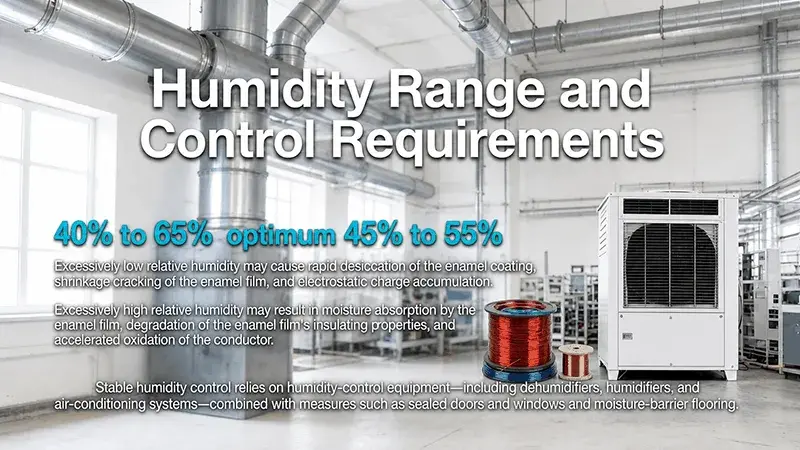
The ideal relative humidity range for magnet wire storage is typically 40% to 65%, with the optimum relative humidity being 45% to 55%. Excessively low relative humidity may cause rapid desiccation of the enamel coating, shrinkage cracking of the enamel film, and electrostatic charge accumulation. Excessively high relative humidity may result in moisture absorption by the enamel film, degradation of the enamel film’s dielectric properties, and accelerated oxidation of the conductor.
Humidity stability requirements are equally critical. The daily fluctuation of relative humidity in storage environments must be controlled within ±10%, and seasonal fluctuations of relative humidity must be controlled within ±20%. Stable humidity control relies on humidity-control equipment—including dehumidifiers, humidifiers, and air-conditioning systems—combined with measures such as sealed doors and windows and moisture-barrier flooring.
Temperature and Humidity Monitoring and Recording
Continuous monitoring and recording of temperature and humidity are fundamental to warehouse environmental control. The warehouse environment must be equipped with multi-point temperature and humidity sensors to monitor ambient temperature and relative humidity in real time. Monitoring data must be continuously recorded and retained long-term to establish a temperature and humidity database, supporting temperature/humidity analysis and anomaly traceability.
The temperature and humidity monitoring system shall be equipped with an alarm function that automatically triggers an alarm when temperature or humidity exceeds preset thresholds. The alarm thresholds shall be set rationally based on the storage requirements for magnet wire, with recommended limits of 30°C (upper) and 10°C (lower) for temperature, and 65% (upper) and 40% (lower) for relative humidity. The alarm response time shall be rapid to ensure timely handling of abnormal conditions.
Ideal Storage Environment Design
Basic Requirements for Warehouse Buildings
Basic requirements for magnet wire storage facilities include thermal insulation, air-tightness, moisture resistance, and light shielding. The walls, roof, and floor of the storage facility must provide effective thermal insulation to prevent external temperature fluctuations from affecting the storage environment. Moisture barriers shall be installed on walls and roofs to prevent groundwater vapor from penetrating into the storage environment.
Window design for warehousing buildings must prevent direct sunlight exposure; double-glazed insulating glass and external shading devices are recommended. Low-emissivity (Low-E) glass effectively blocks ultraviolet (UV) radiation. The lighting system for warehousing buildings shall employ UV-low-emission LED lighting to prevent UV damage to magnet wire.
Temperature and Humidity Control System
The temperature and humidity control system is the core equipment for achieving an ideal storage environment for magnet wire. This system comprises air conditioning units, dehumidification systems, humidification systems, and constant-temperature/constant-humidity units. The air conditioning system ensures precise temperature control, while the dehumidification and humidification systems ensure precise humidity control. Constant-temperature/constant-humidity units are integrated devices capable of simultaneously regulating both temperature and humidity, making them the preferred equipment for high-end magnet wire storage.
Selection of temperature and humidity control systems shall be comprehensively determined based on warehouse space volume, enameled wire storage capacity, enameled wire storage requirements, and temperature/humidity control accuracy. System control accuracy typically requires temperature control within ±2°C and relative humidity control within ±5%. The system must be equipped with backup units or emergency measures to ensure continuous operation in case of equipment failure.
Shelf and Pallet Design
Rack and stacking design for magnet wire storage directly affects enamel coating quality and warehouse space utilization. Magnet wire stacking must avoid excessive layering, as over-stacking subjects the bottom layers to excessive pressure, potentially causing enamel coating indentations, deformation, or damage. The number of stacking layers for magnet wire shall be determined based on product specifications, packaging configuration, and stacking stability.
The design of magnet wire shelving must facilitate air circulation for temperature and humidity control to prevent localized temperature and humidity anomalies. Shelving materials must not contaminate magnet wire; stainless steel, aluminum alloy, or plastic—non-contaminating materials—are recommended. Shelving surfaces must be smooth, free of burrs and sharp edges, to prevent damage to the magnet wire enamel coating.
Differences in Storage Requirements Among Various Enamel Systems
Polyester and Polyurethane Enamel Film Systems
Polyester enamel is the fundamental enamel system for magnet wire, rated at Class 130 temperature class. The storage temperature and humidity requirements for polyester enamel are identical to those for general magnet wire (temperature: 10°C to 30°C; relative humidity: 40% to 65%). Polyester enamel exhibits moderate sensitivity to temperature, with a slightly higher thermal aging rate under elevated temperatures compared to polyurethane enamel.
Polyurethane enamel is a commonly used enamel system with thermal classes ranging from Class 130 to Class 155. Polyurethane enamel exhibits high sensitivity to humidity; hydrolysis may occur under prolonged high-humidity conditions, resulting in relatively rapid degradation of enamel performance. The typical shelf life for both polyester and polyurethane enamels is 12 months.
Polyester-imide Enamel System
Polyesterimide enamel is a Class 180 temperature rating enamel system. Polyesterimide enamel exhibits low sensitivity to temperature and outstanding thermal aging resistance, making it the preferred enamel system for high-temperature magnet wire. The storage temperature and humidity requirements for polyesterimide enamel are identical to those for general-purpose magnet wire.
The shelf life of polyester-imide enamel is typically 18 months, longer than that of polyester and polyurethane enamels. Key inspection items during the shelf life include dielectric strength, enamel adhesion, enamel flexibility, and thermal shock resistance. Polyester-imide magnet wire exceeding the 18-month shelf life is recommended to undergo performance retesting prior to use.
Polyamide-imide Enamel System
Polyamide-imide enamel is an insulation system rated for thermal classes 200 to 220. Polyamide-imide enamel exhibits leading performance in thermal aging resistance and chemical resistance among all enamel systems.
The shelf life of polyamide-imide enamel is typically 24 months, making it one of the enamel systems with longer shelf life. Key inspection items during the shelf life include dielectric strength, adhesion, flexibility, thermal shock resistance, and chemical resistance of the enamel film. The shelf life of composite-coated enamels (e.g., polyester-imide/polyamide-imide composite enamels) is typically 18 to 24 months.
Shelf Life Management
Principles for Setting Storage Life
The storage life of magnet wire is determined based on factors including the aging resistance of the enamel coating, application requirements for the magnet wire, and quality assurance capability. The specified storage life must ensure that magnet wire at the end of its storage period continues to meet application requirements. The storage life shall be established comprehensively, based on accelerated aging test data and actual warehouse environmental conditions.
Standardization of storage life is a critical aspect of magnet wire storage management. Manufacturers shall explicitly specify the storage life in product specifications; warehouse personnel must strictly enforce storage life management, establish a storage life warning mechanism, a reinspection procedure for expired magnet wire, and a disposal process for expired magnet wire.
First-In, First-Out (FIFO) Principle
First In, First Out (FIFO) is the core principle for managing the storage life of magnet wire. The FIFO principle ensures that magnet wire received earlier is prioritized for withdrawal and use, thereby preventing extended storage beyond its designated shelf life. Effective implementation of FIFO requires a robust inventory management system, including recording of receipt dates, batch management, and controlled withdrawal sequencing.
Variants of the First-In-First-Out (FIFO) principle include batch FIFO and expiration-date FIFO. In practice, the appropriate FIFO method may be selected based on the characteristics of magnet wire, inventory scale, and management capability. Strict enforcement of the FIFO principle is critical to magnet wire warehouse management.
Extension of Storage Life and Reinspection
The storage life of magnet wire can be extended under specific conditions. Extension of the storage life is contingent upon strict compliance with ideal warehouse environmental requirements and confirmation that performance test results of the magnet wire remain within specification limits throughout the storage period. Approval for storage life extension must be based on an audit of the manufacturer’s quality management system.
Enameled wire that has reached its storage life must undergo a comprehensive performance retest prior to use. The retest items include visual inspection, dimensional inspection, electrical inspection, mechanical inspection, and thermal performance inspection. Enameled wire passing the retest may be used normally; enameled wire failing the retest must be downgraded or scrapped.
Storage Inspection and Quality Control
Incoming and Outgoing Inspection
Enamel wire incoming inspection is the first gate of warehouse quality control. Incoming inspection items include packaging integrity, label legibility, product specification compliance, and visual quality. Enamel wire with damaged packaging requires focused inspection for enamel coating damage; enamel wire with missing or illegible labels must be re-labeled or rejected.
Enamelled wire outbound inspection is the final checkpoint of warehouse quality control. Outbound inspection items include visual inspection, enamel film continuity, batch identification verification, and expiry date verification. Any enamelled wire found to be nonconforming during outbound inspection shall be suspended from shipment pending detailed reinspection or corrective action. Outbound inspection records must form a complete quality traceability chain together with inbound inspection records and periodic storage inspection records.
Shelf-Life Periodic Inspection
Periodic inspection of magnet wire shelf life is a critical component of warehouse quality control. The recommended inspection intervals are three key time points: 3 months, 6 months, and 12 months. Inspection items include visual inspection, film continuity (pinhole test), dielectric strength, and film adhesion.
The sampling rules for periodic inspection must ensure sample representativeness to avoid biased test results. Results of periodic inspections shall be compared with those of incoming inspection to evaluate performance change trends of magnet wire during storage. Magnet wire batches exhibiting abnormal performance degradation require focused attention and early warning of potential expiration risks.
Quality Traceability System
The quality traceability system for magnet wire is a critical support for warehouse quality control. Based on batch management, production date, expiry date, and inspection records, this system enables full-process traceability—from production, warehousing, storage, and dispatch to end-use—of magnet wire. Establishing such a quality traceability system relies on information management systems, barcode or RFID identification technologies, and database technologies.
The quality traceability system functions include batch inquiry, performance history inquiry, recall of defective products, and traceability of defective products. Establishing a quality traceability system significantly enhances the level of warehouse quality management for magnet wire, and constitutes one of the core competencies of magnet wire manufacturers and distributors.
Typical Storage Scenario Cases
Manufacturer-Owned Warehousing Case
A large proprietary warehouse of a magnet wire manufacturer, equipped with a comprehensive temperature and humidity control system. Warehouse temperature is maintained between 20°C and 25°C; relative humidity is controlled between 45% and 55%; daily temperature fluctuation is limited to within 3°C; daily relative humidity fluctuation is limited to within 5%. The warehouse is equipped with a complete fire protection system, lighting system, and racking system.
The advantages of manufacturer-owned warehousing include stringent control of storage environments, standardized inventory management, and a robust quality traceability system. Manufacturer-owned warehousing is suitable for storing high-end magnet wire, specialty-application magnet wire, and magnet wire customized for key customers.
Distributor and End-User Warehousing
A medium-sized distribution warehouse of a magnet wire distributor, with warehouse temperature controlled between 15°C and 28°C and relative humidity controlled between 45% and 60%. The advantages of the distributor’s warehouse include broad geographic coverage, rapid customer response, and flexible inventory turnover, making it suitable for storage of general-purpose magnet wire and magnet wire for conventional applications.
A major motor manufacturer’s enameled wire raw material warehouse maintains temperature at 18°C to 25°C and relative humidity at 45% to 55%, specifically meeting storage requirements for high-end motor-grade enameled wire. End-user warehouse advantages include alignment of storage conditions with production requirements, refined inventory management, and comprehensive quality traceability.
Temporary Storage Scenarios
Temporary storage (short-term turnover and transshipment) is an interim warehousing stage in magnet wire logistics. Environmental control requirements for temporary storage are lower than those for long-term storage, but basic temperature and humidity requirements must still be met to avoid extreme temperature and humidity conditions. The storage duration for temporary storage is short (typically no more than 3 months), and corresponding storage inspection requirements are simplified. Magnet wire in temporary storage must be turned over as soon as possible to avoid prolonged storage.
Common Warehousing Issues and Improvement Measures
Analysis of Common Storage Issues
Common issues in magnet wire storage include temperature and humidity exceeding specified limits, accelerated enamel film aging, packaging damage, batch mixing, and storage beyond the designated shelf life. The root causes of temperature and humidity exceeding specified limits are failures in temperature and humidity control systems, insufficient thermal insulation performance of the warehouse building, poor sealing of doors and windows, and human operational errors. The root causes of accelerated enamel film aging are prolonged exposure to temperature and humidity exceeding specified limits, excessive light intensity, and elevated levels of airborne contaminants.
The root cause of packaging damage is excessive stacking height, improper handling operations, transportation impact, and pest/rodent infestation. The root cause of batch mixing is unclear labeling, improper warehouse location management, and errors in outbound operations. The root cause of extended storage beyond the specified period is inadequate inventory management, non-compliance with the First-In-First-Out (FIFO) principle, and demand forecast deviation.
Improvement Measures
To address common warehousing issues, systematic improvement measures must be implemented. Temperature and humidity control improvements include upgrading temperature and humidity control systems, enhancing thermal insulation performance of warehouse buildings, improving door and window sealing, strengthening personnel training, and establishing temperature and humidity early-warning mechanisms. Enamel coating protection improvements include using low-ultraviolet lighting, enhancing air filtration, implementing regular enamel coating inspection procedures, and promptly handling out-of-date magnet wire.
Packaging management improvements include optimizing palletizing design, standardizing handling procedures, enhancing transportation protection, and implementing pest and rodent control measures. Batch management improvements include adopting barcode or RFID identification, refining storage location management, establishing an outbound verification mechanism, and strengthening inventory counting. Extended storage period management improvements include enhancing the inventory management system, strictly enforcing the First-In-First-Out (FIFO) principle, improving demand forecasting management, and establishing an extended storage period warning mechanism.
Continuous Improvement Mechanism
Magnet wire storage management requires the establishment of a continuous improvement mechanism. This mechanism includes periodic storage management reviews, customer feedback collection, storage management optimization, and technological upgrades. Storage management reviews shall be conducted periodically, covering storage environmental control performance, inventory management quality, customer satisfaction, and the operational status of the quality traceability system.
Continuous improvement initiatives include enhancing temperature and humidity control accuracy, optimizing inventory management efficiency, deepening information-based management, and implementing green warehousing. The establishment and operation of a continuous improvement mechanism ensure the long-term, high-quality development of magnet wire warehousing management.
Conclusion
The engineering implications of temperature and humidity control for enameled wire storage (Ideal Temperature and Humidity for Enameled Copper Wire Warehouse Storage) encompass eight core engineering dimensions: (1) Mechanisms of temperature and humidity effects on enameled wire (impact of temperature on the enamel coating / impact of humidity on the enamel coating / synergistic mechanisms of temperature and humidity); (2) Ideal temperature and humidity ranges and control requirements (temperature range / humidity range / temperature and humidity monitoring and recordkeeping); (3) Design of ideal storage environments (basic requirements for warehouse buildings / temperature and humidity control systems / rack stacking design); (4) Differences in storage requirements among various enamel systems (polyester-polyurethane enamel / polyester-imide enamel / polyamide-imide enamel / composite-coating enamel); (5) Shelf-life management (principles for establishing shelf life / first-in-first-out principle / shelf-life extension and retesting); (6) Storage inspection and quality control (incoming and outgoing inspection / periodic in-storage inspection / quality traceability system); (7) Typical storage scenario case studies (manufacturer-owned warehousing / distributor and end-user warehousing / temporary storage scenarios); (8) Common storage issues and improvement measures (analysis of common issues / corrective measures / continuous improvement mechanisms).
Rational control of the ideal temperature and humidity range (temperature: 10°C to 30°C; relative humidity: 40% to 65%) is central to magnet wire storage quality control. Stable temperature and humidity control, effective operation of air filtration systems, rational design of lighting systems, and standardized fire safety provisions constitute the four fundamental supporting elements of an ideal magnet wire storage environment.
Differences in storage requirements among various enamel systems primarily manifest in their respective shelf lives: polyester enamel and polyurethane enamel typically have a shelf life of 12 months; polyester-imide enamel, 18 months; and polyamide-imide enamel, 24 months. Strict adherence to the specified shelf life and comprehensive retesting upon expiration are critical quality control measures for enameled wire.
Enamel wire warehouse management is one of the core competencies for enamel wire manufacturers and distributors. Continuous optimization of warehouse environmental control, deepening of refined inventory management, strengthening of quality traceability systems, and promotion of green warehousing implementation are key directions for the sustainable development of enamel wire warehouse management.