

Introduction
The evaluation of polyesterimide enameled rectangular copper wire manufacturers is a core issue for the winding wire manufacturing industry and for transformer and motor manufacturers. Polyesterimide enameled rectangular copper wire—a representative Class 180 (H-class) thermal class enameled rectangular wire—is a critical winding material for new-energy traction motors, high-power-density transformers, specialty reactors, wind turbine generators, and rail transit traction motors. Understanding the process engineering capabilities, quality control systems, product technical characteristics, typical application fields, and selection and procurement considerations of polyesterimide enameled rectangular copper wire manufacturers holds significant practical guidance value for transformer manufacturers, motor manufacturers, reactor manufacturers, new-energy vehicle traction motor producers, specialty motor producers, and B2B procurement engineers.
Polyester-imide enameled rectangular copper wire is a highly sophisticated and technologically advanced segment within the enameled wire product portfolio, involving high-precision rectangular conductor drawing, precision annealing, high-performance insulation enamel formulation, multiple-layer enamel coating with high-temperature curing, and stringent control of enamel thickness and quality. The manufacturer’s process engineering capability and quality control level directly determine the product’s performance stability, batch-to-batch consistency, and long-term reliability.
The engineering implications of a polyesterimide enameled rectangular copper wire manufacturer can be systematically elaborated across seven dimensions: the technical foundation of polyesterimide enameled rectangular copper wire; the manufacturer’s core process engineering capabilities; critical quality control systems; product technical characteristics and differentiation advantages; typical application fields and selection considerations; manufacturer evaluation and procurement considerations; and industry development and manufacturing trends. This article provides a systematic engineering reference for transformer manufacturers, motor manufacturers, reactor manufacturers, new-energy vehicle traction motor manufacturers, specialty motor manufacturers, and B2B procurement engineers.
Technical Fundamentals of Polyester-imide Enamelled Rectangular Copper Wire
Characteristics of Polyester-imide Enamel System
The polyesterimide (PEI) enamel system is a hybrid formulation combining polyester and polyimide resins, offering both the high adhesion and excellent flexibility of polyester enamels and the superior thermal resistance of polyimide enamels. The standard thermal class of polyesterimide enamel is Class 180 (H-class), with a continuous operating temperature up to 180°C and short-term overload capability exceeding 200°C. Polyesterimide enamel maintains long-term dielectric strength and mechanical properties at Class 180 temperatures, making it a representative enamel system for high-temperature magnet wire.
The chemical structure of polyester-imide enamel combines ester groups (for flexibility) and imide rings (for thermal resistance), achieving a molecular-level balance between flexibility and thermal resistance. Polyester-imide enamel exhibits excellent adhesion to copper conductor surfaces, with high bonding strength between the enamel film and the copper conductor; its dielectric strength, dielectric loss, chemical resistance, and refrigerant resistance are all at high levels. Key performance indicators—including insulation resistance, breakdown voltage, thermal shock resistance, and softening breakdown temperature—of polyester-imide enamel are significantly superior to those of conventional polyester and polyurethane enamels.
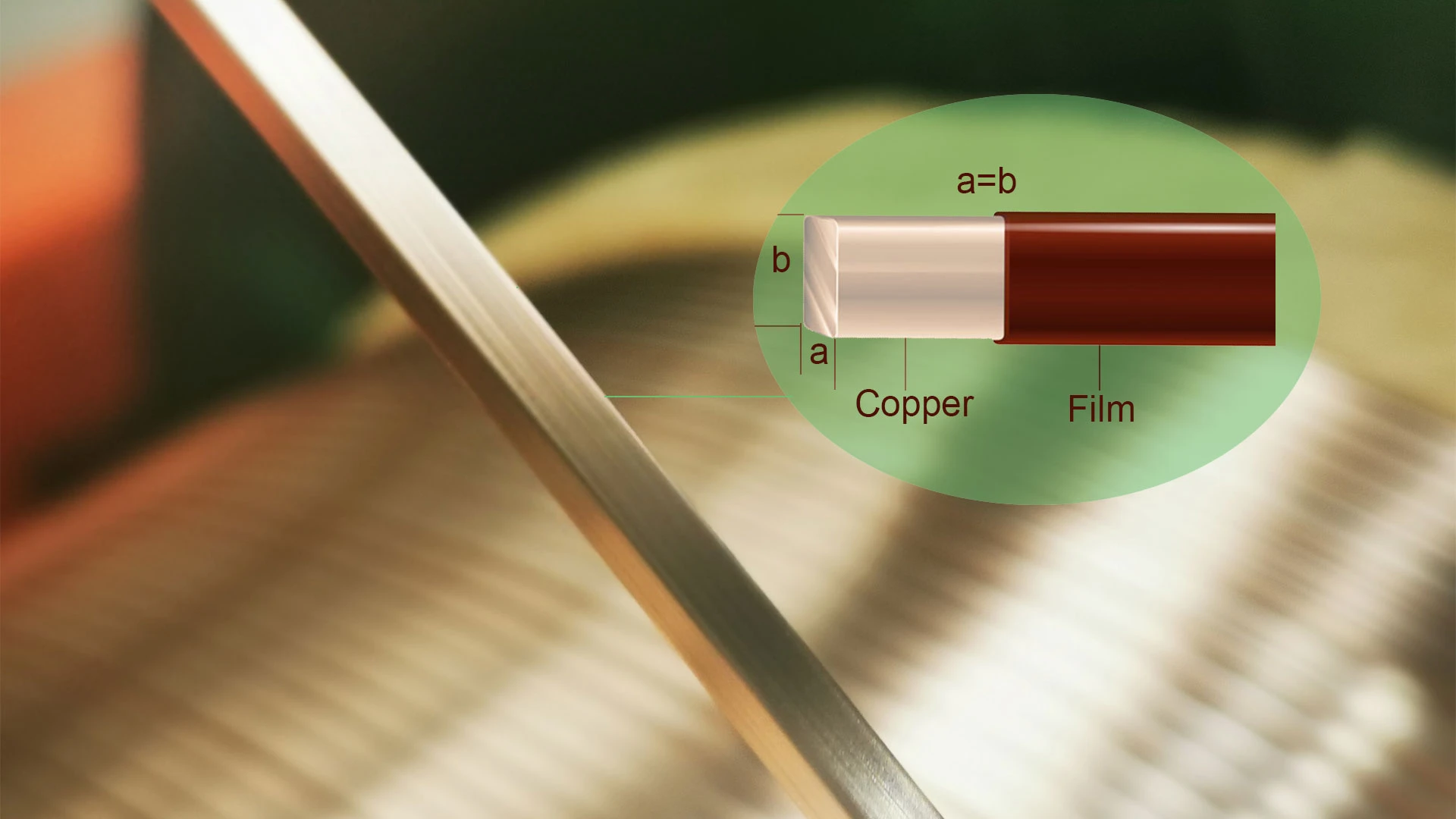
Key technical parameters of polyester-imide enamel coating systems include coating thickness (Build-up), coating continuity (Continuity), coating adhesion (Adhesion), softening temperature (Cut-through Temperature), heat shock resistance (Heat Shock), and refrigerant resistance (Refrigerant Resistance). Internationally standardized test methods for these parameters serve as the critical basis for evaluating the quality of polyester-imide enameled rectangular copper wire.
Rectangular Conductor Characteristics
Key dimensional parameters of rectangular conductors (also known as flat conductors) include width, thickness, corner radius, cross-sectional area, and width-to-thickness ratio. Dimensional accuracy of rectangular conductors directly affects winding fill factor, electromagnetic performance, and insulation compatibility.
Rectangular conductors offer several engineering advantages over round conductors. The space factor of rectangular conductors in windings is significantly higher than that of round conductors, thereby enhancing the power density of transformers and the torque density of motors. Rectangular conductors exhibit superior heat dissipation performance compared to round conductors, facilitating better control of winding temperature rise. Rectangular conductors are compatible with various winding configurations, including hairpin winding, continuous winding, and disc winding.
Enamel Coating and Curing Principles
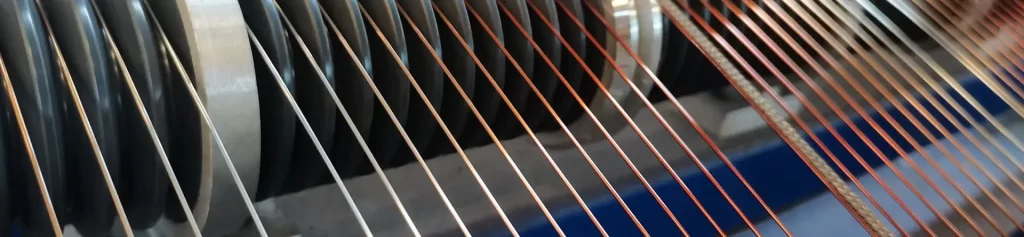
The enamel coating process for rectangular enameled wire primarily employs the die-coating method. After annealing, the rectangular conductor is guided into the enamel tank via guide rollers; the insulating enamel wets the conductor surface within the tank, and then excess enamel is scraped off by a precision-dimensioned coating die to form a uniformly thick wet enamel film. The wet enamel film subsequently enters a high-temperature curing oven to cure, forming a dense, uniform enamel film with excellent adhesion.
The curing process of polyester-imide enamel involves multiple physicochemical processes, including solvent evaporation, condensation polymerization, and crosslinking reactions. Curing temperature, curing time, and curing atmosphere are critical curing process parameters. The curing temperature must be precisely controlled: too low a temperature results in incomplete curing and inadequate enamel film properties, while too high a temperature causes enamel film aging and increased brittleness.
Core Process Engineering Capabilities of the Manufacturer
Rectangular Conductor Drawing Capability
Rectangular conductor drawing is based on the principle of round wire drawing, progressively reducing round wire to a rectangular cross-section through multiple die passes. Key control parameters for rectangular conductor drawing include dimensional accuracy, surface quality, mechanical properties, and batch consistency. Rectangular conductor drawing imposes high requirements on die precision, drawing process parameters, lubrication conditions, and equipment stability. Premium manufacturers equip their lines with precision rectangular drawing dies, in-line dimensional inspection systems, and in-line surface quality monitoring systems to ensure dimensional accuracy and surface quality of rectangular conductors.
The manufacturing process route for rectangular conductors typically includes multiple steps: preliminary drawing of round wire, intermediate annealing, rectangular drawing, and final drawing. Each drawing step requires precise control of process parameters—including drawing force, lubrication conditions, die temperature, and wire speed—to prevent defects such as surface scratches, dimensional deviations, and insufficient mechanical properties. Dimensional accuracy and surface quality of the rectangular conductor constitute the fundamental assurance for subsequent enamel coating quality.
Precision Annealing Capability
Rectangular conductors undergo work hardening during the drawing process and require annealing to restore ductility and electrical conductivity. Key parameters of the annealing process include annealing temperature, annealing time, annealing atmosphere, and line speed for continuous annealing. The annealing process significantly influences the conductor’s final mechanical properties, electrical conductivity, surface condition, and enamel adhesion.
Precision annealing equipment is core machinery for high-end manufacturers. Continuous annealing furnaces are equipped with precise temperature control systems, protective atmosphere injection systems, tension control systems, and in-line quality inspection systems. Uniformity of annealing temperature, purity of the annealing atmosphere, and stability of tension control are critical parameters governing annealing quality.
Enamel Coating Process Capability
Film coating process capability is one of the core competencies in the manufacturing of polyester-imide enameled rectangular copper wire. Film coating involves multiple process steps, including varnish formulation management, varnish bath temperature control, coating die precision, coating speed control, and curing oven temperature profile control. Varnish formulation management encompasses precise control of varnish solids content, varnish viscosity, varnish temperature, and varnish service life. Coating die precision directly affects film thickness uniformity; leading manufacturers employ precision-machined coating dies coupled with scheduled die replacement protocols.
Process control points for enamel coating include coating thickness, coating uniformity, coating continuity, and coating surface quality. Coating thickness is classified into different thickness grades—Grade 1, Grade 2, Grade 3—per international standards. Coating thickness uniformity is the core indicator of coating process capability.
Multi-layer enamel build-up capability
Polyester-imide enameled rectangular copper wire typically requires multiple coating passes to achieve the specified enamel thickness. The key to multi-pass enamel application lies in ensuring the cure quality of each individual enamel layer, interlayer adhesion, and the continuity and uniformity of the overall enamel film. Premium manufacturers employ multi-pass continuous coating production lines, with each pass equipped with an independent varnish tank, coating die, and curing oven, enabling independent and precise control of process parameters for each enamel layer.
Key Quality Control Systems
Conductor Raw Material Quality Control
Conductor raw material quality control encompasses the chemical composition, purity, oxygen content, and impurity levels of copper rod materials such as Electrolytic-Tough-Pitch (ETP) copper and Oxygen-Free Copper (OFC). The quality of conductor raw materials directly affects the final product’s electrical conductivity, mechanical properties, enamel adhesion, and corrosion resistance. Premium manufacturers conduct rigorous qualification reviews and ongoing quality assessments of conductor raw material suppliers to ensure consistent raw material quality.
Key technical specifications of conductor raw materials include conductivity (IACS value), tensile strength, elongation, oxygen content, surface cleanliness, and chemical composition stability. Oxygen-free copper features extremely low oxygen content and excellent conductivity and corrosion resistance, making it the preferred conductor material for high-end polyester-imide enameled rectangular copper wire. The high purity and low oxygen content of oxygen-free copper significantly enhance enamel coating adhesion, corrosion resistance, and resistance to hydrogen embrittlement.
Insulating Enamel Raw Material Quality Control
Insulating enamel is a critical raw material for polyester-imide enameled rectangular copper wire. Quality control of the insulating enamel encompasses solid content, viscosity, acid number, curing characteristics, and storage stability of the polyester-imide enamel solution. Storage conditions for the insulating enamel must be strictly controlled to prevent degradation of enamel performance. During enamel usage, mechanisms must be established for enamel usage logging, enamel performance monitoring, and enamel filtration maintenance.
Manufacturing Process Quality Control
Manufacturing process quality control covers the entire production flow, including conductor drawing, conductor annealing, enamel coating application, enamel curing, and packaging/storage. Key quality control points in the manufacturing process include conductor dimensions, conductor surface condition, annealing temperature, enamel thickness, curing temperature, enamel continuity, and visual quality.
The manufacturing process quality control system incorporates professional quality management tools such as SPC (Statistical Process Control), FMEA (Failure Mode and Effects Analysis), and CPK (Process Capability Index). Premium manufacturers establish comprehensive SPC monitoring systems to perform real-time monitoring and statistical analysis at critical quality control points, enabling prompt detection and correction of process anomalies.
Finished Product Quality Inspection System
The finished product quality inspection system includes visual inspection, dimensional inspection, electrical testing, mechanical testing, chemical testing, and thermal performance testing. Electrical testing covers dielectric strength, dielectric loss, insulation resistance, and film continuity. Mechanical testing includes tensile strength, elongation, bendability, and film adhesion. Chemical testing comprises resistance to chemical media and solvent resistance. Thermal performance testing includes thermal shock testing, thermal aging testing, and softening breakdown testing.
Quality Management System Certification
Manufacturers of polyester-imide enameled rectangular copper wire shall typically hold ISO 9001 quality management system certification; some high-end manufacturers shall additionally hold ISO 14001 environmental management system certification and ISO 45001 occupational health and safety management system certification. Manufacturers serving the automotive industry typically require IATF 16949 automotive quality management system certification. Conformance to product standards constitutes a critical element of the manufacturer’s quality management system, with relevant international standards including IEC 60851, IEC 60317, NEMA MW 1000, and UL certification.
Product Technical Features and Differentiating Advantages
Outstanding Heat Resistance
Class 180 (Class H) thermal rating enables polyester-imide enameled rectangular copper wire to withstand a continuous operating temperature of 180 °C and short-term overload temperatures exceeding 200 °C, making it the preferred winding material for high-temperature motors and high-power-density transformers. Its outstanding thermal resistance allows polyester-imide enameled rectangular copper wire to meet the demanding requirements of high-temperature applications such as new-energy vehicle traction motors, wind turbine generators, and rail transit traction motors.
The thermal aging resistance of polyester-imide enamel is one of its core advantages. Based on the Arrhenius model derived from accelerated aging tests, the design service life of polyester-imide enamel at Class 180 temperature exceeds tens of thousands of hours. The superior thermal aging resistance renders polyester-imide enameled flat copper wire irreplaceable in long-life, high-temperature applications such as new-energy vehicles, wind power generation, and rail transit.
Excellent Dielectric Properties
Polyester-imide enamel film exhibits high dielectric strength, low dielectric loss, excellent insulation resistance, and outstanding corona resistance. Its superior dielectric properties enable polyester-imide enameled rectangular copper wire to withstand medium- to high-voltage operating conditions, making it the preferred winding material for medium-sized motors and medium- to high-voltage transformers.
High Mechanical Strength and High Packing Factor
Polyester-imide enamel exhibits excellent adhesion to copper conductors and good cut-through resistance, abrasion resistance, and impact resistance. Rectangular conductors achieve a significantly higher packing factor in windings compared to enameled round wire and enameled aluminum wire, thereby enhancing the power density of transformers and the torque density of motors. A high packing factor is a core requirement for new-energy-vehicle traction motors and high-power-density transformers.
Excellent process compatibility
Polyester-imide enamel coatings are compatible with high-speed winding, automated insertion, shaping, tying, and impregnation processes in coil manufacturing. Rectangular conductors are suitable for various winding configurations, including hairpin windings, continuous windings, disc windings, and helical windings.
Typical Application Areas
Application in New Energy Vehicle Traction Motors
New energy vehicle (NEV) traction motors operate at elevated temperatures and require high power density, high efficiency, and long-term reliability. Polyester-imide enameled rectangular copper wire—rated Class 180 per IEC 60317, NEMA MW 1000, ASTM B566, UL 1446, and IATF 16949—offers high fill factor, excellent dielectric properties, and high mechanical strength, making it the preferred material for NEV traction motor hairpin windings. The rapid growth of the NEV industry is driving strong demand for polyester-imide enameled rectangular copper wire.
The hairpin winding process for traction motors in new-energy vehicles imposes stringent requirements on the temperature rating, paint film adhesion, and geometric precision of flat wire insulation. Processes such as hairpin forming, welding, twisting, and insulation treatment place extremely high demands on paint film integrity. High-quality paint film on polyester-imide enameled flat copper wire remains intact during hairpin forming and welding, making it a critical material for the hairpin winding process in new-energy vehicle traction motors.
Wind Turbine Applications
Wind turbine generators operate at elevated temperatures under harsh conditions and require extremely high long-term reliability (design life exceeding 20 years). For offshore wind turbine generators, the high-humidity, salt-fog environment imposes stringent weathering resistance requirements on winding insulation; polyester-imide enamel film meets this requirement.
Application in Rail Transit Traction Motors
Rail transit traction motors operate under frequent start-stop cycles, overload conditions, and vibration. Polyester-imide enameled rectangular copper wire—featuring Class 180 thermal class rating, high mechanical strength, and long-term reliability—is the preferred winding material for rail transit traction motors.
Industrial High-Voltage Motor and Special Transformer Applications
Polyester-imide enameled rectangular copper wire is compatible with various winding configurations for industrial high-voltage motors, with dielectric strength meeting insulation requirements and mechanical strength satisfying winding processing requirements. Special transformers and special reactors impose stringent requirements on winding insulation—specifically thermal class, mechanical strength, and long-term reliability—where the comprehensive performance of polyester-imide enamel coating meets these rigorous demands.
Manufacturer Evaluation and Procurement Considerations
Manufacturer Comprehensive Strength Assessment
Comprehensive manufacturer capability assessment covers multiple dimensions, including production capacity, R&D capability, quality control capability, technical service capability, supply capability, financial strength, and creditworthiness. Production capacity assessment includes production scale, production equipment, manufacturing processes, and capacity flexibility. R&D capability assessment includes R&D team composition, R&D investment, and new product development capability. Quality control capability assessment includes quality management system, testing equipment, and process control level.
Technical service capability evaluation includes pre-sales technical support, in-sales technical collaboration, after-sales technical service, and response speed to application issues. Supply capability evaluation covers delivery lead time, supply stability, emergency supply capability, and geographical coverage capability. Financial strength and creditworthiness constitute the fundamental assurance for long-term supplier collaboration; evaluation shall be based on multi-dimensional information including enterprise scale, operating revenue, financial health, industry reputation, customer feedback, and contract performance records.
Product Technical Specification Evaluation
Product technical specification evaluation covers conductor specifications, enamel coating specifications, electrical properties, mechanical properties, thermal properties, chemical properties, and compliance with standards. Customized product capability assessment is a key factor in manufacturers’ differentiated competition; high-end manufacturers possess the ability to tailor product specifications according to customers’ specific requirements.
Precise definition of product technical specifications is a critical step in procurement. The purchaser must specify exact requirements for conductor dimensions, insulation coating thickness, insulation coating type, and performance criteria based on motor design requirements, transformer design requirements, and application-specific characteristics. The manufacturer shall provide detailed product specification documents, test reports, and quality certification documents to support the purchaser’s product verification and quality acceptance.
Cost and Value Assessment
Scientific procurement decisions should be based on comprehensive value assessment rather than unit price alone. High-quality polyester-imide enameled rectangular copper wire, although commanding a higher unit price, typically delivers lower total lifecycle cost and superior reliability—making it the preferred choice for high-end applications.
Dimensions for cost and value assessment include direct procurement cost, processing cost (impact on yield rate in winding manufacturing, coil insertion, shaping, etc.), usage cost (impact on operational efficiency and reliability of motors or transformers), maintenance cost (impact of failure rate and maintenance frequency during long-term operation), and disposal cost (impact of environmental disposal and resource recovery). The methodology for comprehensive value assessment involves establishing a Total Cost of Ownership (TCO) model to compare the TCO across different suppliers, specifications, and brands, thereby selecting the optimal solution.
Building Long-Term Cooperative Relationships
Long-term cooperative relationships encompass stable supply assurance, deepened technical collaboration, joint R&D initiatives, collaborative quality improvement, information-sharing mechanisms, and optimized commercial terms. Establishing long-term cooperative relationships requires joint efforts from both parties, grounded in the principles of trust, mutual benefit, and win-win outcomes.
A strategic partnership represents the highest level of long-term collaboration. It encompasses manufacturer involvement in customers’ early-stage product development, provision of customized products and services by the manufacturer, customer preference for the manufacturer’s premium products, joint sharing of technology roadmaps, and establishment of a collaborative quality improvement mechanism. Establishing a strategic partnership significantly enhances the competitiveness and market responsiveness of both parties.
Industry Development and Manufacturing Trends
Growth in Traction Applications for New Energy Vehicles
The rapid development of the new-energy vehicle industry is the core driver for increasing demand for polyester-imide enameled rectangular copper wire. New-energy vehicle traction motors widely adopt hairpin winding technology, for which polyester-imide enameled rectangular copper wire serves as a critical material. The supply capacity of high-end polyester-imide enameled rectangular copper wire has become a key link in the new-energy vehicle industrial chain.
Expansion of Applications in Offshore Wind Power and High-Power-Density Transformers
The large-scale development of offshore wind power has driven the increase in wind turbine capacity and the intensification of operating conditions, significantly raising requirements for winding insulation in terms of temperature rating, weather resistance, and long-term reliability. High-power-density transformers used in data centers, new energy grid integration, rail transit, and energy storage systems impose stringent requirements on winding insulation, resulting in a continuously expanding application share of polyester-imide enameled rectangular copper wire.
Intelligent Manufacturing and Green Manufacturing
Smart manufacturing technologies include automated production lines, robotic applications, intelligent inspection systems, and intelligent logistics systems, as well as MES (Manufacturing Execution Systems). Digital transformation enhances manufacturers’ production efficiency, quality levels, and responsiveness. Green manufacturing encompasses the application of clean energy, energy-saving production processes, waste minimization, resource recycling, use of environmentally friendly materials, and carbon emission management.
Import Substitution of High-End Products
With technological advancements, process optimization, and quality improvements by domestic manufacturers, the market competitiveness of high-end polyester-imide enameled flat copper wire products continues to strengthen, and the import substitution trend is becoming increasingly evident.
Conclusion
The engineering scope of a Polyesterimide Enameled Rectangular Copper Wire Manufacturer encompasses seven core engineering dimensions: technical fundamentals of polyesterimide enameled rectangular copper wire; the manufacturer’s core process engineering capabilities; critical quality control systems; product technical characteristics and differentiation advantages; typical application fields; manufacturer evaluation and procurement considerations; and industry development and manufacturing trends.
Polyester-imide enameled flat copper wire, as a Class 180 high-end enameled flat wire product, serves as a critical winding material for traction motors in new-energy vehicles, wind-power generators, rail transit traction motors, industrial high-voltage motors, specialty transformers, and reactors. The process engineering capability, quality control level, R&D innovation capacity, and customer service capability of polyester-imide enameled flat copper wire manufacturers constitute key links in the high-end manufacturing supply chain.
The polyester-imide enameled rectangular copper wire manufacturing industry is undergoing multiple opportunities and challenges driven by new-energy vehicle development, offshore wind power expansion, deepening applications of high-power-density transformers, intelligent manufacturing and digital transformation, green manufacturing and sustainable development, and import substitution of high-end products. Manufacturers should continuously optimize process engineering capabilities, strengthen quality control system construction, deepen R&D innovation, and enhance customer service levels to provide higher-performance, more reliable, and more cost-competitive products for the high-end manufacturing sector.