

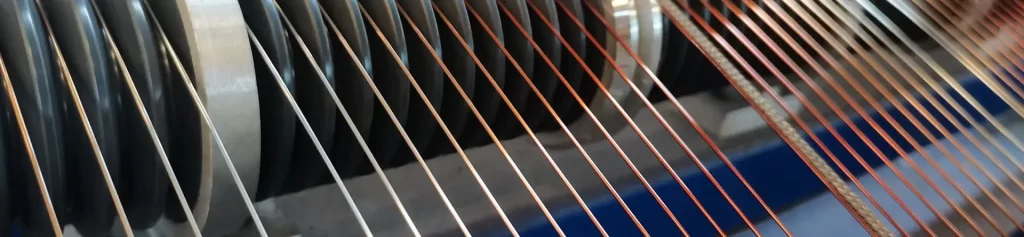
I. Introduction: Automatic Winding Machine and Enameled Wire – The “Perfect Match”the enameled wire
In the modern electronic and electrical manufacturing industry, Automatic Winding Machine has become a standard production equipment for core components such as relays, micro-motors, transformers, inductors, and sensors . However, the production capacity, yield, and equipment life of the winding machine are extremely dependent on the matching of enameled wires – each deviation such as wire diameter tolerance, film thickness, elongation, tensile strength, and film continuity will lead to wire winding failure.
Automatic Winder vs Enameled Wire Adaptation Challenge :
– High speed windings (> 5,000 rpm)→ are sensitive to wire diameter tolerances
– Tension control (5-50 N→) requires high elongation
– Automated production (24/7→) requires high film continuity
– Complex windings → require high accuracy for wiring
– Long-term operation → requires high adhesion to the paint film
6 big matching questions :
– Wire diameter deviation leading to wire breakage
– The paint film is too thin to break down
– The paint film is too thick, resulting in irregular wiring
– Fracture due to insufficient elongation
– Breakage due to insufficient tensile strength
– Poor film adhesion leading to paint stripping
5 core needs :
– Accuracy requirements : wire diameter tolerance ± 0.003-0.005 mm
– Strength requirements : Elongation > 25-30%
– Insulation requirements : Paint film continuity 0 defect
– Process requirements : Paint film thickness uniformity ± 1 μm
– Batch requirements : high batch consistency
1.1 Development of automatic winding machines
3 phases :
– 1970s: single axis CNC winding machine
– 1990s: Multi-axis winding machine
– 2010s to present: Smart Visual Winder + AI Optimization
1.2 6 big winder types
| Type | Rotational Speed | Applicable Wire Diameter | Apply |
|---|---|---|---|
| Single-Shaft Winder | < 3,000 rpm | Φ 0.05-2.0 mm | Universal Relay |
| Multi-axis Winder | < 5,000 rpm | Φ 0.05-1.0 mm | Small Components |
| High Speed Winder | 5,000-15,000 rpm | Φ 0.05-0.3 mm | Micromotor |
| Fork winder | 3,000-8,000 rpm | Φ 0.1-0.5 mm | High density coil |
| Flat wire winder | 1,000-3,000 rpm | Flat wire 1-5 × 3-10 mm | Wind power, traction |
| Frameless winder | 5,000-20,000 rpm | Φ 0.02-0.3 mm | Micromotor, self-adhesive wire |
1.3 5 key parameters of the big winding machine
| Parameters | Typicals | Impacts |
|---|---|---|
| Maximum rpm | 1,000-20,000 rpm | Capacity |
| Wire diameter range | Φ 0.02-5.0 mm | Applicability |
| Tension control | 1-200 N | Paint film breakage |
| Cable Accuracy | 0.01-0.05 mm | Winding Consistency |
| incoming angle | ± 0.5° | neatly lined |
II. Technical Parameters of Enameled Wire and Winding Machine Matchingd with the winder
2.1 Conductor Diameter Tolerance
Tolerance standard (IEC 60317/GB 6109):
– Φ < 0.25 mm: ± 0.003 mm
– Φ 0.25-0.50 mm: ± 0.004 mm
– Φ 0.50-1.00 mm: ± 0.005 mm
-Φ > 1.00 mm: ± 0.008 mm
Winder matching :
– High speed winding (> 5,000 rpm): ± 0.003 mm
– Medium speed winding (1,000-5,000 rpm): ± 0.005 mm
– Low speed winding (< 1,000 rpm): ± 0.008 mm
Tolerance impact :
– Too small tolerances High → cost
– Too large tolerances Uneven → row lines, uneven windings
2.2 Elongation and tensile strength
Elongation criteria :
– Soft copper: > 30% (Φ < 0.5 mm)
– Soft copper: > 25% (Φ ≥ 0.5 mm)
Winder matching :
– High speed winding: Elongation > 30%
– Medium winding: Elongation > 25%
– Complex windings: Elongation > 35%
Tensile strength :
– Soft copper: > 200 MPa
– Enameled wire: > 180 MPa
Winder tension matching :
T = σ × A
Where:
T = Tension (N)
σ = Tensile strength (Pa)
A = cross-sectional area (m ²)
Tension safety factor :
– General winding: safety factor 3-5
– High speed winding: safety factor 5-8
– Enameled wire tension should be controlled at 10-20% of breaking force
2.3 Film thickness and uniformity
Film Grade :
– Grade 0 (Thin): 5-10 μm
– Grade 1 (standard): 8-15 μm
– Grade 2 (thick): 12-20 μm
– Grade 3 (thick): 18-25 μm
Winder matching :
– High density cables: Grade 1 (thin and even)
– High voltage applications: Grade 2-3 (thick)
– General application: Grade 1
Paint film uniformity :
– Radial: ± 1 μm
– Axial: ± 1.5 μm
– Ovality: < 5%
Thin film problem :
– Scratches when arranging wires
– Breakdown during subsequent processing
– Reduced lifespan
Issue with thick paint film :
– Increased outer diameter
– Irregular wiring
– Slot Fill Rate Decrease
2.4 Paint film continuity
Continuity test :
– Saline bath test (IEC 60851)
– 7 kV voltage
– Number of defects: 0/30 m (optimal)
Winder Impact :
– Increased → breakdown rate of enameled wire with poor continuity
– High-speed winding requires high continuity
– Recommended: 0 defects/30 m
Paint film adhesion :
– Sharp pull test: no shedding
– Winding test: 1x diameter without cracking
– After aging: Adhesion retention > 90%
III. Winding Machine Tension Control System and Enameled Wire Adaptationadapted to the enameled wire
3.1 4 large tension control methods
Mode 1: Magnetic Powder Tensioner
– Tension range: 1-200 N
– Accuracy: ± 5%
– Applicable: medium-low speed
– Advantages: simple structure, low price
Mode 2: Servo tensioner
– Tension range: 0.5-500 N
– Accuracy: ± 1-2%
– Applicable: Full speed
– Advantages: high precision and programmability
Mode 3: Pneumatic tensioner
– Tension range: 1-100 N
– Accuracy: ± 3%
– Applicable: Continuous supply line
– Strengths: Fast response, good buffering
Mode 4: Mechanical tensioner
– Tension range: 1-50 N
– Accuracy: ± 10%
– Applicable: General low speed
– Advantages: Low cost
3.2 5 Effects of high tension on enameled wire
Impact 1: Excessive tension
– Broken paint film
– Copper wire elongation
– Tensile failure
– Permanent deformation
Impact 2: Too little tension
– Loose cables
– Inconsistent winding height
– Uneven ends
– Difficulty embedding wires
Impact 3: Tension fluctuations
– Periodic damage to the paint film
– Uneven winding density
– Inaccurate laps
– Decreased short-circuit tolerance
Impact 4: Sudden tension
– Impact load
– Paint film rupture
– Disconnection
Impact 5: Sudden loosening of tension
– Divergence
– Stranded wire
– Winding collapse
3.3 Tension setting calculation
Tension calculation formula :
T = 0.1 × σ_b × A × k
Where:
T = Tension (N)
σ_b = enameled wire tensile strength (MPa)
A = cross-sectional area (mm ²)
k = tension coefficient (0.05-0.20)
Typical tension value :
– Φ 0.1 mm: tension 1-5 g
– Φ 0.3 mm: tension 10-50 g
– Φ 0.5 mm: tension 30-100 g
– Φ 1.0 mm: tension 100-300 g
– Φ 2.0 mm: tension 400-1,000 g
3.4 6 Large Tension Monitoring Parameters
- Real-time tension values
- Mean tension
- Range of tension fluctuations
- Poor tension peaks and valleys
- Abnormal tension alarm
- Tension history
IV. Winding Machine Speed and Enameled Wire Adaptation
4.1Rotation speed and wire diameter relationship
Maximum rpm formula :
N_max = k/√ d
Where:
N_max = Maximum safe speed (rpm)
k = enameled wire coefficient (typical 30,000)
d = Wire diameter (mm)
Typical maximum speed :
– Φ 0.05 mm: 13,000 rpm
– Φ 0.10 mm: 9,500 rpm
– Φ 0.30 mm: 5,500 rpm
– Φ 0.50 mm: 4,200 rpm
– Φ 1.00 mm: 3,000 rpm
– Φ 2.00 mm: 2,100 rpm
4.2 4 major high-speed winding challenges
Challenge 1: centrifugal force
-F = m × ω ² × r
– High centrifugal force at high speeds
– Paint film can easily be thrown out
Challenge 2: Vibration
– High-speed vibration
– Film fatigue
– Incorrect wiring
Challenge 3: Friction heat
– friction between wire and guide wheel
– Temperature rise
– Paint film softening
Challenge 4: Static electricity
– High speed friction
– Electrostatic accumulation
– Paint film adsorption
4.3 6 Effect of high speed on enameled wire
- Wear of paint film
- Temperature rise of paint film
- Conductor elongation
- Line offset
- Decreased lap accuracy
- Increased equipment noise
V. Winding System and Enameled Wire Adaptation
5.1 Cabling
Mode 1: Screw line
– Line accuracy: ± 0.02 mm
– Applicable: medium-low speed
– Strengths: Simple structure
Mode 2: Servo cable
– Line accuracy: ± 0.01 mm
– Applicable: Full speed
– Advantages: high precision and programmability
Way 3: stepping cables
– Line accuracy: ± 0.03 mm
– Applicable: General
– Advantages: Low cost
5.2 Effect of line accuracy on enameled wire
Insufficient line accuracy :
– Uneven windings
– Highly inconsistent
– Uneven ends
– Slot Fill Rate Decrease
Enameled wire factor :
– Wire diameter tolerance
– Uniformity of the paint film
– Roundness of the paint film
– Bending resistance
5 large row line quality indicators :
– Row uniformity
– High consistency
– Angle deviation
– End Alignment
– Embedded adaptation
5.3 Requirements for 5 large rows of wires to enameled wires
- High roundness (ellipticity < 5%)
- Excellent bending resistance
- Flexible paint film
- Smooth surface
- Stable size
VI. Incoming Inspection of Enameled Wire
6.1 5 mandatory inspection items
- Wire diameter inspection :
- Micrometer/laser caliper
- Sampling ratio: 0.1-1%
Qualified: Tolerance meets standard
Film thickness :
- Paint film thickness gauge
- Sampling ratio: 0.1%
Qualified: Level compliant
Elongation :
- Tensile machine
- Sampling ratio: 0.1%
Qualified: > 25-30%
Paint film continuity :
- Salt water bath + voltage
- Sampling ratio: 100%
Qualified: 0 defects/30 m
Dielectric strength :
- High Pressure Testing
- Sampling ratio: 0.1-1%
- Qualified: > 5 kV
6.2 5 big options
- Tensile strength
- Paint film adhesion
- Solder wettability (e.g. solderable enameled wire)
- Softening breakdown temperature
- Aging performance
6.3 8 Big Enameled Wire Batch Problem Symptoms
| Symptoms | Possible causes | Resolution |
|---|---|---|
| Winding break wires | Insufficient tensile resistance, low elongation | Replacement batch |
| Uneven Rowing | Large Wire Diameter Tolerance | Replacement Batch |
| Broken film | Thin film, poor adhesion | Replacement lot |
| Increased breakdown rate | Poor film continuity | Replacement batch |
| Difficulty embedding threads | Paint film too thick | Adjustment process |
| Inconsistent winding height | Uneven paint film | Replacement batch |
| Inaccurate number of turns | Tension fluctuations | Adjusting tension |
| Paint film off | Poor adhesion | Change lot |
VII. 5 Common Failures of Enameled Wire on Winding Machines
7.1 Failure 1: Disconnection
Reason :
– Low tensile strength of enameled wire
– Insufficient elongation
– Partial defects of the paint film
– Too much tension
– Guide wheel wear
Resolve :
– Replace enameled wire batch
– Adjust tension
– Replace the guide wheel
– Reduce rpm
7.2 Failure 2: Paint film broken
Reason :
– Too much tension
– Guide wheels have burrs
– Poor adhesion of paint film
– Over Temperature
Resolve :
– Adjust tension
– Polished guide wheels
– Replace enameled wire
– Improved heat dissipation
7.3 Failure 3: irregular wiring
Reason :
– Large wire diameter tolerance
– Poor roundness of paint film
– Tension fluctuations
– Low accuracy of the cable arrangement system
Resolve :
– Replace enameled wire
– Adjust tension
– Calibrate the cable arrangement system
7.4 Failure 4: Incorrect number of laps
Reason :
– Tension fluctuations
– Low encoder accuracy
– Enameled wire slippery
Resolve :
– Stable tension
– Calibration encoder
– Adjust friction
7.5 Failure 5: Paint film breakdown
Reason :
– Poor film continuity
– The paint film is too thin
– Insufficient dielectric strength
Resolve :
– Replace enameled wire
-Upgrade the paint film level
– Choose high dielectric paint film
VIII. 4 Matching Principles between Automatic Winding Machine and Enameled Wirees of matching
8.1 Principle 1: Wire Diameter Tolerance Matching
Match formula :
Winder accuracy > 5 x wire diameter tolerance
Examples :
– Φ 0.5 mm (tolerance ± 0.005 mm)
– Winder accuracy: > 0.025 mm
– Recommended: ± 0.005 mm enameled wire
8.2 Principle 2: Matching tensile strength
Match formula :
T_max = 0.2 × σ_b × A
Examples :
– Φ 0.5 mm (σ_b = 220 MPa, A = 0.196 mm ²)
– T_max = 0.2 × 220 × 0.196 = 8.6 N
– Recommended tension: 4-8 N
8.3 Principle 3: Paint film thickness matching
Matching principle :
– High Density Cable: Grade 1
– High voltage applications: Grade 2-3
– High line insertion accuracy: Grade 1-2
8.4 Principle 4: Line speed and tension balance
Equilibrium formula :
T = k × v/√ d
Where:
T = Tension (N)
v = line speed (m/s)
d = Wire diameter (mm)
k = coefficient
Examples :
-v = 10 m/s, d = 0.5 mm
-k = 0.05
– T = 0.05 × 10/√ 0.5 = 0.71 N
IX. Enameled Wire Selection for 5 Winding Machine Types
9.1 High-speed winding machine
rpm : 5,000-15,000 rpm
Applicable wire diameter : Φ 0.05-0.3 mm
Enameled wire requirements :
– Elongation > 30%
– Tolerance ± 0.003 mm
– Paint film continuity 0 defect
– Flexible paint film
Recommended Paint Film :
– PU (polyurethane)
– PEI + PU (polyesterimine + PU)
– Film thickness 8-15 μm
9.2 Multi-axis winding machine
rpm : < 5,000 rpm
Applicable wire diameter : Φ 0.05-1.0 mm
Enameled wire requirements :
– Elongation > 25%
– Tolerance ± 0.005 mm
– Excellent adhesion of paint film
Recommended Paint Film :
– PEI + PU
– Pai + PU
– Paint film thickness 10-20 μm
9.3 Fork winder
rpm : 3,000-8,000 rpm
Applicable wire diameter : Φ 0.1-0.5 mm
Enameled wire requirements :
– High roundness
– Excellent bending resistance
– Uniform paint film
Recommended Paint Film :
– PU Grade 1-2
– PEI + PU
– Paint film thickness 12-20 μm
9.4 Flat wire winder
rpm : 1,000-3,000 rpm
Applicable wire diameter : Flat wire 1-5 × 3-10 mm
Enameled wire requirements :
– Corner lacquer intact
– Deformation resistant
– High power
Recommended Paint Film :
– PEI + PU
– Pai + PU
– Paint film thickness 30-80 μm
9.5 Skeletonless Winder
rpm : 5,000-20,000 rpm
Applicable wire diameter : Φ 0.02-0.3 mm
Enameled wire requirements :
– Weldable or self-adhesive
– Micro-diameter
– High speed
Recommended Paint Film :
– Self-adhesive + PU
– PU micro-diameter
– Paint film thickness 5-12 μm
X. Enameled Wire Batch Management and Traceability
10.1 5 Bulk Management Elements
- Batch Identification :
- Batch number
- Date of manufacture
- Suppliers
Specifications
Batch file :
- Incoming Inspection Report
- Process parameters
- Usage history
Abnormal records
Batch storage :
- Temperature and humidity control
- Shelf management
- First in, first out
Avoid mixing batches
Batch traceability :
- Bi-directional traceability
- Quality correlation
- Customer feedback
Recall support
Batch evaluation :
- Yield
- Abnormality rate
- User feedback
- Overall rating
10.2 6 Procedures for using enameled wires
Incoming Inspection
    ↓
Wire Diameter/Paint Film/Elongation
    ↓
Qualified?
  ├─ No → Return/Quarantine
  └─ Is → Inbound
        ↓
        Assembling plate/spool
        ↓
        Test winding on the machine
        ↓
        Process Parameter Optimization
        ↓
        Mass production
        ↓
        Process monitoring
        ↓
        Exception Handling
        ↓
        Batch Evaluation
XI. Enameled Wire Selection Decision Tree
11.1 6 Major Selection Dimensions
| Dimensions | Key Issues |
|---|---|
| Winder type | High/medium/low speed? |
| Line diameter range | Micro-diameter/Small-diameter/Medium-diameter/Large-diameter? |
| Winding type | Cylinder/Pie/Shaped? |
| Application environment | GM/Auto/Aviation? |
| Film Requirements | Solderable/Self-adhesive/High Temperature Resistant? |
| Cost budget | Universal/mid-range/high-end? |
11.2 Selection decision tree
Determine Winder Type
    ↓
Determine Wire Diameter Range
    ↓
Determine film temperature level
    ↓
Determine film properties (solderable/self-adhesive)
    ↓
Determine wire diameter tolerance
    ↓
Determine tensile strength
    ↓
Determine elongation
    ↓
Determine the grade of the paint film
    ↓
Determine dielectric strength
    ↓
Identify Suppliers
    ↓
Sample Test → Mass Production
XII. 20 Glossary of Terms
| Chinese | English | Abbreviations | Definitions |
|---|---|---|---|
| Automatic Winding Machine | AWM | Automatic Winding Machine | |
| Enameled Copper Wire | ECW | Film-insulated copper wire | |
| Wire Diameter Tolerance | – | Allowable Deviation of Conductor Diameter | |
| Film Continuity | Enamel Continuity | – | Film Defect-Free Length Ratio |
| Elongation | – | % increase in tensile breaking length | |
| Tensile Strength | Tensile Strength | σ_b | Tensile Fracture Resistance |
| Film Thickness | Enamel Thickness | – | Film Thickness |
| Film Grade | Grade | – | Film Thickness Grade |
| Film Adhesion | Enamel Adhesion | – | Film Adhesion to Conductor |
| Dielectric Strength | Dielectric Strength | – | Ability of the paint film to withstand voltage |
| Tensile Testing | Jerk Test | – | Method for Testing Film Adhesion |
| Tension Control | – | System for controlling winding tension | |
| Magnetic Powder Tensioner | – | Magnetic Powder Clutch Tensioner | |
| Servo Tensioner | – | Servo Control Tensioner | |
| Line Accuracy | Winding Precision | – | Line Uniformity |
| Fly Winding Machine | – | High Speed Precision Winding Machine | |
| Screw Lines | Screw Winding | – | Screw Drive Lines |
| Servo Cabling | Servo Winding | – | Servo Drive Cabling |
| Flat Wire | – | Rectangular Sections | |
| Skeletonless Coil | Self-Supporting Coil | – | Skeletonless Coil |
XIII. LP Winding Wire Company Introduction
LP Winding Wire is the world’s leading manufacturer of winding wires. Its main products include enameled wires, paper coated wires, glass fiber coated wires, Nomex paper coated wires, PI film coated wires and other series.
Special product for automatic winder :
Round line series (Φ 0.02-2.0 mm) :
– Ultra micro enameled wire :
– Φ 0.02-0.10 mm
– Tolerance ± 0.002 mm
– Paint film 5-10 μm
– Applicable: Micromotor, Sensor, RFID
– Micro enameled wire :
– Φ 0.10-0.30 mm
– Tolerance ± 0.003 mm
– Paint film 8-15 μm
– Applicable: high speed winding, relay
– Standard enameled wire :
– Φ 0.30-1.00 mm
– Tolerance ± 0.005 mm
– Paint film 10-20 μm
– Applicable: General Motors, Transformers
– Large diameter enameled wire :
– Φ 1.00-2.00 mm
– Tolerance ± 0.008 mm
– Paint film 15-25 μm
– Applicable: large motor, traction
Flat wire series (0.5-5 × 2-15 mm) :
– Suitable for flat wire winders
– Corner lacquer intact
– Strong deformation resistance
– Applicable: wind power, traction, new energy
Self-adhesive + solderable + plain enameled wire :
– Self-adhesive + PU: Φ 0.02-0.5 mm
– Weldable + PU: Φ 0.05-2.0 mm
– Normal PU: Φ 0.05-2.0 mm
– PEI + PU: Φ 0.10-1.5 mm
– Pai + PU: Φ 0.20-2.0 mm
6 special products for winders :
– For high speed winders :
– Elongation > 30%
– Tolerance ± 0.003 mm
– Paint film continuity 0 defect
– Applicable: > 5,000 rpm
– For multi-spindle winders :
– Elongation > 25%
– Tolerance ± 0.005 mm
– Excellent adhesion of paint film
– Applicable: < 5,000 rpm
– Fork winder only :
– High roundness (ellipticity < 5%)
– Excellent bending resistance
– Uniform paint film
– Applicable: 3,000-8,000 rpm
– For flat wire winders :
– Corner lacquer intact
– Deformation resistant
– Paint film thickness 30-80 μm
– Applicable: wind power, traction
– For skeletonless winders :
– Self-adhesive + solderable
– Micro-diameter
– High speed
– Applicable: Micromotor, Self-adhesive coil
– For precision winders :
– High roundness
– Tensile 220 + MPa
– Elongation 30% +
– Applicable: Precision Instruments, Aviation
Core strengths :
– Full specification (Φ 0.02-2.0 mm)
– 6 major paint film systems
– Full speed range
– High roundness (ellipticity < 3%)
– High elongation (> 30%)
– Paint film continuity 0 defect
– Full tolerance rating (± 0.002 to ± 0.008 mm)
– UL, VDE, TÜV, CCC, SGS, RoHS, reach fully certified
– IEC 60851/IPC J-STD-001/GB 6109
– Annual capacity of 50,000 tons
Contact :
– Official Website : https://www.lpwindingwire.com
– Email : sales@lpwindingwire.com
XIV. Summary and Outlook
Automatic winding machine and enameled wire matching is the key to winding production – wire diameter tolerance, elongation, tensile strength, film thickness, film continuity each have a significant impact on the winding machine production capacity, yield, equipment life.
14.1 6 Core Matching Elements
| Elements | Recommendations | Importance |
|---|---|---|
| Wire diameter tolerance | ± 0.003-0.005 mm | ★★★★★ |
| Elongation | > 25-30% | ★★★★★ |
| Tensile strength | > 200 MPa | ★★★★ |
| Film continuity | 0 defects/30 m | ★★★★★ |
| Film thickness | Grade 1-2 | ★★★★ |
| Film adhesion | Quick pull without detachment | ★★★ |
14.2 Top 5 Matching Principles
- Wire diameter tolerance matching : winder accuracy > 5 × wire diameter tolerance
- Tensile strength matching : T_max = 0.2 × σ_b × A
- Paint film thickness matching : high density grade 1, high pressure grade 2-3
- Line speed tension balance : T = k × v/√ d
- Batch management : Strict batch + incoming inspection + traceability
14.3 5 Future Trends
- AI Optimization : Real-time tension/rpm AI adjustment
- On-line monitoring : On-line testing of paint film continuity and wire diameter
- Smart Tension : Adaptive Tension System
- Visual inspection : AI visual identification of film defects
- Unmanned factory : Fully automatic enameled wire + winder
14.4 6 Tips for Action
- Choose the right winder : depending on the product type
- Choose the right enameled wire : depending on the type of winder
- Strict inspection of incoming materials : 6 major items
- Process Parameter Optimization : Tension/Speed/Cable
- Process real-time monitoring : 6 parameters
- Strict Batch Management : Traceability + Evaluation
14.5 8 Typical App Recommendations
| Application | Winder | Enameled wire |
|---|---|---|
| Relay | Multi-axis | PU Φ 0.05-0.3 mm |
| Micromotor | High speed | Self-adhesive + PU Φ 0.05-0.2 mm |
| Instruments | Precision | PU Grade 0 Φ 0.02-0.5 mm |
| Wind | Flat wires | Pai + PU 1-3 × 5-10 mm |
| Traction | Fork | Pai + PU Φ 0.3-1.0 mm |
| Transformer | Multi-axis | PEI + PU Φ 0.1-1.0 mm |
| Inductance | High Speed | PEI + PU Φ 0.05-0.5 mm |
| Sensor | High speed | Self-adhesive + PU Φ 0.02-0.1 mm |
LP Winding Wire is committed to providing all-scene enameled wire solutions for automatic winders – from ultra-micro-diameters to flat wires, from general-purpose to special-purpose, so that every winder can get the best enameled wire match.
XV. Appendix A: 6 Major Enameled Wire Supplier Evaluation Dimensions
A.1 5 Dimensions of Quality Evaluation
| Dimension | Weight | Key Review Points |
|---|---|---|
| Quality Stability | 30% | Batch Consistency, CPK Value |
| Supply Capacity | 25% | Capacity, Delivery Capacity |
| Price | 20% | Total Cost of Ownership |
| Technical Support | 15% | Selection + Onsite Support |
| Certification | 10% | System/Product Certification |
A.2 6 Top Supplier Capabilities
- Qualification, technology, capacity, after-sales, delivery, cost
- Detailed, supplementary, assessment
- Joint evaluation, joint development, supplier training
A.3 Supplier evaluation process
- On-site review
- Sample testing
- Batch Validation
- Daily reviews
- Annual Audit
- Linkage cooperation
XVI. Appendix B: 6 Major Winding Machine Fault Diagnosis and Enameled Wire Inspectionnspection
B.1 Disconnection issues
Inspection items :
– Wire diameter deviation, elongation, tensile strength
– Is the tension excessive?
– Are the guide wheels and rails worn?
– Whether the rotation speed is too high
Resolution steps :
1. Check enameled wire specifications
2. Check the tension setting
3. Check device status
4. Adjust process parameters
5. Replace Enameled Wire Batch
B.2 Broken paint film
Inspection items :
– Paint film adhesion
– Paint film continuity
– Paint film thickness
– Guide wheel surface
Resolution steps :
1. Paint film adhesion test
2. Paint film continuity test
3. Wheel Inspection/Replacement
4. Adjust tension
5. Replace the enameled wire
B.3 Irregular wiring
Inspection items :
– Wire diameter tolerance
– Roundness of the paint film
– Tension fluctuations
– Cabling system
Resolution steps :
1. Calibrate the cable arrangement system
2. Stable tension
3. Replace Enameled Wire Batch
4. Check the guide wheel
B.4 Incorrect number of laps
Inspection items :
– Tension fluctuations
– Encoder accuracy
– Enameled wire slippery
Resolution steps :
1. Calibrate the encoder
2. Adjust friction
3. Stable tension
B.5 Increased breakdown rate
Inspection items :
– Paint film continuity
– Paint film thickness
– Dielectric strength
Resolution steps :
1. Replace the enameled wire
2. Upgrade the paint film level
3. Select high dielectric film
B.6 Difficulty embedding
Inspection items :
– The paint film is too thick
– Winding density
– Slot type
Resolution steps :
1. Adjust the grade of the paint film
2. Adjust the embedding process
3. Replace the enameled wire
XVII. Appendix C: 6 Major Enameled Wire Quality Control Indicators
C.1 5 Must-Control Indicators
- Wire diameter tolerance :
- Φ < 0.5 mm: ± 0.003 mm
- Φ 0.5-1.0 mm: ± 0.005 mm
-Φ > 1.0 mm: ± 0.008 mm Sampling: 0.1-1%
Paint film continuity :
- 0 defects/30 m (high speed winding)
- < 1 defect/30 m (generic)
Test: Saltwater bath + 7 kV
Elongation :
- Φ < 0.5 mm: > 30%
- Φ > 0.5 mm: > 25%
Test: tensile machine
Dielectric strength :
- Grade 1: > 5 kV
- Grade 2: > 7 kV
- Grade 3: > 10 kV
Test: High Voltage
Paint film adhesion :
- Quick pull: no shedding
- Winding: 1x diameter without cracking
- Test: hard pull/winding
C.2 6 Auxiliary Control Indicators
- Tensile strength
- Softening breakdown temperature
- Uniformity of the paint film
- Solvent resistant
- Solder wettability (solderable enameled wire)
- Self-adhesive (self-adhesive enameled wire)
C.3 4 Mass Quality Review
- CPK Reviews
- Trend Chart Monitoring
- SPC control
- Abnormal alarm
XVIII. Appendix D: 7 Major Enameled Wire Usage Tips
D.1 Storage techniques
- Ambient: Temperature 18-25°C, Humidity 40-60%
- Avoid direct sunlight
- Shelf management: first in, first out
- Avoid squeezing
D.2 Onboarding tips
- Preheat: 24h at room temperature
- Inspection: spool, enameled wire, guide wheel
- Test winding: 5-10 pieces confirmed
- Surveillance: Highlights 1-10
D.3 Tensioning techniques
- Initial tension: 80% recommended
- Adjustment interval: 80-120% of recommended value
- Recording: daily tension recording
- Verification: once a week
D.4 rpm technique
- Starting speed: 50-70% maximum speed
- Adjustment range: 50-100%
- Monitoring: speed, vibration, noise
- Optimization: by quality
D.5 Cabling tips
- Starting accuracy: ± 0.05 mm
- Optimization: based on the first piece
- Monitoring: height, uniformity
- Inspection: 100% of the first piece in each batch
D.6 Equipment Maintenance
- Daily: cleaning, inspection
- Weekly: lubrication, calibration
- Monthly: Deep Maintenance
- Quarterly: Accuracy calibration
D.7 Troubleshooting
- Records: Detailed fault records
- Analysis: cause analysis
- Improvement: Preventive measures
- Assessment: outcome
XIX. Appendix E: 6 Major Enameled Wire Winding Machine Parameter Recommendations
E.1 Single Shaft Winder
-Rotation speed: 1,000-3,000 rpm
– Applicable wire diameter: Φ 0.05-2.0 mm
– Enameled wire tolerance: ± 0.005 mm
– Elongation: > 25%
– Film grade: Grade 1
– Applicable: general relays, transformers
E.2 Multi-axis winding machine
-Rotation speed: 2,000-5,000 rpm
– Applicable wire diameter: Φ 0.05-1.0 mm
– Enameled wire tolerance: ± 0.005 mm
– Elongation: > 25%
– Film Grade: Grade 1-2
– Applicable: small components, sensors
E.3 High-speed winding machine
-Rotation speed: 5,000-15,000 rpm
– Applicable wire diameter: Φ 0.05-0.3 mm
– Enameled wire tolerance: ± 0.003 mm
– Elongation: > 30%
– Film Grade: Grade 0-1
– Applicable: Micromotor, Precision Coil
E.4 Fork winder
-Rotation speed: 3,000-8,000 rpm
– Applicable wire diameter: Φ 0.1-0.5 mm
– Enameled wire tolerance: ± 0.004 mm
– Elongation: > 28%
– Film Grade: Grade 1-2
– Applicable: high density coil, flat coil
E.5 Flat wire winder
-Rotation speed: 1,000-3,000 rpm
– Applicable wire diameter: flat wire 1-5 × 3-10 mm
– Enameled wire tolerance: ± 0.02 mm (thickness)
– Film Grade: Grade 2-3
– Film thickness: 30-80 μm
– Applicable: wind power, traction, new energy
E.6 Skeletonless winding machine
-Rotation speed: 5,000-20,000 rpm
– Applicable wire diameter: Φ 0.02-0.3 mm
– Enameled wire tolerance: ± 0.002 mm
– Elongation: > 30%
– Film grade: Self-adhesive + PU
– Film thickness: 5-12 μm
– Applicable: Micromotor, Self-adhesive coil
XX. Appendix F: 5 Major Industry Enameled Wire Adaptation Standards
F.1 Electronics industry (IEC 60851)
- Wire diameter tolerance: ± 0.003 mm
- Elongation: > 30%
- Film continuity: 0 defects/30 m
- Dielectric strength: > 5 kV
- Film grade: Grade 1
F.2 Automotive electronics (ISO 6722/IEC 60851)
- Wire diameter tolerance: ± 0.005 mm
- Elongation: > 25%
- Film continuity: 0 defects/30 m
- Dielectric strength: > 6 kV
- Temperature resistance: Class H (180°C)
- Film grade: Grade 2
F.3 Aviation Military (MIL-W-22759/IEC 60851)
- Wire diameter tolerance: ± 0.005 mm
- Elongation: > 30%
- Film continuity: 0 defects/30 m
- Dielectric strength: > 10 kV
- Temperature resistance: Class C (200°C +)
- Film grade: Grade 3
F.4 Medical (IEC 60601/ISO 13485)
- Wire diameter tolerance: ± 0.005 mm
- Elongation: > 25%
- Film continuity: 0 defects/30 m
- Dielectric strength: > 6 kV
- Film Grade: Grade 1-2
- Biocompatibility: Compliant
F.5 New energy sources (IEC 62196/GB/T 33594)
- Wire diameter tolerance: ± 0.005 mm
- Elongation: > 25%
- Film continuity: 0 defects/30 m
- Dielectric strength: > 8 kV
- Temperature resistance: Class H (180°C)
- Film Grade: Grade 2-3
XXI. Appendix G: 6 Major Innovation Trends in Enameled Wire and Winding Machine Collaborationders
G.1 Trend 1: Smart Tension System
- Real-time tension sensing
- AI adaptive control
- Enameled wire quality feedback
- Abnormal automatic alarm
G.2 Trend 2: Visual inspection systems
- AI visual identification of paint film defects
- Real-time breakdown prediction
- Automatic rejection of defects
- Quality Report Generation
G.3 Trend 3: Digital Twins
- Winder + enameled wire digital twin
- Process simulation
- Parameter optimization
- Predictive maintenance
G.4 Trend 4: Customized enameled wire
- Fits specific winders
- Exclusive paint film system
- Exclusive process parameters
- All-in-one solution
G.5 Trend 5: Ultra-fast winding
- 50,000 + rpm
- Micro enameled wire
- Smart tension
- Visual inspection
G.6 Trend 6: Eco-friendly paint film
- Solvent-free paint film
- Recyclable paint film
- Low carbon manufacturing
- Circular economy
XXII. Appendix H: 8 Major Enameled Wire Selection Quick Reference Tables
| Application | Winder Type | Enameled Wire Type | Wire Diameter | Film Grade | Key Parameters |
|---|---|---|---|---|---|
| Relay | Multi-axis | PU | Φ 0.05-0.3 mm | Grade 1 | Elongation > 30% |
| Micromotor | High speed | Self-adhesive + PU | Φ 0.05-0.2 mm | Grade 0-1 | Tolerance ± 0.003 mm |
| Gauge | Precision | PU Grade 0 | Φ 0.02-0.5 mm | Grade 0 | High roundness |
| Wind power | Flat | Pai + PU | Flat wire 1-3 × 5-10 mm | Grade 2-3 | Deformation resistant |
| Traction | Forks | Pai + PU | Φ 0.3-1.0 mm | Grade 2 | Temperature resistant H |
| Transformer | Multi-axis | PEI + PU | Φ 0.1-1.0 mm | Grade 1-2 | Dielectric > 6 kV |
| Inductance | High Speed | PEI + PU | Φ 0.05-0.5 mm | Grade 1 | Low Loss |
| Sensor | High Speed | Self Adhesive + PU | Φ 0.02-0.1 mm | Grade 0 | Micro-Diameter Precision |