


The insulation coating of enameled copper wire serves as the core medium for its electrical, mechanical, thermal, chemical, and fire-safety performance. Different coatings—such as PVF, PEW, UEW, EIW, PEI, AIW, PI, and dual-coating systems—exhibit significant differences across key safety parameters, including dielectric breakdown voltage, dielectric strength, thermal shock resistance, softening breakdown temperature, chemical resistance, moisture resistance, corona resistance, smoke density, and toxic gas emission. These differences directly impact the safe and reliable operation of electrical equipment—including motors, transformers, relays, inductors, and sensors—under extreme conditions such as short circuits, overloads, overvoltages, thermal aging, mechanical impact, chemical corrosion, and fire exposure. Enamel wire safety insulation performance depends not only on the enamel type itself but also on multiple factors, including film thickness grade (Grade 1/2/3), conductor diameter, thermal class, insulation system design, compatibility with impregnating resins, and operating environment. This article systematically compares PVF, PEW, UEW, EIW, PEI, AIW, PI, and dual-coating enameled wires across seven critical safety dimensions—electrical insulation safety, thermal safety, mechanical safety, chemical safety, environmental safety, fire safety, and failure modes—and provides application-specific safety recommendations for motors and transformers. The objective is to deliver practical coating comparison data and safety decision-making support for magnet wire selection engineers, insulation design engineers, and safety certification engineers.
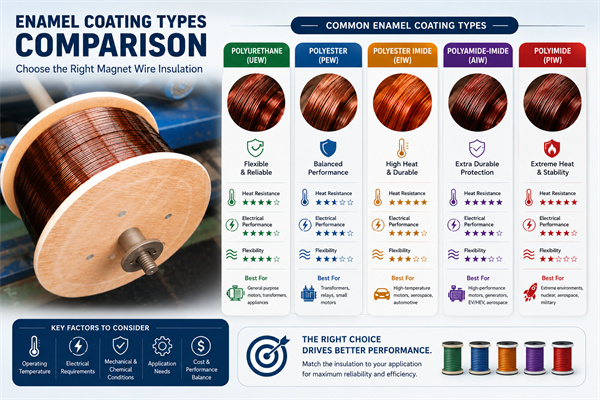
Overview of Safety Insulation Performance of enamel wire
The safety insulation performance of magnet wire is a comprehensive reflection of the enamel type, enamel grade, conductor diameter, thermal class, and insulation system, determining the magnet wire’s resistance to failure under abnormal operating conditions.
Core Safety Performance Dimensions of Magnet Wire:
Electrical Insulation Safety:
- Breakdown Voltage: The maximum voltage the insulation film can withstand
- Dielectric Strength: Breakdown voltage per unit thickness
- Dissipation Factor (tan δ): A high-frequency dielectric loss indicator
- Dielectric Constant: Influences capacitive coupling and electric field distribution
- Volume Resistivity: ≥10¹²–10¹⁶ Ω·m
- Surface Resistivity: ≥10¹¹–10¹⁵ Ω
- Withstand Voltage: The ability to endure prolonged application of voltage
Thermal Safety:
- Continuous Operating Temperature: temperature for 20,000-hour life
- Short-term Peak Temperature: short-time overload temperature
- Cut-Through Temperature: enamel softening and penetration temperature
- Heat Shock Temperature: winding crack-free temperature
- Thermal Aging Life: Temperature Index (TI) evaluation
- Montsinger’s Rule: life halves for every 10°C increase
Mechanical Safety:
- Elongation: Extension at break under tensile loading
- Tensile Strength: Resistance to tensile fracture
- Mandrel Wrap Test: Crack-free winding around a mandrel
- Repeated Bending: Resistance to bending fatigue
- Abrasion Resistance: Resistance to scratching and abrasion
- Springback: Recovery after bending
Chemical Safety:
- Oil resistance: transformer oil, lubricating oil
- Solvent resistance: alcohols, ketones, esters
- Moisture resistance: performance retention under humid and hot conditions
- Acid/alkali resistance: chemical environment stability
- Impregnating varnish compatibility: compatibility with insulating varnish
Environmental Safety:
- Corona Resistance: Resistance to partial discharge
- Radiation Resistance: Resistance to ultraviolet (UV) and gamma (γ) radiation
- Ozone Resistance: Resistance to ozone aging
- Thermal Cycling: No cracking under repeated thermal cycling
Fire Safety:
- Flame Rating: UL 94 V-0/V-1/V-2
- Smoke Density: ASTM E662 / ISO 5659-2
- Toxic Gas Emission: NES 713 / SMP 800-C
- Oxygen Index (LOI): ≥21% self-extinguishing
- Ignition Temperature: ≥400–600 °C
Failure Mode Safety:
- Gradual Failure: Slow aging
- Catastrophic Failure: Instantaneous breakdown
- Failure Predictability: Whether failure can be warned in advance
- Failure Severity: Safety risk level
Overview of Safety Characteristics of Film Types
Comparison of Mainstream Enamel Types and Their Safety Characteristics:
| Enamel Type | Full Name | Thermal Class | Solderable Without Stripping | Primary Safety Advantages | Primary Safety Limitations |
|---|---|---|---|---|---|
| PVF | Polyvinyl Formal | 105°C | No | Uniform, flexible enamel film | Poor solvent resistance, low thermal class |
| PEW | Polyester | 130/155/180°C | No | Balanced overall performance | Not suitable for high-frequency applications, not solderable without stripping |
| UEW | Polyurethane | 130/155/180°C | Yes | Solderable without stripping, low dielectric loss | Poor chemical resistance, moderate mechanical strength |
| EIW | Polyester-imide | 180°C | No | High heat resistance, high mechanical strength | Not solderable without stripping |
| PEI | Modified polyester-imide | 200°C | No | Excellent high-temperature resistance, thermal shock resistance | Not solderable without stripping |
| AIW | Polyamide-imide | 220/240°C | No | Exceptional heat resistance, chemical resistance | Not solderable without stripping, high cost |
| PI | Polyimide | 240°C | No | Highest thermal class, radiation resistance | Not solderable without stripping, highest cost |
| Dual Coating | PEW/PEI + AIW/PI | 180–240°C | No | Excellent comprehensive performance | Not solderable without stripping, complex manufacturing process |
Engineering significance of enamel coating safety class:
- Solderability: Affects subsequent joining processes; UEW is the only solderable enamel coating.
- Thermal Class: Affects enamel coating service life and maximum operating temperature.
- Chemical Resistance: Affects impregnating resin selection and suitability for harsh environments.
- Softening Breakdown: Affects safety margin under short-circuit or overload conditions.
- Corona Resistance: Affects safety in high-voltage, high-frequency applications.
Safety Performance of PVF (Polyvinyl Formal) Film
PVF is the oldest type of magnet wire enamel coating, corresponding to NEMA MW 15-C (round wire) and MW 18-C (rectangular wire), with a thermal class of 105 °C.
PVF film safety characteristics:
Chemical Structure:
- Polyvinyl Formal (Formvar)
- Polyvinyl Butyral
- Typically blended with phenolic resin
- Uniform enamel film with excellent adhesion
Electrical Safety:
- Breakdown voltage: 1500–3000 V typical for Grade 1–3
- Dielectric strength: 10–30 kV/mm
- Dielectric constant: approx. 3.5 at 1 kHz
- Dissipation factor (tan δ): approx. 0.020 at 1 kHz
- Volume resistivity: ≥10¹³ Ω·m
- Applicable voltage: standard household appliances, low-voltage motors
Thermal Safety:
- Long-term operating temperature: 105°C (Class A)
- Thermal shock temperature: 125–140°C
- Softening breakdown temperature: ≥200°C
- Thermal aging life: 20,000 hours
- Temperature index (TI): 105
Mechanical Safety:
- Elongation: ≥20–30% (depending on wire diameter)
- Tensile strength: 220–280 MPa
- Winding test: No cracking at 1×D
- Abrasion resistance: ≥2.0 N
- Springback: Low (soft temper)
Chemical Safety:
- Oil resistance: Good (transformer oil, mineral oil)
- Alcohol resistance: Poor (dissolved by alcohols)
- Ketone resistance: Poor (dissolved by ketones)
- Ester resistance: Moderate
- Impregnating resin compatibility: Good (avoid strong solvent-based resins)
Environmental Safety:
- Corona resistance: Fair
- Radiation resistance: Poor
- Ozone resistance: Fair
- Suitable environments: Dry indoor, oil-immersed
Fire Safety:
- UL 94: HB (lowest flame retardancy)
- Smoke density: medium
- Toxic gas emission: low
- Oxygen index: ≤22%
Failure mode:
- Primary failure modes: thermal aging, solvent attack
- Failure characteristics: enamel brittleness, cracking, blistering
- Safety margin: low
PVF Application Scenarios:
- Household appliances: electric fans, air conditioners, washing machines
- Small transformers: control transformers, low-voltage transformers
- Oil-immersed transformers
- Cost-sensitive applications
- Not suitable for: high-frequency, high-temperature, high-reliability, or fire-sensitive applications
Safety Performance of PEW (Polyester) Film
PEW is the most widely used enamel type for magnet wire, corresponding to NEMA MW 35-C (round wire) and MW 36-C (rectangular wire), with thermal classes of 130/155/180 °C.
PEW enamel coating safety characteristics:
Chemical Structure:
- Polyethylene terephthalate (PET)
- Polybutylene terephthalate (PBT)
- Modified polyester
- Smooth enamel film with medium mechanical strength
Electrical Safety:
– Breakdown voltage: 1700–3400 V typical for Grade 1–3
– Dielectric strength: 15–35 kV/mm
– Dielectric constant: approx. 3.2 at 1 kHz
– Dissipation factor (tan δ): approx. 0.015 at 1 kHz
– Volume resistivity: ≥10¹⁴ Ω·m
– Applicable voltage range: general-purpose motors and transformers
Thermal Safety:
- Continuous operating temperature: 130/155/180 °C (Class B/F/H)
- Thermal shock temperature: 155/175/200 °C
- Softening breakdown temperature: ≥230 °C
- Thermal aging life: 20,000 hours
- Temperature index (TI): 130/155/180
- Montzing rule: Life halves for every 10 °C increase
Mechanical Safety:
- Elongation: ≥20–30% (depending on wire diameter)
- Tensile strength: 220–300 MPa
- Wrap test: No cracking at 1×D
- Abrasion resistance: ≥3.0 N
- Springback: Medium
Chemical Safety:
- Oil resistance: Good
- Alcohol resistance: Moderate
- Ketone resistance: Poor
- Ester resistance: Moderate
- Compatibility with impregnating resins: Good
Environmental Safety:
- Corona resistance: Medium
- Radiation resistance: Poor
- Ozone resistance: Medium
- Application environment: General-purpose
Fire Safety:
- UL 94: HB to V-2
- Smoke density: Medium to high
- Toxic gas emission: Low
- Oxygen index: ≤22%
Failure mode:
- Primary failure modes: thermal aging, overload, moisture
- Failure characteristics: brittle enamel film, dielectric breakdown
- Safety margin: medium
PEW Application Scenarios:
– General-purpose motors: household motors, small motors
– General-purpose transformers: control transformers, power transformers
– Standard electrical appliances: electric fans, air conditioners, washing machines, refrigerators
– Industrial motors: standard industrial motors
– Not suitable for: direct soldering processes, high-frequency applications, high-temperature environments, high-reliability requirements, fire-sensitive applications
Safety Performance of UEW (Polyurethane) Film
UEW is the only enamel type with solderability without prior stripping, corresponding to NEMA MW 79-C (round wire) and MW 80-C (rectangular wire), thermal classes 130/155/180°C.
UEW enamel coating safety characteristics:
Chemical Structure:
- Polyurethane resin
- Isocyanate (NCO) reactive enamel coating
- Thin enamel coating, solderable without pre-stripping
Electrical Safety:
- Breakdown voltage: 1500–3000 V typical for Grade 1–3
- Dielectric strength: 12–30 kV/mm
- Dielectric constant: ≈3.0 at 1 kHz
- Dissipation factor (tan δ): ≈0.010 (minimum) at 1 kHz
- Volume resistivity: ≥10¹⁴ Ω·m
- High-frequency performance: Optimal (minimum loss)
- Applicable voltage range: Low to medium voltage
Thermal Safety:
- Continuous operating temperature: 130/155/180 °C (Class B/F/H)
- Thermal shock temperature: 155/175/200 °C
- Softening breakdown temperature: ≥220 °C (slightly lower than PEW)
- Thermal aging life: 20,000 hours
- Temperature index (TI): 130/155/180
- Solderability temperature: 380 °C for 3 seconds immersion
Mechanical Safety:
- Elongation: ≥15–25% (slightly lower than PEW)
- Tensile strength: 200–260 MPa (slightly lower than PEW)
- Winding test: No cracking at 2×D
- Abrasion resistance: ≥1.5 N (slightly lower than PEW)
- Resilience: Low
- Direct-solder adhesion: Good
Chemical Safety:
- Oil resistance: Medium
- Alcohol resistance: Poor (alcohol-soluble)
- Ketone resistance: Poor
- Ester resistance: Medium
- Compatibility with impregnating resins: Requires careful selection (some resins cause dissolution)
Environmental Safety:
- Corona resistance: medium
- Radiation resistance: poor
- Ozone resistance: medium
- Service environment: dry indoor
Fire Safety:
- UL 94: HB to V-2
- Smoke density: Medium
- Toxic gas emission: Low-toxicity isocyanate-containing
- Oxygen index: ≤22%
- Solderability smoke: Trace amounts of isocyanate
Failure mode:
- Primary failure modes: overload, thermal aging, solvent attack
- Failure characteristics: enamel softening, dielectric breakdown
- Direct soldering failure: false solder joint, cold solder joint
- Safety margin: medium (direct soldering process is critical)
UEW Application Scenarios:
- Small relays: telecommunications relays, automotive relays
- SMD inductors: high-frequency inductors, power inductors
- High-frequency transformers: switch-mode power supply (SMPS) transformers, RF transformers
- Winding termination: windings requiring direct soldering
- Automated winding: high-speed winding applications
- Not suitable for: high-temperature (>180°C), high-reliability, fire-sensitive applications
Safety Performance of EIW (Polyesterimide) Film
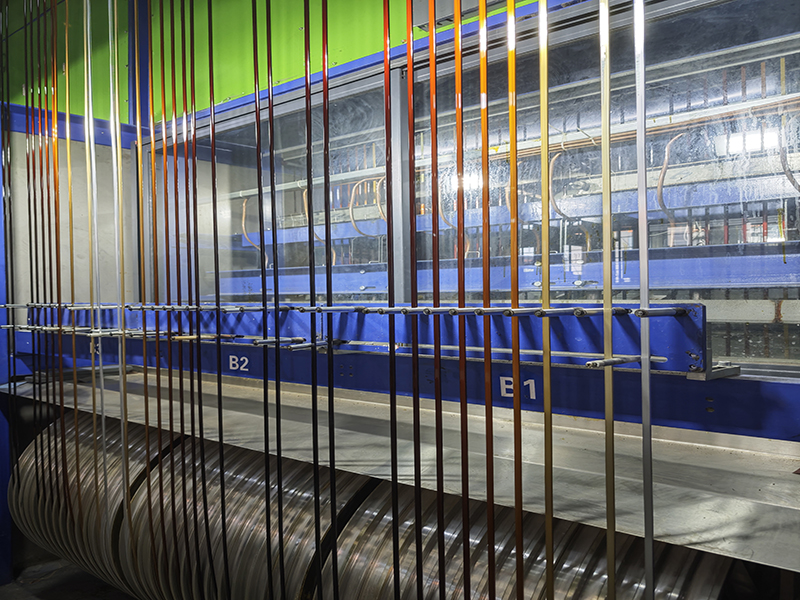
EIW is a standard high-temperature enamel coating, corresponding to NEMA MW 76-C (round wire) and MW 77-C (rectangular wire), thermal class 180°C.
EIW enamel coating safety characteristics:
Chemical structure:
- Polyesterimide resin
- Polyester + imide modification
- High mechanical strength of the enamel film
Electrical Safety:
- Breakdown voltage: 2300–5000 V typical for Grade 1–3
- Dielectric strength: 18–40 kV/mm
- Dielectric constant: approx. 3.5 at 1 kHz
- Dissipation factor (tan δ): approx. 0.020 at 1 kHz
- Volume resistivity: ≥10¹⁴ Ω·m
- Applicable voltage rating: medium- and high-voltage motors
Thermal Safety:
- Continuous operating temperature: 180 °C (Class H)
- Thermal shock temperature: 200 °C
- Softening breakdown temperature: ≥250 °C
- Thermal aging life: 20,000 hours
- Temperature Index (TI): 180
- One thermal class higher than PEW
Mechanical Safety:
- Elongation: ≥20–30% (depending on wire diameter)
- Tensile strength: 240–320 MPa
- Wrap test: Crack-free at 1×D
- Abrasion resistance: ≥4.0 N
- Springback: Medium
- Mechanical strength: Superior to PEW
Chemical Safety:
- Oil resistance: Good
- Alcohol resistance: Moderate
- Ketone resistance: Poor
- Ester resistance: Moderate
- Compatibility with impregnating resins: Good
Environmental Safety:
- Corona resistance: Medium
- Radiation resistance: Medium
- Ozone resistance: Medium
- Service environment: Standard high-temperature environment
Fire Safety:
- UL 94: HB to V-2
- Smoke density: Medium
- Toxic gas emission: Low
- Oxygen index: ≤23%
Failure modes:
- Primary failure modes: long-term thermal aging, overload
- Failure characteristics: brittle enamel coating, dielectric breakdown
- Safety margin: good
EIW Application Scenarios:
- High-temperature motors: Class H insulated motors
- Traction motors: Industrial traction motors
- Industrial transformers: High-temperature transformers
- Household appliances: Premium household appliances (high insulation class)
- Not suitable for: Direct soldering process, 240°C operating temperature
Safety Performance of PEI (Modified Polyesterimide) Film
PEI is a 200 °C insulation system, corresponding to NEMA MW 82-C (round wire) and MW 83-C (rectangular wire), thermal class 200 °C.
PEI enamel safety characteristics:
Chemical Structure:
– Modified polyesterimide
– Further enhanced temperature resistance compared to EIW
– Excellent comprehensive enamel film properties
Electrical Safety:
– Breakdown voltage: 2700–5500 V typical for Grade 1–3
– Dielectric strength: 20–45 kV/mm
– Dielectric constant: approx. 3.4 at 1 kHz
– Dissipation factor (tan δ): approx. 0.018 at 1 kHz
– Volume resistivity: ≥10¹⁴ Ω·m
– Applicable voltage: high-voltage motors
Thermal Safety:
- Continuous operating temperature: 200 °C (Class N)
- Thermal shock temperature: 220 °C
- Softening breakdown temperature: ≥270 °C
- Thermal aging life: 20,000 hours
- Temperature index (TI): 200
Mechanical Safety:
- Elongation: ≥20–30% (depending on diameter)
- Tensile strength: 240–320 MPa
- Wrap test: No cracking at 1×D
- Abrasion resistance: ≥4.5 N
- Springback: Medium
Chemical Safety:
- Oil resistance: Good
- Alcohol resistance: Moderate
- Ketone resistance: Moderate
- Ester resistance: Moderate
- Compatibility with impregnating resins: Good
Environmental Safety:
- Corona resistance: Good
- Radiation resistance: Medium
- Ozone resistance: Medium
- Suitable environment: High-temperature environment
Fire Safety:
- UL 94: V-2 to V-1
- Smoke density: Medium
- Toxic gas emission: Low
- Oxygen index: 24–26%
Failure mode:
- Primary failure modes: long-term thermal aging, overload
- Failure characteristics: enamel brittleness, dielectric breakdown
- Safety margin: good
PEI Application Scenarios:
- High-temperature motors: Class N insulation motors
- Traction motors: Railway traction motors
- Industrial transformers: Class N transformers
- Aerospace motors: Standard aerospace motors
- Not suitable for: Direct soldering process
Safety Performance of AIW (Polyamide-imide) Film
AIW is a 220 °C grade enamel coating, corresponding to NEMA MW 84-C (round wire) and MW 85-C (rectangular wire), with thermal classes of 220/240 °C.
AIW enamel coating safety characteristics:
Chemical Structure:
- Polyamide-imide resin
- Amide + imide functional groups
- Extremely heat-resistant and chemical-resistant enamel coating
Electrical Safety:
- Breakdown voltage: 3000–6000 V typical for Grade 1–3
- Dielectric strength: 25–50 kV/mm
- Dielectric constant: approx. 3.6 at 1 kHz
- Dissipation factor (tan δ): approx. 0.020 at 1 kHz
- Volume resistivity: ≥10¹⁵ Ω·m (higher)
- Suitable for: high-voltage, high-frequency applications
Thermal Safety:
- Long-term operating temperature: 220/240 °C (Class R/240)
- Thermal shock temperature: 240/260 °C
- Softening breakdown: ≥330–350 °C (among the highest)
- Thermal aging life: 20,000–40,000 hours
- Temperature index (TI): 220/240
- Extreme heat resistance advantage
Mechanical Safety:
- Elongation: ≥20–30% (depending on wire diameter)
- Tensile strength: 260–340 MPa (higher available)
- Wrap test: Crack-free at 1×D
- Abrasion resistance: ≥5.0 N (maximum)
- Springback: Medium
- Mechanical strength: Very high
Chemical Safety:
- Oil resistance: Excellent
- Alcohol resistance: Good
- Ketone resistance: Good
- Ester resistance: Good
- Refrigerant resistance: Good (suitable for compressors)
- Compatibility with impregnating resins: Excellent
Environmental Safety:
- Corona resistance: Excellent
- Radiation resistance: Good
- Ozone resistance: Good
- Service environment: Extreme environments
Fire Safety:
- UL 94: V-1 to V-0 (highest rating)
- Smoke density: low
- Toxic gas emission: extremely low
- Oxygen index: ≥28% (high flame retardancy)
- Fire safety: excellent
Failure mode:
- Primary failure mode: Extremely long-term aging
- Failure characteristic: Enamel film embrittlement
- Safety margin: Excellent
AIW Application Scenarios:
- Extreme high-temperature motors: aerospace, aviation, nuclear industry
- Traction motors: high-speed railway traction
- High-voltage motors: high-voltage variable-frequency motors
- Fire-sensitive applications: metro systems, wind power generation
- Refrigeration compressors: refrigerant-resistant
- Not suitable for: direct soldering processes, cost-sensitive applications
Safety Performance of PI (Polyimide) Film
Polyimide (PI) is the highest thermal class enamel coating, corresponding to NEMA MW 24-C (round wire) and MW 25-C (rectangular wire), with a thermal class of 240 °C.
PI coating safety characteristics:
Chemical structure:
- Polyimide resin
- Imide ring structure
- Enamel coating exhibits extreme resistance to high temperature and radiation
Electrical Safety:
- Dielectric breakdown voltage: Grade 1–3 typical values 3500–7000 V (maximum)
- Dielectric strength: 30–60 kV/mm (maximum)
- Dielectric constant: approx. 3.2 at 1 kHz
- Dissipation factor (tan δ): approx. 0.010 at 1 kHz (very low)
- Volume resistivity: ≥10¹⁶ Ω·m (maximum)
- Applicable voltage range: extra-high voltage, high frequency
Thermal Safety:
- Continuous operating temperature: 240 °C (Class 240)
- Thermal shock temperature: 260 °C
- Softening breakdown: ≥ 400 °C (maximum)
- Thermal aging life: ≥ 40,000 hours (maximum)
- Temperature index (TI): 240
- Short-term peak temperature: 400 °C (short-term)
- Extreme temperature resistance advantage
Mechanical Safety:
- Elongation: ≥15–25% (slightly lower)
- Tensile strength: 240–320 MPa
- Winding test: crack-free at 2×D (slightly lower flexibility)
- Abrasion resistance: ≥4.0 N
- Elastic recovery: high
Chemical Safety:
- Oil resistance: Excellent
- Alcohol resistance: Excellent
- Ketone resistance: Good
- Ester resistance: Good
- Chemical resistance: Excellent
- Compatibility with impregnating resins: Good
Environmental Safety:
- Corona resistance: Excellent
- Radiation resistance: Excellent (γ-rays, electron beam)
- Ozone resistance: Excellent
- Operating environment: Extreme environments (nuclear, space)
Fire Safety:
- UL 94: V-0 (highest rating)
- Smoke density: extremely low
- Toxic gas emission: low
- Oxygen index: ≥35% (extremely high flame retardancy)
- Fire safety: excellent
Failure mode:
- Primary failure mode: Extremely long-term aging
- Failure characteristic: Enamel film embrittlement (slow)
- Safety margin: Excellent
PI Application Scenarios:
– Extreme high-temperature motors: aerospace, aviation, rocketry
– Nuclear industry: nuclear reactors, radiation environments
– Superconducting magnets: low-temperature superconductors (LTS), high-temperature superconductors (HTS)
– High-frequency motors: variable-frequency traction
– Not suitable for: direct soldering processes, cost-sensitive applications
Safety Performance of Dual-Coating Film
Dual coating is the enamel film type offering the best overall performance, with common combinations including PEW+AIW, PEI+AIW, and PEI+PI.
Dual-coating enamel film safety characteristics:
Chemical Structure:
- Base layer: PEW / PEI (primary insulation layer, providing basic dielectric strength)
- Top layer: AIW / PI (enhancement layer, providing extreme heat resistance and chemical resistance)
- Complementary dual-layer structure
Electrical Safety:
- Breakdown voltage: 3500–6500 V typical for Grade 1–3
- Dielectric strength: 25–50 kV/mm
- Dielectric constant: approx. 3.4 at 1 kHz
- Dissipation factor (tan δ): approx. 0.015 at 1 kHz
- Volume resistivity: ≥10¹⁵ Ω·m
Thermal Safety:
- Continuous operating temperature: 180–240 °C
- Thermal shock temperature: 200–260 °C
- Softening breakdown temperature: ≥280–350 °C
- Thermal aging life: ≥30,000 hours
Mechanical Safety:
- Elongation: ≥20–30%
- Tensile strength: 240–320 MPa
- Winding test: No cracking at 1×D
- Abrasion resistance: ≥5.0 N
- Mechanical strength: High
Chemical Safety:
- Oil resistance: Excellent
- Chemical resistance: Excellent
- Compatibility with impregnating resins: Excellent
Environmental Safety:
- Corona resistance: Excellent
- Radiation resistance: Good
- Ozone resistance: Good
Fire Safety:
- UL 94: V-1 to V-0
- Smoke density: Low
- Fire safety: Excellent
Failure modes:
- Primary failure mode: Extremely long-term aging
- Failure characteristic: Gradual embrittlement
- Safety margin: Optimal
Dual-coating application scenarios:
- Extreme-duty motors: aerospace, aviation, traction
- High-reliability applications: nuclear power, medical
- High-voltage variable-frequency motors
- High fire-safety environments: metro systems, wind power
- Not suitable for: direct soldering processes, cost-sensitive applications
Safety Comparison of Breakdown Voltage
Breakdown voltage is the most critical parameter for the electrical safety of magnet wire, determining its ability to withstand voltage surges.
Breakdown Voltage Test Standard:
- IEC 60851-5 (International)
- ASTM D1676 (USA)
- GB/T 4074.5 (China)
- Test method: 50/60 Hz power frequency, voltage ramp rate of 100 V/s
- Specimens: Single wire, twisted pair, wound
Breakdown Voltage vs. Enamel Type (Typical Grade 2 Round Copper Wire AWG 22 / 0.644 mm):
| Enamel Type | Minimum Breakdown Voltage | Continuous Breakdown Voltage | Safety Margin Assessment |
|---|---|---|---|
| PVF | 2700 V | 8000 V | Low |
| PEW | 2700 V | 12000 V | Medium |
| UEW | 2400 V | 9000 V | Medium |
| EIW | 3500 V | 14000 V | Good |
| PEI | 4000 V | 16000 V | Good |
| AIW | 4500 V | 18000 V | High |
| PI | 5000 V | 20000 V | Very High |
| Dual Coating | 5000 V | 20000 V | Very High |
Breakdown Voltage vs. Insulation Class (typical AWG 22 PEW round copper wire):
| Grade | Minimum Breakdown Voltage | Application Scenario |
|---|---|---|
| Grade 1 (Thin) | 1700 V | Low-voltage, high slot-fill ratio |
| Grade 2 (Medium) | 2700 V | General-purpose |
| Grade 3 (Thick) | 3400 V | High-voltage, high-reliability |
Breakdown Voltage vs. Conductor Diameter (PEW Grade 2 Round Copper Wire):
| AWG | Diameter (mm) | Dielectric Withstand Voltage |
|---|---|---|
| AWG 30 | 0.255 | 1700 V |
| AWG 24 | 0.511 | 2400 V |
| AWG 22 | 0.643 | 2700 V |
| AWG 18 | 1.024 | 3500 V |
| AWG 14 | 1.628 | 4500 V |
| AWG 8 | 3.264 | 6000 V |
Recommended safety margin:
- Breakdown voltage / operating voltage ≥ 3–5 times (standard recommendation)
- Breakdown voltage / operating voltage ≥ 5–10 times (recommended for high-voltage and high-reliability applications)
- Short-circuit voltage consideration: account for 2–3 times short-circuit overvoltage
Safety Comparison of Dielectric Loss
Dielectric loss (tan δ) is a critical parameter for magnet wire used in high-frequency applications, determining heat generation and efficiency of high-frequency motors, transformers, and inductors during high-frequency operation.
Dielectric loss versus enamel type (tested at 1 kHz):
| Enamel Type | Dielectric Loss Tangent | High-Frequency Safety Evaluation |
|---|---|---|
| UEW | 0.010 | Optimal |
| PI | 0.010 | Optimal |
| Double-Coated | 0.015 | Good |
| PEI | 0.018 | Good |
| PVF | 0.020 | Fair |
| PEW | 0.015 | Good |
| EIW | 0.020 | Fair |
| AIW | 0.020 | Fair |
Selection of Magnet Wire for High-Frequency Motors:
- Below 1 kHz: PEW, EIW, and AIW are all suitable
- 1–100 kHz: UEW, PI, and double-coated wires are preferred
- Above 100 kHz: PI and Litz wire (braided enameled wire)
Safety Comparison of Cut-Through Temperature
Softening breakdown temperature is a critical parameter for magnet wire’s resistance to short circuits, overloads, and overheating, and determines the maximum temperature at which the enamel coating retains integrity under mechanical stress.
Softening Breakdown and Enamel Type:
| Enamel Type | Softening Breakdown Temperature | Short-Circuit Safety Rating |
|---|---|---|
| PVF | ≥200°C | Low |
| PEW | ≥230°C | Medium |
| UEW | ≥220°C | Medium |
| EIW | ≥250°C | Good |
| PEI | ≥270°C | Good |
| AIW | ≥330–350°C | Very High |
| PI | ≥400°C | Highest |
| Dual-Coated | ≥280–350°C | High |
Softening-breakdown test standard:
- IEC 60851-6 (International)
- Test method: Applying pressure to crossed enameled wires on a heated plate
- Temperature ramp rate: 5 °C/min
- Failure criterion: Insulation puncture resulting in short circuit
Recommended short-circuit safety margin:
- Softening breakdown temperature ≥ operating temperature + 150 °C (standard)
- Softening breakdown temperature ≥ short-circuit peak temperature (worst-case condition)
Safety Comparison of Heat Shock
Thermal shock temperature is a critical parameter indicating the enameled wire’s resistance to abrupt temperature changes, determining the reliability of the enamel coating under thermal cycling conditions.
Thermal Shock and Enamel Type:
| Enamel Type | Continuous Operating Temperature | Thermal Shock Temperature | Shock Margin |
|---|---|---|---|
| PVF | 105°C | 125°C | 20°C |
| PEW | 130°C | 155°C | 25°C |
| UEW | 130°C | 155°C | 25°C |
| EIW | 180°C | 200°C | 20°C |
| PEI | 200°C | 220°C | 20°C |
| AIW | 220°C | 240°C | 20°C |
| PI | 240°C | 260°C | 20°C |
| Dual Coating | 180–240°C | 200–260°C | 20°C |
Thermal shock test standard:
- IEC 60851-6 (International)
- Test method: Winding test of enameled wire at specified temperature for 1 hour
- Sample diameter: As specified in the standard
- Failure criterion: Cracking of the enamel coating
Thermal shock safety implications:
- The thermal shock temperature represents the maximum capability of the enamel coating to withstand abrupt temperature changes.
- During motor start-up/shut-down and temperature cycling, the enamel coating is subjected to thermal stress.
- A higher thermal shock temperature indicates better safety for the motor under temperature cycling conditions.
Comparison of Chemical Safety
Magnet wire comes into contact with impregnating resins, insulating oils, insulating varnishes, cooling media, and lubricants in motors or transformers; chemical compatibility is critical for long-term safety.
Chemical Safety Comparison:
| Enamel Type | Oil Resistance | Alcohol Resistance | Ketone Resistance | Ester Resistance | Impregnating Resin Compatibility |
|---|---|---|---|---|---|
| PVF | Good | Poor | Poor | Medium | Good |
| PEW | Good | Medium | Poor | Medium | Good |
| UEW | Medium | Poor | Poor | Medium | Use with Caution |
| EIW | Good | Medium | Poor | Medium | Good |
| PEI | Good | Medium | Medium | Medium | Good |
| AIW | Excellent | Good | Good | Good | Excellent |
| PI | Excellent | Excellent | Good | Good | Good |
| Dual Coating | Excellent | Good | Good | Good | Excellent |
Chemical Safety Critical Points:
- UEW compatibility with impregnating resins requires caution (some resins dissolve UEW).
- AIW/PI/dual-coated enamels are the chemically most stable insulation films.
- Improper selection of impregnating resins may cause enamel dissolution, blistering, and reduced adhesion.
- AIW or PI must be used in applications involving refrigerant exposure.
Comparison of Fire Safety
Fire safety is a critical safety criterion for applications such as metro systems, wind power generation, aerospace, nuclear power, and household appliances.
Fire Safety Comparison:
| Enamel Type | UL 94 Flame Rating | Smoke Density | Toxic Gas Emission | Limiting Oxygen Index (LOI) |
|---|---|---|---|---|
| PVF | HB | Medium | Low | ≤22% |
| PEW | HB-V-2 | Medium-High | Low | ≤22% |
| UEW | HB-V-2 | Medium | Low | ≤22% |
| EIW | HB-V-2 | Medium | Low | 22–24% |
| PEI | V-2–V-1 | Medium | Low | 24–26% |
| AIW | V-1–V-0 | Low | Very Low | ≥28% |
| PI | V-0 | Very Low | Low | ≥35% |
| Dual-Coated | V-1–V-0 | Low | Low | ≥28% |
Fire Safety Critical Points:
- AIW, PI, and dual-coated magnet wires are the preferred choices for applications requiring high fire safety.
- UL 94 V-0 is the highest flame-retardant rating (self-extinguishing time ≤10 seconds).
- LOI ≥28% represents the high flame-retardancy threshold.
- AIW/PI/dual-coated magnet wires are prioritized for metro, wind power, and aerospace applications.
- Smoke density and toxic gas emission are especially critical in confined environments (e.g., metros, tunnels).
Comparison of Environmental Safety
Safety of magnet wire under special environmental conditions (corona, radiation, ozone, thermal cycling).
Corona Resistance:
- AIW: Excellent (long corona resistance life)
- PI: Excellent
- Dual-coated: Excellent
- PEW: Medium
- UEW: Medium
- EIW: Medium
- PEI: Good
- PVF: Fair
Radiation Resistance:
- PI: Excellent (aerospace, nuclear industry)
- AIW: Good
- Dual coating: Good
- PEI: Moderate
- EIW: Moderate
- PEW: Poor
- UEW: Poor
- PVF: Poor
Ozone Resistance:
- PI: Excellent
- AIW: Excellent
- Dual coating: Excellent
- PEI: Good
- EIW: Fair
- PEW: Fair
- UEW: Fair
- PVF: Poor
Thermal Cycling Resistance:
- Depends on enamel flexibility
- PI: Slightly brittle (risk of cracking during thermal cycling)
- UEW: Good (flexible)
- PEW: Good
- EIW: Good
- AIW: Good
- Dual coating: Best (complementary)
Safety Comparison of Film Thickness Grade
Film thickness grade (Grade 1/2/3) directly affects breakdown voltage, safety margin, and winding slot fill factor.
Enamel Coating Thickness Class and Safety Margin:
| Grade | Film Thickness | Dielectric Breakdown Voltage | Safety Margin | Slot Fill Factor Impact |
|---|---|---|---|---|
| Grade 1 (Thin) | Thin | Low | Low | High (Space-Saving) |
| Grade 2 (Medium) | Medium | Medium | Medium | Medium |
| Grade 3 (Thick) | Thick | High | High | Low (Space-Consuming) |
Safety principle for selecting enamel coating thickness grades:
- High-voltage motors (≥600 V): select Grade 3
- Medium-voltage motors (220–600 V): select Grade 2
- Low-voltage motors (<220 V): select Grade 1 or Grade 2
- High-frequency motors: consider skin effect; Grade 1 is preferred
- High slot-fill applications: Grade 1
- Applications requiring high safety margin: Grade 3
Safety Recommendations for Different Application Scenarios
Scenario 1: Household Electric Fan Motor
Requirements:
- Operating temperature: 105–130 °C (Class A/B)
- Voltage: 220 V AC
- Frequency: 50 Hz
- Service life: 10 years
- Cost-sensitive
- Fire safety: UL 94 HB compliant
Safety Recommendations:
- Insulation type: PEW (optimal overall cost)
- Insulation grade: Grade 2
- Dielectric breakdown voltage: ≥2700 V
- Thermal class: 130 °C (Class B)
- Rationale: Balanced performance, low cost, and sufficient properties
Scenario 2: Inverter Air-Conditioning Compressor Motor
Requirement:
- Operating temperature: 130–155 °C
- Voltage: 220 V AC
- Frequency: 50–1000 Hz (variable frequency)
- Service life: 15 years
- Refrigerant resistance
- Medium fire safety
Safety Recommendations:
- Enamel type: PEW or UEW + PEW composite
- Enamel grade: Grade 2–3
- Dielectric breakdown voltage: ≥3500 V
- Thermal class: 155 °C (Class F)
- Rationale: Variable-frequency high-frequency applications; refrigerant resistance required; PEW for cost-effectiveness or UEW for high-frequency performance
Scenario 3: Industrial Traction Motors
Requirement:
- Operating temperature: 180–220 °C
- Voltage: 3000 V AC
- Frequency: Variable frequency (50–1000 Hz)
- Service life: 30 years
- High reliability
- Fire safety: UL 94 V-0
Safety Recommendations:
- Insulation type: AIW or dual coating
- Insulation grade: Grade 2–3
- Dielectric breakdown voltage: ≥10,000 V
- Thermal class: 220 °C (Class R)
- Rationale: High voltage, high reliability, high fire safety, long service life
Scenario 4: Aerospace High-Frequency Motors
Requirement:
- Operating temperature: 200–240 °C
- Voltage: 1000 V AC
- Frequency: 10–50 kHz
- Service life: 20 years
- Extreme environments (high altitude, low temperature)
- Highest fire safety rating
Safety Recommendations:
- Insulation system: Polyimide (PI) or dual coating (PEI + PI)
- Insulation thickness grade: Grade 2–3
- Dielectric breakdown voltage: ≥5000 V
- Thermal class: 240 °C (Class 240)
- Rationale: Extreme temperature, high frequency, radiation, low temperature, and long service life
Scenario 5: Nuclear Power Primary Pump Motor
Requirement:
- Operating temperature: 200°C
- Voltage: 6000 V AC
- Frequency: 50 Hz
- Service life: 60 years
- Radiation-resistant and earthquake-resistant
- Highest safety class
Safety Recommendations:
- Insulation type: Polyimide (PI)
- Insulation grade: Grade 3
- Dielectric breakdown voltage: ≥15,000 V
- Thermal class: 240 °C (Class 240)
- Rationale: Nuclear-grade service life, extreme radiation resistance, ultra-high safety margin
Scenario 6: Small Relay Winding
Requirement:
- Operating temperature: 130°C
- Voltage: 12–220 V
- Frequency: DC or low frequency
- Service life: 10 years
- Automated winding
- Direct solder connection
Safety Recommendations:
- Enamel type: UEW
- Enamel grade: Grade 1–2
- Dielectric breakdown voltage: ≥2400 V
- Thermal class: 130–155 °C (Class B/F)
- Rationale: Direct soldering process, high-speed winding, low cost
Scenario 7: High-Frequency Transformer for Switch-Mode Power Supplies
Requirement:
– Operating temperature: 130–155 °C
– Voltage: ≤ 1000 V
– Frequency: 50–500 kHz
– Service life: 10 years
– Low loss
Safety Recommendations:
- Enamel type: UEW or PI
- Enamel grade: Grade 1–2
- Dielectric breakdown voltage: ≥3000 V
- Thermal class: 155–180 °C
- Rationale: High-frequency low-loss (UEW) or extreme temperature resistance (PI)
Scenario 8: Metro Traction Motor
Requirements:
- Operating temperature: 200–220 °C
- Voltage: 1500–3000 V DC
- Frequency: Variable frequency
- Service life: 30 years
- High fire safety (subway applications)
- Vibration resistance
Safety Recommendations:
- Insulation type: AIW or dual coating
- Insulation grade: Grade 2–3
- Dielectric breakdown voltage: ≥8,000 V
- Thermal class: 220 °C (Class R)
- Rationale: High fire safety, high voltage capability, high reliability, and long service life
Summary Table of Safety Coating Comparison
Comprehensive Safety Performance Score (out of 10)
| Enamel Type | Electrical | Thermal | Mechanical | Chemical | Environmental | Fire | Overall |
|---|---|---|---|---|---|---|---|
| PVF | 4 | 3 | 5 | 4 | 3 | 3 | 3.7 |
| PEW | 6 | 6 | 6 | 6 | 5 | 4 | 5.5 |
| UEW | 6 | 5 | 5 | 4 | 5 | 4 | 5.0 |
| EIW | 7 | 7 | 7 | 6 | 6 | 5 | 6.3 |
| PEI | 8 | 8 | 7 | 7 | 7 | 6 | 7.2 |
| AIW | 9 | 9 | 8 | 9 | 8 | 8 | 8.5 |
| PI | 10 | 10 | 7 | 10 | 9 | 9 | 9.2 |
| Dual Coating | 9 | 9 | 8 | 9 | 9 | 8 | 8.7 |
Safety-Based Selection Decision Tree
Decision 1: Operating Temperature
- ≤130°C: PEW, UEW
- 130–180°C: EIW
- 180–200°C: PEI
- 200–220°C: AIW
- ≥220°C: PI, dual coating
Decision 2: Is direct soldering required?
- Yes: UEW (solderable only)
- No: Other insulation coatings
Decision 3: Voltage Class
- ≤220 V: PEW, UEW (Grade 1–2)
- 220–1000 V: PEW, UEW, EIW (Grade 2–3)
- 1000–3000 V: EIW, PEI, AIW (Grade 2–3)
- ≥3000 V: AIW, PI, Dual-coated wire (Grade 2–3)
Decision 4: Frequency
- 50/60 Hz: All enamel coatings
- 1–100 kHz: UEW, Polyimide (PI), dual-coated wires
- ≥100 kHz: Polyimide (PI), Litz wire
Decision 5: Fire Safety
- Household appliances and general-purpose applications: PEW, UEW
- High-fire-risk applications: AIW, PI, dual coatings (UL 94 V-0)
Decision 6: Chemical Environment
- General-purpose: PEW, UEW
- Oil-resistant: PEW, AIW, PI
- Refrigerant-resistant: AIW, PI
- Radiation-resistant: PI
Decision 7: Cost Sensitivity
- High sensitivity: PEW, UEW
- Medium sensitivity: EIW, PEI
- Low sensitivity: AIW, PI, dual coating
Failure Mode and Safety Analysis
Failure modes and safety performance of magnet wire coatings under abnormal operating conditions.
Failure Mode Classification
Catastrophic Failure:
- Instantaneous dielectric breakdown of enamel coating
- Winding short circuit
- Consequences: motor burnout, fire
- Safety risk: extremely high
- Protection: multiple insulation layers, overload protection
Gradual Failure:
- Gradual aging and embrittlement of the insulation film
- Progressive reduction in dielectric breakdown voltage
- Consequence: Reduced motor service life
- Safety risk: Medium
- Mitigation measures: Periodic inspection and thermal protection
Failure Characteristics of Different Coatings
PVF failure:
- Primary causes: solvent attack, thermal aging
- Failure characteristics: whitening and embrittlement of the enamel coating, dielectric breakdown
- Time to failure: 5–10 years (at 105°C)
- Failure warning: detectable (electrical parameter changes)
- Safety risk: low
PEW failure:
- Primary causes: Thermal aging, overload
- Failure characteristics: Brittle enamel film, dielectric breakdown
- Time to failure: 15–20 years (130 °C)
- Failure warning: Detectable
- Safety risk: Medium
UEW failure:
- Primary causes: Overload, thermal aging, solvents
- Failure characteristics: Enamel softening, dielectric breakdown
- Time to failure: 10–15 years (130 °C)
- Failure warning: Detectable
- Solderability failure: False soldering, cold soldering
- Safety risk: Medium
EIW failure:
- Primary cause: Long-term thermal aging
- Failure characteristics: Embrittlement and dielectric breakdown of the enamel coating
- Time to failure: 20–25 years (at 180 °C)
- Failure warning: Detectable in advance
- Safety risk: Low
PEI failure:
- Primary cause: Long-term thermal aging
- Failure characteristics: Enamel film embrittlement and dielectric breakdown
- Failure time: 25–30 years (200 °C)
- Failure warning: Detectable
- Safety risk: Low
AIW failure:
- Primary cause: Extremely long-term aging
- Failure characteristic: Enamel film embrittlement (gradual)
- Time to failure: 30–40 years (at 220°C)
- Failure warning: Detectable
- Safety risk: High
PI failure:
- Primary cause: Extremely long-term aging
- Failure characteristic: Enamel coating embrittlement (extremely slow)
- Time to failure: ≥40 years (240°C)
- Failure warning: Predictable
- Safety risk: Extremely high
Dual-coating failure:
- Primary cause: Extremely long-term aging
- Failure characteristic: Gradual embrittlement
- Failure time: ≥30 years
- Failure warning: Predictable
- Safety risk: Optimal
Safety Monitoring Recommendations
Common methods for monitoring the condition of magnet wire:
- Insulation Resistance (IR) Test: Periodic measurement of insulation resistance
- Dielectric Loss (tan δ) Test: Monitoring of aging
- Partial Discharge (PD) Test: Monitoring of corona
- Dielectric Withstand Voltage Test: Sampling test
- Visual Inspection: Periodic inspection of enamel coating appearance
- Thermal Imaging: Monitoring of winding temperature
Safety Principles for Coating Selection
Core Safety Principles for Magnet Wire Selection:
Principle 1: Temperature Margin Principle
- Thermal class ≥ operating temperature + 15–25 °C
- Softening breakdown ≥ operating temperature + 100–150 °C
- Thermal shock ≥ operating temperature + 20–40 °C
Principle 2: Voltage Margin Principle
- Breakdown voltage ≥ 3–5 × operating voltage (standard)
- Breakdown voltage ≥ 5–10 × operating voltage (high reliability)
Principle 3: Frequency Matching Principle
- 50/60 Hz: All enamel coatings
- 1–100 kHz: UEW, Polyimide (PI), Dual-coated (low loss)
- ≥100 kHz: Polyimide (PI), Litz Wire (ultra-low loss)
Principle 4: Environmental Compatibility Principle
- Dry chamber: General-purpose enamel
- High humidity/moisture: AIW, PI, dual coating
- Oil-immersed: All enamels (PVF preferred)
- Refrigerants: AIW, PI (chemical-resistant)
- Radiation/ozone: PI (optimal)
Principle 5: Fire Safety Principle
- Household appliances: HB-V-2
- High-fire-risk applications (e.g., metro systems, wind power): V-0 (AIW, PI, dual coating)
- Low smoke density: PI, dual coating
- Low toxic gas emission: AIW, PI
Principle 6: Cost-Balancing Principle
- Cost-sensitive: PEW, UEW
- Performance-prioritized: AIW, PI, dual-coated
- Balanced: PEI, EIW
Principle 7: Process Compatibility Principle
- Direct soldering: UEW
- High-speed winding: UEW, PEW
- Compatibility with impregnating resins: All enamel types (UEW requires caution)
- Automated winding: All enamel types (UEW and PEW are preferred)
Coating Test Standards and Safety Verification
Core Safety Standards for Magnet Wire
Electrical Testing Standards:
- IEC 60851-5: Breakdown Voltage Test
- ASTM D1676: Magnetic Wire with Insulating Film Test
- GB/T 4074.5: Breakdown Voltage Test
- JIS C 3003: Electrical Insulation Test
Thermal Testing Standards:
- IEC 60851-6: Thermal shock and softening breakdown
- ASTM D2307: Thermal aging
- GB/T 4074.6: Thermal shock test
- IEC 60216: Electrical insulating materials—Electrical strength and thermal endurance
Mechanical Test Standards:
- IEC 60851-3: Elongation and springback
- IEC 60851-4: Chemical properties
- ASTM D1676: Mechanical properties
- GB/T 4074.3–4: Mechanical and chemical testing
Chemical Testing Standards:
- IEC 60851-4: Chemical resistance
- ASTM D1676: Chemical properties
- GB/T 4074.4: Chemical testing
Safety Certification Testing:
- UL 1446: Insulation System
- UL 94: Flammability Rating
- IEC 60317: Specifications for Enamelled Wires
- ISO 9001: Quality Management
- ISO 14001: Environmental Management
Safety Certification Process:
- Certificate of Conformance (CoC): 100% batch testing prior to shipment
- Third-party certification: UL, TÜV, CSA, etc.
- Sampling retest: Customer-conducted sampling retest
- Long-term aging test: Accelerated aging test
- Application validation: Simulation of actual operating conditions
Conclusion
Different magnet wire coatings—PVF, PEW, UEW, EIW, PEI, AIW, PI, and dual coatings—exhibit significant differences across the seven safety dimensions: electrical insulation safety, thermal safety, mechanical safety, chemical safety, environmental safety, fire safety, and failure modes, directly impacting the safe and reliable operation of magnet wire in electrical equipment such as motors, transformers, and relays.
Core Recommendations for Selecting Magnet Wire Safety Coatings:
- Temperature Rating: Thermal Class ≥ Operating Temperature + 15–25°C; PVF (105°C), PEW (130/155/180°C), UEW (130/155/180°C), EIW (180°C), PEI (200°C), AIW (220/240°C), PI (240°C), and Dual-Coated (180–240°C) progressively increase in thermal class.
- Voltage Rating: Dielectric Breakdown Voltage ≥ 3–5× Operating Voltage (standard) or 5–10× Operating Voltage (high-reliability); PI and Dual-Coated wires exhibit the highest dielectric breakdown voltage.
- Frequency Rating: For high-frequency applications (≥1 kHz), UEW, PI, and Dual-Coated wires are preferred due to low dielectric loss.
- Chemical Resistance: Oil resistance: PEW/AIW/PI; refrigerant resistance: AIW/PI; radiation resistance: PI.
- Fire Safety: For high-fire-safety applications (metro systems, wind power, aerospace, nuclear power), AIW, PI, and Dual-Coated wires (UL 94 V-0) are selected.
- Environmental Resistance: For extreme environments (radiation, ozone, low temperature), PI or Dual-Coated wires are selected.
- Process Compatibility: Direct soldering process requires UEW (the only enamel system compatible with direct soldering).
- Cost Consideration: Cost-sensitive applications select PEW or UEW; performance-critical applications select AIW, PI, or Dual-Coated wires.
Magnet wire safety engineers should systematically enhance their understanding of magnet wire coating safety through structured learning (international standards, coating types, parameter tables), case studies (coating selection for different motor types), and experimental verification (dielectric breakdown voltage, thermal shock, softening breakdown, chemical compatibility), thereby establishing a decision-making framework for safe magnet wire coating selection—providing core assurance for the high-quality manufacturing and safe, reliable operation of electrical equipment such as motors, transformers, and inductors.