

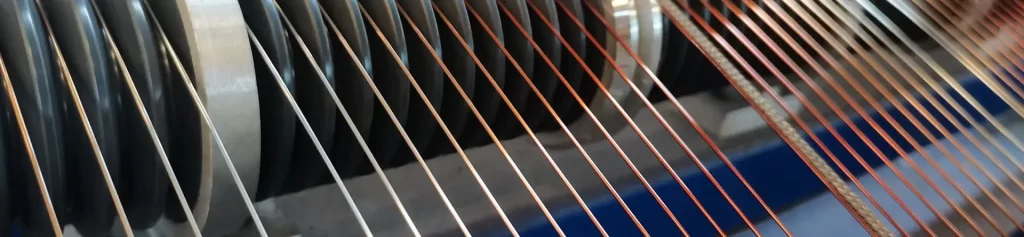
Industrial power equipment encompasses electrical apparatus used in critical sectors including industrial manufacturing, power transmission, energy conversion, metallurgy and chemical processing, mining and port operations, and railway transportation—serving as core infrastructure for industrial production. Paper covered wire (PCW) functions as the primary winding insulation material for key components of industrial power equipment—such as transformers, reactors, motors, generators, rectifiers, electric furnaces, electrical control cabinets, and switchgear. From conventional kraft paper to high-performance aromatic polyamide paper (Nomex T410), and extending to 220°C (Class C) high-temperature applications, paper-based insulation materials continue to play an irreplaceable role in industrial power equipment due to their exceptional dielectric strength, thermal class rating, short-circuit electromagnetic force resistance, partial discharge suppression capability, mechanical reinforcement effect, and chemical resistance. This document systematically addresses: fundamental classification and technical requirements of industrial power equipment; the critical role of PCW in such equipment; comparative analysis between industrial-grade and commercial-grade PCW; types and specifications of industrial-grade PCW; manufacturing processes and quality control; typical applications—including transformers, reactors, motors, generators, electrical control cabinets, switchgear, electric furnaces, induction heating systems, rectifiers, and uninterruptible power supply (UPS) units; key performance requirements and test methods; selection guidance; and future development trends.
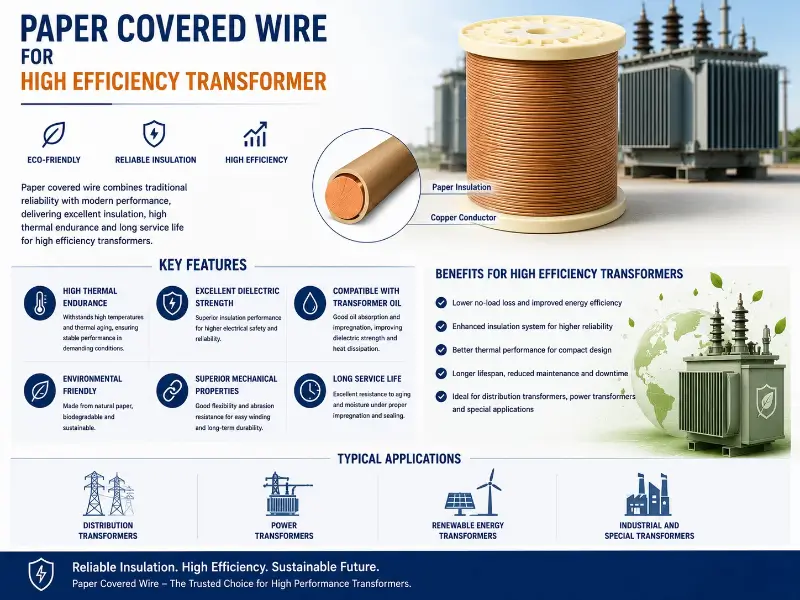
Basic Classification and Technical Requirements of Industrial Power Equipment
Industrial Power Equipment refers to the collective term for electrical equipment and systems used in industrial production processes for electric energy conversion, transmission, distribution, control, protection, and measurement; it constitutes the infrastructure and critical support for industrial production. Technical requirements for Industrial Power Equipment are significantly higher than those for residential power equipment (e.g., temperature, vibration, harmonics, overload, service life, reliability), and corresponding demands on the electrical, mechanical, thermal, and chemical properties of winding insulation materials are also markedly elevated.
Industrial power equipment classified by function:
- Transformers: Power transformers, distribution transformers, furnace transformers, rectifier transformers, traction transformers, isolation transformers, autotransformers, voltage regulators, reactors, and instrument transformers (CT/VT)
- Rotating machines: High-voltage motors (asynchronous/synchronous/wound-rotor/permanent-magnet), large generators (steam-turbine/hydro-turbine/diesel), and large motors (driving pumps/fans/compressors/rolling mills/grinding mills)
- Power electronic equipment: Rectifiers, inverters, variable-frequency drives (VFDs), choppers, reactive power compensation devices (SVG/SVC), and active power filters (APF)
- Switchgear: High-voltage switchgear (KYN28, KYN61), low-voltage distribution panels (GCK, MNS), ring-main units (RM6, SafeRing/SafePlus), and circuit breakers (VCB, VCC, ACB, MCCB)
- Industrial power supplies: UPS (uninterruptible power supply), EPS (emergency power supply), DC power supplies, variable-frequency power supplies, and voltage stabilizers
- Industrial heating equipment: Arc furnaces, medium-frequency induction furnaces, IGBT-based medium-frequency power supplies, vacuum furnaces, resistance furnaces, and welding machines
- Electrochemical applications: Electrolysis (aluminum/copper/zinc/chlor-alkali), electroplating, and electrolytic polishing
- Industrial control systems: PLC control systems, SCADA monitoring systems, and DCS distributed control systems
- Mining equipment: Mine-duty transformers, mine-duty motors, mine-duty variable-frequency drives, and explosion-proof switches
- Port and lifting equipment: Port transformers, crane variable-frequency drives, and shore power systems
- Marine equipment: Marine transformers, marine motors, and marine propulsion systems
- Railway traction systems: Traction transformers, traction motors, converters, and auxiliary power supplies
Regarding technical requirements for industrial power equipment, industrial-grade power equipment features the following core technical requirements:
Electrical performance requirements:
- High voltage rating: 0.4 kV–1000 kV (covering low voltage to ultra-high voltage)
- High current capacity: 100 A–100 kA (covering medium-small to ultra-large scale)
- High short-circuit withstand capability: 25–100 kA for 3–4 s (short-circuit current 25–100 kA, duration 3–4 s)
- High insulation dielectric strength: BIL 200 kV–2400 kV (Basic Impulse Level)
- Low losses: transformer efficiency 99–99.8 %, motor efficiency 95–98 %
- Low temperature rise: oil-immersed transformers ≤65 K (top-oil temperature rise), dry-type transformers ≤80 K (winding temperature rise), motors ≤80 K (Class B) to ≤125 K (Class F)
Mechanical property requirements:
- Short-circuit electromagnetic force resistance: Withstands high axial/radial electromagnetic forces during transformer short-circuit conditions
- Vibration resistance: 5–2000 Hz vibration frequency, 10–30 g acceleration
- Shock resistance: 50 g, 11 ms half-sine waveform
- Seismic resistance: Seismic intensity level 7–9 (nuclear power plants, major engineering projects)
- Noise resistance: Industrial equipment operating noise ≤75–90 dB
- Fatigue resistance: Vibration fatigue over a 30-year service life
Environmental adaptability requirements:
- Operating temperature: –40 °C to +55 °C (outdoor), –25 °C to +40 °C (indoor)
- Relative humidity: 5–100 % (including condensation)
- Altitude: ≤1000 m (standard), 4000–5000 m (high-altitude)
- Protection rating: IP23–IP55 (indoor/outdoor)
- Pollution degree: Class II–III (indoor), Class III–IV (outdoor)
- Chemical resistance: Oil-resistant (mineral oil/synthetic ester/natural ester), acid- and alkali-resistant, solvent-resistant
Lifetime and reliability requirements:
- Design life: 25–40 years (vs. 20–25 years for civil applications)
- Availability: ≥99.9% (vs. 99% for civil applications)
- Mean time between failures (MTBF): 100,000–500,000 hours
- Maintenance interval: 3–6 years (scheduled maintenance)
- Condition monitoring: Real-time temperature, partial discharge (PD), vibration, and oil chromatography monitoring
Load characteristic requirements:
- Continuous high load: 80–100% rated load operation
- Frequent overload: 1.1–1.5× overload (for several hours)
- Harmonic pollution: 6-/12-/18-pulse rectifier harmonics, 5–30% THD
- Frequent starting: 10–50 motor starts per hour
- Short-duration surges: arc surges in electric furnace transformers, load surges in rolling mills
Core Requirements for Paper-Insulated Magnet Wire in Industrial Power Equipment:
- High dielectric strength: single-layer ≥5 kV, multi-layer ≥10–30 kV
- High temperature resistance: long-term operation at 155–220 °C
- High short-circuit resistance: withstands transformer short-circuit currents of 25–100 kA for 3 s without damage
- Low partial discharge: PD ≤5 pC (per IEC 61262)
- High thermal dissipation: oil-immersed thermal dissipation coefficient increased by 50–80%
- Fire-retardant: UL 94 V-0 rating
- Long service life: >30 years
- Intelligent monitoring: integrated fiber-optic temperature sensors and PD sensors
- Chemical resistance: compatible with various insulating oils, ester-based oils, and resins
Key Functions of Paper Covered Wire in Industrial Power Equipment
Paper-covered magnet wire performs critical, multifunctional roles in industrial power equipment: electrical insulation, enhanced heat dissipation, mechanical support, partial discharge suppression, chemical protection, and integration of intelligent monitoring.
Regarding the fundamental role of insulation, high voltage, high current, and high short-circuit capacity in industrial power equipment impose stringent requirements on insulation:
- Turn-to-turn insulation: Insulation between adjacent conductors; industrial motors/generators/transformers commonly employ 1–3 layers of paper wrapping (thickness: 0.10–0.50 mm).
- Layer-to-layer insulation: Insulation between different layers within the same winding; industrial transformers use 2–5 layers of paper wrapping (thickness: 0.30–1.50 mm).
- Phase-to-phase insulation: Insulation between windings of different phases; phase-to-phase insulation distance for industrial three-phase equipment is 20–100 mm plus paper wrapping plus insulating cylinder.
- Ground insulation: Insulation between the winding and the core or enclosure; ground insulation voltage rating for industrial motors is 5–20 kV, and for transformers is 25–1500 kV.
- Main insulation (high-voltage transformers): Multiple layers of kraft paper plus insulating oil (30–100 layers laminated), or multiple layers of NOMEX 410 (10–30 layers).
Dielectric strength of paper insulation (after oil impregnation): Nomex 410 ≥50 kV/mm, kraft paper ≥30 kV/mm, DMD ≥40 kV/mm, polyimide film ≥200 kV/mm.
Regarding enhanced heat dissipation, the high power density of industrial equipment—particularly motors, generators, and transformers—imposes stringent thermal management requirements.
- Heat dissipation surface area: The micro-fiber structure of the paper wrap increases the conductor’s heat dissipation surface area by 30–50% (especially crepe paper).
- Oil-immersion compatibility: The paper wrap for oil-immersed transformers is fully impregnated by insulating oil, increasing the heat transfer coefficient by 50–100% after impregnation.
- Dry-type transformer cooling: NOMEX 410 enables natural air cooling (AN) or forced-air cooling (AF) via air ducts in dry-type transformers, achieving 30–80% higher thermal dissipation capacity than plain enameled wire.
- Temperature distribution: The fibrous structure of the paper wrap improves winding temperature distribution, reducing hot-spot temperature rise by 5–10 K.
- Composite heat dissipation: Paper-wrapped wire combined with vacuum pressure impregnation (VPI) resin yields a 40–60% improvement in overall thermal dissipation performance.
Regarding mechanical reinforcement, the high short-circuit current, high vibration, and high shock encountered in industrial equipment impose stringent requirements on mechanical properties:
- Short-circuit electromagnetic force resistance: During transformer short-circuit events, enormous axial/radial electromagnetic forces are imposed (typically 25–100 kA/3 s); the bonding strength and ductility of paper insulation—particularly crepe paper—distribute mechanical stress.
- Vibration resistance: Long-term operational vibration (50–2000 Hz) in industrial motors, transformers, and generators is mitigated by paper insulation.
- Impact resistance: Paper insulation provides cushioning against impacts and vibrations occurring during transportation, installation, and operation.
- Shape retention: Paper insulation maintains winding geometry and prevents deformation under short-circuit electromagnetic forces.
- Bend resistance: Crepe paper exhibits elongation of 50–100%, resisting cracking under bending stress.
Specific benefits of short-circuit resistance: Compared with plain enameled wire windings, paper-covered wire windings exhibit a 30–50% increase in electromagnetic force resistance during short-circuit events, and winding service life is extended by a factor of 2–3.
Regarding partial discharge (PD) suppression, long-term high-voltage operation of industrial equipment imposes stringent requirements on PD control:
- Uniform electric field: Uniform coating of the paper layer eliminates electric field concentration on the conductor surface
- High dielectric strength: Dielectric strength of oil-impregnated paper-based insulation ≥50 kV/mm
- Low loss tangent: Loss tangent (tan δ) of high-quality paper-based insulation ≤0.5% (dry), ≤0.3% (oil-impregnated)
- High partial discharge (PD) inception voltage: PD inception voltage of oil-impregnated paper-wound windings >10 kV
Specific benefits of PD suppression: After oil impregnation, PD inception voltage increases by 30–50%, PD level decreases by one order of magnitude (from 10 pC to 1 pC), and transformer service life extends by a factor of 5–10.
Regarding chemical resistance, oils, acids, alkalis, and solvents present in industrial environments are corrosive to the insulation material:
- Oil resistance: Compatible with transformer oils (mineral oil, synthetic ester oil, natural ester oil, silicone oil) without chemical reaction
- Acid/alkali resistance: Resistant to weak acids and weak alkalis (transformer oils may contain trace amounts of acid/water)
- Solvent resistance: Resistant to common industrial solvents (alcohol, acetone, benzene-based solvents)
- Aging resistance: Nomex 410 exhibits a service life ≥25 years at 220°C continuous operation
- UV resistance: UV protection required for outdoor equipment (housing + insulating varnish)
Regarding intelligent monitoring integration, modern industrial power equipment requires integrated intelligent monitoring functionality:
- Optical fiber temperature sensors: Distributed optical fiber (FBG, Brillouin/Raman scattering) for real-time winding temperature monitoring
- PD sensors: Built-in high-frequency current transformers (HFCT) or UHF sensors for real-time partial discharge (PD) monitoring
- Vibration sensors: Built-in piezoelectric sensors for winding vibration monitoring
- Oil chromatography sensors: Online oil chromatography monitoring (dissolved gas analysis, DGA, in transformer oil)
- Smart insulation materials: Paper-based insulation materials integrated with sensors to simplify installation
Comparison of Industrial-Grade and Commercial-Grade Paper Covered Wire
Paper-covered magnet wire for industrial-grade and commercial-grade power equipment differs significantly in insulation specifications, temperature class, electrical properties, mechanical properties, reliability, application scenarios, and price.
Application Scenario Comparison:
- Industrial Grade:
- Industrial Transformers (10 kV–500 kV, 100 kVA–1000 MVA)
- Industrial Furnace Transformers (Arc Furnaces, Medium-Frequency Furnaces, Vacuum Furnaces)
- Rectifier Transformers (Electrochemical, Electrolytic, Variable-Frequency)
- Traction Transformers (Railway, Metro, Locomotive)
- Large Motors (>1 MW, 3 kV–13.8 kV)
- High-Voltage Generators (>10 MW, 6 kV–27 kV)
- High-Voltage Reactors (Current-Limiting, Shunt, Series)
- Electrical Control Cabinets / Switchgear
- Industrial UPS/EPS (>100 kVA)
- Induction Heating / Electric Furnaces (>100 kW)
- Rectification / Electrolysis / Electroplating
- Commercial-grade:
- Residential distribution transformers (10 kV/0.4 kV, 50–2500 kVA)
- Household appliance motors (<1 kW)
- Electronic transformers
- Commercial uninterruptible power supplies (UPS) (<20 kVA)
- EV charging stations
- Telecommunication power supplies
- Building distribution systems
- Solar inverters
- EV charging station transformers
- Smart home applications
Voltage Class Comparison:
- Industrial grade: 0.4 kV–1000 kV (covering low voltage, medium voltage, high voltage, extra-high voltage, and ultra-high voltage)
- Commercial grade: 0.4 kV–35 kV (covering low voltage and medium voltage)
Capacity Comparison:
- Industrial grade: 100 kVA–1000 MVA (medium- and small-size to extra-large)
- Commercial/residential grade: < 2500 kVA (residential, commercial & industrial)
Load characteristic comparison:
- Industrial-grade:
- Continuous high load (80–100% rated)
- Frequent overload (1.1–1.5× rated)
- High harmonic distortion (5–30% THD)
- Frequent starts (10–50 starts/hour for motors)
- Short-duration surges (electric furnaces/rolling mills)
- Commercial grade:
- Medium-to-low load (30–80% rated)
- Occasional overload (1.1–1.2× rated)
- Low harmonic distortion (<5% THD)
- Infrequent starting (motor starts 1–5 times/hour)
- Stable load
Environmental Comparison:
- Industrial Grade:
- Temperature: –40 °C to +55 °C (outdoor/harsh environments)
- Vibration: 5–2000 Hz
- Humidity: 5–100 %
- Pollution Degree: II–IV
- Ingress Protection: IP23–IP55
- Chemical Corrosion Resistance (oils, acids, alkalis, solvents)
- Commercial grade:
- Temperature: −25 °C to +40 °C
- Slight vibration
- Humidity: 30–80 %
- Pollution degree II
- Protection rating: IP20–IP44
- General environment
Lifetime and Reliability Comparison:
- Industrial Grade:
- Design life: 25–40 years
- Availability: ≥99.9%
- MTBF: 100,000–500,000 hours
- Scheduled maintenance (every 3–6 years)
- Condition monitoring required
– Commercial-grade:
– Design life: 20–25 years
– Availability: 99%
– MTBF: 50,000–200,000 hours
– Long maintenance intervals (5–10 years)
– Low condition monitoring requirements
Paper-covered wire specification comparison:
| Item | Industrial Grade | Commercial Grade |
|---|---|---|
| Temperature Rating | 155–220 °C (Class F/C) | 105–155 °C (Class A/F) |
| Dielectric Breakdown Voltage | Single-layer: 5–30 kV | Single-layer: 2–10 kV |
| Dielectric Strength | 50 kV/mm (oil-immersed) | 30 kV/mm (oil-immersed) |
| Short-Circuit Withstand | 25–100 kA/3 s | 4–25 kA/3 s |
| Partial Discharge | ≤5 pC | ≤10 pC |
| Service Life | >30 years | 20–25 years |
| Flame Resistance | UL 94 V-0 | UL 94 V-2 or higher |
| Smart Monitoring | Integrated sensors | Optional |
Price Comparison:
- Industrial-grade paper-covered magnet wire is priced 30–80% higher than commercial-grade (due to high-specification materials + stringent quality control + integrated intelligent monitoring).
- Paper-covered magnet wire accounts for 5–15% of the total cost of industrial-grade transformers/motors.
- The total cost of ownership (procurement + operation + maintenance) over the service life of industrial-grade equipment is typically lower than that of commercial-grade equipment (due to energy efficiency and reliability).
Industrial-Grade Types and Specifications of Paper Covered Wire
Industrial-grade paper-covered magnet wire is classified according to insulation material, wrapping configuration, conductor type, thermal class, and specification.
By insulation material type (by thermal class):
- 105°C (Class A): Kraft paper, telephone paper, interturn insulation paper
- Dielectric strength: ≥8 kV/mm (oil-immersed)
- Thickness: 0.05–0.20 mm
- Moisture absorption rate: ≤8%
- Industrial applications: Low-cost residential transformers/motors
- 130 °C (Class B): Polyester paper, kraft paper + enameled wire composite
- Dielectric strength: ≥10 kV/mm (oil-immersed)
- Industrial applications: Medium- and small-size industrial motors, household appliances
- 155 °C (Class F): DMD (polyester film + polyester fiber + polyester film)
- Dielectric strength: ≥15 kV/mm (oil-immersed)
- Thickness: 0.10–0.30 mm
- Industrial applications: Medium-sized industrial motors, medium- and small-sized industrial transformers
- 180°C (Class H): NMN (Nomex + polyester film + Nomex)
- Dielectric strength: ≥20 kV/mm (oil-immersed)
- Thickness: 0.10–0.30 mm
- Industrial applications: high-efficiency industrial transformers, traction transformers, wind power transformers
- 200°C: Nomex 410 + AIW enamel coating
- Dielectric strength: ≥30 kV/mm (oil-immersed)
- Industrial applications: high-temperature industrial motors, motors for metallurgical industry
- 220 °C (R/C Class): Nomex 410, heavy-gauge (multi-layer, 0.50 mm)
- Dielectric strength: ≥50 kV/mm (oil-immersed)
- Thickness: 0.05–0.76 mm
- Industrial applications: Special-purpose industrial transformers, marine transformers, mining transformers
- 240°C: Polyimide film (Kapton + Nomex composite)
- Dielectric strength: ≥200 kV/mm
- Industrial applications: Aerospace motors, aerospace industry
By wrapping configuration:
- Overlapping wrap: 50% overlap, single-layer or double-layer
- Butt wrap: no overlap
- Gap wrap: minimal gap
- Crepe wrap: stretchable by 50–100%
- Half-lap wrap: 50% overlap per layer, multi-layer buildup (typically 2–4 layers)
- Multi-lap wrap: multi-layer paper tape buildup (2–3 layers), total thickness 0.20–0.80 mm
- Helical wrap: helical configuration, winding angle 5–15°
By conductor type:
- Round wire: diameter 0.50–12.00 mm (fine wire: 0.50–2.50 mm; medium wire: 2.50–5.00 mm; heavy wire: 5.00–12.00 mm)
- Rectangular wire: width 2.00–25.00 mm × thickness 0.80–6.00 mm
- Transposed cable (CTC): multiple enameled rectangular copper wires assembled + transposition + overall paper wrapping
- Copper foil: thickness 0.10–0.50 mm + paper wrapping
- Enameled-paper combination: enameled base layer + outer paper wrapping (dual insulation)
- Paper-wrapped single wire / stranded wire
According to specifications (IEC 60317 / NEMA MW 1000):
- Round copper wire / round aluminum wire: diameter 0.04–7.00 mm (PT4–PT200 spools)
- Rectangular copper wire / rectangular aluminum wire: width 2.00–16.00 mm × thickness 0.80–5.60 mm
- Enamel coating grade: Grade 1 (thin), Grade 2 (medium), Grade 3 (heavy)
- Paper wrapping layer: single-layer (0.10–0.25 mm), double-layer (0.20–0.50 mm), triple-layer (0.30–0.80 mm)
NEMA MW 1000-2018 Industrial-Grade Standard:
- MW 31-A/C (Round, 105°C Kraft Paper)
- MW 33-A/C (Rectangular, 105°C Kraft Paper)
- MW 60-A/C (Rectangular Aromatic Polyamide Paper, 220°C)
- MW 61-A/C (Round Aromatic Polyamide Paper, 220°C)
- MW 64-A/C (Rectangular Aromatic Polyimide Tape, 240°C)
- MW 65-A/C (Round Aromatic Polyimide Tape, 240°C)
- MW 84-C (Polyamide-imide, 220°C)
Manufacturing Process and Quality Control of Industrial-Grade Paper Covered Wire
The manufacturing process for industrial-grade paper-covered magnet wire demands higher precision, stringent quality control, and intelligent production management compared to commercial-grade products.
Round paper-covered magnet wire manufacturing process:
- Conductor preparation: Round copper rod (Cu ≥99.95%) or round aluminum rod (Al ≥99.5%) drawn through multiple dies to target diameter
- Continuous annealing: Copper conductors annealed at 600–650°C (to restore flexibility and eliminate work hardening)
- Surface cleaning: Acid–alkali cleaning to remove oxide layers and lubricant residues
- In-line defect detection: Laser micrometer and CCD vision system (100% inspection of diameter, ovality, and defects)
- Paper tape wrapping: Helical wrapping with paper tapes (e.g., Nomex 410, Crepe paper, kraft paper)
– Wrapping tension: Precisely controlled (10–50 N)
– Wrapping angle: 5–15° (overlap ratio 50–60%)
– Wrapping speed: 50–300 m/min - Multi-layer wrapping: 2–3 layers (staggered lap positions)
- VPI impregnation: Vacuum pressure impregnation (with polyester/silicone/epoxy resins)
- Baking and curing: Hot-air circulation oven (150–200°C, 4–12 hours)
- In-line PD testing: HFCT-based partial discharge detection
- In-line dielectric withstand testing: 100% spark testing (AC 1–5 kV)
- Reeling: Automatic reelers (reel dimensions compliant with IEC 60264-3)
Manufacturing Process of Rectangular Paper-Insulated Magnet Wire:
- Conductor preparation: Rectangular copper wire / rectangular aluminum wire (produced by rolling round wire or using custom-shaped billets)
- Edge rounding: R 0.5–1.0 mm (to prevent stress concentration)
- Continuous annealing: Copper at 600–650 °C / Aluminum at 350–450 °C
- Surface cleaning: Removal of oxide layers and contaminants
- Leveling: Rolling leveling (flatness ≤ 0.10 mm/m)
- Paper tape wrapping: Same process as for round wire
- VPI impregnation: Polyester / silicone resin / epoxy resin
- Baking and curing
- Online partial discharge (PD) testing + spark testing
- Reeling
Transposed Cable (CTC) Paper-Wrapped Manufacturing Process:
- Single enameled rectangular copper wire: 1–3 mm wide × 3–8 mm thick
- Multi-strand transposition: 7–31 enameled rectangular copper wires laid side by side
- Transposed braiding: transposition pattern (transposition every one pitch)
- Overall paper wrapping: Nomex 410 / DMD overall wrap
- Baking and curing
- Reeling
Quality Control of Industrial-Grade Paper-Insulated Magnet Wire:
- Online inspection equipment:
- Laser diameter gauge (diameter tolerance ±0.01 mm)
- Online partial discharge (PD) detection (HFCT sensor, PD threshold ≤5 pC)
- Spark test (AC 1–5 kV, 100% online)
- Tension monitoring (paper tape wrapping tension: 10–50 N)
- CCD vision system (defect, missed wrapping, and breakage detection)
- Online thickness measurement (X-ray, laser)
- VPI impregnation parameters (vacuum level, temperature, pressure)
- Sampling Inspection:
- Breakdown Voltage: 0.1–1% sampling test (≥5 kV for single-layer Nomex)
- Dielectric Strength: Sampling test
- Elongation: Sampling test (≥35% for annealed copper)
- Conductor Resistivity: Cu ≤0.01724 Ω·mm²/m
- Short-Circuit Resistance Test: Industry-grade transformers specially designed for 25–100 kA short-circuit testing
- Quality Management Systems:
- ISO 9001 (Quality Management System)
- ISO 14001 (Environmental Management System)
- IATF 16949 (Automotive Industry—applicable to new-energy vehicles)
- IECQ QC 080000 (HSPM Hazardous Substance Process Management)
- MES System (Manufacturing Execution System, full-process traceability)
- Critical process parameters:
- Annealing temperature: copper 600–650 °C / aluminum 350–450 °C
- Winding tension: 10–50 N
- Winding speed: 50–300 m/min
- VPI vacuum level: 25–40 kPa
- VPI pressure: 0.5–1.0 MPa
- Baking temperature: 150–200 °C
- Baking time: 4–12 hours
- Spark test voltage: AC 1–5 kV
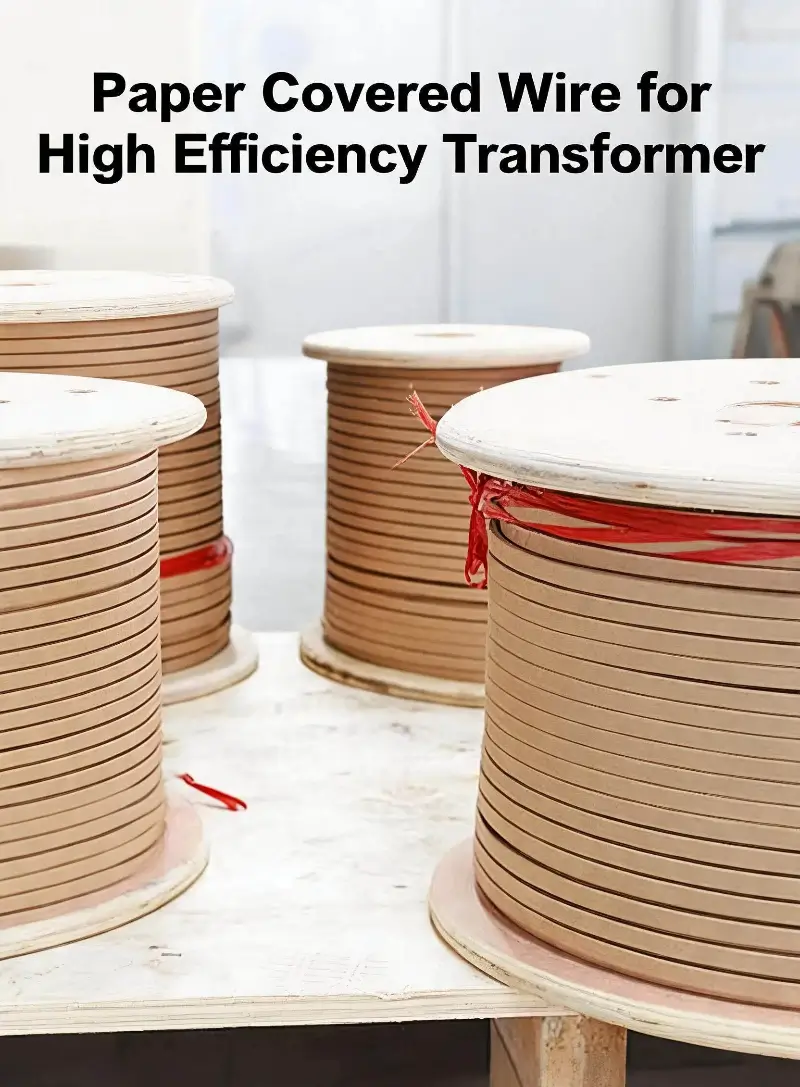
Applications in Industrial Transformers and Reactors
Industrial transformers are core equipment in industrial power systems, and paper-covered magnet wire is the most widely used type in industrial transformers.
Industrial power transformers:
- Capacity range: 10 kV–110 kV, 100 kVA–100 MVA
- Typical applications: Substations, captive power plants, large-scale industrial facilities
- Winding configuration: High-voltage winding (cylindrical / layered / disc-type) + low-voltage winding (foil / layered / disc-type)
- Insulating medium: Mineral oil, synthetic ester oil, natural ester oil
- Recommended paper-covered wire:
- Low-voltage winding: Rectangular copper wire (width 5–20 mm × thickness 1.2–5 mm) + kraft paper + crepe paper
- High-voltage winding: Enamelled round or rectangular wire + telephone paper / cable paper + crepe paper
- Main insulation: 30–100 layers of kraft paper stacked
- Shielding layer: Semiconductive paper (copper foil composite paper)
Industrial electric furnace transformers:
- Capacity range: 1–200 MVA
- Typical applications: Electric arc furnaces, medium-frequency induction furnaces, vacuum furnaces
- Characteristics: Extremely high current (10–100 kA), frequent short-circuit events, severe vibration
- Winding configuration: High-voltage winding (disk-type) + low-voltage winding (helical/interleaved)
- Recommended paper-covered magnet wire:
- High-current low-voltage windings: Transposed conductor (CTC) + Nomex 410 paper wrap
- Vibration damping: Crepe paper (resistant to electromagnetic forces during short circuits)
- Fire resistance: Nomex 410 + mica tape combination
- Forced-air cooling: High-strength Nomex 410 paper wrap
Industrial rectifier transformers:
- Capacity range: 1–50 MVA
- Typical applications: electrochemical processes, aluminum electrolysis, copper electrolysis, inverters
- Characteristics: high-order harmonics (6-/12-/18-pulse), frequency-dependent additional losses
- Winding configuration: high-voltage winding (disk-type) + low-voltage winding (foil-type/disk-type)
- Recommended paper-wrapped wire:
- High-voltage winding: enameled rectangular wire + Nomex 410 paper wrapping + crepe paper
- Low-voltage winding: copper foil winding + Nomex 410 paper wrapping
- Harmonic shielding: conductive paper shielding
- Forced-air cooling: high-strength Nomex 410 paper wrapping
Industrial traction transformers:
- Capacity range: 1–20 MVA
- Typical applications: Electrified railways, subways, locomotives
- Characteristics: Severe vibration, frequent start-stop cycles, wide operating temperature range (−40 °C to +55 °C)
- Winding configuration: Disc-type / helical
- Recommended paper-wrapped conductors:
- High-voltage winding: Enameled rectangular wire + Nomex 410 paper wrapping
- Low-voltage winding: Rectangular copper conductor + Nomex 410 paper wrapping
- Vibration resistance: Crepe paper
- Impact resistance: Multi-layer Nomex 410
Industrial reactors:
- Capacity range: 0.1–100 MVar
- Typical applications: current-limiting reactors, shunt reactors, series reactors, filter reactors
- Winding structure: disc-type / layer-type
- Insulation medium: mineral oil / dry-type
- Recommended paper-wrapped magnet wire:
- Current-limiting reactor: flat copper wire + Nomex 410 paper wrap + VPI impregnation
- Shunt reactor: transposed cable (CTC) + Nomex 410
- Filter reactor: stranded conductor + Nomex 410
- Dry-type reactor: copper foil / flat copper wire + Nomex 410
Applications in Industrial Motors and Generators
Industrial motors and generators are critical power equipment in industrial production, and paper-covered magnet wire is widely used in large industrial motors and high-voltage generators.
Industrial large motors (>1 MW):
- Voltage ratings: 3 kV, 6 kV, 10 kV, 13.8 kV
- Capacity range: 1–50 MW
- Typical applications: Large pumps, fans, compressors, rolling mills, grinding mills, cranes, and mining equipment
- Winding configurations: Form-wound windings, random-wound windings
- Insulation systems: Class F/H/C (155/180/220 °C)
- Recommended paper-wrapped wire:
- Stator windings: Enameled rectangular wire + Nomex 410 paper wrapping + vacuum pressure impregnation (VPI)
- Rotor windings: Enameled rectangular wire + Nomex 410 paper wrapping (wound-rotor type)
- Formed coils: Rectangular copper wire + multi-layer Nomex 410 paper wrapping + mica tape
- End-winding tie-downs: Nomex 411 thin sheet + impregnating resin
- Slot insulation: NMN + Nomex 410
Industrial high-voltage motors (>1 MW, 3–13.8 kV):
- Main insulation for formed coils: Multilayer Nomex 410 (thickness 1–3 mm) + mica tape (thickness 0.10–0.20 mm) + vacuum pressure impregnation (VPI)
- Turn-to-turn insulation: Enamel coating of magnet wire (Grade 2/3) + Nomex 410 (thickness 0.10–0.20 mm)
- Layer-to-layer insulation: Nomex 410 (thickness 0.20–0.50 mm)
- Slot insulation: NMN (thickness 0.30–0.50 mm)
Industrial large-scale generators (>10 MW):
- Capacity range: 10–1800 MW
- Typical applications: Steam turbine generators, hydro turbine generators, diesel generators
- Winding configuration: Formed coils (Roebel bars) + half-coils
- Insulation system: Class F/H (155/180 °C); Class H/C for modern large-scale generators
- Paper-wrapped wire recommendations:
- Stator coils: Flat copper wire + multi-layer Nomex 410 paper wrapping + mica tape
- Rotor coils: Enamelled flat wire + Nomex 410 paper wrapping
- End winding tie-down: Nomex 411 thin-gauge tape
- Main insulation: Mica tape + Nomex 410 + VPI
Industrial special-purpose motors:
- Traction Motors (Rail Transit):
- Power Rating: 100 kW–1.5 MW
- Voltage: 500–3,000 V
- Windings: Formed Coils + Nomex 410 Paper Wrap
- Features: Vibration-resistant, Shock-resistant, Wide Operating Temperature Range
- Mining Motors:
- Power Rating: 50 kW–5 MW
- Voltage: 380 V–10 kV
- Windings: Formed Coils + Nomex 410 Paper Wrap
- Features: Explosion-proof (Ex d, Ex e), Dust-proof
- Marine Motors:
- Power Rating: 100 kW–20 MW
- Voltage: 380 V–10 kV
- Windings: Formed Coils + Nomex 410 Paper Wrap
- Features: Vibration-resistant, Shock-resistant, Salt Mist-resistant
- Blast Furnace Fan Motors:
- Power Rating: 1–50 MW
- Voltage: 6–10 kV
- Windings: Formed Coils + Nomex 410 Paper Wrap
- Features: High-temperature Environment (>40°C), Continuous High Load
- Rolling Mill Motors:
- Power Rating: 1–20 MW
- Voltage: 6–10 kV
- Windings: Formed Coils + Nomex 410 Paper Wrap
- Features: Frequent Overload, Vibration and Shock
Applications in Electrical Control Cabinets and Switchgear
Control cabinets and switchgear are control and protection devices for industrial power systems; paper-covered magnet wire is primarily used in current transformers (CTs) and voltage transformers (VTs), busbar insulation, and switchgear insulation.
Current Transformers (CT) / Voltage Transformers (VT):
- Current Transformers (CT):
- Rated output: 5 VA to 100 VA
- Primary current: 10 A to 5,000 A
- Secondary current: 5 A or 1 A
- Insulation system: Enamelled round wire + insulating paper + epoxy resin casting or oil impregnation
- Recommended paper-wrapped wire: Enamelled round wire + kraft paper + epoxy resin casting
- Voltage Transformer (VT):
- Rated capacity: 50 VA–1000 VA
- Primary voltage: 0.4–500 kV
- Secondary voltage: 100/√3 V, 100/3 V, or 100 V
- Insulation system: Enamelled round wire + multi-layer insulating paper + epoxy resin casting
- Paper-wrapped wire recommendation: Enamelled round wire + kraft paper/Nomex 410 + epoxy resin casting
High-voltage switchgear (KYN28, KYN61):
- Busbar insulation: copper busbar + paper wrapping (Nomex 410, 0.20–0.50 mm) + heat-shrink tubing
- Current/voltage transformer insulation: CT/VT + paper wrapping
- Insulators: porcelain or composite insulators
- Insulating barriers: Nomex 410 board (thickness 1–3 mm)
- Isolating contacts: epoxy resin + paper wrapping
- Vacuum circuit breaker (VCB): epoxy resin cast housing
Low-voltage distribution cabinets (GCK, MNS):
- Busbar insulation: copper busbar + paper wrapping + impregnation
- Control transformer: enameled wire + kraft paper
- Contactor: enameled wire + impregnation
- Circuit breaker (MCCB): phenolic resin + paper wrapping
- Insulating barrier: Nomex 410 sheet
Ring Main Unit (RM6, SafeRing):
- SF₆ gas insulation (GIS): SF₆ gas replaces paper insulation
- Solid insulation: Epoxy resin + paper insulation
- Busbar: Copper busbar + paper insulation
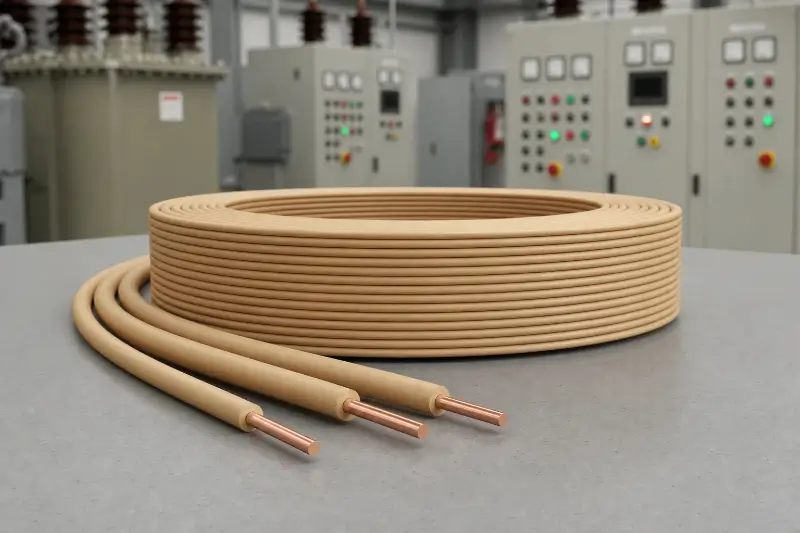
Applications in Electric Furnaces, Induction Heating, and Rectifiers
Industrial heating and rectification equipment are critical process equipment in industrial production, where paper-covered magnet wire is primarily used for high-current windings, harmonic suppression windings, and special insulation structures.
Induction heating equipment方面:
- Power capacity range: 10 kW–20 MW
- Frequency range: 1 kHz–500 kHz (medium frequency: 1–50 kHz; high frequency: 50–500 kHz)
- Typical applications: metal melting, heat treatment, welding, forging
- Key components: induction coil, resonant capacitor, rectifier/inverter
- Recommended paper-wrapped magnet wire:
- Induction coil: flat copper wire (rectangular cross-section) + fiberglass sleeving + water cooling (for special applications)
- Medium-frequency power transformer: transposed conductor (CTC) + Nomex 410 paper wrap
- High-frequency power transformer: Litz wire + Nomex 410 paper wrap
- High-temperature heat treatment: Nomex 410 + mica tape (rated for ≥200 °C)
Electric Arc Furnace (EAF):
- Capacity: 10–200 MVA
- Typical Applications: Iron and steel metallurgy, non-ferrous metal smelting
- Key Components: Electric furnace transformers, secondary busbars, electrodes
- Recommended Paper-Wrapped Wires:
- Low-voltage windings of electric furnace transformers: Transposed cable (CTC) + Nomex 410 paper wrapping
- Secondary busbars: Copper busbars + paper wrapping + water cooling
- Compensation reactors: Flat copper wire + Nomex 410 + VPI impregnation
- Vibration resistance requirement: Crepe paper for vibration damping
Resistance Furnace:
- Capacity: 1 kW–5 MW
- Typical applications: Heat treatment, sintering, annealing
- Key components: Resistance wire, transformer, control system
- Recommended paper-wrapped wire:
- Transformer windings: Enamelled round wire/flat wire + Nomex 410 paper wrap
- High-temperature insulation: Mica tape + Nomex 410 + ceramic fiber
Rectifiers:
- Capacity: 10 kW–50 MW
- Typical applications: electrochemical processes, electrolysis, electroplating, HVDC transmission
- Key components: rectifier transformer, rectifier elements, filter
- Recommended paper-wrapped wire:
- Rectifier transformer: refer to industrial rectifier transformers
- Filter reactor: flat copper wire + Nomex 410 + VPI impregnation
- Rectifier element heat dissipation: insulating pads (Nomex 410 + silicone)
- HVDC transformer: multilayer Nomex 410
Electrolysis/Electroplating:
- Capacity: 100 kW–50 MW
- Typical Applications: Aluminum electrolysis, copper electrolysis, zinc electrolysis, chlor-alkali production, electroplating
- Key Components: Rectifier transformer, busbar, electrolytic cell
- Paper-covered wire recommendations:
- Rectifier transformer: Refer to industrial rectifier transformers
- Busbar insulation: Paper-covered + epoxy resin
- Chemical resistance: Acid- and alkali-resistant Nomex 410 + fluoroelastomer
Welding Equipment:
- Capacity: 1 kVA–1000 kVA
- Typical applications: Arc welding, resistance welding, laser welding
- Key components: Welding transformers, rectifiers, inductors
- Recommended paper-wrapped wire:
- Welding transformers: Enameled rectangular wire + Nomex 410 paper wrap
- Rectifier transformers: Enameled round wire + paper wrap
- Filter inductors: Rectangular copper wire + Nomex 410
Key Performance Requirements and Testing Methods
Key performance requirements for industrial-grade paper-covered magnet wire include: electrical properties, mechanical properties, thermal properties, chemical properties, reliability, and intelligence.
Electrical properties:
- Dielectric Withstand Voltage:
- Single-layer 0.10 mm Nomex 410: ≥5 kV (air), ≥10 kV (oil-immersed)
- Double-layer 0.20 mm: ≥10 kV (air), ≥20 kV (oil-immersed)
- Triple-layer 0.30 mm: ≥15 kV (air), ≥30 kV (oil-immersed)
- Industrial-grade high-voltage requirement: multilayer buildup ≥50 kV
- Dielectric strength (after oil immersion):
- Nomex 410: ≥50 kV/mm
- Kraft paper: ≥30 kV/mm (oil-immersed)
- DMD: ≥40 kV/mm
- Polyimide film: ≥200 kV/mm
- Dissipation factor (tan δ):
- Dry: ≤0.5%
- Oil-immersed: ≤0.3%
- 100°C: ≤0.5%
- Withstand Voltage: Paper-wrapped windings shall withstand a voltage test at 3–10 times the rated voltage for 1 minute.
- Partial Discharge (PD): PD level of oil-immersed paper-wrapped windings ≤5 pC (per IEC 61262).
- Basic Insulation Level (BIL): 35 kV / 200 kV, 110 kV / 480 kV, 500 kV / 1550 kV, 1000 kV / 2400 kV.
- Switching Impulse Level (SL): 1.5–2.5 times the maximum operating voltage for high-voltage and extra-high-voltage applications.
Mechanical Properties:
- Tensile strength: ≥220 MPa for soft-annealed rectangular copper wire
- Elongation: ≥35% for soft-annealed rectangular copper wire
- Bendability: paper-covered rectangular wire shall exhibit no cracking or delamination of the paper layer after bending
- Short-circuit electromagnetic force resistance: short-circuit test at 25–100 kA for 3 s (industrial-grade special design)
- Vibration resistance: 5–2000 Hz, acceleration 10–30 g
- Shock resistance: 50 g, 11 ms half-sine waveform
- Seismic resistance: seismic intensity level 7–9 (for critical infrastructure such as nuclear power plants)
- Hardness: HV 60–90 (soft-annealed copper wire)
Thermal performance:
- Continuous operating temperature:
- 105°C (Class A): Kraft paper (oil-impregnated)
- 130°C (Class B): Polyester film
- 155°C (Class F): DMD
- 180°C (Class H): NMN
- 200°C: Nomex 410 + AIW
- 220°C (Class R/C): Nomex 410
- 240°C: Polyimide film
- Short-term overload: 1.2× rated load for 30 minutes; insulation temperature rise ≤10 K
- Short-circuit thermal resistance: 250°C (copper) / 200°C (aluminum) for 3 seconds
- Flame retardancy: UL 94 V-0 (industrial-grade high requirement)
Chemical properties:
- Oil resistance: Compatible with various insulating oils (mineral oil/synthetic ester/natural ester/silicone oil)
- Acid and alkali resistance: Resistant to weak acids and weak alkalis
- Solvent resistance: Resistant to common industrial solvents
- Moisture resistance: Moisture absorption ≤5% (Nomex 410), ≤8% (kraft paper)
- Aging life: ≥30 years at 155–220 °C under oil immersion
- UV resistance: UV protection required for outdoor equipment
Reliability:
- Temperature Index: Nomex 410 TI 220
- Thermal Aging: UL 1446 / IEC 61857
- Vibration: 5–2000 Hz, 10–30 g
- Shock: 50 g, 11 ms
- Drop Test: 1 m drop onto steel plate
- Long-Term Aging: 155–180 °C for 3000–5000 hours
Intelligence-related aspects (industrial-grade special requirements):
- Optical fiber temperature monitoring: FBG (Fiber Bragg Grating) or distributed optical fiber
- Partial discharge (PD) online monitoring: High-Frequency Current Transformer (HFCT) or Ultra-High Frequency (UHF) sensor
- Vibration monitoring: Piezoelectric accelerometer
- Oil chromatography monitoring: Online Dissolved Gas Analysis (DGA)
- Data transmission: 4G/5G wireless transmission to cloud platform
- AI-based predictive maintenance: Multi-parameter AI model
Test method standards:
- Breakdown voltage: IEC 60851, ASTM D149
- Dielectric strength: IEC 60243, ASTM D149
- Dissipation factor (tan δ): IEC 60250, ASTM D150
- Tensile strength/elongation: ASTM E8
- Thermal endurance: UL 1446, ASTM D2304
- Flame retardancy: UL 94
- Partial discharge (PD): IEC 61262
- PD online monitoring: IEC 62478
- Oil chromatography: IEC 60567
- Vibration: IEC 60068-2-6
- Shock: IEC 60068-2-27
- Drop: IEC 60068-2-31
- Aging: UL 1446, IEC 61857
Selection Decision Recommendations
Selection of industrial-grade paper-covered magnet wire shall be based on a comprehensive evaluation of power rating, voltage rating, insulating medium, thermal class, operating environment, load characteristics, reliability requirements, and intelligent monitoring requirements.
Recommended by power rating:
– Small industrial equipment (<100 kVA): Paper-wrapped + enameled wire combination (DMD, 130 °C)
– Medium industrial equipment (100 kVA–2.5 MVA): Paper-wrapped rectangular wire (Nomex/kraft paper) + enameled wire
– Large industrial equipment (2.5–40 MVA): Paper-wrapped rectangular wire + CTC + multi-layer Nomex 410
– Extra-large industrial equipment (40–1000 MVA): CTC + multi-layer Nomex 410 + kraft paper (30–100 layers)
– Ultra-high-voltage industrial equipment (>1000 MVA): CTC + multi-layer Nomex 410 + composite insulating paper
Recommended by voltage class:
- ≤1 kV: Paper-wrapped, 0.10–0.30 mm (single-layer/double-layer)
- 1–10 kV: Paper-wrapped, 0.20–0.50 mm (double-layer/triple-layer)
- 10–35 kV: Paper-wrapped, 0.50–1.50 mm (multi-layer)
- 35–110 kV: Paper-wrapped, 1.50–3.00 mm (multi-layer + insulating cylinder)
- 110–500 kV: Paper-wrapped, 3.00–8.00 mm + multi-layer insulating cylinder + shielding
- 500–1000 kV: Special insulation design (multi-layer Nomex + multi-layer oil ducts + shielding + barrier)
Recommended by industrial application type:
- Industrial power transformers: Kraft paper + Crepe paper + Calendered paper (oil-immersed)
- Industrial furnace transformers: CTC + Nomex 410 + Forced-air cooling
- Rectifier transformers: Enameled rectangular wire + Nomex 410 + Harmonic shielding
- Traction transformers: Nomex 410 + Crepe paper + Anti-vibration design
- Large motors (>1 MW): Formed coils + Nomex 410 + Mica tape + Vacuum Pressure Impregnation (VPI)
- Large generators (>10 MW): Roebel bar + Nomex 410 + Mica tape + Vacuum Pressure Impregnation (VPI)
- Instrument transformers (CT/VT): Enameled round wire + Kraft paper + Epoxy resin casting
- Industrial reactors: Rectangular copper wire + Nomex 410 + VPI impregnation
- Industrial switchgear: Copper busbar + Paper-wrapped + Epoxy resin
- Induction heating: Transposed conductor (CTC) + Nomex 410
- Rectifiers/electroplating: Transformer + Filter reactor
Recommended by thermal class:
- 105°C (Class A): Kraft paper, telephone paper (low-cost residential/small industrial applications)
- 130°C (Class B): Polyester film + PEW (small industrial motors)
- 155°C (Class F): DMD + EIW (medium-to-large industrial motors/transformers)
- 180°C (Class H): NMN + EIW/AIW (mainstream industrial applications)
- 200°C: Nomex 410 + AIW (high-temperature industrial applications)
- 220°C (Class R/C): Nomex 410 (specialized industrial applications)
- 240°C: Polyimide film (aerospace/specialty applications)
Recommended by load characteristics:
- Continuous high load: Enhanced heat dissipation (multi-layer paper wrapping + forced-air cooling + high-temperature insulation)
- Frequent overload: Overload resistance (high thermal class + forced-air cooling + low temperature rise)
- Severe harmonic distortion: Harmonic resistance (transposed multi-strand conductors + shielding)
- Frequent starting: Impact resistance (vibration resistance + fatigue resistance)
- Short-duration surge: Impact resistance (Nomex 410 + Crepe paper)
Recommended by environment:
- General industrial environment: DMD + NMN
- High-temperature environment: Nomex 410 + Kapton
- High-humidity environment: Nomex 410 (low moisture absorption)
- Chemical corrosion: Nomex 410 + fluororubber seal
- Outdoor use: Nomex 410 + UV-resistant enclosure
- Severe vibration: Crepe paper + multilayer Nomex
- Fire resistance: Nomex 410 UL 94 V-0
Recommended according to reliability requirements:
- General industrial: Standard paper-wrapped wire
- High-reliability (nuclear power/medical): Nomex 410 + multi-layer + intelligent monitoring
- Long-life (30–40 years): Nomex 410 + high-quality enameled wire
- Intelligent (Industry 4.0 factory): Integrated sensors + online monitoring + AI-based diagnostics
Not recommended solution:
– Civil-grade paper-covered wire used in industrial high-voltage equipment: insufficient electrical, mechanical, and thermal performance
– Round paper-covered wire used in industrial high-voltage equipment >35 kV: excessive curvature stress on round wire
– Low-quality kraft paper used in high-temperature industrial equipment: inadequate dielectric strength after oil impregnation
– Paper covering layer too thin (<0.05 mm): insufficient breakdown voltage
– Paper covering layer overlap rate insufficient (<30%): insufficient breakdown voltage
– No vacuum drying prior to oil impregnation: air bubbles trapped in paper layer, partial discharge (PD) increased
– Industrial high-temperature oil-impregnated equipment without Nomex 410: inadequate temperature resistance
Conclusion
Paper-covered wire is a critical core insulation material for industrial power equipment, fulfilling essential functions—including winding insulation, enhanced heat dissipation, mechanical support, partial discharge suppression, chemical protection, and integration of intelligent monitoring—in key apparatus such as industrial transformers, reactors, motors, generators, instrument transformers, rectifiers, electric furnaces, induction heating systems, electrolysis/electroplating equipment, electrical control cabinets, and switchgear. Paper-covered wire utilizes materials including kraft paper, crepe paper, Nomex 410 aromatic polyamide paper, and DMD/NMN composite insulation paper to deliver multiple temperature classes ranging from 105°C (Class A) to 240°C (Class C), breakdown voltage ratings spanning 5–50 kV, and short-circuit electromagnetic force resistance of 25–100 kA/3s.
Industrial-grade paper-covered magnet wire exhibits significant improvements over commercial-grade wire in terms of temperature resistance, dielectric breakdown voltage, short-circuit resistance, reliability, service life, and intelligent monitoring capabilities. Industrial-grade paper-covered magnet wire is categorized by application into multiple specifications, including industrial power transformers, industrial furnace transformers, rectifier transformers, traction transformers, industrial motors/generators, instrument transformers, industrial reactors, industrial switchgear, induction heating equipment, rectifiers, and electrolysis/electroplating equipment.
Energy efficiency standards such as DOE 2016 (USA), EU Tier 2 (EU), and GB 20052-2020 (China) drive continuous improvement in industrial transformer energy efficiency. Industry 4.0, intelligent manufacturing, and digital transformation impose higher requirements for intelligence in industrial power equipment; paper-insulated magnet wire will integrate intelligent monitoring functions—including optical fiber temperature sensing, partial discharge (PD) detection, vibration monitoring, and oil chromatography analysis. Amorphous alloy/nanocrystalline alloy cores combined with high-specification paper-insulated windings constitute the core technological direction for high-efficiency industrial transformers.
Future industrial-grade paper-insulated magnet wire technology will evolve toward intelligent manufacturing, high power density, high-temperature superconductivity (HTS), AI-optimized design, integrated intelligent monitoring (smart paper-insulated wire), eco-friendly insulation materials (bio-based/recyclable), and modular & customizable solutions. Industrial power equipment design engineers must select the appropriate paper-insulated wire type, specification, thermal class, insulation thickness, insulation medium, and optional features based on specific application requirements—including power rating, voltage, load profile, operating environment, reliability targets, and intelligent monitoring needs—to ensure high efficiency, high power density, high reliability (25–40 year service life), Industry 4.0 intelligence, and optimal total cost of ownership over the equipment’s lifetime.