

High-efficiency transformers are core power equipment for critical infrastructure, including power systems, new energy grid integration, industrial power distribution, data centers, and medical imaging devices; their energy efficiency directly impacts total lifecycle operating costs and carbon emissions. Paper covered wire (PCW), as a key insulation material for transformer windings, has maintained an irreplaceable role in high-efficiency transformer design—from traditional kraft paper for oil-immersed transformers to aromatic polyamide paper (Nomex T410) for dry-type transformers, and further to H- and C-class high-temperature-resistant applications. Paper-based insulation materials deliver outstanding dielectric performance, thermal class ratings, mechanical strength, and resistance to electromagnetic forces during short-circuit events. This article systematically addresses the fundamental principles of high-efficiency transformer design, types of losses and energy efficiency standards, the critical role of PCW in high-efficiency transformers, comparative analysis between PCW and enamel-coated wire, PCW types and specifications, manufacturing processes, typical applications (distribution transformers, dry-type transformers, oil-immersed transformers, rectifier transformers, furnace transformers), key performance requirements and test methods, selection guidance, and future development trends.
Basic Principles of High Efficiency Transformer Design
A transformer is a stationary electromagnetic device operating on the principle of electromagnetic induction and achieving power transfer between circuits via magnetic coupling. Its primary functions include: 1) voltage transformation (step-up/step-down); 2) current transformation; 3) impedance transformation; 4) electrical isolation; and 5) phase transformation. The core components of a transformer comprise: the core, windings, insulation system, cooling system, tank and conservator (for oil-immersed transformers), and enclosure and terminals (for dry-type transformers).
The operating principle of a transformer is based on Faraday’s law of electromagnetic induction: when an alternating current flows through the primary winding, it generates an alternating magnetic flux in the core; this alternating magnetic flux links the secondary winding, enabling voltage and current transformation according to the transformer equation N₁/N₂ = V₁/V₂ = I₂/I₁. The fundamental design equation for transformers is V = 4.44 × f × N × B × A, where V is voltage (V), f is frequency (Hz), N is number of turns, B is magnetic flux density (T), and A is core cross-sectional area (m²).
Regarding transformer loss types, the losses of high-efficiency transformers primarily fall into four categories:
- Core Loss (No-Load Loss)
- Hysteresis Loss: Related to frequency, magnetic flux density, and grain orientation of electrical steel; typical material values: 0.5–2 W/kg (electrical steel) / 0.1–0.5 W/kg (amorphous alloy)
- Eddy Current Loss: Proportional to the square of frequency, the square of magnetic flux density, and the square of electrical steel lamination thickness; electrical steel lamination thickness of 0.23–0.30 mm reduces eddy current loss
- Anomalous Loss: Additional loss caused by domain wall motion
- Copper Loss (Copper Loss, Winding Loss, Load Loss)
- DC Resistance Loss (DC I²R Loss): Proportional to the square of the current and the conductor’s DC resistance
- AC Stray Loss: Additional losses induced by skin effect and proximity effect (5–15%)
- Eddy Current Loss (within the conductor): Eddy current loss in high-current conductors
- Stray Load Loss: Includes eddy current losses in metallic structural components (oil tank, clamping frames, tie plates), lead losses, and losses not modeled in the core and windings (typically 3–10% of load losses).
- Mechanical Loss: Electrical energy consumed by auxiliary equipment such as fans and oil pumps (typically < 0.5% of total losses for oil-immersed transformers)
Regarding transformer loss distribution, the typical loss distribution for a 10 MVA oil-immersed distribution transformer is:
- Iron loss (no-load loss): approximately 30–50% (load-independent, constant)
- Copper loss (load loss): approximately 40–60% (proportional to the square of the load)
- Stray loss: approximately 5–15%
- Auxiliary loss: approximately 1–3%
Regarding transformer efficiency, transformer efficiency η = Pout / Pin = Pout / (Pout + P_loss) = 1 − P_loss / (Pout + P_loss). Efficiency is closely related to the load factor β (load current / rated current).
- Light load (β < 0.3): Low efficiency; iron losses predominate
- Rated load (β = 1.0): Near peak efficiency (design target)
- Overload (β > 1.0): Efficiency decreases; copper losses increase
- Maximum efficiency point: Iron losses = copper losses (optimal load factor ≈ 0.5–0.8)
Typical efficiency of distribution transformers:
- 10 kV/0.4 kV distribution transformers (315–2500 kVA): efficiency 98–99.2%
- Medium-voltage power transformers (2.5–40 MVA): efficiency 98.5–99.5%
- Large power transformers (>40 MVA): efficiency 99.0–99.7%
- Extra-high-voltage transformers (>500 kV): efficiency 99.5–99.8%
Regarding high-efficiency transformer energy efficiency standards, the primary international and regional energy efficiency standards for distribution transformers include:
- DOE 2016 (U.S. Department of Energy 2016 Energy Efficiency Regulation): Effective January 2016, implemented in three phases (2016, 2019, and 2023) to progressively increase energy efficiency requirements for liquid-immersed distribution transformers rated 10–2500 kVA and dry-type distribution transformers rated 15–2500 kVA.
- EU Tier 2 (EU Ecodesign Directive No. 548/2014): Effective July 2015, implemented in two phases (2015 and 2021) with the most stringent requirements.
- CSD-1 (Canadian CSA C802 Standard): Developed in alignment with DOE 2016.
- China GB 20052-2020 “Minimum Allowable Values and Energy Efficiency Grades for Power Transformer Energy Efficiency”: Three efficiency grades—Grade 1 (highest), Grade 2, and Grade 3 (lowest)—implemented in July 2020.
- Japan Top Runner Program: Sets transformer energy efficiency targets.
- Korea KS C IEC 60076-11
Core technology directions for high-efficiency transformers:
- Low-loss silicon steel: High-grade silicon steel (30/27/23) from Japanese manufacturers JFE, Kawasaki Steel, and Nippon Steel; specific core loss of 0.85–1.0 W/kg (1.5 T / 50 Hz), representing a 10–30% reduction compared to conventional silicon steel (23G110).
- Amorphous alloy core: Metglas 2605SA1 / 2605HB1 (iron-based amorphous alloy); specific core loss of 0.20–0.35 W/kg (1.5 T / 50 Hz), achieving a 60–75% reduction versus silicon steel—currently the mainstream technology for high-efficiency distribution transformers.
- Nanocrystalline alloy core: Iron-based nanocrystalline alloys (e.g., Finemet 1K107); specific core loss of 0.10–0.30 W/kg (1.4 T / 50 Hz), preferred for compact, high-frequency, high-efficiency transformers.
- Step-lap joint: Optimized lamination overlap configuration for silicon steel cores, reducing interlaminar air-gap losses by 20–40%.
- Laser scribing: Surface laser scribing of silicon steel to refine magnetic domains, reducing anomalous losses by 10–15%.
- Flux shunting: Use of flux shunters to reduce local magnetic flux density.
- Low-loss winding materials: Continuously transposed conductors (CTC), copper foil windings, and rectangular enameled wire to mitigate skin effect and proximity effect losses.
- Optimized design (DOE / AI optimization): Electromagnetic design optimization based on finite element analysis (FEA) and AI algorithms.
- Insulation system optimization: Optimized insulation structure for paper-covered wire to minimize insulation clearance and maximize conductor cross-sectional area.
- Low-noise design: Low-noise core materials combined with vibration-damping structures to reduce operational noise by 5–10 dB.
Regarding transformer types, high-efficiency transformers are primarily categorized by application and insulating medium as follows:
- Distribution Transformer: 10 kV/0.4 kV, capacity 50–2500 kVA, suitable for residential, commercial & industrial, and small-to-medium industrial applications
- MV Transformer: 35–110 kV, capacity 2.5–40 MVA, suitable for substations
- Power Transformer: 110–500 kV, capacity 40–1000 MVA, suitable for backbone power grids
- EHV Transformer: 500–1000 kV, capacity 100–3000 MVA, suitable for ultra-high-voltage power grids
- Dry-Type Transformer: epoxy-cast or vacuum-pressure impregnated (VPI), suitable for indoor and fire-resistant environments
- Oil-Immersed Transformer: mineral oil, synthetic ester oil, or natural ester oil, suitable for outdoor and large-scale applications
- Rectifier Transformer: used in electrochemical processes, electrolysis, and HVDC transmission systems
- Electric Furnace Transformer: used with arc furnaces and line-frequency or medium-frequency induction furnaces
- Traction Transformer: used in electrified railways and metro systems
- Wind Turbine Transformer: installed either in the nacelle or at the tower base
- PV Inverter Transformer: step-up transformer integrated into centralized or string inverter
Key Functions of Paper Covered Wire in High Efficiency Transformer Design
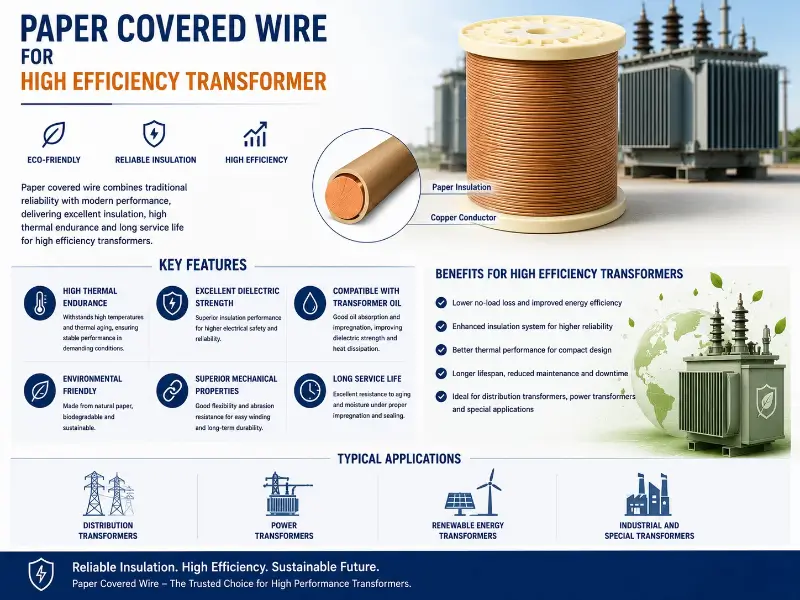
Paper Covered Wire (PCW) is a critical insulation material for high-efficiency transformer windings; paper-based insulation materials deliver exceptional dielectric strength, thermal class rating, resistance to electromagnetic forces during short-circuit events, impregnability, and weather resistance—fulfilling essential functions in high-efficiency transformer design, including electrical insulation, heat dissipation, mechanical support, and partial discharge suppression.
The Critical Role of Paper-Insulated Magnet Wire in High-Efficiency Transformer Design:
Regarding the insulating core function, paper-covered magnet wire provides multi-level insulation protection for transformer windings:
- Turn-to-turn insulation: Insulation between adjacent turns to prevent turn-to-turn short circuits. Paper wrapping thickness: 0.05–0.25 mm; dielectric breakdown voltage ≥ 5 kV.
- Layer-to-layer insulation: Insulation between different layers within the same winding to prevent layer-to-layer short circuits. Paper wrapping thickness: 0.10–0.50 mm; multiple layers may be applied.
- Phase-to-phase insulation: Insulation between windings of different phases to prevent phase-to-phase short circuits. Composite paper wrapping + insulating cylinder + angle rings.
- Phase-to-ground insulation: Insulation between the winding and the core/tank, comprising paper wrapping + insulating cylinder + insulating oil + barrier insulation.
Regarding enhanced heat dissipation, the paper-based insulation layer of paper-covered magnet wire—particularly Nomex insulation paper and crepe paper—exhibits the following thermal dissipation characteristics:
- High surface area: The microfibrous structure of the paper wrapping increases the conductor’s heat-dissipation surface area by 30–50%.
- Porosity: The fibrous paper substrate exhibits microporosity, facilitating insulation oil impregnation and circulation (oil-immersed applications).
- Oil-immersion compatibility: The paper wrapping is fully impregnatable with insulation oil, significantly enhancing dielectric strength after impregnation (dry-state dielectric strength → 50–100% increase after oil impregnation).
- Dry-type cooling: Nomex paper enables natural convective cooling via air ducts in dry-type transformers.
Heat dissipation benefit of paper-wrapped wire: Compared with plain enameled wire, the overall heat dissipation capacity of paper-wrapped wire is improved by 30–80%, and transformer operating temperature rise is reduced by 5–15 K.
Regarding mechanical reinforcement, the paper wrap provides critical mechanical support to transformer windings:
- Short-circuit electromagnetic force resistance: During transformer short-circuit events, enormous axial and radial electromagnetic forces are generated; the bonding strength and ductility of the paper wrapping layer (e.g., Crepe paper) help distribute mechanical stress.
- Vibration resistance: Transformer operational vibration (50/60 Hz electromagnetic vibration plus harmonic vibration); the paper wrapping layer provides vibration damping.
- Impact resistance: Impacts and vibrations during transportation, installation, and operation; the paper wrapping layer provides cushioning.
- Shape retention: The paper wrapping layer maintains the geometric shape of windings and prevents winding deformation.
Mechanical advantage of paper-covered magnet wire: short-circuit electromagnetic force resistance improved by 30–50% (versus plain enameled wire); winding service life extended by 2–3 times.
Regarding partial discharge (PD) suppression, the uniformity of the paper wrapping layer, oil compatibility, and dielectric strength contribute to PD suppression:
- Uniform electric field: Uniform coating of the paper layer eliminates electric field concentration on the conductor surface.
- High dielectric strength: Dielectric strength of oil-impregnated paper-based insulation ≥50 kV/mm.
- Low loss tangent: Loss tangent (tan δ) of high-quality paper-based insulation ≤0.5%.
- PD inception voltage: Partial discharge (PD) inception voltage of oil-impregnated paper-wound windings >10 kV (dependent on insulation thickness).
PD suppression benefits of paper-covered wire: PD inception voltage increased by 30–50%; PD level reduced by one order of magnitude (10 pC → 1 pC); transformer service life extended 5–10 times.
Comparison of Paper Covered Wire and Enameled Wire
Paper-covered wire and enamel-coated wire are two major categories of insulating materials for transformer/motor windings, exhibiting significant differences in insulation structure, temperature rating, electrical insulation properties, mechanical properties, thermal dissipation performance, application scenarios, and cost.
Insulation structure:
- Paper-wrapped wire: A paper-based insulation layer is helically wrapped over the outer surface, in single-, double-, or triple-layer configurations, typically using either overlapping or butt-wrapping techniques. Nomex paper wrapping thickness: 0.05–0.25 mm per layer; Crepe paper wrapping thickness: 0.10–0.30 mm per layer; Kraft paper wrapping thickness: 0.10–0.20 mm per layer. Total paper wrapping thickness: 0.10–1.00 mm.
- Enamelled wire: Insulating varnish is applied to the outer surface in single-, double-, or triple-layer coatings. Film thickness: Grade 1: 0.02–0.07 mm; Grade 2: 0.05–0.13 mm; Grade 3: 0.10–0.25 mm. Total film thickness: 0.02–0.50 mm.
Paper-covered magnet wire features a thicker insulation layer that can be applied in multiple layers, making it suitable for high-voltage transformers requiring high insulation thickness. Enamelled wire features a thinner, more uniform enamel coating, making it suitable for small- and medium-sized low-voltage motors.
Temperature rating (NEMA MW 1000-2018 / IEC 60317):
- Paper-covered wire:
- Kraft paper: 105°C
- Kraft paper + enamel composite: 130°C (Class B)
- Polyester paper: 130°C
- Polyester fiber paper: 155°C (Class F)
- DMD (Dacron-Mylar-Dacron): 155°C
- NMN (Nomex-Mylar-Nomex): 180°C (Class H)
- Nomex 410 (Aromatic polyamide paper): 220°C (Class R/C)
- Polyimide paper: 220°C+
- MW 60/61 (Aromatic polyamide paper): 220°C
- MW 64/65 (Aromatic polyimide tape): 240°C
- Magnet Wire:
- PVF (Polyvinyl Formal): 105 °C (Class A)
- UEW (Polyurethane): 130/155/180 °C (Classes B/F/H)
- PEW (Polyester): 130/155/180 °C
- EIW (Polyesterimide): 155/180 °C
- AIW (Polyamideimide): 220 °C (Classes R/C)
- PI (Polyimide): 240 °C (maximum)
Overall, the maximum temperature rating of paper-covered magnet wire—particularly the Nomex® series—is comparable to that of enameled wire (220–240 °C); however, paper-covered wire exhibits superior long-term thermal stability at elevated temperatures compared to enameled wire (whose insulation film oxidizes and cracks under high-temperature conditions).
Insulation properties:
- Dielectric strength: Single-layer paper-wrapped wire ≥5 kV (0.10 mm Nomex); multi-layer stacking increases dielectric strength to ≥20 kV. Enamelled wire: Grade 1 ≥2 kV, Grade 2 ≥4 kV, Grade 3 ≥6 kV
- Loss tangent (tan δ): Paper-wrapped wire ≤0.5% (dry), ≤0.3% (oil-immersed); enamelled wire ≤0.7%
- Breakdown voltage: Paper-wrapped wire exhibits significantly higher breakdown voltage than enamelled wire (advantage of multi-layer stacking)
- Partial discharge (PD): PD inception voltage of paper-wrapped wire >10 kV under oil immersion; enamelled wire exhibits slightly inferior PD suppression performance
Mechanical properties:
- Tensile strength: Paper-covered wire exhibits slightly lower tensile strength (dependent on paper substrate + enamel coating composite)
- Elongation: Crepe paper-covered wire achieves elongation of 50–100%
- Flexibility: Paper-covered wire may experience cracking of the paper layer during bending; crepe paper mitigates this issue through its corrugated design
- Abrasion resistance: Enamel coating abrasion resistance exceeds that of paper insulation
- Chemical resistance: Enamel coating chemical resistance surpasses that of paper insulation (particularly against oils and solvents)
- Bonding strength: Paper insulation facilitates impregnation with varnish and resin bonding, whereas enamel-coated wire requires specialized varnish impregnation processes
Thermal Dissipation Performance:
- Heat dissipation surface area: paper-covered magnet wire increases by 30–50% (especially with crepe-structured paper)
- Heat transfer coefficient: paper-covered magnet wire exhibits a 50–80% higher heat transfer coefficient under oil-immersed conditions
- Temperature rise: windings using paper-covered magnet wire show a 5–15 K lower temperature rise than those using enamel-coated magnet wire at the same current density
Application scenarios:
– Paper-covered wire: power transformers, distribution transformers, oil-immersed transformers, dry-type transformers, high-voltage motors (10 kV+), reactors, and instrument transformers
– Enamelled wire: small transformers, household appliance motors, medium- and low-power motors (< 1 MW), electronic transformers, electromagnetic coils, and relays
Cost aspect (based on 2024 data):
– Paper-wrapped wire cost: Copper-based NOMEX-wrapped wire is 30–60% more expensive than pure enameled wire (paper substrate material cost + processing fee).
– Enameled wire cost: Relatively low, with mature processing and large-scale production.
In terms of complementary advantages, paper-wrapped wire and enameled wire are complementary products:
- High-voltage, high-power: Paper-wrapped wire (preferred for oil-immersed power transformers)
- Medium-voltage, medium-to-high-power: Composite paper-wrapped and enameled wire (multi-layer insulation)
- Small- and medium-sized low-voltage: Enameled wire (for motors and household appliances)
- High-temperature applications: Paper-wrapped wire (Nomex) + enameled wire (AIW/PI)
Some high-efficiency transformer designs employ paper-wrapped wire (turn-to-turn insulation) in combination with enamel-coated wire (base insulation) to fully leverage the advantages of both material types.
Types and Specifications of Paper Covered Wire
Paper-covered magnet wire for high-efficiency transformers is classified according to insulation material, wrapping configuration, conductor type, and specification.
By insulation material type, the primary insulating materials for paper-wrapped magnet wire include:
- Kraft paper: Unbleached/bleached kraft paper, thickness 0.05–0.20 mm, dielectric strength ≥8 kV/mm, thermal class 105°C, moisture absorption ≤8% (unimpregnated); significantly improved after oil impregnation; low cost
- Telegraph paper: Thin cable paper, thickness 0.04–0.08 mm, dielectric strength ≥6 kV/mm, thermal class 105°C, suitable for thin insulation
- Cable paper: High-voltage cable paper, thickness 0.08–0.20 mm, dielectric strength ≥10 kV/mm, thermal class 105°C
- High-voltage paper: High-dielectric paper, thickness 0.10–0.25 mm, dielectric strength ≥12 kV/mm, thermal class 105°C
- Interturn insulation paper: Designed for interturn insulation, thickness 0.05–0.15 mm
- Polyester paper: PET fiber paper, thickness 0.10–0.20 mm, dielectric strength ≥12 kV/mm, thermal class 130°C
- Polyester film + paper composite (DMD): Composite of polyester film + polyester fiber paper + polyester film, thickness 0.10–0.30 mm, dielectric strength ≥15 kV/mm, thermal class 130°C (Class B/F)
- Aromatic polyamide paper (Nomex 410): DuPont Nomex insulation paper, thickness 0.05–0.76 mm, dielectric strength ≥18 kV/mm, thermal class 220°C
- Aromatic polyamide paper (Nomex 411): Lightweight, thin-gauge Nomex series, thickness 0.05–0.10 mm
- Nomex-Mylar-Nomex (NMN): Composite of Nomex + polyester film + Nomex, thickness 0.10–0.30 mm, dielectric strength ≥20 kV/mm, thermal class 180°C
- Nomex-Kapton-Nomex (NHK): Composite of Nomex + polyimide film + Nomex, thermal class 220°C
- Polyimide film (Kapton): PI film, thickness 0.025–0.125 mm, dielectric strength ≥200 kV/mm, thermal class 240°C
- Polyarylsulfone amide paper (PSA): High-temperature-resistant polyarylsulfone amide paper, thermal class 240°C (aerospace/special applications)
In terms of wrapping configuration, paper-wrapped wire configurations include:
- Overlapping Wrap: 50% overlap of wrapping layers; single-layer or double-layer; high wrapping density; high dielectric strength
- Butt Wrap: Butting of wrapping layers without overlap; low wrapping density; relatively low dielectric strength
- Gap Wrap: Small gaps maintained between adjacent wrapping layers, intended for oil impregnation or varnish impregnation
- Crepe Wrap: Wrapping with crepe paper; stretchable by 50–100%; suitable for rectangular cross-sections and bent sections
- Helical Wrap: Paper tape wrapped helically at a winding angle of 5–15°
- Multi-Lap Wrap: Multiple-layer (2–3 layers) overlapping wrap; total thickness 0.20–0.80 mm
- Half-Lap Wrap: Each layer overlapped by 50%; multi-layer (typically 2–4 layers)
- Single Wrap: Single-layer coverage with 50–60% overlap
By conductor type, the conductor types of paper-covered magnet wire include:
- Round Paper Covered Copper Wire: Round-section copper conductor + paper covering
- Round Paper Covered Aluminum Wire: Round-section aluminum conductor + paper covering
- Rectangular Paper Covered Copper Wire: Rectangular-section copper conductor + paper covering (mainstream for transformers)
- Rectangular Paper Covered Aluminum Wire: Rectangular-section aluminum conductor + paper covering
- Continuously Transposed Conductor (CTC): Multiple enameled rectangular copper wires assembled + transposition + overall paper covering, for large power transformers
- Copper Foil Paper Covering: Copper foil winding + paper insulation, flat-type winding
- Enameled Paper Covered Wire: Base enamel coating + outer paper covering, dual insulation
- Enameled Clad Aluminum Wire with Paper Covering: Copper-clad aluminum + enamel coating + paper covering
- Single Wire Paper Covering: Single-wire paper covering
- Litz Wire Paper Covering: Multi-strand litz wire + overall paper covering (for high-frequency applications)
In terms of specifications, common specifications for paper-covered magnet wire:
- Round paper-covered wire (copper/aluminum):
- Diameter 0.50–5.00 mm (fine wire, for small transformers/electronic transformers)
- Diameter 5.00–12.00 mm (medium wire, for distribution transformers)
- Diameter 12.00–25.00 mm (heavy wire, for large power transformers)
– Rectangular paper-covered wire (copper/aluminum):
– Width 2.00–16.00 mm × Thickness 0.80–5.60 mm (IEC 60317-0-8 range)
– Width 5.00–25.00 mm × Thickness 1.00–6.00 mm (mainstream for high-efficiency transformers)
- Paper wrap thickness:
- Single layer: 0.10–0.25 mm (total thickness after overlapping winding)
- Double layer: 0.20–0.50 mm
- Triple layer: 0.30–0.80 mm
- Four or more layers: ≥0.50 mm (for special applications)
- Insulation thickness (conductor + paper wrapping):
- Transformers rated 25–150 kV: total paper wrapping thickness ≥ 0.50 mm
- Transformers rated 35–110 kV: total paper wrapping thickness ≥ 1.00 mm
- Transformers rated above 110 kV: total paper wrapping thickness ≥ 2.00 mm (multiple insulation) + insulating cylinder + insulating oil
Regarding thermal class, the thermal class of paper-covered magnet wire corresponds to the insulation class:
- 105°C (Class A): Kraft paper, telephone paper, inter-turn insulation paper
- 130°C (Class B): Kraft paper + varnish composite, polyester paper
- 155°C (Class F): DMD (polyester film + polyester nonwoven)
- 180°C (Class H): NMN (Nomex + polyester film + Nomex), Nomex 410
- 200°C: Nomex 410 + AIW enamel coating
- 220°C (Class R): Thick-gauge Nomex 410 (multi-layer, 0.50 mm)
- 240°C: Polyimide film (Kapton + Nomex composite
Manufacturing Process of Paper Covered Wire
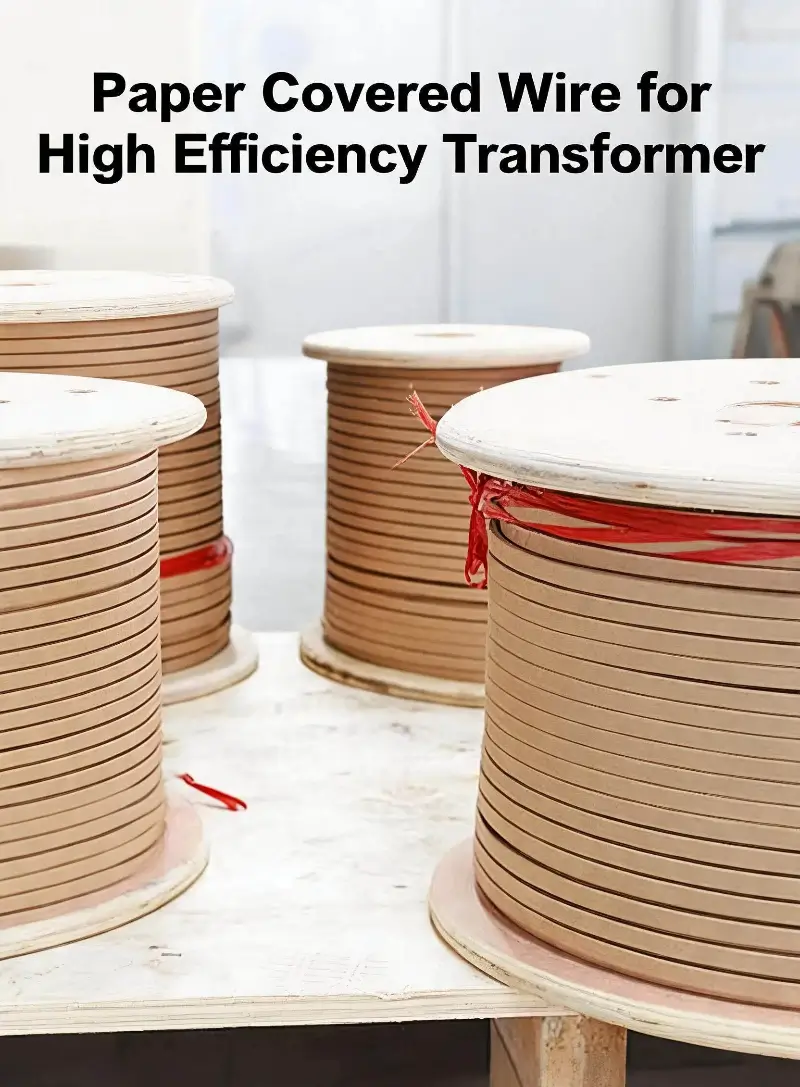
The manufacturing process of paper-covered wire for high-efficiency transformers varies depending on conductor type and insulation material.
Round paper-covered magnet wire manufacturing process:
- Conductor preparation: Round copper or aluminum rod (diameter 8–12 mm) drawn through multiple dies to target diameter (0.50–12.00 mm)
- Annealing: Copper conductor annealing (to relieve work hardening and restore flexibility); aluminum conductor annealing
- Surface cleaning: Acid–alkali cleaning to remove oxide layer
- Paper tape wrapping: Paper tape (e.g., Nomex 410, Crepe paper, kraft paper) helically wrapped onto the conductor
– Wrapping tension: Precisely controlled (10–50 N) to prevent tape damage
– Wrapping angle: 5–15° (ensuring 50–60% overlap)
– Wrapping speed: 50–300 m/min (dependent on conductor diameter and paper tape specifications) - Multi-layer wrapping (optional): Secondary or tertiary wrapping performed after initial wrapping (with staggered lap positions)
- Surface treatment (optional): Impregnation with insulating varnish, resin, or silicone oil
- Baking/curing: Thermal convection oven baking/curing (150–200 °C, 4–12 hours)
- Reeling: Automatic reeling machine (reel dimensions compliant with IEC 60264-3)
Manufacturing Process of Rectangular Paper-Insulated Magnet Wire:
- Conductor preparation: Flat copper wire / flat aluminum wire (produced by flattening round conductors or using shaped billets)
- Edge treatment: Edge rounding of flat wire (R 0.5–1.0 mm) to prevent stress concentration
- Annealing: Annealing at 550–650 °C (copper conductor) / 350–450 °C (aluminum conductor) to restore flexibility
- Surface cleaning: Removal of oxide layer and contaminants
- Leveling: Rolling and leveling of flat wire; flatness ≤ 0.10 mm/m
- Paper tape wrapping: Paper tape winding onto the flat wire surface (same process as for round wire)
- Impregnation with varnish/resin: Impregnation with insulating varnish/resin (especially Nomex + AIW composite)
- Baking and curing: Curing in hot-air ovens
- Reeling: Reeling onto spools
Transposed Cable (CTC) Paper-Wrapped Manufacturing Process:
- Preparation of single enameled rectangular copper wire: width 1–3 mm × thickness 3–8 mm
- Multi-wire transposition: typically 7–31 enameled rectangular copper wires laid side by side
- Transposition braiding: multiple enameled wires braided according to the transposition pattern (transposed every one pitch)
- Overall paper wrapping: paper tape (Nomex 410 or DMD) wrapped overall around the transposed conductor
- Baking and curing
- Reeling
Key manufacturing equipment for paper-covered magnet wire:
- Automatic taping machines: brands including POLYGLASS (Italy), Crosby (UK), Dongyang (South Korea), and Tanaka (Japan)
- CNC flat-wire rolling mills: continuous rolling ensures dimensional accuracy of flat wire
- Multi-layer taping equipment: completes 2–3 layers of taping in a single pass
- Vacuum pressure impregnation (VPI) equipment: full vacuum impregnation of paper-wrapped wire with insulating varnish, resin, or silicone oil
- Tension control system: maintains constant tension during paper tape wrapping
- Online defect detection (CCD): detects defects, missed wrapping, and damage in the paper insulation layer
Critical Quality Control (QC) Points:
- Conductor dimensions: Width tolerance ±0.05 mm; thickness tolerance ±0.02 mm (round wire diameter tolerance ±0.01 mm)
- Paper wrap thickness: Single-layer tolerance ±0.02 mm; multi-layer total thickness tolerance ±0.05 mm
- Paper wrap continuity: 100% online continuity inspection (capacitance method, optical method)
- Paper wrap overlap: Overlap ratio 50–65% (allowable variation ±5%)
- Dielectric breakdown voltage: Sampling test ≥5 kV (single-layer Nomex 0.10 mm)
- Elongation: Round wire ≥25% (annealed condition); rectangular wire ≥30% (annealed condition)
- Conductor resistivity: Cu ≤0.01724 Ω·mm²/m; Al ≤0.0282 Ω·mm²/m
Applications in Distribution Transformers
Distribution transformers are the most numerous and widely used transformers in power systems, with capacities ranging from 10 to 2500 kVA and voltage ratings of 10–35 kV / 0.4 kV, performing the critical function of converting electricity from high-voltage distribution networks to low-voltage end users. Energy efficiency requirements for high-efficiency distribution transformers (DOE 2016, EU Tier 2, GB 20052) are becoming increasingly stringent, and paper-covered magnet wire is central to their application.
Distribution transformer winding structure:
- High-voltage winding (HV winding): Typically employs enameled round wire or enameled rectangular wire, arranged in single-layer or multi-layer cylindrical configurations. Conductor cross-sectional area: 5–50 mm²; operating voltage: 10–35 kV
- Low-voltage winding (LV winding): Typically employs paper-covered rectangular wire (multi-layer disc-type configuration) or copper foil windings; conductor cross-sectional area: 50–500 mm²; operating voltage: 0.4 kV
- Tap winding: ±5% or ±2.5% voltage-regulating taps on the HV winding (with no-load tap changer or on-load tap changer)
Application of Paper-Insulated Magnet Wire in LV Windings of Distribution Transformers:
- Insulation: Paper-wrapped rectangular wire provides insulation between low-voltage windings and the core (0.4 kV class) as well as interlayer insulation.
- Heat dissipation: Microporous structure of the paper wrapping enables oil-immersion (oil-immersed type) or air-channel (dry-type) cooling.
- Mechanical performance: Withstands electromagnetic short-circuit forces (distribution transformer short-circuit impedance: 4–8%).
- Energy efficiency: Paper-wrapped rectangular wire improves space utilization versus round wire; conductor fill factor increases by 8–15% within the same window area, reducing copper losses by 5–10%.
Recommended specifications for paper-covered magnet wire:
- Low-voltage windings:
- Round wire: diameter 1.00–5.00 mm + double-layer paper wrap 0.10–0.25 mm
- Rectangular (flat) wire: width 3.00–12.00 mm × thickness 1.00–4.00 mm + paper wrap 0.10–0.20 mm
- Insulation materials: DMD (130 °C), NMN (180 °C), Nomex 410 (220 °C)
- High-voltage windings:
- Round wire: enameled wire (PEW/UEW/EIW) diameter 0.50–2.50 mm + insulating tube
- Rectangular (flat) wire: width 2.00–8.00 mm × thickness 0.80–2.50 mm + paper wrap 0.10–0.30 mm
- Insulation materials: polyvinyl acetal enamel (Class 120) + kraft paper; or PEW/EIW + Nomex 410
Energy consumption standard for distribution transformers achieved:
- DOE 2016 Level 1 Efficiency: A typical 1000 kVA transformer requires core losses < 1000 W and copper losses < 8500 W.
- High-Efficiency Design: Achieved using amorphous alloy cores (core losses < 300 W) combined with paper-wrapped rectangular magnet wire to reduce copper losses to < 7000 W.
- Space Efficiency: Improved space factor of paper-wrapped rectangular magnet wire reduces core window area by 15–20%, lowering core material cost.
Typical application scenarios for distribution transformers:
- Pole-Mounted Distribution Transformer: 10 kV / 0.4 kV, 50–500 kVA, predominantly oil-immersed
- Indoor Distribution Transformer: 10–35 kV / 0.4 kV, 315–2500 kVA, dry-type or oil-immersed
- Package Substation: 10 kV incoming, 0.4 kV outgoing, 500–1600 kVA, suitable for indoor and outdoor applications
Applications in Dry-Type and Oil-Immersed Transformers
Dry-type transformers and oil-immersed transformers are the two primary insulation types of transformers, each suited for different application scenarios.
Regarding dry-type transformers, dry-type transformers use air or solid insulating materials as the primary insulation medium and contain no insulating oil; the main types include:
- Epoxy-Cast Dry-Type Transformer: Epoxy resin cast coils, Class B/F/H, suitable for indoor medium-voltage applications
- Impregnated Dry-Type Transformer: Insulating varnish impregnated coils, Class B/F, suitable for indoor low-to-medium voltage applications
- Vacuum Pressure Impregnation (VPI) Dry-Type Transformer: Polyester or silicone resin varnish impregnated via VPI process, Class H/C
- Wrapped Dry-Type Transformer: NOMEX paper wrapped windings (non-cast), Class H/C, suitable for indoor high-safety applications
Application of paper-covered magnet wire in dry-type transformers:
- Main insulation: NOMEX 410 paper wrap (220°C), NMN (180°C)
- Turn-to-turn insulation: NOMEX 410 + DMD composite
- Ground insulation: NOMEX 410 insulating tube + end rings
- Heat dissipation: High-temperature resistance of NOMEX paper (220°C continuous rating) + forced-air cooling or water cooling
- Fire resistance: NOMEX paper rated UL 94 V-0, flame-retardant, low-smoke, low-toxicity
Recommended paper-covered magnet wire for dry-type transformers:
- Low-voltage winding: Copper foil or flat copper wire + NOMEX 410 paper wrap (single-layer, 0.10–0.25 mm)
- High-voltage winding: Enamelled round/flat wire + NOMEX 410 paper wrap (double-layer, 0.10–0.30 mm) + VPI impregnation
- Interlayer insulation: NOMEX 410 paper wrap (0.10–0.20 mm)
- End-winding insulation: NOMEX 410 corner rings
- Lead wire insulation: NOMEX 411 thin-gauge
Regarding oil-immersed transformers, the primary insulating medium is insulating oil (mineral oil, synthetic ester oil, or natural ester oil), while insulating paper (kraft paper, crepe paper, supercalendered paper, and adhesive-coated paper) works in conjunction with the insulating oil to provide electrical insulation. The paper-based insulation system of oil-immersed transformers constitutes the core of the transformer:
– Insulating paper (kraft paper/crepe paper): inter-turn, inter-layer, phase-to-phase, and ground insulation
– Insulating oil (mineral oil/synthetic ester/natural ester): fills voids between insulating papers to further enhance insulation performance
– Calendered paper: high dielectric density, used for high-voltage insulation
– Dots paper: epoxy adhesive coated on surface, used for inter-layer bonding
– Angle ring: voltage equalization at winding ends
– Electrostatic plate / capacitive ring: improves electric field distribution
Paper-covered magnet wire application for oil-immersed transformers:
- Low-voltage winding: Rectangular copper wire/copper foil + kraft paper + crepe paper (short-circuit resistant)
- High-voltage winding: Enamelled round/rectangular wire + telephone paper/cable paper + crepe paper
- Main insulation: Kraft paper + insulating oil (30–50 layers laminated)
- End insulation: Angle rings + end rings + pressure plates
- Lead insulation: Crepe paper + end caps
Recommended paper-covered wire for oil-immersed transformers:
- Low-voltage winding:
- Rectangular wire: width 5.00–20.00 mm × thickness 1.20–5.00 mm
- Paper-wrapped: kraft paper 0.10–0.20 mm + crepe paper 0.20–0.40 mm (overlap winding)
- Oil impregnation: vacuum impregnation (vacuum level 25–40 kPa + pressure impregnation)
- High-voltage winding:
- Enamelled wire: PEW/EIW (130–180 °C) + multi-layer insulating paper
- Paper-wrapped: kraft paper 0.10–0.30 mm + crepe paper 0.20–0.30 mm
- Main insulation: multi-layer kraft paper (layer count determined by voltage class)
- Inter-layer insulation: calendered paper 0.10–0.20 mm
- Shielding: conductive paper (copper foil laminated paper)
- Shield layer (shield winding): semi-conductive paper
Regarding rectifier transformers, they are used in applications such as electrochemistry, electrolysis, HVDC transmission, and inverters; key features include:
- Rich in higher-order harmonics (6-pulse, 12-pulse, and 18-pulse rectification)
- High frequency-dependent losses (eddy current losses: 100–200 W/kg)
- High insulation requirements (special applications demand chemical resistance)
Recommended Rectifier Transformer Paper-Insulated Magnet Wire:
- High-voltage winding: Enameled rectangular wire + NOMEX 410 paper wrap + Crepe paper
- Low-voltage winding: Copper foil winding + NOMEX 410 paper wrap
- Harmonic shielding: Conductive paper shielding
- Heat dissipation: High-strength NOMEX 410 paper wrap + forced-air cooling
Regarding electric furnace transformers, these transformers are used in electric arc furnaces, medium-frequency induction furnaces, vacuum furnaces, etc., and feature:
- Extremely high current (10–100 kA)
- Frequent short circuits and surge currents
- Severe vibration
- Harsh operating environment (high temperature, dust, chemical corrosion)
Recommended paper-covered magnet wire for electric furnace transformers:
- High-current, low-voltage windings: Transposed Cable (CTC) + NOMEX 410 paper wrapping + forced-air cooling
- Vibration absorption: Crepe paper for vibration damping
- Fire resistance: NOMEX 410 + mica tape combination
For reactors and instrument transformers (reactor/instrument transformer), reactors and instrument transformers (CT/VT) are critical grid equipment utilizing paper-covered magnet wire.
- Reactors: Flat copper wire + NOMEX 410 + VPI impregnation
- CT (Current Transformers): Enamelled round wire + Insulating paper + Epoxy casting or oil impregnation
- VT (Voltage Transformers): Enamelled round wire + Insulating paper + Epoxy casting
Key Performance Requirements and Testing Methods
Key performance requirements for paper-covered wires used in high-efficiency transformers include electrical properties, mechanical properties, thermal properties, chemical properties, and reliability.
Electrical Properties:
- Breakdown Voltage:
- Single-layer 0.10 mm Nomex 410: ≥5 kV (in air), ≥10 kV (oil-immersed)
- Double-layer 0.20 mm Nomex 410: ≥10 kV (in air), ≥20 kV (oil-immersed)
- Triple-layer 0.30 mm Nomex 410: ≥15 kV (in air), ≥30 kV (oil-immersed)
- Dielectric strength (after oil immersion):
- Nomex 410: ≥50 kV/mm
- Kraft paper: ≥30 kV/mm (oil-immersed)
- DMD: ≥40 kV/mm (oil-immersed)
- Polyimide film: ≥200 kV/mm
- Dissipation factor (tan δ):
- Dry: ≤0.5%
- Oil-immersed: ≤0.3%
- At 100°C: ≤0.5%
- Withstand Voltage: Paper-wrapped windings shall withstand a voltage test at 3–10 times the rated voltage for 1 minute.
- Partial Discharge (PD): PD level of oil-immersed paper-wrapped windings ≤5 pC (per IEC 61262).
- Basic Impulse Level (BIL): 200 kV BIL for 35 kV transformers; 480 kV BIL for 110 kV transformers.
- Switching Impulse Level (SL): 1.5–2.5 times the highest operating voltage for high-voltage and extra-high-voltage transformers.
Mechanical properties:
- Tensile strength: soft temper flat copper wire ≥220 MPa
- Elongation: soft temper flat copper wire ≥35%
- Bendability: paper insulation on flat wire remains uncracked and adheres fully after bend testing
- Short-circuit electromagnetic force resistance: paper-insulated windings pass 25 kA/3 s short-circuit test (typical design)
- Vibration resistance: paper insulation remains intact under transformer operational vibration (frequency range 50–2000 Hz)
- Hardness: HV 60–90 (soft temper copper wire)
Thermal performance:
- Continuous operating temperature: dependent on insulation material
- 105°C (Class A): Kraft paper (oil-impregnated)
- 130°C (Class B): Polyester paper
- 155°C (Class F): DMD, polyester fiber
- 180°C (Class H): NMN
- 220°C (Class R/C): Nomex 410
- Short-term overload: Insulation temperature rise ≤10 K under 1.2× rated load for 30 minutes
- Short-circuit thermal resistance: No damage after 3-second short circuit at 250°C (copper conductor) / 200°C (aluminum conductor)
- Flame retardancy: UL 94 V-0 rating (Nomex 410)
Chemical properties:
- Oil resistance: Compatible with transformer oils (mineral oil/synthetic ester oil/natural ester oil) without chemical reaction
- Acid/alkali resistance: Resistant to weak acids and weak alkalis (transformer oils may contain trace amounts of acid/water)
- Moisture resistance: Moisture absorption ≤5% (Nomex 410), ≤8% (kraft paper), ≤1% (film materials)
- Aging life: ≥20 years under oil immersion at 155°F (transformer design life: 30 years)
Reliability:
- Temperature Index (TI): Nomex 410 TI 220, Kraft paper TI 105
- Thermal aging test: per UL 1446 / IEC 61857
- Vibration test: 5–2000 Hz, 10–30 g acceleration
- Shock test: 50 g, 11 ms half-sine waveform
- Drop test: 1 m drop onto steel plate
- Long-term aging test: 155–180 °C for 3000–5000 hours
Test method standards:
- Breakdown voltage: IEC 60851, ASTM D149
- Dielectric strength: ASTM D149, IEC 60243
- Dissipation factor (tan δ): ASTM D150, IEC 60250
- Tensile strength: ASTM E8
- Elongation: ASTM E8
- Thermal class: UL 1446, ASTM D2304
- Flame resistance: UL 94
Selection Decision Recommendations
Selection of paper-covered wire for high-efficiency transformers shall be based on a comprehensive assessment of power rating, voltage class, insulation class, insulation medium (oil-immersed/dry-type), insulation fluid (mineral oil/synthetic ester/natural ester), and operating environment.
Recommended by power rating:
- Miniature transformers (<1 kVA): Enamelled wire predominant; paper-wrapped wire rarely used
- Small transformers (1–10 kVA): Enamelled wire + thin paper wrap (0.10–0.20 mm)
- Medium distribution transformers (10–1000 kVA): Paper-wrapped rectangular wire (NOMEX / kraft paper) + enamelled wire
- Large distribution transformers (1000–2500 kVA): Paper-wrapped rectangular wire (NOMEX) + enamelled wire
- Medium power transformers (2.5–40 MVA): Paper-wrapped rectangular wire + CTC + multi-layer NOMEX 410
- Large power transformers (40–1000 MVA): CTC + NOMEX 410 + kraft paper (multi-layer main insulation, 30–100 layers)
- Ultra-high-voltage transformers (>1000 MVA): CTC + multi-layer NOMEX 410 + composite insulating paper
Recommended by voltage class:
- ≤1 kV: Paper-wrapped, 0.10–0.30 mm (single-layer/double-layer)
- 1–10 kV: Paper-wrapped, 0.20–0.50 mm (double-layer/triple-layer)
- 10–35 kV: Paper-wrapped, 0.50–1.50 mm (multi-layer)
- 35–110 kV: Paper-wrapped, 1.50–3.00 mm (multi-layer + insulating cylinder)
- 110–500 kV: Paper-wrapped, 3.00–8.00 mm + multi-layer insulating cylinder + shielding
- 500–1000 kV: Special insulation design (multi-layer NOMEX + multi-layer oil ducts + shielding + barrier)
Recommended by insulating medium:
- Oil-immersed (mineral oil): Kraft paper + Crepe paper + Calendered paper
- Oil-immersed (synthetic ester oil): NOMEX 410 (better compatibility) + Kraft paper
- Oil-immersed (natural ester oil): NOMEX 410 + Kraft paper
- Dry-type (epoxy casting): NOMEX 410 paper-wrapped + epoxy casting
- Dry-type (VPI impregnation): NOMEX 410 + polyester/silicone VPI
- Dry-type (encapsulated): Multi-layer NOMEX 410 (high-voltage)
Insulation material selection recommendation by thermal class:
- 105°C (Class A): Kraft paper, telephone paper, interturn insulation paper (low-cost applications)
- 130°C (Class B): Polyester paper + PEW enameled wire (small motors, household appliances)
- 155°C (Class F): DMD + EIW enameled wire (medium- and small-size transformers)
- 180°C (Class H): NMN + EIW/AIW enameled wire (mainstream for high-efficiency transformers)
- 220°C (Class R/C): Nomex 410 + AIW enameled wire (special high-efficiency transformers, traction transformers)
Recommended by application component:
- Low-voltage windings:
- Round wire (≤100 kVA): diameter 1.50–5.00 mm + paper wrap 0.10–0.20 mm
- Rectangular wire (>100 kVA): width 5–25 mm × thickness 1–5 mm + paper wrap 0.10–0.25 mm
- Copper foil: thickness 0.10–0.50 mm + paper wrap 0.10–0.20 mm
- High-voltage windings:
- Round wire (≤500 kVA): diameter 0.50–2.50 mm enameled wire + insulating paper 0.10–0.30 mm
- Rectangular wire (>500 kVA): width 2–10 mm × thickness 0.80–2.50 mm + paper wrap 0.10–0.30 mm
- Main insulation (110–500 kV): multi-layer kraft paper (N-fold) + NOMEX 410 + insulating cylinder
- Inter-turn insulation: DMD/NMN (dry-type) / calendered paper (oil-immersed)
- End winding insulation: angle ring + end ring
- Lead insulation: NOMEX 411 + crepe paper
- Shielding layer: conductive paper (copper foil composite paper)
Recommended by environment:
- General environment: Standard paper-wrapped wire
- High-humidity environment: NOMEX 410 (low moisture absorption)
- High-temperature environment: NOMEX 410 + Kapton (up to 240°C)
- Chemically corrosive environment: NOMEX 410 + fluororubber sealing
- Outdoor environment: NOMEX 410 + UV-resistant outer sheath
- Fire-safety-critical applications: NOMEX 410 UL 94 V-0
- Low-noise environment: Low-loss transformer + vibration-damping supports
Not recommended solution:
- Paper-wrapped round wire used for high-voltage windings (>35 kV): high curvature stress on round wire leads to increased risk of partial discharge.
- Enamelled wire replacing paper-wrapped wire in large power transformers: insufficient enamel film thickness results in poor short-circuit resistance.
- Low-quality kraft paper used in high-temperature oil-immersed transformers: dielectric strength inadequate after oil impregnation; prone to aging.
- Paper-wrapped rectangular wire substituting for insulating cylinders: the paper wrapping layer cannot fulfill the overall insulation function of an insulating cylinder.
- Paper wrapping layer too thin (<0.05 mm): insufficient breakdown voltage.
- Paper wrapping overlap ratio insufficient (<30%): insufficient breakdown voltage.
- Failure to perform vacuum drying prior to oil impregnation: air bubbles remain trapped in the paper wrapping layer, increasing partial discharge.
Future Development Trends
High-efficiency transformer technology continues to evolve, and paper-covered magnet wire technology will likewise advance, with key trends including:
Regarding amorphous alloy cores paired with paper-covered magnet wire, amorphous alloy cores have been widely adopted in 10 kV distribution transformers (accounting for over 30% of new market share), and the integration of paper-covered magnet wire with amorphous alloy cores represents the mainstream design direction for high-efficiency distribution transformers. Amorphous alloy strip thickness is 25 μm—compared to silicon steel’s 0.23–0.30 mm—resulting in a 60–75% reduction in specific core loss. Amorphous alloy cores require compact winding designs using paper-covered magnet wire (reducing core window area by 15–25%) and necessitate noise reduction measures (including lamination techniques, vibration damping, and damping paper).
For high-frequency applications using nanocrystalline alloy cores, nanocrystalline alloy (Nanocrystalline Alloy) cores are employed in high-frequency, high-efficiency transformers operating in the 1–100 kHz range, with core losses of 0.10–0.30 W/kg (1.4 T / 50 Hz). Nanocrystalline alloy cores combined with paper-covered magnet wire (high-frequency paper-based insulation) are applied in high-frequency, compact-medium-sized transformers for new-energy grid-connected inverters, energy storage PCS systems, high-speed rail traction systems, and 5G power supplies.
Intelligent manufacturing: intelligent manufacturing direction for paper-covered magnet wire production
- Online thickness inspection (X-ray, laser thickness gauge)
- Online defect detection (CCD vision system + AI recognition)
- Automated wrapping (CNC wrapping machine, automatic tension control)
- Automatic impregnation (VPI automatic control system)
- Online data traceability (MES system, digital quality tracking)
Regarding environmentally friendly insulation materials, environmental regulations (RoHS, REACH, IEC 61221) drive the adoption of environmentally friendly insulation materials:
- Halogen-free insulating paper: replaces conventional halogen-containing insulating paper
- Recyclable paper-based material
- Natural ester insulating oil combined with paper-based insulation: replaces mineral oil
- Vegetable oil–based paper insulation: paper-wrapped wire impregnated with castor oil or rapeseed oil
Regarding high-temperature superconducting (HTS) transformers, superconducting transformers represent the future development direction for highly efficient transformers; superconducting windings require specialized high-temperature dielectric insulation.
– Glass fiber tape + polyimide film + insulating varnish
– Insulation for high-field superconducting magnets (liquid nitrogen temperature: 90–150 K)
– Special application of paper-based insulation in superconducting transformers
AI-optimized design: Application of AI technology in high-efficiency transformer design
- AI-optimized electromagnetic design (neural network + finite element analysis)
- AI-optimized insulation design (insulation thickness, minimization of insulation volume)
- AI-optimized paper-wrapped wire specifications (thickness, cost, and performance trade-off)
- AI-optimized operating parameters (real-time load, temperature, and losses)
Regarding the impact of SiC/GaN power electronics on transformers, SiC/GaN power electronics have led to the replacement of certain transformers with high-frequency switching power supplies:
- Medium-frequency (1–50 kHz) medium-power transformers (500 kW–10 MW)
- High-frequency (50–500 kHz) small transformers (<500 kW)
- Application of paper-covered wire in high-frequency transformers (medium-frequency specialty paper + insulated winding)
Digital twin and condition monitoring: digital twin of paper-wrapped transformers
- Real-time condition monitoring (temperature, partial discharge [PD], vibration, oil chromatography)
- Lifetime prediction (based on temperature aging and PD accumulation)
- Health status assessment (based on multi-parameter comprehensive scoring)
- Fault early warning (based on AI models)
Conclusion
Paper-covered wire is a critical insulation material in high-efficiency transformer design, fulfilling core functions including winding insulation, enhanced heat dissipation, mechanical support, and partial discharge suppression. Paper-covered wire utilizes materials such as kraft paper, crepe paper, Nomex 410 aromatic polyimide paper, and DMD/NMN composite insulation paper to provide multiple temperature ratings from 105°C (Class A) to 240°C (Class C), breakdown voltage ratings ranging from 5 kV to 30 kV, and short-circuit electromagnetic force resistance of 30 dB to 90 dB.
Efficient transformer design requires comprehensive consideration of power rating, voltage class, insulation medium, thermal class, and operating environment. Energy efficiency standards—including DOE 2016 (USA), EU Tier 2 (EU), and GB 20052-2020 (China)—drive continuous improvements in transformer energy efficiency; amorphous/nanocrystalline alloy cores combined with high-specification paper-wrapped windings represent a core technological direction for efficient transformers. Paper-wrapped magnet wire offers significant advantages over enamel-coated wire in terms of high insulation thickness, high short-circuit resistance, high-temperature stability, and compatibility with oil-immersed applications, making it the preferred choice for high-voltage, large-capacity transformers.
Future high-efficiency transformer technologies will evolve toward amorphous/nanocrystalline cores, high-temperature superconductors (HTS), AI-optimized design, intelligent manufacturing, digital twin and condition monitoring, eco-friendly insulation materials, and high-frequency miniaturization. Paper-covered wire technology will likewise advance: thin-gauge, high-dielectric paper-based materials; multi-layer composite paper wrapping; smart monitoring integration (fiber-optic/sensor-embedded paper wrapping); and specialized superconducting insulation. High-efficiency transformer design engineers must select appropriate paper-covered wire types, dimensions, thermal classes, insulation thicknesses, and insulation media based on specific application requirements to ensure high energy efficiency (DOE Tier 1 / EU Tier 2 / GB 1), high power density, high reliability (25–40-year service life), and optimal total cost of ownership over the operational lifetime.