

I. Introduction: The “Century Duel” Between Two Major Paper Insulation Materials
In the field of transformers, motors, generators, electrical equipment manufacturing, insulating paper is one of the most critical insulating media for winding wires. For decades, two major paper-based insulation materials have formed in the market: Kraft Paper and Nomex Paper (polyaramide fiber paper) .
Cable paper is the traditional mainstay of oil-immersed transformers , with low cost, stable performance and outstanding oil-immersed gain. Nomex Paper is a modern choice for dry type transformers, high temperature transformers , high temperature resistance, high mechanical strength, flame retardant and non-toxic. Both have advantages and limitations.
In this paper, the system compares the 8 dimensions of paper wrapping (cable paper) vs Nomex paper insulation , including electrical properties, mechanical properties, temperature grades, chemical resistance, cost, application scenarios , etc., and gives selection decision trees and typical cases .
1.1 Why this comparison matters
- ✅ Large market size : Global paper insulation market size > $5 billion
- ✅ Wide range of applications : transformers, reactors, motors, generators, high-voltage equipment
- ✅ High cost of selection errors : directly determines the life of the device (30-40 years)
- ✅ Big technology difference : 5-10 times difference in BDV, temperature, oil immersion compatibility
1.2 Core Concepts at a Glance
| Terminology | Full Name | Definitions |
|---|---|---|
| Cable Paper | Kraft Paper/Cable Paper | Cellulose Insulated Paper Made of Wood Pulp |
| Nomex Paper | Nomex Paper/Aramid Paper | DuPont Aramid Fiber Insulated Paper |
| Paper Covered Wire | Paper Covered Wire/PCW | Composite Insulation of Cable Paper + Winding Wire |
| Nomex Covered Wire | Nomex Covered Wire | Composite Insulation of Nomex Paper + Winding Wire |
| Oil Paper Insulation | Oil-Paper Insulation | Composite Insulation System for Oil + Paper |
| DDP Paper | Diamond Dotted Paper | Diamond Dotted Paper |
| Transformer Oil | Transformer Oil | Mineral Oil/Vegetable Oil |
1.3 Core positioning of the two major insulation materials
| Dimension | Cable Paper (Wrapped) | Nomex Paper |
|---|---|---|
| Core positioning | Traditional workhorse of oil-immersed transformers | High-temperature selection of dry-type transformers |
| Temperature Rating | 105°C (Rating A) | 180-220°C (Rating H/N) |
| Breakdown Voltage | 10-15 kV/mm | 18-25 kV/mm |
| Oil Immersion Gain | 3-5 × | 1.5-2 × |
| Flame Retardant | Flammable | Self-Extinguishing Flame Retardant |
| Cost | Low | Medium-High |
| Lifespan | 30-40 years | 25-30 years |
II. Detailed explanation of cable paper (paper wrapping)
2.1 Definition and production process of cable paper
Cable paper is an insulating paper made of unbleached sulfate wood pulp as the main raw material through paper copying, calendering, rewinding and other processes.
Production Process :
1. Wood pulp preparation (pine/fir)
2. Cooking, bleaching
3. Paper Molding
4. Calendering
5. Unwinding and slitting
Typical Specifications :
– Thickness: 0.05 mm/0.075 mm/0.125 mm/0.25 mm
– Density: 0.7-1.0 g/cm ³
– Moisture content: < 8%
– Ash: < 1%
– Tensile strength: longitudinal > 8 kN/m
2.2 Core Strengths of Cable Paper
Advantage 1: Excellent oil immersion compatibility
– Perfect combination with transformer oil
– 3-5 times increase in BDV after oil immersion (10-15 → 30-50 kV/mm)
– This is the biggest advantage of cable paper
Advantage 2: Low cost
– Unit price: about 30-60 yuan/kg
– 5-10x lower than Nomex
– Mass production, mature technology
Advantage 3: Technology maturity
– 100 + years of application history
– Global transformer industry standard
– IEC 60554, GB/T 7969, etc.
Advantage 4: Repairable
– Local damage is repairable
– Oil can be re-impregnated after drying
Advantage 5: Biodegradation
– Natural cellulose, degradable
– Good environmental performance
2.3 Limitations of Cable Paper
- ❌ Low temperature class : only 105°C (Class A)
- ❌ Flammable : requires oil immersion or flame retardant treatment
- ❌ Strong hygroscopicity : Vacuum drying required
- ❌ Medium mechanical strength : easily torn
- ❌ Poor chemical resistance : Poor acid and alkali resistance
2.4 Typical applications of cable paper in transformers
| Apply | Number of layers | Voltage level | Remarks |
|---|---|---|---|
| 35 kV oil-immersed distribution transformer | Layer 4-6 | 35 kV | High voltage winding |
| 110 kV oil-immersed power transformers | 8-10 layers | 110 kV | High voltage windings |
| 220 kV oil-immersed power transformer | 10-12 layers | 220 kV | High voltage winding |
| 500 kV UHV Transformer | 12-15 layers + Nomex | 500 kV | High Voltage Winding |
| Oil-immersed reactors | Layer 6-8 | < 35 kV | Windings |
| Transformer Sleeves | 10-15 Layers | < 500 kV | Insulation |
2.5 Core Performance Parameters of Cable Paper
| Parameters | Numeric | Test Criteria |
|---|---|---|
| Thickness | 0.05-0.25 mm | GB/T 7969 |
| Density | 0.7-1.0 g/cm ³ | GB/T 451 |
| Tensile strength | > 8 kN/m (longitudinal) | GB/T 12914 |
| Breakdown voltage | 10-15 kV/mm (dry) | IEC 60243 |
| Oil-immersed breakdown | 30-50 kV/mm | IEC 60243 |
| Moisture Content | < 8% | GB/T 462 |
| Ash | < 1% | GB/T 742 |
| Dielectric constant | 2.0-2.5 (1 MHz) | IEC 60250 |
| Dielectric Loss | 0.002-0.005 (1 MHz) | IEC 60250 |
| Operating Temperature | -40 to +105°C | – |
III. Nomex Paper Insulation Explained in Detail
3.1 Definition and production process of Nomex paper
Nomex paper is an Aramid Fiber insulating paper developed by DuPont in the 1960s, with the scientific name “polyisophthaloyl-m-phenylenediamine”.
Production process :
1. Poly (isophthaloyl-m-phenylenediamine) polymerization
2. Dry spinning into fibers
3. Chopped fiber + precipitated fiber mix
4. Wet Paper Making
5. Thermoforming
Typical product range :
– Nomex 410 : Universal (0.05-0.76 mm)
– Nomex 411 : high density (high dielectric)
– Nomex 414 : Low density type (high oil absorption)
– Nomex 416 : ultra-thin (0.05-0.25 mm)
– Nomex 464 : flame retardant enhanced
– Nomex 992 : high density (high dielectric)
– Nomex 994 : High Temperature Resistant
3.2 Core Strengths of Nomex Paper
Advantage 1: High Temperature Resistance
– Continuous operating temperature: 180-220°C (H/N class)
– Short-term temperature resistance: 300°C
– UL Temperature Index: 220°C
Advantage 2: High BDV
– Dry breakdown: 18-25 kV/mm
– 50-100% higher than cable paper
Advantage 3: Flame retardant
– Natural flame retardant, oxygen index > 28
– Non-melting droplets, self-extinguishing
– UL 94 V-0 compliant
Advantage 4: High mechanical strength
– Tensile strength > 50 kN/m
– 6x the cable paper
– Tear and abrasion resistant
Advantage 5: Chemical resistance
– Oil, acid and alkali resistant
– Insoluble in transformer oil
– Non-absorbent
Advantage 6: Stable size
– Does not shrink at changes in temperature
– Dielectric stability
3.3 Limitations of Nomex Paper
- ❌ High cost : unit price 250-500 yuan/kg
- ❌ Small oil immersion gain : BDV only increased by 1.5-2 ×
- ❌ Non-degradable : synthetic fibers
- ❌ Unrepairable : Unrepairable after injury
- ❌ Poor workability : high hardness, not easy to wind
3.4 Typical applications of Nomex paper in transformers
| Apply | Nomex Model | Number of Layers | Remarks |
|---|---|---|---|
| Dry Transformer Class H | Nomex 410 | Layer 4-6 | High Voltage Winding |
| Dry Transformer Class H (Small) | Nomex 410 | Layer 2-4 | Low Voltage Winding |
| SCB Dry Type Transformer | Nomex 410 + Resin | 4-6 Layers | Epoxy Casting |
| High Temperature Motor | Nomex 410 | Layer 2-4 | Tank Insulation |
| High Temperature Motor (Phase to Phase) | Nomex 410 | Layer 1-2 | Phase to Phase Insulation |
| Traction Transformer | Nomex 410 | Layer 4-6 | Anti-vibration |
| Wind Power Transformer | Nomex 410 | Layer 4-8 | Weather Resistance |
| Oil-immersed power transformer | Nomex 410 + cable paper | 8-12 layers + 4-6 layers | 220 kV + |
| Special Transformers | Nomex 994 | Floors 4-8 | High Temperature Scenarios |
3.5 Core Performance Parameters for Nomex 410
| Parameters | Numeric | Test Criteria |
|---|---|---|
| Thickness | 0.05-0.76 mm | ASTM D374 |
| Density | 0.7-1.1 g/cm ³ | ASTM D202 |
| Tensile strength | > 50 kN/m (longitudinal) | ASTM D828 |
| Breakdown voltage (air) | 18-25 kV/mm | ASTM D149 |
| Breakdown voltage (oil) | 30-45 kV/mm | ASTM D149 |
| Moisture Content | < 5% | ASTM D644 |
| Dielectric constant | 1.6-2.5 (1 MHz) | ASTM D150 |
| Media Loss | 0.005-0.015 (1 MHz) | ASTM D150 |
| Operating Temperature | -40 to +220°C | – |
| Short-Term Temperature Resistance | 300°C | – |
| Oxygen Index | > 28 | ASTM D286 |
| UL 94 | V-0 | UL |
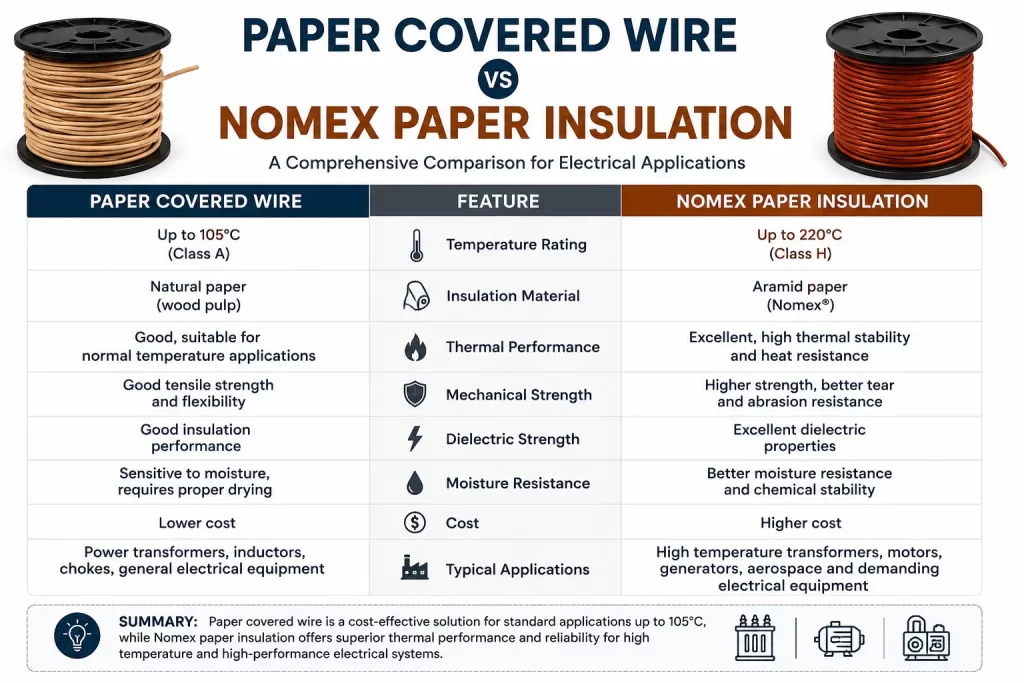
IV. Cable Paper vs Nomex Paper: 8 Dimensions Overall Comparison
4.1 Electrical Performance Comparison
| Metrics | Cable Paper | Nomex 410 | Multiplier Difference |
|---|---|---|---|
| Dry state breakdown voltage | 10-15 kV/mm | 18-25 kV/mm | 1.5-1.7 × |
| Oil-immersed breakdown voltage | 30-50 kV/mm | 30-45 kV/mm | 0.9-1.0 × |
| Dielectric constant (1 MHz) | 2.0-2.5 | 1.6-2.5 | Equivalent |
| Media loss (1 MHz) | 0.002-0.005 | 0.005-0.015 | Lower cable paper |
| Volume resistivity | 10 ¹ ² Ω · cm | 10 ¹ ² Ω · cm | Nomex Higher |
| Dielectric Strength Temperature Coefficient | Negative Correlation | Weak Negative Correlation | Cable Paper More Sensitive |
| Partial Discharge Resistance | Medium | Good | Nomex Better |
Core Conclusions :
– Dry : 50-70% higher breakdown voltage for Nomex 410
– Under oil immersion : The two are basically flat (30-45 kV/mm)
– Media loss : Cable paper is better at high frequencies
4.2 Comparison of temperature levels
| Temperature Indicators | Cable Paper | Nomex 410 | Differences |
|---|---|---|---|
| Continuous Operating Temperature | 105°C (Class A) | 220°C (Class N) | 2.1 × |
| UL Temperature Index | 105°C | 220°C | 2.1 × |
| Short-Term Temperature Resistance | 130°C | 300°C | 2.3 × |
| Glass transition temperature | N/A | 270°C | Nomex higher |
| Thermal Decomposition Temperature | 200°C | 370°C | 1.85 × |
| Flame Retardant | Flammable | V-0 Self-Extinguishing | Nomex Excellent |
Core Conclusions :
– Temperature level : Nomex 410 is more than 2x higher (220°C vs. 105°C)
– Temperature tolerance in the short term : Nomex 410 2.3x higher
– Flame retardant : Nomex 410 natural flame retardant, cable paper needs to be soaked in oil
4.3 Comparison of mechanical properties
| Mechanical Indicators | Cable Paper | Nomex 410 | Differences |
|---|---|---|---|
| Tensile strength (longitudinal) | 8-12 kN/m | 50-80 kN/m | 5-6 × |
| Tensile strength (transverse) | 4-6 kN/m | 30-50 kN/m | 6-8 × |
| Elongation | 2-3% | 5-10% | 2-3 × |
| Tear Strength | Medium | High | Nomex Excellent |
| Abrasion resistance | Poor | Excellent | Nomex Excellent |
| Strong | Medium | High | Nomex Excellent |
| Flexibility | Excellent | Medium | Cable Paper Excellent |
Core Conclusions :
– Tensile strength : Nomex 410 is 5-8 times stronger than cable paper
– Wear and tear resistance : Nomex significantly outperforms cable paper
– Flexibility : Softer cable paper for complex winding
4.4 Chemical resistance comparison
| Chemical Indicators | Cable Paper | Nomex 410 | Differences |
|---|---|---|---|
| Transformer oil resistance | Excellent | Excellent | Flat |
| Mineral Oil Resistance | Excellent | Excellent | Flat |
| Silicone Resistant | Excellent | Excellent | Flat |
| Vegetable Oil Resistance | Excellent | Excellent | Flat |
| Acid Resistance (Thin) | Poor | Excellent | Nomex Excellent |
| Alkali Resistance (Thin) | Poor | Excellent | Nomex Excellent |
| Water Resistant | Poor | Good | Nomex Excellent |
| Ozone Resistant | Good | Excellent | Nomex Excellent |
| Radiation Resistance | Medium | Excellent | Nomex Excellent |
Core Conclusions :
– Oil-resistant : Equivalent
– Acid and alkali resistance : Nomex significantly outperforms cable paper
– Water resistant : Cable paper susceptible to moisture, Nomex resistant to moisture
4.5 Resistance to aging vs. longevity
| Aging Indicators | Cable Paper | Nomex 410 | Differences |
|---|---|---|---|
| Thermal Ageing Life (180°C) | < 1 year | > 20 years | 20 × |
| Thermal Ageing Life (130°C) | < 1 year | > 30 years | 30 × |
| Oil Immersion Aging | Slow Degradation | Extremely Stable | Nomex Excellent |
| Shelf Life | 1-2 years | > 10 years | Nomex Excellent |
| Design lifetime | 30-40 years | 25-30 years | Slightly longer cable paper |
| Actual Life | 30-40 years (oil immersion) | 25-30 years | Approaching |
Core Conclusions :
– At high temperatures : Nomex lifespan far exceeds cable paper
– Oil immersion scenario : Long life under cable paper oil immersion (30-40 years)
– Design life : Cable paper oil leaching is better than Nomex
4.6 Cost Comparison
| Cost Indicators | Cable Paper | Nomex 410 | Variance |
|---|---|---|---|
| Unit Price (RMB/kg) | 30-60 | 250-500 | 5-10 × |
| Unit Price (yuan/m ²) | 5-15 | 30-80 | 4-6 × |
| Transformer insulation cost share | 5-10% | 15-25% | Nomex high |
| Total cost (500 kVA dry) | 100% | 200-300% | Nomex 2-3 × |
| Total cost (500 kVA variation) | 100% | 150-200% | Nomex 1.5-2 × |
Core Conclusions :
– Unit price : Nomex 410 is 5-10 times more expensive than cable paper
– Total cost : Nomex system is 50-200% higher than cable paper system
– Dry change scenario : most significant cost variance (2-3 ×)
– Oil change scenario : small cost variance (1.5-2 ×)
4.7 Comparison of processing and construction
| Machining Indicators | Cable Paper | Nomex 410 | Differences |
|---|---|---|---|
| Entanglement | Excellent | Medium | Cable paper |
| Cutting | Easy | Medium | Cable Paper |
| Folding | Easy | Harder | Cable paper |
| Cracking after bending | None | Less | Cable paper |
| Vacuum Drying | Required | Not required | Nomex Excellent |
| Impregnation process | Required | Selective | Cable paper to impregnate |
| Oil Dip | Need | Selective | Cable Paper Needs Oil Dip |
| Repairability | Easy | Hard | Cable Paper |
Core Conclusions :
– Processability : Cable paper is more suitable for manual/mechanical winding
– Repairability : Local damage to cable paper is repairable
– Drying process : Nomex does not require vacuum drying
4.8 Environmental vs. Sustainability
| Environmental Indicators | Cable Paper | Nomex 410 | Differences |
|---|---|---|---|
| Raw materials | Wood pulp | Petroleum-based | Cable paper environmentally friendly |
| Degradability | Biodegradable | Non-degradable | Optimal cable paper |
| Recyclability | Recyclability | Recyclability | Equivalent |
| Carbon Footprint | Low | High | Cable Paper Excellence |
| Production Energy Consumption | Low | High | Cable Paper Excellence |
| RoHS Compliance | Yes | Yes | Quite |
| reach Compliance | Yes | Yes | Quite |
Core Conclusions :
– Degradable : Cable paper is naturally degradable
– Carbon footprint : Cable paper is lower carbon
– Energy consumption in production : Low energy consumption in cable paper production
V. Selection Decision Tree and Comparison Matrix
5.1 5 Major Selection Principles
1. Oil immersed transformer?→ Cable paper (low cost, high oil immersion gain)
2. Dry transformer?→ Nomex 410 (high temperature, flame retardant)
3. Operating Temperature > 130°C?→ Nomex 410
4. High voltage (> 110 kV)?→ Cable Paper + Nomex Composite
5. Budget sensitive?→ Cable paper
5.2 Decision trees
Determine transformer type
    ↓
Oil-immersed transformer?
  ├─ Is → the voltage > 110 kV?
  │         ├─ Is → cable paper 8-12 layers (high oil immersion gain)
  │         └─ No → 35-110 kV?
  │                  ├─ Yes → Cable Paper 4-10 Layers (Oil Immersion)
  │                  └─ No → < 35 kV → cable paper 2-6 layers
  └─ No → Dry type transformer → temperature > 130°C?
                              ├─ Is → Nomex 410 (floors 4-6)
                              └─ No → Enameled + Nomex Composite
5.3 Selection of five application scenarios
| Scenario | Voltage | Recommended Material | Layers | Remarks |
|---|---|---|---|---|
| 35 kV oil-immersed distribution transformer | 35 kV | cable paper | 4-6 layers | preferred cable paper |
| 110 kV oil-immersed power transformer | 110 kV | cable paper | 8-10 layers | preferred cable paper |
| 220 kV Oil-immersed Power Transformer | 220 kV | High Performance Cable Paper | 10-12 Layers | Preferred Cable Paper |
| 500 kV UHV Transformer | 500 kV | Cable Paper + Nomex | 12-15 + 4-6 | Composite |
| Dry transformer (small) | < 10 kV | Nomex 410 | Layer 2-4 | Preferred Nomex |
| SCB Dry Type Transformer | 10-35 kV | Nomex 410 + Resin | 4-6 Layers | Nomex Preferred |
| Traction Transformer | 25 kV | Nomex 410 | Layer 4-6 | Anti-vibration |
| Wind Power Transformer | 35 kV | Nomex 410 | Layer 4-8 | Weather Resistance |
| Mining Transformer | < 35 kV | Nomex 410 | 4-8 floors | Explosion-proof |
| Test Transformer | > 100 kV | Cable Paper + Oil | 10-20 Layers | Oil Immersion |
VI. Composite Insulation: Cable Paper + Nomex’s “Gold Combo”
6.1 Why composite insulation is needed
A single insulating material is difficult to meet all the requirements of an UHV (220-1,000 kV) transformer. Cable Paper + Nomex Composite is the current mainstream solution:
– Cable paper : high oil immersion gain and low cost
– Nomex 410 : high temperature resistance, high mechanical strength
– Compound use : take advantage of the shortcomings
6.2 Typical applications of composite insulation
| Transformer | Voltage | Cable Paper | Nomex 410 | Composite |
|---|---|---|---|---|
| 220 kV oil-immersed power transformer | 220 kV | 8-10 layers | 2-4 layers | Nomex outer layer/cable paper inner layer |
| 500 kV UHV Transformer | 500 kV | 10-12 Layers | 4-6 Layers | Nomex Outer Layer/Cable Paper Inner Layer |
| 1,000 kV UHV Transformer | 1,000 kV | 12-15 Layers | 6-8 Layers | Multilayer Nomex Wrapped Cable Paper |
6.3 Design principles for composite insulation
Inner layer (close to conductor): Cable paper → provides BDV + combined with oil
Middle layer: cable paper → high BDV + oil immersion gain
Outer layer (by core): Nomex 410 → Heat-resistant, mechanically protected, flame-retardant
6.4 Cost-effectiveness of composite insulation
| Plan | Unit Price | Lifetime | Consolidated Cost |
|---|---|---|---|
| Full Cable Paper | 100% | 30-40 | 100% |
| Full Nomex | 500-700% | 25-30 years | 200-300% |
| Cable Paper + Nomex Composite | 200-300% | 35-40 years | 120-180% |
Core conclusion : Composite solutions strike the best balance between performance and cost .
VII. 4 Typical Application Cases
7.1 Case 1: 35 kV oil-immersed distribution transformer
Application : 35 kV oil-immersed distribution transformer for a power company
Specifications :
– Capacity: 5,000 kVA
– Voltage: 35 kV/10 kV
– Insulation class: Class A (105°C)
Insulation design :
– High voltage winding: Cable paper 6-layer cladding (cable paper preferred)
– Low voltage winding: enameled wire grade H grade 2
– Regulating winding: 4 layers of cable paper
– Insulation medium: 25 # transformer oil
Running results :
– 25 years of operation
-Good insulation
– Failure rate < 0.1%
Why cable paper :
– ✅ 35 kV oil immersion, optimal oil immersion gain of cable paper
– Low ✅ cost, 70% savings over Nomex
– ✅ Longer lifespan of 30-40 years
7.2 Case 2: SCB epoxy cast dry transformer
Application : SCB dry transformer at a subway station
Specifications :
– Capacity: 2,500 kVA
– Voltage: 10 kV/0.4 kV
– Insulation class: Class H (180°C)
Insulation design :
– High voltage windings: Nomex 410 4 layers + epoxy casting (Nomex preferred)
– Low voltage windings: Nomex 410 4 layers + epoxy casting
– Copper foil + Nomex 410
– Vacuum casting of epoxy resin
Running results :
– 12 years of operation
– Flame retardant and reliable
– Suitable for subway environment
Why Nomex :
– ✅ Dry type transformer, cable paper to be soaked in oil is not suitable
– High flame ✅ retardant requirements, Nomex V-0 self-extinguishing
-Temperature ✅ resistance of 220°C, far exceeding the 180°C requirement
7.3 Case 3: 500 kV UHV Transformer
Application : A transformer for a 500 kV UHV substation
Specifications :
– Capacity: 1,000 MVA
– Voltage: 500 kV/220 kV
– Insulation class: Class A (105°C)
Insulation design :
– High voltage winding: Cable paper 12 layers + Nomex 410 6 layers (composite scheme)
– Medium voltage winding: 8 layers of cable paper
– Low-voltage windings: 6 layers of cable paper
– Electrostatic screen: paper wrapped wire + aluminum foil
– Insulating medium: high-purity transformer oil
Running results :
– 10 years of operation
– BDV > 1,000 kV
– Design life: 40 years
– Failure rate < 0.02%
Why compound :
– ✅ 500 kV UHV, very demanding BDV
– ✅ Inner cable paper provides oil immersion gain
– ✅ Outer Nomex provides mechanical protection and temperature resistance
– Low cost of ✅ full cable paper but insufficient mechanical strength
– ✅ Full Nomex is too expensive
7.4 Case 4: Traction transformer
Application : A high-speed rail traction transformer
Specifications :
– Capacity: 30 MVA
– Voltage: 220 kV/25 kV
– Insulation class: Class H (180°C)
– Anti-vibration: Strong
Insulation design :
– High voltage windings: Nomex 410 6-layer cladding
– Low voltage windings: Nomex 410 4-layer cladding
– Anti-vibration special treatment
– Mineral oil + impregnation
Running results :
– 8 years of operation
– Excellent anti-vibration and weather resistance
– Failure rate < 0.05%
Why Nomex :
– ✅ Strong vibration environment, Nomex tensile strength advantage 5-8 times
– High ✅ traction transformer temperature, Nomex temperature resistance 220°C
– High vibration ✅ resistance requirements
VIII. Quality Control of Cable Paper and Nomex
8.1 Incoming Cable Paper Inspection
| Inspection Items | Methodology | Acceptance Criteria |
|---|---|---|
| Thickness | Micrometer | 0.05-0.25 mm |
| Density | Densitometer | 0.7-1.0 g/cm ³ |
| Tensile strength | Tensile machine | > 8 kN/m (longitudinal) |
| Breakdown voltage | Breakdown instrument | > 10 kV/mm (dry state) |
| Moisture Content | Drying | < 8% |
| Ash | Scorching | < 1% |
| Appearance | Visual Inspection | No damage, no impurities |
8.2 Nomex Paper Incoming Inspection
| Inspection Items | Methodology | Acceptance Criteria |
|---|---|---|
| Thickness | Micrometer | 0.05-0.76 mm |
| Density | Densitometer | 0.7-1.1 g/cm ³ |
| Tensile strength | Tensile machine | > 50 kN/m (longitudinal) |
| Breakdown voltage | Breakdown instrument | > 18 kV/mm (dry state) |
| Moisture content | Drying | < 5% |
| Oxygen Index | Oxygen Index Meter | > 28 |
| Flame Retardancy | UL 94 | V-0 |
| Appearance | Visual Inspection | No damage, no impurities |
8.3 Quality control in paper envelope production
| Process | Key parameters | Detection method |
|---|---|---|
| Paper Winding | Tension, Speed | Tension Meter |
| Number of Layers | Counting | Visual Inspection |
| Tape Lap | Lap Length | Visual Inspection |
| Cladding Uniformity | Compactness | Visual |
| Tip Fixing | Tape | Visual Inspection |
8.4 Quality control in transformer manufacturing
| Process | Key Points | Detection Method |
|---|---|---|
| Vacuum Drying | Temperature, Vacuum, Time | Vacuum Gauge, Thermometer |
| Moisture Content | < 0.5% | Karl Fischer Method |
| Oil Immersion | Degree of Vacuum, Pressure | Vacuum Gauge |
| Oil Testing | BDV, Moisture, Chromatography | Oil Testers |
| Partial Discharge | < 100 pC | Local Discharge Instrument |
| Insulation Resistance | > 1,000 MΩ | Megohmmeter |
IX. Future trends in transformer insulation
9.1 New paper insulation
Trend 1: High Density Cable Paper
– Density 1.0-1.2 g/cm ³
– 20-30% increase in BDV
– Oil-immersed transformer main direction
Trend 2: Modified Nomex
– Nomex + nanomaterials
– 20-50% increase in BDV
– For 1,000 kV UHV
Trend 3: Polyimide (PI) film
– Thickness 0.025-0.125 mm
– BDV > 200 kV/mm
– High-end applications for dry transformers
Trend 4: DDP diamond dispensing paper
– Surface gluing
– Slip and wrinkle resistant
– Special for dry transformers
9.2 Intelligent insulation system
- Integrated sensors : temperature, humidity, partial discharge sensors
- On-line monitoring : real-time insulation status
- Predictive maintenance : AI algorithm predicts insulation aging
- Digital twin : virtual insulation simulation
9.3 Eco-friendly insulation
- Vegetable insulating oil : alternative mineral oil
- Bio-based paper : substitute wood pulp cable paper
- Degradable material : eco-friendly insulation
- No SF6 : Eco-friendly gas insulation
9.4 1,000 kV UHV Transformer
- Voltage class : 1,000 kV/1,100 kV
- Insulation challenge : ultra-high BDV, ultra-low loss
- Material scheme : cable paper 12-15 layers + Nomex 6-8 layers
- Composite insulation : multilayer composite