

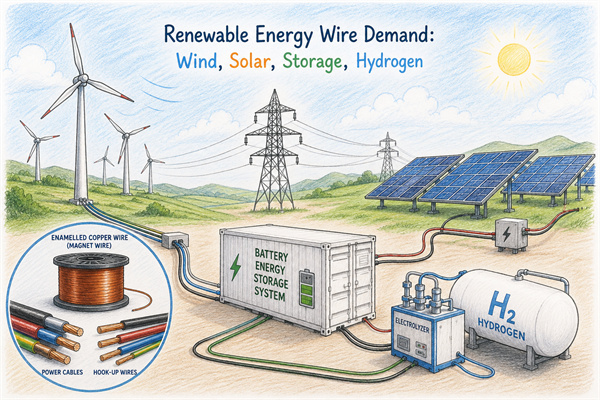
Renewable Energy Wire Demand: Wind, Solar, Storage, Hydrogen I. Global Renewable Energy Cable Market Overview
1.1 Market Size and Growth Trend
According to data from the Bloomberg NEF and IEA 2025 reports, the global renewable energy cable market size was approximately US$18.6 billion in 2024 and is projected to grow to US$38-42 billion by 2030, with a compound annual growth rate (CAGR) of approximately 12.5%. Of these, wind power cables account for approximately 28% ($5.2 billion), photovoltaic cables approximately 32% ($6 billion), energy storage cables approximately 18% ($3.3 billion), hydrogen energy cables approximately 5% ($900 million), and other renewable energy cables (biomass, geothermal, ocean energy) approximately 17% ($3.2 billion). China, Europe, the United States, India, and Brazil are the five major markets for renewable energy cables.
1.2 Regional Market Distribution China Market – Installed capacity in 2024 is approximately 1,400 GW (31% of global capacity), with cable demand of approximately $5.6 billion.
The characteristics of the Chinese market are: dominance by local suppliers (75% share), intense price competition, and rapid technological iteration. Europe Market – Installed capacity in 2024 is approximately 700 GW (16% of global capacity), with cable demand of approximately $4.8 billion. The European market prefers high-end products (TÜV, VDE certification) and emphasizes environmental protection (CPR flame retardant rating).
North American Market – Installed capacity in 2024 is approximately 480 GW (11% of global capacity), with cable demand of approximately US$3.8 billion. The North American market requires UL certification and is subject to IRA regulations. Indian Market – Installed capacity in 2024 is approximately 200 GW (rapidly growing), with cable demand of approximately US$1.6 billion. The Indian market is one of the fastest growing markets in the next 5-10 years.
1.3 Classification and Scope of
This Article “Cables” in the renewable energy field include three main categories: power cables (medium-high voltage transmission, 35-220 kV), winding wires (motor, transformer windings), and control and communication cables (signal, monitoring). This article focuses on winding wires – namely, enameled copper wire, enameled aluminum wire, paper-insulated wire, fiberglass-insulated wire, etc., used in generators, transformers, power storage converters (PCS), photovoltaic inverters, and wind power converters.
II. Cable Demand in the Wind Power Sector
2.1 Cable Demand for Onshore Wind Power
The capacity of a single onshore wind turbine has increased from 1.5-3 MW in the early days to 6-10 MW, with permanent magnet direct-drive generators and doubly-fed asynchronous generators becoming the mainstream. The winding wire requirements for each turbine include:
generator stator windings (enameled flat copper wire/enameled round copper wire, cross-section 4-25 mm², Class H/N), transformer windings (enameled round copper wire/aluminum wire, cross-section 2-50 mm², Class F/H), and converter reactor windings (enameled round copper wire/Litz wire, Class H/N). The winding wire consumption for a single 8 MW onshore wind turbine is approximately 3-5 tons. According to GWEC data, the global installed capacity of onshore wind power in 2024 is approximately 105 GW, corresponding to a winding wire demand of approximately 35,000-50,000 tons.
2.2 Demand for Offshore Wind Turbine Cables
Offshore wind turbines have reached single-unit capacities of 14-18 MW (Vestas V236, China Mingyang MySE 18.X-20MW), and are developing towards 20+ MW. Offshore wind power has much higher requirements for winding wires than onshore wind power: resistance to salt spray corrosion (according to
ISO 12944 C5-M marine atmospheric corrosion rating), resistance to high humidity (85°C/85% RH, 1,000+ hours), high power density (higher current density), and long lifespan (25-30 years vs. 20-25 years for onshore).
A single 16 MW offshore wind turbine requires approximately 8-12 tons of winding wire, and requires Grade 3 thick enamel coating, Class N 200°C enamel coating, and special anti-corrosion treatment. According to GWEC data, the global installed capacity of offshore wind power in 2024 was approximately 8 GW, corresponding to a demand of approximately 6,000-9,000 tons of winding wire—the value per ton is 30-50% higher than that of onshore wind power.
2.3 Wind Power Converters and Transformer Windings
The reactors, filters, and transformers in wind power converters (PCS) have special requirements for winding wires: Litz wire—used for high-frequency transformers (above 10 kHz) to reduce skin effect losses; Triple-insulated wire (TIW)—used for high-frequency transformers, meeting IEC 60950/IEC 62368 insulation requirements; Polyimide film-insulated wire—used for high-temperature, high-frequency, high-power reactors. The wind power converter winding wire market is worth approximately $800 million per year, representing a high-value-added segment for winding wire suppliers.
III. Cable Demand in the Photovoltaic Sector
3.1 Centralized Photovoltaic Power Plants
The demand for winding wire in centralized photovoltaic power plants (large ground-mounted power plants) is concentrated in prefabricated substations (step-up transformers) and centralized inverters. Every 100 MW of centralized photovoltaic power plant requires: approximately 2-3 35 kV step-up transformers (each using 1-3 tons of enameled wire), approximately 50-100 centralized inverters (each using 50-200 kg of enameled wire), and a quantity of high and low voltage cables. The winding wire demand for centralized photovoltaic systems is mainly Class F/H with enamel coating, voltage levels of 0.4-35 kV, corresponding to the IEC 60502 standard. According to IRENA data, the global newly installed capacity of centralized photovoltaic systems in 2024 is approximately 250 GW, corresponding to a winding wire demand of approximately 8,000-12,000 tons.
3.2 Distributed Photovoltaics vs. Residential Photovoltaics
The demand for winding wire in distributed photovoltaic (commercial and industrial rooftop) and residential photovoltaic systems is concentrated in string inverters and small transformers. A single 50 kW string inverter uses approximately 20-50 kg of enameled wire—mainly for high-frequency transformer windings (Litz wire), EMI filter windings, and common-mode reactor windings. Residential photovoltaic micro-inverters (1-5 kW) use approximately 0.5-2 kg of enameled wire—mainly for high-frequency transformers and power inductors. According to IRENA data, the global installed capacity of distributed photovoltaic systems in 2024 was approximately 350 GW, corresponding to a winding wire demand of approximately 3,500-5,000 tons. The characteristics of distributed photovoltaic winding wire are small per unit but large batch size and high technical requirements.
3.3 Integrated Photovoltaic Energy Storage Units
Integrated photovoltaic energy storage units (PV+ESS Hybrid Inverters) are a rapidly developing niche market in recent years, integrating photovoltaic inverters, energy storage converters, and battery management.
Each 100 kW integrated photovoltaic energy storage unit uses approximately 100-300 kg of wire—including DC/DC converter windings, DC/AC inverter windings, isolation transformer windings, and bidirectional converter windings. This niche market has the highest technical requirements for winding wire: high-frequency characteristics, low loss, wide temperature range (-40°C to +60°C), and long lifespan (15+ years). By 2030, integrated photovoltaic energy storage units will account for more than 40% of new photovoltaic installations—this is a strategic track that winding wire suppliers must focus on.
IV. Cable Demand in the Energy Storage Sector
4.1 Battery Energy Storage System (BESS)
Battery Energy Storage System (BESS) is one of the fastest-growing segments of the renewable energy market.
The winding wire demand per 100 MWh BESS power plant includes: PCS converter windings (enameled copper/aluminum wire, Class H), step-up transformer windings (enameled copper/aluminum wire, Class F/H), BMS isolation transformer windings, and battery module connection wires (copper busbars/aluminum busbars + insulation sheaths). Approximately 30-60 tons of winding wire are used per 100 MWh of BESS. According to BloombergNEF data, approximately 180 GWh of new BESS capacity was installed globally in 2024, corresponding to a winding wire demand of approximately 50,000-90,000 tons—with an annual growth rate exceeding 30%, making it the fastest-growing segment of the renewable energy market for winding wires.
4.2 Pumped Hydro Storage and Compressed Air Energy Storage Pumpe
d hydro storage (PHS) and compressed air energy storage (CAES) are large-scale, long-life energy storage forms. Pumped hydro power plants require winding wires for: stator windings (enameled flat copper wire, insulation class F/H, 20-50 tons per unit), excitation windings, and control windings of large synchronous generator sets (100-400 MW). Pumped hydro power plants have large quantities of winding wire per unit, high technical requirements, and long lifespans (50+ years). As of 2024, the global installed capacity of pumped hydro storage was approximately 180 GW, mainly distributed in China, Japan, the United States, and Europe.
4.3 Special Requirements for {Energy Storage System}
{Energy storage system} has unique and special requirements for winding wires (different from traditional motors/{transformers}):
frequent cycling (1-2 charge-discharge cycles per day, 3,000-7,000 cycles cumulatively over 10 years, requiring high thermal fatigue resistance to insulation); deep discharge (DoD 80-100%, requiring high mechanical stress on windings); wide SOC range (battery voltage variation 2.5-4.2 V, posing design challenges for DC/DC converter windings); fire safety (battery thermal runaway risk, requiring enamel coating to meet
UL 94 V-0 flame retardancy and low smoke halogen-free standards). UL 9540A, IEC 62933, and GB/T 36276 are key certification standards for energy storage system winding wires.
V. Cable Demand in the Hydrogen Energy Sector
5.1 Electrolyzer-based Green Hydrogen Production
(Water Electrolysis for Hydrogen Production) is the core of the hydrogen energy industry.
Electrolytic cells require winding wire for power supply transformers (high-voltage isolation transformers, winding wire Class H/N), rectifier windings, reactor windings, and heater windings in both PEM and alkaline electrolytic cells. A single 5 MW electrolytic cell power system requires approximately 2-5 tons of winding wire. According to IEA data, global electrolytic cell installations increased by approximately 5 GW in 2024 (rapid growth), corresponding to a winding wire demand of approximately 2,000-5,000 tons. By 2030, global electrolytic cell installations are projected to reach 200 GW—with an annual growth rate of over 50% in winding wire demand.
5.2 Fuel Cells and Hydrogen Fuel Cell Vehicles
The air compressor motor windings, humidifier windings, and circulation pump windings in fuel cell systems have special requirements for enameled wire: Class H/N enamel coating (fuel cell operating temperature 60-80°C, but local stack temperatures can reach 90°C); low noise characteristics (required < 60 dB for automotive applications); vibration resistance (automotive-grade vibration requirements, according to ISO 16750). The fuel cell system winding wire market is approximately $300 million per year, currently dominated by Japanese and European/American manufacturers.
5.3 Hydrogen Energy Storage and Transportation Equipment
The demand for winding wires in hydrogen energy storage and transportation (high-pressure gaseous hydrogen storage, liquid hydrogen storage, pipeline hydrogen transportation) is concentrated in compressor drive motors (large asynchronous motors or permanent magnet synchronous motors, single unit power 50 kW-1 MW) and liquid hydrogen pump drive motors (Class H enamel coating, low-temperature adaptability). The market size for winding wires used in hydrogen energy storage is approximately $200 million per year—currently in its early stages, but with enormous growth potential.
VI. Technological Trends in Renewable Energy Cables
6.1 The voltage levels of renewable energy systems are continuously increasing:
wind power is rising from 690 V to 1,500 V and 3,300 V, with future offshore wind power reaching 66 kV; photovoltaic power is rising from 1,000 V to 1,500 V, 2,000 V (residential), and 3,500 V (large-scale power plants); and energy storage PCS is rising from 1,500 V to 2,000 V and 3,000 V.
The increasing voltage demands on winding wires: higher enamel coating breakdown voltage (Grade 3+ thickened enamel coating), stronger partial discharge (PD) resistance, and optimized creepage distance design. Class N 200°C enamel coating (polyamide-imide AIW/200) will become the mainstream.
6.2 High
Copper Prices (LME copper price expected to be 8,500-10,500 USD/ton in 2024-2026) + Demand for Weight Reduction Drives the Expanded Application of Aluminum Alloy Cables in the Renewable Energy Sector. Typical Applications: Power cables inside wind turbine towers (partially using 8000 series aluminum alloy), medium-voltage cables in photovoltaic power plants (partially using 8030 series aluminum alloy), and battery connections in energy storage systems (copper-aluminum composite busbars). Aluminum alloy cables are 30-50% lighter and 20-40% cheaper than copper cables—a technological trend that winding wire suppliers must pay attention to. CCA (copper-clad aluminum) wire, as an intermediate form, is also widely used in small and medium-sized renewable energy equipment.
6.3 Low-Smoke Halogen-Free
The demand for low-smoke halogen-free (LSZH/LSOH) cables is rapidly increasing in renewable energy power plants (especially offshore wind power, offshore photovoltaic, and energy storage power stations). According to EN 50575 CPR regulations and IEC 61034 standards, cables should meet the following requirements in case of fire: low smoke density (transmittance > 60%), low toxicity (free of corrosive gases such as HCl and HF), and low corrosivity (pH > 4.3). Low-smoke halogen-free winding wires require a special enamel coating system (such as polyolefin or fluoroplastic coating), and the main suppliers are currently Japanese and European/American manufacturers.
6.4 Intelligentization and Monitoring Renewable energy power pla
nts are evolving towards intelligent operation and maintenance, increasing the demand for intelligent monitoring of winding wires: Distributed fiber optic temperature measurement (DTS) – real-time monitoring of winding temperature; online partial discharge monitoring – early detection of insulation defects; vibration monitoring – assessment of mechanical condition. Intelligent winding wires (embedded fiber optic sensors, wireless temperature sensors) are moving from the laboratory to engineering applications – this is a cutting-edge direction for the next 5-10 years.
VII. Opportunities and Strategies for enameled wire Suppliers
7.1 Seize High-Growth Niche Markets
The renewable energy cable market has four high-growth segments: offshore wind power winding wire (gross margin 30-40%, value per ton 1.5-2 times that of onshore), energy storage PCS winding wire (CAGR 30%+), hydrogen electrolyzer winding wire (CAGR 50%+), and photovoltaic-energy storage integrated unit winding wire (CAGR 25%+). Winding wire suppliers should prioritize these niche markets—rather than engaging in price wars in the traditional industrial motor market.
7.2 Technology Upgrade Path Technology upgrade path for entering the renewable energy market:
enamel coating grade upgrade – from Class F (155°C) to Class H (180°C), Class N (200°C); wire diameter accuracy upgrade – from ±0.010 mm to ±0.005 mm; enamel coating thickness upgrade – from Grade 2 to Grade 3; weather resistance upgrade – passing 1,000+ hours of damp heat aging and salt spray tests; certification upgrade – obtaining specialized certifications such as TÜV,
UL 4703, UL 9540, and IEC 62933.
7.3 Customer Development Strategy Customer development strategy for the renewable energy market:
Prioritize leading customers – Establish long-term partnerships with leading customers such as Vestas, Siemens Gamesa, GE Renewable Energy, Goldwind, Mingyang, Sungrow Power, CATL, and BYD; Participate in industry exhibitions – Participate in industry exhibitions such as SNEC PV Power Expo, CWP Beijing Wind Energy Expo, ESIE Energy Storage Expo, and Intersolar Europe; Joint development – Collaborate with leading customers to develop new materials and processes; Overseas certification – Obtain certifications from target markets such as
UL (North America), TÜV (Europe), JET (Japan), and BIS (India). ## VIII. Conclusion Renewable energy is the biggest growth engine for the winding wire industry in the next 10-20 years.
The demand for winding wire from the four major sectors of wind power, photovoltaics, energy storage, and hydrogen energy will grow from 100,000+ tons in 2024 to 250,000+ tons in 2030, with a compound annual growth rate of 15-20%. This growth stems not only from the expansion of installed capacity but also from technological upgrades such as higher voltage, aluminum alloy, low-smoke halogen-free, and intelligent technologies, leading to increased usage per unit and higher value per ton.
For winding wire suppliers: the renewable energy market is no longer a “niche market”—it is becoming a mainstream market. The ability to capitalize on the four high-growth segments—offshore wind power, energy storage, hydrogen energy, and integrated photovoltaic-storage systems—will determine market position over the next 5-10 years. For equipment manufacturers: choosing winding wire suppliers with Class H/N enamel coating, Grade 3 thickened enamel coating, TÜV/UL certification, and a thermal life of 20,000+ hours is fundamental to long-term product reliability.
For industry investors: winding wire is a “small but beautiful” niche market—while the total market size is small (approximately US$25 billion in 2024), it boasts high gross margins (25-40% for high-end products), strong technological barriers, and high customer loyalty. The rise of renewable energy is not only an energy revolution, but also a materials revolution—winding wire, as the core material for electromagnetic conversion, will play a key role in this revolution.